
Electronic Warfare Market Snapshot

Key Players

  • BAE Systems (United Kingdom)
  • Lockheed Martin (United States)
  • Elbit Systems (Israel)
  • Thales Group (France)
  • SaaB AB (Sweden)
  • Raytheon Technologies Corporation (United States)
  • L3Harris Technologies (United States)
  • Northrop Grumman (United States)
  • Leonardo S.p.A. (Italy)
  • Rheinmetall AG (Germany)

Market Size

Base Year 2024
$18.94 Bn
CAGR
7.8%
Forecast 2034
$40.14 Bn

Market Segments

By Category
  • Electronic Attack (EA)
  • Electronic Support (ES)
  • Electronic Protection (EP)
By Equipment
  • Jammer
  • Antenna
  • Radar Warning Receiver
  • Directed Energy Weapon
  • Anti-radiation Missile
  • Counter Measure Dispenser System (CMDS)
  • Directional Infrared Countermeasure (DIRCM)
  • Self-protection EW Suite
  • Others
By Platform
  • Land-Based
  • Airborne
  • Naval
  • Space

Market Dynamics

Drivers
  • Increasing defense budgets
  • Technological advancements in warfare
Restraints
  • High development costs
  • Strict regulatory policies
Opportunities
  • Rising cybersecurity threats
  • Investments in defense sector

Market Size

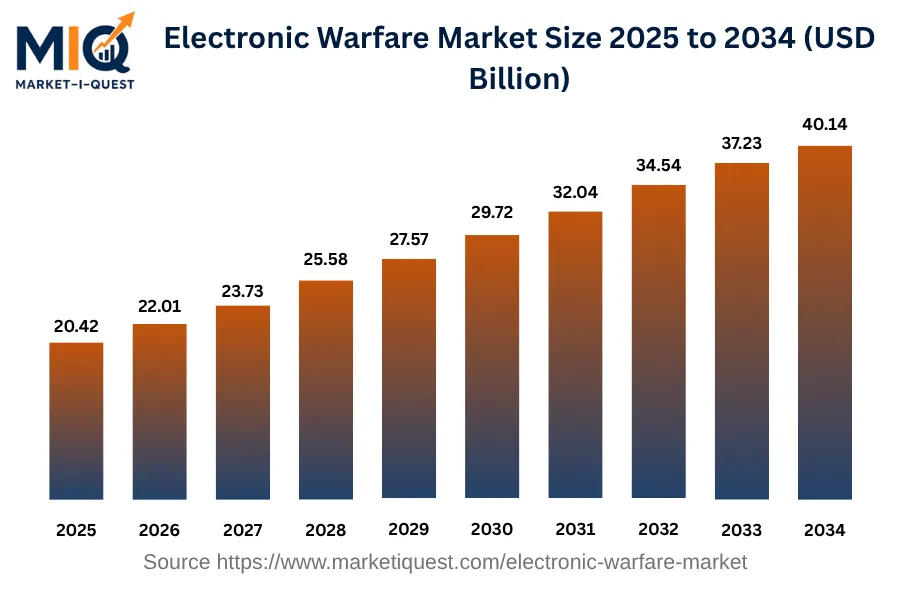
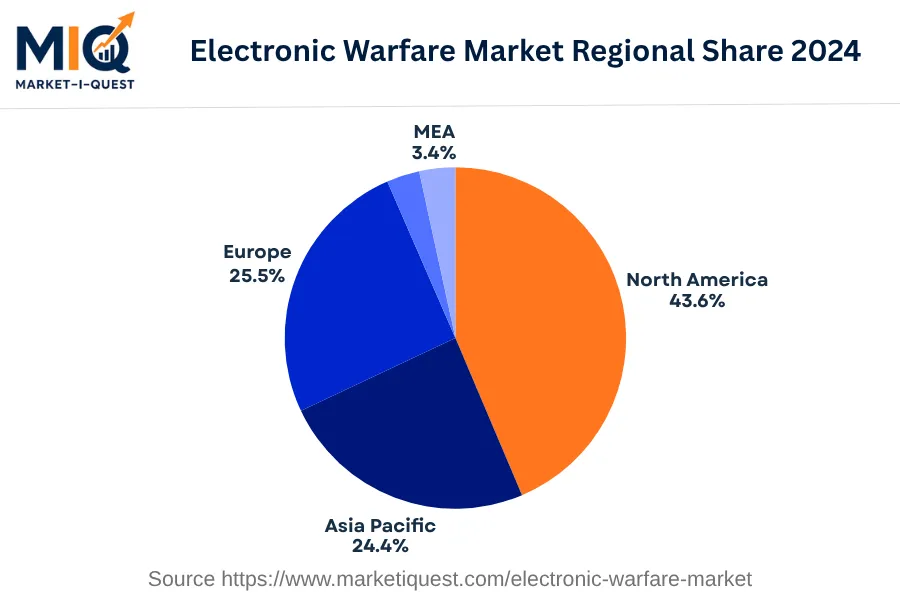
The Electronic Warfare Market size was valued at 18.94 billion in 2024 growing subsequently to reach $40.14 billion in 2034, registering a CAGR of 7.8%. On a regional scale, North America held the largest share in 2024 at 43.6%. However, other regions such as Europe with a 25.5% share and Asia Pacific at 24.4% were also made valuable contributions. On the other hand, LATAM held 3.1% of the market share with MEA just behind at 3.4%. This data further highlight that while North America led in regional contribution, the Electronic Warfare Market witnessed remarkable engagement across various regions, each contributing significantly towards the overall market growth during this period.

Key Takeaways

  • By Category - Electronic Support segment held the leading market share.
  • By Equipment - Antenna led the market accounting for a significant market share.
  • By Platform - Naval segment dominated with the highest market share.
electronic-warfare-market market size

Key Driving Factors

Defense Modernization Efforts

Numerous nations are modernizing their defense armories in response to ongoing global security concerns. Modernization efforts, particularly within NATO members and Asia Pacific nations, often involve the integration of advanced electronic warfare systems into their defense architecture. These systems effectively counteract enemy radar and communications, giving military forces an upper hand in conflict situations. Governments in these nations are issuing new procurement contracts for electronic warfare systems which are steering the market. These actions are based on the understanding that the strategic importance and effectiveness of electronic warfare technology in current and future combat actions is supreme.
Shift Towards Asymmetric Warfare

In recent years, there has been a noticeable shift towards asymmetric warfare, the kind where non-state actors use guerrilla tactics, cyber-attacks, and electronic jamming as primary weapons. This shift has made electronic warfare technology even more essential in the vision of modern armed forces. Military leaders realize that maintaining supremacy in electronic warfare directly influences battle outcomes, given the high reliance on communications, satellite navigation, and radar systems. As such, the armed forces and defense contractors are investing heavily in research and development of sophisticated electronic warfare equipment to counter these asymmetric threats, this driving the growth of the electronic warfare market.

Market Evolution by Timeline

2019-2023
In this period, integrated electronic warfare systems such as EW Suite, developed by Lockheed Martin, started being widely adopted by the US military. New tech initiatives were introduced in countries like India, investing in native development of EW systems like the Samyukta. Buyers were primarily military organizations from North America and Asia Pacific attributed to increased defense budgets. Market operation tended towards fixed-price contracts, driving affordability. Important factors were the development of guidelines and specifications by organizations such as the Under Secretary of Defense for Acquisition and Sustainment which improved system ownership reliability.
2024
The market is in high demand from government organizations, particularly the Europe and North America. There is growing use of cognitive electronic warfare capabilities, a system that can adapt in real time, to provide advanced signal processing and identification. In terms of policy, the Defense Acquisition Regulation (DAR) is having notable impact on the adoption and ownership of systems. Partnerships between industry leaders start to solidify, with contracts typically being long-term supply agreements.
2025-2029
Regional conflicts and increasing defense budgets in countries including Russia and China will contribute to high demand for electronic warfare systems. In terms of supply, the implementation of AI and Machine Learning in EW systems will notably improve threat detection capabilities. Adoption will be influenced by new cybersecurity standards like ISO/IEC 27032. Pricing will be heavily influenced by the level of technology integration and customization required. Integrated product development partnerships will be formed between software companies like Vector and hardware manufacturers like Marvin Test Solutions, will provide complete solutions to buyers.
2030-2034
Demand will be largely driven by geopolitical tensions in the Middle East and Asia, triggering faster upgrades of equipment to stay ahead of opponents. Quantum radar technology, will provide additional stealth and target detecting capabilities, will be increasingly prominent. DOT&E's annual operational testing will influence the system development and adoption. Contract types will shift towards performance-based agreements, encouraging for higher quality products. Strategic alliances and joint ventures among prominent players in the market will reduce R&D costs.

Future Market Outlook

Future Opportunities

Today’s market of electronic warfare presents different chances for transformation and advancement. The ongoing race to technological ascendancy drives growing demand for enhanced countermeasures. In 2023 the US Air Force began developing partnerships with DARPA in conjunction with different organizations in an attempt to increase the capability of its signal intelligence capabilities, in a bid to become prepared to face the coming generation of threats. In Europe, the EU Defence Fund is also embarking on initiatives that help strengthen joint operations of member states regarding electronic warfare capabilities, demonstrating a growing concern on collective defence strategies. Hybrid warfare strategy of today necessitates advanced EW capabilities, therefore major companies like BAE Systems are starting to implement all in one, integrated systems ready to be deployed in contested environments, this is further compounded by increased efforts of Governments to improve simulation technologies for EW readiness, as demonstrated in 2022 when the UK Ministry of Defence awarded a simulation project for its troops.
Increased cyber warfare activities in EW means defence manufacturers are forced to develop joint initiatives with tech companies to deal with ever evolving threats, growing collaborations between defence entities and private sector players will lead to the development of novel tools and techniques, meanwhile international regulation agencies such as the ITU begin to consider the future challenges for high frequency EM emissions thus pushing for regulatory collaboration with defence initiatives in EW, therefore the near future of this market should present rapid innovation and collaboration driven expansion

Segmentation Analysis

By Category

The market is divided into subsegments including Electronic Attack, Electronic Support, and Electronic Protection. Electronic Support accounted for the largest revenue share, while Electronic Attack is expected to grow at the fastest CAGR during the forecast period.

Largest Revenue Share

Electronic Support

Market Share Leader

Electronic Support, as a subsegment, currently holds the largest share of revenue in its category. This is because cybersecurity plays an important part in keeping systems safe from electronic threats. It’s also important, for electronic systems to work properly. Cybersecurity boost the performance of these systems. ES primarily enables identification, location, and evaluation of electromagnetic signals. Its wide application in commercial, military, national security, and cyber security contributes to its large share in the market. Furthermore, advanced economies majorly utilize the ES capabilities for intelligence gathering and surveillance purposes, highlighting its importance in the strategic security framework. Moreover, its regulation and supply are well established across many developed countries, ensuring its continued demand. The purchasing decision for this subsegment is often driven by its performance capabilities, signal processing abilities, and compatibility with existing electronic systems.

Fastest CAGR

Electronic Attack

Forecast Period Growth Leader

Projected to grow at the highest CAGR, Electronic Attack is a critical subsegment to watch. Rapid advancements in technology, such as AI and machine learning, give way to innovative attack strategies, increasing the demand for effective Electronic Attack solutions. This growth is helped more by companies that make technology and defense organizations working together to make solutions that are specific to certain industries. The growth is driven by these partnerships between tech firms and defense organizations to make solutions that're specific, to certain industries. Though initial capital expenditures for developing and implementing these advanced tools can be high, the long-term benefits of effective electronic offense and defense are effective. As privacy and data leak concerns are increasingly important, so does this subsegment's growth potential. Risks in the near term mostly revolve around regulatory changes and successfully managing cyber threats. This segment's growth is contingent on the continuous development and integration of advanced technologies within the industry.

By Equipment

The market is divided into subsegments including Jammer, Antenna, Radar Warning Receiver, Directed Energy Weapon, Anti-radiation Missile, Counter Measure Dispenser System (CMDS), Directional Infrared Countermeasure (DIRCM), Self-protection EW Suite, and Others. In the base year 2024, Antenna accounted for the largest revenue share, while the Directed Energy Weapon sector is expected to grow at the fastest CAGR during the forecast period.

Largest Revenue Share

Antenna

Market Share Leader

The Antenna subsegment drives the highest revenue in the equipment segment, with its dominance rooted in its widespread need across numerous modern technologies. Visualizing the traditional defence sector, every communication and radar system require antennas, creating a vast demand. Furthermore, the rise in complication of these communication and radar systems requires highly technical antennas, which typically come at higher costs, driving up revenues. Regulations for noise free communication has also increased the demand for highly efficient antennas, further supporting revenues. But in turn, cutting-edge developments like Jammers and Directed Energy weapons will enhance market growth and reinforce leadership in the established antenna market.

Fastest CAGR

Directed Energy Weapon

Forecast Period Growth Leader

Directed Energy Weapon (DEW) subsegment presents the fastest growth in CAGR. DEWs dominates substantial capital investments in research and development from both the governmental and private sectors. This surge in investments aims to upgrade traditional weaponry to modern standards, with DEWs highlight due to their precision strike capabilities and lowering collateral damage. DEWs also provide cost-effective measures in the long run, further prompting its rapid adoption. Policy incentives for modernisation of military armories and partnerships for shared technology development have accelerated the growth of this subsegment.

By Platform

The market is divided into subsegments including Land-Based, Airborne, Naval, and Space. In 2024, the Naval subsegment accounted for the largest revenue share while the Space subsegment is expected to grow at the fastest CAGR during the forecast period.

Largest Revenue Share

Naval

Market Share Leader

The Naval subsegment currently leads the market in terms of revenue. This can largely be attributed to various factors such as growing tensions around the world, geopolitical conflicts, and increasing need for naval infrastructure upgrading. These activities often require significant investment in naval platforms, making it a prime revenue generator. Additionally, there is ongoing development and adoption of sophisticated naval technologies globally. With naval defense becoming a major concern for several nations, there has been a significant increase in allocation of budgets for naval operations both in developed and emerging economies. The full upgrade of maritime warfare capabilities to this stage has increased the acquisition of these sophisticated vessels and drive the segment.

Fastest CAGR

Space

Forecast Period Growth Leader

The Space subsegment, shows the fastest growth outlook. This forecasted growth can be attributed to several blooming factors including an increased interest in space exploration and a global push for more satellite deployments. Technological advancements and innovations are steadily reducing the cost of space missions, thus making them more accessible and frequent. Furthermore, there is an increased privatization of space activities with more private organizations and corporations entering the space exploration scene. Major technological captains are now investing and leading their own space initiatives.

Competitive Analysis

Key Market Players

Manufacturers / OEMs

Northrop Grumman Corporation
US
Thales Group
France
Raytheon Technologies
US

Key Suppliers & Raw Materials

Microchip Technology Inc.
US
Analog Devices, Inc.
US
Xilinx, Inc.
US

Distributors, Integrators & Channel Partners

BAE Systems plc
UK
Lockheed Martin Corporation
US
L3Harris Technologies
US

Porter’s Five Forces Analysis

This analysis explores the competitiveness and attractiveness factors within the Electronic Warfare Market.

Supplier Bargaining Power

High

Focused on few large-scale manufacturers having proprietary technology and high switching costs.

Buyer Bargaining Power

Low

Consists of government entities requiring specialized, high-end products reducing negotiation power.

Threat of Substitutes

Low

Minimal viable substitutes exist due to the specialized nature of electronic warfare equipment.

Threat of New Entrants

Low

Entry requires substantial investments, technological expertise and complicated regulatory approvals.

Competitive Rivalry

Medium

Limited numbers of substantial competitors, intense requirements for advanced R&D and specialization.

Regional Analysis

Geographic market dynamics and growth opportunities across key regions

Global Market Outlook

electronic-warfare-market market regional share

North America

In the base year of 2024, North America's Electronic Warfare Market had significant growth driven by various factors and trends. The market dynamics were driven by the expansive defense budgets in the U.S., Mexico, and Canada, prioritizing the modernization of their military infrastructures. Demand for EW systems saw marked growth due to the surging cyber threats and rising geopolitical tensions. Moreover, governmental regulations favoring investment in electronic warfare systems, particularly in the U.S, stimulated growth within this sector. The accelerated technology adoption across the defense spectrum, aimed at sustaining strategic superiority, acted as a fundamental driver.

There was a buyer shift towards advanced, integrated systems capable of multi-spectrum operations. The trend of joint ventures and strategic partnerships was prevalent, as demonstrated by the U.S.-Canada NORAD cooperation on advanced radar systems. Positive spillover impact on the electronic warfare market from the policy regulations like U.S National Defense Authorization Act (NDAA) allocating for EW systems. Simultaneously, the defense sectors of these countries were primary customers, while the private security domain was an emerging market participant. Overall, complex geopolitical realities, supportive government policies, and combined efforts to strengthen cyber defenses defined the North American Electronic Warfare Market dynamics in 2024.

Asia Pacific

In 2024, the Asia Pacific electronic warfare market experienced significant expansion, largely catalyzed by the geopolitical tensions in the region. As China strengthened its push for self-sufficiency, the need for electronic warfare systems grew considerably, creating considerable incentive for R&D and quick tech-takeup. Meanwhile, India increased its military modernization efforts, necessitating greater supply of advanced electronic warfare solutions, with a focus on indigenous development and procurement. Similar trends were observed in Japan and South Korea as both amplified their defense budgets in response to North Korean aggression.

Changing buyer behavior drove the market dynamics, with customers prioritizing compatible and multi-functional systems over single-function devices. Customer bases expanded beyond traditional governmental sectors to include utilities and manufacturing industries due to the increased threat of cyber-attacks. Product shifts witnessed a surge in demand for electronic support measures (ESMs) to enhance situational awareness. More partnerships and mergers were noticed, particularly between South Korean and Australian firms, indicating a combination trend within the industry. China emerged as the lead in setting industry standards and policy enforcement, with Chinese firms winning contracts across key ASEAN markets. This development pointed towards an increased influence of Chinese electronic warfare capabilities, technology, and equipment in the region.

Europe

In 2024, the European Electronic Warfare Market experienced significant shifts in demand and operations. Drivers included elevated security threats leading European nations to invest heavily in electronic warfare capabilities. For instance, countries such as the United Kingdom, France, and Germany prioritised strengthening their electronic warfare equipment and systems. Additionally, faster technology adoption, particularly in the Nordics and Central & Eastern Europe, drove the demand for advanced electronic warfare solutions. Further, regulatory changes, such as stringent arms export laws in Italy and Spain, influenced supply dynamics, affecting pricing within the market. Also, increased Research and Development activities in Benelux nations pushed for the evolution of disruptive electronic warfare technologies, driving market growth.

In terms of trends, AI and machine learning was an obvious growth trend in EW systems that spurred increased sophistication of solutions required by buyers. Major countries channels dominated by strategic alliances and merger and also the country's manufacturers and defence contracting leading. For example, several UK-based defence companies went into alliances with continental players to deal with the post-Brexit scenario. Policy enforcement around cybersecurity protocols also played a key role, especially within the government and enterprise sectors.

Latin America

In 2024, Latin America's Electronic Warfare Market was characterized by growing technological adoption and stringent regulations governing the sector. Demand for more advanced precision strike capabilities in countries like Mexico and Brazil, coupled with a drive towards a modern defense solution for the problem of organised crime had been the key drivers. Simultaneously, heavy investments in R&D by countries such as Argentina and Colombia spurred technological advances, while supply dynamics were shaped by the collaborative efforts of Chile and Peru to bolster domestic production capabilities and reduce defense import dependence.

Trends in 2024 included an increase in government acquisition of electronic warfare systems in Brazil following the implementation of its new National Defense Strategy. Additionally, public-private partnerships gained focus, particularly in Mexico, with major defense firms partnering with local industries to enhance production capabilities. Argentina and Chile saw a shift towards native developed wireless communications jamming systems, highlighting technological self-sufficiency. New regulatory measures establishing quality standards for electronic warfare equipment have been observed in Colombia and Peru. Both nations seek to enhance the operational effectiveness of their respective defense establishments, as well as guarantee quality assurance in domestic hardware solutions that affect this market in particular.
Across the entire region, these drivers and trends pointed towards a sophisticated, self-reliant, and competitive electronic warfare market.

Middle East & Africa

In 2024, the Electronic Warfare Market in the Middle East and Africa was dynamic and complex. Drivers included the escalating regional conflicts and heightened defense budgets in Saudi Arabia and the United Arab Emirates. Investment in electronic warfare capabilities increased, particularly in countries such as Qatar, seeking to backbone their defense infrastructures. Prominent trends included a noticeable upsurge in governments spending on electronic warfare systems with Saudi Arabia and UAE in the leading positions. Israel, known for its advanced tech ecosystem, saw a shift towards autonomous and AI-enhanced systems for electronic warfare.

Meanwhile, collaboration and partnerships were prominent, with Egypt and South Africa actively pursuing international alliances to bolster their electronic warfare capabilities. Last, the enforcement of policies concerning spectrum management and control were severe that has had influence on the market, particularly the telecommunication market. Consequently, significant cross-sector partnerships and M&A activity were noted. Particularly for industries heavily reliant on telecommunications, such as healthcare, manufacturing, retail, and financial services, the evolving landscape of electronic warfare had profound impact.

Recent Industry Developments

Latest market innovations, product launches, and strategic initiatives

January 2026

The U.S. Department of Defense initiated a $1.2 billion cross-domain EW infrastructure modernization program, while BAE Systems secured a critical U.S. Navy contract to supply next-generation electronic protection suites for surface combatants. This matches a broader global trend toward spectrum dominance, with Japan allocating ¥280 billion for specialized EW development and Australia funding a $500 million sovereign capability priority initiative.

February 2025

L3Harris Technologies successfully completed the first test flight of its new Viper Shield electronic warfare suite integrated onto a Block 70 F-16 fighter jet. Concurrently, Northrop Grumman introduced an adaptive high-frequency EW suite; both configurations extensively leverage artificial intelligence algorithms to process unknown signals and execute autonomous jamming countermeasures in real time.

Frequently Asked Questions