
Electronic Adhesives Market Snapshot

Key Players

  • Henkel AG & Co. KGaA (Germany)
  • 3M Company (US)
  • H.B. Fuller (US)
  • Dow Inc. (US)
  • Sika AG (Switzerland)
  • Avery Dennison Corporation (US)
  • BASF SE (Germany)
  • Hitachi Chemical Co. Ltd. (Japan)
  • KYOCERA Chemical Corporation (Japan)
  • LG Chem Ltd. (South Korea)

Market Size

Base Year 2024
$5.16 Bn
CAGR
6.2%
Forecast 2034
$9.42 Bn

Market Segments

By Form
  • Paste
  • Solid
  • Liquid
By Type
  • UV Curing
  • Thermally Conducive
  • Electrically Conducive
  • Others
By Application
  • Integrated Circuit
  • Semiconductor
  • Printed Circuit Boards
  • Others

Market Dynamics

Drivers
  • Growing electronic manufacturing industry
  • Increasing miniaturization of electronic devices
Restraints
  • High production costs
  • Regulatory compliance issues
Opportunities
  • Rising electronic devices demand
  • Increased miniaturization trend in electronics

Market Size

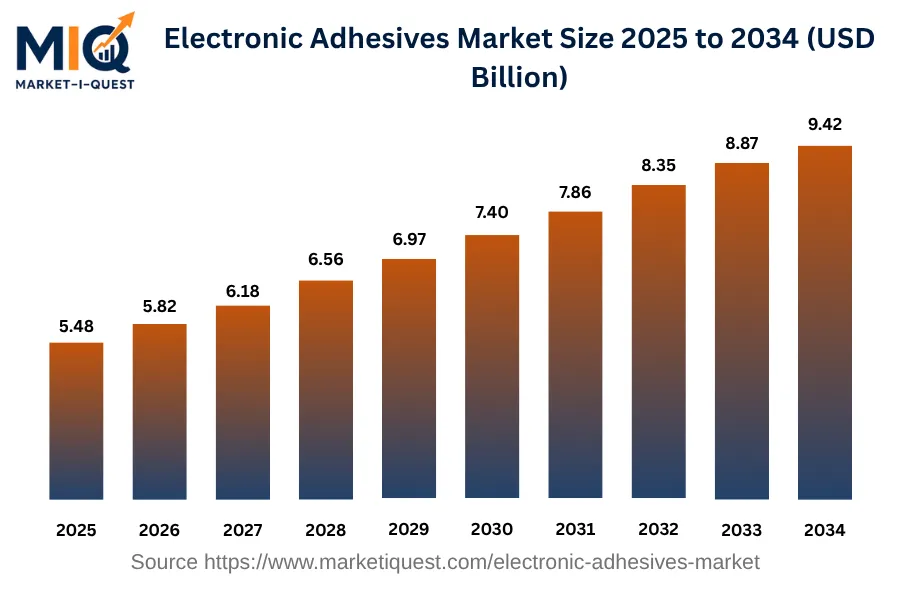
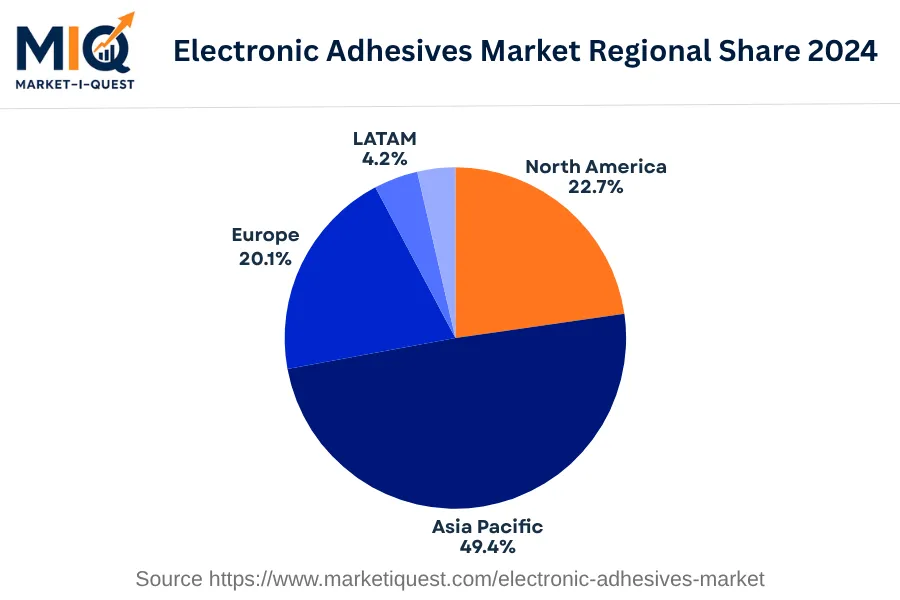
The Electronic Adhesives Market size in 2025 is projected to be $5.48 billion before growing to $9.42 billion in 2034, demonstrating a CAGR of 6.2%. This growth trajectory spans almost a decade, with the market size seeing a consistent increase year over year. Notably, the market hovered at $5.16 billion in 2024 before beginning its climb. The increase in the Electronic Adhesives Market size can be attributed to a variety of factors, key among them being the constant demand for advanced electronic adhesives in various technologies and developments in the adhesive market that spurred its use. Additionally, in terms of regional shares in 2024, the Electronic Adhesives Market was divided as follows: Asia Pacific held the majority share at 49.4%, followed by North America at 22.7%, Europe at 20.1%, and with smaller contributions from LATAM and the MEA at 4.2% and 3.6% respectively.

Key Takeaways

  • By Form - Solid subsegment held the leading position in the Electronic Adhesives market.
  • By Type - UV Curing Adhesives led accounting for a significant market share in the base year.
  • By Application - Integrated Circuit segment held a prominent share in the Electronic Adhesives market.
electronic-adhesives-market market size

Key Driving Factors

Stringent Environment Regulations on VOC Emissions

A specific driver for the growth in the Electronic Adhesives Market is the increasing strictness of environmental regulations related to Volatile Organic Compounds (VOCs) emissions worldwide. Governments, notably in developed regions like the European Union and North America, have established stringent regulations against the emission of VOCs due to their harmful effect on the environment. To comply with these regulations, industries including electronics, automotive, and aerospace, have shifted towards the use of electronic adhesives as they are low in VOCs. Subsequently, this switch to adhesives with a lower environmental impact by major industries is creating a major push in demand for the Electronic Adhesives Market.
Surging Miniaturization Trend in Electronics Industry

Another core driver stimulating growth in the Electronic Adhesives Market is the escalating trend of miniaturization in the electronics industry. As devices become smaller and more complex, the various components within these devices must also be reduced in size. This trend towards miniaturization demands precision and reliability, qualities that conventional soldering methods often fall short in delivering. Electronic adhesives provide a viable solution as they offer high precision placement, thereby ensuring stability in miniaturized circuits. Consequently, the miniaturization trend in the electronics industry is considerably influencing the expansion of the Electronic Adhesives Market.

Market Evolution by Timeline

2019-2023
In the beginning of this period, demand for electronic adhesives arose predominantly from the consumer electronics market, specifically in the Asia-Pacific region. The need for durable and compact electronics has boosted the need for these adhesives. Improvements in adhesive technology have allowed for more stable and reliable electronic components. However, the market faced hurdles in the form of complex manufacturing processes for advanced adhesives. Certifications like the ISO 14001 were adopted by manufacturers adhering to environmental requirements. The prevalent commercial model involved long-term contracts with manufacturers, with prices fairly stable due to abundant raw material supply. A significant risk during this time was the dependency on non-renewable raw materials.
2024
The year was marked by a substantial rise in demand from the automotive sector, especially in Europe. The increasing trend of adding electronic components to vehicles increased the need for electronic adhesives. Several manufacturers made major breakthroughs in easing the complexity of advanced adhesive production. Regulations around electronic waste spurred development of eco-friendly adhesives. Contract manufacturing became more prominent, with shorter-term contracts becoming more common due to volatile raw material prices. The risk in this period swayed towards volatile raw material prices, showing the industry's susceptibility to broader market dynamics.
2025-2029
In this period, demand from nascent sectors like wearable tech and smart home devices began to flourish, with North America leading the trend. Advances in adhesive tech allowed more efficient and easy-to-integrate products, enabling the market to meet the demands of these new sectors. A broader acceptance of standards like REACH, pertaining to regulation of chemicals, ensured safer and more sustainable products. Pricing dynamics shifted with increasing popularity of flexible pricing models depending on volume and material costs. The risk of limited technological advancements was dealt with through increased research and development activities by major market players.
2030-2034
Increased demand from emerging technologies like Internet of Things (IoT) and 5G infrastructure, predominately in regions like Middle East and Africa shaped the market landscape. Further integration of adhesive technologies into diverse electronic components was observed. No major regulatory changes influenced the industry during this time. Partnerships between electronic producers and adhesive manufacturers became more prevalent, leading to trade practices focused on collaborative contract agreements. The prominent risk included constraints in raw material supply, particularly for specialized adhesive types. This was mainly addressed by exploring alternate renewable sources by manufacturers.

Future Market Outlook

Future Opportunities

Current efforts in the development of electronic adhesives suggest several future opportunities poised for market expansion. For example, the push by the International Organization for Standardization (ISO) for more stringent safety and quality standards in electronic components could drive demand for adhesives that meet those elevated expectations. In 2023, a partnership between Henkel and a leading automotive manufacturer resulted in the integration of high-performance bonding solutions for next-generation electric vehicles, highlighting opportunities for growth in the automotive sector. Similarly, ongoing research into bio-based electronic adhesives, such as those developed at the University of Massachusetts in 2022, points toward a rising trend in eco-friendly solutions that can capture market share as sustainability becomes paramount. With consumer electronics' rapid evolution, manufacturers like Samsung are actively seeking adhesives that not only provide strong bonds but also offer thermal and moisture resistance; thus, the integration of such materials presents a gap in the market. Furthermore, as wearable technology gains popularity, the need for lightweight, flexible electronic adhesives could create significant opportunities for innovation. The increasing implementation of IoT devices calls for adhesives that support connectivity and functionality, as highlighted in the 2023 launch of various smart home devices. This convergence of regulatory demands, technological advancements, and a focus on sustainability indicates a promising trajectory for the electronic adhesives market.

Segmentation Analysis

By Form

The market is divided into subsegments including Paste, Solid, and Liquid forms. The Solid form accounted for the largest revenue share while the Liquid form is expected to grow at the fastest CAGR during the forecast period.

Largest Revenue Share

Solid

Market Share Leader

The solid form represents the highest earning subsegment within the market. This leadership can be largely attributed to the extensive utilization of solid forms across multiple industries, primarily due to its versatility, ease of storage, and relatively long shelf life. It is the preferred form used in many industrial processes, which contributes significantly to its dominant market share. In terms of geographies, regions with well-established manufacturing sectors bestow a hefty demand for solid forms, further propelling its sales. Moreover, regulatory policies favoring the use of solid forms over liquid or paste due to environmental and safety considerations also bolster its market supremacy. From a purchasing standpoint, customers tend to opt for solid forms due to their cost-effectiveness, and oftentimes, product specifications necessitate its usage, creating an inherent switching cost. Distribution is typically executed through direct and indirect sales channels, where reliable supply chain networks bode well for its market prospects.

Fastest CAGR

Liquid

Forecast Period Growth Leader

On the other hand, the liquid subsegment presents the most promising growth potential as indicated by its CAGR. While currently not the front-runner in terms of revenue, the factors driving its rapid growth are manifold. Specialized applications that specifically require liquid form due to its ease of application and high solubility, such as in pharmaceutical, cosmetics, or food and beverages industries, serve as primary growth catalysts. Furthermore, technological advancements that improve the efficiency of liquid form usage and new production techniques could aid its rapid market uptake. Blocs of untapped potential markets and strategic partnerships could also accelerate the liquid subsegment's growth. However, challenges like higher production costs and policy regulations may hinder its pace of growth. Notwithstanding, ongoing R&D and innovations could represent valuable growth opportunities moving forward, positioning the liquid form to potentially outpace other subsegments over the coming years.

By Type

The market is divided into subsegments including UV Curing, Thermally Conducive, Electrically Conducive, and Others. UV Curing accounted for the largest revenue share while Thermally Conducive is expected to grow at the fastest CAGR during the forecast period.

Largest Revenue Share

UV Curing

Market Share Leader

UV Curing ranks as the subsegment responsible for the most substantial revenue generation. This is primarily due to its extensive application across various industries such as automotive, electronics, and packaging. The UV curing process provides high productivity through its fast curing capability, reducing manufacturing time and leading to lower production costs. This key benefit drives the demand, making it the primary purchasing criterion. Geographically, regions with rich industrial activities such as China and the US contribute the most to the UV Curing revenue. Furthermore, regulations favoring eco-friendly and energy-efficient solutions facilitate UV Curing growth, considering it emits low VOCs. The robust supply chain, typically through direct sales and distributors, assures its market penetration and reach to customers.

Fastest CAGR

Thermally Conducive

Forecast Period Growth Leader

Thermally Conducive is projected to be the fastest-growing subsegment due to several growth catalysts. Chief among these is the rising demand for heat management in electronics and automotive components. As tech advancements lean towards compact designs, mitigating thermal risks becomes critical, fuelling Thermally Conducive material adoption. Capital investments in manufacturing technology improvements further bolster this demand. Barriers to adoption remain, largely due to cost and compatibility issues, but partnerships among companies can facilitate information flow, orchestrate standards, and leverage combined resources for research. However, near-term risks such as raw material supply disruptions and regulatory changes may affect growth. Hence strategies should closely monitor these factors for building market resilience.

By Application

The market is divided into subsegments including Integrated Circuit, Semiconductor, Printed Circuit Boards, and Others. The Integrated Circuit subsegment accounted for the largest revenue share while the Semiconductor subsegment is expected to grow at the fastest CAGR during the forecast period.

Largest Revenue Share

Integrated Circuit

Market Share Leader

The Integrated Circuit (IC) segment dominates the market because of the broad set of applications it serves and it's central role in any electronics. It's a mature market and the main driver is the customer base, predominately companies in industries such as telecommunications, computing and industrial electronics. Additionally, the ongoing progress in technology, leading to the miniaturization of devices, has led to a surge in the IC market since these circuits are key in achieving smaller devices. Geographical areas such as Asia-Pacific are emerging as major consumers of ICs due to expanding electronic industries. Major manufacturing countries include China, Korea, and Taiwan. Another notable growth driver is the increase in demand for high-speed processing, which has fostered innovations in IC technology. However, there are some challenges, mainly pricing pressures and the necessity of high initial investment. Regulatory and supply chain aspects have a limited effect due to the maturity of the market.

Fastest CAGR

Semiconductor

Forecast Period Growth Leader

The Semiconductor subsegment is poised for the fastest growth during the forecast period. Currently, semiconductors are becoming increasingly important due to the digital revolution and the widespread use of digital devices. Growth drivers include the advent of high-tech devices that require semiconductors. For example, the demand for energy-efficient semiconductor solutions for power devices is a crucial driver. The semiconductor industry is also facilitated by governmental policies favoring the industry expansion in countries like China. Investment in new plants, partnerships for technology transfer, and improvements in fabrication methods are further catalysts. This particular industry's growth is primarily constrained by high operational costs and extremely volatile market conditions due to its cyclic nature. Moreover, the dispersive levels of technology adoption across different regions represent a challenge as well as an opportunity.

Competitive Analysis

Key Market Players

Manufacturers / OEMs

3M
US
Henkel AG & Co. KGaA
Germany
H.B. Fuller Company
US

Key Suppliers & Raw Materials

Dow Inc.
US
BASF SE
Germany
Evonik Industries AG
Germany

Distributors, Integrators & Channel Partners

RS Components
UK
Ellsworth Adhesives
US
Mouser Electronics
US

Porter’s Five Forces Analysis

This analysis examines the competitive dynamics within the electronic adhesives market.

Supplier Bargaining Power

Low

Availability of multiple suppliers lowers the bargaining power of suppliers.

Buyer Bargaining Power

High

Buyers have high power due to presence of multiple suppliers and low switching costs.

Threat of Substitutes

Medium

Substitute materials pose moderately varied threat based on performance and cost perspectives.

Threat of New Entrants

Low

High capital investment and regulatory requirements deter new entrants.

Competitive Rivalry

High

Intense competition exists among established players in electronic adhesives market.

Regional Analysis

Geographic market dynamics and growth opportunities across key regions

Global Market Outlook

electronic-adhesives-market market regional share

North America

In 2024, the North American Electronic Adhesives Market was characterized by significant dynamics in technology adoption, regulations, and demand. Key drivers included stringent environmental regulations in the U.S. and Canada pushing for the adoption of eco-conscious adhesives, fueling demand for non-toxic electronic adhesives. The rise in investment and research in high performance materials in markets like automotive and aerospace also amplified the consumption of such adhesives.

Technological advancements in miniaturization, particularly in the U.S., necessitated precision and superior bonding capabilities, further driving the demand. Lastly, the presence of numerous electronic manufacturing companies in Mexico caused a boost in supply dynamics across the region.

Trends in 2024 included a shift in buyer behavior towards environmentally friendly electronic adhesives in light of rising sustainability concerns. Adoption of advanced technologies fueled the growth of UV curing adhesives in sectors such as healthcare and manufacturing. Partnerships and Mergers and Acquisitions played a significant role in expanding the product offerings and global footprints of several established companies. Online sales channels also witnessed growth, especially in the consumer electronics sector with e-commerce platforms strengthening their hold. Lastly, with stricter policy enforcement in concerned sectors, there was an encouraged effort towards upgrading performance standards across the North American region.

Asia Pacific

In 2024, the Asia Pacific region displayed substantial growth in the electronic adhesives market, with key growth regions being China, India, Japan, South Korea, Australia, and key ASEAN markets. This propel was chiefly impelled by growing electronic device consumption, prevalence of miniaturization in electronics, and stringent environmental regulations. Firstly, increased technological adoption led to higher demand for smart gadgets, boosting the electronic adhesive industry. Secondly, the trend of device miniaturization necessitated advanced bonding materials, thereby strengthening the market. Finally, government regulations demanding eco-friendly production procedures escalated the usage of electronic adhesives significantly.

Simultaneously, certain trends have been influencing the electronic adhesives market. A noticeable shift towards bio-based adhesives was discernible, with companies prioritizing sustainability in response to increased environmental consciousness. Channel dynamics have transformed with online retail emerging as a dominant platform for adhesive procurement, significantly influencing distribution strategies. Significant moves have been observed in terms of partnerships and M&A as companies endeavour to tap rapidly growing markets like China and India. For instance, corporate alliances have been pivotal for businesses to comply with regulations, especially in the manufacturing and retail sectors.

These dynamics have catered to various end-use sectors, including enterprise, healthcare, utilities, manufacturing, and retail, reflecting the inclusive market environment for electronic adhesives in the 2024 Asia Pacific landscape.

Europe

In 2024, the electronic adhesives market in Europe maintained a crucial role in the global landscape due to the region's strong industrial and technological sphere. Key market drivers included consumer electronics' considerable demand, green manufacturing policies enforcing environment-friendly adhesive use, noteworthy investments in R&D for advanced adhesive solutions, high adoption rate of miniaturization technology in electronic devices, and Europe's robust supply chain efficiency. Interestingly, pricing dynamics became less influential as market concentration shifted towards product quality and performance.

Some discernible trends were the increased interest in electrically conductive and thermal conductive adhesives within the automotive and aerospace sectors. There was a strong shift towards silicone-based adhesives in the healthcare sector due to their superior thermal properties. Channel dynamics saw the rise of reliable online portals for bulk purchases by industries. High-profile M&A such as Henkel's acquisition of Bergquist enhanced market competitiveness. Additionally, rigorous enforcement of EU's Restriction of Hazardous Substances (RoHS) directive led to the adoption of eco-friendly adhesives.

Key sectors influencing the electronic adhesives market in 2024 included enterprise manufacturing of electronic goods, healthcare equipment manufacturers, utilities for their infrastructural needs, and the retail sector for consumer electronics. Countries like Germany, the UK, and France were major contributors considering their technological advancement, while Italy, Spain, Benelux, Nordics, and Central & Eastern Europe also played significant roles despite varying market dynamics.

Latin America

In the base year 2024, the Latin American (LATAM) electronic adhesives market experienced significant growth. The market was actively driven by increased industrial automation in countries such as Brazil and Mexico, leading to a surge in demand for electronic adhesives in sectors such as manufacturing and utilities. Regulatory emphasis on the use of environmentally-friendly materials in Argentina also pushed adoption of bio-based electronic adhesives, influencing the region's market dynamics. Additionally, the rapid growth of the consumer electronics industry in Colombia and Peru necessitated increased production of electronic adhesives.

Market trends indicated a shift in buyer behavior towards high-performance, quick curing adhesives, particularly in Chile's fast-paced electronics manufacturing sector. Another visible trend was the integration of nanotechnology with electronic adhesives to enhance their conductive properties, notably embraced in Mexico's thriving tech sector. Furthermore, the region witnessed increased strategic partnerships and Mergers & Acquisitions (M&As), especially in Brazil, to strengthen supply chain dynamics and optimize production costs.

The LATAM electronic adhesives market in 2024 primarily catered to enterprise customers across sectors such as manufacturing, retail, and utilities, with distinct demand patterns observed for each. The government sector also emerged as a significant customer, driven by the digitalization wave in many Latin American countries.

Middle East & Africa

In the base year 2024, the Electronic Adhesives Market in the Middle East and Africa demonstrated unique dynamics driven by multiple factors. Among these, demand for miniaturization and high performance in electronic goods spurred growth, particularly in Saudi Arabia and the United Arab Emirates' thriving consumer electronics sectors. Stringent environmental regulations in Egypt and South Africa also triggered a shift towards eco-friendly adhesives in manufacturing industries. Additionally, technology adoption in telecommunication sectors, predominantly in Israel and Qatar, boosted the market demand due to the enhanced capabilities of electronic adhesives in offering thermal management for telecom equipment.

Concurrently, discernible trends underscored the market landscape. A discernible shift towards silicon-based adhesives was observed in the automotive and manufacturing sectors across Nigeria and Kenya, driven by its enhanced thermal resistance to protect sensitive electronic components. Equally, a surge in partnerships and acquisitions – particularly in the United Arab Emirates and Saudi Arabia – underpinned efforts to diversify adhesive portfolios. More vigorous enforcement of product quality and safety standards by governmental bodies – notably in South Africa and Israel – increased demand for high-grade electronic adhesives, as industries sought to meet these heightened specifications. This concert of drivers and trends manifested in a dynamic Electronic Adhesives Market across the Middle East and Africa during 2024.

Recent Industry Developments

Latest market innovations, product launches, and strategic initiatives

October 2025

Dow launched DOWSIL EG-4175, a high-performance silicone gel adhesive engineered for next-generation insulated-gate bipolar transistor (IGBT) power modules. Designed for high-voltage electric vehicle (EV) and renewable energy powertrains, the formulation provides robust structural dampening and thermal stability under continuous operational stresses up to 180°C.

September 2025

Henkel AG & Co. KGaA unveiled its next-generation electronic materials portfolio focusing on multi-benefit adhesives. The new product lines combine mechanical bonding with electromagnetic interference (EMI) shielding, high-capacity thermal interface performance, and eco-friendly "design-for-debonding" capabilities to streamline end-of-life electronics recycling.

Frequently Asked Questions