Electronic Access Control Systems Market Snapshot

Key Players

  • Johnson Controls (US)
  • ASSA ABLOY (Sweden)
  • Tyco International (Ireland)
  • Honeywell International Inc. (US)
  • Bosch Security Systems (Germany)
  • Siemens (Germany)
  • Panasonic Corporation (Japan)
  • Dormakaba Holding (Switzerland)

Market Size

Base Year 2024
$56.83 Bn
CAGR
11.4%
Forecast 2034
$167.27 Bn

Market Segments

By System Type
  • Authentication System
  • Intruder Alarm System
  • Perimeter Security System
By End User
  • Residential
  • Commercial
  • Industrial

Market Dynamics

Drivers
  • Rising security concerns globally
  • Technological advancements in access systems
Restraints
  • High installation costs
  • Technology compatibility issues
Opportunities
  • Rising security concerns globally
  • Advancements in IoT technology

Market Size

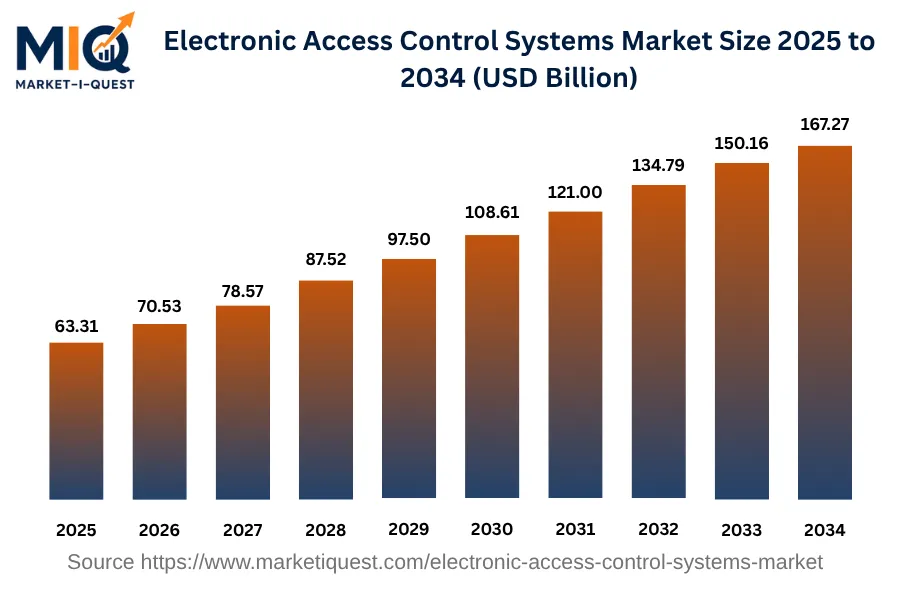
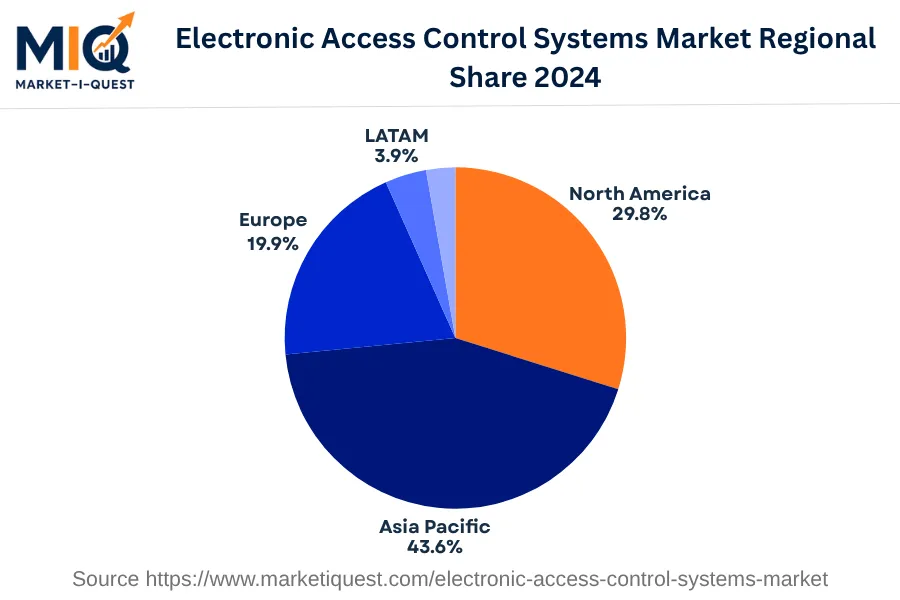
The Electronic Access Control Systems Market was worth USD 63.31 billion in 2025 and is predicted to grow to USD 167.27 billion by 2034. This represents a Compound Annual Growth Rate (CAGR) of 11.4% across this duration. This substantial increase can be attributed to an increased adoption of automated security systems and advanced technology integration in security devices. This adoption and integration were happening across various geographical locations, leading to significant growth throughout this time period. Moreover, increasingly stringent security regulations across different sectors also propelled the market size significantly. Looking at the regional share in 2024, Asia Pacific accounted for the largest share at 43.62%, followed by North America with 29.84%. Europe occupied 19.86% of the market share, while the remaining fractions were held by LATAM with 3.92% and MEA with 2.76%. These numbers give a picture of the global distribution of the Electronic Access Control Systems Market during the initial stage of the period under review.

Key Takeaways

  • By System Type -Intruder Alarm System led the market accounting for a major share.
  • By End User - Industrial sector held the largest share of the segment.
electronic-access-control-systems-market market size

Key Driving Factors

Increasing Need for Higher Security in Sensitive Infrastructure

Sensitive infrastructures such as power plants, data centers, and intelligence agencies are experiencing a growing need for robust security measures, driven by concerns over cyber-attacks and physical intrusions. This is pushing the adoption of electronic access control systems, which provide enhanced protection by allowing only authorized personnel to access secure areas. Security breaches at such locations can result in negative consequences ranging from data theft to the shutdown of critical infrastructure. This urgency to ensure security is acting as a driving factor for the electronic access control systems market as more organizations realize the direct linkage between their operational success and robust access control measures.
Stringent Compliance with Data Protection Regulations

Governmental and industrial regulations like the General Data Protection Regulation (GDPR) in the EU and the California Consumer Privacy Act (CCPA) in the US enforce strict adherence to data protection measures. These requirements demand organizations to manage and control the accessibility of their data processing and storage areas effectively. As a part of their compliance strategy, many organizations are employing electronic access control systems to ensure only authorized individuals can access these specific locations where sensitive data is processed or stored. Non-compliance can lead to heavy fines and damage to reputation. As a result, the necessity to comply with data protection regulations is a significant driver for the electronic access control systems market.

Market Evolution by Timeline

2019-2023
During this period, main buyers were from industrial, commercial and residential sectors seeking enhanced security, with heavy demand from North America and Europe. Manufacturers shipped biometric-based systems, smart cards, and proximity readers, yet the integration maturity among them were on the development stage. Regulatory bodies imposed rules like GDPR and ISO/IEC 27001, influencing the adoption of these systems. Pricing was mostly based on per-user license fee and product type, while exclusive distributor partnerships dominated the market. Concerns arose around interoperability of systems and potential data breaches, leading to strengthened cybersecurity measures.
2024
In 2024, government institutions joined as notable buyers, primarily for identity verification and tracking purposes. Increased shipments of mobile-based and IoT-enabled access control systems showed, though integration with legacy systems posed a challenge. Added regulatory standards like the Personal Information Protection and Electronic Documents Act (PIPEDA) in Canada began influencing the market. Subscription-based pricing models started to emerge, with increased public-private partnerships for distribution. Risks around user privacy and data protection heightened due to expanded use cases.
2025-2029
From 2025 to 2029, healthcare and education sectors propelled demand, driven by the need for visitor management and access control. Manufacturers shipped AI-enabled and facial recognition systems, but full integration with digital infrastructures was often lacking. Globally, more stringent privacy regulations were implemented, such as CCPA in the US, mandating strict data management practices. The predominance of cost-per-door pricing and SaaS-based models shaped the commercial landscape. Heightened cybersecurity threats demanded attention to risk management.
2030-2034
Between 2030 and 2034, Smart City initiatives boosted demand for integrated electronic access systems. Core products shipped were cloud-based and multi-factor authentication control systems, though issues around compatibility with multiple IoT devices persisted. The EU's ePrivacy Regulation and standards around identity protocols defined market conditions. Varied pricing models including freemium and pay-per-use defined commercial transactions, with tech-provider partnerships popular. Risks pertaining to technology obsolescence and data integrity were prevalent, pushing tech upgrades and disaster recovery plans.

Future Market Outlook

Future Opportunities

Future opportunities in the electronic access control systems market are closely tied to enhanced security protocols and evolving organizational needs. In early 2023, the National Institute of Standards and Technology (NIST) released guidelines advocating for stronger multi-factor authentication, which presents an opportunity for vendors to enhance product offerings. Companies innovating in AI and machine learning, such as Amazon with its Amazon Web Services (AWS), are expected to develop new functionalities to forecast security issues. The ongoing trend towards greater sustainability is underscored by initiatives like the United Nations’ Sustainable Development Goals, compelling manufacturers to explore energy-efficient solutions in electronic access systems. The integration of renewable energy sources within devices can create competitive advantages as businesses pursue eco-friendly certifications. Increasing demand for seamless user experiences across different access points suggests opportunities for platforms that centralize management and create user-friendly interfaces. Additionally, businesses in Asia-Pacific regions, particularly India and China, are investing heavily in smart city initiatives that include electronic access systems, stimulating regional technological advancements. Collaborations among stakeholders, as seen with the partnership of Honeywell and Johnson Controls in 2024, focus on comprehensive security frameworks blending traditional and advanced access controls. This landscape fosters an environment ripe for innovation, driving continuous evolution in security measures worldwide.

Segmentation Analysis

By System Type

The market is divided into subsegments including Authentication System, Intruder Alarm System, and Perimeter Security System. The Intruder Alarm System accounted for the largest revenue share while the Perimeter Security System is expected to grow at the fastest CAGR during the forecast period.

Largest Revenue Share

Intruder Alarm System

Market Share Leader

The Intruder Alarm System commands the lion's share of the revenue in the market, driven significantly by its key role in residential, commercial, and industrial security. Constantly growing public and private infrastructure across developing and developed countries has contributed massively to its high revenue. Residential and commercial customers, in particular, favor Intruder Alarm Systems because of their convenience and efficiency, not to mention the role they play in preventative security. Other contributing factors include favorable regulations and policies that are being deployed by governments worldwide to assure the safety of their citizens. The purchase decision is often dictated by the system's reliability, affordability, and after-sales service. The saturation in these technologies can pose a barrier to switching, thus assuring customer loyalty while continuing to grow steadily.

Fastest CAGR

Perimeter Security System

Forecast Period Growth Leader

The Perimeter Security System subsegment is observed to be the fastest-growing due to growing security concerns among commercial properties and sensitive government sectors. They are gaining traction primarily because of their proactive approach to security by detecting and alerting the system of an intrusion before it happens, causing a significant change in the allocation of security spending. Today, we see the manifestation of a significant amount of capital spending on research and development of more efficient and advanced Perimeter Security Systems. Collaborations and partnerships with technology companies have resulted in improved system capabilities with features like AI and IoT integration. However, near-term risks include disruption in the supply chain and project execution due to COVID-19 pandemic-related restrictions and the perceived complexity in operating these advanced systems which may necessitate additional training.

By End User

The market segments are divided into residential, commercial, and industrial sectors, with the industrial sector accounting for the highest revenue share, while the commercial sector is expected to exhibit the highest CAGR during the forecast period.

Largest Revenue Share

Industrial

Market Share Leader

The industrial segment leads in the market revenue, and this can be attributed to the high use of advanced technologies in the manufacturing and processing industry. The booming industrial sector worldwide, especially in the developing economies, is driving substantial growth. High capacity requirements and mass production capabilities necessitate the adoption of high-powered machinery, thereby driving demand in the industrial sector. Strict government regulations towards efficient energy use and environmental conservation call for the deployment of advanced technologies in the industry. The industrial sector's need to streamline operations, reduce operational costs, and improve product quality and safety fuels the demand. Also significant is the increasing competition among industrial firms which drives the adoption of technologies that enhance efficiency and productivity.

Fastest CAGR

Commercial

Forecast Period Growth Leader

The commercial sector is expected to witness the fastest growth during the forecast period. The key driver for this growth is the increasing adoption of product and services to improve efficiency across commercial establishments such as office spaces, malls, and other public areas. As businesses grow and their operations expand, the demand for advanced technologies and services in the commercial sector sees a significant uptick. Government policies promoting digitalization and modernization of traditional commerce, increasing foreign investments in commercial establishments and growing awareness about the benefits of advanced practices contribute to the adoption. However, factors such as initial cost and lack of technological understanding might pose as barriers initially. Overcoming these would require ramped-up efforts from stakeholders, including public-private partnerships and dedicated learning drive for users and consumers.

Competitive Analysis

Key Market Players

Manufacturers / OEMs

Honeywell
US
Assa Abloy
Sweden
Tyco International
Ireland

Key Suppliers & Raw Materials

Allegion plc
Ireland
Bosch Security Systems
Germany
United Technologies Corporation
US

Distributors, Integrators & Channel Partners

ADT Security Services
US
Stanley Convergent Security Solutions
US
Securitas AB
Sweden

Porter’s Five Forces Analysis

This analysis delves into the competitive dynamics within the Electronic Access Control Systems Market.

Supplier Bargaining Power

Medium

Specialized inputs determine moderate supplier power in the electronic access control systems market.

Buyer Bargaining Power

High

Buyers enjoy high power due to numerous suppliers and low switching costs.

Threat of Substitutes

Low

Specialized nature of electronic access control systems reduces substitute threat.

Threat of New Entrants

Medium

Technical knowledge and initial capital investment pose moderate barriers to entry.

Competitive Rivalry

High

Intense competition exists due to diversity in product offerings and multiple key players.

Regional Analysis

Geographic market dynamics and growth opportunities across key regions

Global Market Outlook

electronic-access-control-systems-market market regional share

North America

In 2024, the North American market for electronic access control systems had expanded due to boosting demand, technology adoption, and evolving regulations.

Several drivers propelled the market. Within enterprises, the need for enhanced security due to a rise in safety breaches led to a more widespread adoption of access control systems. For governments and utility sectors, regulatory requirements necessitated improved access management, driving system purchase and investment. Technological advancements, particularly in biometric scans and mobile access, also fueled this market's growth. Additionally, manufacturers and suppliers balanced supply dynamics and pricing to appeal to a broad customer base.

Trends shaping this market included a shift towards multifactor identification, adding an extra layer of security, especially within the healthcare and retail sectors. Companies were increasingly integrating their physical and information security systems, influenced by an uptick in cyber threats. There was also a notable increase in partnerships and mergers between technology and security firms, aimed at market expansion and system sophistication. Moreover, enforcement of stringent policies such as the U.S. Federal Information Security Modernization Act (FISMA) spurred adherence to approved access control systems across federal agencies.

In conclusion, the North American market for electronic access control systems in 2024 was dynamic, influenced by a cocktail of drivers and evolving trends.

Asia Pacific

In 2024, the Asia Pacific market for Electronic Access Control Systems (EACS) witnessed vigorous dynamism due to multiple driving factors and emerging trends. Demand surged, primarily propelled by increasing security concerns in enterprise, government, and healthcare sectors across key markets such as China, India, and Japan. China's "Safe City" initiative significantly catalyzed EACS adoption in urban areas, while regulatory mandates for enhanced access control in India's manufacturing and retail sectors spurred market expansion. Tech-savvy South Korea witnessed a surge in investment in advanced EACS technologies, substantially influencing supply dynamics and pricing.

Trends in this space were shaped by changing buyer behavior and distinct product shifts. End-user preference leaned towards integrated, IoT-enabled EACS solutions, observed notably in Australia's corporate and government sectors. In Japan, partnerships and strategic M&As among leading EACS providers increased to leverage technology shifts and enhance market footprint. Meanwhile, the ASEAN markets saw rigorous enforcement of standards and policies for effective access control, particularly in utilities and related sectors. The affinity towards biometric-based EACS solutions stood out, especially in healthcare facilities across India and China, revealing a crucial trend in this market landscape during the base year.

Europe

The Electronic Access Control Systems Market in Europe flourished in 2024, energised by evolving security needs, regulatory compliances, and technological advancements. Key demand factors included rising security concerns across sectors such as government, healthcare, utilities, manufacturing, retail, and enterprise. Amid escalating cybersecurity threats, Germany, the United Kingdom, France, and Benelux governments enforced stringent data protection regulations, incentivising businesses to invest in secure access control systems. Rapid technological adoption, particularly in the Nordics and Central & Eastern Europe, further stimulated market growth.

In 2024, the shift towards intelligent security solutions and biometric systems marked significant trends within the European market. As businesses in Italy and Spain evolved, recognising the associated cost savings, effectiveness, and improved data integrity, the demand for these smart systems grew. Partnerships and M&A activities prevailed, with companies leveraging each other's strengths to offer advanced, integrated systems. Finally, the enforcement of GDPR policy instigated a shift in customer behaviour, prioritising vendors providing GDPR-compliant access control systems. Thus, in the base year 2024, the European Electronic Access Control Systems Market experienced robust growth, driven by security demands, regulatory mandates, and digital transformation trends.

Latin America

In 2024, the Latin American (LATAM) Electronic Access Control Systems Market was fueled by a surge in security and privacy concerns. Demand was driven by increased investment in smart cities projects, particularly in Brazil and Mexico, adopting advanced security infrastructure. Regulatory changes in Argentina mandated the use of such systems in public buildings, accelerating their market penetration. Furthermore, reduced hardware and software prices increased accessibility for smaller enterprises and residential users in Colombia and Chile.

A notable trend was the adoption of biometric-based systems by the healthcare and government sectors in Peru, owing to their superior security levels. Cloud-based systems witnessed significant growth due to their flexibility and remote access capabilities, with major uptake in the manufacturing and utilities sectors across LATAM. There was a surge in partnerships between local and international players to leverage market presence, exemplified by Assa Abloy’s collaboration with Brazilian firm Metalika. The enforcement of the General Data Protection Law (LGPD) in Brazil became a defining trend, mandating stringent data security measures in electronic control systems across sectors.

In all, the LATAM Electronic Access Control Systems Market in 2024 was energized by security necessities, smart cities projects, regulatory mandates, affordability, and strategic collaborations, while having to keep a keen eye on data security standards.

Middle East & Africa

In 2024, the Electronic Access Control Systems (EACS) market in the Middle East and Africa reflected strong growth, primarily driven by security concerns and stringent regulatory measures. Implementations increased due to escalating threats of physical and data theft, predominantly in Saudi Arabia, Nigeria and South Africa. The higher adoption rate of advanced technologies in these countries demanded fortified access control. Regulatory measures like Saudi Arabia's Vision 2030 policy, fuelled the EACS market, outlining infrastructure development with robust security essentials.

A notable trend was the wide acceptance of biometric solutions across sectors like government, healthcare, and financial services. Biometric integration became a powerful tool for identity verification in Qatar's government facilities and UAE's banking sector. The digitization wave in Israel and UAE gave rise to wireless EACS, offering enhanced security with seamless integration. Mergers and acquisitions were prevalent; a noteworthy instance is the collaboration of Honeywell with UAE's Emirates National Oil Company (ENOC) to secure its operations. Another trend observed was the implementation of multi-factor authentication in telecom and utilities sectors in Egypt and Kenya due to a high rate of cyber threats. The EACS market in 2024 was thus, marked by technological advancements with a strong focus on security and regulatory compliance in these regional sectors.

Recent Industry Developments

Latest market innovations, product launches, and strategic initiatives

October 2025

ASSA ABLOY finalized the acquisition of SiteOwl, a U.S.-based cloud platform specializing in physical security lifecycle management. The acquisition scales ASSA ABLOY’s cloud portfolio, providing system integrators and security managers with unified, browser-accessible tools to design, install, and audit complex electronic access control topologies.

August 2025

ASSA ABLOY expanded its European division by acquiring Germany-based Kentix GmbH, a prominent developer of smart environmental monitoring and electronic access devices. The strategic move directly targets the booming data center security market, integrating physical token-less access control with real-time temperature, humidity, and threat monitoring.

Frequently Asked Questions