Electron Microscope Market Snapshot

Key Players

  • Jeol Ltd. (Japan)
  • Thermo Fisher Scientific Inc. (US)
  • Carl Zeiss AG (Germany)
  • Hitachi High-Technologies Corporation (Japan)
  • Nikon Corporation (Japan)
  • Bruker Corporation (US)
  • Danish Micro Engineering A/S (Denmark)
  • Leica Microsystems GmbH (Germany)

Market Size

Base Year 2024
$5.97 Bn
CAGR
8.45%
Forecast 2034
$13.44 Bn

Market Segments

By Type
  • Transmission Electron Microscope
  • Scanning Electron Microscope
  • Others
By Application
  • Nanotechnology
  • Material Sciences
  • Semiconductors
  • Others

Market Dynamics

Drivers
  • Rising nanotechnology research
  • Increased semiconductor demand
Restraints
  • High equipment costs
  • Requirement of skilled personnel
Opportunities
  • Emerging nanotechnology industries
  • Increasing academic research activities

Market Size

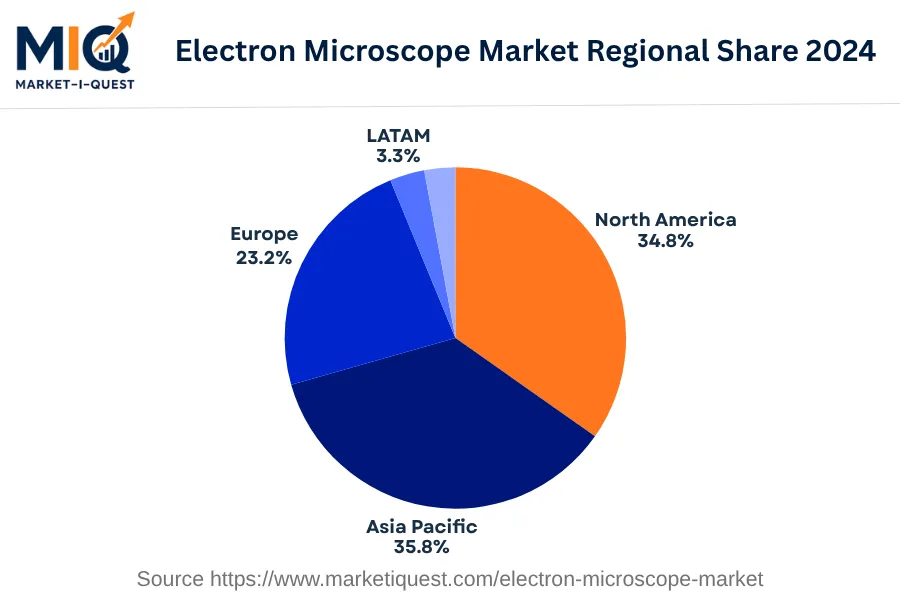
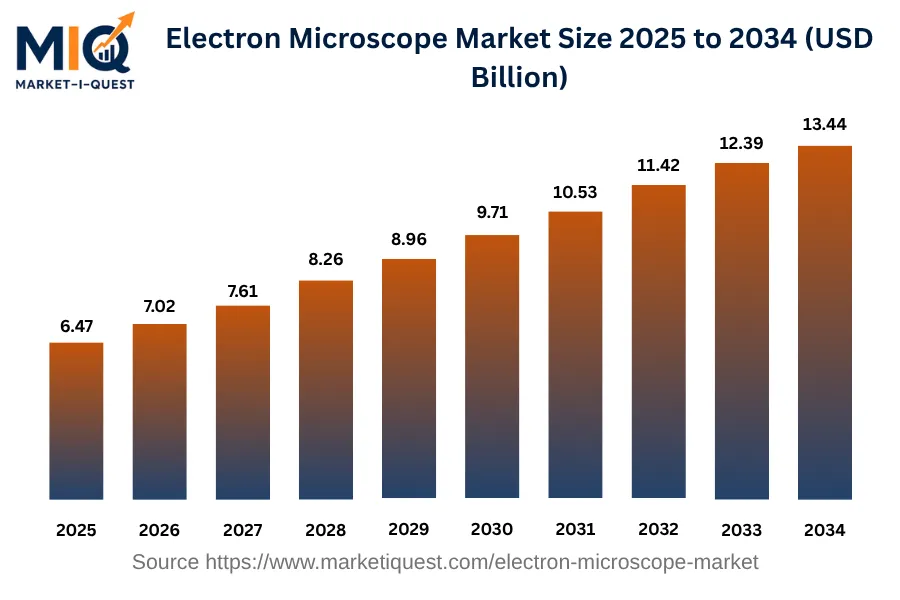
The Electron Microscope Market, valued at 6.47 billion USD in 2025, will expand to reach 13.44 billion USD by 2034, growing at a compound annual growth rate (CAGR) of 8.5%. This definitive upward trend in the market size embodies nearly a doubling of the market capital over this period. A year prior to 2025, the market stood at 5.97 billion USD, implying a substantial growth even in the starting years of the period. The regional share mix in 2024 provides an understanding of the geographic distribution of this market. North America and Asia Pacific held the most significant shares at 34.8% and 35.8% respectively, followed by Europe at 23.2%, indicating the leading roles played by these regions in the market. Latin America and Middle East and Africa (MEA) region had much smaller portions with 3.3% and 2.9% respectively, showing comparatively less penetration in these markets.

Key Takeaways

  • By Type - Transmission Electron Microscope led the market accounting for a substantial share of the market.
  • By Application - Semiconductors held dominated position of the market.
electron-microscope-market market size

Key Driving Factors

Emergence of Nanotechnology

The increasing adoption of nanotechnology, particularly in material science, healthcare, and energy sectors, is influencing growth in the Electron Microscope Market. Nanotechnology demands high-resolution imaging and analysis capabilities, due to its focus on manipulating matter at atomic and molecular scales. Electron microscopes, known for their superior resolution, are ideal for observing and analyzing nanoscale particles. As researchers and businesses investigate the potential of nanomaterials, the needs for advanced visualization techniques such as electron microscopy are likely to see an upward trend. Hence, the surge in nanotechnology activities across various sectors significantly contributes to the demand for electron microscopes.

Adoption of 3D Printing in Healthcare

The rising use of 3D printing, particularly in personalized healthcare applications, is another driver for the Electron Microscope Market. Detailed structural and material insights offered by electron microscopes play a critical role in developing 3D printed medical equipment like implants and surgical tools. Electron microscopes are used to inspect micro-structures and ensure optimal quality in these carefully designed medical tools. As 3D printing takes a more central role in the medical field, the need for tools like electron microscopes that can ensure precision manufacturing will continue to grow. This adoption of 3D printing in healthcare is driving more purchases of electron microscopes for inspection purposes.

Market Evolution by Timeline

2019-2023
During this period, a significant demand for electron microscopes was observed from the educational sector in Europe, due to the enhancement of science curriculum in schools. Suppliers mainly offered Scanning Electron Microscopes and Transmission Electron Microscopes. Technical integration between these types and energy-dispersive spectrometers became more mature in offerings. The European Research Infrastructure for Imaging Technologies in Biological and Biomedical Sciences (Euro-BioImaging ERIC) program influenced adoption largely. Suppliers generally priced their products based on resolution and integration capabilities, with multi-year service contracts. Significant risks included the high cost of the equipment and the required trained personnel.
2024
In 2024, global demand rose due to the increase in materials science research, especially in Asia. The product shipped were Seeing Atoms (SA) type microscopes, which offered a greater degree of precision. The European Standards for Microscopy (ESM) was introduced, which insisted on better performance parameters. Academic and industrial research labs were dominant buyers, with purchase agreements typically including installation and training. The high cost and complex maintenance procedures continued to pose risks during this year.
2025-2029
This period witnessed further advances in the medical research sector, particularly in North America, raising demand for electron microscopes. Suppliers responded with AI-supported TEM analysis systems, making microscopes more user-friendly and reducing the need for highly trained operators. The establishment of the Global Medical Imaging (GMI) protocol influenced adoption. Typical contracts included multi-year warranty and maintenance packages. Challenge remained in terms of the integration of AI capabilities with existing microscopes in laboratories and the requirement of AI-optimized hardware.
2030-2034
During these years, demand stemmed mainly from nanotechnology and metallurgical industries across the globe. There was a significant market shift towards compact, portable electron microscopes capable of in-situ and real-time imaging. Moreover, Quantum Electron Microscopy (QEM) had its trial phase and showed promising results. The implementation brought a shift in regulatory standards, with the 'Code for Good Lab Practices' governing use. Subscription-based models with flexible servicing plans became popular. A significant risk associated with this period was meeting the challenges of space optimization and thermal stability in portable devices.

Future Market Outlook

Future Opportunities

The electron microscope market is poised for opportunities driven by increasing applications across multiple sectors, reflecting ongoing technological advancements and heightened research activity. For instance, in March 2023, the National Institutes of Health launched a multi-year initiative to expand electron microscopy resources, recognizing its importance in biomedical research. This move facilitates access for academic institutions and small research firms, creating demand for sophisticated electron microscopy solutions. Similarly, in July 2022, the European Union initiated funding programs aimed at developing innovative materials and nanotechnologies, including electron microscopy research facilities. These initiatives suggest a rising trend toward collaboration between public funding and private enterprises, enhancing the overall ecosystem. Companies like FEI, a part of Thermo Fisher Scientific, are strategically positioning themselves by developing specialized models tailored to biotechnology and materials science. The growth of industries such as semiconductor manufacturing and advanced materials fabrication further propels demand for electron microscopy solutions, particularly in Asia-Pacific nations emphasizing technological leadership. As organizations increasingly recognize the value of precise microstructural analysis, the need for educational partnerships and training programs emerges, fostering a skilled workforce in this domain. This synergy between technological evolution and educational enhancement signifies a fruitful future ahead for professionals engaged in electron microscopy.

Segmentation Analysis

By Type

The market is divided into subsegments including Transmission Electron Microscope, Scanning Electron Microscope, and Others. The Transmission Electron Microscope accounts for the largest revenue share, while the Scanning Electron Microscope is expected to grow at the fastest CAGR during the forecast period.

Largest Revenue Share

Transmission Electron Microscope

Market Share Leader

Transmission Electron Microscopes or TEMs contribute to the highest revenue share in the market. This can be attributed to several factors. Primarily, TEMs offer advantages over other types of electron microscopes such as superior magnification and resolution capabilities. This makes them an indispensable tool for biological, material science, and nanotechnology research. Additionally, the recent growth in the nanotechnology industry has amplified the demand for TEMs. Geographically, high-income countries with advanced research infrastructure contribute significantly to the TEM market. Regulatory factors such as stringent quality and safety standards in industries like pharmaceuticals and biotechnology also drive the demand for TEMs. The need for precise and accurate results further propels the demand. Finally, procurement practices favor TEMs due to their high reliability, affecting purchasing decisions of institutions and industries.

Fastest CAGR

Scanning Electron Microscope

Forecast Period Growth Leader

The Scanning Electron Microscope or SEM, despite not being the largest contributor to market revenue, is expected to see the most rapid growth over the forecast period. This growth is driven by its substantial role in industrial applications, including semiconductor manufacturing, metallurgical studies, quality control, and failure analysis. Furthermore, the ongoing miniaturization of electronic components is increasing the need for SEMs. Sullivan regulations promoting higher standards of quality control in manufacturing significantly contribute to the growth of this subsegment. Moreover, a shift towards digital microscopes in educational and research institutions for demonstration and teaching is also favoring the adoption of SEMs. There may, however, be adoption barriers such as high cost and need for specialized training that may hinder growth in some geographies. To overcome these hurdles, manufacturing companies may form partnerships or invest in capacity expansion, thereby catalyzing growth in the near term.

By Application

The market is segmented into subsegments including Nanotechnology, Material Sciences, Semiconductors, and others. In base year 2024, the Semiconductors subsegment has accounted for the largest revenue share, while Nanotechnology is expected to grow at the fastest CAGR during the forecast period.

Largest Revenue Share

Semiconductors

Market Share Leader

Semiconductors demonstrated the highest revenue in the given year, due to the sector's widespread use. This can be attributed to constant technological advancements that require sophisticated and high-end semiconductors, which are integrated within the many products we use in our day-to-day lives ranging from electronics and automotive parts to industrial machinery. Geographic factors also play a significant role, with key revenue generation coming from technology-dense regions like Asia, North America, and Europe. Regulatory policies allowing the facilitation of international trade have further boosted growth in this sector. Consumer preference for faster and more efficient devices has amplified the demand for semiconductors globally, propelling its revenue growth. The technology is also regulation-friendly, encountering minimum hurdles for its large-scale production and distribution.

Fastest CAGR

Nanotechnology

Forecast Period Growth Leader

Nanotechnology is primed to have the fastest growth rate in the coming years due to its potential to revolutionize various industries from healthcare to energy production. Though initially, its adoption might face some barriers due to the nascent stage of this technology and the high capital expenditure required for research and development, strategic partnerships and policy facilitation can act as catalysts for its growth. Affirmative investment in innovation and technological advancement, supported by favorable regulations, could spur the adoption of nanotechnology. However, possible near-term risks could revolve around unanticipated environmental impacts or regulatory changes, which would demand adaptive strategies to maintain the momentum of growth.

Competitive Analysis

Key Market Players

Manufacturers / OEMs

Thermo Fisher Scientific
US
JEOL
Japan
Hitachi High-Technologies Corporation
Japan

Key Suppliers & Raw Materials

Carl Zeiss
Germany
Nikon Corporation
Japan
FEI
US

Distributors, Integrators & Channel Partners

Danaher Corporation
US
Agar Scientific
UK
Bruker Corporation
US

Porter’s Five Forces Analysis

Porter's Five Forces analysis offers market insights into the electron microscope industry's competitive dynamics.

Supplier Bargaining Power

High

Specialized components restrict the number of suppliers, increasing their bargaining power.

Buyer Bargaining Power

Medium

Buyers have moderate power due to the variety of brands and price ranges.

Threat of Substitutes

Low

Due to the specific and advanced functionality, there are few substitute products.

Threat of New Entrants

Low

High capital expenditure and technological expertise pose barriers to entry.

Competitive Rivalry

High

Fierce competition exists among existing players in the market, with innovation as a key differentiator.

Regional Analysis

Geographic market dynamics and growth opportunities across key regions

Global Market Outlook

electron-microscope-market market regional share

North America

In 2024, the North American Electron Microscope market was propelled by demand in sectors such as healthcare, manufacturing, and research. The increase in disease outbreak investigations and rising compound semiconductors manufacturing warranted detailed nano-scale observations, boosting the use of electron microscopes. Policy standards favoring better diagnosis techniques in the healthcare sector also spurred adoption. The substantial investments made by research institutions in the U.S. and Canada augmented this growth.

Principal trends in 2024 involved a shift towards high sophistication and technological advancements in electron microscopy. Buyers increasingly preferred Scanning Electron Microscopes for their three-dimensional imaging capabilities. Integration of Machine Learning algorithms for improved image processing surfaced as a visible trend in the U.S., signaling a probable alliance between academic research networks and leading market players. Enforcement of strict manufacturing standards in the automobile and electronics sectors of the U.S., Canada, and Mexico amplified the need for electron microscopes.

The key customer base constituted diagnostic laboratories, research institutions, and quality control departments across industries. Enterprises in the U.S. demonstrated an increased interest in SEM, while Canadian laboratories preferred Transmission Electron Microscopes for specimen analysis. The Government sector in Mexico intensified focus on quality in manufacturing, funding advanced inspection technology including electron microscopes. The pumping dynamics in the need for precision instruments affirmed the market's growth trajectory.

Asia Pacific

In 2024, the Asia Pacific Electron Microscope (EM) market has shown robust growth due to varied factors. Dominant drivers include increased investment in R&D by countries like China and South Korea, reinforcement of nanotechnology industry regulations, and a surge in demand within sectors such as healthcare, manufacturing, and education. China, in particular, is a key player, doubling its investment in nanotech research, incentivizing faster adoption of EM technology. India's regulatory body, the Indian Nanoscience and Nanotechnology Policy, has also strengthened regulations and contributed to market dynamism.

Noteworthy trends in 2024 feature shifting buyer preferences and technological advancements. Buyers gravitated towards the more compact and automated Scanning Electron Microscopes (SEM), particularly in Japan’s high-tech manufacturing sector. A noteworthy deal - Hitachi's acquisition of JEOL - fostered increased market consolidation. Governments across Asia Pacific, with Australia at the helm, began enforcing stricter product quality standards in the biotechnology field, boosting the demand for efficient, high-resolution microscopes. In key ASEAN markets, digital advancements saw an increase in remote operation of SEMs, particularly in the industrials sector—an adaptation induced by prevailing 'work-from-anywhere' norms.

Europe

In 2024, the Electron Microscope Market in Europe witnesses significant growth catalyzed by several key factors. Firstly, mounting demand in sectors such as healthcare, utilities, manufacturing, and academia drive market expansion. In healthcare specifically, growing diagnostic requirements and advancements in pathological research propel adoption rates. Secondly, supportive government policies and investment in R&D initiatives, evidenced by Germany's generous funding for microtechnology, contribute to a landscape conducive to growth. Lastly, supply dynamics underscore market growth, with leading suppliers like Thermo Fisher Scientific and Carl Zeiss downsizing product costs, thus boosting adoption.

Several trends defined the market in 2024. Digitalization altered buyer behavior, with customers veering towards software-integrated systems for superior diagnosis and research. The emergence of versatile, portable electron microscopes, such as Hitachi's Tabletop Microscopes, reinvented technology usage. Shifting channel dynamics, especially the rise of e-commerce platforms in the UK and France, provided a constructive distribution network. Significant partnerships and M&A activities also characterized the market landscape, for instance, Bruker's incorporation of Luxendo’s microscopy unit. Additionally, stringent policy enforcement around specimen handling and disposal across various European regions further stipulated market growth. These drivers and trends thus coalesce to shape the robust Electron Microscope Market in Europe in 2024.

Latin America

In 2024, the Latin American Electron Microscope market remained highly competitive and growth-oriented. Market expansion was primarily driven by significant investment in research and development across healthcare, manufacturing, and enterprise sectors, particularly in Brazil and Mexico. The adoption of advanced technology further stimulated the market; for instance, increasing reliance on nanotechnology in Argentina fueled demand for high-resolution imaging tools like electron microscopes. In Chile, stricter quality control regulations in manufacturing mandated the use of electron microscopy, contributing to supply dynamics.

Simultaneously, buyer behavior saw a shift towards higher magnification and imaging clarity. In Colombia, this was most pronounced in the healthcare sector, where more accurate diagnoses drove demand. Significant technological enhancements, such as 3D electron microscopy, started gaining traction in Peru’s manufacturing sector. Partnerships and M&A activity also shaped the market landscape: for example, the collaboration between Brazilian universities and international electron microscope providers facilitated access to technologically superior and cost-efficient options for scientific research. In terms of standards, Mexican regulatory authorities implemented rigorous inspection protocols enforcing the use of electron microscopes in utilities. All in all, 2024 marked notable progress for the Latin American Electron Microscope market.

Middle East & Africa

In 2024, the Electron Microscope Market within the Middle East and Africa showcased distinct growth and diversity. Drivers of this expansion included increased investment in scientific and industrial research, most notably within wealthy gulf nations such as Qatar, Saudi Arabia, and the UAE, where state-sponsored universities and corporations have underpinned demand. A heightened emphasis on technology-driven healthcare solutions in countries like Israel, South Africa, and Egypt, coupled with stringent regulations enforcing advanced diagnostic tools, have also escalated requirements for such equipment. High-resolution materials testing in sectors like manufacturing and oil and gas has resulted in burgeoning demand, while the growing prominence of nanotechnology has leveraged market traction, particularly in economies like Nigeria and Kenya.

Trends shaping the market constituted a shift towards integration with analytical software to deliver comprehensive imaging solutions, a transition predominantly led by Israel's innovative tech scene. The burgeoning e-commerce industry in markets such as South Africa and UAE facilitated easy accessibility and distribution of electron microscopes. An increase in cross-border partnerships, acquisitions and joint ventures, particularly within Nigeria's oil and gas sector, has also shaped the landscape. Enhanced policy enforcement promoting R&D in technical fields, of which Egypt's 'Science, Technology and Innovation Funding Authority' is exemplary, has reinforced the trend towards sophisticated, high-tech research tools, solidifying demand for electron microscopes.

Recent Industry Developments

Latest market innovations, product launches, and strategic initiatives

April 2026

Global market valuations confirmed that the electron microscope equipment industry crossed $5.28 billion, maintaining an 8.2% compound annual growth rate. While versatile Scanning Electron Microscopes (SEMs) secured a dominant 78.7% volume share, automated Transmission Electron Microscopes (TEMs) emerged as the fastest-growing financial segment due to soaring structural biology and advanced semiconductor node validation needs.

January 2026

Samsung Foundry scaled its implementation of plasma-focused-ion-beam scanning electron microscopy (PFIB-SEM) across its logic chip development tracks. The metrology update enables high-throughput, automated lamella sample preparation on ultra-brittle, low-k dielectric materials, mitigating electronic beam damage during sub-5nm node defect analysis.

Frequently Asked Questions