Electric DC Motor Market Snapshot

Key Players

  • ABB Ltd (Switzerland)
  • Siemens AG (Germany)
  • Rockwell Automation Inc. (United States)
  • Nidec Corporation (Japan)
  • Ametek Inc. (United States)
  • Johnson Electric Holdings Limited (Hong Kong)
  • WEG S.A. (Brazil)
  • Toshiba Corporation (Japan)
  • Maxon Motor AG (Switzerland)
  • Regal Beloit Corporation (United States)

Market Size

Base Year 2024
$17.28 Bn
CAGR
8.4%
Forecast 2034
$38.71 Bn

Market Segments

By Type
Brushed DC Motor, Brushless DC Motor
By Voltage
Low Voltage (Up to 24V), Medium Voltage (25V–96V), High Voltage (Above 96V)
By Output Power
Up to 500 Watts, 500W–5 kW, Above 5 kW
By End User Industry
Automotive, Aerospace & Defense, Industrial Machinery, Consumer Electronics, Healthcare, Others

Market Dynamics

Drivers
  • Increasing demand for energy-efficient products
  • Rising adoption in electric vehicles
Restraints
  • High manufacturing costs
  • Technological sophistication requirement
Opportunities
  • Increased use in electric vehicles
  • Rising automation in industries

Market Size

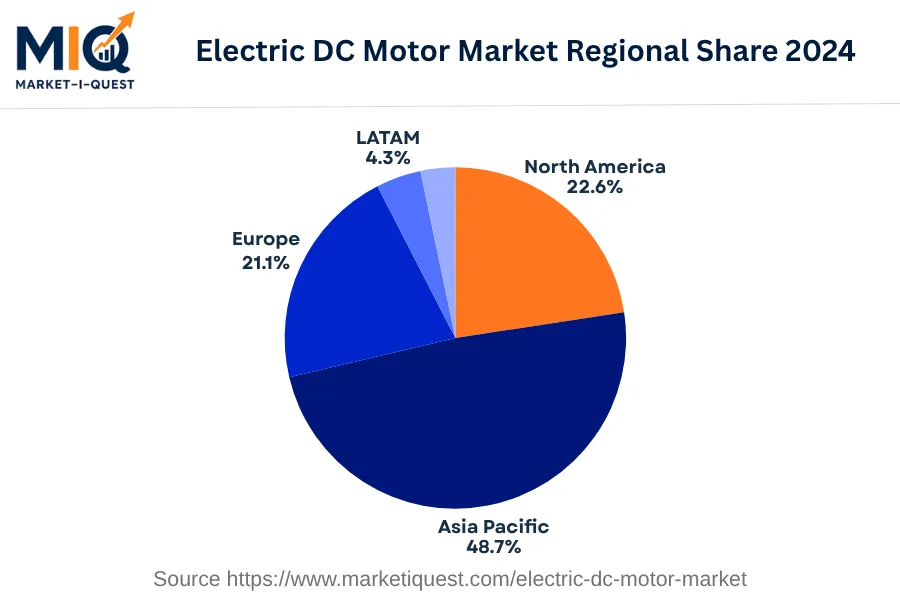
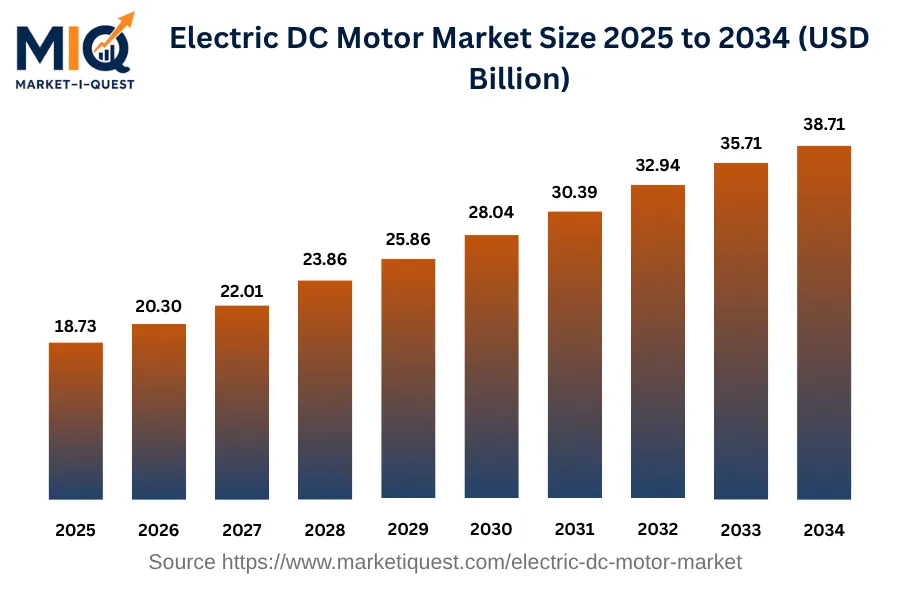
The Electric DC Motor Market was valued at USD 18.73 billion in 2025, whereas USD 17.28 billion in 2024. The market size is expected to grow to USD 38.71 billion by 2034, indicating a CAGR of 8.4%. This rapid growth has influenced to the increasing demand for these motor types across different industries, from general manufacturing to the rapidly advancing electric vehicle industry. In terms of regional share in 2024, the Asia Pacific held the largest share of the market at 48.7%, followed by North America at 22.6% and Europe at 21.1%. The Latin America and Middle East & Africa regions held shares at 4.3% and 3.3% respectively.

Key Takeaways

  • By Type - Brushed DC Motor held its leading position in the Electric DC Motor Market.
  • By Voltage - High Voltage DC motors held a significant position in the market.
  • By Output Power - 500W to 5kW led the largest market segment in the base year.
  • By End Use -Automotive sector accounted for a significant portion of the market.
electric-dc-motor-market market size

Key Driving Factors

Implementation of Energy Efficiency Standards for Motors

Increased priority towards energy efficiency worldwide is playing a significant role in driving the Electric DC Motor Market. Regulating bodies such as the U.S Department of Energy and the European Union are implementing stringent measures on energy consumption to reduce adverse environmental impacts. These measures require any motor in operation, including those in Electric DC Motors, to be compliant with certain energy efficiency criteria. Manufacturers are thereby concentrating on the enhancement of energy efficiency in their products to meet these energy standards, pushing the growth of the Electric DC Motor Market. This higher efficiency not only reduces energy consumption but also decreases operating costs, making Electric DC Motors even more appealing.

Adoption of Electric Vehicles (EVs) Globally

The growing adoption of Electric Vehicles (EVs) across the globe is a significant driver for the Electric DC Motor Market. Governments are encouraging the use of zero-emission vehicles through policies with offering lucrative incentives to both manufacturers and consumers. Electric DC Motors forms as a major heart of an EV, replacing traditional internal combustion engines to convert electrical energy into mechanical energy. This increasing trend towards EVs and the subsequent demand for Electric DC Motors stems from raised environmental concerns and a collective move toward cleaner energy sources. As production and adoption of EVs gain momentum, so does the market for Electric DC Motors.

Market Evolution by Timeline

2019-2023
From 2019 to 2023, the Electric DC Motor Market primarily served automotive industries, HVAC equipment manufacturers and power tools industries mainly in the United States, Europe and Asia-Pacific. The supply was characterized by the increasing integration of IoT technology for remote operation and monitoring. However, problems along the supply chain, often linked to the complexity of integrating IoT, were frequently encountered. Policy-wise, the EU's Ecodesign Directive, aiming to reduce environmental impact of products, influenced manufacturers to improve energy efficiency. Typical pricing was based on power rating and motor type and size. Contracts usually spanned multiple years and included service-level agreements. One critical risk was cybersecurity of IoT-enabled motors, requiring manufacturers to invest in secure systems.
2024
In 2024, notably demand for electric DC motors was driven by rapidly evolving industries like electric vehicles, home appliances and industrial automation, particularly in emerging markets like China and India. Motors with built-in sensors with offerings such as predictive maintenance functionalities gained popularity. Regulations like EU's RoHS Directive strictly controlled usage of hazardous substances in electric and electronic devices. Motor manufacturers and end-users frequently engaged in long-term agreements which included routine maintenance and repair provisions.
2025-2029
From 2025 to 2029, user-controlled drones, robotic cleaning devices and high-performance electric cars drove demand primarily in developed regions. Brushless DC motors dominated the market offering extended motor lifetime with less maintenance. Their wide adoption was primarily constrained by higher initial cost. Governments standards like US Department of Energy's Small Motor Rule positively influenced energy efficiency practices. End-user pricing was largely influenced by average lifespan, in-built sensor capabilities, and software complexities of DC motors. Volatility in raw material prices, particularly copper and steel, constituted the most prominent risk.
2030-2034
From 2030 to 2034, intelligent manufacturing and various segments of smart city projects have likely become the main buyers. Adoption of DC motors with fully-integrated AI and machine-learning capabilities was expected. The quality of supply, however, may have been constrained by complexities in integrating advanced machine learning algorithms. Policies like the EU's 'Smart Readiness Indicator' for improving energy efficiency, likely influenced design efforts. Commercial models likely shifted towards 'Motor-as-a-service' where predictive maintenance and real-time monitoring were provided within the contract. Risks during this time were likely tied to a largely unregulated AI-based technology and its vulnerability to cyber-attacks.

Future Market Outlook

Future Opportunities

The increasing adoption of electric DC motors across a range of industries in 2023 indicates notable future opportunities, especially in sectors undergoing transformation towards sustainability. The automotive industry is notably shifting, as evidenced by General Motors' partnership with LG Energy Solution to develop electric vehicle systems that utilize high-performance DC motors. This collaboration underscores a growing trend towards electrification and the need for efficient motor solutions. Furthermore, with the global push for renewable energy, electric DC motors are integral to wind turbine technology, as 2023 data from the International Renewable Energy Agency highlights their role in maximizing energy capture. The rise of home automation systems also represents an emergent opportunity for DC motors, particularly in smart appliances; companies like Philips are launching products that require high-efficiency motors to optimize performance and energy usage. Similarly, advancements in drone technology, as seen with the increasing integration of small electric DC motors in delivery systems, point towards immense potential in logistics. Regulatory frameworks supporting electric mobility and renewable energy initiatives worldwide will continue to stimulate market growth. Overall, as industries adapt to environmental pressures and technological advancements, the electric DC motor market is expected to see substantial expansion across diverse applications, driven by innovation and regulatory compliance efforts that emphasize sustainable solutions.

Segmentation Analysis

By Type

The market is divided into subsegments including Brushed DC Motor and Brushless DC Motor, with Brushed DC Motor accounting for the largest revenue share while Brushless DC Motor is expected to grow at the fastest CAGR during the forecast period.

Largest Revenue Share

Brushed DC Motor

Market Share Leader

Brushed DC motors continue to hold the largest revenue share in the DC motors market because of their sturdy, long-lasting construction, ease of use, and lower upfront cost compared to brushless DC motors. In various industrial sectors, including automotive, manufacturing, and consumer appliances, brushed DC motors are commonly used. They have a well-established customer base due to their consistent performance and greater torque per dollar. These motors are commonly employed in budget-sensitive applications, resulting in substantial volumes. Moreover, older applications and technologies that still use brushed DC motors are less likely to switch due to high switching costs and complexities of integration with existing equipment. Despite their simplicity and cost-effectiveness, their usage is likely to decrease as more advantages of brushless DC motors are recognized by the market.

Fastest CAGR

Brushless DC Motor

Forecast Period Growth Leader

Brushless DC Motors have a positive growth trajectory and are expected to grow at a faster rate. Adoption of these motors is increasing due to several factors. The brushless design results in better efficiency, increased operational lifespan, and less maintenance. In sectors such as automation, robotics, and electric transportation, where efficiency, accuracy, and reliability are paramount, the demand for brushless motors is increasing. Technological advancements are likely to continue to drive the shift toward these brushless DC motors. However, initial adoption is slowed by higher upfront costs and integration complexities. Near-term risks include potential disruption in the supply chain due to geopolitical factors and the higher technical skills needed for maintenance and repair. As these barriers are slowly mitigated through policy development and market adaptation, brushless DC motors are poised for accelerated growth in the near future.

By Voltage

The market is divided into subsegments including Low Voltage (Up to 24V), Medium Voltage (25V–96V), and High Voltage (Above 96V). In the base year 2024, the High Voltage subsegment accounted for the largest revenue share, while the Low Voltage subsegment is projected to grow at the fastest CAGR during the forecast period.

Largest Revenue Share

High Voltage (Above 96V)

Market Share Leader

The high voltage segment holds the most significant market share, primarily driven by its widespread application in heavy-duty and industrial machinery. High voltage systems are integral to large-scale power plants, industrial complexes, and electric vehicles, which necessitate these high-powered systems to function effectively. The increased focus on sustainability and green energy solutions has spurred the growth of renewable energy generation plants, contributing significantly to the high voltage market. Furthermore, the introduction of regulatory standards encouraging energy efficiency has accelerated the adoption of high-voltage systems. Moreover, they have high purchasing criteria due to their durability, efficiency, and reliability and are typically sourced through established supply chains. The substantial switching cost due to the requirement of significant capital investment, coupled with the technical expertise necessary for a system overhaul, has resulted in a high retention rate within this segment.

Fastest CAGR

Low Voltage (Up to 24V)

Forecast Period Growth Leader

The low voltage subsegment is poised for the fastest growth, fueled by its broad spectrum of applications in consumer electronics, residential and commercial lighting, and portable devices. As consumers' digital connectivity increases, the demand for Low voltage systems has accelerated, primarily driven by their higher energy efficiency, safety, and affordability. Their easy installation and lower switching costs have contributed to faster adoption rates. The ongoing technology advancements and innovation in low-powered devices, coupled with increased IoT integration, provide significant growth opportunities for this segment. Regulatory policies promoting energy conservation and safety also favor low voltage systems. However, the intense competition and proliferation of counterfeit products pose a risk to this segment's near-term growth prospects.

By Output Power

The market is divided into subsegments including Up to 500 Watts, 500W–5 kW, and Above 5 kW. In 2024, the 500W–5 kW category accounted for the largest revenue share while the Above 5 kW segment is expected to grow at the fastest CAGR during the forecast period.

Largest Revenue Share

500W–5 kW

Market Share Leader

The 500W-5 kW subsegment achieved the largest revenue share in 2024 due to its wide application across multiple sectors. The primary driving factors for this are the better compatibility with a broad spectrum of applications and the cost-effectiveness of these systems. Whether it's commercial facilities, residential areas, or utility applications, this moderate output range serves the power requirements efficiently. In geographies where power outages are frequent or where grid infrastructure is weak, these systems are considered ideal. Furthermore, regulatory policies also favor the deployment of this output range, stimulating its growth. Another factor contributing to customer preference for this subsegment is the relatively low switching cost it offers compared to higher power systems. It allows consumers to maintain a balance between optimal power supply and expenditure, establishing the 500W–5 kW segment as the leader in terms of revenue generation.

Fastest CAGR

Above 5 kW

Forecast Period Growth Leader

The Above 5 kW subsegment, while not the largest revenue generator in 2024, exhibits the fastest growth potential. This can be attributed to technological advancements and policy incentives that promote high output power systems. Higher capacity systems prove beneficial for large scale industrial applications and dense urban areas with significant power requirements. These large systems also enable more significant power savings over the long term, thereby promising an attractive return on investment despite the high upfront capital expenditure. Public-private partnerships are also acting as a catalyst, providing necessary funds and fostering the growth. While the larger and more expensive power units may pose an adoption barrier for some, the long-term benefits and policy incentives that minimize the initial capital costs are expected to encourage the adoption of Above 5 kW systems. However, near-term risks include potential regulatory changes and the availability and pricing pressure of key components.

By End User Industry

The market is divided into subsegments including Automotive, Aerospace & Defense, Industrial Machinery, Consumer Electronics, Healthcare, and Others. Of these, the Automotive subsegment accounted for the largest revenue share while the Healthcare sector is expected to grow at the fastest CAGR during the forecast period.

Largest Revenue Share

Automotive

Market Share Leader

The Automotive sector is the highest revenue contributing subsegment in 2024 due to several accurately allocated factors. Technological advancements and the increasing adoption of automation within the industry have notably driven revenue growth. Furthermore, the growing demand for private vehicles in developing economies and the rising popularity of electric and autonomous vehicles have substantially fueled this growth. Additionally, original equipment manufacturers (OEMs) have been significantly investing in research and development to enhance vehicle capabilities, thus elevating the market presence and revenue contribution of the automotive subsegment. The growth rider for this sector also points towards the stringent emission norms enacted globally, pressuring vehicle manufacturers to innovate and adapt, driving further growth. The global spread of the automotive industry across geographies such as North American, Asia-Pacific and the rise of the industry in developing European countries has also been a significant contributor to its revenue dominance.

Fastest CAGR

Healthcare

Forecast Period Growth Leader

Projected to generate the highest CAGR during the forecast period is the Healthcare subsegment. Critical drivers for this vigorous growth include increased global health care expenditures, especially in emerging markets such as India and China, the rapid expansion of healthcare infrastructure, and the transition towards digitized health records. Advances in technology and a growing demand for personalized healthcare have led to the growth of telemedicine, digital pathology, and other related software solutions, further catalyzing industry growth. On the policy front, increased private and public investments in healthcare infrastructure development and R&D activities, government initiatives for eHealth, stringent regulatory requirements for the healthcare sector, and the growing pressure to curb healthcare costs while enhancing patient care are acting as significant growth stimuli. However, data privacy and security issues, along with the initial capital requirement for setting up advanced health systems, could pose potential growth barriers for this subsegment in the near term.

Competitive Analysis

Key Market Players

Manufacturers / OEMs

ABB Ltd
Switzerland
Siemens AG
Germany
Nidec Corporation
Japan

Key Suppliers & Raw Materials

Ametek Inc.
US
Maxwell Technologies
US
Magnet Schultz Ltd
UK

Distributors, Integrators & Channel Partners

Rockwell Automation, Inc.
US
General Electric Company
US
Fuji Electric Corp.
Japan

Porter’s Five Forces Analysis

Analysis of Electric DC Motor Market using Porter's five forces framework.

Supplier Bargaining Power

Medium

Due to the availability of multiple supplier choices yet proprietary technology requirements in some areas.

Buyer Bargaining Power

High

Owing to the availability of numerous motor manufacturers and low switching costs.

Threat of Substitutes

Low

Due to the highly specialized nature of electric DC motors that make them hard to replace.

Threat of New Entrants

Medium

Balance between high initial capex for production facility and increasing demand for electric DC motors.

Competitive Rivalry

High

Intense competition due to presence of numerous global and local manufacturers.

Regional Analysis

Geographic market dynamics and growth opportunities across key regions

Global Market Outlook

electric-dc-motor-market market regional share

North America

In 2024, the North American Electric DC Motor market experienced significant growth primarily due to various demand factors, regulatory changes, technology adoption, and investment dynamics. The drivers of this growth include increased demand in the automotive industry, particularly due to the rise of electric vehicles in the U.S., Canada, and Mexico. Regulatory shifts enforced by governments for energy efficiency standards have also amplified the need for electric DC motors. High investment in automation across industries like healthcare, utilities, and manufacturing has led to rapid technology adoption. Competitive supply dynamics and reasonable pricing of electric DC motors have further stimulated market activity.

Key trends influencing the market include a pronounced shift towards innovative and energy-efficient DC motor technologies. The changing buyer behavior, particularly in the automotive and manufacturing sectors has driven demand for higher powered motors. Considerable movement in the area of partnerships and mergers & acquisitions has been observed, with significant transactions occuring to consolidate market share and expand product lines. Other observable trend is the strict implementation of energy efficiency policies and standards by the North American governments. In summary, the North American Electric DC Motor market in 2024 was driven by high demand from diverse sectors, regulatory pushes, technological advancements, strategic partnerships, and pronounced buyer behavior shifts towards energy-efficient solutions.

Asia Pacific

In the base year 2024, the Electric DC Motor Market in Asia Pacific represented a significant segment in the global landscape. Growth was driven by rapid industrialization, particularly in developing economies like India and China, where demand for energy-efficient motors increased substantially. Japan’s robust manufacturing sector invested heavily in high-speed DC motors, while Australia's mining industry sought out high-power motors for efficient operations. South Korea's aggressive push for electric vehicles spurred demand for automotive DC motors.

Market trends reflected a sharp shift towards compact, high-efficiency DC motors, especially in China and key ASEAN markets where energy conservation regulations were strictly enforced. In India, government initiatives to promote electric vehicles resulted in strategic partnerships between motor manufacturers and automotive companies. Japan saw new product launches in the robotics sector, which heavily favored DC motors. Furthermore, online sales grew prominently, most notably in Australia, as manufacturers and distributors adapted to changing buyer behaviors.

Notably, electric DC motors found diversified application across sectors. In addition to manufacturing, enterprise, and automotive sectors, utilities embraced these motors for renewable energy applications. Health and retail sectors showed growing interest in the realm of automation, which also benefited the DC motor market. Overall, the market exhibited steady growth and innovation, driven by regulatory incentives and the region's shift towards energy-efficient technologies.

Europe

In 2024, the Electric DC Motor Market in Europe experienced a significant turning point. The market was fueled by strong demand due to a rise in automation across manufacturing industries and stringent government regulations for energy-efficient appliances in countries such as Germany, the United Kingdom, France, and Italy. The introduction of smaller, robust, and energy-saving DC motors across various sectors, especially in the retail, utilities, and manufacturing sectors, significantly stimulated market growth.

Key market trends included growing demand for electric vehicles, coupled with advancements in brushless DC motors technology. Europe's accelerated integration of renewable energy resources and sustainable practices also led to a higher adoption of DC motors across industries. Furthermore, in the Nordics, Benelux, and Central & Eastern Europe, significant partnerships and mergers noted amongst key players intensified competition, and fostered innovation.

Automotive manufacturers, like Volkswagen, relished increased demand for electric vehicles, prompting enhanced use of DC motors. As a response to increased environmental policy enforcement, especially by the German and French governments, many industries started replacing less-efficient AC motors with capable DC variants. These developments in 2024 consistently shaped the progressing landscape of the Electric DC Motor Market in Europe.

Latin America

In 2024, the electric DC motor market in Latin America demonstrated a vibrant and dynamic landscape. Investment in electric vehicles (EVs) and renewable energy projects were key drivers, specifically in Brazil and Mexico, stimulating demand for electric motors. Electrical efficiency regulations in Argentina and Chile also fostered the market, pushing manufacturers to invest in advanced, energy-efficient DC motor technology. Furthermore, reduced supply chain costs, due to the improvement of regional product sourcing in markets like Peru, made DC motors more affordable to various sectors.

Trends observed betray a shift toward high-efficiency, compact DC motors, particularly in the EV and the industrial automation sectors. With Brazil's soaring demand for electric public transit, the focus on EV-specific motors was apparent. The rise of e-commerce in Mexico led to increased use of electric DC motors in logistics and warehousing automation. Manufacturers engaged actively in partnerships, chiefly in Colombia and Chile, to co-develop specialized motors for various applications. In addition, regulatory bodies across the region enforced standards for electric motor energy efficiency, pushing the market towards sustainability. Key customers were seen across several sectors, including manufacturing, utilities, and the rapidly expanding renewable energy sector.

Middle East & Africa

The Electric DC Motor market in the Middle East and Africa was characterized by a considerable surge in adoption during the base year, 2024. Market drivers encompassed a rise in industrialization with rapid urbanization, particularly noted in countries like Saudi Arabia, UAE, and Nigeria. The shift towards energy-efficient motors in the industrial sector, particularly manufacturing, and oil and gas was pronounced. Moreover, considerable infrastructural investments in utilities across the region, mainly Kenya and South Africa, led to an increase in DC motor demand.

In terms of trends, customer preference leaned towards compact, lightweight DC motors for applications in healthcare, telecom, and retail sectors. The market witnessed technological innovation focused on improving motor longevity and reducing maintenance costs, notably in Egypt and Israel. Partnerships focused on enhancing supply chain dynamics were observed, especially between UAE and Saudi Arabia. Strict enforcement of energy-saving policies and regulations across the region also guided market trends significantly.

Key customers ranged from government and utilities to sectors like retail, manufacturing, oil and gas, telecom, and healthcare. For example, the government in Qatar and Egypt played a critical role in deploying DC motors in public utilities. The oil and gas industry in Saudi Arabia and Nigeria was a substantial customer, shifting towards energy-efficient DC motors for their operations. The demand in telecom and healthcare sectors was more pronounced in South Africa and Israel, reflecting their thrust towards modernization.

Recent Industry Developments

Latest market innovations, product launches, and strategic initiatives

May 2026

Oriental Motor announced a major expansion of its Brushless Motors for Inverters lineup, introducing new power ranges from 120 W to 750 W. These units feature an IE5 ultra-premium efficiency rating and a compact, fanless design engineered to allow industrial operators to downsize from traditional AC motors while cutting energy costs.

April 2026

Crompton Greaves officially launched the Energion Niteo Pro, a premium Brushless DC (BLDC) motor ceiling fan. This launch underscores a massive shift in the consumer electronics market, where manufacturers are rapidly abandoning conventional brushed motors in favor of BLDC technology to comply with strict energy-efficiency standards and consumer demand for low-noise appliances.

February 2026

According to industry market analysis, FAULHABER expanded its highly specialized product line with a new Slotless Frameless brushless DC motor series. By eliminating traditional housings and bearings, this frameless design allows original equipment manufacturers to embed the rotor and stator directly into tight mechanical assemblies, which is a critical requirement for scaling surgical robotics and semiconductor manufacturing equipment.

Frequently Asked Questions