
Electric AC Motors Market Snapshot

Key Players

  • ABB Ltd (Switzerland)
  • Siemens AG (Germany)
  • Emerson Electric Co. (United States)
  • Toshiba Corporation (Japan)
  • Nidec Corporation (Japan)
  • Rockwell Automation Inc. (United States)
  • Johnson Electric Holdings Limited (Hong Kong)
  • Mitsubishi Electric Corporation (Japan)
  • WEG SA (Brazil)
  • Bosch Rexroth AG (Germany)

Market Size

Base Year 2024
$18.63 Bn
CAGR
4.8%
Forecast 2034
$29.77 Bn

Market Segments

By Motor Type
Induction Motors, Synchronous Motors
By Voltage
Up to 1kV, 1 to 6 kV, Above 6 kV
By Sales Channel
OEM, Aftermarket
By Power Output
Fractional Horsepower (Up to 1HP), Integral Horsepower (Above 1HP)
By End Use
Residential, Commercial, Industrial

Market Dynamics

Drivers
  • Rising industrial automation trends
  • Increasing energy efficiency regulations
Restraints
  • High Manufacturing Costs
  • Lack of Technological Awareness
Opportunities
  • Emerging electric vehicle industry
  • Increasing automation in industrial processes

Market Size

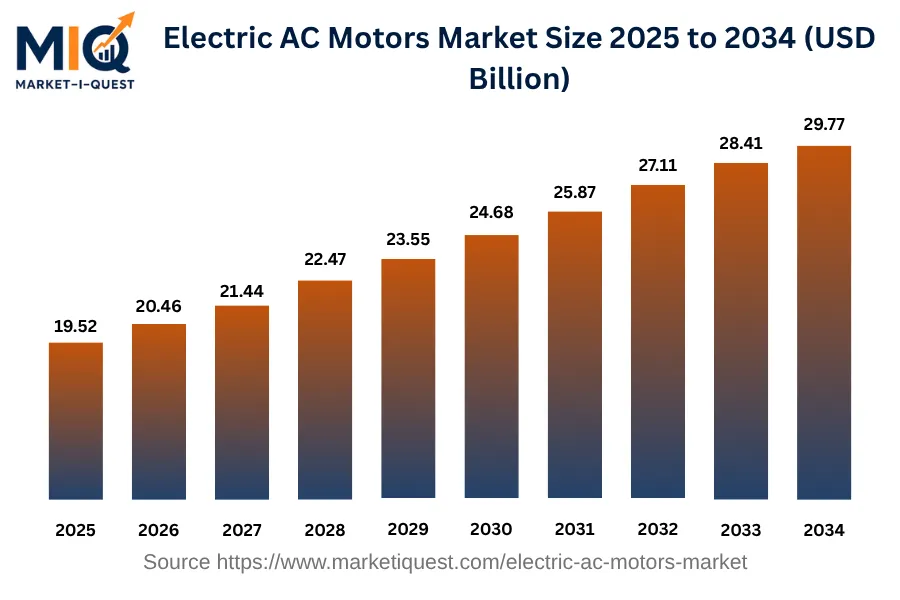
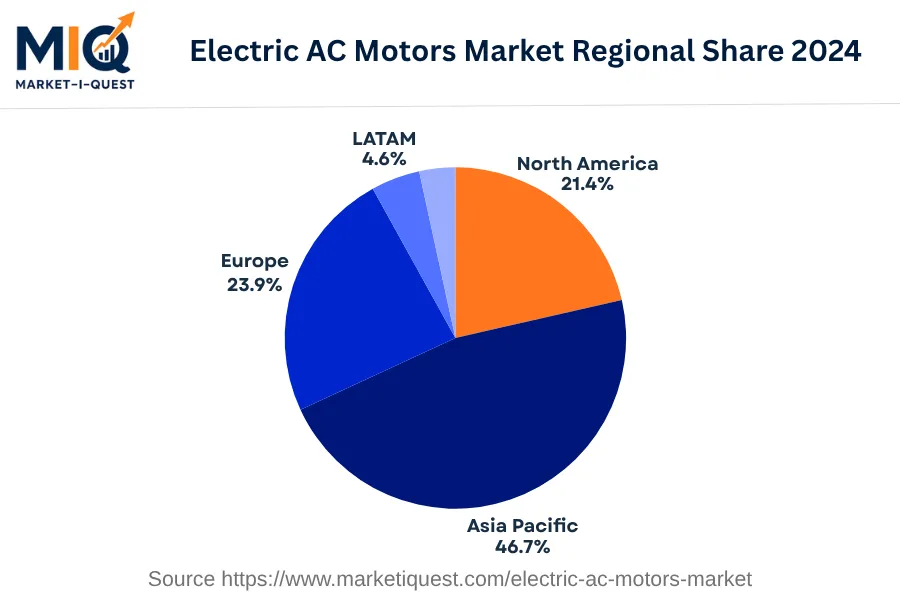
The Electric AC Motors Market, initially standing at 18.63 billion USD in 2024, is projected to grow to 19.52 billion USD by 2025 and eventually reach 29.77 billion USD by 2034, value at which it stands at end of projection period. This evolution of market size represents a Compound Annual Growth Rate (CAGR) of 4.8% over this course of time, indicating a steady increase in industry size over the assessed ten years. The growth in Electric AC Motors market can be attributed to demand increases in the regions. In 2024, regional market share was distributed as such: Asia Pacific had the largest share with 46.7%, followed by Europe with 23.86%, and North America with a substantial 21.43%. The remaining market shares of 4.63% and 3.41% were held by LATAM and MEA regions respectively.

Key Takeaways

  • By Motor Type - Induction Motors held a significant position in the Motor Type segment in 2025.
  • By Voltage - 1 to 6 kV subsegment led the market in 2025.
  • By Sales Channel - OEM accounted for a substantial share in 2025.
  • By Power Output - Integral Horsepower (Above 1HP) led the market in 2025.
  • By End Use - Commercial segment held the largest share of the segment in 2025.
electric-ac-motors-market market size

Key Driving Factors

Adoption of Energy-Efficient Electric AC Motors

Increasing efforts from industries to reduce carbon footprints and requirement of power for industrial purposes is a considerable driver for Electric AC Motors market. Many countries are introducing strict regulations, advising industries to use energy-efficient motors, owing to their capacity to lower energy consumption by 3-5%. This acts as an essential procurement trigger for businesses looking to comply with these regulations and to save costs in a longer run. Implementing energy-efficient motors is a direct way for industries to cut power consumption, therefore reducing their environmental impact. An added benefit is reduction in electricity and maintenance costs, as these motors have extended lifespans. Thus, the push towards energy efficiency and sustainability is significantly boosting Electric AC Motors market.
Electrification of Transportation Sector

Another leading driver for Electric AC Motors market is electrification of the transportation sector. This trend is being driven in part by climate change policies targeting CO2 emissions. Electric vehicles (EVs) for instance, require Electric AC Motors for functioning. Many governments worldwide are encouraging EV adoption through fiscal incentives and stringent emission norms, to reduce the health hazards and environmental pollution caused by gas-emitting vehicles. As use of EVs becomes widespread, demand for Electric AC Motors naturally increase. Therefore, shift towards environmentally friendly vehicles and subsequent demand for Electric AC Motors represents strong driving force for the market.

Market Evolution by Timeline

2019-2023
During 2019-2023, the well known e-commerce boom in the Asia Pacific region, specifically China and India, became a significant driver for Electric AC Motors Market. Low cost and high volume suppliers could manipulate larger sales volumes yielding small margin. In terms of technology, AC induction motors segment dominated thanks to cost-effectiveness in various applications, including electric vehicles. There were constraints, though, with issues related to power factor, efficiency, and torque. IOT in electric AC motors saw initial acceptance but lack of interoperability standards was a barrier. Pricing depended considerably on the requirements of the end industry, performance, and efficiency of the motor.
2024
In 2024, the demand was primarily driven by industries such as automotive, HVAC equipment, and household appliances. Oil and gas companies increased use of electric AC motors due to spotlight on operational efficiency. Germany, Japan, and United States led in advanced motor controls integration, despite complexity in adoption. Commercial models favored long-term contracts with focus on after-sales services and partnerships became crucial. Certain potential risks arose due to uncertainty in raw material prices and fluctuating exchange rates
2025-2029
Between 2025 and 2029, enhanced awareness of energy consumption and green initiatives was the major demand driver. United States and European countries regulated aggressive energy efficiency norms, directly influencing motor manufacturers. With adoption of IOT, electric AC motor supply chains were becoming smarter and more integrated. Technological evolution focused on reducing losses, increasing motor speed, and improving overall performance. As a result, buyers faced increased upfront costs but found value in long-term energy savings and carbon reduction. Price volatility of the raw materials posed challenges.
2030-2034
During 2030-2034, due to climate change efforts, there was a notable shift from fossil fuels to electricity for operations in industries and households. Recycling became a vital process due to regulations on rare earth elements in motors. Artificial Intelligence started being used to predict maintenance needs. Country-specific regulations on efficiency standards increased. Leasing contracts for motors were typical due to cost pressures in the buyer market. Risk management strategies for electric AC motors included sourcing strategies, maintaining strategic partnerships and hedging against price fluctuations to protect profitability

Future Market Outlook

Future Opportunities

The electric AC motors market is poised for substantial opportunities driven by rising adoption of automation across various sectors. The global manufacturing landscape is increasingly embracing Industry 4.0 principles, and electric motors are at the heart of automation and robotics applications. In 2022, International Federation of Robotics reported a surge in robot deployment in manufacturing, creating a burgeoning need for reliable and energy-efficient electric motors. Additionally, transition toward electrification in automotive sector continues to gain momentum, especially in regions like North America and Asia-Pacific, prompting automotive companies to invest in electric propulsion systems. Partnerships, like collaboration between Tesla and Siemens in 2023 for developing electric drive systems, further demonstrate how industries are aligning with electric motor technologies to foster innovation. Furthermore, rising emphasis on renewable energy solutions contributes to new applications for electric AC motors in wind, solar, and energy storage systems. Notably, U.S. Department of Energy's initiatives in promoting clean energy technologies create an environment ripe for development in electric motor applications. Considering these factors, manufacturers that align themselves with the ongoing trends in automation, electrification, and clean energy are likely to explore new market segments and solidify their presence globally in the electric AC motors market.

Segmentation Analysis

By Motor Type

The market is divided into subsegments including Induction Motors and Synchronous Motors, with Induction Motors accounting for the largest revenue share, while Synchronous Motors are expected to grow at a fast CAGR during the forecast period.

Largest Revenue Share

Induction Motors

Market Share Leader

In base year 2024, Induction motors dominate the revenue share due to their extensive use in various industries. A key factor contributing to their high market share is their wide range of applications spanning diverse sectors such as manufacturing, energy, automotive, and agriculture among others. Their demand is driven by superior features like simplicity, ruggedness, and cost-effectiveness. Furthermore, they require less maintenance and provide higher efficiency as compared to other motor types, adding to their appeal in the industrial sector. The widespread availability and ease of procuring induction motors in major geographies further add to its widespread adoption. Also, regulations favoring energy efficiency are driving companies to opt for these motors, reinforcing their market position. Owing to these drivers, the Induction Motors subsegment is commanding the largest revenue share in 2024.

Fastest CAGR

Synchronous Motors

Forecast Period Growth Leader

Despite the dominant market position of Induction Motors, Synchronous Motors are posed for the fastest CAGR growth during the forecast period. The primary growth driver is the increasing adoption of these motors in high-precision applications in industries such as robotics, power generation, and electric vehicles. Synchronous motors offer high efficiency and precise speed control, essential in these sectors. Advances in technology are reducing the initial high capital investment, further accelerating their adoption. Another significant catalyst for their growth is the growing momentum towards green and sustainable practices pushing industries to opt for these highly efficient motors. However, barriers such as high initial cost, complexity in operation, and the need for a separate DC source remain, which can slow down their rate of adoption. Regulatory initiatives promoting energy-efficient technologies in industrial equipment could serve as a catalyst for faster adoption.

By Voltage

The market is divided into subsegments including Up to 1kV, 1 to 6 kV, and Above 6 kV, of which the 1 to 6 kV segment accounted for the largest revenue share, while the Above 6 kV segment is expected to grow at the fastest CAGR during the forecast period.

Largest Revenue Share

1 to 6 kV

Market Share Leader

The 1 to 6 kV voltage subsegment holds the largest market share due to its widespread applicability in several end-use sectors such as residential, industrial, and commercial. This range of voltage is commonly used for powering medium-sized machinery and devices. Hence, the increasing number of small industries and rise in residential constructions have fuelled business growth. Moreover, the energy supplied at this voltage level is typically stable and reliable, which makes this subsegment particularly popular. Further, the convenience and safety provided by this voltage range as compared to higher voltages are reasons for its dominant revenue share. The segment's growth is also propelled by the rising need for energy-efficient sources and the global shift towards sustainable energy practices.

Fastest CAGR

Above 6 kV

Forecast Period Growth Leader

Despite presenting a smaller portion of the market currently, the Above 6 kV sector is poised to grow rapidly. This is driven by the expansion of heavy industries and large commercial complexes requiring higher voltage for their operations. Improved safety measures and advancements in technology are enabling safer handling of higher voltage levels, facilitating this growth. Additionally, policy initiatives promoting modernization of aging infrastructures and increased investment in grid expansion projects worldwide are further contributing to segment growth. However, the high initial capital investment and maintenance costs could be potential hindrances. Nevertheless, ongoing research and innovations aimed at cost reduction and improved efficiency suggest a positive future outlook for this segment.

By Sales Channel

The market is divided into subsegments including OEM and Aftermarket. In 2024, the OEM subsegment accounted for the largest revenue share while Aftermarket subsegment is expected to grow at the fastest CAGR during the forecast period.

Largest Revenue Share

OEM

Market Share Leader

The Original Equipment Manufacturer (OEM) segment emerged as the one with the largest revenue in the base year 2024. Predominantly, this can be ascribed to OEM's dominant position in specialised product manufacturing, where comprehensive technical know-how and substantial capital investment are necessary. These factors often deter new entrants, enabling OEMs to dictate market prices and maintain a substantial revenue share. Further, OEMs often maintain strategic relationships with large end-users through multi-year contracts, providing the demand-side stability that undergirds long-term revenue growth. Regulation also favors OEMs indirectly. High compliance requirements synergise with the OEMs' inherent strengths in vertical integration, large-scale operations, intellectual property stakes, and quality consistency. Moreover, geographical distribution plays a pivotal role. Developed markets with the stringent regulation and high purchasing power significantly contribute to the segmental revenue.

Fastest CAGR

Aftermarket

Forecast Period Growth Leader

Despite its current smaller revenue share, the Aftermarket subsegment is expected to register the fastest growth. Drivers for this growth can be traced to factors such as digital technology advancements, changes in regulatory policies, and strategic partnerships, which are gradually blurring the traditional boundaries between OEMs and independent Aftermarket players. Digitisation and IoT adoption in the market are catalysing the growth, making spare parts availability and order processing swift and cost-effective. Changing policies and increased customer awareness are leading to greater market transparency, enabling Aftermarket players to compete more effectively for end-users. Strategic partnerships with major OEMs can facilitate a dynamic balance of competitive and cooperative interaction, and the increased capex enables Aftermarket players to further scale and innovate, promising growth in the future. Yet, risks associated with unpredictable regulatory changes and the challenge of managing the complex supply chain suggest a cautious approach to this fast-growing segment.

By Power Output

The market is segmented by power output into two sub-segments: Fractional Horsepower (Up to 1HP) and Integral Horsepower (Above 1HP). In 2024, the Integral Horsepower subsegment accounted for the largest revenue share while the Fractional Horsepower subsegment is expected to grow at the fastest pace during the forecast period.

Largest Revenue Share

Integral Horsepower (Above 1HP)

Market Share Leader

The Integral Horsepower subsegment leads in revenue generation due to its wide-range applications in heavy industries, which require high power. This subsegment caters to engines, machinery and equipment used in industries such as manufacturing, construction, and transportation. As opposed to fractional horsepower (under 1HP) machines, their counterparts in this subsegment are capable of handling higher stress levels, operating continuously for longer hours, and providing maximum efficiency in large-scale operations. Possible customers for this subsegment are large-scale industrial manufacturers who require continuous operations, making these machines integral to their operations. This subsegment is served by a diverse and extensive supply chain system, which further reduces their operational costs and provides a competitive advantage. Factors such as durability, high power output, and efficiency are key criteria taken into consideration by purchases, leading to the dominance of this subsegment in the market.

Fastest CAGR

Fractional Horsepower (Up to 1HP)

Forecast Period Growth Leader

Despite generating less revenue than the Integral Horsepower sub-segment, the Fractional Horsepower sub-segment is expected to grow at a faster rate. The growth of this subsegment is driven primarily by increasing demand from small scale industries and residential consumers who require motors for less strenuous applications. In addition, advances in technology have led to the development of compact and energy-efficient motors that meet the power and size requirements of such consumers, further propelling growth. Regulatory initiatives to promote energy efficiency are also a factor contributing to its growth. However, this subsegment faces obstacles to higher adoption due to its limited power output and application scope. On the other hand, broader economic trends like urbanization and increased spending capacity of consumers have the potential to stimulate market growth.

By End Use

The market is divided into subsegments including Residential, Commercial, and Industrial. Of these, the Commercial sector accounted for the largest revenue share while the Industrial sector is expected to grow at the fastest CAGR during the forecast period.

Largest Revenue Share

Commercial

Market Share Leader

The commercial segment has shown the highest revenue generation in 2024, underpinned by several factors. Primarily, it is the scale of commercial operations that propels the revenue generation. Commercial entities often operate multiple facilities which necessitate substantial investments, contributing largely to the market revenue. Moreover, commercial entities typically have more financial capabilities to invest in advancements and improvements, thus putting them in the lead for revenue shares. They are also driven by regulatory compliance, rising energy costs, and sustainability initiatives and are more likely to invest in efficient practices to improve their operational efficiency and reduce costs. Additionally, geography plays a significant role in this segment's revenue generation, considering the concentration of commercial hubs in certain regions and cities. The focus of this segment on customer satisfaction and service quality leads them to invest more in their operations. Also, the lower switching costs and broad range of channels for purchase and distribution in the commercial market lead to its dominance in revenue generation.

Fastest CAGR

Industrial

Forecast Period Growth Leader

The industrial segment holds the promise of the fastest CAGR growth in the foreseeable future. Several factors contribute to this optimistic outlook. Technology is a major catalyst for growth, providing unprecedented opportunities for industries to streamline their operations, enhance efficiency, and lower costs. As industrial entities adopt more advanced technologies, the market sees accelerated growth. Additionally, governmental policies and initiatives aiming to stimulate industrial growth, couple with significant capital expenditures in advanced equipment and systems drive the growth of this market segment. Specific heavy industries are also supporting this rapid expansion. Yet, there are barriers too. The adoption of novel technologies often entails significant initial outlays, and unfamiliarity with advanced systems might deter some entities from investing. In the near-term, significant risks include volatile commodity prices, policy changes, and global economic uncertainties which could disrupt capital investments and thus delay implied growth.

Competitive Analysis

Key Market Players

Manufacturers / OEMs

ABB Ltd.
Switzerland
Siemens AG
Germany
Toshiba Corporation
Japan

Key Suppliers & Raw Materials

ArcelorMittal
Luxembourg
Nippon Steel Corporation
Japan
Alcoa Corporation
US

Distributors, Integrators & Channel Partners

Wolseley Industrial Group
US
RS Components
UK
Wajax
Canada

Porter’s Five Forces Analysis

This analysis reviews the competitive landscape of the Electric AC Motors Market.

Supplier Bargaining Power

Medium

Suppliers have moderate power due to the relative scarcity of high-quality materials and components.

Buyer Bargaining Power

High

Numerous suppliers and a broad product range increase buyers' bargaining powers.

Threat of Substitutes

Low

Substitute products are limited given the specific technical requirements of electric AC motors.

Threat of New Entrants

Medium

Entry is constrained by high capital requirements, but fostered by accelerating market growth.

Competitive Rivalry

High

The market is characterized by intense competition among established manufacturers.

Regional Analysis

Geographic market dynamics and growth opportunities across key regions

Global Market Outlook

electric-ac-motors-market market regional share

North America

In 2024, the North American Electric AC Motors Market experienced growth driven by a myriad of components. Increased implementation of automation practices in various sectors, including manufacturing, utilities, and healthcare, spurred demand. Government regulations emphasizing energy efficiency and sustainability encouraged shift towards AC motor adoption across U.S., Canada, and Mexico. Additionally, substantial investment in infrastructure development and refurbishment projects boosted the requirement for these motors.

The market was defined by significant trends aimed at customer satisfaction and energy conservation. Tech advancements, with an emphasis on IoT integration into AC motor systems, paved way for smart technologies within market space. Mergers and acquisitions also intensified, creating more robust and efficient solutions for end-user. With regards to channel dynamics, E Commerce continued to dominate as primary avenue for purchase due to the ongoing digitization.

AC motors were widely used in different sectors, with manufacturing sector leading the way, followed by utilities and healthcare. Along with these, Demand from retail sector increased, as businesses adopted more energy-efficient solutions. Meanwhile, government institutions prioritized AC motors for their infrastructure due to regulatory emphasis on energy conservation. Thus, the year 2024 marked a significant transition within Electric AC Motors Market in North America.

Asia Pacific

In 2024, the Electric AC Motors Market in Asia Pacific exhibited robust growth stimulated by several market dynamics. Governmental regulations, like China's Blue Sky Protection Plan, incentivized enterprises to invest in environment-friendly technology, consequently driving demand for electric AC motors. Similarly, India's automotive industry's phased adoption of electric vehicles significantly escalated motor requirements. Furthermore, Japan's technological advancements in high-efficiency induction motors reinforced supply dynamics.

There was a notable shift in buyer behavior, especially in key ASEAN markets like Thailand, where industrial sector started preferring energy-efficient and low-maintenance AC motors due to rising energy costs. Product evolution was evident in South Korea, with businesses increasingly using permanent magnet motors for their superior efficiency and control. In Australia, partnerships and M&A activities increased among vendors, primarily to expand their electric AC motors portfolios, as observed in the case of TECO Electric and Fasco.

Government sectors across China, India, and Japan were trendsetters as they increasingly incorporated electric AC motors in public utilities and transportation systems. In Australia, the retail and manufacturing industries exhibited a similar pattern, aligning their operations with environmental considerations, hence an increased deployment of these motors. Overall, the Electric AC Motors Market showed significant advancement across the Asia Pacific supported by demand factors, technological adoption, and favorable policies.

Europe

In 2024, Electric AC Motors market in Europe demonstrated a strong growth trajectory, driven by several key factors. Consumer demand for energy-efficient vehicles propelled automotive sector to invest in electric AC motor technology, with countries like Germany, UK, and France leading in electric vehicle manufacturing. Stricter regulations on carbon emissions by the European Union (EU) under its Green Deal policy fostered greater adoption of electric motors in industrial and commercial sectors. Meanwhile, advancements in AC motor design offered higher performance at lower costs, heightening their appeal in manufacturing, especially in Italy and Spain.

Behavioral shifts were also evident, with customers increasingly prioritizing sustainability and energy efficiency. Retailers in UK and the Nordics displayed pronounced trend of switching to electric-powered HVAC systems, resulting in an uptick in AC motor sales. Healthcare sector in Benelux and Central & Eastern Europe saw rise in demand for energy-efficient medical devices, benefitting from high torque and extended lifespan of electric AC motors. Moreover, an increasing number of partnerships and mergers within industry indicated strategic move towards consolidating resources and enhancing competitiveness in saturated market. For instance, collaboration between Siemens and Materialise to integrate 3D printing technology into traditional manufacturing further elevated the adoption of electric AC motors.

Latin America

In 2024, Electric AC Motors Market in Latin America (LATAM) witnessed notable growth due to several driving factors and trends. Drivers included technology adoption in Brazil and Mexico, with increased investment in industries like retail, manufacturing, and utilities, which led to high demand for energy-efficient AC motors. Moreover, favorable government regulations in Colombia and Peru promoted the use of electric AC motors, driving market expansion. Furthermore, competitive pricing dynamics, particularly in Argentina's manufacturing sector, positively affected market growth.

Trends in market were shaped by significant shift in buyer behavior across LATAM, prioritizing eco-friendly and low-maintenance products, heavily influencing AC motors industry. Technological advancements, particularly in Chile’s enterprise sector, led to development of highly efficient, compact AC motors, setting new market trend. Channel dynamics saw significant changes, with online sales platforms gaining popularity due to convenience and extensive options. Additionally, there were notable mergers and acquisitions within the industry, promoting market consolidation. Lastly, Enforcement of stringent energy-saving policies across LATAM reinforced market's emphasis on energy-efficient AC motors. Consequently, these drivers and trends shaped LATAM Electric AC Motors Market in 2024.

Middle East & Africa

In 2024, electric AC motors market in Middle East and Africa witnessed significant growth due to host of attributing factors. Increasing demand for energy-efficient solutions amplified adoption of electric AC motors, especially in sectors like oil and gas, utilities, and manufacturing. This was supported by governments' robust regulatory framework geared towards reducing greenhouse gas emissions. Furthermore, strong market growth was fueled by significant investment in technology adoption by countries like Saudi Arabia, United Arab Emirates, and Israel.

The market experienced several pivotal trends. A noticeable shift among consumers towards smart, energy-efficient appliances set a new direction for the industry. The implementation of digital technology and Internet of Things (IoT) in operational procedures became prevalent, particularly within emerging economies such as South Africa, Nigeria, and Kenya. Additionally, there were increased channel collaborations and instances of mergers and acquisitions among market players to enhance their product portfolio and strengthen distribution networks. This was most prominent in the UAE and Qatar. Lastly, stringent energy standards enforced by governments, particularly in Egypt and Israel, pushed for more eco-friendly products, thereby augmenting the electric AC motors market in the region.

Recent Industry Developments

Latest market innovations, product launches, and strategic initiatives

May 2026

ABB launched world's first magnet-free IE6 synchronous reluctance AC motor designed specifically for hazardous industrial environments. This is a critical development because it reduces energy losses by up to 60% while completely bypassing the volatile geopolitical supply chain for rare-earth magnets.

February 2026

Integrated Power Services (IPS) officially completed its acquisition of TechPro Power Group. This move drastically consolidated North American market for the maintenance, repair, and lifecycle management of high-voltage industrial AC motors, generators, and complex rotating machinery.

March 2025

Nidec Corporation officially announced a major expansion of its electric motor manufacturing facility in Mexico. The expansion was strategically executed to nearshore supply chains and aggressively increase regional production capacity for AC motors utilized in both industrial automation and automotive applications across North America.

Frequently Asked Questions