Drone Powered Business Solutions Market Snapshot

Key Players

  • DJI (China)
  • Parrot Drones (France)
  • 3D Robotics (United States)
  • Iris Automation (Canada)
  • SenseFly (Switzerland)
  • Aerovironment (United States)
  • Flirtey (Australia)
  • Microdrones (Germany)
  • Yuneec International (China)
  • Airobotics (Israel)

Market Size

Base Year 2024
$25.98 Bn
CAGR
27.65%
Forecast 2034
$298.43 Bn

Market Segments

By Technology
Fixed-Wing, Rotary-Wing (Multi-Rotor)
By Deployment Mode
Manual, Semi-Autonomous, Autonomous
By Application
Inspection and Monitoring, Delivery and Logistics, Mapping and Surveying, Precision Agriculture, Security and Surveillance
By End Use
Commercial, Government, Industrial

Market Dynamics

Drivers
  • Technological advancements in drone technology
  • Growing demand for quality data acquisition
Restraints
  • Regulatory compliance issues
  • Privacy invasion concerns
Opportunities
  • Emerging industry sectors
  • Technological advancements

Market Size

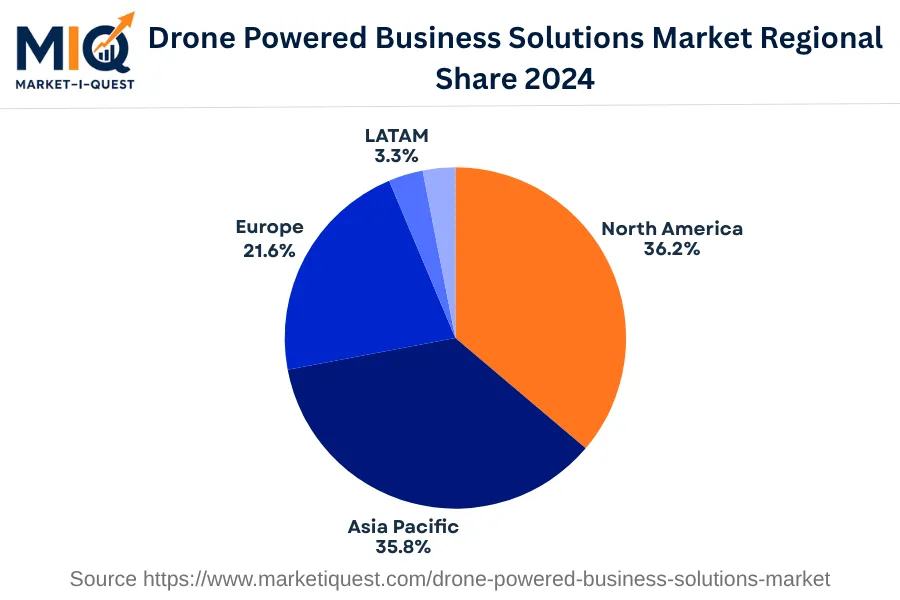
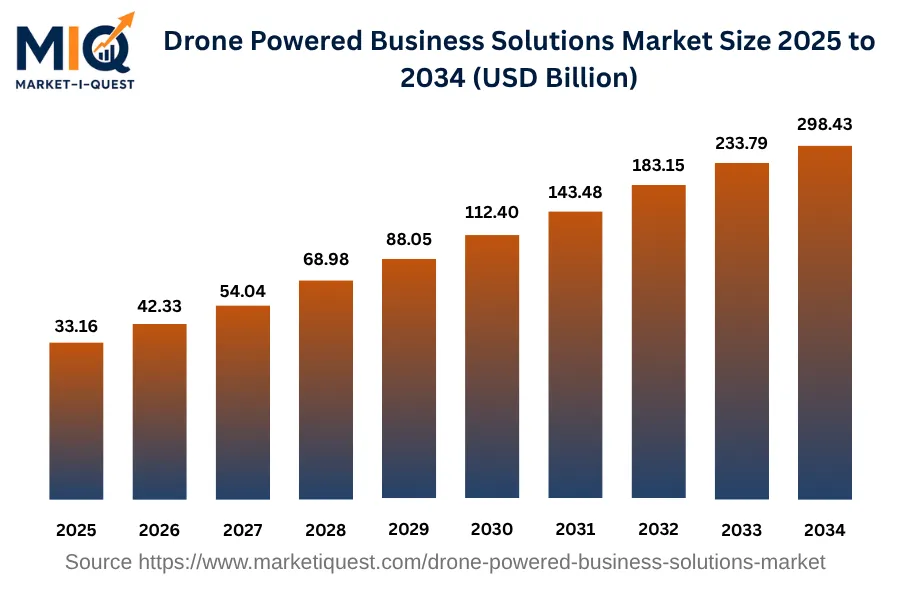
The Drone Powered Business Solutions Market was valued at USD 33.16 billion in 2025, and it is projected to reach USD 298.43 billion by 2034, indicating a CAGR of 27.65%. In 2024, the market size stood at USD 25.98 billion, making 2025 a notable year with significant growth that further drove market expansion till 2034. Regionally, in 2024, North America had the highest share, accounting for 36.2% of the market, followed by the Asia Pacific at 35.8%. Europe held 21.6% of the market share. Whereas Latin America and the Middle East and Africa (MEA) had a share of 3.3% and 3.1% respectively.

Key Takeaways

  • By Technology - Fixed-Wing led the Drone Powered Business Solutions Market.
  • By Deployment Mode - Semi-Autonomous held largest share of the market.
  • By Application - Security and Surveillance held the major share in manufacturing and construction sectors.
  • By End Use - Commercial accounted for the largest market share in quick-service delivery businesses.
drone-powered-business-solutions-market market size

Key Driving Factors

Adoption of Drones in Agriculture for Precision Farming

Agriculture has become a key sector driving the adoption of drone-powered business solutions. Heart of this trend is precision farming and this is turning trend towards it. Precision farming aims to enhance efficiency of agriculture using technology to observe, measure, and respond to diversity in crops. Drones, with their ability to capture high-resolution data and aerial imagery, have found a natural fit in this space. Farmers deploy them not only to monitor crop health and assess soil hydration but also to distribute fertilizers or pesticides. In doing so, they can pinpoint issues early, maximize crop yield, and drive substantial cost savings. This trend is best exemplified in technologically advanced farming regions like the US Midwest and Western Europe, where the value proposition of drones in farming is increasingly being recognized.

Integration of AI in Drone Technology for Industrial Inspections

Industries such as energy, utilities, and infrastructure have turned to the drone-powered solutions market because of one particular development: the integration of Artificial Intelligence (AI) in drones. Drones equipped with AI capabilities are able to conduct sophisticated data analytics to perform tasks such as equipment fault detection, structural inspections, or thermal heat mapping. This function is most prominently sought after in complex, hazardous, or hard-to-reach facilities like oil refineries, wind turbines, power lines, or bridges. The advantage of AI-assisted inspections lie mainly in the reduction of human risk, the promise of higher accuracy, and the speed of data collection. The combination of needs and capabilities have created significant momentum for the drone powered business solutions market within these industrial sectors.

Market Evolution by Timeline

2019-2023
During this period, the main buyer segments were infrastructure, agriculture, and transport. Use cases included data collection, surveillance, and delivery. High drone adoption levels were observed in North America, Europe, and Asia-Pacific. Drone technology powered by AI and robotics was in the early stages of integration. Major constraints included limited battery life and size restrictions of payloads. Strict FAA rules limited operations to daylight and within visual line of sight. Commercial models featured flat-rate pricing and pay-per-use contracts. Limited partnerships were noted with data analytics and telecom companies. The major risk was misuse of drones leading to privacy concerns, addressed by geofencing and similar tracking technologies.
2024
In This year growing adoption of drone solutions have observed specifically in emergency services and law enforcement dedicatedly for disaster response and surveillance. The growth was majorly in North America. Advancement in battery technology and payload capacities were developed, though mobility in Urban areas is still a challenge. Regulations allowed night-time operation of drones. Pricing models became more complex, including subscription and usage-based contracts. Partnerships with telecommunication providers for expanded coverage were more common.
2025-2029
In these years, primary drone users will be media and entertainment companies. With the purpose of filmmaking and event coverage. Fast expansion in South America and the Middle East will be observed. Drone swarms, combining multiple drones for collective tasks, will be piloted successfully. Flight beyond visual line of sight will be legal under several conditions. For real-time processing Partnerships will expanded to cloud-service providers.
2030-2034
Towards the end of this period, the primary buyer segments will included space exploration agencies, using drones for research and mapping. A rise in the adoption of drone solutions in Africa will be observed. Autonomous drone technology will be fully integrated. Size constraints on payloads will significantly eased. Space regulations will permit drone operation in controlled airspace. Pricing policies will aim to accommodate diverse use-cases through flexible contracts. Partnerships will include those with satellite communication companies. The risk of collision, particularly in space missions, was addressed by advanced autopilot systems.

Future Market Outlook

Future Opportunities

The increasingly favorable regulatory environment presents multiple opportunities for companies in the drone-powered business solutions market. In 2024, the implementation of the FAA's Remote ID requirements is expected to enable new business models, particularly in urban air mobility. This shift could lead companies such as EHang and Volocopter to expand their operations beyond initial pilot projects, focusing on passenger and cargo transport in cities like Los Angeles and Paris. Emerging markets also offer significant potential; in India, the Ministry of Civil Aviation issued a new drone policy in 2021, promoting the use of drones in agriculture and enabling startups to develop crop monitoring solutions. Engagement with industry bodies like the International Civil Aviation Organization (ICAO) is fostering global harmonization of drone regulations, which could ease international business expansion for drone companies. Moreover, partnerships between technology firms and traditional industries, such as the collaboration between DroneDeploy and agriculture companies, are manifesting in new software solutions that enhance data analysis and operational efficiency. In addition, the growing focus on sustainability is prompting companies to explore greener drone technologies, including solar-powered systems. This trend aligns with global climate goals and could lead to increased investment in environmentally friendly drone initiatives. Overall, these developments create a fertile landscape for businesses willing to capitalize on the interplay between technology, regulation, and market needs.

Segmentation Analysis

By Technology

The market is divided into subsegments including Fixed-Wing and Rotary-Wing (Multi-Rotor) technologies, with Fixed-Wing accounting for the largest revenue share while Rotary-Wing (Multi-Rotor) is forecasted to grow at the fastest CAGR during the period under review.

Largest Revenue Share

Fixed-Wing

Market Share Leader

The Fixed-Wing technology is currently leading the market in terms of revenue. Historically, Fixed-Wing aircraft have been the supporting piller of aviation. They offer advantages in speed, range, and efficiency, as compared to other forms of air travel. Commercial aviation, military, and private consumers are key consumers of Fixed-Wing technology, In terms of customer segmentation. Geographically, majority of revenues come from developed economies where aviation infrastructure is steadily developed. Governmental standards also played crucial role in maintaining the high revenue. The strict safety and performance regulations in aviation heavily encourage the use of heavily tested Fixed-Wing technology. additionally, purchasing criteria such as payload capacity, and range often favor Fixed-Wing designs.

Fastest CAGR

Rotary-Wing (Multi-Rotor)

Forecast Period Growth Leader

The Rotary-Wing (Multi-Rotor) technology is predicted to show the fastest CAGR during the forecast period. Key growth drivers for this subsegment include advancements in drone technology and increasing adoption of Vertical Take-off and Landing (VTOL) aircraft. Barriers to adoption, such as regulatory challenges and safety concerns, are beginning to decrease as technological progress addresses these issues. The technology's adaptability and suitability for a range of applications, from military use to cargo delivery and emergency response, further contributed to its growth. Favorable policy changes, capital investments in drone and VTOL technology, and strategic partnerships between tech firms and aviation companies contribute to reduce friction.

By Deployment Mode

The market is divided into subsegments including Manual, Semi-Autonomous, and Autonomous, with Semi-Autonomous accounting for the largest revenue share while Autonomous is expected to be the fastest-growing during the forecast period.

Largest Revenue Share

Semi-Autonomous

Market Share Leader

In 2024, Semi-Autonomous deployment mode accounted for the largest revenue share. This is due to the intermediate state of technologies and infrastructure required for complete autonomic operations. This is prompting many organisations to opt semi-autonomous systems. These systems reduce human error and gives high efficiency. Yet, they need human involvement, to providing a safety net against potential system failures that may challenge autonomous systems. From a geographical standpoint, developed markets - with more mature tech infrastructures and regulation - have been leading this adoption. Customer focus has been a key motivator. It has dense competitive landscape pushing organisations towards differentiation and optimization. Regulatory and supply-side factors, particularly increased investment in Artificial Intelligence and Machine Learning, have further triggered the trend towards semi-autonomous systems.

Fastest CAGR

Autonomous

Forecast Period Growth Leader

Autonomous systems shown the highest compound annual growth rate. Acceleration in technological advancements, policy implications, alliances, and capital expenditures are catalysts for this momentum. The increasing refining of Machine Learning algorithms and Artificial Intelligence capabilities offer huge potential to boost the autonomous segment. Additionally, advances in IoT connectivity support machine-to-machine interaction and data transfer in real-time, creating the infrastructure required for autonomous systems. Governments are also promoting autonomy with policies trend towards digital transformation. However, there are potential near-term risks like security concerns, technological failure and high switching costs that could limit its adoption. Nevertheless, the forward momentum and investments indicate a promising growth for the Autonomous segment.

By Application

The market is divided into subsegments including Inspection and Monitoring, Delivery and Logistics, Mapping and Surveying, Precision Agriculture, Security and Surveillance, with Security and Surveillance accounting for the largest revenue share while Precision Agriculture is expected to grow at the fastest CAGR during the forecast period.

Largest Revenue Share

Security and Surveillance

Market Share Leader

Revenue wise security and surveillance has emerged as the leading subsegment. This can be largely due to high demand for enhanced security measures in public as well as private sectors. With increasing cases of crime and terrorism, various organizations are investing in advanced surveillance technology to protect their assets and maintain safety. Additionally, authorities are implementing strict regulations, further driving the demand for advanced security systems. Surveillance systems are majorly finding their applications in various sectors such as banking, city surveillance, and transportation, among others. Switching cost is Another contributing factor to this segment's revenue. Once organizations invest heavily in a security and surveillance system, they are less chances to shift to another provider, to ensure continuous revenue flow. Furthermore, technological innovations leading to the integration of artificial intelligence and machine learning with security systems are enhancing their capabilities, thereby driving revenue growth.

Fastest CAGR

Precision Agriculture

Forecast Period Growth Leader

While Security and Surveillance accounts for the most significant revenue, Precision Agriculture is set to grow at an exceptional rate. Several growth drivers are playing a pivotal role in this trend. Technological advancements and the increasing adoption of IoT devices in agriculture are among the top drivers for this subsegment. Also, with the pressing need for optimum yield due to increasing global food demand, farmers and agricultural businesses are rapidly adopting precision agriculture technologies. Precision agriculture offers benefits like reduced costs and improved crop yields which makes it a favorable choice. Policies supporting smart farming, alongside significant capital investments in agri-tech companies, are further fueling growth. Possible barriers to adoption include a lack of technical knowledge among farmers and high initial investment costs. However, increased partnership between tech firms and farming communities aiming to overcome such challenges suggests a strong growth outlook for this subsegment.

By End Use

The market is divided into the subsegments Commercial, Government, and Industrial. In 2024, the Commercial sector accounted for the largest revenue share while the Industrial sector is projected to grow at the fastest CAGR during the forecast period.

Largest Revenue Share

Commercial

Market Share Leader

The commercial subsegment leads the market in terms of revenue generation. This dominance is basically due to the high demand for products and services in the commercial sector, linked with the significant financial budget these segments have. Geographically, regions with robust commercial sectors such as North America and Europe contribute significantly to this revenue. Strict regulatory standards across these regions further drive demand as businesses need to follow these guidelines, by increasing their spending. The decision-making criteria for purchasing are commonly based on quality, cost-effectiveness, and delivery speed. These things force businesses to constantly innovate and stay competitive. With robust distribution channels, businesses can reach extensive consumer bases, further driving the revenue. However, the high switching costs often lead to customer retention by stabilizing the revenue flow.

Fastest CAGR

Industrial

Forecast Period Growth Leader

The industrial subsegment is expected to record the fastest growth rates. This is driven by the rapidly changing technology and increasing automation. Furthermore, capital investment in innovative technologies is driving this growth. Collaboration with tech firms can offer a significant boost to this subsegment. However, a few barriers, including the high cost of implementation and resistance to change, are challenges to this fast-paced growth. There are near-term risks and uncertainties associated with policy changes and variable market conditions that might influence the rate of adoption. Yet, the Probability of improved efficiency and productivity in the industrial sector creates a promising outlook for growth. The potential for scalable solutions within the industrial sector is masive and is likely to contribute to the fastest CAGR throughout the subsegments.

Competitive Analysis

Key Market Players

Manufacturers / OEMs

DJI
China
3D Robotics
US
Parrot Drones
France

Key Suppliers & Raw Materials

Microchip Technology Inc.
US
Japan Radio Co.
Japan
Yuneec
China

Distributors, Integrators & Channel Partners

SkyBoss Drones
US
Dronenerds
US
Droneshop
Netherlands

Porter’s Five Forces Analysis

This analysis evaluates the intensity and profitability of the Drone Powered Business Solutions Market.

Supplier Bargaining Power

Medium

Suppliers possess moderate power due to existence of several component manufacturers.

Buyer Bargaining Power

High

Buyers maintain high bargaining power because of the availability of numerous drone solution providers.

Threat of Substitutes

Low

The threat of substitutes is low because drones offer distinct benefits over traditional methods.

Threat of New Entrants

Medium

Moderate barriers to entry include regulatory compliances and high technical expertise.

Competitive Rivalry

High

Intense competition exists among numerous established drone solution providers.

Regional Analysis

Geographic market dynamics and growth opportunities across key regions

Global Market Outlook

drone-powered-business-solutions-market market regional share

North America

In 2024, the drone-powered business solutions market in North America was Rigorously absorbed with the United States, Canada, and Mexico, significantly contributing to the sector. The market drivers included robust demand from government, utilities, and retail sectors. Advanced drone regulations in the United States, such as the Federal Aviation Regulation Part 107, drove the market by supporting commercial drone operations. Significant investments were directed into technology adoption to ensure a broad range of applications and services. Mexico’s thrust on adopting digital technologies for its manufacturing sector accelerated drone usage. Notable supply dynamics involved Canadian manufacturers focusing on producing environmentally-friendly drones.

Trends such as the United States' enhanced drone ATC systems showed a Noticeable shift in product technology. There were increased partnerships and M&A; a Relevant example being the collaboration between American security company, Aegis Systems, and Canadian drone manufacturer, increased. There was an amplification of retail businesses utilizing drones for delivery services. Standards like ASTM's F2910-14 in the US dictated safety requirements, ensuring uniform drone usage. Policy enforcements like Canada's Drone Management System boosted harmony and safety in drone operations. Sectors notably infiltrated by drone technology in 2024 comprised of healthcare, for remote medication deliveries, and utilities, for infrastructure monitoring in the United States, Canada, and Mexico.

Asia Pacific

In 2024, the drone powered business solutions market in the Asia Pacific region witnessed remarkable growth drove by several key drivers and trends. Regulatory support, such as China's policy encouraging drone usage in the agriculture sector, was a major driver, which increased market growth. Similarly, significant technological advancements and adoption in nations like Japan and South Korea drove market growth. Elevated investment levels were seen in India and Australia, reflecting market confidence.

Moreover, trends indicated increased buyer interest in drone utilization within sectors like retail, manufacturing, and utilities, extending beyond traditional early-adopter sectors like enterprise and government. Emerging technologies, like AI-integrated drones, saw significant uptake within these sectors. Key partnerships and mergers, such as those between leading drone manufacturers and service providers in ASEAN markets, expanded market size and scope. Standards saw notable evolvement, specifically in South Korea, aimed at safety, interoperability, and efficiency. Furthermore, policy enforcements demonstrated commitment for drone-powered solutions. For example, China enforced strict manufacturing guidelines that increased drone reliability, India developed comprehensive regulations advocating for controlled airspace use, and Australia prioritized rules regarding drone operation safety. These drivers and trends underscore a Vibrant and evolving drone powered business solutions market in the Asia Pacific region for 2024.

Europe

In 2024, the European drone-powered business solutions market witnessed a surge. Drivers included increased demand for efficient and cost-effective solutions in industries like retail, manufacturing, and utilities. Governmental regulations, such as the European Union’s regulations on drone usage, facilitated safe and widespread adoption of these technologies. Investment in drone technology grew significantly, notably in the UK, Germany, and France, reflecting a trend toward automation and digitalization in business operations. Technology adoption was further accelerated by improved supply dynamics, with Italy and Spain becoming major drone manufacturers, and competitive pricing.

Consumer behavior trends indicated a preference for drone-enabled services, particularly in the retail and healthcare sectors, the former because of faster delivery times, the latter for remote patient care. In technology, there was a shift towards AI-powered drones providing smarter business solutions. Channel dynamics evolved, with online platforms becoming key avenues for marketing and selling drones. Partnerships and M&A were widespread, particularly in the Nordics and Benelux regions, as firms aimed to Combine their positions. In terms of standards and policy enforcement, there was a rose emphasis on safety and privacy across all sectors, reflected in measures like the UK’s Drone Bill and Germany’s Air Traffic Act amendments. Overall, the drone-powered business solutions market in 2024 was dynamic and growing across Europe.

Latin America

In 2024, drone-powered business solutions in Latin America (LATAM) proved to be transformative across several industries, specifically in Brazil, Mexico, Argentina, Colombia, Chile, and Peru. Drivers for this included regulatory ease by government entities intent on boosting local tech ecosystems—like Brazil's INMETRO—, increasing direct foreign investment (especially from North America), and stronger regional adoption of digital transformation practices across the enterprise sector, including the utilities, manufacturing, and retail sectors. One invaluable factor was the deployment of cost-effective solutions in surveillance and logistics.

Buyer behavior shifted towards more efficient, drone-based alternatives, especially in the e-commerce logistics sectors in Mexico and Chile, where companies like Mercado Libre led the way. Partnerships formed between drone technology suppliers and enterprise customers, such as the case between Argentina's Globant and drone manufacturers, that enabled crucial tech migration. In addition, regional standardization of drone operation guidelines, similar to the ones implemented by the Colombian Aviation Authority, were pivotal in driving safe and regulated usage. Finally, the use of drone technology became more pronounced in areas Applicable to public safety and health, especially in Peru, where drones were employed for quicker responses in emergency situations.

Middle East & Africa

In 2024, the Drone Powered Business Solutions Market in the Middle East and Africa has witnessed significant growth. Drivers of this growth included increased demand for efficient data collection and management in sectors such as oil and gas, utilities, telecom, and retail. Saudi Arabia and UAE's regulatory support for drone operations, coupled with extensive investments into drone technology from Israel, have further propelled the market. A rising trend of technology adoption in Nigeria, Kenya, and South Africa, demonstrated by the accelerated use of drones in healthcare and manufacturing, has also significantly impacted supply dynamics.

Major trends spotted in 2024 encompassed a shift in buyer behavior, with businesses in Egypt and Qatar prioritizing drone solutions for surveying, inspection, and delivery services. Increased partnerships and M&As were observed, particularly in Saudi Arabia and UAE, supported by policy enforcements that favored drone-based solutions. The financial services sector, predominantly in Nigeria and South Africa, started utilizing drones for improved surveillance and risk management. Furthermore, the growing drone adoption was observed in the retail sector, notably in Israel, for efficient inventory management and delivery operations. Thus, these drivers and trends underpinned the adoption and growth of the Drone Powered Business Solutions Market in the Middle East and Africa in 2024.

Recent Industry Developments

Latest market innovations, product launches, and strategic initiatives

June 2026

ZenaTech signed an offer to acquire an Alberta-based land surveying and geomatics company, marking its first Canadian acquisition and first focused on drone-based oil and gas industry services — a sector growing at over 28% annually.

April 2025

Lloyds Engineering expanded its strategic drone partnership with FlyFocus through an MoU for First Person View (FPV) systems, strengthening India's capability spectrum from long-range surveillance to rapid-response tactical operations.

Frequently Asked Questions