Drone Detection Market Snapshot

Key Players

  • Dedrone GmbH (Germany)
  • DJi (China)
  • DroneShield (Australia)
  • Thales Group (France)
  • Fortem Technologies (United States)
  • Robin Radar Systems (Netherlands)
  • Airbus (Germany)
  • SRC Inc. (United States)
  • CerbAir (France)
  • DETECT INC. (United States)

Market Size

Base Year 2024
$0.958 Bn
CAGR
28.75%
Forecast 2034
$11.99 Bn

Market Segments

By Technology
Radar Systems, RF Detection, Optical Systems, Acoustic Systems, Others
By Range
Short Range (Up to 1 km), Medium Range (1 km to 5 km), Long Range (Above 5 km)
By Platform
Ground-Based, Handheld
By End Use
Military & Defense, Commercial, Government, Others

Market Dynamics

Drivers
  • Increased security threat
  • Technological advancements
Restraints
  • High installation costs
  • Strict governmental regulations
Opportunities
  • Rising security concerns
  • Technological advancements in detection systems

Market Size

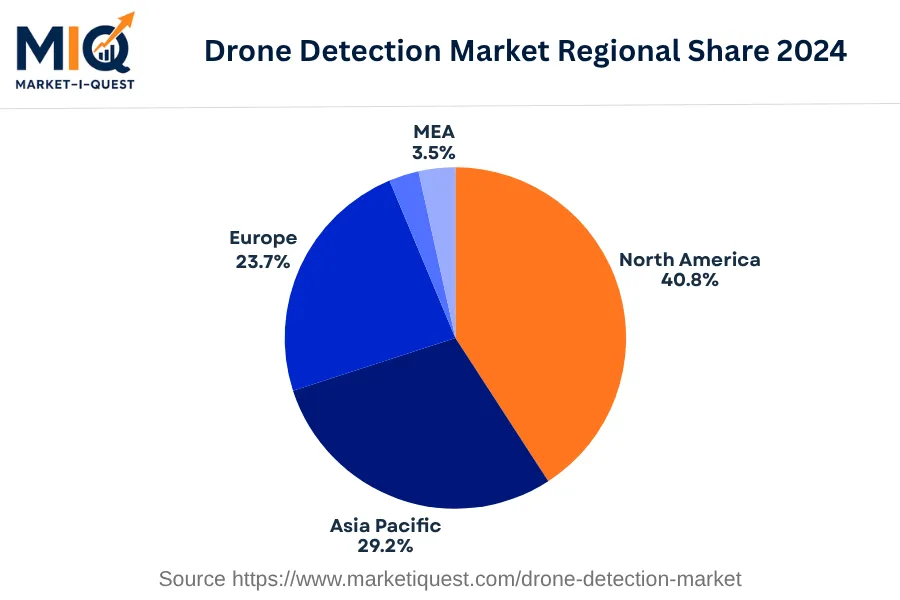
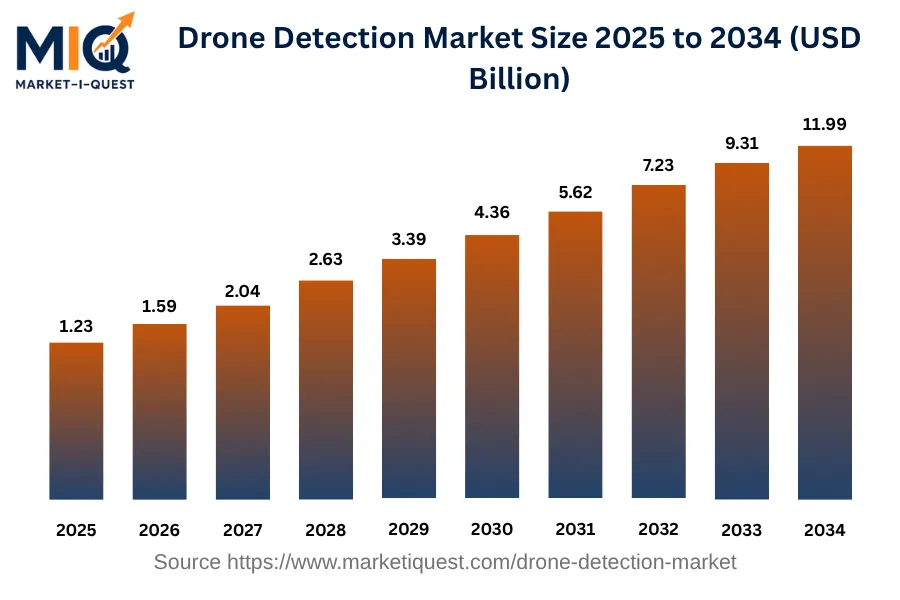
The Drone Detection Market was valued at $1.23 billion in 2025 and is projected to grow to $11.99 billion by 2034, at a CAGR of 28.75%. The market demonstrated solid growth, starting from $0.96 billion in 2024 and exceeding the billion-dollar mark by the next year. The subsequent decade will see an almost tenfold increase, underpinned by consistent year-on-year growth. This fairly strong expansion is driven by a steadily rising demand for drone detection technology, resulting from advancements in drone capabilities and heightened security concerns. As of 2024, the regional distribution of the market share was as follows: North America held the largest share with 40.84%, followed by the Asia Pacific at 29.17% and Europe at 23.68%. The rest was split between the LATAM region at 2.84%, and the MEA region with the smallest share at 3.47%.

Key Takeaways

  • By Technology - Radar Systems held the leading position within the Drone Detection Market.
  • By Range segment - Medium Range (1 km to 5 km) expanded as Largest in recent years.
  • By Platform - Ground-Based systems led the market due to widespread usage in military and commercial sectors.
  • By End Use - Commercial accounted for the significant market segment share in the Drone Detection Market.
drone-detection-market market size

Key Driving Factors

Escalating Security Concerns at Critical Infrastructure

There's a rising trend of using drones for nefarious purposes including the unauthorized surveillance of sensitive sites, contraband delivery, and in some instances, attacks. This has notably raised security concerns, especially for critical infrastructures like airports, power plants, and government facilities. These infrastructures are now increasingly incorporating drone detection systems into their security protocols to prevent potential threats. The need to ensure uninterrupted operation and safeguard these sites from any form of drone-induced disturbances is currently driving the demand for advanced drone detection systems, hence influencing market growth in the near term.

Stringent Regulatory Laws and Policies

Governments worldwide are tightening regulations regarding drone use to protect public safety, privacy, and national security. In the U.S., for instance, the Federal Aviation Administration's (FAA) rules require drone pilots to operate their drones within visible line sight, prohibit operation over people or moving vehicles, and limit operating altitude. As these regulations get more stringent, enforcement agencies, private corporations, and individuals increasingly seek drone detection solutions to help enforce compliance and prevent potential violations. This regulatory pressure is a direct driver of growth in the drone detection market.

Market Evolution by Timeline

2019-2023
In the period from 2019 to 2023, government and military organizations were the primary buyers in the drone detection market, mainly due to the increasing usage of drones for surveillance and delivery purposes. Asia-Pacific was the dominant region, particularly due to extensive adoption in China. The available technology mostly comprised radar and radio frequency-based drone detection units. However, their integration with other surveillance tools was not fully mature, resulting in occasional false positives. Noteworthy regulations during this time included FAA's Remote Identification Rule, which mandated drone owners in the US to broadcast identification codes. Pricing was most often on a per-unit basis, occasionally paired with service contracts for installation and maintenance. Lack of standardization posed a significant risk, leading to interoperability issues between different manufacturers.
2024
In 2024, commercial entities started to significantly contribute to the drone detection market as the use of drones in delivery services expanded. Regions including Europe and North America saw an increase in demand. This year also saw the emergence of AI-based drone detection systems, providing better accuracy and integration abilities with existing infrastructure. This, however, called for more robust data privacy regulations. Firms started to offer subscription-based pricing models alongside traditional contracts, making it more affordable for smaller companies. Cybersecurity formed a concern as technologies became more advanced, creating a novel demand for security-oriented software solutions.
2025-2029
Between 2025 and 2029, the drone detection market continued to expand, with growing demand from infrastructure facilities like airports and power plants. Latin America emerged to be a promising region due to increased drone activities. Developments in AI integration with drone detection units were apparent, allowing more efficient and effective surveillance. However, this led to more stringent regulations in data handling and protection. The commercial model moved increasingly towards service contracts with regular updates to keep pace with fast-evolving drone technologies. Cyber threats continued to be significant risks, corroborated by an uptick in cyber insurance for drone detection systems.
2030-2034
In the time span of 2030–2034, businesses in logistics and delivery services became a major purchaser for drone detection systems as drone delivery became more commonplace. Africa was the most rapidly emerging market, reflecting increased economic activity in the region. The drone detection technology during this period became highly integrated with other surveillance systems, providing comprehensive security solutions. The focus of legal framework was on ensuring that drone detection did not infringe on individuals' privacy rights. Pricing moved towards 'as-a-service' models. The primary risk remained to be potential cyber attacks on advanced drone detection systems, prompting continued attention to cybersecurity.

Future Market Outlook

Future Opportunities

As government regulations tighten around drone operations, new opportunities for the drone detection market are expected to emerge. The ongoing discussions led by the U.N. International Civil Aviation Organization (ICAO) regarding global drone regulation frameworks suggest that higher compliance will become mandatory over the upcoming years. This regulatory shift is likely to increase demand for comprehensive drone detection systems, especially in sensitive areas such as airports and critical infrastructure. Companies like Leonardo and Northrop Grumman are well-positioned to leverage this opportunity through collaboration with governmental agencies to create tailored solutions. Additionally, the introduction of new capabilities such as remote identification, mandated by the FAA for certain drone operations starting in 2023, indicates a shift towards sophisticated monitoring systems capable of real-time compliance checks. Regions like Asia-Pacific, which have seen a rise in drone deliveries, particularly in countries such as Japan, will likely see a parallel increase in demand for detection capabilities. Major events such as the 2024 Summer Olympics in Paris may also act as catalysts for enhanced security measures, prompting cities to invest in advanced drone detection technologies. Consequently, various stakeholders, including local governments and private enterprises, are expected to actively seek partnerships with technology providers to ensure robust measures are in place. Such collaborations will likely pave the way for innovation and strengthened market positions.

Segmentation Analysis

By Technology

The market is divided into subsegments including Radar Systems, RF Detection, Optical Systems, Acoustic Systems, and Others. Radar Systems accounted for the largest revenue share while Optical Systems is expected to grow at the fastest CAGR during the forecast period.

Largest Revenue Share

Radar Systems

Market Share Leader

Radar Systems currently lead in revenue share within the technology sector. This leading position can be attributed to its comprehensive application across various areas such as military defense, weather monitoring, airspace control, and even in the ocean vessels for navigation purposes. These wide-ranging applications of radar systems can primarily be credited for the sector's positive performance. High procurement budgets allocated to defense sectors in countries like the USA and China are favoring the radar system's market. Also, regular technological advancements are being made to ensure the radar systems are adapting to the evolving demands and threats, driving regular purchases and replacements. Another key driver is the increasing use of radars in weather monitoring and prediction due to increasing climate risks. Despite the dominant market share, switching costs are high due to the evolving nature of threats and complexity of systems involved, leading to a more-or-less steady market share. Under the assumption of status quo in terms of political and climatic threats, radar systems are expected to maintain their dominant share.

Fastest CAGR

Optical Systems

Forecast Period Growth Leader

Optical Systems, despite not being the segment with the largest revenue, hold the highest promise in terms of growth rate. This can be attributed to the increasing use of these systems in various sectors like healthcare diagnostics, surveillance, and communications. Optical systems' capacity to carry a significantly higher payload of data and their immunity to radio frequency interference makes them particularly attractive in areas requiring large-scale data transmission. However, high costs of optical fiber installation and need for technical expertise in handling optical systems can serve as adoption barriers. Strategic partnerships and joint venture initiatives can potentially offset these challenges by streamlining the production process and closing the gap between demand and supply. Also, heavier emphasis on R&D coupled with government policies favoring the transition towards digital economy can further fuel growth in this segment. Nevertheless, potential risks like economic slowdown and political instability must be kept in view as they can adversely affect growth projections.

By Range

The market is divided into subsegments including Short Range (Up to 1 km), Medium Range (1 km to 5 km), and Long Range (Above 5 km). Of these, Medium Range accounted for the largest revenue share, while the Short Range is expected to grow at the fastest CAGR during the forecast period.

Largest Revenue Share

Medium Range (1 km to 5 km)

Market Share Leader

Medium Range technologies hold the lion’s share in the market, primarily due to the balance they strike between performance and cost. With the ability to cover distances from 1 kilometer to 5 kilometers, they provide adequate range for many practical applications without the increased expenses often associated with Long Range technologies. The necessity for longer ranges is typically found in specific, niche markets, and so the demand for Medium Range technologies is more widespread in comparison. From logistics operations to residential applications, Medium Range technology supports a broad spectrum of needs. Its popularity is further bolstered by regulatory frameworks which largely accommodate this range, unlike the more strict limitations for Long Range operations in certain geographies. The steady supply, favorable purchasing criteria, and established channels ensure this segment's robust revenue generation.

Fastest CAGR

Short Range (Up to 1 km)

Forecast Period Growth Leader

The Short Range subsegment, covering up to 1 kilometer, is set for the fastest growth. As the market matures, the focus is increasingly shifting towards efficiency, and Short Range technologies offer the maximum efficiency for specific applications. While Short Range devices may have faced adoption barriers earlier due to their limited reach, improvements in tech have increased their utility. With lower initial capex and accelerated returns, it appeals to budget-conscious end users. Furthermore, partnerships between tech providers and consumer-centric businesses are acting as catalysts for Short Range growth. However, risks remain in the form of potential regulatory changes and supply chain disruptions. The subsegment will benefit from strategies promoting tech advancements, optimized supply chain management, and proactive regulatory navigations.

By Platform

The market segmentation consists of Ground-Based and Handheld platforms. In 2024, the Ground-Based sector commanded the largest revenue share, whereas the Handheld segment is anticipated to exhibit the fastest growth in the forthcoming years.

Largest Revenue Share

Ground-Based

Market Share Leader

The Ground-Based platform commands the highest revenue share in the market due to several factors. Its leading position can be attributed to its ability to offer wider coverage and higher durability compared to handheld platforms. For essential applications that require better reliability and protection, ground-based solutions remain the preferred choice. Organizations are increasingly deploying ground-based systems as they require less maintenance and are more resistant to elements. The significant investment in the military and defense sector also contributes largely to the high revenue of this segment. The stringent regulation in certain geographies also favors ground-based systems providing a steady demand. Customers often choose to purchase these systems based on their well-established nature and prefer them due to their familiarity and prevalence in the market. Lastly, the established distribution channels of ground-based platform have cemented their foothold in the market, thus contributing to larger revenue numbers.

Fastest CAGR

Handheld

Forecast Period Growth Leader

On the other hand, the Handheld platform subsegment is forecasted to register the most rapid growth. The primary driver for this growth is the increasing adoption of handheld devices due to their portability and convenience. Technological advancements have significantly improved the reliability and performance of these devices, thus providing a significant boost to their demand. Furthermore, policies promoting the use of efficient and compact technology could significantly speed up their adoption. Despite the favorable outlook, there are substantial risks to consider. The dependency on capital expenditure and partnerships for technology development may slow the rate of adoption. Extremely high switching costs present another critical barrier, particularly for established users of ground-based solutions. Nevertheless, as handheld technology continues to evolve, it is expected that these barriers will lower, paving the way for higher growth rates in the future.

By End Use

The market is divided into subsegments, including Military & Defense, Commercial, Government, and Others. In this diverse market, the Commercial subsegment accounted for the largest revenue share, while the Military & Defense sector is expected to grow at the fastest CAGR during the forecast period.

Largest Revenue Share

Commercial

Market Share Leader

The Commercial subsegment holds the largest share of revenue in the market. This prominence is primarily attributable to the vast number of commercial entities that utilize these services and products consistently. Several factors drive the strong purchasing activity, including geographical dispersion of operations, regulatory compliance requirements, and evolving global operational landscapes. In addition, the regular need for technology upgrades in the commercial sector leads to a continuous stream of purchases to keep up with advances and maintain efficient operations. These purchases often carry significant scale, increasing the revenue for suppliers. Leveraging digital channels for sales also allows providers to broaden their customer base beyond traditional geographic boundaries, increasing their sales volume. The purchasing criteria include reliability, cost-effectiveness, and scalability, all of which are highly valued among commercial customers. Thus, these providers who cater to these needs while maintaining attractiveness in pricing hold the largest revenue share in the market.

Fastest CAGR

Military & Defense

Forecast Period Growth Leader

The Military & Defense subsegment is predicted to witness the fastest growth in CAGR over the forecast period. This growth can largely be attributed to the increasing threats of cyber-warfare and the growing need for advanced defense technology. The provoked urgency for improving national security has led to subsequent increases in capital expenditure within the sector. Furthermore, partnerships with innovative tech companies add momentum to this rapid growth as they help expedite the integration of advanced technologies into defense systems. However, the adoption of new technologies in this segment can be impeded due to stringent regulations, creating barriers that must be navigated delicately to ensure compliance. Moreover, the high costs associated with developing and implementing these technologies present near-term risks, potentially slowing down their rate of adoption. But as governments continue to prioritize national security, the strong growth trend in the Military & Defense segment is expected to endure.

Competitive Analysis

Key Market Players

Manufacturers / OEMs

Dedrone GmbH
Germany
DroneShield Ltd
Australia
Infiniti Systems
UK

Key Suppliers & Raw Materials

Lockheed Martin Corporation
US
Northrop Grumman Corporation
US
Thales Group
France

Distributors, Integrators & Channel Partners

AARTOS
Germany
Cerberus Black
UK
Fortem Technologies
US

Porter’s Five Forces Analysis

This analysis assesses the competitiveness and strategic situation in the Drone Detection Market.

Supplier Bargaining Power

Low

Owing to the abundance of hardware and software suppliers, their bargaining power is low.

Buyer Bargaining Power

Medium

Given the increasing importance of drone security, customers have moderate bargaining power.

Threat of Substitutes

Low

The complexity and technological sophistication of drone detection systems limit the threat of substitutes.

Threat of New Entrants

Medium

While initial R&D costs are high, growing market demand reduces barriers to entry.

Competitive Rivalry

High

With a surge in demand for drone detection systems, competition among existing players is intense.

Regional Analysis

Geographic market dynamics and growth opportunities across key regions

Global Market Outlook

drone-detection-market market regional share

North America

In 2024, North America's drone detection market was shaped by a confluence of technological advancements, regulatory parameters, and evolving security concerns. Driving the market was the continuous demand from government sectors and commercial enterprises to enhance their anti-drone capabilities, responding to increasing drone-related threats. The Federal Aviation Administration's enforcement of regulations on drone flights in the U.S. further stimulated investments in advanced drone detection infrastructure. Innovations in AI and machine learning technologies were adopted by market players, Western Advance, Radarcs, and Dedrone, offering superior detection of UAV threats. Additionally, pricing competition in Canada and Mexico spurred suppliers to optimize their cost and production efficiency.

Trends in the drone detection market revolved around shifting buyer behaviors and technological changes. Commercial entities, healthcare facilities, and utility plants displayed a growing inclination towards integrated drone detection solutions. Advances in radar and RF technology were embraced, replacing traditional camera-based systems. Channel Fragmentation saw firms creating partnerships to streamline distribution: Lockheed Martin and DeTect in the U.S. exemplify this. Market consolidations were also evident, as seen in DroneShield's acquisition of Droneshield. Lastly, stricter policy enforcement around drone operations created a unavoidable importance for drone detection systems across sectors. Overall, the domains of regulatory compliance, advancing tech adoption, and emerging security concerns prevailed as the key determinants of North America's drone detection market in 2024.

Asia Pacific

In 2024, the drone detection market witnessed amplified growth across the Asia Pacific, with particularly strong traction in China, India, Japan, South Korea, and key ASEAN markets. Key drivers propelling this growth include heightened security concerns, stringent regulations, and deep-pocketed government investment in drone detection technology. Rising instances of unauthorized drone activities triggered increased demand particularly in public safety and defense sectors in China and India. Moreover, progressive adoption of advanced technology by government bodies in Japan and Korea resulted in key supply dynamics.

Pertinent market trends were observed in the base year, such as evolving buyer behavior with a leaning toward integrated drone detection systems and prominent tech shifts toward AI-powered solutions. Increased partnerships and M&A activities were seen in Australia and ASEAN markets, given the attempt to consolidate market position and expanding capabilities. Strict policy enforcement, particularly in China, underpinned the updated standards in the domain. The major sectors seen driving the demand were largely spread across the government, defense, public safety, and utilities segments. For example, smart city initiatives in Singapore and Korea significantly boosted demand for sophisticated drone detection systems. Furthermore, the retail sector in India and manufacturing sectors in China and Japan added momentum to the consumption of drone detection technology.

Europe

In 2024, the European drone detection market experienced significant expansion due to increased security concerns and regulatory response. Security fears surrounding the unauthorized use of drones in sensitive areas, particularly airports and government facilities, prompted amplified demand. In addition, regulatory bodies across the region implemented stricter drone-related laws, driving the need for more drone detection systems to ensure compliance. Investment in anti-drone technology markedly grew, particularly within Germany and the United Kingdom where drone activity was notably high. Growing technology adoption in the enterprise sector accelerated market growth. Businesses increasingly utilized drone detection systems, especially within manufacturing and retail industries, to safeguard proprietary information and secure premises. Government entities also contributed substantially to demand, incorporating drone detection in security protocols for public safety.

Simultaneously, buyer behavior evolved with heightened awareness of drone-related risks altering the market dynamic. The emergence of innovative technology like AI and machine learning in drone detection systems became notable. Moreover, notable partnerships, such as the collaboration between the Italian aerospace company Leonardo and drone detection company DDrone Detection, bolstered market expansion. The market also witnessed stricter policy enforcement, as seen in France where a law mandating drone identification systems came into effect, stimulating further market growth. Overall, the European drone detection market in 2024 underwent significant expansion attributed to increased demand, investment, and technological adoption.

Latin America

In the base year 2024, the Drone Detection Market in Latin America underwent significant adjustments driven by technological adoption, regulatory changes, and growing security concerns. Key drivers included increasing instances of drone misuse resulting in privacy abridgement in major LATAM countries like Brazil and Mexico, escalating demand for drone detection mechanisms. Additionally, governmental investment in drone security boosted the market, with countries like Argentina, Colombia, and Chile allotting budget for acquiring advanced drone detection solutions.

On trend analysis, most enterprises, particularly in the sectors of utilities, manufacturing, and retail, showed a shift towards investing in drone detection technologies to safeguard their operational territories. This displays an inclination towards enhanced security measures. The use of Artificial Intelligence in drone detection also gained momentum in countries like Peru. Similarly, partnerships and merger activities were prevalent, such as key drone detection technology providers collaborating with local security firms for better market penetration. Meanwhile, LATAM nations showed a vigilance in enforcing drone regulations and standards, significantly influencing the drone detection market. The key customer base, in the year of review, encompassed governments and enterprise sector with a particular stress from utilities, manufacturing, and retail, adopting these technologies as a critical element of their security infrastructure. Increased regulatory scrutiny has successfully shaped the drone detection market dynamics in LATAM in 2024.

Middle East & Africa

In 2024, the Drone Detection Market in the Middle East and Africa revealed substantial growth dynamics. Regulatory developments, heightened security needs, and technological advancement drove this growth. Nations like Saudi Arabia and the UAE adopted stringent regulations against unauthorized drone activity, sparking higher demand for drone detection systems. Additionally, escalating terrorist activities in regions like Nigeria and Kenya made drone interception techniques stand out as crucial for maintaining security. Furthermore, Israel's renowned tech sector, eager to adapt to new technologies, seizes drone detection and provided leading-edge solutions to the market.

Several trends emerged with buyers showing preference for advanced systems that integrated AI and machine learning capabilities, like those seen in Egypt and Qatar's robust telecommunications sectors. The oil and gas industries, particularly in Saudi Arabia and the UAE, sought partnerships with drone detection firms to protect their valuable infrastructures. Middle Eastern countries displayed increased enforcement of drone-related policies, leading to greater dependency on reliable drone detection systems. In Africa, nations like South Africa and Kenya featured the drone detection technology usage in sectors like healthcare and retail, showcasing a shift towards broader applicability of the technology. The 2024 market demonstrated a remarkable blend of regulatory, technological, and sector-specific factors collectively sculpting the drone detection landscape.

Recent Industry Developments

Latest market innovations, product launches, and strategic initiatives

July 2026

The Joint Interagency Task Force 401 (JIATF-401) awarded an Indefinite Delivery/Indefinite Quantity contract with a $500 million ceiling to increase counter-UAS capabilities for warfighters and security personnel.

March 2026

The United States and the United Kingdom issued a joint declaration establishing common C-UAS data standards, marking a foundational step toward streamlining counter-UAS acquisition and interoperability between allied nations.

Frequently Asked Questions