Drone Data Services Market Snapshot

Key Players

  • PrecisionHawk (United States)
  • DroneDeploy (United States)
  • Cyberhawk Innovations (United Kingdom)
  • Equinor (Norway)
  • Airobotics (Israel)
  • Delair (France)
  • Terra Drone (Japan)
  • Sharper Shape Inc. (Finland)
  • Sky-Futures (United Kingdom)
  • Skycatch (United States)

Market Size

Base Year 2024
$12.95 Bn
CAGR
31.58%
Forecast 2034
$201.45 Bn

Market Segments

By Service Type
  • Mapping & Surveying
  • Photogrammetry
  • 3D Modeling & Digital Elevation Model (DEM)
  • Others
By Platform
  • Cloud-Based
  • Operator Software
By End Use
  • Real Estate & Construction
  • Agriculture
  • Mining
  • Oil & Gas
  • Renewables
  • Others

Market Dynamics

Drivers
  • Increased drone technology adoption
  • High-demand in surveillance services
Restraints
  • Strict regulatory frameworks
  • High initial investment costs
Opportunities
  • Expanding commercial usage
  • Untapped sectors in emerging economies

Market Size

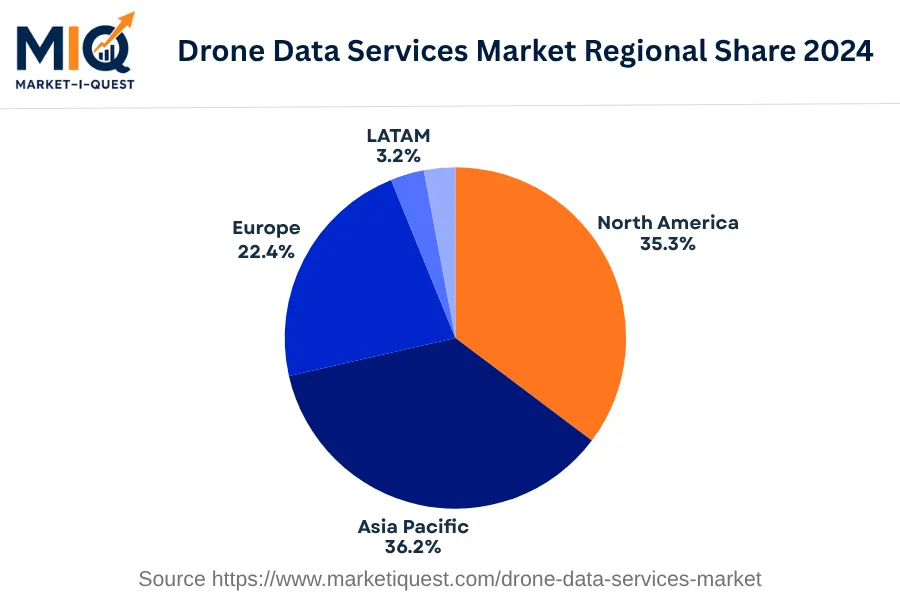
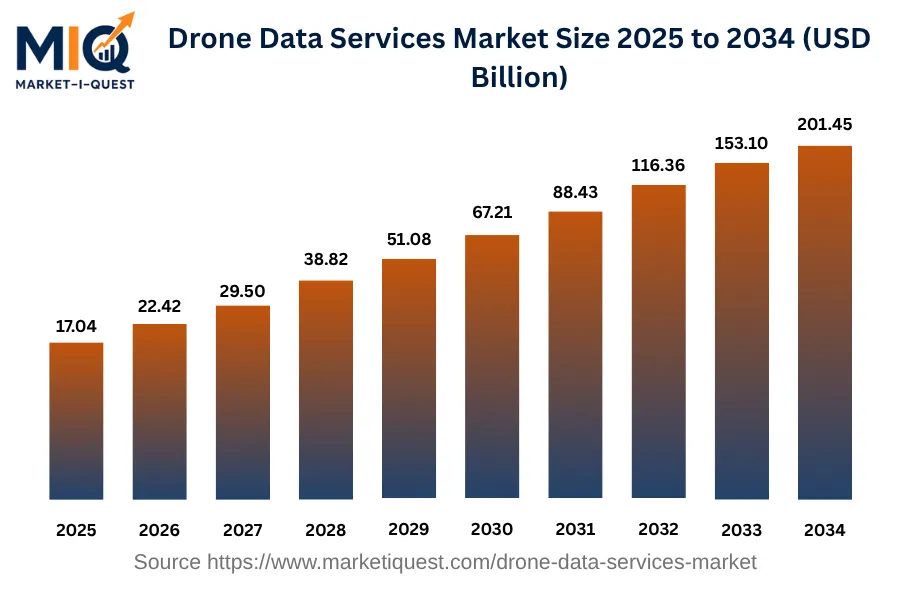
The Drone Data Services Market was valued at $17.04 billion in 2025, up from $12.95 billion in 2024. By 2034, the market size is expected to reach $201.45 billion, marking a Compound Annual Growth Rate (CAGR) of 31.6% over the period from 2025 to 2034. The rapid escalation in the market worth over these years is largely due to the progressive increase in the implementation and utilization of these services across various industries. Furthermore, the augmented demand for process optimization and automation has served as a driving factor in the expansion of the Drone Data Services Market. In terms of regional market share in 2024, the Asia Pacific region held the largest share at 36.2%, closely followed by North America at 35.3%. On the other hand, Europe accounted for 22.4% while Latin America (LATAM) and the Middle East and Africa (MEA) held a smaller share of the market, with 3.2% and 3.0% respectively.

Key Takeaways

  • By Service Type - Photogrammetry led in terms of use holding the majority market share in recent years.
  • By Platform category - Operator Software held the top position in the Drone Data Services Market as preferred delivery method.
  • By End Use - Oil & Gas emerged as the main segment utilizing drone data services accounting for significant market share.
drone-data-services-market market size

Key Driving Factors

Increased usage of drones in disaster management

The use of drones in disaster management has seen significant escalation recently. This rapid adoption is due to the unique abilities of drones to collect data in real-time from otherwise inaccessible or dangerous locations, proving highly valuable in both planning and execution of relief efforts. For instance, aerial images captured by drones can assist in assessing the level of damage, identifying victims, and tracking relief progression. Furthermore, regulations globally are becoming increasingly in favour of drone use in emergency situations; providing an impetus for the growth of the drone data services market. Initiatives by government and non-government organisations in using drones for disaster management contributes significantly towards this trend.

Adoption of precision agriculture techniques

The agriculture industry is progressively adopting precision agriculture techniques worldwide. This approach involves the use of technology to enhance crop health and yield, thereby improving overall farm productivity. Here, drones play a pivotal role by capturing clear, accurate, and detailed data about the condition of the crops and the soil. Drones equipped with sensors can gather information such as crop health, soil moisture, and pest infestations. Farmers around the globe are investing heavily in this technology to optimise their farming practices. This has led to a surge in the demand for drone data services, giving a boost to the market.

Market Evolution by Timeline

2019-2023
Early adopters of drone data services in this period include agriculture, insurance, construction, and oil & gas industries. North America grabs the largest market share, business preference from FAA regulations to integration. Maturity of aerial data collection technology notable, shipment of drones surged. Notable constraints include drone flight range and limited payload capacity. Regulatory bodies like FAA introduced more flexible rules, allowed drone use in commercial applications. Pricewise, subscription-based model was dominantly adopted, partnerships were formed with drone manufacturers for integrated solutions. Risks include airspace safety challenges, and the accuracy of data collected by drones.
2024
In 2024, rising compliance demands fueled government sectors becoming major buyers. Especially in Europe, public safety and traffic management agencies showed significant demand. Drone hardware improvements lead to extended flight duration and larger payload capacity. Strict data privacy rules were implemented in the EU shaping industry dynamics. Majority of providers opted for business model changes from subscription to per-usage based pricing. Cybersecurity threats to drone data increased, providers invested in encryption and secure cloud storage for data protection.
2025-2029
This period witnessed the rising demand from retail and ecommerce, aided by urban air mobility initiatives in cities like Amsterdam, Dubai, and Singapore. Commercial drones with advanced machine learning capabilities shipped in larger quantities. Drone traffic management systems became integral part of infrastructures in busy airspaces. Governments pushed for higher standards and regulations for commercial use. Rather than just partnering with drone manufacturers, service providers started in-house drone development for better integration. Concerns arose around the environmental impact of widescale drone use leading to the adoption of sustainable materials and battery pilot projects.
2030-2034
In these years, the healthcare sector emerged as a significant buyer for delivery of medical supplies in rural and remote areas. With advanced AI capabilities, drones could autonomously gather meaningful data. Regulatory environment promoted international drone standards and traffic management. Pricing models evolved to include value-based components, considering specific outcomes rather than mere usage. Environmental sustainability became a crucial risk, as the drone population exploded. Regulations enforced greener manufacturing practices, extended battery life, and waste management for end-of-life drones.

Future Market Outlook

Future Opportunities

The ongoing evolution of regulations by authorities like the FAA and the European Union Aviation Safety Agency (EASA) creates pathways for innovation within the drone data services sector. For example, the expected rollout of Beyond Visual Line of Sight (BVLOS) operations in the United States signifies a critical shift for industries requiring large-scale aerial data services. Companies such as Zipline, which successfully delivered medical supplies in Rwanda using BVLOS operations, are likely to inspire similar innovations in logistics globally. The growing focus on sustainability presents additional opportunities, as firms explore how drones can reduce their carbon footprint compared to traditional delivery methods. Participation in public-private partnerships, such as the FAA’s BEYOND program, currently encourages stakeholders like government entities and technology firms to collaborate on advanced applications. Moreover, the international standardization efforts through organizations such as the International Civil Aviation Organization (ICAO) aim to promote uniform operational frameworks that could reinforce trust and adoption in various markets. Therefore, as these organizations finalize and implement new guidelines, companies involved in drone data services could benefit from streamlined operational practices and enhance their service offerings. The anticipated integration of drones with emerging technologies, such as autonomous vehicles and IoT applications, will further expand the potential use cases and market penetration for drone data services across multiple industries.

Segmentation Analysis

By Service Type

The market is divided into subsegments including Mapping & Surveying, Photogrammetry, 3D Modeling & Digital Elevation Model (DEM), and Others. Photogrammetry accounted for the largest revenue share while 3D Modeling & Digital Elevation Model (DEM) is expected to grow at the fastest CAGR during the forecast period.

Largest Revenue Share

Photogrammetry

Market Share Leader

Photogrammetry stands out as the subsegment with the highest revenue due to several factors. Firstly, it's a versatile process used extensively in fields including architecture, engineering, geology, archaeology, and meteorology. The rise in construction and infrastructure projects across the globe has generated a high demand for detailed and accurate 3D models of terrains and buildings, which photogrammetry can provide effectively. Furthermore, advancements in drone technology have made aerial photogrammetry more accessible and efficient, leading to savings in cost and time for projects. Second, the need for geospatial data from various industries, like agriculture, forestry, and environmental management, has propelled the use of photogrammetry, adding to its dominance in revenue generation. Lastly, regulations favoring the mapping and surveying technologies also contribute positively to its market acceptance.

Fastest CAGR

3D Modeling & Digital Elevation Model (DEM)

Forecast Period Growth Leader

Despite not being the current leader in revenue, 3D Modeling & Digital Elevation Model (DEM) presents a high growth potential. This is primarily driven by advancements in technology and the growing use of these technologies in a wide array of applications. The high-detailed 3D models created in this process are a necessity in design-based industries like gaming, animation, and virtual reality. Further, applications extending to urban planning, Disaster Management, and military and defense strategies highlight the rising requirement. Additionally, forecasting and managing natural resources in sectors like oil, gas, and mining have recognized the potential of DEM, thereby, boosting its growth. On the flip side, the adoption of this segment may face challenges such as higher costs and technical skills prerequisite. However, progressing computer capabilities and software development may mitigate these barriers. It is important to note that our analysis assumes a continuing trend of technological uptake and demand for higher spatial resolution data.

By Platform

The market is divided into subsegments including Cloud-Based and Operator Software. In 2024, Operator Software accounted for the largest revenue share while Cloud-Based is expected to grow at the fastest CAGR during the forecast period.

Largest Revenue Share

Operator Software

Market Share Leader

Operator Software has gained the largest share in revenue due to its adoption in various business operations. It manages critical business applications which are needed to run an enterprise smoothly resulting in high demand. This segment witnessed significant adoption in 2024 and is characterized by businesses shifting their focus towards operational efficiency and data-driven business insights. Major drivers include need for the integration of complex and disordered insights across various departments, demands for streamlining operations, and requirement for an efficient method for storing and managing voluminous data. The proliferation of operator software in developing regions, particularly in industries such as retail, manufacturing, and healthcare, also contributed a major portion of its market revenue. Adoption of these applications is rapidly increasing with businesses realizing the importance of resource management.

Fastest CAGR

Cloud-Based

Forecast Period Growth Leader

The fastest growing segment is the Cloud-Based subsegment, which has a promising CAGR for the forthcoming years. As companies continue to migrate towards digital platforms, there is a notable increase in the requirement of cloud-based solutions. The increase in workforce mobility, need for real-time upgrades and maintenance, and cost-effectiveness are the key growth-drivers for this subsegment. Additionally, the ease of implementation, scalability, and flexible pricing structures have propelled its growth. However, the upcoming challenges to this market include data security concerns, bandwidth sensitivity, and the reliance on internet connectivity. Despite these potential barriers, strategic partnerships, government policies supporting digitization and increasing technology advancements are expected to promote rapid growth in this segment.

By End Use

The market is split into different sectors namely Real Estate & Construction, Agriculture, Mining, Oil & Gas, Renewables, and Others. The Oil & Gas sector accounted for the largest revenue share, whereas the Renewables sector is predicted to grow at the fastest CAGR during the forecast period.

Largest Revenue Share

Oil & Gas

Market Share Leader

The Oil & Gas sector has traditionally been a dominant contributor to the market's total revenue. The sector’s operation necessitates a vast range of high-tech equipments and services, increasing its revenue significantly. Several international oil conglomerates have increased their E&P projects, and middle eastern and American regions have seen significant developments, contributing to an uptick in revenues. The sector’s contribution can also be attributed to the fact that the demand for oil & gas has surged globally due to their primary role as energy supplies that drive the operations of most forms of transport, and manufacturing and production industries. As industrialization and urbanization have expanded in developing countries, the demand for petroleum products has surged. Regulatory policies, however, could temper this sector’s growth in the future as global climate change concerns intensify.

Fastest CAGR

Renewables

Forecast Period Growth Leader

The Renewables sector is set to show the fastest CAGR due to the growing global commitment toward reducing carbon emissions and the transition to a green economy. Technological advancements, such as modern, more efficient wind turbines and solar panels, make renewable source installations more budget-friendly, aiding in sector expansion. Governments’ incentives and supportive regulatory frameworks including feed-in tariffs and auctions are acting as a catalyst for the renewables sector growth. Furthermore, the decreasing cost of renewables technology and the rising investment in R&D will likely facilitate the sector's rapid growth. Potential risks include failures in technological innovation, unpredictable weather patterns affecting energy output, and legislative changes that decrease renewable energy funding. However, the growing consciousness about climate change and organizations' sustainable goals strengthen the position for renewables among the end-use segments.

Competitive Analysis

Key Market Players

Manufacturers / OEMs

PrecisionHawk
US
DroneDeploy
US
Airware
US

Key Suppliers & Raw Materials

SZ DJI Technology Co., Ltd
China
Intel Corporation
US
Parrot Drones
France

Distributors, Integrators & Channel Partners

AgEagle Aerial Systems Inc.
US
Sky Futures
UK
Delair
France

Porter’s Five Forces Analysis

This analysis summarizes the key forces operating in the Drone Data Services Market.

Supplier Bargaining Power

Medium

Suppliers' power is moderate due to the presence of several droning technology and software providers.

Buyer Bargaining Power

High

Buyers' power is high because of the increasing demand and multiple options in drone data service providers.

Threat of Substitutes

Low

Threat of substitutes is low due to the unique technology and efficiency of drone services.

Threat of New Entrants

Medium

The market has medium entry barriers due to required tech expertise and regulatory compliance requirements.

Competitive Rivalry

High

Rivalry is high due to the presence of several large and small players competing on cost and service offerings.

Regional Analysis

Geographic market dynamics and growth opportunities across key regions

Global Market Outlook

drone-data-services-market market regional share

North America

In 2024, the North American drone data services market experienced significant advancement due to various driving factors and emerging trends. Key drivers included increased government investment in drone technology, particularly in the U.S. and Canada, driving innovation and supply. With the FAA's progressive drone regulations and Canada's Beyond Visual Line of Sight (BVLOS) scheme facilitating unmanned aircraft operations, demand grew significantly. Furthermore, technology adoption rates hit new highs in the enterprise and utility sectors, with drones proving invaluable for businesses requiring efficient data collection methods in areas such as infrastructure monitoring and maintenance.

Market trends indicated a shift in buyer behavior, with an increased emphasis on partnerships and mergers. Notably, tech giants like Microsoft deepened collaborations with drone manufacturers, integrating drone-captured data into their cloud-based data analysis platforms. The enforcement of data privacy policies also emerged as a pivotal trend, with stringent standards set by governments across North America. Companies in sectors such as healthcare and retail showed a marked interest in drone data services to optimize their operations, while manufacturing embraced drones for increased operational efficiency. Overall, the North American drone data services market in 2024 was characterized by increased investment, progressive regulations, and targeted sector usage, underpinned by strategic partnerships and policy enforcement.

Asia Pacific

The Drone Data Services Market experienced substantial growth in Asia Pacific in 2024 with China, India, Japan, Australia, South Korea, and key ASEAN countries developing as dynamic market participants. Influence from a tech-savvy population, government support for drone technology, and investments into digital infrastructure boosted the market. China's regulations on drone registration and usage coupled with India's Digital India initiative paved the way for a tech-friendly environment. Technology adoption was high with South Korea's venture into drone taxi services and Australia’s use of drones for surveillance and delivery services.

Buyer trends leaned towards tech-innovation as a paramount factor with a preference for drones capable of sophisticated data services. Shifts in technology favoured autonomous and AI-integrated drones, which characterized product advancements in 2024. Partnerships such as between Japan's Terra Drone and India’s Skylark Drones enhanced the marketability and reach of these services. Drone services largely served sectors like manufacturing, enterprise, retail and government in tasks such as data collection, surveillance, and delivery for which the precise control and data accuracy of drones offered unmatched utility. The 2024 market scenario reflects a burgeoning drone data services sector fostered by technological adoption, regulatory frameworks, and emerging partnerships in the Asia Pacific region.

Europe

In 2024, the European drone data services market turned out to be an active space, accelerated by technologically advanced countries including Germany, the UK, France, and others. Enhanced regulatory frameworks endorsing the utilization of drones for commercial purposes have acted as a chief market driver. Notably, implementation of the European Union's U-space initiative, seeking to integrate drone traffic in the region's airspace, has echoed positively across the drone market. Furthermore, elevated investment in drone technology by multinational corporations and governments, coupled with the rapid adoption in sectors, like utilities, manufacturing, and retail, have spurred market growth.

Primary trends encompass shifts in buyer behavior, inclined towards adopting drone technology for data collection and monitoring, thereby reducing manual labor and enhancing efficiency. Technological advancements, particularly AI integration for data analysis, have established a new norm in drone usage. Additionally, the rise in partnerships and joint ventures to enhance product offerings has shaped the market structure. For instance, the collaboration between German firm Droneii and multinational telecom provider Vodafone to integrate Internet of Things solutions represents a significant milestone. It's worth noting that policy enforcement towards ensuring drone safety, further sustained by the U-space regulation, has been defining for the industry. Despite challenges pertaining to privacy and data security, the European drone data services market in 2024 showcased a dynamic, growth-oriented trajectory.

Latin America

In 2024, the Drone Data Services Market in Latin America underwent substantial growth, leveraging the region's increasing technological capabilities. Drivers included regulatory changes permitting wider drone usage, like Brazil's ANAC rules that allowed broader commercial drone applications. Increased investment in drone technologies, primarily in Mexico and Argentina, poised drones as efficient data collection tools. Technological adoption flourished, notably in Peru and Chile, where drones were integrated into mining operations for real-time data assessment, boosting productivity.

Underscoring these drivers, critical trends emerged in response to market dynamics. Industry-customer relationships altered, with an uptick in enterprise customers seeking tailored drone data services across sectors such as agriculture, construction, and utilities. Advances in autonomous flight and data processing tech prompted shifts in market offerings, with service providers in Colombia launching sophisticated solutions suiting different clientele needs. Amid rampant growth, significant partnerships and mergers occurred, exemplifying the effort to consolidate market presence. Enforcement of Global UTM (Unmanned Traffic Management) standards became more prevalent in LATAM, ensuring safe and efficient drone operations. Retail sector, mainly in Mexico, began utilizing drone data for logistics purposes, revealing an evolving operational paradigm within the industry. This 2024 Latin American Drone Data Services landscape was shaped significantly by regulatory, investment and technological drivers, alongside shifts in customer behavior, technological advances, and policy enforcement.

Middle East & Africa

In 2024, the Drone Data Services Market has gained noticeable traction in the Middle East and Africa due to increasingly sophisticated technology and growing sectors’ needs. The demand is driven by regulations such as Saudi Arabia's General Authority for Civil Aviation drone regulations, which enabled drone applications across different sectors. Investment and technology adoption has accelerated, especially in the United Arab Emirates, significantly enhancing supply dynamics. Lowering prices have led to increased use in utility sectors, including oil and gas and telecom.

A significant trend is the discernible shift in buyer behavior, particularly in Egypt and South Africa, resulting in a high acceptance rate of drone technology across multiple sectors. Machine-learning advancements have made drones more efficient and viable for different applications. Strategic partnerships, seen notably in Nigeria and Kenya, have led to consorted growth and expanded market reach. The Israeli drone data services market has seen strict policy enforcement ensuring secure and regulated drone usage. Key sectors utilizing these services prominently are government, utilities, telecom, and oil & gas sectors. For instance, the Saudi government has employed drone technology for security and surveillance purposes while the South African telecom sector utilizes drones for infrastructure maintenance. In the manufacturing sector, particularly in Qatar and the UAE, drones have become indispensable for logistical operations.

Recent Industry Developments

Latest market innovations, product launches, and strategic initiatives

June 2026

ZenaTech signed an offer to acquire a Western Canadian geospatial and land surveying company, expanding its DaaS presence into utilities, forestry, agriculture, and government sectors. The company had completed 23 acquisitions toward its goal of 25 by mid‑2026.

December 2025

ZenaTech signed an offer to acquire a long‑established surveying and spatial services firm in Queensland, Australia, marking its first entry into the Asia‑Pacific region.

Frequently Asked Questions