Disposable Syringes Market Snapshot

Key Players

  • Becton Dickinson and Company (US)
  • Medtronic (Ireland)
  • Smiths Group (United Kingdom)
  • Terumo Corporation (Japan)
  • Nipro Corporation (Japan)
  • Hindustan Syringes (India)
  • Retractable Technologies (US)
  • Braun Melsungen AG (Germany)
  • Cardinal Health (US)
  • Andersen Caledonia (United Kingdom)

Market Size

Base Year 2024
$19.85 Bn
CAGR
6.95%
Forecast 2034
$38.87 Bn

Market Segments

By Type
  • Conventional Syringes
  • Safety Syringes
By Application
  • Vaccines and Immunizations
  • Anaphylaxis
  • Rheumatoid Arthritis
  • Diabetes
  • Autoimmune Diseases
  • Oncology
  • Others
By End Use
  • Hospitals
  • Diagnostic Laboratories
  • Blood Banks
  • Pharmaceutical Industry
  • Veterinary Purposes
  • Others

Market Dynamics

Drivers
  • Rising healthcare awareness
  • Increased prevalence of diseases
Restraints
  • Intense competitive pricing
  • Environmental disposal concerns
Opportunities
  • Rising healthcare demand
  • Innovation in product design

Market Size

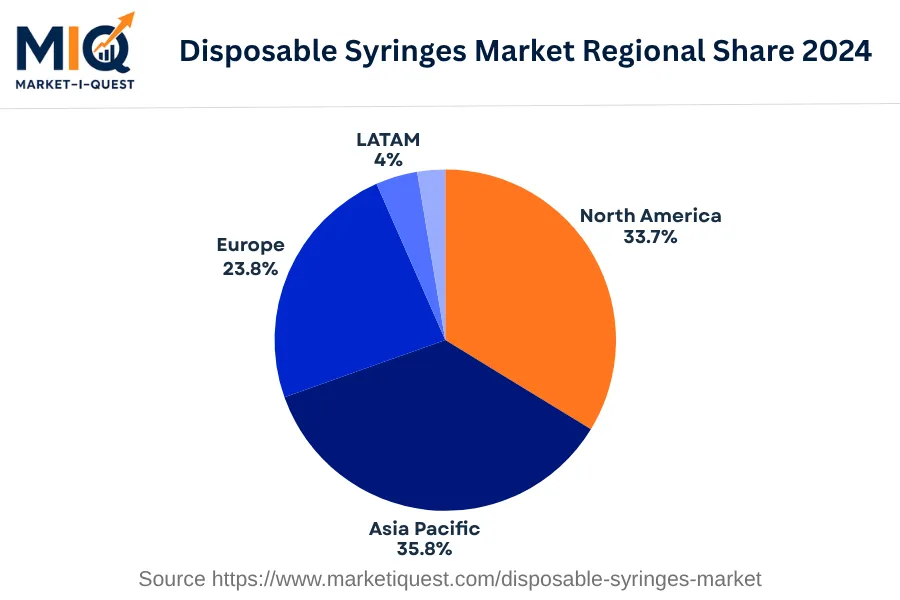
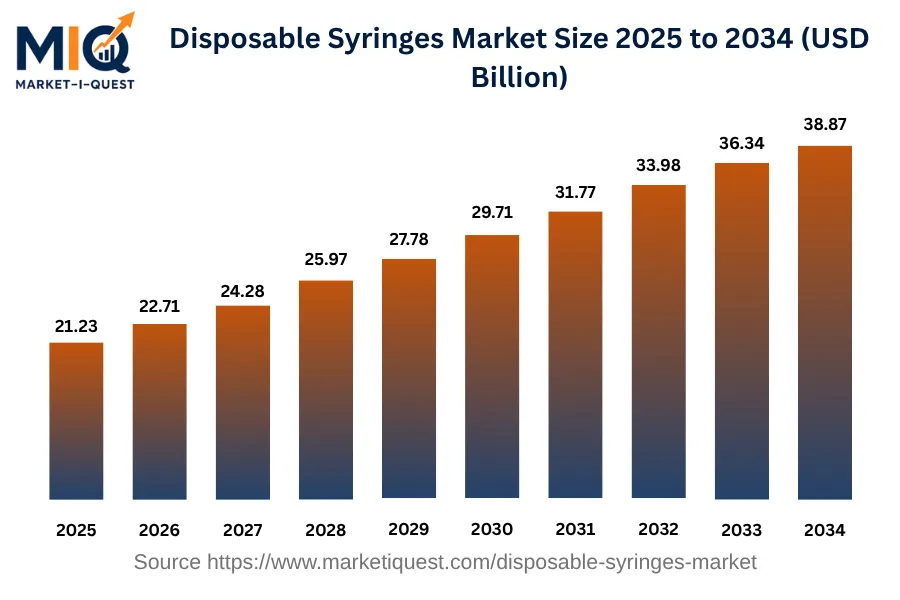
The disposable syringes market was valued at $21.23 billion in 2025, and it is projected to reach $38.87 billion by 2034, growing at a CAGR of 6.95%. The sizable growth between these years can be attributed to several factors. Firstly, increasing healthcare infrastructure and awareness about the use of safe and hygienic medical equipment, including disposable syringes, are likely contributing to the rise in the market size. Additionally, the growing demand for disposable medical products to prevent cross-contamination and infection further explains the expansion in the market. In 2024, the market was dominantly held by the Asia Pacific with a share of 35.82%. North America followed closely with a regional share of 33.74%. Europe held 23.84% of the market share, while less extensive shares were observed in LATAM and MEA, accounting for 3.96% and 2.64% respectively. These regional shares indicate the geographical distribution of the disposable syringes market.

Key Takeaways

  • By Type - Conventional Syringes led the segment with a significant market share in 2024.
  • By Application - Diabetes held the bulk of the share in 2024.
  • By End Use - Diagnostic Laboratories are expected to expand at a fastest CAGR in the forecast period.
disposable-syringes-market market size

Key Driving Factors

Regulatory Push Towards Infection Control

Unregulated reusable syringes pose multiple risks such as cross-contamination and infection outbreaks. This has prompted global healthcare authorities to lay down stringent guidelines for infection control. For instance, the World Health Organization promotes the use of 'smart' syringes that are designed for single use, mitigating the risk of infection spread. The Center for Disease Control also emphasizes enhanced disposable syringe utilization to prevent healthcare-associated infections. These regulatory mandates are creating a coercive drive towards the adoption of disposable syringes in healthcare settings, thereby propelling the market size. These are not just in developed countries, but also emerging economies are increasingly adopting such rigorous infection control measures.

Increasing Prevalence of Chronic and Lifestyle Diseases

The rise in chronic diseases like diabetes, autoimmune disorders, and cardiovascular diseases has led to an increased demand for disposable syringes. Patients with these conditions frequently require medications that can be self-administered at home using disposable syringes, enhancing their convenience and enabling consistent care. In autoimmune disorders, drugs such as insulin or methotrexate are often injected subcutaneously which can be done using disposable syringes. Similarly, a rise in cosmetic treatments that use neurotoxins, fillers or mesotherapy also increases the usage of disposable syringes. As the population continues to grapple with these health conditions, the disposable syringes market is experiencing a considerable drive.

Market Evolution by Timeline

2019-2023
This period saw a heightened demand for disposable syringes, primarily led by buyers from the healthcare sector. This is particularly relevant to countries highly involved in campaigns against diseases requiring immunization. India and African countries such as Nigeria showed considerable demand. The supply side was dominated by established companies like Becton, Dickinson and Company, which shipped a large number of syringes during this period. However, shipping constraints were common due to supply chain disruptions. Regulatory aspects were governed by WHO prequalification, a standard to ensure quality. In terms of commercial models, pricing was typically based on volume-based contracts with suppliers also offering partnerships for bulk purchases. A significant risk during this period was contamination due to poor storage facilities.
2024
In 2024, healthcare institutions remain the main buyers due to the COVID-19 pandemic. Geographically, the US sees a surge in syringes demand due to vaccine drive. Newer players such as Retractable Technologies enter the market, providing more advanced options with integrated safety mechanisms. Regulatory requirements prevail, with the US FDA ramping up its guidelines around safety and efficacy. Standard contracts show a trend of bundling syringe purchases with other medical equipment, promoting a more cost-effective strategy. The issue of biohazard waste due to improper syringe disposal was a key risk during this year.
2025-2029
Leading up to 2029, hospital chains continue to be the primary buyers of disposable syringes. Asia-Pacific region records higher demand, likely due to growing healthcare infrastructures. The supply side matures as technology improvements lead to the integration of RFID in disposable syringes for better inventory management. Regulatory aspects further evolve as European standards for medical devices, MDR 2017/745 comes into force. Commercially, value-based pricing over volume-based models becomes typical for procurement models. Risks of counterfeit products entering the market emerge as a potential challenge.
2030-2034
By 2030, automated injections gain prominence leading to a change in buyer segment, with tech companies becoming potential purchasers. US and Europe continue with robust demand trends. Supply side includes pilot programs by companies like Ypsomed, focusing on smart disposable syringes. Following the introduction of ISO standards for needle stick prevention, regulatory landscape becomes more stringent. The commercial models fragment, with lease or pay-per-use models becoming typical. The risk of dealing with a more technologically advanced product, poses challenges in terms of technical skills required to handle and maintain these products.

Future Market Outlook

Future Opportunities

The growing emphasis on infection control in healthcare settings is creating significant opportunities within the disposable syringes market. In response to the global health challenges highlighted by the pandemic, hospitals are exploring new partnerships with syringe manufacturers, particularly those who can provide innovative safety solutions. By 2023, healthcare providers in North America have begun integrating disposable syringes equipped with enhanced safety features into their protocols, based on recommendations from the Centers for Disease Control and Prevention. As a result, manufacturers focusing on sustainable materials and environmentally friendly production processes are increasingly appealing to stakeholders eager to comply with evolving regulatory frameworks. The rise of telehealth services, accelerated during 2020, has paved the way for home healthcare solutions that incorporate the use of disposable syringes for self-administration. In this context, companies like Medtronic have begun implementing educational programs aimed at patients, ensuring that these new methodologies are effectively understood. Furthermore, the increasing emphasis on chronic disease management, such as diabetes, has prompted more specific product development efforts that cater to patient preferences and usability. This trend is supported by regulatory frameworks from the European Medicines Agency that seek to foster the availability of safe self-injection devices. Increasing interest in personalized medicine is also anticipated to drive demand for customizable syringe solutions, reflecting the ongoing shift toward patient-centered healthcare.

Segmentation Analysis

By Type

The market is divided into subsegments including Conventional Syringes and Safety Syringes, with Conventional Syringes accounting for the largest revenue share while Safety Syringes are expected to grow at the fastest CAGR during the forecast period.

Largest Revenue Share

Conventional Syringes

Market Share Leader

Conventional Syringes, being the traditional and most long-standing product in the market, command the largest revenue share. Their dominance can be attributed to several factors. Firstly, these types of syringes are widely used across different patient demographics and therapeutic areas due to their simplicity and cost-effectiveness. They are used extensively in both hospital and home-care settings which broadens their market reach. Furthermore, conventional syringes are commonly used in emergency care, surgery, and routine patient check-ups, all of which are prevalent practices in healthcare. The procurement for these syringes is usually higher because they are available in bulk, thereby facilitating more frequent purchases and a larger volume of transactions. These factors coordinate to maintain the conventional syringes' leading position in generating revenues for this market segment.

Fastest CAGR

Safety Syringes

Forecast Period Growth Leader

Even though safety syringes are not the segment with the most substantial revenue at present, they are projected to grow at the fastest CAGR in the upcoming years. This trend is propelled by increasing awareness of healthcare safety regulations and a rising incidence of needlestick injuries. Another catalyst for growth is the advancement in the design of safety syringes which provides better protection against accidental needlestick injuries. Regulatory authorities in many countries have started to enforce laws that mandate the use of safety syringes, further stimulating the segment's growth. Moreover, partnerships between syringe manufacturers and healthcare institutions aiming at improving patient safety also contribute to the acceleration of this market. However, relatively higher prices of safety syringes compared to conventional ones and potential user resistance due to unfamiliarity with the new system may pose certain adoption barriers in the near term.

By Application

The market segment, by application, encompasses subsegments comprising Vaccines and Immunizations, Anaphylaxis, Rheumatoid Arthritis, Diabetes, Autoimmune Diseases, Oncology, and Others. The Diabetes subsegment commanded the largest revenue share in 2024, while Oncology is projected to exhibit the fastest growth during the forecast period.

Largest Revenue Share

Diabetes

Market Share Leader

Market dominance of the Diabetes subsegment roots from two chief factors – the high prevalence rates globally, and the continuous need for management and therapy. Diabetes, being a chronic disease, requires constant supervision and often life-long treatment, producing steady demand for diabetes-related medical products and services. Furthermore, emerging markets, characterized by changing lifestyles and increasing urbanization, are witnessing a surge in diabetes cases, thus driving overall growth. Purchasing criteria are majorly influenced by efficacy and patient-friendliness, with insulin pens and advanced monitoring devices gaining more traction among consumers. Regulatory bodies, on the other hand, are keen on approving novel and improved treatments, thereby fostering innovation in this sphere. Elevated healthcare awareness and willingness to invest in premier medical facilities also contribute to this subsegment's revenue.

Fastest CAGR

Oncology

Forecast Period Growth Leader

The Oncology subsegment is projected to witness the fastest growth, demonstrating a high CAGR outlook. Contributing factors range from increased cancer prevalence to advances in cancer therapy. For one, the occurrence of cancer has risen significantly due to lifestyle changes and genetic factors, propelling demand for oncology treatments. Additionally, the continual development in medical technologies along with aggressive R&D outlay has resulted in innovative and effective oncology solutions, further fueling growth. Another slightly understated driver is the policy environment, which has grown increasingly supportive of cancer care. Governments have been launching comprehensive cancer control programs and partnering with private entities to better cancer care. Nonetheless, the high cost of therapy could hinder adoption rates, while the risk associated with new technologies might impact the near-term growth trajectory.

By End Use

By end use, the market is divided into subsegments including Hospitals, Diagnostic Laboratories, Blood Banks, Pharmaceutical Industry, Veterinary Purposes, and Others. Of these, the Pharmaceutical Industry accounted for the largest revenue share, while Diagnostic Laboratories is expected to grow at the fastest CAGR during the forecast period.

Largest Revenue Share

Pharmaceutical Industry

Market Share Leader

The Pharmaceutical Industry subsegment holds the largest revenue share in the base year. This is primarily due to the significant demand for medical products and services in the pharmaceutical sector, which outstrips other subsegments in terms of volume and revenue generation. Pharmaceutical companies typically operate on a large scale and continuously require medical inputs for research and development, production, and distribution of a wide variety of drugs and vaccines. These companies usually have significant purchasing power, owing to their scale of operations and financial resources, contributing to a major portion of the market revenue. Additionally, the growing focus on innovative drug development, increased expenditure on healthcare, and the ever-rising global demand for effective medicines contribute to the robust growth of this subsegment. Regulation is another important factor; regulatory approvals for medicines make the supply more predictable and less easy for new entrants to disrupt.

Fastest CAGR

Diagnostic Laboratories

Forecast Period Growth Leader

The Diagnostic Laboratories subsegment is anticipated to exhibit the fastest-growing CAGR. Where hospital visits may have plateaued, diagnostic laboratories continually introduce new tests and screen more patients, thus driving greater demand for services. This increase in demand is also fueled by the proliferation of chronic diseases which require regular monitoring and flagged by initial screening. Additionally, tech advancements in laboratory testing equipment have led to faster results, higher throughput, and ultimately more efficient operations. However, it faces adoption barriers such as the high cost of advanced diagnostic devices and stringent regulatory procedures in some countries. To catalyze growth, firms in this subsegment are increasingly focusing on partnerships with technology providers and strategic investments in capex for advanced diagnostic tools. It's noteworthy that potential risks include new regulations, tech disruptions, and changing healthcare policies in the near term.

Competitive Analysis

Key Market Players

Manufacturers / OEMs

Becton, Dickinson and Company
US
Terumo Corporation
Japan
Braun Melsungen AG
Germany

Key Suppliers & Raw Materials

ExxonMobil Chemical
US
LyondellBasell Industries N.V.
Netherlands
Dow Chemical Company
US

Distributors, Integrators & Channel Partners

McKesson Corporation
US
Cardinal Health
US
Henry Schein Inc.
US

Porter’s Five Forces Analysis

This analysis evaluates the competitive intensity and profitability of the Disposable Syringes Market.

Supplier Bargaining Power

Medium

Limited number of suppliers raise raw material prices, but strong brand names balance power.

Buyer Bargaining Power

High

Buyers often being large healthcare institutions or government agencies have high purchasing power.

Threat of Substitutes

Low

No effective substitute for disposable syringes; reusable syringes carry risk of cross-contamination.

Threat of New Entrants

Medium

Initial capital investment and regulatory compliance are potential barriers for new entrants.

Competitive Rivalry

High

Intense competition due to presence of multinational manufacturers having vast product portfolios.

Regional Analysis

Geographic market dynamics and growth opportunities across key regions

Global Market Outlook

disposable-syringes-market market regional share

North America

In 2024, North America's Disposable Syringes Market thrived due to various drivers and trends. Effective public health policies bolstering the credibility of vaccination drives lifted the demand for disposable syringes. The substantial investments in medical technology adoption fostered innovation, leading to production efficiencies and affordable pricing, fortifying the accessibility of such products in the U.S., Canada, and Mexico. Stringent sterilization standards played a crucial role. They propelled the use of disposable syringes in healthcare providers to restrain cross-transmission of infections. As such, the governments reinforced their regulations in the healthcare sector to minimize the risk of medical contamination.

The shifting consumer preference towards single-use medical tools dictated a decisive trend in the market where a notable surge in the demand for disposable syringes unfolded. Furthermore, several high-profile M&As in 2024 led to improved supply chain dynamics, ensuring a stable provision of disposable syringes across the region. Such strategic partnerships strengthened the horizontal integration in the market, reducing costs and ensuring quality control. Meanwhile, the adoption of accountability policies increased in medical facilities, providing transparency on usage and disposal of syringes. E-commerce platforms also benefitted from these trends, seeing sales volumes surge as consumers utilized these accessible channels to obtain disposable syringes. Overall, strict regulations, consumer preference, and technological advances underpinned growth in North America's Disposable Syringes Market in 2024.

Asia Pacific

In 2024, the Disposable Syringes Market in Asia Pacific was strongly influenced by several macro and sectoral elements. Regulatory approvals and heightened investments in healthcare infrastructures, particularly in China and India, have significantly stimulated demand. In Japan and Australia, adoption of innovative technologies, such as safety syringes, has increased due to rising concerns over needlestick injuries. Fluctuating supply dynamics, especially in key ASEAN markets, have led to price adjustments influencing market characteristics.

On the trends front, buyer behavior in 2024 leaned towards single-use syringes primarily in healthcare settings in response to increased awareness about cross-contamination risks. A shift towards prefilled syringes was observed, backed by their benefits in chronic disease management, exemplified by continued adoption in South Korean hospitals. Channel dynamics revealed a rise in online sales, which was particularly evident in China's robust e-commerce landscape. Partnerships involving local manufacturers and international players were prevalent, notably in India due to its vast market size. Strict enforcement of policy measures on safety syringes, like Japan's industrial standards for medical instruments, also shaped the market environment. Sectors driving this market predominantly included government-supported healthcare facilities, private hospitals, and retail pharmacies, with a notable uptick in enterprise-level procurement for employee healthcare in manufacturing industries in 2024.

Europe

The European disposable syringes market experienced remarkable growth in 2024. This growth was primarily fueled by increased healthcare expenditure, tighter regulatory scrutiny, and burgeoning biopharmaceutical research. Germany, the United Kingdom, France, Italy, and Spain played leading roles in the market expansion, championing initiatives for infection prevention and control. Also, there was a larger scale adoption of disposable syringes due to their cost-effectiveness and low risk of cross-contamination. Increasing cases of chronic diseases and frequent vaccinations were other major market accelerators. Factors such as an aging population and the rise in self-medication practices in regions like the Nordics and Benelux further propelled demand.

In the same year, a notable market trend was the growing preference for safety syringes, primarily in healthcare settings. This was largely because of increased awareness and the enforcement of stringent healthcare protocols, which prioritized patient safety. Additionally, the integration of advanced technologies like auto-disable (AD) syringes and 'smart' syringes grew in popularity in the medical sector across Central & Eastern Europe. This aligns with an overall trend towards digitalization in healthcare. Major partnerships and acquisitions also took place in 2024, propelling the market’s upward trajectory and supporting the diversification of product portfolios. One example includes Becton Dickinson’s acquisition of C.R Bard, a move that significantly impacted the overall European disposable syringes landscape.

Latin America

In 2024, the disposable syringes market in Latin America showed significant growth driven by numerous factors. Prominent drivers included increasing government and private sector investments in healthcare infrastructure, especially in countries like Brazil, Mexico, and Argentina due to higher demand. Also, policies promoting the adoption of safer medical practices across hospitals and clinics played a crucial role, as seen in the "National Policy for Patient Safety" in Brazil. Technological adoption propelled market growth with advanced syringe variants gaining traction across the region, especially in developed healthcare systems of Chile and Argentina. Another key driver was pricing dynamics, where low-cost, mass-produced syringes appealed to budget-constrained healthcare settings in Peru and Colombia.

Trends shaping the market included an on-going shift towards self-administered injectable treatments in chronic disease management, catalyzing homecare demand for disposable syringes. Changing channels with a gradual shift from offline to online procurement became evident, especially in countries like Mexico and Brazil with burgeoning e-commerce sectors. Furthermore, increased partnership activities and M&A among local and international medical device manufacturers were observed. An example is the strategic alliance between Brazil's leading syringe manufacturer, B.Braun, and Argentina's Dispomedic. Implementation of stringent manufacturing standards, as outlined in Mexico's NOM-241 regulation, also emerged as a major trend reinforcing patient safety. These developments primarily catered to healthcare providers, followed by retail pharmacies, government health institutions, and homecare.

Middle East & Africa

In the base year 2024, the disposable syringes market in the Middle East and Africa exhibited growth. The drivers of this expansion include increased spending in healthcare sectors across nations such as Saudi Arabia, UAE, Qatar, Egypt, South Africa, Nigeria, Kenya, and Israel. The adoption of innovation technologies within these healthcare systems, such as the implementation of safety syringes, reduces the spread of infectious diseases, notably in highly populated areas like Nigeria and South Africa. Regulations enforcing disposable syringe use for medical procedures promoted increased market demand, particularly in Saudi Arabia and UAE.

In terms of trends, governments across these regions initiated partnerships with major supply chain companies to ensure a constant supply of disposable syringes. The development and application of environmentally friendly, biodegradable disposable syringes emerged as a key trend in Egypt and Kenya, driven by a growing focus on sustainable healthcare. Lastly, policy enforcement resulted in stringent quality checks for syringes, thereby boosting the requirement for standard-compliant models, readily observed in the UAE and Israel. Key customers of this market comprised government healthcare services, private healthcare facilities, and emergency medical services, with an increase in purchases witnessed in the retail sector due to growing home healthcare trends. However, efficient understanding and adherence to national and regional disposal regulations remained a significant challenge for many customers.
Recent Industry Developments

Latest market innovations, product launches, and strategic initiatives

June 2026

Hindustan Syringes & Medical Devices Ltd announced a ₹100 crore investment over three years for capacity expansion and entry into new overseas markets, repurposing machines to produce standard disposable syringes for curative healthcare drug delivery.

February 2026

CMT Health Pte. Ltd. received FDA 510(k) clearance for Profoject Insulin Syringes and Profoject Safelock Disposable Insulin Syringe (K253068), expanding its disposable insulin syringe portfolio.

Frequently Asked Questions