
Digital X-Ray Devices Market Snapshot

Key Players

  • Siemens Healthineers (Germany)
  • GE Healthcare (USA)
  • Philips Healthcare (Netherlands)
  • Canon Medical Systems Corporation (Japan)
  • Fujifilm Holdings Corporation (Japan)
  • Shimadzu Corporation (Japan)
  • Konica Minolta Inc. (Japan)
  • Agfa-Gevaert Group (Belgium)
  • Carestream Health (USA)
  • Hitachi Medical Corporation (Japan)

Market Size

Base Year 2024
$15.83 Bn
CAGR
7.36%
Forecast 2034
$32.20 Bn

Market Segments

By Type
General Radiography, Dental Radiography, Mammography, Fluoroscopy
By Technology
Computed Radiography, Direct Radiography, Flat Panel Detectors, Portable X-ray Devices
By Application
Orthopedics, Dental, Cardiology, Oncology, Others
By End Use
Hospitals, Diagnostic Imaging Centers, Academic Institutes, Research Laboratories

Market Dynamics

Drivers
  • Increased adoption in healthcare industry
  • Technological advancements in imaging
Restraints
  • High initial investment costs
  • Technological complexity for users
Opportunities
  • Increasing healthcare digitization
  • Growth in dental disorders

Market Size

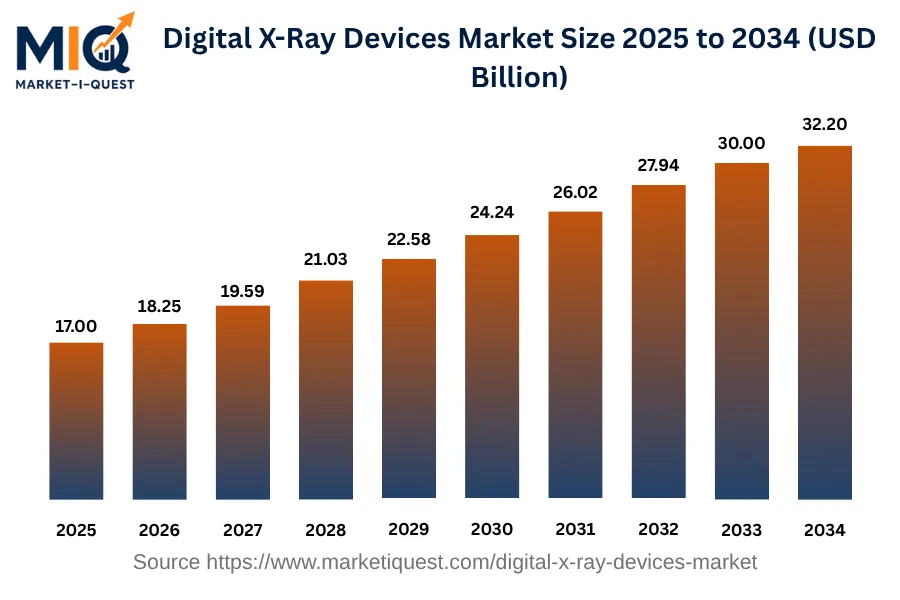
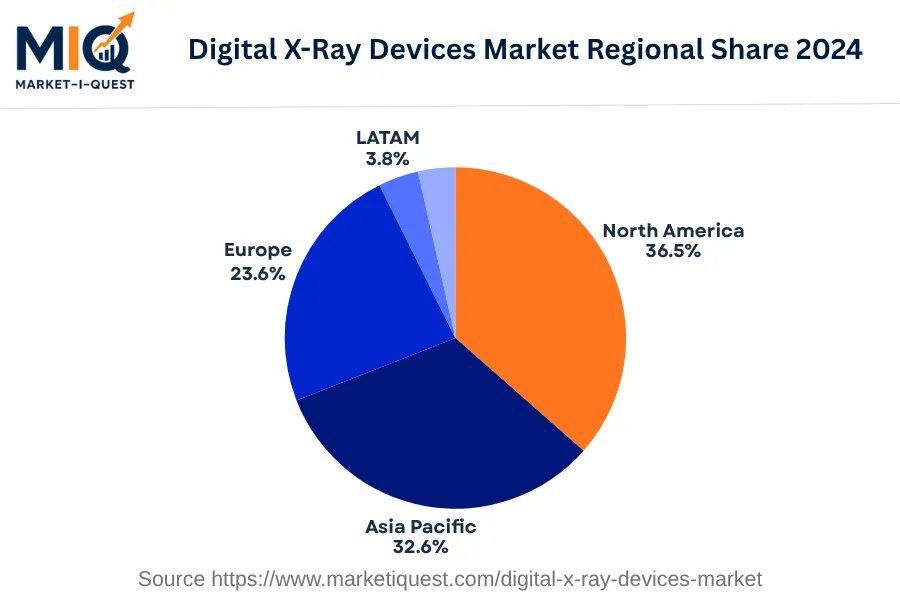
The Digital X-Ray Devices Market was valued at $16.99 billion in 2025 and is expected to grow to $32.20 billion by 2034, showing a CAGR of 7.36%. The market value saw a slight increase of around $1.15 billion from the start value of $15.83 billion in 2024 to $16.99 billion in 2025. It is on a steady growth trajectory as it nearly doubles in size over the course of the decade from 2025 through to 2034. This impressive growth is attributed to continuous advancements in digital radiography technologies that are achieving greater accuracy with less radiation. Additionally, higher adoption of these innovations by healthcare providers to improve patient outcomes and workflow efficiencies contributed to this growth. The regional market share shows North America leading in 2024 with 36.5%, closely followed by Asia Pacific at 32.6%. Europe follows with a 23.6% share, while LATAM and MEA account for a nominal 3.8% and 3.5% respectively.

Key Takeaways

  • By Type - General Radiography segment held the majority market share in the Digital X-Ray Devices Market.
  • By Technology - Direct Radiography sub-segment led accounting for the highest growth rate.
  • By Application - Dental grew fastest in the Digital X-Ray Devices Market.
  • By End Use - Hospitals dominated revealing a notable position in the market during the research period.
digital-x-ray-devices-market market size

Key Driving Factors

Increased Prevalence of Orthopedic and Cardiovascular Disorders

A significant driver of the digital X-ray devices market is the growing incidence of orthopedic and cardiovascular diseases worldwide. Both conditions often require diagnostic imaging for accurate diagnosis and treatment planning. Digital X-ray devices provide clear images, which has seen their adoption rise in medical institutions dealing with these diseases. For instance, hospitals and diagnostic centers are increasingly utilizing digital x-ray systems for patients suffering from osteoporosis, arthritis, and heart diseases. The devices' ability to produce detailed images enables doctors to detect and monitor these diseases more effectively. Hence, the necessity for more exact diagnostic techniques, overly presented by these disorders, is pushing the need for digital X-ray devices.
Government Initiatives Promoting Digital Imaging

Another key factor driving the demand for digital X-ray devices is initiatives by governments to promote digital imaging. As part of efforts to modernize healthcare infrastructure, many governments are encouraging healthcare facilities to transition from traditional analog systems to digital systems. For example, the U.S. federal government's 'meaningful use' initiative encourages healthcare providers to adopt electronic health records and associated technologies like digital X-ray systems. This transition is further accelerated by government reimbursement policies favoring the use of digital over analog systems in some countries. With such initiatives supporting the adoption of digital systems, the market for digital X-ray devices is seeing a positive growth trend.

Market Evolution by Timeline

2019-2023
In this period, dental clinics and hospitals elevated their demand for Digital X-Ray Devices, with North America and Europe being major buyer regions. Manufacturers like GE and Siemens were in the spotlight for their advanced, integrated digital solutions. The introduction of 3D imaging and AI technology enhanced diagnosis accuracy. Pricing for the devices generally remained high due to technological sophistication and high production costs. Medical Device Regulation (MDR) enacted in the EU governed the use and approval of medical devices, including Digital X-Ray Devices. High costs and significant amounts of radiation were key concerns in this period.
2024
In 2024, there was continued high demand from hospitals in North America and Asia. Suppliers responded by integrating cloud technology into their devices, thus easing access to patient history and diagnosis across different platforms. The reduction in prices following bulk production and competition was appreciated by consumers. The U.S. FDA adopted policies ensuring the safe use of radioactivity and proficient AI technology in Digital X-Rays Devices. The main risk remained data security with the advent of cloud technology.
2025-2029
The desire for Digital X-Ray devices spanned the globe, with Asia-Pacific regions notably enhancing their healthcare capabilities. Companies like Canon and Hitachi started using AI more intensively for diagnosis. Integration into vast medical systems became more seamless. The China National Medical Products Administration (NMPA) began heavily influencing the Asian market, enforcing stringent approval processes. Large-scale contracts between hospitals and manufacturers were common due to lowered costs, but radiation hazards continued to be a dominant risk factor.
2030-2034
The market heavily incorporated AI and IoT for diagnosis and efficiency. Primarily in Africa and South America, healthcare establishments evolved to favour digital solutions. The reduction in prices ensured the wide adoption of Digital X-Ray devices. Globally, regulations concerning Digital X-Rays Devices tightened, emphasizing on radiation management. Partnerships between tech companies and healthcare institutions became more prevalent, enabling technology advancement and market growth. Despite technical advancements, worries about the growing cybersecurity threats surfaced.

Future Market Outlook

Future Opportunities

Current advancements in digital X-ray technology are generating numerous growth opportunities throughout the industry. The aging population, especially in regions like Europe, is increasing the demand for diagnostic imaging services, as older individuals typically require more medical evaluations. The World Health Organization reported in 2022 that age-related diseases necessitate higher imaging volumes in healthcare institutions. Furthermore, partnerships between technology firms and healthcare providers, such as the collaboration between Philips and Mount Sinai Health System announced in early 2023, are facilitating innovation in imaging solutions that align with clinical needs. There is also a notable push for eco-friendly imaging solutions, with several manufacturers working towards reducing the carbon footprint of medical devices, contributing to global sustainability goals. In regions like Asia-Pacific, countries are investing heavily in digital infrastructure, thereby increasing the demand for advanced healthcare imaging technologies. For instance, the government of India has introduced initiatives to improve telemedicine capabilities and diagnostic technologies since 2021. As healthcare systems increasingly prioritize efficiency and productivity, the integration of telehealth services with digital X-ray technologies presents significant avenues for growth. These combined factors create a landscape ripe for innovation, allowing companies to leverage emerging technologies while addressing pressing healthcare needs effectively.

Segmentation Analysis

By Type

The market is divided into subsegments including General Radiography, Dental Radiography, Mammography, and Fluoroscopy. Of these, General Radiography accounted for the largest revenue share, while Dental Radiography is expected to grow at the fastest CAGR during the forecast period.

Largest Revenue Share

General Radiography

Market Share Leader

General Radiography is currently leading in terms of revenue generation among all the subsegments. This can be attributed to its broad range of applications in the medical field. General Radiography involves producing two-dimensional images of the body, which gives it a high utility value across a host of treatments including detecting bone fractures, infections, and locating foreign objects in the body. Furthermore, the technological enhancement in general radiography such as the transition from film to digital has significantly increased the accuracy, thereby further boosting its adoption. These images also support a wide range of medical disciplines, from orthopedics to internal medicine, which contributes to its large revenue share. Patient switching costs are virtually non-existent due to the near-universal standard of these methods across healthcare providers. Lastly, healthcare regulations globally support its adoption due to the essential nature of this type of radiography. The largest markets for this subsegment are regions with well-funded public healthcare systems, such as Europe and North America.

Fastest CAGR

Dental Radiography

Forecast Period Growth Leader

On the other hand, Dental Radiography is expected to experience the highest growth in the coming years. This can largely be attributed to the rising awareness of oral health worldwide and the importance of regular dental check-ups. Also, the significant technological adaptations like the shift from analog to digital radiography systems have improved image quality and reduced radiation dose, which has made these tools more appealing to dental practitioners and patients. Moreover, the increasing prevalence of oral diseases, particularly among the geriatric population, is expected to propel the demand for these procedures. The potential for further growth in underpenetrated markets, especially emerging economies, namely Africa and Asia, presents a substantial opportunity for this subsegment. However, concerns related to radiation and high equipment costs could pose challenges and would need to be addressed to ensure sustained growth.

By Technology

The market, divided into subsegments including Computed Radiography, Direct Radiography, Flat Panel Detectors, and Portable X-ray Devices, sees Direct Radiography accounting for the largest revenue share, while Portable X-ray Devices are expected to grow at the fastest CAGR during the forecast period.

Largest Revenue Share

Direct Radiography

Market Share Leader

In 2024, Direct Radiography emerged as the sub-segment with the largest revenue share in the market. This can be attributed to its widespread adoption in various healthcare settings, ranging from small clinics to large hospitals, due to its accuracy and reliability in delivering high-quality medical imaging. Along with its superior image quality, Direct Radiography also offers time efficiency as it reduces the need for film processing. Additionally, the technology's ease of use and flexibility in handling different types of radiographic examinations contributes to its high purchasing rate. The high initial investment is justified by its cost-effectiveness over the long term, particularly driven by low operating costs, film-less operation, and reduced use of chemicals. Geographically, the demand for Direct Radiography is robust in developed regions where sophisticated healthcare infrastructure exists, while fast-developing economies are catching up rapidly, drawn by the confluence of increasing healthcare spending and a growing focus on improving diagnostic capabilities.

Fastest CAGR

Portable X-ray Devices

Forecast Period Growth Leader

Expect to see impressive growth from the Portable X-ray Devices subsegment. The market's driving force is the increasing need for on-the-go diagnostic solutions, particularly in home healthcare settings and emergency scenarios. Underlying this demand is the rising elderly population with mobility issues and an increasing shift towards outpatient care in many geographies. Portable X-ray Devices offer the benefit of bedside imaging, critical in intensive care and trauma cases. The enhanced convenience, coupled with the continuous improvement in image quality comparable with stationary systems, presents a compelling value proposition to healthcare facilities intending to increase patient comfort and streamline workflow. Technological advancements, such as digital radiography and lightweight, battery-operated designs, are the key catalysts for uptake. However, regulatory obstacles and the high capital expenditure might pose short-term adoption barriers. In overcoming these obstacles, manufacturers' focus on cost-effective solutions and strategic partnerships with healthcare providers will play a pivotal role.

By Application

The market is divided into subsegments including Orthopedics, Dental, Cardiology, Oncology, and Others. Of these, Oncology accounted for the largest revenue share, while Dental is expected to grow at the fastest CAGR during the forecast period.

Largest Revenue Share

Oncology

Market Share Leader

In 2024, oncology as a segment dominated the overall market revenue due to a number of factors that tend to increase demand for oncology-related products and services. The main contributor is an increasing global incidence of various types of cancer, driving a greater need for advanced therapeutics and diagnostics in this area. The aging population across the world, who are more susceptible to cancer, has also been a contributing factor, as has been a developing preference for personalized medicine which often involves unique oncologic approaches. The oncology market has also demonstrated resilience in the face of regulatory pressures and evolving healthcare policies across major economies. Importantly, the willingness of healthcare providers and payers to invest in high-cost oncology therapeutics, owing to their often life-saving nature, also plays a substantial role in revenue generation for this segment.

Fastest CAGR

Dental

Forecast Period Growth Leader

The Dental subsegment, although not the largest, has shown the fastest CAGR during the forecast period. This growth can be attributed to an increased awareness and emphasis on oral health among consumers across various regions. In addition, changing dietary habits leading to high rates of dental ailments such as dental caries and periodontal diseases have accelerated the need for dental solutions. Technological advancements in the dental field, like digital dentistry and adoption of CAD/CAM (Computer-Aided Design/Computer-Aided Manufacturing) systems, are also expected to spur the subsegment. Dental tourism arising from high dental treatment costs in developed nations has also catalyzed the growth of this subsegment. However, the high cost of advanced dental treatments and lack of access in certain regions may slow this fast-paced growth down in the near future.

By End Use

The market is divided into subsegments including Hospitals, Diagnostic Imaging Centers, Academic Institutes, Research Laboratories. Among them, Hospitals accounted for the largest revenue share while Research Laboratories is expected to grow at the fastest CAGR during the forecast period.

Largest Revenue Share

Hospitals

Market Share Leader

The hospital segment leads the market in terms of revenue for several reasons. First and foremost, hospitals are the primary points of care for most patients across the globe. They provide a wide range of medical services, from routine check-ups and medical procedures to emergency care, thus requiring a broad and diverse set of medical equipment and supplies. Moreover, hospitals in countries with advanced healthcare systems receive substantial funding, which allows them to regularly update their equipment and incorporate newer, higher-cost technologies. Regulatory needs are also an important factor, as hospitals must meet specific standards and regulations related to patient care, which often necessitate the acquisition of specific and potentially high-cost equipment. Additionally, the likelihood of repeat purchases or large-volume purchases is relatively high for hospitals due to the high patient turnover and the broad scope of services they offer. This frequent, high-volume purchasing could significantly contribute to their large revenue share.

Fastest CAGR

Research Laboratories

Forecast Period Growth Leader

Research Laboratories is the segment which is expected to register the fastest growth. This growth can largely be attributed to the increasing investment in R&D activities around the world. Advances in medical diagnosis techniques require laboratories to use updated and specialized equipment, leading to regular purchases and replacements. This ensures that emerging, state-of-the-art technologies find their initial applications and acceptance in research labs. Collaboration and partnerships with tech companies can also serve as a catalyst for the fast growth of this segment as it can result in innovative product introductions. However, high capital expenditure can sometimes be a barrier for labs to access some sophisticated technologies. In addition, regulations could pose near-term risks by restricting the use or acquisition of certain types of research equipment. As long as technology continues to advance and investment in R&D remains strong, the growth pace of this segment is likely to maintain its momentum.

Competitive Analysis for Digital X-Ray Devices Market

Key Market Players

Manufacturers / OEMs

Fujifilm Holdings Corporation
Japan
Canon Inc.
Japan
Koninklijke Philips N.V.
Netherlands

Key Suppliers & Raw Materials

Hologic, Inc.
US
Teledyne Technologies Inc.
US
Carestream Health
US

Distributors, Integrators & Channel Partners

Siemens Healthcare Private Limited
Germany
GE Healthcare
US
Agfa-Gevaert Group
Belgium

Porter’s Five Forces Analysis

This analysis explores key forces shaping the competitive dynamics in the Digital X-Ray Devices Market.

Supplier Bargaining Power

Medium

Limited number of specialized suppliers provides some pricing power.

Buyer Bargaining Power

Low

High switching costs and custom requirements limit buyer power.

Threat of Substitutes

Low

Unique benefits and lower radiation exposure limit the threat of substitutes.

Threat of New Entrants

Medium

High capital investment and technical knowledge form entry barriers.

Competitive Rivalry

High

Intense competition due to presence of international, regional and local vendors.

Regional Analysis

Geographic market dynamics and growth opportunities across key regions

Global Market Outlook

digital-x-ray-devices-market market regional share

North America

In 2024, the North American Digital X-Ray Devices Market witnessed significant growth due to a confluence of factors. High uptake in the healthcare sector, driven by escalating needs for efficient diagnostic tools in the US, Canada, and Mexico, coupled with significant investments in healthcare technology, fueled the market expansion. The region’s strong emphasis on quality healthcare led regulatory bodies to promote the adoption of digital X-ray devices. Increased supply dynamics, propelled by competitive pricing strategies by key players, also contributed to greater market penetration.

Several noteworthy trends outlined the market behavior. A noticeable shift towards portable and wireless digital X-ray devices was seen in response to the growing demand for mobile healthcare solutions. Telemedicine’s expansion acted as a catalyst for this shift. Concurrently, consolidation activities characterized the market, with key technology providers engaging in strategic partnerships and mergers to enhance their market prowess. Lastly, policy enforcement around radiation safety and digital recordkeeping standards became integral, driving hospitals and clinics to adopt digital X-ray devices more widely. Major customers in this market were predominantly hospitals, diagnostic centers, and outpatient clinics across North America. Nonetheless, the retail segment also showed increased interest, implemented primarily in pharmacy-based clinics in the United States. The manufacturing sector recognizing the application of these devices for non-destructive testing also marked a new direction for market growth in 2024.

Asia Pacific

In 2024, the Digital X-ray Devices Market, particularly in the Asia Pacific region, exhibited robust growth due to several key drivers and trends. Adoption of advanced healthcare technology and prolific investment by China and Japan have strongly driven the market expansion. The rise in orthopedic and cardiovascular disorders in populous countries like India and China caused a surge in demand, with numerous government healthcare initiatives bolstering market growth. High-tech medical infrastructure in Australia and South Korea, coupled with falling device prices, significantly affected supply dynamics.

Trends in the Asia Pacific market were majorly influenced by changing consumer behavior and rapid product innovations. There was a noticeable shift towards portable and handheld devices across the region’s hospitals and diagnostic centers. Technological advancements in Artificial Intelligence (AI) and Machine Learning (ML) substantially conditioned the product adaptations. Several strategic partnerships were formed across key ASEAN markets, particularly in Indonesia and Malaysia, where integration with cloud-based software became a standard trend. Most prominent was the increased enforcement of patient safety regulations promoting the use of low-dose radiation devices. Such developments impacted sectors ranging from healthcare providers to governments and manufacturers, collectively stimulating the digital X-ray devices market in the Asia Pacific region.

Europe

In 2024, the Digital X-Ray Devices Market in Europe experienced significant growth, driven by technological advancements and increasing public health investments. Specifically, accelerated adoption of digital radiography across leading European countries such as Germany, the United Kingdom, and France led to enhanced efficiency and reduced radiation exposure. Further, increased investments in the healthcare technology by governmental agencies bolstered market growth. Germany witnessed considerable market expansion due to the adoption of AI-based x-ray devices in diagnostic centres, while in Italy, rapid urbanization and robust healthcare infrastructure elevated the demand for digital x-ray devices in hospitals. Spain experienced growth triggered by a rise in orthodontic treatments requiring x-ray technology.

Key trends include a shift towards portable digital x-rays in the United Kingdom and Benelux for improved patient care, particularly in home care settings. In the Nordics and Central & Eastern Europe, the focus on digitizing healthcare systems led to increased integration and interoperability of these devices in the healthcare IT ecosystem. Notably in France, collaborations between device manufacturers and healthcare providers resulted in a strategic emphasis on product innovation. Governmental policies, like the European Union's directive reinforcing radiation protection, enforced the adoption of advanced x-ray devices. Overall, the market saw significant transformations with emerging customer groups including enterprise healthcare providers, government facilities, and specialized diagnostic centres.

Latin America

In the base year 2024, the Digital X-Ray Devices market in Latin America emerged as a crucial component in the healthcare sector, with a growing demand in countries like Mexico, Brazil, Colombia, Argentina, Chile, and Peru. Increased investment in healthcare infrastructure, positive regulatory climate promoting the transition from conventional X-Ray systems to digital ones, and the general acceptance of advanced imaging technology by local healthcare providers were key drivers. Region-specific factors such as the surge in orthopedic disorders and the adoption of tele-radiology further accelerated the market growth.

On the trends front, a shift towards portable digital x-ray devices was seen in medical institutions. Concurrently, partnerships and mergers between local hospitals and international medical equipment manufacturers enhanced the provision of digital x-ray systems. Cloud-based solutions for data storage also saw a growth in adoption, attributed to the increasing digitalization of healthcare services in the region. However, the market witnessed challenges in the form of high equipment costs and the deficit of skilled radiologists. On the policy front, governments imposed rigorous quality and safety standards in line with international norms, ensuring increased patient safety and upholding the quality of digital images captured. Overall, the digital x-ray devices market demonstrated robust momentum in Latin America in 2024.

Middle East & Africa

In 2024, the Digital X-Ray Devices Market in the Middle East and Africa experienced significant activity due to various drivers and trends. The increasing demand for advanced diagnostic tools, the evolving regulatory framework favoring digital imaging, and the significant investments in healthcare sectors significantly influenced market dynamics. Specifically, Saudi Arabia, United Arab Emirates, Qatar, and Israel witnessed accelerated adoption of technology due to regulatory support and burgeoning healthcare infrastructure.

Furthermore, key trends observed were rising patient preference for non-invasive diagnostic procedures and the increasing usage of portable digital x-ray devices. South Africa, Nigeria, Egypt, and Kenya experienced soaring demand from governmental healthcare units, manufacturing sectors, and oil and gas industry, driven by rising health concerns in these industries and associated workplace safety regulations. The advancements in technology also led to an increased implementation of AI in digital x-rays, seen prominently in the healthcare sector across Israel and UAE. A notable market dynamic was the strategic partnerships fostered between digital x-ray manufacturers and healthcare services to ease diagnostic processes, primarily observed in Saudi Arabia, Qatar, and South Africa. Lastly, rigorous policy enforcement was seen around data privacy and cyber security in the digital medical imaging landscape, directly influencing the digital x-ray devices market in the region.

Recent Industry Developments

Latest market innovations, product launches, and strategic initiatives

December 2025

GE HealthCare and NVIDIA expanded their existing medical imaging infrastructure alliance to co-develop edge-computed, autonomous software configurations for digital X-ray and ultrasound modalities. The technical integration embeds NVIDIA Isaac for Healthcare and Holoscan processing platforms directly near the imaging devices to drive low-latency automated workflows.

July 2025

GE HealthCare announced the commercial launch and market availability of the Definium Pace Select ET. This specialized, floor-mounted digital radiography system incorporates the Intelligent Workflow Suite to automate manual in-room tasks, utilizing AI to execute automated patient positioning, protocol selection, and body-habitus collimation checks before radiation exposure.

Frequently Asked Questions