Untitled Report Snapshot

Key Players

  • Zeon Corporation (Japan)
  • ExxonMobil (United States)
  • Shell Chemicals (Netherlands)
  • LyondellBasell Industries NV (Netherlands)
  • Kolon Industries Inc. (South Korea)
  • Cymetech Corporation (United States)
  • Rishiroop Ltd (India)
  • Jiangsu Jitian Chemical Co. Ltd. (China)
  • Liaoning Yufeng Chemical Co. Ltd. (China)
  • Shandong Yuhuang Chemical Co. Ltd (China)

Market Size

Base Year 2024
$1.14 Bn
CAGR
6.2%
Forecast 2034
$1.96 Bn

Market Segments

By Type
  • DCPD UPR Grade
  • DCPD Resin Grade
  • DCPD High Purity
By Application
  • Unsaturated Polyester Resin
  • Hydrocarbon Resins
  • Ethylene Propylene Diene Monomer (EPDM) Elastomers
  • Cyclic Olefin Copolymer (COC) and Cyclin Olefin Polymer (COP)
  • Poly-DCPD
  • Others
By End Use
  • Building and Construction
  • Automotive
  • Marine
  • Electrical and Electronic
  • and Others

Market Dynamics

Drivers
  • Rising demand in end-use industries
  • Surge in automotive & construction sectors
Restraints
  • Volatile raw material prices
  • Stringent environmental regulations
Opportunities
  • Raised demand in adhesives industry
  • Increasing usage in unsaturated polyester resins

Market Size

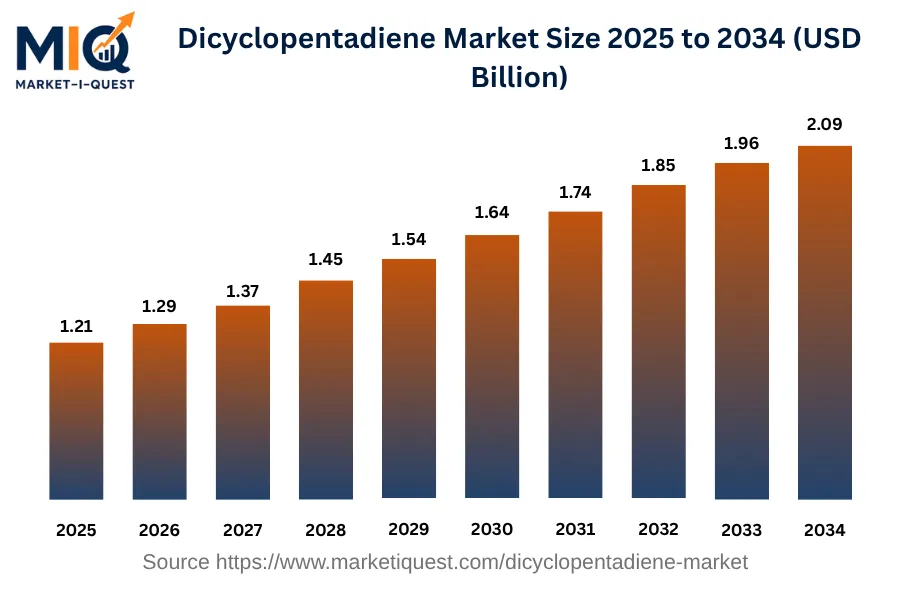
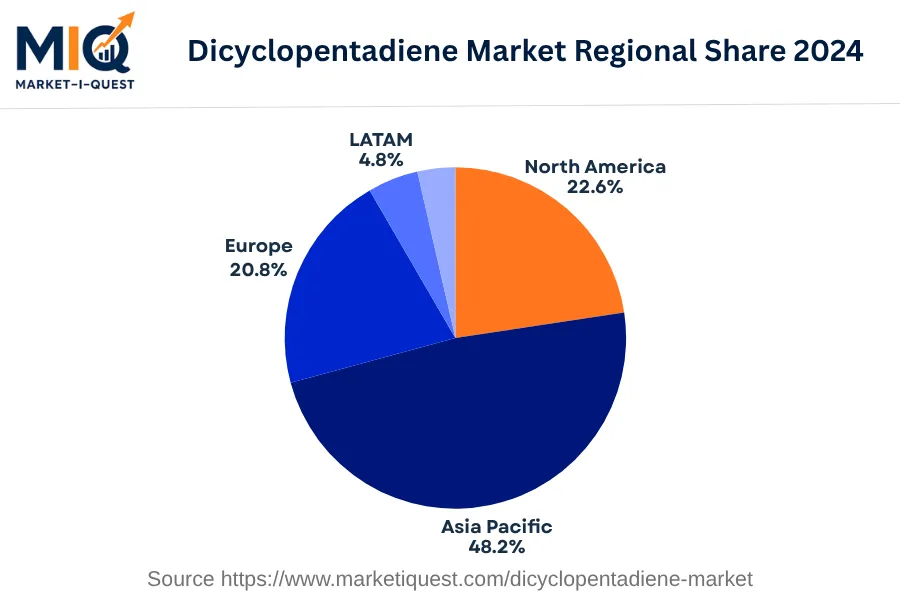
The Dicyclopentadiene Market size is expected to be approximately 1.21 billion USD in 2025 and is projected to increase to around 2.09 billion USD by 2034. This represents a CAGR of 6.23%. The market value was about 1.14 billion USD in 2024, and the market experienced an increase of approximately 0.07 billion USD in the next year. This continuous growth over the years indicates an increasing expansion in the Dicyclopentadiene Market industry. The growth from 2024 to 2025, and subsequently to 2034, signifies a substantial expansion in the market. In 2024, the regional share of the Dicyclopentadiene Market was distributed as follows: North America made up 22.61%, Asia Pacific held a dominating 48.18% share, Europe contributed 20.84%, Latin America accounted for 4.79%, and the Middle East and Africa composed the remaining 3.58% of the total market.

Key Takeaways

  • By Type - DCPD Resin Grade held prominent positioning due to its vast utilization.
  • By Application - Unsaturated Polyester Resin led the sector with significant market share.
  • By End Use - Automotive segment expanded rapidly due to the growing need for lightweight and strong materials.
dicyclopentadiene-market market size

Key Driving Factors

Expansion of the Unsaturated Polyester Resins (UPR) Industry

A major driving factor for the growth of the dicyclopentadiene market is the expansion of the Unsaturated Polyester Resins (UPR) industry. Dicyclopentadiene is a key ingredient in the production of UPR which is extensively used across different industries - from construction, marine, to automotive. Developments in the real estate sector, the resurgence of the automotive industry post-pandemic, and the rebuilding of infrastructures are increasing the demand for UPR and consequently, the market for dicyclopentadiene. Marine transportation is also experiencing growth due to the global trade recovery. Therefore, as these industries continue to grow and evolve, the demand for dicyclopentadiene will likely keep increasing.
Emergence of Bio-Based Dicyclopentadiene

Another significant factor pushing the dicyclopentadiene market is the emergence of bio-based dicyclopentadiene. Many industries are transitioning to more sustainable manufacturing practices in response to increasing environmental regulations and policies to reduce carbon footprint. Bio-based dicyclopentadiene, derived from renewable resources, is considered an environmentally friendly alternative compared to traditional, petroleum-based dicyclopentadiene. Moreover, it's gaining acceptance in various markets like elastomers and hydrocarbon resins. Companies are under pressure not just from regulators, but also from consumers demanding greener products. As a result, the demand for bio-based dicyclopentadiene as a sustainable option, is set to rise.

Market Evolution by Timeline

2019-2023
In this phase, the prominent demand for Dicyclopentadiene came from gym equipment manufacturers in North America due to its strength and light weight properties. It was integrated into production with matured technology in the form of resin. Supply issues were prevalent due to environmental restrictions in China leading to decreased production. European Union regulation REACH, impacted the import and use of dicyclopentadiene, limiting market growth. Pricing was influenced by raw material costs, particularly crude oil. Contracts were typically long-term deals, with growing partnerships between suppliers and end-use industries. Risks included over-reliance on Asian suppliers and potential price volatility of crude oil.
2024
The Dicyclopentadiene Market saw amplified demand from plastic manufacturers in Southeast Asia in 2024, largely for producing hydrocarbon resins. The integration into production as a flame retardant component was piloted by multiple companies. Constricted supply due to limited raw materials was a concern. The legislation of the Reducing Plastic Waste Act by the United Nations influenced adoption. The price was susceptible to changes in the manufacturing cost. Contracts were mainly on a subscription basis. Risks were centered on the limited availability of raw materials.
2025-2029
Demand from automotive sectors, majorly in countries like US, China and Germany peaked due to the use of Dicyclopentadiene in vehicle construction. Technological advancement led to the use of Dicyclopentadiene as a hardener in epoxy resins. However, shortages in supply were frequent due to natural disasters interrupting production. Implementation of specific EPA standards affected both production and usage. Commercially, prices remained subject to raw material availability and the cost of processing. Price per ton contracts were prevalent. Primary risks involved climate changes that would affect raw material accessibility.
2030-2034
In this stage, the increased demand for Dicyclopentadiene was observed from paint and coatings industry throughout Europe. The material was efficiently shipped in liquid form due to its versatile functionality. Constraints in the supply chain were seen due to new environmental policies. The establishment of 'Green Paint Act' in EU influenced its adoption in paint industry. Price dynamics were governed by geo-political scenarios affecting oil production. Partnerships were significant with paint manufacturers and suppliers. Risks in this phase involved strict environmental regulations affecting production and usage.

Future Market Outlook

Future Opportunities

Future prospects for the dicyclopentadiene market are closely linked to ongoing technological advancements and changing regulatory frameworks. In 2023, the US Department of Energy emphasized the need for advanced materials in energy storage systems, creating an opportunity for DCPD as a crucial component in battery technology. Existing partnerships between Academic institutions and private companies, such as those under the aegis of the National Science Foundation, are already investigating the role of DCPD in next-generation composites for energy applications. This synergy between academia and industry is expected to drive innovation in DCPD usage in sectors like renewable energy and electrical vehicles. Furthermore, the rising focus on circular economy principles is prompting manufacturers to explore recycling pathways and sustainable practices for DCPD. In 2022, the European Union endorsed the Circular Economy Action Plan, leading to increased investment in sustainable raw material sourcing. With environmental concerns at the forefront, companies are actively looking for bio-alternatives and sustainable feedstock sources for DCPD production. Additionally, reports from the International Organization for Standardization indicate an increasing alignment towards international standards for environmental management in chemical manufacturing by 2024, suggesting that organizations adopting these practices may gain a competitive advantage in a stricter regulatory landscape. By capitalizing on technological innovations and addressing sustainability challenges, the dicyclopentadiene market is positioned for strategic growth across multiple sectors.

Segmentation Analysis

By Type

The market is divided into subsegments including DCPD UPR Grade, DCPD Resin Grade, and DCPD High Purity. DCPD Resin Grade accounted for the largest revenue share while DCPD High Purity is expected to grow at the fastest CAGR during the next few years.

Largest Revenue Share

DCPD Resin Grade

Market Share Leader

DCPD Resin Grade leads the market in terms of revenue for a variety of reasons. Its high application versatility in industries such as construction, automotive, and marine industries contributes to its high market share. There's a strong demand for DCPD Resin Grade for production of corrosion-resistant equipment due to its excellent anti-corrosive properties. Furthermore, significant market penetration in developing regions with thriving construction and automobile industries, such as Asia-Pacific and South America, drives demand. On the supply side, advances in production technology have improved yield and quality, enticing more customers. Producers have cultivated strong distribution networks and partnerships that ensure steady market growth and dominance. The purchasing criteria for DCPD Resin Grade, are reliability and durability under harsh conditions, which this grade fulfills effectively.

Fastest CAGR

DCPD High Purity

Forecast Period Growth Leader

The subsegment showcasing the fastest growth is DCPD High Purity. It's necessary to mention that, based on industry patterns, this subsegment's growth has a set of unique drivers. One of the primary reasons for its rapid growth is the increasing demand for high-quality material in sensitive and precision applications. The emerging techno-industrial advancements require materials of high purity for better performance, pushing the demand for DCPD High Purity. It’s worth noting that financial investments in research and development have led to innovative applications and improved product functionality. From a policy perspective, safety and environmental regulations favor the use of high purity substances, which results in greater adoption. The key risks associated with this subsegment are largely technological, as consistency in high purity levels might be challenging to maintain, presenting both a short-term barrier and a long-term opportunity.

By Application

The market is divided into subsegments including Unsaturated Polyester Resin, Hydrocarbon Resins, Ethylene Propylene Diene Monomer (EPDM) Elastomers, Cyclic Olefin Copolymer (COC) and Cyclin Olefin Polymer (COP), Poly-DCPD, and Others. As of the base year 2024, the Unsaturated Polyester Resin subsegment accounted for the largest revenue share, while the Ethylene Propylene Diene Monomer (EPDM) Elastomers subsegment is expected to grow at the fastest CAGR during the forecast period.

Largest Revenue Share

Unsaturated Polyester Resin

Market Share Leader

Unsaturated polyester resins represent a significant revenue generating subsegment due to their diverse applications in several prominent industry verticals such as automotive, building and construction, and marine. These resins are known for their excellent mechanical, chemical resistant and durability properties - attributes that make them highly desirable in mentioned sectors. Further, they are cost-effective relative to other resin types, driving their adoption rate across various cost-conscious emerging regions. The strict regulations in favor of reducing vehicle weight to minimize emissions have boosted the demand for unsaturated polyester resins in automotive applications, as these resins offer lightness combined with high strength. As construction activities continue to grow especially in the Asia Pacific region, the use of these resins is expected to rise proportionally, strengthening its dominating position in the market.

Fastest CAGR

Ethylene Propylene Diene Monomer (EPDM) Elastomers

Forecast Period Growth Leader

Ethylene Propylene Diene Monomer (EPDM) Elastomers is anticipated to be the fastest-growing subsegment. This segment's growth can be ascribed to its wide range of applications in weatherseals, roofing membranes, and hoses, due to its outstanding heat, ozone, and weather resistance characteristics. Additionally, the product's capacity to function well in high temperature and harsh conditions makes it the first choice in automotive, construction, and aerospace industries. Regulatory norms enforcing the usage of EPDM for waterproofing in construction are expected to further accelerate its demand. However, volatility in the raw material prices could pose challenges to the growth of this sub-segment. Close collaboration with raw material suppliers and advances in technology would be critical for manufacturers to mitigate this risk and maintain their growth trajectory.

By End Use

The market is divided into subsegments including Building and Construction, Automotive, Marine, Electrical and Electronic, and Others. The Automotive subsegment accounted for the largest revenue share while the Electrical and Electronic subsegment is expected to grow at the fastest CAGR during the forecast period.

Largest Revenue Share

Automotive

Market Share Leader

The Automotive subsegment generates the highest revenue in the market due to several factors. The continuous demand for vehicles, particularly in emerging markets, drives substantial growth. Additionally, technological advancements in the automotive industry contribute immensely to this subsegment's revenue. Innovations such as connected cars, autonomous vehicles, and electrification of vehicles play a pivotal role in determining the automotive subsegment's market leadership. Geographically, markets like the Americas and Asia-Pacific region, showcasing robust automotive sales, contribute significantly to this subsegment's revenue. Excellent supply-chain management, regulatory support for low emission vehicles, and high purchasing power of customers also work in favor of this market's growth. However, switching costs and the need for heavy capex investment can pose a challenge for new entrants.

Fastest CAGR

Electrical and Electronic

Forecast Period Growth Leader

Electrical and Electronic is projected as the fastest-growing subsegment going forward. This is largely due to the rapid pace of industrialization and increasing consumer reliance on electronic devices. Technological advancements act as a catalyst for growth in this subsegment. Increasing investments in the smart city projects and the Internet of Things (IoT) drive demand in this field. The advent of 5G technology also paves the way for the subsegment's rapid growth. In terms of potential barriers, cybersecurity threats and a highly competitive market may slow down progress. However, strategic partnerships and collaborations could counter such risks. Governments worldwide are making policy interventions to support sustainable practices in the sector, which can further boost growth.

Competitive Analysis

Key Market Players

Manufacturers / OEMs

Zeon Corporation
Japan
ExxonMobil
US
Braskem
Brazil

Key Suppliers & Raw Materials

Shell Chemicals
Netherlands
Fushun Yikesi New Material
China
LyondellBasell Industries
US

Distributors, Integrators & Channel Partners

DH Corporation
South Korea
Polymerupdate
India
ChemPoint
US

Porter’s Five Forces Analysis

Summary analysis of the competitive forces in the Dicyclopentadiene Market.

Supplier Bargaining Power

Medium

Controlled by a few key suppliers with specialized knowledge in DCPD production.

Buyer Bargaining Power

High

Numerous buyers in diverse industries like electronics and construction increase buyer power.

Threat of Substitutes

Low

Few substitutes available due to unique properties of DCPD in epoxy resins and polyesters.

Threat of New Entrants

Medium

High setup costs and technical proficiency form a barrier to entry.

Competitive Rivalry

High

Stiff competition among established players in the global DCPD market.

Regional Analysis

Geographic market dynamics and growth opportunities across key regions

Global Market Outlook

dicyclopentadiene-market market regional share

North America

In 2024, the North American Dicyclopentadiene (DCPD) market was characterized by robust demand and supply dynamics. Growing demand was driven by the automotive and construction industries seeking high-quality resins, a trend accelerated by the recovery post-COVID-19. Environmental regulations also factored into the market growth, promoting DCPD use in green technologies. Investments in R&D, most notably in the U.S., fueled technology adoption, advancing the production efficiencies and DCPD quality. However, the pricing was subjected to the fluctuations of crude oil, a primary raw material to the DCPD.

Trends highlighted a shift in buyer behavior, as industries leaned towards high-performance and sustainable materials, favoring DCPD. Furthermore, technological advancements enabled the production of hydrogenated DCPD, receiving significant interest. An increase in M&A activities, particularly in Canada and the U.S., expanded the capabilities and geographic reach of players. Production standards were rigorously enforced, particularly in the U.S., influencing local and import markets. The primary customers were found in the manufacturing sector, with enterprises such as automotive companies and infrastructure developers leading the demand, while retailers and utility providers also showed significant interest. Government policies nudging towards sustainable material usage also contributed to the DCPD market dynamics in North America in 2024.

Asia Pacific

In 2024, the Dicyclopentadiene (DCPD) market in Asia Pacific demonstrated notable growth, primarily influencing by chemical industries across China, India, and Japan. This rise was driven by increasing demand for unsaturated polyester resin (UPR), utilized extensively in the production of plastics in these countries. Regulatory push, especially in China, toward a more environmentally sustainable manufacturing landscape also fueled market growth, as DCPD offers a recyclable solution. Incremental investments in technological breakthroughs in key markets such as South Korea and Australia had an amplifying effect on the production and processing efficiency, further driving up availability and catering to the overarching demand.

The year marked a noticeable shift toward integrating advanced technologies into supply chain processes, which in turn optimized production, inventory management, and delivery schedules in Japan and India. Strategic partnerships were observed among prominent DCPD market players across the region, fostering innovation and competition. Heightened environmental regulation enforcement from government bodies in China led to a move towards DCPD, owing to its recyclable feature. Enterprise customers from the plastics sector, particularly in manufacturing and retail, were behind much of the demand for the derived products, steering the DCPD market towards a robust growth cycle within the region.

Europe

In 2024, the dicyclopentadiene (DCPD) market in Europe exhibited steady yet integral dynamics across industrial sectors. Driving factors included rising demand in the manufacturing sector, particularly for unsaturated polyester resins, and the robust growth in the European automotive industry. Strict environmental regulations nudged companies to adopt DCPD, given its role in producing eco-friendly products. Investments flourished in Germany and the United Kingdom, due to their strong automotive and manufacturing sectors, reflecting a strengthening supply side.

Market trends leaned towards technology adoption, with DCPD increasingly used in 3D printing. Renewable energy sectors in Spain and the Nordics utilized DCPD in advanced composite materials production. A clear shift was observed in buyer behavior, favoring products with environmental credentials, pushing France and Italy towards stringent DCPD policies.

In terms of partnerships, Central & Eastern Europe witnessed notable consolidation, driven by Poland’s natural rubber manufacturers teaming with Germany’s DCPD composite providers to access better quality raw materials. The Benelux region anticipated similar efforts, evident in the increased policy enforcement centering on DCPD import and production standards. Overall, the DCPD market's evolution in Europe in 2024 hinged on balancing regulatory compliance, maintaining supply efficiency, and capturing the benefits of technology-driven applications in diverse sectors.

Latin America

In 2024, the Dicyclopentadiene (DCPD) market in Latin America demonstrated robust growth, driven by several distinct factors. Key drivers included increased demand for unsaturated polyester resins, especially from Brazil's booming construction industry, and heightened investments in Mexico and Argentina's automotive sector, which heavily utilizes DCPD. Stringent environmental regulations in Colombia and Chile also boosted demand for DCPD as a greener alternative to traditional petrochemical products. Meanwhile, advances in technology enabled cost-effective DCPD production in Peru, further strengthening market dynamics.

Trends impacting the DCPD market encompassed shifts in buyer behavior and product technology. A strong preference for eco-friendly products pervaded consumer sentiment across LATAM. From utilities to retail, sectors favored DCPD-based products due to their low environmental impact. Significant partnerships and mergers and acquisitions were observed, with local manufacturers in Argentina and Brazil partnering with international players to expand their market reach and improve DCPD quality. Improved policy enforcement in Mexico and Colombia fostered a favorable business environment, particularly for foreign investments in the DCPD market. A notable shift toward digital channels for DCPD procurement was also prevalent, marking a significant change in the traditional supply chain across Latin America. These dynamics have cemented the DCPD market's importance in the region, driving diverse applications from government procurement to manufacturing processes.

Middle East & Africa

In 2024, the Dicyclopentadiene (DCPD) market in the Middle East and Africa witnessed significant growth due to a combination of demand factors, regulatory shifts, investments, technological adoption, and pricing dynamics. The demand was driven by industries such as oil and gas, utilities, manufacturing, and retail. Regulatory changes in major markets like Saudi Arabia and United Arab Emirates facilitated the adoption of DCPD in multiple sectors, creating a favorable market environment. Strengthening economies, notably Qatar and South Africa, led to increased investment in DCPD-related industries.

Emerging trends in the DCPD market include changing buyer behaviors as a result of increasing technological shifts, particularly in telecom and healthcare sectors. Manufacturers and distributors in Egypt and Kenya realized that channel dynamics were redefined by digital transformations, prompting partnerships and Mergers & Acquisitions. In Nigeria and Israel, standards and policy enforcement for the use of DCPD in industrial applications became more stringent.

Pricing dynamics greatly influenced the DCPD market across the region. Slight fluctuations in the energy sector, especially in oil-dominated economies like Saudi Arabia and UAE, had substantial effects on the overall market structure. While the DCPD market in the Middle East and Africa faced various challenges, it remained resilient in 2024, displaying significant potential for future growth.

Recent Industry Developments

Latest market innovations, product launches, and strategic initiatives

May 2026

Zeon Corporation formally approved an investment to increase its DCPD production capacity by 20% at its Mizushima Plant, explicitly aiming to secure a stable supply for creating optical films and plastics without increasing its carbon dioxide emissions.

Frequently Asked Questions