Diagnostic Medical Imaging Market Snapshot

Key Players

  • Siemens Healthineers (Germany)
  • GE Healthcare (United States)
  • Philips Healthcare (Netherlands)
  • Canon Medical Systems Corporation (Japan)
  • Hitachi Medical Corporation (Japan)
  • Shimadzu Corporation (Japan)
  • Carestream Health (United States)
  • Hologic Inc. (United States)
  • Esaote SpA (Italy)
  • Koninklijke Philips N.V. (Netherlands)

Market Size

Base Year 2024
$41.67 Bn
CAGR
5.9%
Forecast 2034
$73.64 Bn

Market Segments

By Product Type
  • X-Ray
  • Ultrasound
  • Computed Tomography
  • Nuclear Imaging
  • Magnetic Resonance Imaging
By Application
  • Cardiology
  • Oncology
  • Neurology
  • Orthopedics
  • Gastroenterology
  • Gynecology
  • Others
By End User
  • Hospitals
  • Diagnostic Imaging Centers
  • Ambulatory Imaging Centers

Market Dynamics

Drivers
  • Growing geriatric population
  • Advancements in imaging technologies
Restraints
  • High equipment costs
  • Regulatory compliance hurdles
Opportunities
  • Emerging AI technologies
  • Increasing global healthcare expenditure

Market Size

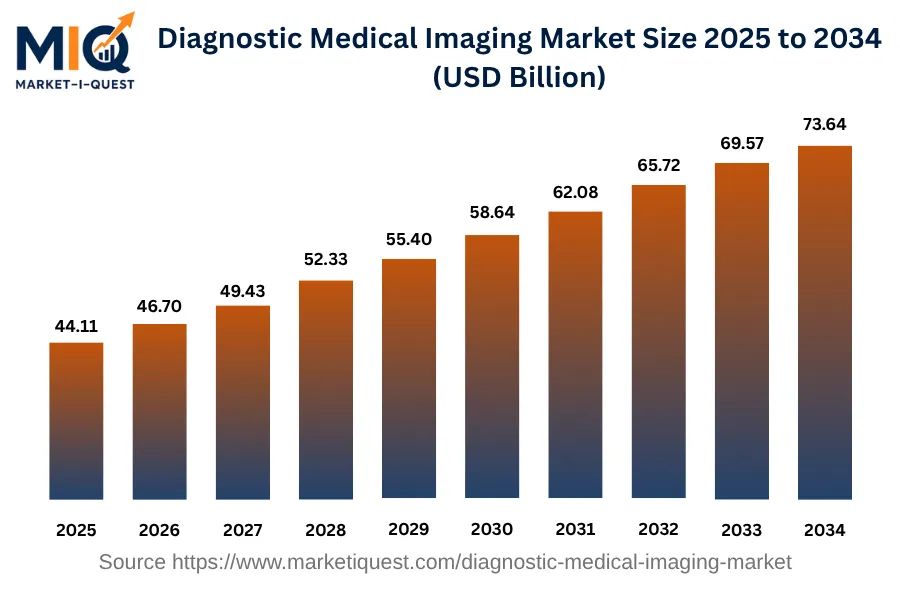
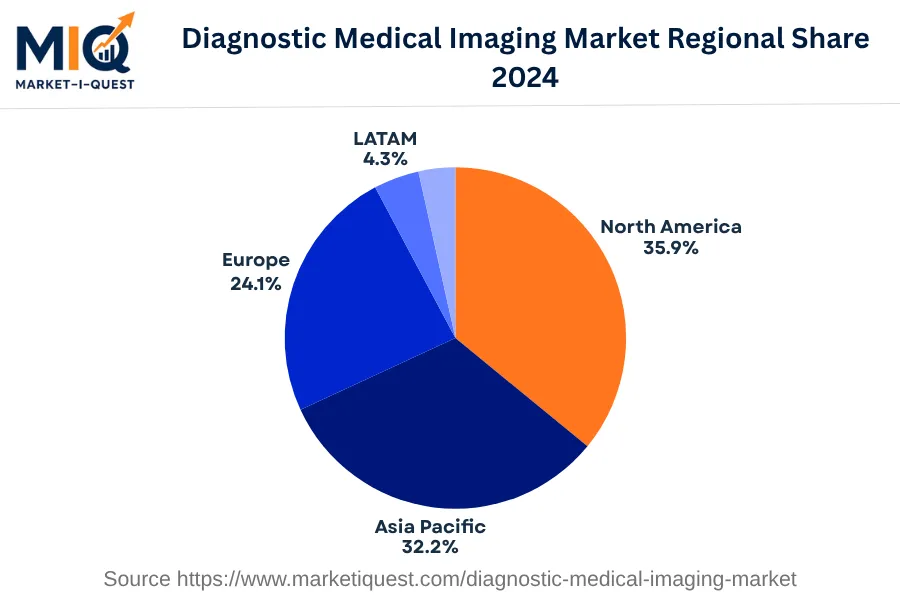
The Diagnostic Medical Imaging Market was valued at $44.11 billion in 2025 and is projected to reach $73.64 billion by 2034, with a CAGR of 5.9%. The increase in value from the recorded $41.67 billion in 2024 highlights the steady growth trajectory of the market. The rise is a result of technological advancements and increased demand for early disease detection. The upscaling demand has driven innovation, leading to the development of more sophisticated, accurate, and efficient medical imaging techniques. Additionally, the robust growth in telehealth services supports the expanding market, contributing to the observed growth from 2025 onwards. Regionally, the market was predominantly held by North America with a 35.9% share as of 2024, followed closely by the Asia Pacific with a 32.2% share while Europe held a 24.1% share. The remaining market was shared between LATAM with a 4.3% share and MEA with 3.5%.

Key Takeaways

  • By Product Type - X-Ray held the leading position in the market in terms of share in 2024.
  • By Application - Oncology led the Diagnostic Medical Imaging Market with the highest share in 2024.
  • By End User - Hospitals led the market segment highlighting a significant expansion path in the forecast period from 2025 to 2034.
diagnostic-medical-imaging-market market size

Key Driving Factors

Expansion of Telemedicine Services

Telemedicine, having gained significant traction in recent years, markedly influences the diagnostic medical imaging market. As a convenient, cost-effective solution, telemedicine enables remote patient monitoring and diagnosis, necessitating the widespread use of diagnostic imaging. During the COVID-19 pandemic, healthcare professionals rapidly adopted telemedicine to limit virus spread and maintain continuity of care. This reaches beyond pandemic contexts, extending to rural or under-resourced areas where local healthcare lacks specialist diagnostic equipment or personnel. As telemedicine continues expanding, fueled by supportive legislation like the US Furthering Access to Stroke Telemedicine (FAST) Act, the demand for diagnostic medical imaging technology is likely to surge, driving growth in the segment.
Integration of Artificial Intelligence in Medical Imaging

Artificial Intelligence (AI) has started permeating the diagnostic medical imaging industry, offering several advancements, such as improved image analysis accuracy, early-stage disease detection, and personalized patient care. For instance, algorithms may assist in identifying patterns or anomalies in scans that human eyes might overlook, enhancing the precision and speed of diagnostics. These benefits attract healthcare providers seeking to deliver better patient outcomes and more efficient services. Additionally, governments provide support: the FDA's Digital Health Innovation Action Plan encourages AI application in health technologies. Therefore, the application of AI in diagnostic medical imaging is a yield-bearing and sustainable trend acting as a key driver in this market.

Market Evolution by Timeline

2019-2023
The diagnostic medical imaging market saw an increasing demand in Asia, primarily in India and China, because of large patient pools and infrastructure development efforts. During this period, tele-radiology became common in hospitals, enabling remote diagnosis and consultations. Constraints included lack of skilled professionals and high cost of imaging devices. The United States' Affordable Care Act promoted preventive care, under which diagnostic imaging services became more accessible. On the commercial front, manufacturers moved towards service contract models, offering affordable options to healthcare institutions. The high radiation dose of imaging systems was a primary public health concern, prompting vendors to develop low-dose imaging systems.
2024
In 2024, the diagnostic medical imaging market saw a surge in demand for portable imaging devices from doctors' offices and ambulatory care centers. As a response to this demand, manufacturers introduced compact, cloud-connected devices with improved image quality. AI-based medical imaging software was broadly adopted, providing analysis and support for clinical decisions. The European Union implemented more stringent rules on device safety and performance under the Medical Device Regulation. Regarding pricing strategies, volume-based contracts became prominent. However, the short supply of technetium-99m, a medical isotope vital for several imaging procedures, posed a significant risk.
2025-2029
The period between 2025 and 2029 recorded considerable technological improvements, contributing to diagnostic precision, speed, and patient comfort. High demand from geriatric population drove the market in North America and Western Europe. AI continued to improve, aiding in early disease detection and personalized treatment. The FDA implemented the IMDRF's 'Software as a Medical Device' guidelines, influencing AI integration. An uptick in public-private partnerships was similar to the NHS' partnership with Philips for digital pathology solutions in 2025. There was a general shift towards value-based payment models. The risks in this period revolved around cybersecurity threats due to increased device connectivity.
2030-2034
By 2030–2034, more diagnostic medical imaging procedures were conducted in outpatient centers and patients' homes due to the growing remote patient monitoring trend. There was a spike in demand in Africa, supported by increased healthcare funding and infrastructure development. There were improvements in technologies like wearable imaging devices, miniaturized ultrasound equipment, and AI-driven automation. The WHO's global standard for radiation protection in medicine influenced policy on equipment usage and safety. Collaboration between vendors and imaging centers favored a shared risk model in procurement. Emerging risks included dealing with outdated equipment and regulatory challenges for devices with advanced technologies.

Future Market Outlook

Future Opportunities

The current trends in diagnostic medical imaging reveal several opportunities for market participants to expand their influence and enhance service delivery. As artificial intelligence applications in imaging software gain approval from regulatory agencies like the FDA, firms such as IBM Watson Health are positioned to leverage these technologies to provide more precise diagnostics. The aging global population, projected to reach 2 billion by 2050, increasingly necessitates advanced medical imaging solutions for age-related conditions. In 2023, the World Health Organization emphasized the importance of improved imaging in detecting early signs of diseases, creating demand for more comprehensive imaging services. Collaborations between technology developers and healthcare providers, as seen in partnerships between Zebra Medical Vision and top hospitals, underscore the growing need for integration of analytics into imaging workflows. Furthermore, ongoing investments in telemedicine, particularly post-pandemic, present a significant opportunity for remote diagnostic imaging services, catering to patients unable to access traditional healthcare settings. In March 2023, the American Telemedicine Association advocated for policies to support remote radiology interpretations as part of standard patient care. Additionally, expanding into emerging markets in Southeast Asia and Africa, where healthcare infrastructure is developing rapidly, presents a significant growth avenue for imaging manufacturers more keenly focused on accessibility and affordability. These future opportunities highlight a dynamic interplay between technological advancements, demographic shifts, and evolving healthcare policies that will shape the diagnostic imaging landscape.

Segmentation Analysis

By Product Type

The market is divided into subsegments including X-Ray, Ultrasound, Computed Tomography, Nuclear Imaging, Magnetic Resonance Imaging, with X-Ray accounting for the largest revenue share while Magnetic Resonance Imaging is expected to grow at the fastest CAGR during the forecast period.

Largest Revenue Share

X-Ray

Market Share Leader

The X-Ray segment leads in revenue generation due to various factors. Foremost among these is the prevalent use of X-ray diagnostics in the medical field. Being one of the earliest forms of medical imaging, X-ray technology is standard in medical facilities, from larger hospitals to smaller clinics. The relative low cost, compared to more advanced imaging technologies, makes its usage common in resource-sensitive environments, which expands the customer base. Geographically, while the technology is widespread worldwide, regions with a higher concentration of medical facilities, like North America and Europe, report larger revenue shares. Regulatory favorability, due to the long-standing safety and effectiveness record of X-ray diagnostics, has also contributed to this subsegment's dominance. From a sales perspective, the low switching costs associated with this technology make it a preferred choice. The technology's maturity has resulted in a well-established sales channel, which ranges from direct manufacturer sales to third-party medical suppliers. In summary, X-Ray's broad customer base, regulatory favorability, and established channels allow it to maintain the largest revenue share in this market segment.

Fastest CAGR

Magnetic Resonance Imaging

Forecast Period Growth Leader

The Magnetic Resonance Imaging (MRI) subsegment is projected to experience the fastest CAGR during the forecast period, thanks to a number of growth drivers. Technological advancements, which have improved image quality significantly, are a key catalyst for the rapid adoption of MRI. More specific diagnostic information, coupled with a non-invasive procedure, are appealing to both medical professionals and patients. Potential barriers to adoption may include the high capital expenditure or fear of confined spaces, but these are largely reduced through financing options and open MRI technology. Regulatory policies also support its adoption, as they underscore the necessity of precise and less invasive diagnostics. Crucially, partnerships between manufacturers, hospitals, and clinics are increasing accessibility, thereby driving further adoption. However, potential near-term risks include the high need for power and technical experts to operate and interpret the machinery, which may limit adoption to more developed regions initially. Despite this, MRI's superior capabilities and growth momentum make it the subsegment with the fastest growth.

By Application

The market is divided into subsegments including Cardiology, Oncology, Neurology, Orthopedics, Gastroenterology, Gynecology, and Others. In 2024, Oncology accounted for the largest revenue share while Neurology is expected to grow at the fastest CAGR during the forecast period.

Largest Revenue Share

Oncology

Market Share Leader

Oncology, the study and treatment of tumors and cancer, has always had a significant share of the healthcare sector, and it continues to grow in relevance due to high prevalence of cancer. Diagnosis and treatment of cancer are critical and high-cost areas of healthcare leading to substantial revenues. This segment benefits from a robust pharmaceutical industry that invests heavily in research and development of new cancer drugs. Global emphasis on early diagnosis and the growing availability of cancer screening programs contribute to generating sizable revenue in this subsegment. Regulatory bodies encourage advancements in oncology, leading to the approval and commercialization of innovative therapies, which also adds to the revenue. Geographically, developed countries with advanced healthcare infrastructure contribute heavily to oncology revenue. High-cost treatments and the prevalence of insurance also play significant roles. Within the subsegment, major pharmaceutical and biotechnological firms shoulder the burden of drug discovery and provision, which invariably drives revenue growth.

Fastest CAGR

Neurology

Forecast Period Growth Leader

Neurology, the branch of medicine that deals with disorders of the nervous system, is expected to grow at the fastest pace in the forecast period. Driving this growth are an aging population worldwide and a resulting surge in neurological conditions such as Alzheimer's, Parkinson's disease, epilepsy, and strokes. These factors significantly increase the demand for innovative neurological solutions. Technological advancements and research breakthroughs in understanding the human brain and nervous system also serve as catalysts for growth. The introduction of artificial intelligence and machine learning in diagnostics and treatment planning is expected to provide significant opportunities for market expansion. However, the high costs of advanced neurological procedures and devices may limit rapid adoption. Partnerships between healthcare providers and tech companies could lower costs, increasing accessibility and driving growth. Nonetheless, near-term risks include the stringent and time-consuming approval processes for new treatment methods or devices, which may slow down the speed of growth within the subsegment.

By End User

The market is divided into subsegments including Hospitals, Diagnostic Imaging Centers, and Ambulatory Imaging Centers. Hospitals accounted for the largest revenue share while Diagnostic Imaging Centers are expected to grow at the fastest CAGR during the forecast period.

Largest Revenue Share

Hospitals

Market Share Leader

Hospitals currently lead the market in terms of revenue, largely due to their advanced capabilities and high patient volume. They are often at the forefront of implementing new imaging technologies owing to their direct affiliation with healthcare systems. This gives them an advantage in terms of first access to innovations and increased financial capacity to invest in more advanced imaging equipment. Additionally, hospitals often cater to a broader range of services, including emergency care, where urgent imaging service is required, thereby increasing their overall utilization of imaging services. Moreover, several compelling factors such as increasing prevalence of chronic diseases, advanced infrastructure facilities, and favorable reimbursement policies are further driving the growth in this segment. The consistency of these factors across various jurisdictions indicates a high probability of continued dominance of hospitals during the forecast period.

Fastest CAGR

Diagnostic Imaging Centers

Forecast Period Growth Leader

Diagnostic Imaging Centers are projected to demonstrate the fastest growth within this market segment. Often operating independently from hospital systems, these facilities specialize in providing diagnostic imaging services including MRI, CT Scan, and X-ray imaging. With the increasing shift towards outpatient care and decreasing dependency on hospital resources, these centers are positioned for growth. The advancements in telemedicine and teleradiology further encourage their expansion. However, they can face barriers in terms of lower reimbursement rates and varying regulations across regions. To overcome these challenges, potential partnerships with local health systems or regulatory bodies could fast-track their adoption. Moreover, capital investment in state-of-the-art imaging technology and software can enhance their efficiency, providing a competitive advantage in this rapidly evolving market.

Competitive Analysis

Key Market Players

Manufacturers / OEMs

GE Healthcare
US
Siemens Healthineers
Germany
Philips Healthcare
Netherlands

Key Suppliers & Raw Materials

Shimadzu Corporation
Japan
Canon Medical Systems Corporation
Japan
Carestream Health
US

Distributors, Integrators & Channel Partners

McKesson Corporation
US
Cardinal Health
US
Henry Schein, Inc.
US

Porter’s Five Forces Analysis

Analysis of the Diagnostic Medical Imaging Market using Porter's Five Forces.

Supplier Bargaining Power

Medium

Suppliers, mainly OEMs, have significant control due to complex manufacturing processes of imaging equipment.

Buyer Bargaining Power

Low

High switching costs and the critical nature of medical imaging limit the buyers' bargaining power.

Threat of Substitutes

Low

Few substitutes are available for comprehensive diagnostic medical imaging.

Threat of New Entrants

Low

High capital expenditure, regulatory barriers, and technical expertise curb the entry of new players.

Competitive Rivalry

High

High competition exists among established players for market share and technological advancement.

Regional Analysis

Geographic market dynamics and growth opportunities across key regions

Global Market Outlook

diagnostic-medical-imaging-market market regional share

North America

In 2024, the North American Diagnostic Medical Imaging Market experienced significant shifts fueled by various drivers. Aging populations in the U.S., Canada, and Mexico intensified the demand for diagnostic medical imaging services as the need for early detection and treatment of age-related diseases heightened. Regulatory changes, such as the U.S.'s Medicare Access and CHIP Reauthorization Act, further spurred demand by broadening patient accessibility to these services. The preference for non-invasive diagnostic procedures accelerated technology adoption, and hefty investments in advanced medical imaging systems from healthcare facilities underscored this shift.

Simultaneously, other market trends were evident. Increasing health consciousness saw substantial consumer preference for preventive health checks, prompting healthcare facilities to invest in cutting-edge diagnostic imaging equipment. There has also been a significant digital transformation of radiology processes, with artificial intelligence integration becoming increasingly common in diagnostic procedures. A surge in telehealth platforms offering imaging services was witnessed, driven by continued social distancing measures. Notably, partnerships blossomed between traditional healthcare providers and tech startups, as a bid to improve patient-centered diagnostic services. This was punctuated by the highly-publicized collaboration between Google Cloud and Mayo Clinic. The Diagnostic Medical Imaging Market in 2024 served a diverse clientele that included government bodies, healthcare institutions, and, increasingly, individual consumers seeking preventive care.

Asia Pacific

In 2024, the Asia Pacific Diagnostic Medical Imaging Market flourished due to technological advancements, rising healthcare expenditure, and increasing patient awareness. Drivers included improved adoption of advanced technologies such as 3D and 4D imaging in China and Japan, fueled by both government and private sector investment in healthcare infrastructure. India’s regulation towards mandatory imaging equipment in all hospitals stimulated market growth. Moreover, continuous innovation in diagnostic imaging devices, specifically in South Korea and Australia, led to better efficient diagnoses, pushing demand upwards.

On the trends front, a noticeable shift towards portable and mobile imaging equipment was evident, owing to its convenience and cost-effectiveness. The emphasis on partnerships and mergers & acquisitions was witnessed across key ASEAN markets, aiming at broadening the product portfolio and enhancing market reach. For instance, mergers between diagnostic imaging firms and local hospitals in Australia intending to integrate advanced imaging techniques into healthcare services. Additionally, the enforcement of stricter emission standards for imaging machinery in China affected the manufacturers' operations. Key sectors driving demand for diagnostic medical imaging included governmental health departments, private healthcare institutions, and large-scale hospitals across the region. Indeed, the increased utilization of diagnostic imaging in retail health clinics is clear evidence of the radiating influence of this technological adoption across the healthcare landscape. Overall, the diagnostic medical imaging market showcased robust growth within the Asia Pacific in 2024.

Europe

In 2024, Europe's Diagnostic Medical Imaging Market was primarily fuelled by rising chronic disease prevalence, technological advancements, and investment in healthcare infrastructure. Specifically, Germany's robust healthcare funding increased the demand for timely disease detection, leading to a better adoption rate of enhanced imaging technologies. In the United Kingdom, government regulations favored increased utilization of diagnostic imaging technologies in public and private healthcare institutions, consequently propelling the market. Additionally, the integration of AI and machine learning in medical imaging contributed to the market expansion in technologically advanced regions like Benelux and the Nordics.

The growing consumer preference for non-invasive diagnostic procedures emerged as a significant trend across Europe, especially in France and Italy. Tele-radiology saw an upswing, particularly in Spain and Central & Eastern Europe, where remote patient monitoring became increasingly vital. Furthermore, strategic mergers and acquisitions among leading imaging technology providers contributed to the broadening of product portfolios and market consolidation predominantly in the Nordics and Germany. Lastly, the implementation of strict radiation safety standards by governments in the United Kingdom and France shaped the market, urging invention of safer imaging technologies and influencing purchaser preferences towards CE Marked systems – established, pan-European policy enforcement affirming compliance with health, safety, and environmental protection standards.

Latin America

In 2024, the Diagnostic Medical Imaging Market in Latin America observed substantial growth, spurred by drivers in demand, technologies, and regional healthcare investments. Primary drivers shaping this surge include increased government funding in healthcare across major economies, such as Brazil and Mexico, advancements in imaging technologies, and a heightened demand resulting from aging populations with chronic diseases. Implementation of regulation policies, like Mexico’s National Health Plan, pursued the integration of imaging services to enhance diagnostic accuracy, effectively boosting market growth. Argentina’s active investment in modern imaging technologies signifies the broad adoption of sophisticated diagnostic tools.

The notable trends in 2024 were anchored in buyer behavior adjustments, product technology shifts, and systemic changes in healthcare policies. Patients in countries like Chile, Colombia, and Peru, driven by increasing health-consciousness, are seen preferring early diagnostic procedures, influencing the market positively. The rampant digitization of medical imaging, with an increased reliance on Artificial Intelligence in Brazil, has revolutionized diagnostic procedures. Furthermore, the enforcement of stricter accreditation standards by regulatory bodies across the region has enhanced both service quality and patient safety, thus promoting the use of advanced medical imaging. Healthcare providers, government healthcare agencies, and enterprises remained the primary customers contributing to the flourishing Diagnostic Medical Imaging Market in Latin America in 2024.

Middle East & Africa

In 2024, the Diagnostic Medical Imaging market in the Middle East and Africa got defined by substantial technological adoption and robust investments, driven largely by the healthcare policy reforms across Saudi Arabia, UAE, and Qatar. Firstly, increased investment in healthcare infrastructure, like Saudi Arabia’s Vision 2030 initiative, promoted a greater demand for advanced medical imaging technologies. Secondly, favourable regulatory environments, particularly in the UAE and Qatar, encouraged businesses to develop localized solutions, resulting in a surge in supply. Lastly, increases in the prevalence of chronic diseases across the region led to higher demand, driving up pricing.

Trends encompassed product innovation, market penetration, and consumer engagement. There was prominent innovation, especially towards AI-integrated imaging devices. Moreover, growing partnerships with major hospitals and initiatives from Israeli firms saw escalation in product penetration rates. The introduction of tele-radiology, especially across Nigeria and Kenya, enabled remote access to medical images, enhancing consumer engagement. In sectors including government, healthcare, and financial services: UAE’s Ministry of Health partnered with Philips for continuous health monitoring, South Africa’s Life Healthcare Group expanded diagnostic imaging services, and Egypt saw investments from EFG-Hermes in radiology centers.

Recent Industry Developments

Latest market innovations, product launches, and strategic initiatives

June 2026

GE HealthCare received regulatory clearance for new artificial intelligence software that automates and speeds up the planning process for cancer radiation treatments.

May 2026

Siemens Healthineers secured government approval to release six new imaging systems that act as real-time visual guides for doctors performing minimally invasive surgeries.

April 2026

Bracco Imaging partnered directly with NYU Langone Health to research and develop new contrast materials, which are the specialized fluids given to patients to make internal organs visible on medical scans.

Frequently Asked Questions