Untitled Report Snapshot

Key Players

  • Atlassian (Australia)
  • Rackspace (USA)
  • AWS (USA)
  • Puppet (USA)
  • Chef Software (USA)
  • Docker (USA)
  • Microsoft (USA)
  • Red Hat (USA)
  • IBM (USA)
  • CA Technologies (USA)

Market Size

Base Year 2024
$13.58 Bn
CAGR
15.9%
Forecast 2034
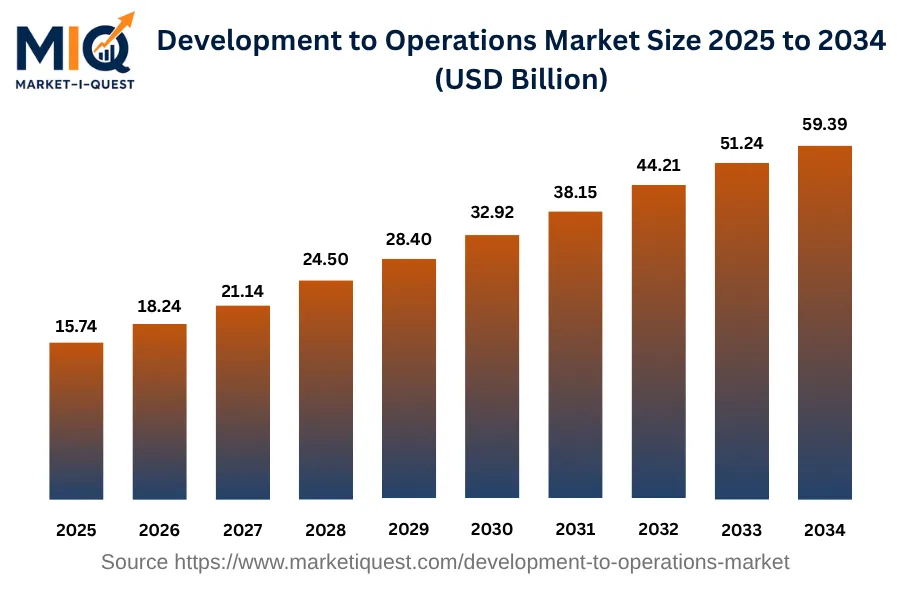
$59.39 Bn

Market Segments

By Deployment
  • Cloud
  • On-premises
By Enterprise Size
  • Small & Medium-Sized Enterprises
  • Large Enterprises
By End Use
  • IT
  • BFSI
  • Retail
  • Telecom
  • Others

Market Dynamics

Drivers
  • Increasing Efficiency in Processes
  • Rise in Automation Technologies
Restraints
  • Limited IT infrastructure
  • Budget constraints
Opportunities
  • Increased demand for streamlined workflows
  • Rising automation technology adoption

Market Size

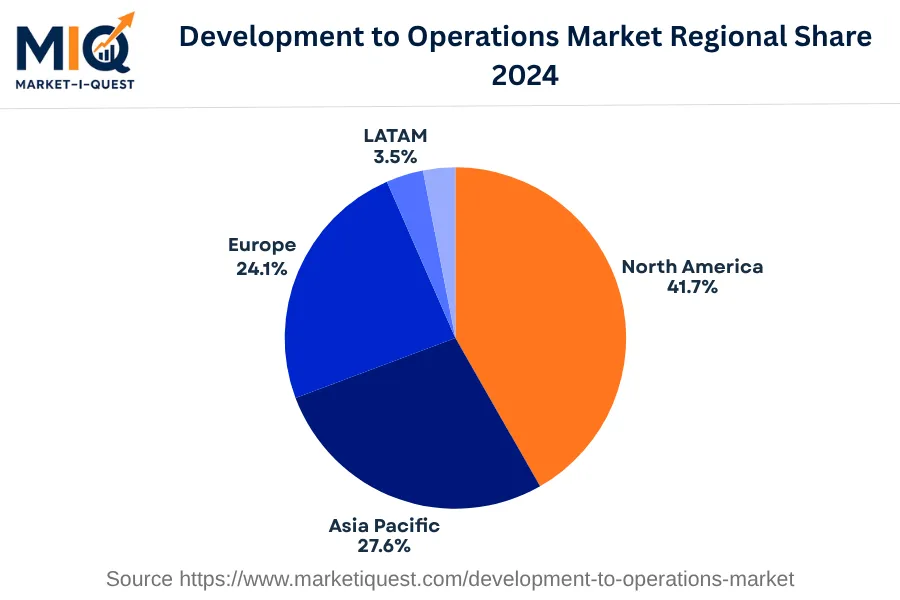
The Development to Operations Market was sized at $15.74 billion in 2025, and it is set to expand substantially to reach $59.39 billion by the end of 2034. This exceptional growth reflects a CAGR of 15.9% over the given period. This marked increase in the market's value from 2025 to 2034 directly corresponds to the growth rate specified. The market is growing at a consistent pace every year under review. As for the regional distribution, in 2024, North America held the largest share at 41.74%. The Asia Pacific accounted for the second-largest share at 27.56%, closely followed by Europe at 24.13%. Latin America and the Middle East and Africa had the smallest shares at 3.52% and 3.05% respectively.

Key Takeaways

  • By Deployment - Cloud grew rapidly indicating a shift in enterprise preference.
  • By Enterprise Size - Large Enterprises showcased robust growth reflecting the increasing digitalization of SMEs.
  • By End Use - Telecom held substantial market share demonstrating the industry's growth towards Development to Operations solutions.
development-to-operations-market market size

Key Driving Factors

Acceleration of Cloud Migration Strategies

The Development to Operations (DevOps) market is experiencing a robust push from the acceleration of cloud migration strategies across numerous industries. With Covid-19 having catalyzed a wave of remote work adoption, companies are seeking cloud solutions to maintain agility and scalability of software operations. Here, DevOps plays a crucial role - its principles and practices are key to regulate, support, and streamline these migrations to virtual environments. Importantly, organizations such as financial services and healthcare that handle sensitive customer data are taking the lead, as they require robust solutions to maintain security and regulatory compliance during their digital transitions, a demand DevOps solutions are well-positioned to fulfill.

Increased Adoption of Microservices Architecture

Another specific driving factor in the Development to Operations market is the increased adoption of a microservices architecture in software development. Microservices enable the continuous delivery and deployment of large, complex applications. They promote the use of modular, independently deployable components that can operate in isolation, thus reducing the complexity of deploying and testing new versions of applications. DevOps sits at the heart of this architectural trend as it offers the necessary tools and methodologies to manage this structure effectively. Predominantly, organizations with high-traffic online platforms such as e-commerce or digital streaming services are turning to microservices and by extension DevOps, in order to efficiently manage their platforms, reduce downtime, and deliver a more seamless experience to users.

Market Evolution by Timeline

2019-2023
In this period, Development to Operations (DevOps) popularized around to improve software development efficiencies. Key buyers included IT industry giants like Amazon, Google, and IBM, focusing on cloud-based solutions in regions including North America, West Europe and Australia. On the supply side, a shift towards containerization tools, like Docker and Kubernetes, proved significant, troubleshooting integration issues. However, major constraints included lack of skilled workforce and security issues. On policy, the US Department of Defense started 'Enterprise DevOps' initiative. Usually, pricing was subscription-based, with annual or multi-year contract tendencies. Partnerships emerged between software providers to deliver comprehensive DevOps solutions. Risks involved overestimation of benefits leading to missed objectives, mitigated by agile adoption of practices.
2024
DevOps in 2024 saw an increased demand from emerging markets like India and Brazil driven by mobility and digital transformation. In terms of supply, automation technologies like Artificial Intelligence and Machine Learning for DevOps started to make an impact. The increase in cyber threats led to more stringent regulations in regions including the European Union. Subscription-based pricing models still dominated, the rise in 'value-based' contracts was prominent, shifting accountability from client to provider. New collaborations between IT firms and academic institutions addressed the shortage of skilled practitioners. Resistance to adopt DevOps culture due to uncertainty in returns posed a major risk.
2025-2029
Between 2025 and 2029, large non-tech corporations invested in DevOps to modernize their IT operations, predominantly in North America and Europe. More mature automation tools surfaced, including AI-driven testing solutions. The ISPMA-DASA DevOps Standard, a significant regulatory initiative, influenced adoption, offering a benchmark for quality. Prices began to stabilize due to increased competition, and risk-sharing contracts became common, leading to deeper vendor-client partnerships. However, blending traditional IT practices with DevOps approach remained challenging, a risk that many firms tackled by mapping out clear transition plans.
2030-2034
In this period, demand for DevOps solutions spread into governmental and public sector, mainly in Europe and Asia. Proliferation of AI-enhanced DevOps tools was remarkable, yet supply constraints surfaced related to data privacy and ethical dilemmas of automation. The OECD Digital Reg Framework notably regulated AI use. Growing competition led to introduction of dynamic pricing schemes, with deals often bundled with consultation and transition support. Strategic partnerships between tech and non-tech firms enabled mutual penetration of markets. The critical risk was overdependency on AI, countered by enhanced human oversight and evaluation mechanisms.

Future Market Outlook

Future Opportunities

The landscape for the Development to Operations market is poised to evolve further, building on current trends and regulatory shifts. The increasing focus on sustainable software development, driven by initiatives like the EU's Green Deal, encourages organizations to implement environmentally friendly practices across the entire development lifecycle. As corporations like Microsoft align their strategies with carbon neutrality goals by 2030, opportunities in eco-conscious DevOps solutions will likely emerge. Furthermore, the ongoing expansion of 5G networks globally can create avenues for enhanced application performance and connectivity across distributed systems, prompting businesses to innovate their DevOps strategies accordingly. As open-source projects continue to flourish, communities around platforms like OpenShift are likely to foster collaboration among developers worldwide, enhancing knowledge sharing and innovation. Additionally, as cybersecurity threats rise, businesses will increasingly adopt zero-trust architectures, fortified by industry standards like ISO/IEC 27001, creating demand for integrated security solutions within DevOps environments. The global shift towards edge computing, accelerated by remote work initiatives since 2020, prompts enterprises to seek adaptive DevOps models that optimize performance closer to end users. By leveraging these emerging trends, organizations can anticipate shifting consumer demands while building agile and secure development practices, ultimately shaping the future of the DevOps market landscape.

Segmentation Analysis

By Deployment

The market is divided into subsegments including Cloud and On-premises. Cloud accounted for the largest revenue share while On-premises is expected to grow at the fastest CAGR during the forecast period.

Largest Revenue Share

Cloud

Market Share Leader

The cloud subsegment leads the market in terms of revenue generation, driven by several key factors. Firstly, the trend towards digital transformation in various industries has significantly increased the adoption of cloud services. Businesses are leveraging cloud computing to modernize their operations and enhance their efficiency. Moreover, the elastic nature of cloud provides businesses with the flexibility to scale up or down their IT resources based on requirements, ultimately leading to cost savings. Geographical barriers have been minimized thanks to cloud technology, expanding customer reach for businesses globally. Regulatory environments too are gradually evolving in favor of cloud adoption, with regulations supporting data security and privacy. The purchasing criteria often revolve around factors such as scalability, cost-effectiveness, and data handling capacity, where cloud generally score high. High switching costs associated with migrating from traditional IT systems to cloud also contribute to the high revenue share. Furthermore, prominent cloud service vendors have established robust channels for product distribution and post-sales services, facilitating customer acquisition and retention.

Fastest CAGR

On-premises

Forecast Period Growth Leader

Although trailing in terms of revenue share, the On-premises subsegment is primed for high growth in the coming years. Increasing concerns over data security and privacy are leading organizations, particularly in sensitive industries such as banking, healthcare and defense, towards on-premises solutions. These, despite involving comparatively higher CAPEX, give them full control over their data and systems. Technological advancements such as improved hardware performance, virtualization and sophisticated data center design are acting as catalysts for this growth. Additionally, strategic partnerships between on-premises solution providers and leading tech companies are fostering innovation and driving market adoption. While barriers like the need for trained personnel and frequent infrastructure upgrades exist, the growing realization of the strategic value of data is helping overcome these. It should, however, be noted that unexpected shifts in policy or sudden economic downturns could pose near-term risks. Nonetheless, the growth trajectory for the On-premises subsegment looks promising.

By Enterprise Size

The market, divided by enterprise size into Small & Medium-Sized Enterprises and Large Enterprises, sees Large Enterprises generating the largest revenue. However, Small & Medium-Sized Enterprises is projected to grow at the fastest CAGR.

Largest Revenue Share

Large Enterprises

Market Share Leader

Large enterprises often dominate in terms of revenue generation. There are numerous drivers behind this. Firstly, these enterprises have more resources at their disposal allowing them to invest in advanced technologies and highly skilled labor to maintain a competitive edge. Next, in many industries, size equates to a larger customer base providing a steady stream of revenue. Additionally, they often operate across multiple geographical regions, having wider market coverage contributing to increased sales volume. Furthermore, large enterprises are better equipped to navigate through regulations or supply chain complexities owing to their well-established legal and logistics teams. Lastly, companies often prioritize large enterprises when developing their go-to-market strategies, given their potential to purchase in larger quantities and provide more significant sales.

Fastest CAGR

Small & Medium-Sized Enterprises

Forecast Period Growth Leader

Despite large enterprises accounting for the lion's share of revenues, the Small & Medium-Sized Enterprises segment is expected to register the fastest compounded annual growth rate. This can be attributed to several factors. The most prominent among them is technology adoption. In recent years, small and medium-sized businesses have been leveraging new technologies to level the playing field with their larger counterparts. Additionally, government policies and initiatives promoting SME growth and entrepreneurship are acting as catalysts. However, obstacles such as access to capital and digital literacy may slow down the adoption rate. The risk of market saturation and heightened competition in this segment could also pose challenges in the near term. Nevertheless, strategic partnerships with technology providers and network effects, where the value of service increases with more users, are two areas that hold promising growth prospects for this segment.

By End Use

The market is divided into subsegments including IT, BFSI, Retail, Telecom, and others. In 2024, the Telecom subsegment accounted for the largest revenue share while the IT subsegment is expected to grow at the fastest CAGR during the forecast period.

Largest Revenue Share

Telecom

Market Share Leader

The Telecom subsegment leads the market in terms of revenue, driven by the growing demand for high-speed internet connectivity, advancements in wireless technologies, and the proliferation of smart devices. Key players in this sector are heavily investing in infrastructure development to support the delivery of various services such as VoIP, video streaming, and teleconferencing. Regulatory landscapes are also facilitating the growth of telecom by promoting competition and technological innovation. Highly populated regions like Asia and Africa, with their increasing telecommunication needs, are significantly contributing to the segment's revenue. While the purchasing decisions in this segment are largely driven by service quality, data speed, and network coverage, customers are demonstrating high switching costs due to the often difficult and time-consuming process associated with it. The primary channels for revenue have been the sales of data plans and voice minutes, which are expected to continue their significant contributions in the coming years.

Fastest CAGR

IT

Forecast Period Growth Leader

The IT subsegment is anticipated to exhibit the fastest CAGR during the forecast period. The growth is primarily driven by the increasing adoption of cloud-based services and the swift digitalization across various industries. Technological enhancements such as automation, artificial intelligence, machine learning, and IoT are propelling the growth in this segment. Corporate and government spending on digital infrastructure and cybersecurity is also playing an essential role in driving this rapid growth. Barriers to adoption include concerns around data security and privacy, high setup costs, and lack of technical expertise. A major catalyst for growth could be strategic partnerships between IT providers and businesses where they assume the role of an end-to-end IT solution provider. The turbulence and fluctuations in the global economic conditions pose a near-term risk to the expected growth in this subsegment.

Competitive Analysis - Development to Operations Market

Key Market Players

Manufacturers/OEMs

IBM
US
Oracle
US
Microsoft
US

Key Suppliers & Raw Materials

Red Hat, Inc.
US
Chef Software Inc.
US
Atlassian Corporation Plc
Australia

Distributors, Integrators & Channel Partners

Docker, Inc.
US
Puppet, Inc.
US
SaltStack, Inc.
US

Porter’s Five Forces Analysis

This brief examines the competitive forces impacting the Development to Operations (DevOps) market.

Supplier Bargaining Power

Medium

Vendors have moderate power due to the reliance on their technical expertise and software solutions.

Buyer Bargaining Power

High

Buyers enjoy strong bargaining power due to numerous available vendors, customizable solutions and low switching costs.

Threat of Substitutes

Medium

In-house development and traditional IT operations pose a moderate substitution threat.

Threat of New Entrants

Low

Significant technical knowledge and resource investment act as barriers to entry.

Competitive Rivalry

High

Rivalry is intense among existing providers, with constant innovation and feature enhancements.

Regional Analysis

Geographic market dynamics and growth opportunities across key regions

Global Market Outlook

development-to-operations-market market regional share

North America

In 2024, the North American Development-to-Operations (DevOps) market entered a phase of significant expansion due to varying factors. Key market drivers included robust demand from enterprises making the shift towards digital transformation, regulatory pressures prompting IT optimization, and substantial investments into AI and automation technologies. For instance, the U.S.'s adoption of stringent data governance regulations significantly encouraged businesses to implement DevOps practices for efficient compliance. Moreover, technology giants like IBM and Google spurred the market through their commitment to fostering advanced AI-powered DevOps solutions.

Simultaneously, buyer behavior trended towards end-to-end DevOps tools offering comprehensive management, allowing for simplified processes and greater IT agility. As a decisive shift, Cloud-based DevOps solutions witnessed growing favorability among a broad range of sectors, from government and healthcare to retail and manufacturing, thanks to their scalability and flexibility. Furthermore, the market saw a considerable surge in partnerships and M&A, such as Microsoft's acquisition of GitHub, set to consolidate market positions and broaden DevOps service offerings. Finally, policy enforcement became increasingly stringent, and standardization efforts from standards bodies like the DevOps Institute were instrumental in driving best practices, thereby buttressing the market.

Asia Pacific

In 2024, the Asia Pacific Development to Operations (DevOps) market reflected significant expansion, primarily influenced by digital transformation initiatives and rapid technical advancements. Drivers for growth included robust demand for seamless software delivery from various sectors, including government, healthcare, utilities, manufacturing, and retail. Significant investments in Artificial Intelligence (AI) and machine learning technologies by China and India accelerated infrastructure automation, boosting the DevOps market. Meanwhile, stringent IT regulations particularly in Japan and South Korea necessitated streamlined workflows, further driving adoption. Supply dynamics in Australia's IT market facilitated cost-effective DevOps solutions, influencing positive market sentiments.

Trends witnessed a surge in cloud-native DevOps adoption due to its scalability and efficiency, promoted largely by growing digital enterprises in India and key ASEAN markets. There also existed an increased emphasis on cybersecurity, resulting in the integration of DevSecOps particularly in sectors with data-sensitive operations like healthcare. Significant partnerships and M&A, particularly in the tech-savvy markets of China and Japan, indicated rising confidence in DevOps strategies. Moreover, enforced policies for standardization, such as India's Digital India initiative, set the tone for widespread adoption.

Europe

In 2024, the Development to Operations (DevOps) Market in Europe has shown significant growth, driven by factors such as increasing demand for efficient computing practices, investment in digital transformation, and regulatory requirements for data management. New cybersecurity laws in the European Union have spurred the adoption of DevOps practices, particularly in sectors such as banking, healthcare, and retail. Additionally, continuous integration and deployment, integral to DevOps, has attracted IT enterprises due to the need for continuous software delivery.

Trends in the market include a shift towards cloud-based DevOps solutions, influencing buyer behavior across sectors like manufacturing and utilities. Meanwhile, the rising popularity of Kubernetes in the tech landscape has driven the shift towards containerization in DevOps practices. Partnerships and M&A activity also signify the expansion of the market, with larger IT firms in Germany and United Kingdom acquiring smaller DevOps solution providers. Lastly, enforcement of GDPR has resulted in the adoption of DevOps practices as a measure of ensuring policy compliance, especially in data-sensitive sectors such as banking and healthcare. Overall, the European DevOps market in 2024 is heavily driven by regulatory requirements, technological advancements, and strategic market activities.

Latin America

In 2024, the Development to Operations (DevOps) Market in Latin America (LATAM) displayed significant growth as various sectors adopted advanced software development practices. Key drivers included regulatory changes enabling digital innovation, growing demand for quick software deliveries and updates, increased investment in IT infrastructure across industries, and the rising adoption of cloud technologies in countries like Brazil, Mexico, Argentina, Colombia, Chile, and Peru. The implementation of new tech policies encouraged the migration to Agile and DevOps practices in sectors like enterprise, government, healthcare, utilities, manufacturing, and retail.

Dominant trends in 2024 involved a shift in buyer behaviors as organizations increasingly sought customized DevOps solutions to optimize their operations. Channel dynamics shifted towards cloud-oriented service distribution, driven by advances in software development technology. Strategic partnerships and M&As in natural resource-rich nations such as Brazil and Argentina grew as an integral part of expanding DevOps applications in the industrial sector. The enforcement of data sovereignty laws spurred the demand for localized cloud and DevOps solutions in different LATAM markets, pushing companies to seek localized vendors. The year witnessed strong collaboration between local vendors and international players, aiding in the adoption and normalization of DevOps practices across multiple LATAM industries.

Middle East & Africa

In 2024, the Development to Operations (DevOps) market in the Middle East and Africa experienced significant growth. Stimulating this growth were factors such as wide-ranging digital transformation initiatives in countries like Saudi Arabia, UAE, and Qatar. Government regulations in these countries encouraged the adoption of innovative technologies, creating an environment conducive for this development. Moreover, substantial investment flowed into DevOps from various sectors, notably oil and gas, telecom, and financial services, seeking efficiency gains and robust software solutions.

The market also saw intriguing trends. For instance, customization of DevOps tools became common as varied industries with unique requirements adopted the practice. There was a noticeable shift towards containerization, particularly in sectors such as manufacturing, healthcare, and retail. Additionally, an increase in strategic partnerships was evident across the region, especially in Kenya, Egypt, and South Africa, aiming to foster technological exchange and shared growth. Notably, in Israel, widespread acceptance and implementation of DevOps was observed across the teeming startup scene. Government policies and support in the country have been instrumental in this surge. However, in Nigeria, a significant growth in the use of DevOps was seen within the financial services industry, fueled primarily by the sector's drive for digital innovation and efficiency amidst competitive market dynamics. Consequently, the market was boosted across diverse sectors and regions, with evident interplay of various drivers and trends.

Recent Industry Developments

Latest market innovations, product launches, and strategic initiatives

February 2026

Perforce published the 2026 State of DevOps Report. The global survey data revealed that organizations with strict, established development practices are significantly more successful at implementing and scaling artificial intelligence tools than those with informal processes.

December 2025

The organization released version 1.35 of Kubernetes. This software update introduced a feature that allows engineering teams to adjust computing memory and processing power without having to restart their running applications.

Frequently Asked Questions