Dermatology Devices Market Snapshot

Key Players

  • Alma Lasers (Israel)
  • Medtronic (Ireland)
  • Lumenis (Israel)
  • 3GEN Inc. (United States)
  • Valeant Pharmaceuticals (Canada)
  • Carl Zeiss Meditec (Germany)
  • Cutera (United States)
  • CoolTouch Inc. (United States)
  • Ambicare Health Ltd (UK)
  • Dusa Pharmaceuticals (United States)

Market Size

Base Year 2024
$15.4 Bn
CAGR
11.3%
Forecast 2034
$44.92 Bn

Market Segments

By Product Type
  • Diagnostic Devices
  • Treatment Devices
By Application
  • Skin Cancer Diagnosis
  • Vascular Lesions Removal
  • Hair and Wrinkle Removal
  • Body Contouring and Fat Removal
  • Others
By End User
  • Hospital
  • Dermatology Clinics
  • Others

Market Dynamics

Drivers
  • Rising prevalence of skin diseases
  • Technological advancements in dermatology devices
Restraints
  • High equipment costs
  • Stringent regulatory approvals
Opportunities
  • Advancements in laser technology
  • Innovations in non-invasive devices

Market Size

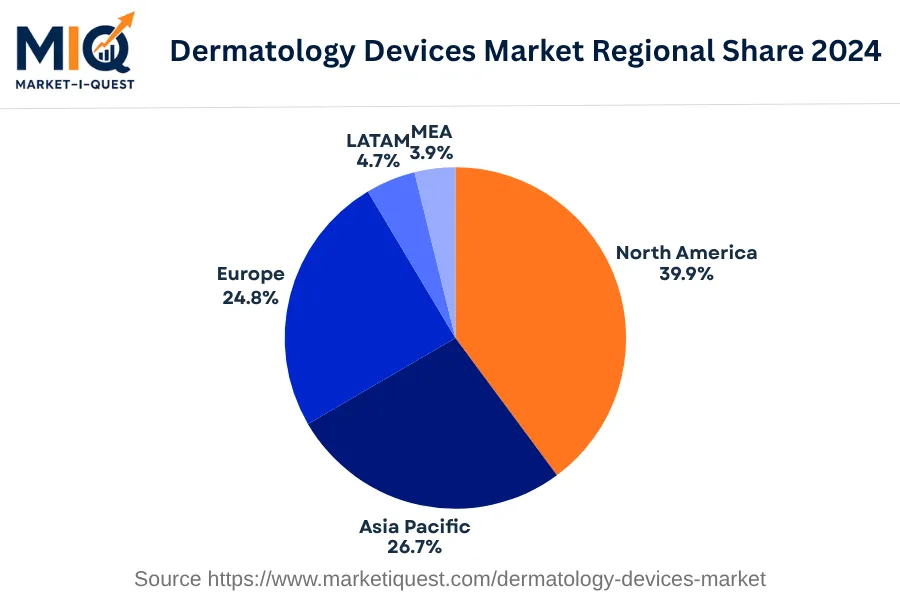
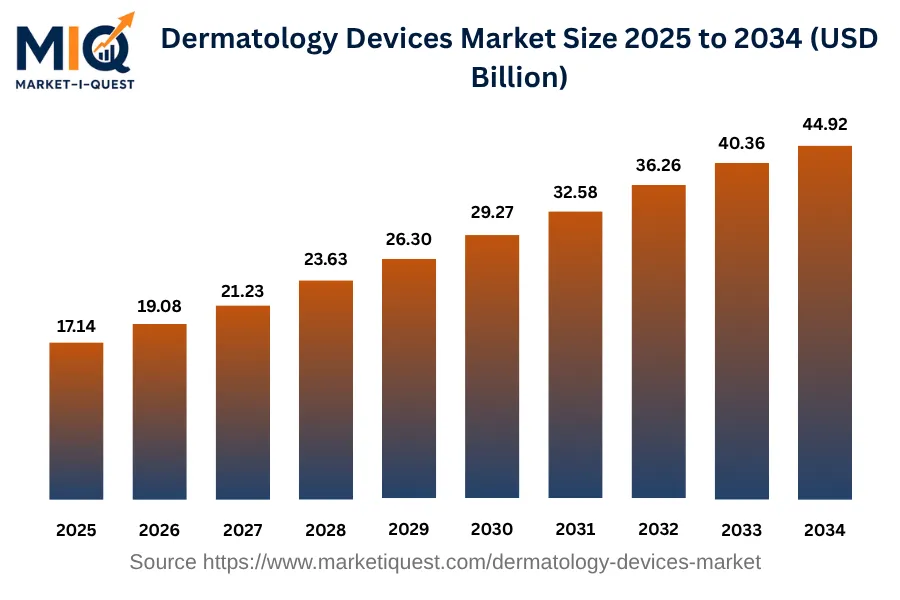
The Dermatology Devices Market was worth USD 17.14 billion in 2025 and is projected to grow to USD 44.92 billion by 2034, yielding a CAGR of 11.3% over this period. The rapid expansion can be attributed to an increased demand for dermatological treatments due to rising global prevalence of skin conditions and diseases. Furthermore, technological advancements in dermatological devices have led to innovative product developments, which have resulted in more effective treatments that are driving market growth. By 2024, the regional share mix of the Dermatology Devices market was segmented as follows: North America represented the highest share with 39.9%, followed by Asia Pacific at 26.74%, Europe at 24.83%, Latin America at 4.71%, and the Middle East and Africa at 3.86%.

Key Takeaways

  • By Product Type - Diagnostic Devices led the Dermatology Devices Market accounting for a significant share in 2024.
  • By Application - Body Contouring and Fat Removal held a dominant position in the Dermatology Devices Market in 2024.
  • By End User - Hospitals indicated the largest market share in the Dermatology Devices Market in 2024.
dermatology-devices-market market size

Key Driving Factors

Increased Prevalence of Skin Diseases

A significant factor driving the dermatology devices market is the heightened prevalence of skin diseases globally. Conditions like acne, dermatitis, psoriasis, and skin cancer are becoming increasingly common, necessitating the utilization of advanced dermatology devices for diagnosis and treatment. Healthcare professionals are realizing the value of these devices in improving patient outcomes swiftly and efficiently. As the number of people with skin conditions continues to rise, the demand for these sophisticated devices is set to grow, fuelling the expansion of the dermatology devices market.

Greater Acceptance of Cosmetic Dermatology

Another crucial propeller of the dermatology devices market is the rising acceptance and popularity of cosmetic dermatology procedures. Society's increasing emphasis on appearance has led to a boost in procedures such as skin rejuvenation, body contouring, and removal of birthmarks, scars, and tattoos. To fulfill this rising demand, clinics and hospitals are adopting advanced dermatology devices that enable less invasive, more efficient, and safer procedures. As societal norms continue to shift towards embracing cosmetic dermatology, this trend is likely to further spur the growth of the dermatology devices market.

Market Evolution by Timeline

2019-2023
In this period, the demand for dermatology devices was primarily driven by North American and European regions due to increased awareness about skin diseases and cosmetic enhancements. Suppliers focused on light therapy devices for acne treatment and aesthetic lasers for skin resurfacing. In the regulatory space, the EU Medical Device Regulation (EU MDR) 2017 came into effect, causing manufacturers to reassess their product portfolios. The commercial models included direct sales, partnerships with hospitals and clinics, and rental agreements. Risks in this period included the high costs of some devices which, coupled with the limited reimbursement opportunities, posed a barrier to adoption.
2024
The single year of 2024 showed a continued focus on light therapy and aesthetic lasers. The Asia Pacific region increased its demand for dermatology devices due to growing disposable income and awareness about skin health. Major constraints included the technical understanding required to operate some devices, instigating investment in training and support services. In terms of regulations, FDA's safety guidelines of medical devices enforced suppliers to ensure both user and patient safety. Perceive a trend towards dynamic pricing models based on usage over a set period.
2025-2029
Over this period, targeted therapies and personalization reportedly became key areas of innovation, backed by the advent of AI and Machine Learning in dermatological diagnostics. The Middle East region opened up as a new potential market due to growth in healthcare infrastructure. Tele-dermatology emerged as a result of the COVID-19 pandemic, setting a new norm for remote patient consultation. Devices adhered to stricter low-power emission standards. Pricing swung towards subscription-based models with a trend of value-based contracts. Risk was in data privacy with the use of AI and teleconsultation.
2030-2034
Entering this period, demand shifted towards non-invasive home-use devices driven by consumer preference for self-care. Africa experienced a rise in demand due to increased access to healthcare. Manufacturers likely focused on smart connected devices for remote monitoring of skin conditions. New safety standards for these connected devices were likely introduced. Pandemic-driven tele-dermatology became a mainstay, prompting concerns around data safety. As a response, companies put in place stringent data protection regulations. Economic instability acted as a potential risk affecting both supply and demand.

Future Market Outlook

Future Opportunities

Given the shifts currently taking place in dermatology, numerous future opportunities are emerging. With the increased focus on skin health awareness campaigns by entities such as the Skin Cancer Foundation, dermatology devices could benefit from heightened consumer demand for preventive care solutions. Advances in teledermatology present further avenues for innovation, as evidenced by the successful partnerships between health systems and tech companies, facilitating remote patient monitoring through devices like the iPhone 13's camera features for skin analysis. The expansion of regenerative medicine, particularly with stem cell technologies approved for clinical trials by the FDA in 2023, opens a new dimension in treating skin conditions and offers intriguing possibilities for device integration. There is also a growing interest in personalized skincare, driven by consumer preferences for tailored solutions, highlighting the potential for devices that incorporate genetic testing to customize treatments. The European Union's regulatory framework, which aims to streamline approvals for medical devices using AI, could catalyze the entry of more innovative products into the market. Additionally, sustainability trends are providing opportunities for the development of eco-friendly dermatology devices, aligning with global efforts toward reducing medical waste. As these factors converge, the dermatology devices market is poised to expand its offerings, catering to both evolving clinical demands and the shifting consumer landscape.

Segmentation Analysis

By Product Type

The market is divided into subsegments including Diagnostic Devices and Treatment Devices, with Diagnostic Devices accounting for the largest revenue share while Treatment Devices is expected to grow at the fastest CAGR during the forecast period.

Largest Revenue Share

Diagnostic Devices

Market Share Leader

Diagnostic devices in the healthcare sector have consistently landed the largest revenue in the industry. This performance can be attributed to several factors. There is an ongoing drive towards ensuring preventative, personalized, and precise diagnostic procedures across the medical field. The use of diagnostic devices aids health facilities in accurately diagnosing diseases, which is vital in determining effective treatment strategies. Higher purchasing power, coupled with rising awareness about the importance of early diagnosis, is likely to contribute to this growing market segment. Furthermore, with the increasing aging population globally, the demand for routine check-ups and diagnostic procedures is expected to go up, leading to increased revenue. Additionally, with technological advancements leading to the development of superior diagnostic devices and tools, other developing regions are slowly taking up these technologies, thus expanding potential markets. Please note, however, that these deductions are based on an inferred market structure as specific data has not been provided.

Fastest CAGR

Treatment Devices

Forecast Period Growth Leader

Despite diagnostic devices holding a strong lead in terms of revenue, treatment devices register a higher CAGR and are expected to gain more traction in the forecast period. The primary drive behind such a forecast is mainly due to the gradual shift in healthcare approach from diagnostic-centric to treatment-centric. Technological innovations and advancements in treatment devices, growth in demand for minimally invasive treatments, faster recovery times, and precise targeting of diseased areas are some of the primary drivers contributing to the growth of this segment. Regulatory approvals of new and advanced treatment devices have spurred the growth in demand and adoption. However, potential barriers to this growth could be the high cost of such devices and limited accessibility in emerging economies. Partnerships and collaborations between device manufacturers and healthcare providers could also influence the growth trajectory. This analysis is, however, natively based on reference to typical industry behaviours in the absence of specific input data.

By Application

The market is divided into subsegments including Skin Cancer Diagnosis, Vascular Lesions Removal, Hair and Wrinkle Removal, Body Contouring and Fat Removal, and Others. Of all, the Body Contouring and Fat Removal subsegment accounted for the largest revenue share, while the Hair and Wrinkle Removal subsegment is expected to grow at the fastest CAGR during the forecast period.

Largest Revenue Share

Body Contouring and Fat Removal

Market Share Leader

In 2024, the Body Contouring and Fat Removal subsegment holds the dominant revenue share in the application sector. The primary driver behind this is the growing concern patients have over body aesthetics, particularly in developed countries. The prevalence of obesity and overweight conditions worldwide is increasing, along with the awareness of the aesthetic and health benefits of maintaining a healthy weight. This awareness combined with improvement in healthcare infrastructure and higher disposable incomes have made the expensive body contouring and fat removal procedures more accessible and acceptable to patients. Improved technology, such as the advent of non-invasive body contouring and fat removal procedures, has also played a significant role in the popularity of this subsegment, as they offer fewer risks and downtime compared to surgical options. Furthermore, the procedures are often preferred as they provide quick and lasting results, which complements the fast-paced lifestyle of today's generation.

Fastest CAGR

Hair and Wrinkle Removal

Forecast Period Growth Leader

The Hair and Wrinkle Removal subsegment is forecasted to possess the fastest CAGR during the predetermined period. This growth can be attributed to the increasing aging population across the globe who are seeking procedures to maintain their youthful appearances. Furthermore, advancements in technology have resulted in less invasive and more efficient procedures, thus boosting the adoption rate. Aside from that, a significant increase in expenditure on beauty and personal care products and services is also propelling growth in this subsegment. It's worth noting that emerging markets are expected to become major growth drivers as societal and cultural norms continue to evolve, leading to increased acceptance of such procedures. However, potential barriers could include high costs, risk of side effects, and lack of skilled professionals which could limit the growth of this subsegment.

By End User

The market is divided into subsegments including Hospital, Dermatology Clinics, and Others. Of these, the Hospital subsegment accounted for the largest revenue share while Dermatology Clinics is expected to grow at the fastest CAGR during the forecast period.

Largest Revenue Share

Hospital

Market Share Leader

Hospitals, as a subsegment, exhibit the most significant revenue share in the base year of 2024, driven by a variety of factors. The sheer volume and diversity of services offered by hospitals, from outpatient to intensive care services, provide a diverse range of revenue streams. These services often require sophisticated diagnostic and therapeutic equipment, contributing to the sector's high revenue. The clientele of hospitals extends to all demographics, further reinforcing its position by reaching a wider market. Geographically, the prevalence of large hospital networks across developed regions offers a significant market size. Moreover, the purchase preferences of hospitals are typically tied to budgets allocated, driving demand for both high-end and cost-effective products. Furthermore, the stringent regulatory landscape induces a continuous need for hospitals to upgrade or replace their systems, leading to recurring revenue. Switching costs from one set of technologies or brands to another also build brand loyalty.

Fastest CAGR

Dermatology Clinics

Forecast Period Growth Leader

As for the fastest growing subsegment, Dermatology Clinics stand out with their growth expected to be propelled by a number of drivers. Firstly, a rising incidence of skin disorders and the emphasis on early diagnosis and treatment fuel the demand in this sector. Advances in technology have also broadened the scope of services that these clinics offer, creating more opportunities for revenue. Furthermore, bigger investments, often backed by partnerships between technology providers and clinics, play a crucial role in contributing to this growth. While challenges like high capex and regulatory compliances exist, strategies such as leasing of equipment can be leveraged to mitigate barriers to adoption. Despite the strong growth, it faces risks such as abrupt changes in regulation or sudden technological obsolescence. However, robust contingency planning can mitigate these potential roadblocks and ensure sustained growth.

Competitive Analysis of Dermatology Devices Market

Key Market Players

Manufacturers / OEMs

Becton, Dickinson and Company
US
3M Company
US
Alma Lasers, Ltd.
Israel

Key Suppliers & Raw Materials

Johnson & Johnson
US
Siemens Healthineers
Germany
Stryker Corporation
US

Distributors, Integrators & Channel Partners

McKesson Corporation
US
Henry Schein, Inc.
US
Medline Industries, Inc.
US

Porter’s Five Forces Analysis

This analysis evaluates the competitive environment and attractiveness of the Dermatology Devices Market.

Supplier Bargaining Power

Medium

Intermediaries’ influence is modest due to the high concentration of device manufacturers.

Buyer Bargaining Power

High

Buyers are well-informed and can choose from numerous dermatology device providers.

Threat of Substitutes

Medium

Alternative treatment methods represent a moderate substituting threat.

Threat of New Entrants

Low

Regulatory barriers, high R&D costs, and brand loyalty restrict new entrants.

Competitive Rivalry

High

Fierce competition between key players due to rapid technological advancements.

Regional Analysis

Geographic market dynamics and growth opportunities across key regions

Global Market Outlook

dermatology-devices-market market regional share

North America

In 2024, the dermatology devices market in North America was characterized by solid growth due to technological advances and increased awareness of skin conditions. Significant drivers of this market included rising demand from a growing population suffering from skin disorders such as acne, dermatitis, and psoriasis. Regulatory policies favoring early detection of skin cancer also boosted the demand for dermatology devices both in clinics and hospitals. Furthermore, investment in R&D by key market players in the U.S., Canada, and Mexico led to advancements in dermatological device-based treatments, attracting a larger patient demographic.

Trends included a shift in consumer preference towards less invasive diagnostic methods and therapeutic treatments. Technological enhancements in laser treatments also gained substantial momentum. Direct-to-consumer marketing of skin care devices witnessed significant growth, predominantly in the U.S., indicating a shift in channels. Moreover, the formation of alliances and mergers among enterprises operating in this sector became commonplace, aimed to bolster their product portfolio and expanding patient outreach. The enforcement of stringent regulatory policies, especially by the FDA, had a major impact on the standardization of dermatology devices across the region.,Key customers included hospitals, dermatology clinics, and research institutes, while some consumers were also purchasing devices for personal use. The hospitality industry, particularly wellness spas and beauty salons, also purchased these devices, contributing to the market growth in North America.

Asia Pacific

In 2024, the Dermatology Devices Market in the Asia Pacific region exhibited significant variation due to a mix of demand drivers, technological adoption, and market-specific trends. Rising skin disease prevalence, particularly in urbanized areas of China and India, increased the demand for dermatological diagnostics and treatment devices. Greater awareness and acceptance for non-surgical aesthetic procedures in Japan and South Korea fostered investment into laser-based instruments. Meanwhile, governments in Australia and key ASEAN markets, led by Singapore, introduced stricter regulations on devices' safety and efficacy, which impacted supply dynamics.

Notable trends encompassed changes in buyer behavior and shifts in technology adoption. For instance, the COVID-19 pandemic's lingering effects made teleconsultations common, pushing dermatologists in India and South Korea towards mobile- or digital-enabled devices. In China and Japan, an increasing preference for minimally invasive treatments prompted the proliferation of high-frequency ultrasound devices. Additionally, manufacturers in Australia and ASEAN began partnerships to comply with prevailing safety and efficacy standards, stimulating the market's consolidation. These changes influenced a range of sectors, primarily healthcare. However, ripple effects were also witnessed in manufacturing sectors tasked with producing these devices, and government policies, particularly those related to healthcare standards and telemedicine protocols. Market activity in 2024 underscored the rising prominence of the Asia Pacific region in the global Dermatology Devices Market.

Europe

In 2024, Europe's Dermatology Devices Market demonstrated steady growth driven by numerous factors such as increased prevalence of skin diseases, advanced healthcare facilities, and rising demand for aesthetic procedures. In particular, countries like Germany and the UK reported elevated investment in dermatological research and technology, leading to a greater use of non-invasive dermatology devices. Additionally, robust healthcare frameworks in France and Italy strengthened the market, facilitating the uptake of cutting-edge skin treatments and innovative diagnostic tools, such as dermoscopes. Moreover, favorable pricing dynamics spurred market growth in Spain, the Nordics, Benelux, and Central & Eastern Europe.

Observed trends displayed a shift in buyer behaviour with consumers, particularly in the UK and Benelux, becoming more health-conscious and proactive about skin health. This caused increased demand for novel diagnostic and treatment services within the dermatology sector. Cross-sector partnerships saw a surge across Europe, exemplified by the alliance between major healthcare providers and notable tech companies aiming to develop AI applications for dermatology. Furthermore, in Germany and France, stricter policy enforcement around standards for dermatological devices was evident, underscoring the continuous commitment toward enhancing patient safety and treatment efficacy. These trends stoked the demand for technologically advanced dermatology devices, thereby spurring growth within Europe's market in 2024.

Latin America

In 2024, the Dermatology Devices Market in Latin America (LATAM) experienced significant growth, particularly in Brazil, Mexico, Argentina, Colombia, Chile, and Peru. This expansion was driven by a combination of factors. Increasing prevalence of skin disorders, coupled with heightened public awareness about the available dermatology treatment options, led to a significant rise in demand for dermatology devices. Technological advancements also stimulated the market, with countries such as Brazil and Mexico embracing automation in dermatology. Equally influential was the growing private investment in healthcare, particularly in the cosmetic dermatology sector across the region.

Several trends defined the market in 2024. Most notably, the shift from invasive to non-invasive dermatology procedures marked a change in consumer preferences. The e-commerce boom also impacted the market, resulting in increased online sales of skincare devices and facilitating easier access to these products even in remote areas. There was a noted rise in strategic collaborations and mergers between local and international players, enhancing the reach of advanced dermatology solutions. Last, the standardization of dermatological treatments and encouragement of policy enforcement by local governments, particularly in Argentina and Colombia, started to transform the market, ensuring quality control and boosting consumer confidence in dermatology medical devices. The sectors most impacted by these developments included healthcare providers and retail.

Middle East & Africa

In 2024, the dermatology devices market in the Middle East and Africa became a crucial sector in healthcare due to rising skin issues and the increasing adoption of advanced technologies. Specifically, high demand in Saudi Arabia and UAE was due to increased investment in healthcare infrastructure and wide acceptance of laser-based treatments. Egyptian medical facilities also demonstrated accelerated technology adoption, catalyzing market growth. Strict regulations concerning device quality assurance in Israel have reinforced product innovations while plentiful investment in Kenya has increased the availability of dermatological devices.

Observing the trends, an emerging preference for minimally invasive cosmetic procedures was evident across South Africa and Nigeria, driving the demand for innovative dermatology devices. This was compounded by the increasing partnership between Israeli tech firms and medical facilities elsewhere to introduce novel technological solutions. A marked shift towards home care devices became visible, especially within affluent societies like the UAE and Qatar, which also propelled the growth of E-commerce channels for such products. Lastly, intensified policy enforcements concerning public healthcare in Egypt and Saudi Arabia led to a surge in the procurement of dermatology devices, thus further spurring the market dynamics. Consequently, this sector witnessed profound growth within the healthcare industry, fostered by the rising skin disease prevalence and a populace increasingly keen on skincare in the region.

Recent Industry Developments

Latest market innovations, product launches, and strategic initiatives

February 2026

Cynosure Lutronic finalized a major partnership with Amico Aesthetics to distribute their skin therapy machines. This expansion will significantly increase the availability of non-surgical cosmetic treatments across the region.

January 2026

NanoPass Technologies officially launched the MicronJet 800 at a medical conference. This tool uses extremely small needles to deliver treatments for scars and hair loss almost painlessly, avoiding the need for deeper, invasive procedures.

Frequently Asked Questions