Depyrogenated Sterile Empty Vials Market Snapshot

Key Players

  • Schott AG (Germany)
  • Corning Incorporated (United States)
  • Gerresheimer AG (Germany)
  • West Pharmaceutical Services Inc. (United States)
  • Stevanato Group (Italy)
  • Bormioli Pharma (Italy)
  • DWK Life Sciences (United States)
  • Nipro Corporation (Japan)
  • Ompi (Italy)
  • SGD Pharma (France)

Market Size

Base Year 2024
$5.73 Bn
CAGR
7.25%
Forecast 2034
$11.54 Bn

Market Segments

By Material Type
Glass, Plastic, Others
By Capacity
Less than 10mL, 10-20mL, 20-30mL, Greater than 30mL
By Closure Type
Rubber Stopper, Flip-Off Caps, Screw Caps, Crimp Caps
By Sterilization Method
Autoclaving, Dry Heat Sterilization, E-beam Radiation, Gamma Radiation
By End Use
Pharmaceuticals, Biotechnology, Diagnostics, Research and Development

Market Dynamics

Drivers
  • Increasing pharmaceutical manufacturing
  • Rising demand in vaccine production
Restraints
  • High production cost
  • Regulatory compliance challenges
Opportunities
  • Rising pharmaceutical industry demand
  • Increased vaccine production worldwide

Market Size

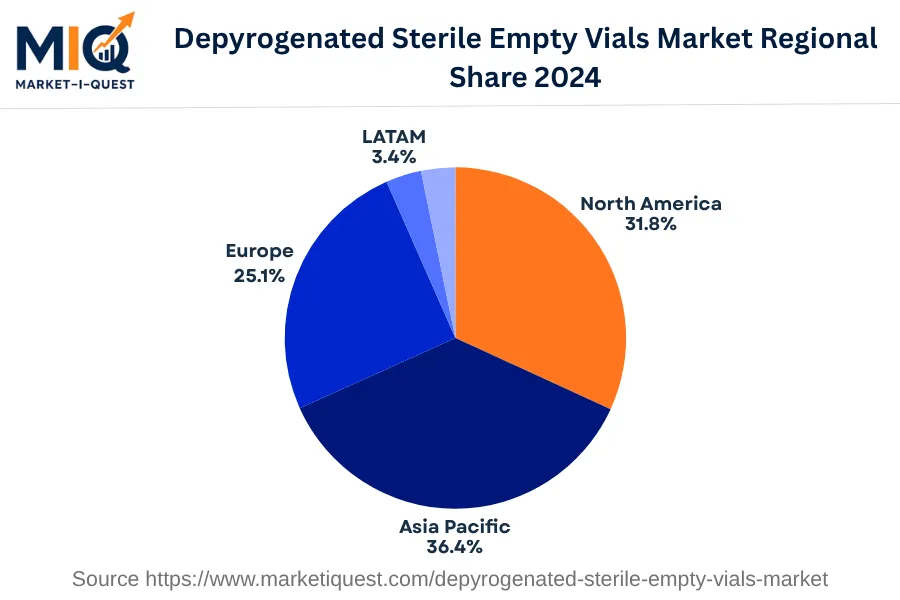
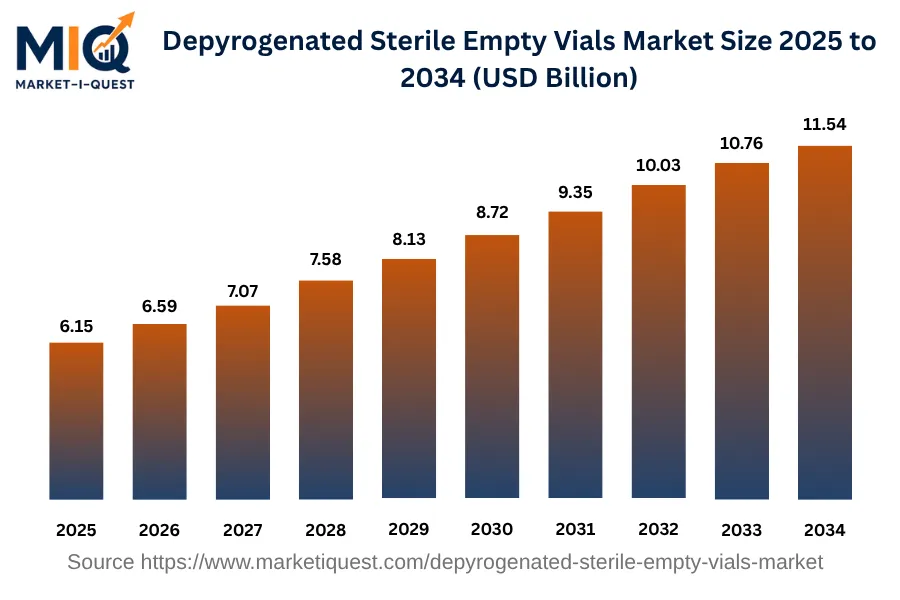
The Depyrogenated Sterile Empty Vials market was sized at USD 6.15 billion in 2025 and, following a path of steady growth, rose to be valued at USD 11.54 billion in 2034, marking a CAGR of 7.25%. These vials were at an estimated value of USD 5.73 billion in 2024, proceeding to rise by roughly 7.25% to reach a market size of USD 6.15 billion in 2025. The growth then continued in a similar pattern over the decade, finally hitting the mark of USD 11.54 billion by 2034. The regional share in 2024 was distributed as follows: North America led with the largest share at 31.84%, closely followed by Asia Pacific holding a substantial share at 36.42%. Europe held a significant percentage of 25.13%, whereas less extensive shares were seen by Latin America and the Middle East and Africa at 3.37% and 3.24% respectively.

Key Takeaways

  • By Material Type - Glass held the predominant share in the market for the base year.
  • By Capacity - 10-20mL sized vials led the market in the base year.
  • By Closure Type - Screw Caps held the largest share of the segment in the base year.
  • By Sterilization Method - Autoclaving was the preferred method expanding rapidly in the base year.
  • By End Use - Pharmaceuticals registered the highest growth in the market for the base year.
depyrogenated-sterile-empty-vials-market market size

Key Driving Factors

Stringent Regulatory Requirements

One of the key driving factors for the Depyrogenated Sterile Empty Vials Market is the strict regulatory requirements for pharmaceutical packaging, specifically by the United States Pharmacopeia (USP) and European Pharmacopoeia (EP). They mandate the use of depyrogenated sterile empty vials for injectable drug packaging to ensure the safety, efficiency, and reliability of drugs. The vials, having undergone depyrogenation, comply with these norms by effectively eliminating pyrogens – bacterial toxins that could cause fevers or other adverse reactions upon injection. Therefore, such a regulatory obligation definitely pushes the pharmaceutical companies to procure these vials thus creating a robust demand within the market.

Increasing Adoption of Biotech Processes and Biosimilars

The second driving factor fueling the growth of the Depyrogenated Sterile Empty Vials Market is the surge in the adoption of biotechnology processes and biosimilars by the pharmaceutical industry. Biosimilars, as biologic medical products, are highly sensitive to contamination and thus rely heavily on sterile and depyrogenated packaging solutions for their storage and transport. Similarly, biotech processes that involve genetic manipulation also demand high levels of sterility and freedom from pyrogens, thus necessitating the use of depyrogenated sterile empty vials. The increasing preference towards these high-potential areas hence propels the demand and consequently the growth of this market.

Market Evolution by Timeline

2019-2023
A marked uptake is observed in pharmaceutical and biotechnology industries, primarily in North America and Europe. This trend, triggered by the extensive usage of vials in the formulation of injectable drugs, also emphasizes good manufacturing practices. The introduction of automated depyrogenation tunnels brought operational efficiencies and enhanced sterility assurances but also increased production cost. In line with the policy shifts, environmentally friendly depyrogenation methods were emphasized. The demand was catered mostly by independent suppliers, with contracts heavily slanted towards volume-based pricing. However, availability of raw materials and increased production costs, posed as roadblocks to scale.
2024
In this year, the Asia Pacific region demonstrated growing interest in the market. Rising urbanization and an increase in chronic diseases led to a spike in demand for sterile injectable drugs. Adoption of robotics and artificial intelligence to scale up the production while ensuring sterility became more prominent. Government policies stressed on standardized norms for vial production and usage in developing nations. Contractual agreements tipped in favor of collaborations with pharmaceutical companies to ensure product quality and regulated pricing, while raw material shortages continued being a substantial risk.
2025-2029
The period witnessed an intensified use of depyrogenated sterile empty vials across healthcare and life science research facilities. North America continued to be the primary market player while Europe kept contributing substantially. Most vials in circulation were still produced with automated processes, though sustainably-driven cleansing methods gained momentum. Regulatory policies fluctuated, instigating a lean towards stricter adherence to a sustainable and regulation-compliant commercial model. Partnership agreements took a turn towards technology adoption for large-scale sustainable production, but raw materials scarcity assumed a higher risk profile.
2030-2034
This era integrated the depyrogenated sterile empty vials market with emerging trends like personalized medicine and precision therapeutics. Regions such as Latin America and Middle East stepped up as significant players. Sterility assurance moved from automation to more sustainable alternatives. Along with policy advancements on sustainable practices, contracts began reflecting higher prices due to heightened material scarcity. The risk of non-feasible manufacturing due to raw material deficits grew, urging an exploration of innovative, sustainable alternatives.

Future Market Outlook

Future Opportunities

The landscape for depyrogenated sterile empty vials is poised for expansion, driven by increasing biopharmaceutical and vaccine development efforts globally. The ongoing COVID-19 pandemic has resulted in substantial investments by companies such as Moderna and Pfizer in vaccine production and distribution, highlighting the critical role of sterile vials. The ongoing collaboration between regulatory authorities and pharmaceutical firms to streamline approval processes for new biologics, especially in the United States and Europe, enhances the demand for compliant storage solutions. As of mid-2023, pharmaceutical giants have committed to sustainable development goals, which frequently include the transition to eco-friendly materials. This shift presents an opportunity for manufacturers to innovate and differentiate themselves in a competitive market. Additionally, the rise in personalized medicine has led to a need for small-batch production capabilities, emphasizing the versatility of depyrogenated vials that cater to this demand. Emerging markets in Asia-Pacific, particularly India and China, are witnessing rapid growth in pharmaceutical manufacturing, spurred by governmental support for domestic production as seen in India's Production-Linked Incentive Scheme initiated in 2020. Furthermore, there is a pressing need for training and education in handling ultra-sensitive biologics, creating a niche for companies offering specialized consultation and training services for end-users. Enhanced focus on developing robust logistical frameworks for the distribution of sensitive medications underscores these growing market dynamics.

Segmentation Analysis

By Material Type

The market is divided into subsegments including Glass, Plastic, and Others. The Glass subsegment accounted for the largest revenue share, while Plastic is expected to grow at the fastest CAGR during the forecast period.

Largest Revenue Share

Glass

Market Share Leader

Glass as a material has a substantial lead in the market, mainly due to its proven durability, safety, and flexibility in manufacturing. Moreover, it allows for high-clarity view and robust containment for many products across industries like consumer goods, electronics, and automotive. Given its inert nature, glass is often the preferred choice for storing food, beverages, and pharmaceuticals, where preserving the product's quality over time is of paramount importance. Geographically, the demand for glass is consistent across regions, with slight variations tethered to the local manufacturing ecosystem and the demand patterns. While regulations in some countries mandate the use of glass in certain applications for safety and disposal reasons, its supply is also generally stable due to the abundant availability of silica, the primary raw material for glass. Customer purchasing criteria largely hinge on the overall product quality and the cost-effectiveness of glass, with the latter being sensitive to energy costs for producing and recycling glass. Switching to other materials usually entails a costly change in mating components and assembly processes, benefiting glass in the competitive landscape.

Fastest CAGR

Plastic

Forecast Period Growth Leader

Plastic, while accounting for a lower market share currently, is projected to grow at the fastest rate during the forecast period. Key drivers of this growth are likely to include its light-weight nature, cost-effectiveness, and design flexibility. Lightweight properties of plastic can lead to significant cost reductions in product packaging and transportation, making it a preferred choice across sectors like retail, fast-moving consumer goods, and eCommerce. Moreover, added benefits like easy mouldability allow for a wide range of uses, thus increasing its demand. However, barriers such as adverse environmental impact and regulatory restrictions can limit the reach of plastic, particularly in European and North American markets. Furthermore, the growth of Plastic depends on catalysts like the evolution of bio-plastics and partnerships driving recycling initiatives. Despite these ongoing advancements, there is an inherent risk associated with fluctuating petrochemical prices that feed into the raw material cost for plastic production.

By Capacity

The market, segmented by capacity, includes categories such as below ten milliliters (less than 10mL), between ten and twenty milliliters (10-20mL), between twenty and thirty milliliters (20-30mL), and more than thirty milliliters (greater than 30mL). As of the base year 2024, the subsegment between 10mL-20mL records the largest revenue share, while the subsegment less than 10mL is projected to grow at the fastest CAGR during the forecast period.

Largest Revenue Share

10-20mL

Market Share Leader

The 10-20mL capacity segment yields the highest revenue in the market by 2024. This is primarily due to its wide array of applications across various sectors, from healthcare to cosmetics and personal care. In the healthcare sector, this capacity range is predominantly used for storing samples, medication, and vaccines, which are highly demanded worldwide. The regulatory emphasis on safe storage and transportation of medical components further drives the market. With regards to cosmetics and personal care, there is a high demand for mid-range capacity containers that facilitate convenient usage and portability. Products such as travel-sized toiletries, sample-size skincare or makeup items, and regular-sized eye drops commonly fall within this size category. This subsegment's success is witnessed globally but is more significant in developed regions where higher disposable income and higher demand for convenience-oriented products exist.

Fastest CAGR

Less than 10mL

Forecast Period Growth Leader

The fastest growing subsegment in terms of CAGR is the segment of capacities less than 10mL. This surge is notably due to the growing trend of miniaturization in various industries, coupled with the rise in single-use disposable products. In the healthcare sector, for example, smaller vials are increasingly preferred for specific treatment protocols and personalized medication, paving the way for this subsegment's rapid growth. Additionally, the burgeoning trend towards more compact and portable versions of products in cosmetics and personal care also propels this sub-segment ahead. This category includes travel-friendly miniature fragrances, beauty samples, and mini personal care kits, which are gaining popularity among consumers. However, possible risks to consider include potential regulatory changes and the increasing environmental concerns regarding single-use disposable products. Nonetheless, the on-going advancements in sustainable, small-capacity packaging solutions offer hopeful prospects for this subsegment.

By Closure Type

The market is divided into subsegments including Rubber Stopper, Flip-Off Caps, Screw Caps, and Crimp Caps. Screw caps accounted for the largest revenue share, while the Rubber Stopper subsegment is expected to grow at the fastest CAGR during the forecast period.

Largest Revenue Share

Screw Caps

Market Share Leader

The Screw Caps subsegment leads the market due to their wide application across various industries, including food and beverages, cosmetics, pharmaceuticals, and others. They are preferred because of their tight sealing capabilities, which prevents contamination and extends the shelf life of the product. Screw caps are also cost-effective and easy to use, which contributes to their popularity. When it comes to purchasing criteria, customers prefer screw caps due to their simplicity and the fact they require no additional tools for opening and closing. The Asia-Pacific region, led by countries like China and India, is a significant market for Screw Caps due to the growing consumer goods and pharmaceutical industry. Furthermore, regulations promoting the use of eco-friendly and recyclable closure types have raised the demand for Screw Caps.

Fastest CAGR

Rubber Stopper

Forecast Period Growth Leader

The Rubber Stopper subsegment is witnessing the fastest CAGR due to increasing adoption in the pharmaceutical industry. Rubber stoppers, especially those made from bromobutyl or chlorobutyl rubber, have excellent sealing capabilities and compatibility with drugs, making them the preferred choice for injectable drug vials and other sensitive pharmaceutical packaging. The growth in the healthcare sector, particularly the expansion of the injectables market driven partly by the global vaccination initiatives, is a key catalyst for the increased demand. Additionally, partnerships and collaborations between rubber stopper manufacturers and pharmaceutical companies drive the market growth further. However, slight barriers to adoption include potential interaction between the rubber and the drug, which manufacturers are overcoming through research and product innovation. Meanwhile, near-term risks include fluctuating raw material prices and supply chain disruptions due to unpredictable global events.

By Sterilization Method

The market is divided into subsegments including Autoclaving, Dry Heat Sterilization, E-beam Radiation, and Gamma Radiation, with Autoclaving accounting for the largest revenue share while E-beam Radiation is expected to grow at the fastest CAGR during the forecast period.

Largest Revenue Share

Autoclaving

Market Share Leader

Autoclaving maintains its position at the top in terms of revenue due to its wide adoption across multiple industries including healthcare, pharmaceuticals, and biotech. Its cost-effectiveness, time efficiency and effectiveness in killing microorganisms and spores have made it a preferred sterilization method. Autoclaving, being a high-temperature based process, eliminates the need for harmful chemical substances, thereby garnering favor not only from a health and safety perspective but from a regulatory standpoint as well. It is widely used in hospitals and labs for sterilizing surgical instruments, laboratory equipment and other items that require swift and effective sterilization. Furthermore, the customer base for autoclaving continues to grow as the demand for sterilization in various sectors surges. Despite being an age-old process, it remains relevant in geographies worldwide due to the absence of substantial switching costs. Through tried and tested channels, the autoclaving industry has firmly established its foothold, leading the pack in revenue generation.

Fastest CAGR

E-beam Radiation

Forecast Period Growth Leader

Projected to grow at the fastest rate, E-beam radiation sterilization is finding increasing acceptance owing to its unique advantages. Compared to other methods, E-beam radiation is faster, more energy-efficient, and offers excellent penetration, making it effective for sterilizing dense or multi-layered products. It also does not require any chemical additives or leave any residues, which makes it an environmentally friendly alternative. As industries move towards more sustainable practices, this feature could act as a catalyst, driving its faster adoption. However, the initial capex can be high, potentially causing adoption barriers. Anticipated technological improvements and increased partnerships between solution providers could potentially address these issues. Looking ahead, regulatory bodies might favor sterilization procedures with lower environmental impact, which would likely provide tailwind to E-beam radiation's growth. Yet, it is imperative to keep an eye on near-term risks, such as market acceptance and technological compatibility, that could potentially challenge its growth trajectory.

By End Use

The market is segmented into Pharmaceuticals, Biotechnology, Diagnostics, and Research & Development. Among these, Pharmaceuticals holds the largest revenue share, while Biotechnology is predicted to grow at the fastest rate during the forecast period.

Largest Revenue Share

Pharmaceuticals

Market Share Leader

Pharmaceuticals makes up the greatest proportion of the revenue within our segment_5 end users. Several factors account for this dominance. Firstly, the global demand for innovative and effective medicines is continually high. As public health challenges evolve and new illnesses emerge, the reliance on pharmaceuticals intensifies. Furthermore, the sector benefits from expansive client pools, encompassing nearly every demographic, and hence, a broad market base. Geographically, high-income regions contribute significantly to the sector's revenue, although rising economies are increasingly meaningful contributors. Regulatory frameworks often facilitate the pharmaceuticals sector, with governments around the world recognizing the paramount importance of medicines for ensuring public health. In addition, the high cost of medicines and the infrequent chances of switching brands due to trust and efficacy factors, contribute to the sector's substantial revenue.

Fastest CAGR

Biotechnology

Forecast Period Growth Leader

Biotechnology is anticipated to be the fastest-growing segment, demonstrating robust CAGR during the forecast period. This sector is driven by scientific advancements in areas like gene therapy, stem cell research, and precision medicine. Emerging technologies and increased investments are key catalysts for growth, driving innovation and expansion in the biotechnology sector. Furthermore, partnerships often play a crucial role in driving growth, with collaborations between academic institutions and biotech firms producing cutting-edge research and products. Nonetheless, the sector faces barriers to adoption, including complex and stringent regulatory environments, and the high costs of biotechnology products and treatments. These may pose near-term risks, but as technology advances and regulations catch up, these barriers are expected to diminish, paving the way for accelerated growth in the biotechnology sector.

Competitive Analysis

Key Market Players

Manufacturers / OEMs

Schott AG
Germany
Gerresheimer AG
Germany
DWK Life Sciences
US

Key Suppliers & Raw Materials

Corning Incorporated
US
Nipro Corporation
Japan
Bormioli Pharma S.p.A.
Italy

Distributors, Integrators & Channel Partners

McKesson Corporation
US
Cardinal Health
US
HD Smith Wholesale Drug Co
US

Porter’s Five Forces Analysis

An analysis of key structural trends and competitive forces in the Depyrogenated Sterile Empty Vials Market.

Supplier Bargaining Power

Low

Domination by major manufacturers and high capex for production limits supplier power.

Buyer Bargaining Power

Medium

Large pharmaceutical companies can dictate terms but lack of substitutes limit their power.

Threat of Substitutes

Low

Switching to alternatives is constrained by stringent regulatory and safety requirements.

Threat of New Entrants

Low

High regulatory barriers, substantial initial investment, and technology knowledge limit new entrants.

Competitive Rivalry

High

Competition is intense among existing players like Thermo Fisher, SCHOTT, Gerresheimer.

Regional Analysis

Geographic market dynamics and growth opportunities across key regions

Global Market Outlook

depyrogenated-sterile-empty-vials-market market regional share

North America

In 2024, the North American Depyrogenated Sterile Empty Vials Market stood as a key segment within the healthcare manufacturing industry. Driving factors included increased demand for prefilled injectables, an upturn in the biosimilars market, and stringent regulations enforcement across the USA, Canada, and Mexico. The U.S. FDA, for instance, heightened the requirement for depyrogenation to ensure patient safety, impacting investment decisions and prompting technological adoption for sterilization. Pharmaceutical manufacturing companies responded to supply chain disruption risks by ramping up capacity, dynamically adjusting pricing to meet demand.

Trends within this market pointed towards growth in the demand for high-quality, durable packaging solutions within the healthcare sector. Consumer behavior featured a preference for reliable and compliant products, leading to manufacturers focusing on improvement in product quality and safety. Shifts included a transition towards borosilicate depyrogenated sterile vials due to their compatibility with a broad range of drug compounds. Channel dynamics revealed a substantial increment in online distribution, with companies such as Covectra and Schott AG partnering to improve traceability capabilities. Regulatory bodies stepped up policy enforcement, with the FDA and Health Canada enhancing vigilance on pharmaceutical packaging standards to ensure drug stability and sterility. The attention directed towards depyrogenated sterile empty vials across North America in 2024 signified a vital cog in the aim to ensure safe and effective drug delivery systems.

Asia Pacific

In 2024, the Depyrogenated Sterile Empty Vials Market in Asia Pacific experienced substantial growth fueled by robust demand dynamics, regulations, and technological adoption. Increased interest in biosimilar and biologic drugs, particularly in China and India, drove demand as these medicines require depyrogenated sterile empty vials for safe storage. The rigorous regulatory environment in Japan and South Korea further spurred market growth as pharmaceutical companies sought compliant packaging solutions. Moreover, significant investment in their healthcare infrastructure boosted demand in Australia and key ASEAN markets.

From a trends standpoint, the shift towards prefilled syringes posed a challenge to the market; however, the inherent longevity and safety of sterile empty vials offset this. Notably, China's policy enforcement around vaccine safety following 2023's immunization program issues steered enterprises and healthcare providers toward these reliable containers. Partnerships and M&A activity became prevalent, with Japanese firms seizing Australian manufacturing capabilities to reinforce supply dynamics. Channel dynamics also saw a shift, especially in India, where an increase in online B2B sales became evident, reflecting the retail market's digital transformation. Finally, the adoption of international sterilization standards by manufacturers, driven by ongoing policy enforcement, remained a noticeable trend across Asia Pacific. This ensured quality and reinforced the credibility of depyrogenated sterile empty vials market in the region.

Europe

In 2024, the Depyrogenated Sterile Empty Vials (DSEV) market in Europe was operationally influenced by demand factors, regulatory environments, and technology adoption. Public health sector investments in Germany and the United Kingdom accelerated the requirement for DSEV, driving demand. In Italy and Spain, regulatory standards mandating sterilization and pyrogen-free medical containers bolstered the market. Central and Eastern Europe displayed notable technology adoption with innovative sterilization processes, supporting supply dynamics.

Concurrently, buyer behavior favored local manufacturers credited to reduced logistics costs and quicker turnarounds. Merger and acquisitions were evident in the Nordics and Benelux, as larger entities sought to leverage production scale and technology capabilities, thereby sustaining market competitiveness. Regulatory enforcements tightened in the healthcare sector across Europe, influencing higher standards for DSEV production and distribution. Therefore, the DSEV market in 2024 across the covered European regions was predominantly driven by rising healthcare sector investments, stringent regulatory norms, and adoption of advanced sterilization techniques. Trends included a preference for locally sourced products, consolidation activities, and rigorous enforcement of production standards.

Latin America

In the base year 2024, the Depyrogenated Sterile Empty Vials Market experienced substantial growth in Latin America due to robust healthcare sector advancements and strict regulatory compliance. Significant investments in the pharmaceutical sector, primarily in countries like Brazil, Argentina, and Mexico, drove demand for sterile vials, instigating market expansion. Regulatory bodies imposed stringent policies ensuring safe and effective drug delivery, pushing manufacturers to adopt advanced technologies for sterility. Surging export of drugs from Latin America, especially Brazil and Mexico, influenced supply dynamics noticeably, periodically affecting pricing structures of vials.

Regarding trends, buyer behavior shifted towards demand for high-quality, reliable sterile empty vials, influenced by escalating health safety concerns. Technological advancements emerged in vial manufacturing processes, employing heat-treatment methods for depyrogenation, gaining traction especially in advanced healthcare markets like Argentina and Chile. Distribution channels underwent reorganization with pharmaceutical companies forming strategic alliances and M&A with vial manufacturers to ensure a steady supply of depyrogenated sterile vials. Increased scrutiny led to strict policy enforcement on sterile procedures, transforming the market landscape predominantly in Peru and Colombia. The primary customer base encompassed the pharmaceutical industry and healthcare institutions across Latin America, with high demand generated from sectors with an emphasis on injectable drug production.

Middle East & Africa

In 2024, the Depyrogenated Sterile Empty Vials market in the Middle East and Africa presented growth and penetration opportunities. Key market drivers included the increased demand in the healthcare sector in Saudi Arabia and UAE due to the prevalence of chronic diseases requiring intravenous therapy. Egyptian and South African governments' regulations promoting the local production of pharmaceutical packaging further stimulated the market. Advances in technology, particularly in sterilization techniques, facilitated the adoption of these vials in Israel’s biotech sector. Additionally, the ongoing investments in Qatar's pharmaceutical industry influenced supply dynamics positively.

On the trend front, an escalated preference for glass vials over plastic ones was observed because of their higher resistance to heat during the depyrogenation process – a notable shift in Nigeria and Kenya. The healthcare sectors in UAE and Egypt experienced a surge in online purchases of these vials due to the convenience factor, altering the channel dynamics. Lastly, significant partnerships were formed between vial manufacturers and biotech companies in South Africa and Israel to ensure steady supplies for vaccine production. The market in 2024, therefore, showed noteworthy growth and development driven by various factors and trends in the healthcare, manufacturing, and biotech sectors across different countries.

Recent Industry Developments

Latest market innovations, product launches, and strategic initiatives

March 2026

The 2 ml depyrogenated sterile vial segment expanded rapidly to support personalized medicine and gene therapies. Contract manufacturers expanded aseptic fill-finish capacity for these small-volume formats to limit extractable risks in highly sensitive, premium payloads.

January 2026

Medical packaging companies introduced high-durability deep-cold freeze vials to accommodate next-generation biologics. These sterile, depyrogenated containers are engineered to maintain structural and sterility integrity at extreme cryogenic temperatures down to –150°C.

Frequently Asked Questions