Dental Software Market Snapshot

Key Players

  • Henry Schein Inc. (United States)
  • Curve Dental Inc. (Canada)
  • Carestream Dental (United States)
  • Patterson Companies Inc. (United States)
  • Dovetail (Canada)
  • ACE Dental (India)
  • Dentimax LLC. (United States)
  • Doxo Dental (France)
  • Oral Vision (Italy)
  • MedicTalk DentForms Inc. (United States)

Market Size

Base Year 2024
$2.89 Bn
CAGR
10.2%
Forecast 2034
$7.63 Bn

Market Segments

By Type
  • Practice Management Software
  • Dental Imaging Software
  • Others
By Deployment
  • Web-based
  • Cloud-based
  • On-premise
By End User
  • Hospitals
  • Dental Clinics
  • Others

Market Dynamics

Drivers
  • Rising dental health awareness
  • Increasing digitization trends
Restraints
  • High implementation costs
  • Lack of specialized IT skills
Opportunities
  • Increasing digitalization in healthcare
  • Untapped developing countries market

Market Size

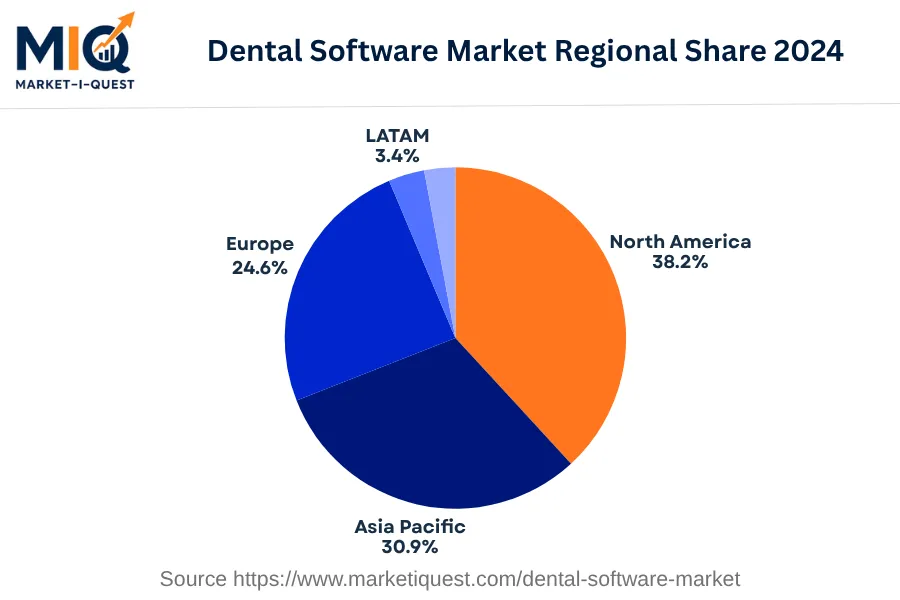
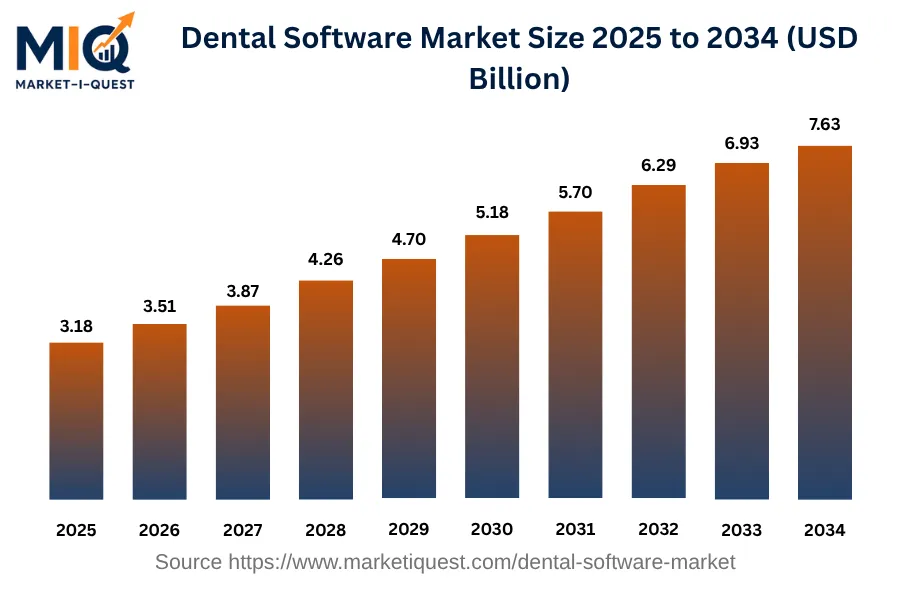
The Dental Software Market valued at USD 3.18 billion in 2025 and is projected to reach USD 7.63 billion by 2034, expanding at a CAGR of 10.2%. This nearly two and a half times increase in the market size from 2025 to 2034 is a noticeable growth path. Across this journey from USD 2.89 billion in 2024, crossing USD 3.18 billion in 2025, and finally culminating at USD 7.63 billion in 2034, the Dental Software Market showcases a constant and substantial expansion. The regional market share data for 2024 provide a clear indication of how the Dental Software Market cuts across various geographies. North America dominates the regional share at 38.16%, followed closely by Asia Pacific at 30.87%. Europe is another significant contributor with 24.62%, while LATAM contributes 3.41%, and MEA constitutes approximately 2.94% to the overall market size.

Key Takeaways

  • By Type - Practice Management Software held the leading position in 2024.
  • By Deployment - Web-based solutions grew fastest reflecting changing technological practices.
  • By End User - Hospitals held a significant position indicating their increasing reliance on dental software.
dental-software-market market size

Key Driving Factors

Stringent Regulatory Standards for Patient Information Management

Recently, the healthcare systems globally have been focusing more on patient data privacy. Several regulatory standards, such as the Health Insurance Portability and Accountability Act (HIPAA) in the USA, have been imposed to protect confidential data. As a result, dental practices are compelled to employ dental software that ensures data privacy and security. These software systems provide secure platforms for storing patient information and offer features like data encryption, thereby helping dental practices adhere to the regulations for patient data privacy. Hence, the rigorous nature of data privacy laws is driving the adoption of dental software in dental clinics, hospitals, and other dental services.

Emerging Trend of Dental Tourism

In recent years, cost-effective dental procedures combined with tourism, known as dental tourism, have been proliferating. Countries such as Mexico, Costa Rica, and Thailand have been increasingly recognized as preferred dental tourism destinations due to affordable rates, quality of service, and high levels of dental expertise. To manage an increase in international patient inflows and to streamline their services, dental practices are integrating dental software into their systems. This software aids in appointment scheduling, patient management, treatment planning, and reporting, making the operations more efficient. Therefore, the emerging trend of dental tourism is significantly contributing to the growth of the dental software market.

Market Evolution by Timeline

2019-2023
During this period, dental software was in the growth phase with private clinics as the major buyers in North America and Europe. The practice management software became popular due to the need for efficient patient management and billing. Products were primarily cloud-based, leading to lower initial setup costs but ongoing subscription expenses. Products such as Denticon and Dental Intelligence saw frequent use. However, the fragmented market had issues with the lack of standardized integration between different software. Government regulations such as HIPAA in the U.S. influenced the software's security and privacy features. The commercial model typically involved monthly or annual subscriptions with occasional partnerships with dental hardware manufacturers. One major risk was the use of outdated systems by dental offices, slowing down software adoption.
2024
In 2024, AI-enhanced features started gaining traction, influencing supply. The emphasis was on image analysis and predictive analytics for diagnosis. The primary buyers remained private clinics, but there was a noticeable increase in purchases by large hospital chains, particularly in the Asia-Pacific region, taking advantage of centralized systems. The Data Protection Act in the UK and GDPR in Europe influenced software privacy features. Fixed contracts became more frequent, usually involving customization and integration services. The primary risk was systems becoming obsolete rapidly, necessitating frequent upgrades and continuous customer engagement.
2025-2029
Software will likely become highly refined during this period, with a clear dominance of cloud-based AI-enhanced products like Denti.AI and NiaDent. Tele-dentistry application might witness surge in demand due to increasing teledentistry practices. North America is expected to retain its leading position in the market, with Asia-Pacific steadily catching up. Software interconnectivity may become smooth due to the adoption of global standards like HL7. Policy emphasis will likely shift towards data ownership and patient access to their data. Companies are expected to start offering value-added services such as practice consultancy, making pricing more complex. The evolving nature of AI technology might pose potential risks of malfunctions, leading to a strong focus on software reliability and vendor support.
2030-2034
Integrated dental platforms will likely develop during this period, featuring seamless cooperation between different software types. Administratively focused software are expected to start integrating with clinical software, drive by the increase in corporate dental clinics and group practices globally. The U.S. and China might lead in platform adoption rates. Policymakers may start focusing on AI and machine learning ethics, apart from privacy and data protection. The commercial model will likely evolve towards a one-stop solution providing software and hardware on a lease basis. Furthermore, constant regulatory updates might necessitate continuous software development and agility in compliance procedures.

Future Market Outlook

Future Opportunities

The dental software market presents numerous opportunities for development, particularly in integrating artificial intelligence and machine learning systems. Research institutions such as the University of Pennsylvania are conducting studies that explore how machine learning algorithms can enhance diagnostic accuracy in detecting dental diseases. Furthermore, with the growth of remote patient monitoring tools for oral health, dental software companies have an opportunity to create applications that encourage preventive care, aligning with the World Health Organization's emphasis on preventative health strategies. Partnerships between technology companies and dental practices could also facilitate better data analytics, customizing treatment plans based on individual patient histories. A collaboration between Align Technology and various dental professionals demonstrated how data sharing can improve patient outcomes in orthodontics. Moreover, regulatory bodies, including the American Dental Association, are advocating for the use of standardized digital records, which could lead to the development of interoperable systems that connect various healthcare providers. Companies focusing on compliance with regulations like HIPAA and GDPR will see increased demand for their products, as practices prioritize patient confidentiality. Staying ahead of these trends will enable software developers to cater to the evolving needs of practitioners and patients, ultimately leading to enhanced oral health services on a global scale.

Segmentation Analysis

By Type

The market is divided into subsegments including Practice Management Software, Dental Imaging Software, and Others. Practice Management Software accounted for the largest revenue share while Dental Imaging Software is expected to grow at the fastest CAGR during the forecast period.

Largest Revenue Share

Practice Management Software

Market Share Leader

Practice Management Software commands the largest share of the revenue in the market. The key driver for this subsegment's market dominance is the essential role it plays in managing and maintaining administrative and clinical functions within healthcare facilities. This software assists in appointment scheduling, billing, and other backend operations which typically consume large amounts of time and resources. The increased digitization and automation of such crucial functions have made investing in practice management software a necessity for healthcare providers. Large-scale establishments especially realize high switching costs, reinforcing the dominance of this subsegment. In addition, stringent healthcare regulations that require accurate and timely patient data management further boost the uptake of Practice Management Software. Furthermore, the expansion of healthcare infrastructure across various regions, especially in developing nations, has propelled the demand for this software, thereby anchoring it as the subsegment with the largest revenue.

Fastest CAGR

Dental Imaging Software

Forecast Period Growth Leader

Dental Imaging Software is projected to be the fastest-growing subsegment in the market. Underpinning this growth is the advancement in dental imaging technology and increasing oral health consciousness among the population. High-resolution imaging software is being employed to accurately diagnose and strategize treatments for dental conditions, a step-up from traditional methods. The software provides significant advantages such as reduced radiation exposure, superior image quality, and quicker treatment planning which catalyzes its adoption in the dental healthcare sector. Investment in this technology is growing, fueled by partnerships between software providers and dental clinics. Despite this, adoption barriers do exist such as a lack of technical proficiency among some practitioners, which could, in the short term, hinder the full potential of this subsegment's growth.

By Deployment

The market is divided into subsegments including Web-based, Cloud-based, and On-premise deployments. Cloud-based deployments account for the largest revenue share, while Web-based deployments are expected to grow at the fastest CAGR during the forecast period.

Largest Revenue Share

Cloud-based

Market Share Leader

Cloud-based deployments dominate the market in terms of revenue, a trend projected from the base year of 2024. This leadership is primarily rooted in several key factors. The scalability and flexibility that cloud services offer make them appealing to companies of all sizes. Businesses can easily adjust their service consumption based on their needs, providing an efficient way to manage resources. Furthermore, cloud-based platforms are comparatively inexpensive to implement and maintain. The reduced overhead costs are a significant draw for organizations seeking to streamline operations and maximize profit margins. Additionally, these services eliminate the need for physical hardware, ensuring that businesses no longer need to invest in costly equipment and the personnel to manage it. Vendors have made significant strides in allaying fears over security, bringing about strong regulatory compliance benefits, and greater collaboration.

Fastest CAGR

Web-based

Forecast Period Growth Leader

Web-based deployments are projected to exhibit the fastest growth in terms of CAGR from the base year of 2024. They offer a level of convenience unmatchable by their on-premise counterparts because they can be accessed from anywhere with an internet connection. This deployment method largely eliminates compatibility issues as they operate across multiple operating systems, which makes them increasingly favorable in today's diverse technology landscape. On top of that, the often lower up-front costs make it attractive to budget-constrained businesses looking to go digital. Similarly, the ease of implementing updates ensures businesses are always utilizing the latest version of a service, keeping in step with evolving industry trends and requirements. The flexibility, cost-effectiveness, and simplicity of web-based deployments explain their accelerated growth.

By End User

Segmentation of the market reveals key players such as Hospitals, Dental Clinics, and Others. In 2024, Hospitals accounted for the largest revenue share while Dental Clinics are expected to grow at the fastest CAGR during the forecast period.

Largest Revenue Share

Hospitals

Market Share Leader

Hospital holds the largest revenue share of the market. Foremost is the sheer volume of services provided by hospitals compared to other players. Hospitals tend to have a larger patient base due to the versatile range of services they offer. These entities also maintain contracts with a higher number of insurance companies, making them a preferred choice for numerous patients. Geography plays an important role too. In populous regions, hospitals become the primary care unit for the majority, thereby increasing their share in the market. Moreover, the abundance of resources and staff at hospitals facilitate more comprehensive services, often not achievable at smaller establishments like dental clinics. The pricing structures of hospitals, coupled with their credibility, also make them a prime option for those seeking healthcare services. The regulatory framework does benefit hospitals since licenses and permits often favor large-scale operations compared to small-to-mid-size establishments.

Fastest CAGR

Dental Clinics

Forecast Period Growth Leader

Dental Clinics are showing rapid growth in terms of CAGR. The primary driver for this growth can be attributed to the escalating trend of specialized care. As patients become more aware, the demand for dedicated facilities increases. Dental clinics, with their focus on a niche segment of healthcare, are perfectly poised to cater to this demand. Additionally, dental clinics typically have lower operating costs than hospitals which allow them to offer competitive prices, thus attracting cost-conscious consumers. Technology and partnerships play a pivotal role as well. With advancing technologies, dental clinics are equipping themselves with better and faster diagnostic and treatment methods, thereby reducing waiting times and enhancing patient experiences. Partnerships with larger hospitals or chains have also become a common trend, exponentially increasing the reach of small dental clinics.

Competitive Analysis

Key Market Players

Manufacturers / OEMs

Patterson Dental Supply
US
Henry Schein One
US
Dental Wings
Canada

Key Suppliers & Raw Materials

Oracle
US
Microsoft Azure
US
IBM Cloud
US

Distributors, Integrators & Channel Partners

Sikka Software
US
Curve Dental
US
ADSTRA Dental Software
Canada

Porter’s Five Forces Analysis

A comprehensive analysis of the competitive dynamics within the dental software market.

Supplier Bargaining Power

Medium

Limited number of high-quality software suppliers increases their bargaining power.

Buyer Bargaining Power

High

Various software options and easy switching escalates buyer's bargaining power.

Threat of Substitutes

Low

Complex and specialized nature of dental software reduces the threat of substitutes.

Threat of New Entrants

Medium

Growing demand for dental software attracts new market players, but high development cost acts as a barrier.

Competitive Rivalry

High

Intense competition amongst established players to provide innovative solutions.

Regional Analysis

Geographic market dynamics and growth opportunities across key regions

Global Market Outlook

dental-software-market market regional share

North America

In 2024, the North American dental software market manifested a robust position, largely influenced by heightened digital adoption, necessitated by changing patient demands and regulatory incentives. Aiding this proliferation was increased investment in technological infrastructure within the dental industry, particularly in the U.S., to meet heightened demand and ensure regulatory compliance. Regulatory policies, such as the Health Information Technology for Economic and Clinical Health Act in the U.S., stimulated electronic health record adoption, thus driving demand for dental software.

Emergent customer buying behaviors, especially noticeable in the U.S. and Canada, gravitated towards all-in-one solutions, consolidating practice management, patient communication, and imaging. A trend towards cloud-based dental software was discernible, gaining favor for its scalability and real-time access advantages, especially among larger dental practices and healthcare facilities. In response to these shifts, software developers prioritized partnership strategies and acquisitions to broaden their integrated offering and cartelize emerging market segments. This trend was spearheaded by key industry players like Henry Schein Inc., which acquired Lighthouse 360 to enhance its foothold in the patient communication space. Meanwhile, enforcement of data security standards accelerated, particularly within the U.S., as the sector faced rising concerns about patient data security in digital systems.

Asia Pacific

In 2024, the Dental Software Market in the Asia Pacific held considerable dynamism, characterized by a pronounced demand surge and swift technology adoption. Governments, healthcare players, and enterprise clients across China, India, and Japan were particularly vested in modernizing their dental healthcare offerings. Primary demand stimulators included burgeoning dental health awareness, favorable regulations, and increased investment in the sector by entities such as the Chinese government. Technological advancements like AI implementation and cloud-based solutions were readily adopted, notably evident from high-impact applications in countries like South Korea and Australia. Additionally, sustained growth dynamics and competitive pricing fashioned an invigorated supply landscape, particularly in key ASEAN markets.

Consumer behavior exhibited a preference for digital solutions, thereby catalyzing a shift towards software-based, patient-centered dental offerings. Innovations promoting remote patient monitoring reshaped prevailing product trends, facilitated by strong partnerships and M&A activities. Channel dynamics demonstrated a marked tilt towards digital interfaces, with an increased emphasis on interoperability, particularly within healthcare and enterprise sectors in India and China. Finally, strict policy enforcements such as China's 'Healthy China 2030’ initiative underscored the market's governance and future direction. Overall, the Dental Software Market in the Asia Pacific unified a potency of demand, technology, policy, and theme overtones centered on dental wellness.
Europe

In 2024, the Dental Software Market in Europe had become a significant aspect in the digitalization of healthcare services. Various demand factors, including the rising adoption of EHRs in countries such as Germany and the UK, spurred growth. Regulatory compliance requirements further drove the market; for instance, the EU’s General Data Protection Regulation fostered increased adoption of security-centric dental software systems. Investment in health tech startups, especially in the Nordics, directly affected market dynamics.

Trends in 2024 were led by shifts in buyer behavior, with major stakeholders like dental clinics showing increased preference for cloud-based platforms, the impetus being accessibility and cost-effectiveness. A visible technological transition was the implementation of AI-powered dental software, particularly visible in Spain and Italy. Channel-wise, direct selling dominated, yet partnerships were noted, especially in France, where tech firms teamed up with dental service providers. Notably, acquisition activities marked the sector combined with stricter policy enforcement, such as the National Institute for Health and Care Excellence's push for standardization of dental software in the UK. The Dental Software Market in Europe during 2024, thus, presented clear signals of demand-driven growth and technological advancement trends.

Latin America

In 2024, the dental software market in Latin America (LATAM) notably expanded as technology adoption heightened. Prompted by increasing investment in healthcare IT, dental clinics across Brazil, Mexico, Argentina, Colombia, Chile, and Peru adopted various dental software solutions to improve patient care, streamline processes, and reduce operational costs. Government initiatives, such as Brazil's e-SUS Atención Básica to digitise patient records, were key drivers for this trend.

Dental software providers saw an uptick in demand due to the surging need for remote dentistry amidst a rapidly urbanising population. Partnership and M&A activities among software vendors and healthcare providers were on the rise to cater to this swiftly evolving landscape. Vendors’ improved focus on cloud-based dental practice management software also marked a significant technology shift across the LATAM region. On consumer behaviour, customer preference trended towards integrated solutions that merge scheduling, billing, imaging, and electronic medical records. In the retail sector, Equipo Vision adopted dental software for efficient customer management. Ongoing policy enforcement to protect electronic health records continued to influence market dynamics, resulting in higher scrutiny of software security features. Consumers' rising awareness of oral health further drove the adoption of dental software by healthcare providers.

Middle East & Africa

In 2024, the dental software market in the Middle East and Africa experienced considerable growth. The key drivers being increased investments in healthcare infrastructure, particularly in countries like Saudi Arabia, United Arab Emirates and South Africa. Technological adoption was also a significant factor, most notably in Israel, where advanced dental software technology was widely implemented in dental healthcare centers. Regulatory changes in Egypt and Kenya increased market demand, with the governments setting provisions for progressive digital healthcare reforms. Notable trends within this period included a shift in buyer behavior, with many dental practices pivoting towards software solutions for clinical and administrative management.

In Nigeria and Qatar, there was an increased trend of partnerships and mergers between local dental clinics and software providers. Advanced dental imaging was a growing trend in Saudi Arabia and United Arab Emirates due to increased adoption of digital radiography systems. In terms of sectors, the dental software market catered prominently to healthcare, particularly private dental clinics and governmental healthcare institutions. For example, in Saudi Arabia, the Ministry of Health showed substantial use of dental software for managing public healthcare facilities. Similarly, many private dental clinics in South Africa and United Arab Emirates adopted new dental software, underlining the strong growth of this market in 2024.

Recent Industry Developments

Latest market innovations, product launches, and strategic initiatives

May 2025

RevenueWell announced a strategic partnership with Mila Health to integrate an advanced AI-powered virtual assistant into its dental practice management systems. The automation software manages up to 90% of routine care coordination and patient communication, aiming to drastically reduce appointment no-show rates for clinics.

Frequently Asked Questions