Dental 3D Printing Market Snapshot

Key Players

  • Stratasys Ltd. (Israel)
  • 3D Systems Inc. (United States)
  • Roland DG (Japan)
  • Renishaw Plc (United Kingdom)
  • EnvisionTEC GmbH (Germany)
  • DWS Systems SRL (Italy)
  • Formlabs (United States)
  • Asiga (Australia)
  • SprintRay Inc. (United States)
  • RegenHU (Switzerland)

Market Size

Base Year 2024
$4.28 Bn
CAGR
16.35%
Forecast 2034
$19.46 Bn

Market Segments

By Type
  • Vat Polymerization Technology
  • Powder Bed Fusion Technology
  • Polyjet Technology
  • Metal Extrusion Technology
  • Other
By Application
  • Prosthodontics
  • Orthodontics
  • Dental Implants
  • Others

Market Dynamics

Drivers
  • Rising dental disorders
  • Technological advancement in 3D printing
Restraints
  • High Equipment Costs
  • Regulatory Compliance Challenges
Opportunities
  • Rapid advancements in 3D technology
  • Growing dental disorders globally

Market Size

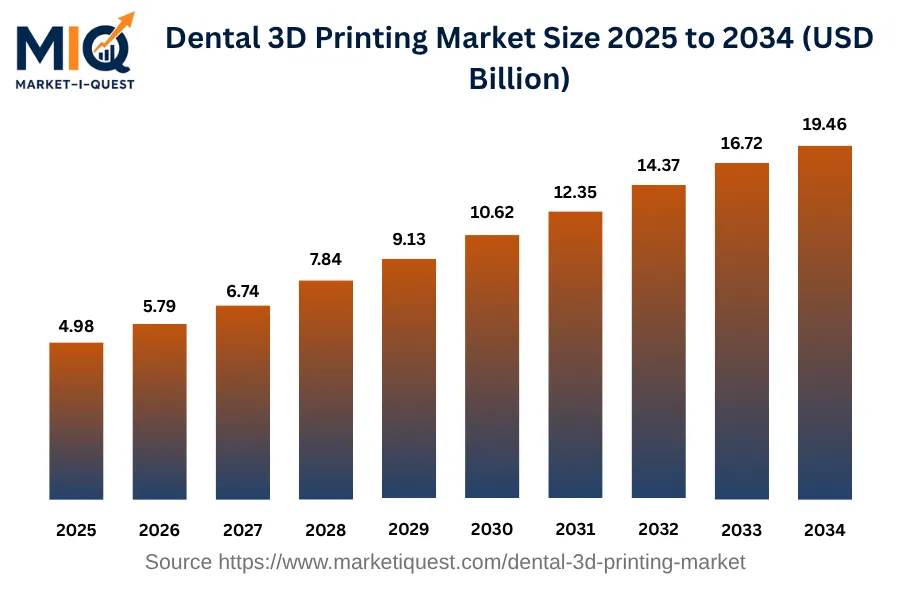
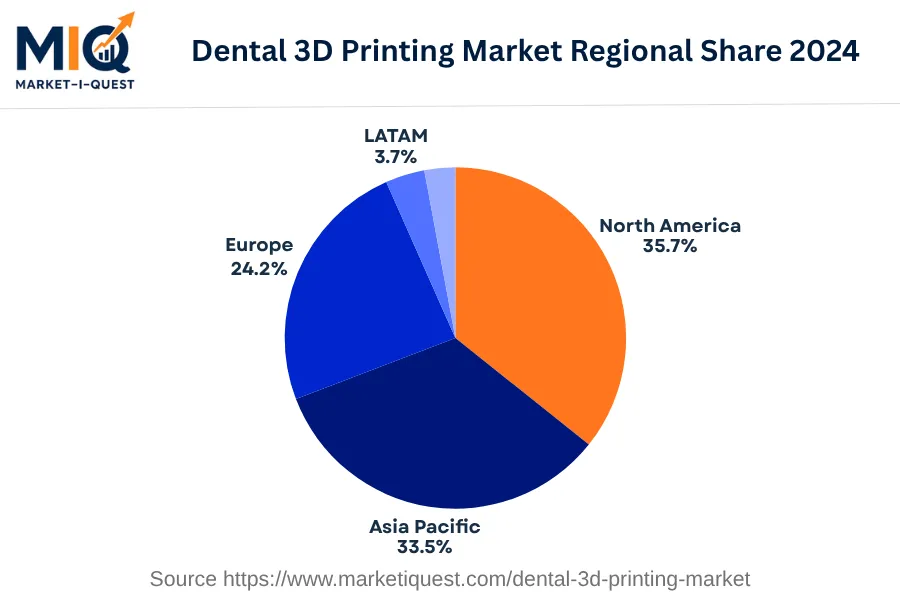
The Dental 3D Printing Market was at a size of USD 4.28 billion in 2024, growing to USD 4.98 billion in 2025, and is forecasted to reach USD 19.46 billion in 2034, with a Compound Annual Growth Rate (CAGR) of 16.35%. This high growth rate manifests substantial market expansion through the decade reviewed. Precisely, the market size increased by approximately 70 cents billion between 2024 and 2025, setting a steady path of significant annual increments leading to the projected endpoint in 2034. The surge is attributed to the steady adoption of dental 3D printing technologies in different geographic regions. Speaking of regions, in 2024, North America took the largest regional share of the market with a significant 35.72%, followed by Asia Pacific at 33.46%. Europe held a notable portion of the share at 24.18%, while LATAM and MEA accounted for smaller shares at 3.72% and 2.92%, respectively.

Key Takeaways

  • By Type - Powder Bed Fusion Technology held a dominant position accounting for the highest market share in 2024.
  • By Application - Dental Implants led the industry taking the largest share in the recent year.
dental-3d-printing-market market size

Key Driving Factors

The Surge in Adoption of Invisalign Braces

The rise in usage of Invisalign braces is a significant driver for the Dental 3D Printing Market. Invisalign braces, a clear and almost invisible alternative to traditional braces, have gained popularity over recent years, capturing attention of adult patients who seek subtler orthodontic solutions. Dental 3D printing's role is critical in creating a precise and custom-fit aligner for each patient. The process involves printing a 3D model of the patient's teeth, upon which the aligners are designed. Thus, the adoption surge in these braces is translating into increased demand in the dental 3D printing market, supporting its growth.

Integration of CAD/CAM Technologies in Dentistry

Integration of Computer-Aided Design and Computer-Aided Manufacturing (CAD/CAM) technology in dental practices is propelling the Dental 3D Printing Market. CAD/CAM technology has revolutionized dentistry by enabling the accurate and rapid production of dental restorations, including crowns, veneers, inlays and onlays, fixed bridges, dental implant restorations, dentures, orthodontic appliances, and even full-mouth reconstruction. The process involves 3D printing, where a digital impression of the patient's mouth is taken and the restoration is designed on a computer, before being 3D printed using a ceramic material. This growing reliance on CAD/CAM technology is a crucial driver for the dental 3D printing market.

Market Evolution by Timeline

2019-2023
During this period, an uptake in Dental 3D Printing was seen in developed countries, especially in Europe and North America. The significant buyer segment included private dental clinics and research institutions, the primary reason being the need for efficient and quick dental solutions. The market was characterized by direct sales from manufacturers and reselling through specialized retailers. Metal and ceramic fused material printers were a key product offering. However, limitations in the production capacity of manufacturers and high initial investments acted as a constraint. The adoption trend was influenced by dental regulatory programs such as FDA's Unique Device Identification (UDI) system that enforces traceability of dental devices. The typical model was the outright purchase of printers coupled with maintenance contracts.
2024
In 2024, Dental 3D printing saw a substantial growth in Asian countries such as Japan, South Korea, and India, majorly due to growing awareness and adoption by government hospitals and clinics. PolyJet technology was a significant innovation, contributing to higher product precision and quality. However, bottleneck in the supply of PolyJet rendering materials and limited printed device durability posed a challenge. Global dental standards like ISO 13485 started being enforced in developing nations, promoting market growth. Shifting from outright sales, subscription-based models gained prominence, allowing clinics to pay for what they print, reducing the financial burden. This year also saw an increased awareness of cybersecurity risks associated with 3D design data. Necessary measures were implemented.
2025-2029
These years were predominantly driven by the digitalization of dental healthcare services. Africa and South America emerged as growing buyer regions due to governmental initiatives in healthcare infrastructure. Innovations included the introduction of 3D color-printed dental restoratives and the integration with imaging technology. But, installation and training for using advanced technology were restrictions for the wider adoption. Manufacturing standards like HL7 FHIR started to be applied to improve interoperability. Shared-use model emerged, where multiple clinics share a 3D printer to distribute investment cost. Manufacturers began to collaborate with cybersecurity firms to ensure security of the data used in printing.
2030-2034
This period had high use of Dental 3D Printing in orthodontics due to an increase in orthodontic cases globally. Technological advancements had output moving towards biocompatible and recyclable materials to minimize medical waste. Training programs were provided for the understanding of advanced technology usage, allowing adoption in remote areas. Dental healthcare regulations like the HTA code of Practice were formulated to ensure high professional standard. Bundling of 3D printers, materials, service, and software solutions into all-in-one packages was a trend in sales strategy. With increasing cybersecurity threats, securing of database containing patient-specific data for printing became a priority. The industry was characterized by strategic partnerships, with mergers and acquisitions to achieve a larger market share.

Future Market Outlook

Future Opportunities

Looking forward, the global dental 3D printing market reveals several avenues for growth, particularly as regulatory frameworks evolve to accommodate new technologies. In 2023, agencies like the FDA and European Medicines Agency are developing streamlined pathways for 3D-printed dental products, enhancing compliance efficiency for manufacturers. There is an increasing trend toward integrating telehealth services within dental practices, creating potential demand for remote printing solutions in countries like Australia and Canada, where access to specialized dental care may be limited. Additionally, the rise of educational programs and resources focusing on 3D printing technology in dental schools, particularly in the United States, indicates a future workforce equipped with the necessary skills for these technologies. Companies like Stratasys are exploring educational partnerships to facilitate this skills development. The collaboration between dental professionals and engineering firms to create specialized printing equipment continues to gain momentum, with workshops and symposiums facilitating discussions on design and material innovation. Another promising area is the application of 3D printing in dental prosthetics and orthodontics, particularly aligners, which presents opportunities for conventional labs to diversify their services. As these elements align, the industry is poised for further evolution, balancing technological advancement with regulatory adaptations and educational initiatives for enhanced market positioning.

Segmentation Analysis

By Type

The market is divided into subsegments including Vat Polymerization Technology, Powder Bed Fusion Technology, Polyjet Technology, Metal Extrusion Technology, and Other. Of these, Powder Bed Fusion Technology accounted for the largest revenue share while Polyjet Technology is expected to manifest the fastest Compounded Annual Growth Rate (CAGR) during the projection tenure.

Largest Revenue Share

Powder Bed Fusion Technology

Market Share Leader

Powder Bed Fusion technology leads the market due, primarily, to its growing adoption in various industries such as aerospace, automotive, and healthcare. This technology's ability to print complex and high-resolution components is contributing to its demand in precision-demanding sectors. Geographically, North America, being a pioneer in aerospace and automotive verticals, is a significant contributor to this technology's revenue share. Currently, there's a shift occurring in the industry's regulatory landscape leaning towards environmental sustainability, which is pushing firms to adopt this technology due to its reduction in waste generation by using almost all the material in the process, giving it an edge over traditional manufacturing. The purchasing criteria for this technology are centred around its superior resolution, complexity handling and material efficiency. While Powder Bed Fusion technology investment may be a significant switching cost, its longer-term benefits in reduced raw material costs and potential for superior product design justify the transition. Distribution for this technology is generally through direct manufacturer to consumer channels.

Fastest CAGR

Polyjet Technology

Forecast Period Growth Leader

In terms of growth rate, Polyjet technology is projected to outperform other subsegments in the coming years. The robust pace is mainly attributed to the technology's distinct advantages, namely its capacity for simultaneous multiple material printing and ultra-high resolution. This enables creation of multi-material prototypes that precisely simulate final product appearance and performance, sparking interest across industries and thus driving adoption. Initial capital expenditure for Polyjet printers poses a barrier, but this is likely to be moderated by strategic partnerships and financing options offered by manufacturers. In addition, breakthroughs in production speed and material variety are expected to catalyse growth. Policy measures promoting additive manufacturing are further anticipated to boost the segment expansion. However, potential near-term risks could include tighter regulations surrounding material safety and usage, along with the steep learning curve associated with mastering the technology's complexities. The aforementioned assumptions are inferred based on general market trends, as the precise segment data is sparse.

By Application

The application-based segmentation of the market covers areas such as Prosthodontics, Orthodontics, Dental Implants, and Others. In the base year of 2024, Dental Implants accounted for the largest revenue share while Prosthodontics is projected to grow at a faster Compound Annual Growth Rate (CAGR) during the forecast period.

Largest Revenue Share

Dental Implants

Market Share Leader

Dental Implants became the subsegment with the largest revenue in 2024 attributed primarily to increasing oral health issues like tooth decay and periodontal diseases across various age groups as well as the rising awareness for oral hygiene. The older population, particularly, is more frequently requiring dental implants due to age-associated oral health challenges. Furthermore, advancements in technology and materials used for dental implants have improved their acceptance among both practitioners and patients, in turn, promoting market growth. Dental implants have also benefited from worldwide health insurance coverage facilitating affordability for patients in many developed economies. Regulatory approval for new and innovative implants has also boosted the market.

Fastest CAGR

Prosthodontics

Forecast Period Growth Leader

Looking ahead, the prosthodontics subsegment is anticipated to demonstrate the fastest CAGR. This can be chiefly attributed to an upturn in cosmetic dentistry procedures and rising incidence of oral diseases requiring prosthodontics treatment. Innovation and technological advancement in dental prosthesis such as the advent of robot-assisted surgeries and CAD/CAM systems have significantly contributed to the growth of prosthodontics. Increased capital investments and partnerships between hospitals and dental clinics have heightened the research capabilities for prosthodontics. However, high costs associated with advanced prosthodontic treatments could hinder market growth temporarily and pose near-term risks. Overall, the narrative for prosthodontics is a balance between supporting catalysts and cyclical risks.

Competitive Analysis

Key Market Players

Manufacturers / OEMs

3D Systems, Inc.
US
Stratasys Ltd.
Israel
EnvisionTEC, Inc.
Germany

Key Suppliers & Raw Materials

Arkema S.A.
France
BASF SE
Germany
Evonik Industries AG
Germany

Distributors, Integrators & Channel Partners

Henry Schein, Inc.
US
Patterson Companies Inc.
US
Pearson Dental Supply Co.
US

Porter’s Five Forces Analysis

This analysis explores the competitive forces affecting the Dental 3D Printing Market.

Supplier Bargaining Power

Medium

Limited number of suppliers and high demand for advanced materials give them moderate power.

Buyer Bargaining Power

Low

Specialized technology and low availability of equivalent substitutes result in low buyer power.

Threat of Substitutes

Low

Lack of viable alternatives to 3D printed dental equipments reduces substitution threat.

Threat of New Entrants

Medium

High initial investment and technical expertise form barriers, but growing demand and technological advances could invite new players.

Competitive Rivalry

High

Prominent companies and intense competition for market share maintain high rivalry.

Regional Analysis

Geographic market dynamics and growth opportunities across key regions

Global Market Outlook

dental-3d-printing-market market regional share

North America

In 2024, the North American market for Dental 3D Printing was characterized by rapid technological advancements and increasing patient demand. Drivers of growth included the rising prevalence of oral health disorders in the US, Canada, and Mexico, necessitating the adoption of advanced dental solutions. Changing regulations, particularly in the US, were an additional factor, with the FDA's approvals and clearances promoting the use of dental 3D printing devices and materials. Investment in the field was robust, underpinned by North America's leading healthcare sector and robust funding for R&D.

Emerging trends in the market included a shift in buyer preference toward personalized and precision dental care, catapulting the demand for custom-fit dental prosthetics using 3D printing. Technological innovations in biocompatible materials and software refinement furthered the capability of dental 3D printing in delivering patient-specific solutions. There was also an observable increase in partnerships between dental clinics and technology providers, driving market expansion. Stricter enforcement of quality and safety standards by health authorities, such as Health Canada, impacted the market dynamics, driving the adoption of certified 3D-printed dental products. Key customer sectors comprised private dental clinics, dental hospitals, group practices, and dental colleges, primarily focused on enhancing patient outcomes and improving dental practice efficiency.

Asia Pacific

In 2024, Asia Pacific made significant strides in the Dental 3D Printing Market, propelled by an increasing demand for dental services and burgeoning technological innovation. Increased investment in dental health across China, India, and Japan led to a vibrant market. Dental hospitals, clinics, and research centers across these countries actively adopted 3D printing technologies to improve dental prosthetics and orthodontic procedures. Furthermore, a supportive regulatory environment, particularly in South Korea and Australia, drove market expansion by fostering technological advancements and facilitating capital inflow.

Dominant trends in the Dental 3D Printing Market in 2024 included a rapid shift towards digitization of dental services and an increasing preference for personalized dental solutions. Patients across the region increasingly sought customized dental prosthetics and implants, propelling demand for dental 3D printing. Notably, leading dental manufacturers forged strategic partnerships to leverage 3D printing technologies, evident in several mergers and acquisitions across the region. Trends towards stricter policy enforcement in the industry was also noticed, with governments across the key ASEAN markets implementing standards to ensure quality and patient safety. As a result, the Dental 3D Printing market in the Asia-Pacific region experienced a significant evolution, centered around quality, customization, and digitization.

Europe

In the base year 2024, the Dental 3D Printing Market in Europe showed a notable expansion. Drivers for growth encompassed a rising demand for personalized dental care, favorable policies for digitization in the healthcare sector, and increased investment in dental technologies by clinics and hospitals. Germany, leading in technology adoption, saw a surge in supplies of dental 3D printers with pricing strategies tapping into economies of scale. Also, the United Kingdom and France benefitted from regulations promoting dental technology advancements.

Trends in 2024 reflected that consumer preferences leaned towards quicker, accurate, and less invasive dental procedures. 3D printing technologies for dental applications were on the rise across Europe, particularly in Spain and Italy. Channel dynamics showed a shift, with online sales growing rapidly. Benelux and the Nordics marked significant M&As in the dental technology sector, and Central & Eastern Europe focused on enhancing policy implementation. Sectors impacted notably included the healthcare sector and manufacturing industries, with significant applications seen in dental clinics, hospitals, and dental prosthetics manufacturers. Furthermore, government policies aimed at integrating technology into healthcare services also influenced the growth and increased uptake of dental 3D printing. The retail segment joined the race, providing easy access to dental 3D printing for consumers.

Latin America

In 2024, the dental 3D printing market in Latin America witnessed significant growth, responding to rising demands and technology adoption. Key drivers include increased investment in 3D technology by healthcare firms, most notably in Brazil and Mexico, where the healthcare sector is robust. Furthermore, the rapid adoption of 3D printing technology in dental care units for customization of dental implants and prosthetics, powered by advanced software and materials, contributed to the market growth. The increase in research funding and cross-country collaborations, particularly in Argentina and Colombia, also stimulated the commercialization of innovative products.

In examining market trends, an upsurge was noticed in patient preference for digital dentistry over traditional methods, largely due to its accuracy and efficiency. A significant shift towards innovative polymer-based materials was visible across the region. Also, the penetration of online sales channels for dental prosthetics substantially increased the availability and accessibility of 3D printing solutions. The year marked noteworthy strategic partnerships and alliances among major dental companies and 3D printing technology providers, aimed at increasing the production capabilities. Another trend worth highlighting was the strengthened government policy enforcement towards digitization of healthcare services in countries like Chile and Peru, resulting in an increased implementation of 3D printing in dental practices.

Middle East & Africa

In 2024, the Dental 3D Printing Market in the Middle East and Africa gained considerable traction due to technological advancements and increased demand in the healthcare sector. The market growth was driven by an uptake of dental 3D printing in hospitals and clinics in Saudi Arabia, UAE, and Qatar, mainly because of increased investment in healthcare infrastructure and rapid adoption of advanced technologies. In Egypt and South Africa, demand was propelled by government regulations promoting dental health care and subsidies to procure modern equipment.

Market trends saw a shift in buyer behavior favoring highly efficient and accurate dental 3D printers. In Kenya and Nigeria, rising awareness about oral health resulted in increased demand for dental replacement, driving the market for dental 3D printing. In Israel, there was increased collaboration between technology manufacturers and healthcare providers to fine-tune dental 3D printing for maximum benefit. Meanwhile, standardization norms enforced by policy-makers across the region ensured quality and safety in 3D printed dental products. Customers across several sectors, including government and healthcare, greatly impacted market dynamics. Telecom and manufacturing sectors also played a role in the growth of the dental 3D printing market, primarily through integrating digital technology in operations, thereby indirectly promoting the adoption of technological advancements in the healthcare sector.

Recent Industry Developments

Latest market innovations, product launches, and strategic initiatives

December 2025

3D Systems signed a five-year, $250 million contract with Align Technology for material sales, the largest in company history, with dentures already FDA approved and new dental products including night guards and monolithic dentures expected to market within 12 months.

September 2025

Pac-Dent, Inc. acquired Ackuretta Technologies, a Taiwan-based pioneer in dental laboratory and chairside 3D printing hardware, to deliver an open, interoperable ecosystem connecting materials, software, and hardware.

Frequently Asked Questions