
Cross Platform and Mobile Advertising Market Snapshot

Key Players

  • Google (United States)
  • Facebook (United States)
  • Apple (United States)
  • Microsoft (United States)
  • Twitter (United States)
  • Alibaba Group (China)
  • Tencent (China)
  • Baidu (China)
  • Flipkart (India)
  • Applovin Corporation (United States)

Market Size

Base Year 2024
$138.92 Bn
CAGR
22.8%
Forecast 2034
$1083.30 Bn

Market Segments

By Platform
Mobile, Tablet, Desktop
By Targeting Type
Demographic Targeting, Behavioral Targeting, Contextual Targeting, Retargeting
By Ad Format
Display Ads, Video Ads, Native Ads, Rich Media Ads
By End User
E-commerce, Gaming, Travel, Finance, Healthcare, Others

Market Dynamics

Drivers
  • Rising smartphone penetration
  • Increasing digital ad spending
Restraints
  • Ad-blocking technology adoption
  • Privacy regulation constraints
Opportunities
  • Expanding mobile user base
  • Innovations in mobile technology

Market Size

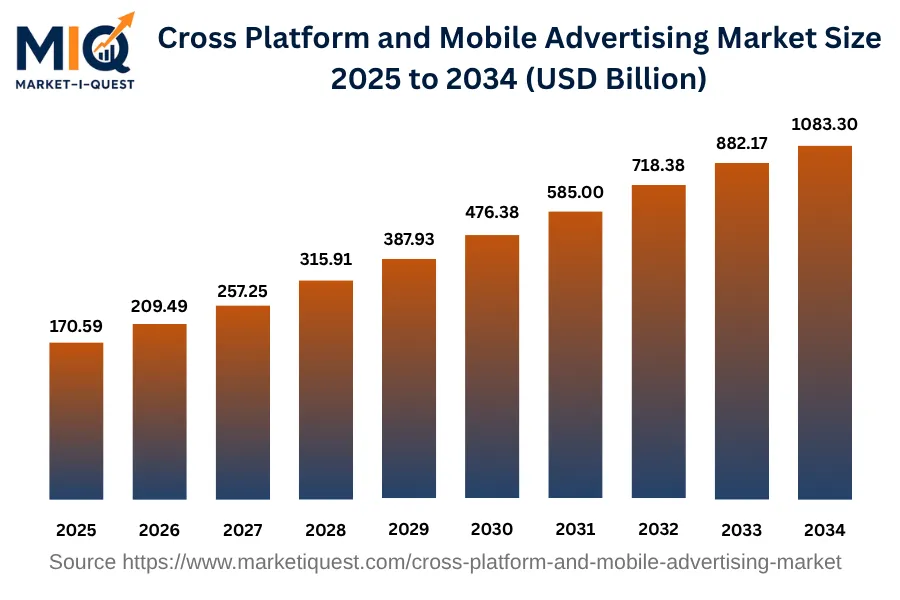
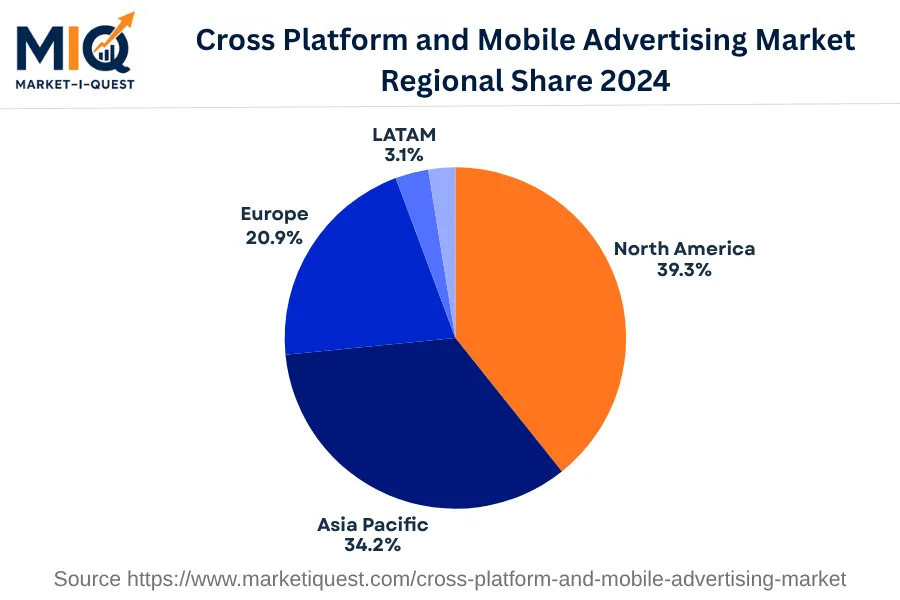
The Cross Platform and Mobile Advertising Market size is projected to be $170.59 billion in 2025, an increase from $138.92 billion in 2024. By 2034, the market size is expected to reach $1083.30 billion, representing a compound annual growth rate (CAGR) of 22.8% for the period 2025 to 2034. This denotes a clear path of steady and substantial growth across this decade, from a baseline of less than two hundred billion dollars to exceeding the trillion-dollar threshold. In terms of regional share, data from 2024 indicates that North America held the largest portion of the market with 39.3% share, closely followed by the Asia Pacific region at 34.2%. Europe had a 20.9% share in the same year. The remaining percentages were held by the LATAM region at 3.1% and the Middle East and Africa (MEA) region at 2.6%.

Key Takeaways

  • By Platform - Desktop held the majority share in the Cross Platform and Mobile Advertising Market.
  • By Targeting Type - Behavioral Targeting emerged as the leading practice in the market.
  • By Ad Format - Display Ads dominated with the most significant usage across platforms.
  • By End User - E-commerce businesses accounted for the majority of advertisements in the market.
cross-platform-and-mobile-advertising-market market size

Key Driving Factors

Increasing smartphone penetration

The drastic rise in global smartphone usage directly fuels the growth of the Cross Platform and Mobile Advertising Market. As access to affordable smartphones expands, particularly in developing regions, marketers increasingly target these devices to reach wider audiences. Cross-platform advertising allows for consistent messaging across devices, making it an appealing strategy for businesses desiring to remain top-of-mind among mobile-dependent consumers. As users continue to utilize multiple screens for content consumption, advertisers can reach them at multiple touchpoints, increasing the chances of ad recall and conversion. In this context, smartphone ubiquity isn't just increasing the audience for this type of advertising, but it's intensifying its effectiveness.
Adoption of data-driven marketing strategies

Data-driven decision making has become a staple for marketers across all industries. This shift has driven growth in the Cross Platform and Mobile Advertising Market. By utilizing customer data, marketers can create personalized ad experiences that resonate with their target audiences on a deeper level. This increases not only the likelihood of conversion, but also customer lifetime value, making data-driven cross-platform and mobile advertising highly appealing. Additionally, data-driven strategies provide insight into customer behavior across devices, helping marketers identify the most effective platforms for their campaigns. As businesses continue to recognize the value of big data, the demand for cross-platform and mobile advertising is expected to remain robust.

Market Evolution by Timeline

2019-2023
In this period, e-commerce retailers and application developers drove demand for cross-platform and mobile advertising. Particularly relevant regions were the Asia-Pacific, led by China and India, as their smartphone penetration soared. Integration with social media platforms became a typical feature, though data privacy constraints surfaced. The market leaned towards CPI (Cost Per Install) and CPM (Cost Per Mille) pricing models, with programmatic advertising gaining traction. GDPR and the California Consumer Privacy Act shaped data privacy standards and affected targeting strategies. Key risk involved ad frauds which was mitigated by leveraging AI and machine learning for ad verification.
2024
In 2024, the shift in buyer segment was noticeable as small-to-mid-sized businesses started adopting mobile and cross-platform advertising. Greater focus was on the Latin American and Middle Eastern markets, largely due to an increase in their internet proliferation. Integration capabilities matured with more businesses adopting cloud-based solutions. Challenges around data privacy continued with governments across the globe tightening their regulations. However, transparency concerns led to technology firms introducing methods to monitor ad performance closely. CPV (Cost Per View) and CPA (Cost Per Action) models were typically adopted, lessening the impact of click fraud.
2025-2029
Through 2025 to 2029, new demand drivers were AR/VR and IoT companies seeking to leverage cross-platform advertising for customer engagement and retention. North America and Europe led the way with 5G connectivity facilitating faster data transmission. Integrations extended towards virtual assistant devices promoting voice-enabled advertising. Various economies adopted stronger data privacy rights like Digital Rights Protection in Brazil affecting cross-platform outreach strategies. CPE (Cost Per Engagement) and CPP (Cost Per Purchase) advertising models gained popularity, encouraging measurable user activities. The risk of data breaches raised security concerns, mitigating which multi-factor authentication became a common practice.
2030-2034
From 2030 to 2034, financial service sectors took a lead in adopting cross-platform and mobile advertising to reach tech-savvy consumers. Africa emerged as a significant market with its surging internet usage and smartphone adoption. The market witnessed an advanced level of platform integration with AI-based predictive algorithms becoming common. ePrivacy Regulation in the EU and net neutrality regulations in the US shaped the market dynamics. Dynamic pricing models became standard, adjusting real-time based on supply and demand. Risks like ad-blocking technologies grew, for which advertisers adopted strategies like native advertising and permission-based ads.

Future Market Outlook

Future Opportunities

The ongoing evolution of the cross-platform and mobile advertising market presents various future opportunities as companies adapt to current technology and regulatory landscapes. The growth of social e-commerce, particularly evident on platforms like Facebook and Instagram, is increasingly influencing the way businesses engage with consumers. In 2022, Meta Platforms reported enhanced shopping features and ad formats, allowing businesses to directly link advertisements to product sales. This trend suggests that advertisers should explore integrating more shoppable content into their strategies to capitalize on the rising consumer interest in direct purchasing through social media. Moreover, advancements in voice search technology, spearheaded by companies like Amazon and Google, are reshaping how users interact with ads; the expanded presence of smart speakers since 2014 indicates a shift towards voice-activated search queries. Brands are now prompted to devise audio-focused advertising strategies to cater to this shift. Blockchain technology is another area of interest, with firms such as BitBrands exploring its application to enhance transparency and reduce ad fraud. The increasing scrutiny over digital ad placements as highlighted by the Federal Trade Commission’s 2021 report on deceptive practices underscores the need for greater accountability in advertising. Furthermore, the growing adoption of programmatic advertising and real-time bidding illustrates a drive towards efficiency in ad spending, compelling advertisers to strategically refine their targeting methods. This dynamic landscape suggests that companies entrenched in traditional advertising must innovate their approaches to effectively meet evolving consumer preferences.

Segmentation Analysis

By Platform

The market is divided into subsegments including Mobile, Tablet, and Desktop. The Desktop subsegment accounted for the largest revenue share, while the Mobile subsegment is expected to grow at the fastest CAGR during the forecast period.

Largest Revenue Share

Desktop

Market Share Leader

Desktop platforms have traditionally dominated the market and continue to hold the largest share of the revenue due to the extensive array of applications they support, their robust performance, and their absolute necessity in workplaces globally. Despite the rise in popularity of mobile and tablet platforms, many businesses still rely on desktop platforms for heavy-lifting tasks that mobile or tablet platforms cannot yet handle efficiently. In addition, key industry-specific software and tools are most compatible with desktop platforms making it indispensable for professional users. Regulation and supply have also played a critical role in maintaining the desktop's market dominance, with system requirements for specific industries coded in law or policy preferring the stability and power of desktop platforms. Furthermore, the purchasers in this segment typically prioritize performance, backward compatibility, utility, and security over portability which additionally supports the demand for the desktop platform.

Fastest CAGR

Mobile

Forecast Period Growth Leader

Although desktops have dominated the market in terms of revenue, mobile platforms present a strong and rapidly growing contender. The mobile platform's salient growth is largely due to its inherent mobility and the worldwide proliferation of smartphones. It's accommodating to the emerging BYOD (bring your own device) culture in corporations, and the increasing portability of business operations with services such as mobile banking, virtual meetings, and digital document signing. Technological advancements are also playing a pivotal role with improved device capabilities, higher mobile internet speeds, and the introduction of 5G, all serving as growth catalysts. However, with this rapid growth also comes risks. The smaller form factor presents challenges in terms of security and performance, and the platform is heavily contingent on technologies such as cloud services. These, however, are more risks than impediments and the mobile subsegment is anticipated to grow at the fastest CAGR during the forecast period.

By Targeting Type

The market is divided into subsegments including Demographic Targeting, Behavioral Targeting, Contextual Targeting, and Retargeting. Of these, Behavioral Targeting accounted for the largest revenue share while Contextual Targeting is expected to grow at the fastest CAGR during the forecast period.

Largest Revenue Share

Behavioral Targeting

Market Share Leader

Behavioral targeting has positioned itself as the leading subsegment in terms of revenue. This can be attributed to its ability to precisely target potential customers by analyzing their past behavior, offering businesses an efficient way to tailor their marketing efforts. Since behavioral targeting empowers marketers to offer personalized experiences based on user behavior, it ensures better conversion rates, and thus higher revenues. Industries across the board are leveraging behavioral targeting, with particularly high acceptance in the e-commerce, media, and advertising sectors. Furthermore, the growing shift towards digital platforms and the proliferation of big data have fueled this trend. Developed regions, such as North America and Europe, majorly contribute to this subsegment’s revenue due to their advanced digital infrastructure. However, developing regions are also catching up, given the increasing internet penetration and digital literacy there. As consumers become increasingly comfortable with personalized online experiences, the growth of behavioral targeting is set to sustain.

Fastest CAGR

Contextual Targeting

Forecast Period Growth Leader

Contextual targeting, despite having a lower revenue share than behavioral targeting currently, is projected to have the highest growth rate in the coming years. This is based on the maturation of machine learning algorithms and artificial intelligence, enhancing the ability of contextual targeting to serve relevant ads based on the content of a webpage. Moreover, privacy regulations have catalyzed this growth: contextual targeting does not rely on personal data, making it more compliant with stringent privacy laws. This positions it as a preferable choice for industries wary of data breaches and compliance issues. However, adoption barriers exist, notably the current dependency on keyword matching which can lead to irrelevant ad placement. But with ongoing advancements in natural language processing, better content understanding will undoubtedly drive faster uptake of contextual targeting. Region-wise, Asia-Pacific is expected to contribute significantly to this growth due to its rapidly expanding digital ecosystem.

By Ad Format

The market, categorized by ad format, includes subsegments such as Display Ads, Video Ads, Native Ads, and Rich Media Ads. In 2024, Display Ads were the frontrunners in terms of revenue generation, while Video Ads were observed as the subsegment with the fastest anticipated growth.

Largest Revenue Share

Display Ads

Market Share Leader

In 2024, amongst the different ad formats, Display Ads constitute the highest revenue. One primary reason behind this lies in Display Ads' widespread adoption due to their familiarity and consistent nature. Further, with the increase in internet users worldwide, digital marketing continues to rise, and Display Ads being the oldest type are enjoying significant growth. Additionally, they are versatile and can be customized according to the requirements of the advertiser, thereby attracting a broad advertiser base. They are also relatively cost-effective, resulting in a much lower investment risk for companies. Display Ads are omnipresent across various platforms, making it easier for brands to connect with consumers readily. Regional markets, particularly in Asia-Pacific, continue to expand, driven by the rapid growth of the middle-class consumer population's digital consumption. A favoring regulatory environment also encourages spending on display ads, bolstering their dominance in the market.

Fastest CAGR

Video Ads

Forecast Period Growth Leader

The Video Ads segment, although not the largest revenue provider in 2024, is forecasted to outpace growth compared to other segments. The increasing popularity of video-oriented content across various platforms serves as a foundational driver for the growth of Video Ads. With the evolution of technologies such as 5G, video-streaming has become exceedingly popular, providing an ideal medium for Video Ads. The continuous surge of influencers on social media platforms also contributes to the rapid adoption of Video Ads. Innovations in ad-formats like shoppable Video Ads are attracting more advertisers to invest in it. Additionally, partnerships amongst content creators, streaming platforms, and advertisers are causing a spur in the growth of Video Ads. However, potential near-term risks include ad fatigue, due to the overexposure of Video Ads, which could lead to the audience ignoring or blocking these ads, generating a demand for more creative Video Ad formats.

By End User

The market is divided into subsegments including E-commerce, Gaming, Travel, Finance, Healthcare, and Others. In 2024, E-commerce accounted for the largest revenue share while Healthcare is expected to grow at the fastest CAGR during the forecast period.

Largest Revenue Share

E-commerce

Market Share Leader

E-commerce leads the market revenue primarily due to the increasing internet penetration and the growth of online shopping. It is driven by consumer preferences for convenience and choice, leading to a surge in online transactions. The massive penetration of smartphones and internet connectivity globally has profoundly impacted the e-commerce segment’s growth. This shift in consumer shopping behaviour from bricks-and-mortar stores to online platforms is escalating. Marketplaces offer greater product range, price comparison options, and ease of use, enticing more people towards e-commerce platforms. Geographically, regions with high internet penetration, mature digital infrastructure and tech-savvy consumers such as North America, Europe and Asia–Pacific contribute significantly to this segment's revenue. In addition, effective online marketing strategies and promotional offers are fueling the popularity of e-commerce platforms. Regulatory support can also positively impact this sector, with governments worldwide pushing for digitalization.

Fastest CAGR

Healthcare

Forecast Period Growth Leader

The Healthcare sector is projected to grow at the highest CAGR in the forecast period primarily due to the increasing application of digital technologies in healthcare services. Industries have acted upon digital advancements, and healthcare is no exception. The rise in data-driven healthcare, electronic health records, telemedicine, e-prescribing, and data analytics is driving this market's rapid growth. Furthermore, the COVID-19 pandemic has triggered the diffusion of digital health technologies making healthcare more accessible. Policies supporting digital healthcare implementation may further spur this growth. However, barriers like data security concerns, technology adoption rates, and patient privacy concerns need to be addressed to maximize this sector's growth potential. The advent of innovative technologies, collaborations between tech giants and health institutions, and significant investment in digital health are further expected to catalyse this booming segment.

Competitive Analysis

Key Market Players

Manufacturers / OEMs

Google
US
Facebook
US
Apple
US

Key Suppliers & Raw Materials

Adobe Systems
US
Microsoft
US
Yahoo
US

Distributors, Integrators & Channel Partners

Twitter
US
SAP
Germany
Oracle
US

Porter’s Five Forces Analysis

A comprehensive analysis detailing the competitive intensity and attractiveness of the Cross Platform and Mobile Advertising Market.

Supplier Bargaining Power

Medium

Power balanced due to diverse range of platform providers, but limited by advertisers' preferences.

Buyer Bargaining Power

High

Abundant platforms and flexible ad packages increase bargaining power for advertisers.

Threat of Substitutes

Medium

Substitutes like conventional advertising exist, but undergoing digital transition.

Threat of New Entrants

Low

High entry barriers due to intense competition and need for substantial technological capabilities.

Competitive Rivalry

High

Stiff competition among existing players like Google, Facebook, and Twitter.

Regional Analysis

Geographic market dynamics and growth opportunities across key regions

Global Market Outlook

cross-platform-and-mobile-advertising-market market regional share

North America

In 2024, the North American Cross Platform and Mobile Advertising Market manifested substantial growth fueled by increased smartphone penetration, technological advancement, and robust digital infrastructure. Primary drivers included escalating demand for personalized advertising due to growing E-commerce activities particularly in the U.S. and Canada. Regulatory emphasis on data privacy, like the California Consumer Privacy Act, encouraged innovative ad techniques ensuring consumer protection. Increased investments in Artificial Intelligence and Machine Learning shaped more targeted and efficient ad strategies, majorly contributing to the market surge.

The market notably witnessed a shift towards programmatic advertising, which allowed advertisers to leverage audience data for optimal results. Demand for In-app advertising heightened, given the increased use time of mobile apps, making it a compelling channel for marketers. Emergence of advanced technologies like 5G enhanced loading speed and ad quality, fundamentally altering the mobile ad space. A significant trend was seen in enterprise sectors, where companies harnessed these advertising tools to engage potential customers, boost brand visibility, and drive sales. For instance, retail giants in the U.S. and Mexico opted for these strategies to tailor ads based on consumer behavior. The healthcare sector also leveraged mobile advertising to deliver critical information, indicating wide-ranging adoption across diverse industries.

Asia Pacific

In 2024, the Cross Platform and Mobile Advertising Market surged across the Asia Pacific region, fueled by factors such as technology adoption, high internet penetration, and rising growth in digital consumer base. China, India, and Indonesia stand out given their massive populations with impressive smartphone penetration rates, fuelling mobile accessibility and hence, mobile advertising. Japan and South Korea, already mature markets with advanced digital infrastructures and regulatory support, witnessed a surge in business investments in new and innovative advertising strategies. The advertising ecosystem evolved, reflecting changing consumer preferences toward personalised, interactive ads. For instance, in-app ads have seen an upturn in platforms past social media. E-commerce businesses, news apps, and gaming platforms, particularly in China and South Korea, have been quick to capitalise on this. Likewise, mobile video ads became more prevalent due to their increased engagement rate.

The healthcare, retail, and entertainment sectors notably integrated cross-platform and mobile ads into their marketing strategies. Furthermore, large tech companies in India and ASEAN markets embraced these ad forms, forging partnerships for better reach. Challenges around data privacy and regulatory standards, however, warranted attention with Japan imposing stringent data protection policies. All these factors marked the landscape of the Cross Platform and Mobile Advertising Market in Asia Pacific throughout 2024.

Europe

In 2024, the Cross Platform and Mobile Advertising market in Europe experienced substantial evolution. Several primary drivers significantly influenced the market landscape that year. A surge in smartphone penetration in countries such as the United Kingdom and France fostered the consumption of mobile advertising. Stringent data privacy regulations like the General Data Protection Regulation (GDPR) compelled advertisers to adopt more consumer-friendly practices. Furthermore, increased investments in advanced advertising technology from advertisers in Germany and the Nordics boosted market growth. The competitive pricing strategies implemented by advertisers in Spain, Italy, and Central & Eastern Europe also contributed to the market dynamism.

Regarding market trends, behavioral targeting became a strong focus for advertisers, particularly in the retail sector, driven by a large amount of available consumer data. Technological advancements witnessed a shift from traditional ad formats to more interactive and immersive content, especially in countries like the United Kingdom and Germany. There was a surge in partnerships and mergers across Europe, led by media firms seeking to leverage advertising technology. As a response to GDPR, there was an increase in the development and implementation of more transparent digital advertising policies. Enterprise and government sectors were among the notable adopters of cross-platform and mobile advertising that year.

Latin America

In 2024, the Cross-Platform and Mobile Advertising Market in Latin America (LATAM) saw significant upswing due to an array of factors and trends. Key market drivers included growing smartphone penetration, increased consumption of mobile internet, and the rising popularity of social media platforms among the youth in countries like Brazil, Mexico, and Argentina. Government initiatives, such as Brazil's National Broadband Plan, also drove market expansion by improving internet infrastructure and accessibility. Simultaneously, the proliferation of location-based services and surge in e-commerce activities, particularly in retail and entertainment sectors, invigorated the market.

Diverse trends were noticed across LATAM, most notably, the shift of advertising budgets from traditional media to digital platforms, especially mobile. As brands endeavored to offer personalized experiences, programmatic advertising saw rise, with real-time bidding (RTB) leading the initiative. We also saw augmented reality (AR) incorporated into advertising strategies of industries like real estate and retail, transforming user interaction within mobile environments. Companies engaged in partnerships, such as Telefónica's alliance with Fyber for in-app programmatic advertising, to gain a strategic edge in the market. Lastly, the implementation of stricter data privacy regulations affected the way businesses collected and used consumer data, influencing ad targeting approaches.

Middle East & Africa

In 2024, the Cross Platform and Mobile Advertising Market in the Middle East and Africa witnessed significant growth. The key drivers included heightened consumer digitization, regulatory support for digital transformation, and significant investment in mobile technology infrastructure. In Saudi Arabia and the United Arab Emirates, accelerated technology adoption was seen in government, retail, and financial services sectors, instigated by digital transformation initiatives. Meanwhile, vibrant mobile ecosystems in Kenya and South Africa fueled the market for cross-platform and mobile advertising.

Trends observed were predominantly around shifts in buyer behavior and technology. A growing preference for mobile commerce among consumers led to an increase in mobile advertising. Israel's tech sector witnessed considerable M&A activity, promoting advancements in adtech. Also, the increased enforcement of data privacy regulations across the region influenced the advertising strategies of businesses, particularly in sectors like healthcare, telecom, and utilities. In countries like Egypt and Nigeria, the expansion of mobile networks contributed to a shift in media consumption habits, causing advertisers to strategically pivot toward these platforms. Overall, the dynamism and digital maturity of these markets significantly shaped the Cross Platform and Mobile Advertising landscape in 2024.

Recent Industry Developments

Latest market innovations, product launches, and strategic initiatives

January 2026

A market forecast report valued the global cross-platform and mobile advertising market at USD 290.45 billion in 2025, projecting it to reach USD 303.12 billion in 2026 and grow at a 5.84% CAGR to USD 432.15 billion by 2032, with privacy regulation and identity strategies driving structural shifts

Frequently Asked Questions