Creatinine Measurement Market Snapshot

Key Players

  • Abbott Laboratories (United States)
  • Roche Diagnostics (Switzerland)
  • Siemens Healthineers (Germany)
  • Ortho Clinical Diagnostics (United States)
  • EKF Diagnostics (United Kingdom)
  • Randox Laboratories (United Kingdom)
  • Nova Biomedical (United States)
  • Radiometer Medical ApS (Denmark)
  • Randox Laboratories Ltd. (Ireland)
  • Shenzhen Mindray Bio-Medical Electronics Co.
  • Ltd (China)

Market Size

Base Year 2024
$2.18 Bn
CAGR
5.5%
Forecast 2034
$3.72 Bn

Market Segments

By Test Type
Blood Test, Urine Test and Creatinine Clearance Test
By Product Type
Consumables, Instruments
By Application
Urinary Tract Obstruction, Renal Failure, Kidney Cancer, Glomerulonephritis
By End User
Hospital and Clinics, Diagnostic Centre, Research Institutes

Market Dynamics

Drivers
  • Rising prevalence of kidney disorders
  • Increasing geriatric population
Restraints
  • High equipment costs
  • Limited awareness in emerging markets
Opportunities
  • Increasing prevalence of kidney disorders
  • Technological advancements in creatinine measurement devices

Market Size

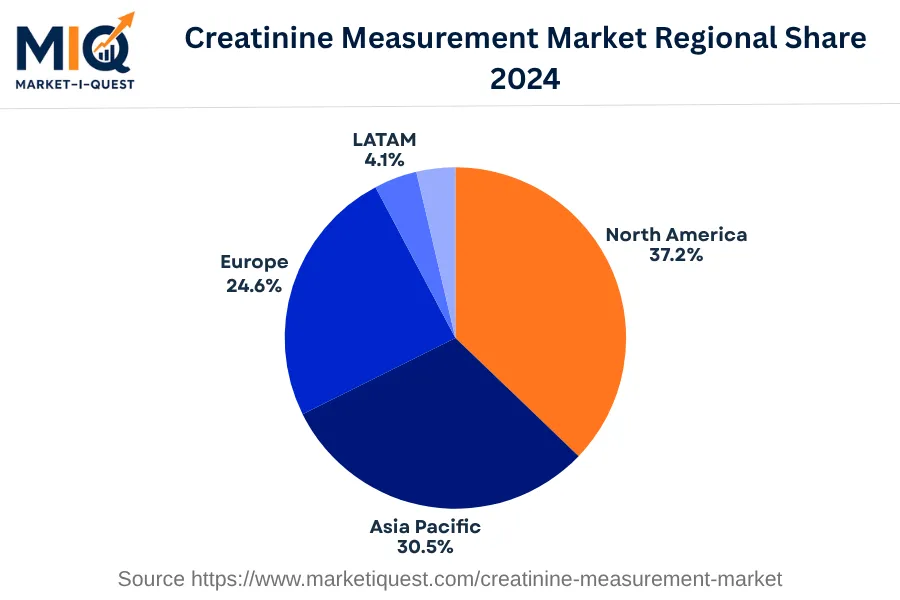
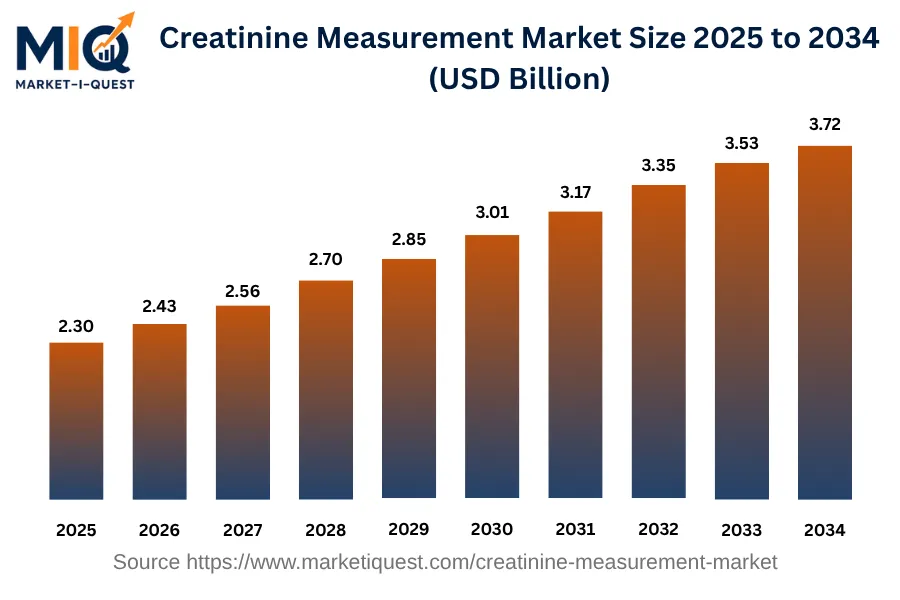
The Creatinine Measurement Market size is projected to grow considerably, reaching a value of $2.30 billion in 2025, from a starting point of $2.18 billion in 2024. This upward trend is expected to continue, culminating in a market value of $3.72 billion by 2034, exhibiting a CAGR of 5.5% over the forecasted period from 2025 to 2034. This steady increase is primarily due to a notable upturn in the diagnosis of renal dysfunctions, as well as a substantial rise in the number of patients undergoing regular health check-ups. However, the regional share distribution indicated North America holding 37.2%, Asia Pacific accounting for 30.5%, Europe representing 24.6%, Latin America with 4.07%, and the Middle East & Africa contributing 3.7% to the total market share.

Key Takeaways

  • By Test Type - Blood Test held the dominating position in the market with the most common method of creatinine measurement in 2024.
  • By Product Type - Consumables maintained a leading role due to their recurrent usage for creatinine measurement in various health conditions in 2024.
  • By Application - Kidney Cancer accounted for a high instance of creatinine measurement because of the associated kidney dysfunction in the base year.
  • By End User - Hospitals and Clinics accounted the largest revenue share for the creatinine measurement market.
creatinine-measurement-market market size

Key Driving Factors

Increased Prevalence of Renal Disorders

One significant driving force for the creatinine measurement market is the heightened presence of kidney diseases worldwide. Kidney disorders, such as Chronic Kidney Disease (CKD) and Acute Kidney Injury (AKI), necessitate the regular measurement of creatinine levels in patients' blood or urine. Creatinine levels serve as a key indicator of how well a kidney is functioning, hence the criticality of this test. Furthermore, creatinine measurement is an initial, non-invasive diagnostic tool for renal impairment. As kidney ailments continue to rise, especially in geriatric populations, the demand for creatinine measurement tests also increases. This rise fuels the size and growth of the market.

Implementation of Mandatory Regular Health Check-Ups

Another driver of the creatinine measurement market is the implementation of regular health check-ups by businesses and governments. Given the consequences of untreated kidney diseases on public health and workplace productivity, routine health assessments, including creatinine tests, have become obligatory in various sectors. In many countries, routine health checks encompassing creatinine levels are now a compliance rule for employee health coverage. Regulatory standards also mandate regular health screenings, particularly for jobs with potential exposure to nephrotoxins. This rise in health consciousness and resultant screenings propels the demand for creatinine testing, thereby boosting the market.

Market Evolution by Timeline

2019-2023
In this period, the primary demand drivers for creatinine measurements were hospitals, diagnostic centers, and research labs, primarily in North America and Europe. Driving this demand, manufacturers focused on improving accuracy and precision of creatinine measurement devices. Integration between creatinine measurement and broader diagnostic platforms was a strong trend as there was a push for harmonized lab results. However, CLSI standards for creatinine measurement began to witness widespread global adoption. The common commercial model was a one-time payment model with manufacturers working through distributors to reach end-users. A significant risk in this period was the potential for supplement contamination which could result in inaccurate measurements.
2024
In 2024, there was a continuation of the previous period's trends with an added emphasis on portable creatinine measurement devices. This demand was driven by in-home healthcare providers looking to provide patients with more direct control over their health in the United States, Canada, and Germany. Regulatory bodies in these regions required these devices to pass stringent accuracy and reliability tests before being market-approved. On the supply side, manufacturers incorporated machine learning techniques to improve the precision of the devices. Commercially, manufacturers were establishing strategic partnerships with telehealth providers. Nevertheless, the further integration of AI posed the risk of software glitches, leading to incorrect results affecting their widespread adoption.
2025-2029
In this period the rise is expected to witnessed in the Asia-Pacific region, primarily China and India, as major markets for creatinine measurement due to the increasing incidence of diabetes and kidney disorders. Technological advancements in this period will likely center around the integration of IoT to provide real-time monitoring capabilities, assisting in early detection and prevention. Commercial models might transition towards subscription-based offerings provided by manufacturers in partnership with healthcare software companies. With the increased digitisation, data security and patient privacy may become a concern posing a risk to the adoption of new technologies in this market.
2030-2034
By this period, demand for creatinine measurement devices are expected to become widespread, with requests, not just from the healthcare sector but also from the personal fitness and wellness sectors. The United States and European Union might act as primary regions for demand. Manufacturers will likely begin leveraging nano-technology for enhancing the sensitivity and accuracy of devices. Subscription-based models which might become dominant, often bundled with comprehensive healthcare packages. However, the broad use of these devices may expose some reliability concerns, especially in non-medical contexts, which will likely have to be carefully manage under new FDA and EU regulations.

Future Market Outlook

Future Opportunities

As health authorities, such as the Centers for Disease Control and Prevention, emphasize chronic kidney disease (CKD) management, opportunities in the creatinine measurement market are expanding significantly. The global shift toward preventive healthcare, particularly in regions like Asia-Pacific, is influencing demand for rapid testing solutions. There is an increasing interest in point-of-care devices that provide immediate results, aligning with initiatives by organizations like the European Renal Association for improving kidney-related health outcomes. Partnerships, such as that between Siemens Healthineers and various regional healthcare providers, highlight the move towards integrated service delivery models. The focus on telehealth has further driven the exploration of remote creatinine monitoring devices, which could cater to populations in remote areas. Moreover, the growing awareness of the impact of diabetes and hypertension on kidney health is opening up avenues for innovative creatinine measurement solutions tailored to high-risk demographics. The shift towards value-based care systems, as promoted by policy changes across multiple countries, suggests a demand for more efficient diagnostic tools that can reduce healthcare costs. Furthermore, collaboration between tech firms and medical device manufacturers is likely to bring forth new approaches, capitalizing on the fusion of software and hardware in creatinine assessment technologies.

Segmentation Analysis

By Test Type

The market is divided into subsegments including Blood Test, Urine Test, and Creatinine Clearance Test. The Blood Test subsegment accounted for the largest revenue share while the Creatinine Clearance Test subsegment is expected to grow at the fastest CAGR during the forecast period.

Largest Revenue Share

Blood Test

Market Share Leader

Blood tests are commonly prescribed medical procedures and form the backbone of diagnostic pathways. This ubiquitous nature coupled with its flat-out necessity in diagnosing, monitoring and managing a sheer multitude of illnesses, diseases and conditions, allow this subsegment to accrue the most revenue. Drivers such as the increase in geriatric population, high prevalence of various chronic diseases alongside infectious ailments, and increase in patient awareness about the importance of preemptive testing, all contribute to the strong performance of blood tests in terms of revenue. The nature of the healthcare system catering to a wide range of consumers including hospitals, clinics, diagnostic centers, home care settings, and research laboratories further propels growth. Geographically, developed markets with high healthcare expenditures and widespread insurance coverage shoulder a large part of this revenue. Regulatory factors also contribute, as required and recommended blood-testing protocols frequently come into play.

Fastest CAGR

Creatinine Clearance Test

Forecast Period Growth Leader

The Creatinine clearance test subsegment is expected to grow at the fastest CAGR outlook. In rising economies and globally, there is a soaring recognition of kidney diseases and conditions, thus, creating an increasing demand for creatinine clearance tests which effectively evaluate kidney performance. Including, the recent focus on preventive healthcare and regular health checks is driving the adoption rates up. Advancements in medical technology and improved test procedures play the roles of catalysts in this accelerated growth. However, since creatinine clearance tests require collection of samples over an extended period, potential patients may find it inconvenient, posing as an adoption barrier that could slow down anticipated growth. Nonetheless, factors such as policy changes encouraging regular health check-ups, rising capital expenditure in healthcare sector and strategic partnerships for the promotion and delivery of kidney performance tests are expected to drive growth in the years ahead.

By Product Type

The market is fragmented into subsegments which include consumables and instruments. In 2024, consumables accounted for the dominant share in terms of revenue, whereas instruments are anticipated to register the fastest growth during the forecast period.

Largest Revenue Share

Consumables

Market Share Leader

The consumables subsegment had the highest revenue share of the product type market in 2024. This is predominantly due to the extensive usage of consumables across a multitude of industries, ranging from healthcare to manufacturing. Consumables are often short-lived and utilized in volume, leading to higher turnover and thus larger revenues. In addition, the uninterrupted demand is buoyed by the necessity for recurring replacements, ensuring a steady revenue for market players. Geographically, the dominance of developed regions, owing to their advanced infrastructures like research laboratories, is pivotal in cementing consumables' revenue legacy. Regulations mandating certain usage levels also bolster their demand. Furthermore, the limited switching costs for consumers allows the sustenance of existing revenue dynamics. The distribution channels for consumables also favor high revenue outcomes, thanks to a complex network of wholesalers, retailers, and direct-to-consumer outlets.

Fastest CAGR

Instruments

Forecast Period Growth Leader

While instruments have not historically commanded the largest revenue share, they show promise of the fastest Compound Annual Growth Rate. This is due to advancements in technology that are constantly improving instrument efficiency, driving adoption at a rapid pace. Instruments are also seeing reduced barriers to entry through financing options and investments into infrastructure that supports their use. Cutting-edge technology and partnerships are propelling the adoption of instruments, but with this, risk could play a part in the potential roller-coaster growth path. Although instruments enjoy lower volatility than consumables, the raw material supply and price hikes may affect their growth rate. The implications of economic policies and capital expenditure on instruments' adoption also need to be accounted.

By Application

The market, segmented by application, is divided into subsegments including Urinary Tract Obstruction, Renal Failure, Kidney Cancer, and Glomerulonephritis. In 2024, Kidney Cancer account for the largest revenue share, while Glomerulonephritis is projected to grow at the fastest Compound Annual Growth Rate (CAGR) during the forecast period.

Largest Revenue Share

Kidney Cancer

Market Share Leader

Kidney Cancer is currently the leading subsegment by revenue in 2024. This is due to a mix of factors, primary being the growing instances of kidney cancer globally. Advancement in medical technology which ensures earlier and more precise detection of kidney cancer also acts as a driver for this subsegment, leading to higher demand for cancer-specific treatments. Kidney cancer, unlike other subsegments, demands immediate, focused treatment, which often makes it more expensive, thereby contributing to its high revenue in the market. Additionally, the public's awareness of the disease, largely due to advocacy and media coverage, has resulted in more people getting tested and diagnosed. High-impact geographies such as North America and Europe contribute a significant share to this revenue owing to their efficient and well-funded healthcare sector.

Fastest CAGR

Glomerulonephritis

Forecast Period Growth Leader

Glomerulonephritis stands out as the fastest-growing subsegment. The projected growth rate can be traced back to the rise of autoimmune diseases that put strain on kidney health, indirectly leading to Glomerulonephritis. With the link between autoimmune disorders and Glomerulonephritis becoming clearer, there is a growing focus from the medical community to develop treatments for the condition, which acts as a catalyst for growth. However, the development and wider adoption of new treatments often meet with challenges such as approval procedures and varied adoption rates across regions. This subsegment, however, is expected to benefit from the ongoing investments in R&D and partnerships between pharmaceutical companies and biotech start-ups.

By End User

The market is divided into subsegments including Hospitals and Clinics, Diagnostic Centres, and Research Institutes. In 2024, Hospitals and Clinics segment accounted for the largest revenue share while Diagnostic Centres is expected to grow at the fastest CAGR during the forecast period.

Largest Revenue Share

Hospitals and Clinics

Market Share Leader

Hospitals and Clinics accounts for the largest share in the revenue, this could be attributable to the high volume of patients they cater to. They offer broad services spectrum - from preventive care to critical medical intervention and treatments, therefore driving demand for various supplies, equipment and services. Moreover, hospitals and clinics are also leading users of medical technology, leveraging the advancements for efficient, timely and accurate diagnosis and treatments. Additionally, the growth in hospitalizations due to aging population and rise of chronic diseases also fuel the revenue. Geographically, hospital networks in urban areas and developed countries lead in revenue generation owing to better accessibility and higher spending capacity of the population. The increasing investments by governments in public healthcare infrastructure also contributes significantly to the revenue.

Fastest CAGR

Diagnostic Centres

Forecast Period Growth Leader

The Diagnostic Centres subsegment is projected to register the fastest growth rate. Enhanced technology, investment in medical research and demand for early disease detection forms the catalyst for this growth. Particularly with the advancements in imaging technology and laboratory equipment, diagnostic centres foresee tremendous growth opportunities. In recent years, the evolution of personalized medicine and predictive diagnostics has increased the need for such modern diagnostic platforms. However, there are barriers in the form of stringent regulatory norms and high capital expenditure that could inhibit growth. Yet, with the potential partnerships between diagnostic centres and technology providers, adoption challenges could be mitigated. Also, increasing global health awareness and preventive healthcare measures risk factors are being addressed early, thus driving the growth of diagnostic centres.

Creatinine Measurement Market Competitive Analysis

Key Market Players

Manufacturers / OEMs

Abbott Laboratories
US
Siemens Healthineers
Germany
Roche Diagnostics
Switzerland

Key Suppliers & Raw Materials

Thermo Fisher Scientific
US
Promega Corporation
US
Becton, Dickinson and Company
US

Distributors, Integrators & Channel Partners

Medline Industries
US
McKesson Medical-Surgical
US
Henry Schein Medical
US

Porter’s Five Forces Analysis

This analysis evaluates the competitive intensity and attractiveness of the Creatinine Measurement Market.

Supplier Bargaining Power

Medium

Focused suppliers with proprietary technologies influence the market moderately.

Buyer Bargaining Power

High

Buyers, possessing ample alternatives, demonstrate high bargaining power.

Threat of Substitutes

Low

Unique nature of creatinine tests and the critical role in healthcare limits substitutes.

Threat of New Entrants

Medium

Regulation and development costs limit entrants, but rising demand provides opportunity.

Competitive Rivalry

High

Numerous global players lead to high competitive rivalry in the market.

Regional Analysis

Geographic market dynamics and growth opportunities across key regions

Global Market Outlook

creatinine-measurement-market market regional share

North America

In 2024, North America's creatinine measurement market was characterized by strong demand in the healthcare sector, namely in diagnostics and patient care. Underpinning this demand were several key drivers. An ageing population in the US, Canada, and Mexico increased the prevalence of kidney diseases, boosting the need for creatinine measurement in diagnostics. Governments across these nations pumped significant investment into healthcare, facilitating wider access to creatinine tests. Technological advancements in creatinine measurement devices propelled adoption rates, backed by favorable supply dynamics, which secured sufficient product availability in the market.

Consumer trends reflected these driving factors. Healthcare providers exhibited a preference for high-precision devices in creatinine measurement, instigated by the shift toward value-based healthcare in North America. In addition, the advent of portable creatinine measurement devices disrupted traditional distribution channels, with many providers seeking these for timely patient care. Furthermore, partnerships and mergers between key market players fueled the market's consolidation, aiming to enhance operational efficiencies and strengthen their reach. Regulatory bodies prioritized stricter policy enforcement concerning product standards, a step toward ensuring reliable creatinine test results. In turn, this obligated manufacturers to comply with stringent quality standards, promoting market competitiveness. Thus, the confluence of these drivers and trends shaped the sphere of creatinine measurement in North America for 2024.

Asia Pacific

The Creatinine Measurement Market in the Asia Pacific in 2024 was clinched by robust healthcare systems and awareness of kidney diseases. Driving the market was the two-pronged surge in renal conditions due to unhealthy lifestyle habits in China and Japan, and the healthcare gaps in India and ASEAN markets fostering high demand for cost-efficient creatinine diagnostic tools. Advances in non-invasive creatinine testing significantly influenced adoption; particularly in developed markets such as Australia and South Korea, where technology adoption and investment in healthcare were strong. The Chinese government's active push for preventative healthcare led to increased uptake in creatinine tests to detect early kidney malfunctions.

Consumer behaviour trended towards convenience and speed in 2024, with a surge in point-of-care testing and home-based creatinine testing units. This shift was assisted by significant strides in digital health platforms in Australia, China, and Japan. Healthcare providers increasingly adopted telehealth as a service delivery channel, driving demand for remote patient monitoring tools, including creatinine measurement devices. Regulatory policies trended towards stringent creatinine measurement standards. In India, the government-encouraged diagnostic centers to adhere to the World Health Organization's 'Five rights of medication administration', prioritizing accuracy of creatinine measurement for correct drug dosage and to prevent medication errors, notably in the treatment of chronic kidney disease.

Europe

In 2024, the creatinine measurement market in Europe showed significant growth due to a variety of factors. Increasing incidence of renal disorders, coupled with the rise in geriatric population across key countries such as Germany, Italy, and the United Kingdom, generated high demand for creatinine measurement solutions. Regulatory emphasis on improved healthcare infrastructure, notably in Central & Eastern Europe, and considerable investment in medical technology also drove market expansion. Moreover, the adoption of advanced diagnostic practices in major healthcare sectors spurred the requirement for accurate creatinine measurement.

Trends in the region exhibited a significant shift to automated biosensing solutions, testament to technology advancement in the healthcare domain. Buyer behavior mirrored emphasis on high sensitivity and rapid test results, particularly in hospital and clinical care facilities. Digital health partnerships in France and Spain, focusing on data-driven renal diagnostics, manifested into increased adoption of creatinine testing tools. A noteworthy trend involved the enforcement of stricter European Union regulatory standards on renal disease diagnostics, raising the bar for product accuracy and reliability. Furthermore, the market witnessed a surge in online procurement, indicating a dynamic channel shift, reinforced by pandemic-induced preferences for contactless business transactions.

Latin America

In 2024, the creatinine measurement market in Latin America (LATAM) observed steady growth, majorly driven by increasing prevalences of kidney disorders in countries like Brazil, Mexico, Argentina, Colombia, Chile, and Peru. Technological advancements in diagnostic methods initiated by local and international vendors bolstered market expansion. The governments also played substantial roles through promotional investment policies and stringent regulations to ensure the quality of healthcare services. A rising trend of preventative healthcare strategies, focusing on early detection of chronic disorders, was observed to drive significant changes in user behaviors across LATAM. The demand for non-invasive creatinine measurement devices saw a surge in 2024, notably from healthcare units, relieving patients from inconvenient and painful traditional methods. The market witnessed an increase in partnerships between local hospitals and international firms, aiming to enhance diagnostic capabilities and streamline healthcare operations. In response to the escalating demand, several manufacturers expanded their production lines, ensuring better availability within the region.

An unexpected hike in creatinine measurement costs put pressure on healthcare budgets, highlighting the need for local manufacturing facilities to match quality with affordability. The government sector played a proactive role in promoting domestic production, with policies favoring the manufacturing industry and stringent checks on pricing trends. In the base year, conventional in-vitro diagnostics held the majority market share. Still, an upward trend in point-of-care diagnostics emphasized the gradual shift of consumer preference, driven by convenience and faster results.

Middle East & Africa

In 2024, the Creatinine Measurement market in the Middle East and Africa witnessed notable dynamism, reflecting multidimensional driving forces and significant trends. The increasing prevalence of kidney disorders, particularly in populous nations like Egypt and Nigeria, amplified demand for Creatinine Measurement; concurrently, a push towards preventive healthcare in wealthier nations like Saudi Arabia and UAE fueled uptake. Additionally, governments investing in healthcare infrastructure, such as South Africa and Israel, broadened market accessibility. Technological advancements also stirred the market. For instance, the adoption of high-throughput screening techniques for Creatinine Measurement proliferated in advanced healthcare systems like Israel, improving diagnostic efficiency. Moreover, the falling prices of Creatinine tests, mainly due to increased competition amongst suppliers, stoked demand across the region.

On the trends front, preference for point-of-care Creatinine Measurement surged, particularly in high-income, highly urbanized economies like UAE and Qatar. The shift towards kidney wellness preceded a swing in patient behavior, with individuals opting for regular kidney function tests even in the absence of symptoms. Furthermore, a tightening regulatory environment, especially in Kenya and Saudi Arabia, standardized testing procedures, bolstering market credibility. Mandatory Creatinine testing in sectors like oil and gas in countries like Nigeria delineated an emergent demand channel. Hence, by 2024, the Creatinine Measurement market, against the backdrop of evolving public health landscapes, stood significantly shaped by healthcare needs, technological progress, patient behavior, and regulatory oversight.

Recent Industry Developments

Latest market innovations, product launches, and strategic initiatives

January 2026

A market analysis estimated the creatinine measurement market at USD 0.79 billion in 2025, projected to reach USD 1.29 billion by 2031 at an 8.5% CAGR, with North America holding 41.15% of 2025 value and Asia-Pacific emerging as the fastest-growing region at 9.51% CAGR .

August 2025

A comprehensive market report valued the global creatinine measurement market at approximately USD 0.61 billion in 2024, with a projected CAGR of 8.40% through 2035, reaching close to USD 1.48 billion, driven by the rising prevalence of chronic kidney disease (CKD) affecting over 850 million people globally.

Frequently Asked Questions