Cranial Fixation and Stabilization Systems Market Snapshot

Key Players

  • Medtronic plc (Ireland)
  • B. Braun Melsungen AG (Germany)
  • Stryker Corporation (United States)
  • DePuy Synthes (United States)
  • Zimmer Biomet Holdings Inc. (United States)
  • Integra Lifesciences Holdings Corporation (United States)
  • KLS Martin Group (Germany)
  • Medartis AG (Switzerland)
  • Micromar (Brazil)
  • OsteoMed (United States)

Market Size

Base Year 2024
$2.58 Bn
CAGR
8.4%
Forecast 2034
$5.78 Bn

Market Segments

By Product Type
Cranial Plates, Cranial Screws, Cranial Clamps, Cranial Anchors
By Material
Metal, Polymer, Ceramic, Composite
By Fixation Type
Internal Fixation, External Fixation, Temporomandibular Joint Fixation
By Application
Neurosurgery, General Surgery, Orthopedic Surgery, Trauma Surgery, Others

Market Dynamics

Drivers
  • Rising neurological disorder prevalence
  • Advancements in surgical technologies
Restraints
  • High procedure costs
  • Limited surgical expertise
Opportunities
  • Rapid technological advancements
  • Increasing neurological disorders prevalence

Market Size

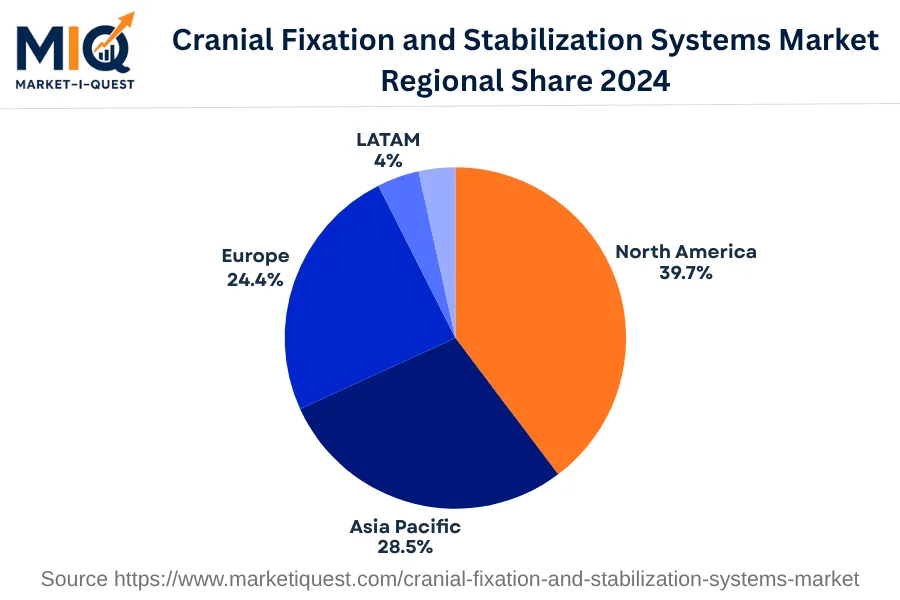
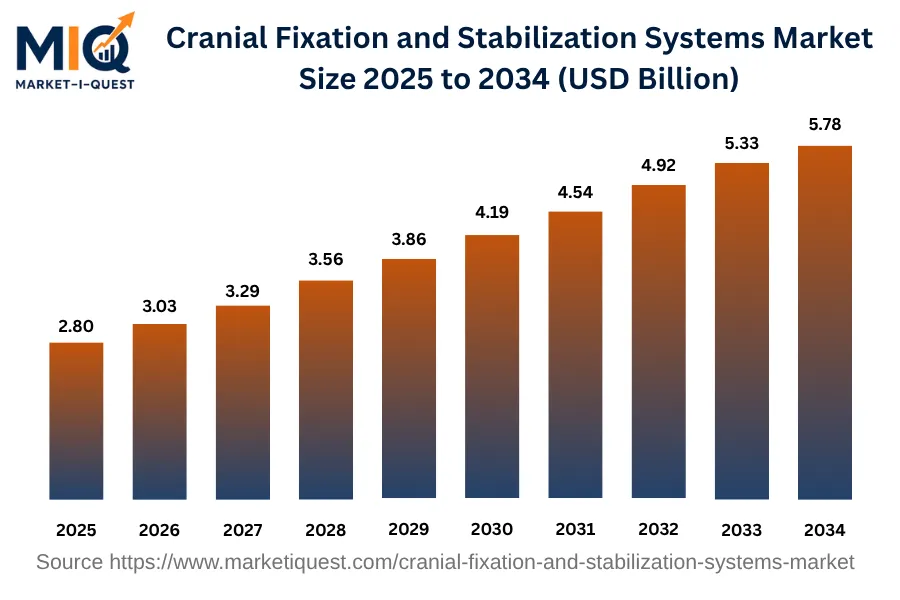
The Cranial Fixation and Stabilization Systems Market size is projected to increase from USD 2.58 billion in 2024 to USD 2.80 billion in 2025. Further, it is expected to more than double to reach USD 5.78 billion by 2034, exhibiting a CAGR of 8.4%. This market growth over the decade is a direct result of rising instances of neurological conditions requiring cranial fixing and stabilization procedures. Moreover, technological advancements leading to the development of more effective products, are also contributing to the upward trajectory of this market. In terms of the regional share in 2024, North America holds the dominant position accounting for 39.7%, followed by the Asia Pacific region at 28.5% and Europe at 24.4%. The regions comprising the smallest share of the market are Latin America and the Middle East and Africa, representing 4.0% and 3.5% respectively.

Key Takeaways

  • By Product Type - Cranial Plates held the highest market share in 2024.
  • By Material - Metal led as the prominent choice in 2024.
  • By Fixation Type - Internal Fixation emerged as the market leader in the given year.
  • By Application - Orthopedic Surgery was the dominantly demanded field in 2024.
cranial-fixation-and-stabilization-systems-market market size

Key Driving Factors

Implementation of Stringent Regulatory Norms

A significant factor that drives the Cranial Fixation and Stabilization Systems Market is the stringent regulatory norms enforced by health agencies. Specifically, the FDA in the United States and the EMA in Europe require that cranial fixation and stabilization systems meet extremely high standards of safety, efficacy, and quality control. These mandates stimulate increased investment from manufacturers in technological innovation and system enhancement to comply with these standards. This heightened focus on compliance often leads to the development of superior products that appeal to a larger customer base, thereby leading to market growth.

Surge in Public Awareness and Accessibility

Another leading driving factor for the Cranial Fixation and Stabilization Systems Market is the surge in public awareness and accessibility to these systems. In recent times, numerous non-governmental and governmental organizations have been organizing awareness campaigns about spine-related disorders and the effectiveness of cranial fixation and stabilization systems in their treatment. Furthermore, there has been increased access to these systems due to favourable healthcare policies and advancement in health care infrastructure, particularly in emerging economies. As a result, the market for cranial fixation and stabilization systems has experienced substantial growth.

Market Evolution by Timeline

2019-2023
In these years, cranial fixation and stabilization systems saw increased use in neurosurgeries due to higher rates of road accidents and the incidence of neurological disorders. Major purchase regions included North America, followed by Europe due to higher healthcare expenditure. Companies shipped more titanium mesh systems, due to their biocompatibility and durability. Regulatory constraints like the EU's Medical Device Regulation (MDR) had manufacturers prioritizing safer, more efficient product designs. Average software package prices increased due to integration with imaging systems. The main risk was changes in healthcare policies that could potentially destabilize funding.
2024
Cranial systems in 2024 were most commonly used for cases related to head trauma, brain tumors, and cranial deformities. The African market started showing potential with an expanding healthcare sector, but North America remained the dominant spender. Technological maturity increased, with more companies introducing resorbable products. Regulatory complexities involved newly implemented ISO 13485:2016 norms for medical devices production. An observable trend was the meaning of less extensive, longer duration contracts. Intricate regulatory changes and the uncertainty of the African financial sector posed as potential market risks.
2025-2029
The system's usage rose for treating elderly patients with chronic disorders during these years. Asia, particularly China and India, showed increased buyer activity due to an aging population and improved healthcare facilities. Manufacturers introduced 3D printing technologies in production lines to reduce costs and increase precision. Harmonization attempts under the International Medical Device Regulators Forum (IMDRF) guided the adoption of systems. Tier-based pricing became common, based on product complexity and additional offerings. Uncertainties in healthcare policies across emerging markets posed a risk to manufacturers.
2030-2034
In this period, neurosurgery departments primarily adopted cranial systems to handle rising oncology cases. These systems also found wider acceptance in Middle Eastern countries. Product differentiation became natural, with AI and machine learning integrated into systems. FDA's Case for Quality program encouraged higher adoption. Also, mena-binding partnerships formed between original equipment manufacturers and software providers. Prices began stabilizing as competition among the products grew. However, cybersecurity in AI-based systems emerged as a new risk to this market.

Future Market Outlook

Future Opportunities

The opportunities within the cranial fixation and stabilization systems market are positioned to expand as healthcare systems respond to an aging population and rising incidences of cranial trauma, particularly in regions like North America and Europe. With increased investments in R&D activities, companies such as Zimmer Biomet are focusing on the development of next-generation cranial stabilization devices that offer improved clinical outcomes and patient comfort. Furthermore, partnerships between hospitals and technology firms are expected to enhance the integration of artificial intelligence for surgical planning and intra-operative decision-making, improving efficiency in surgeries by 2024. The shift towards outpatient procedures driven by insurance reforms is prompting hospitals in countries like Australia to adopt portable cranial fixation systems that can be utilized in various healthcare settings. Additionally, emerging markets in Asia-Pacific are displaying a growing demand for cranial fixation solutions, fueled by increased health awareness and advancements in healthcare infrastructure. The integration of telemedicine and remote monitoring technologies is also paving the way for enhanced post-operative care, with companies like NuVasive exploring solutions that facilitate outpatient follow-ups. As regulatory agencies continue to adapt to technological advancements, there will likely be increased opportunities for market entrants to cater to a diverse range of hospital needs, particularly in the customization of fixation systems to improve surgical outcomes and patient satisfaction. This landscape of evolving needs presents substantial growth avenues in the cranial fixation and stabilization systems market.

Segmentation Analysis

By Product Type

The market is divided into subsegments including Cranial Plates, Cranial Screws, Cranial Clamps, and Cranial Anchors, with Cranial Plates accounting for the largest revenue share while Cranial Screws are expected to grow at the fastest CAGR during the forecast period.

Largest Revenue Share

Cranial Plates

Market Share Leader

The major driver of the Cranial Plates' high revenue share is their critical role in cranial surgeries. They are the core component and are used to restore the integrity of the skull, reestablish normal brain function and reduce the risk of secondary brain injuries. Cranial Plates witness a high demand in markets with rising cases of head injuries and cranial surgeries, especially in developed regions, thus contributing significantly to their large revenue share. The continuous innovations and advancements in material, design and manufacturing techniques also contribute to their wide adoption. In addition, regulation and supply are strongly influenced by stringent standards and requirements, which also push manufacturers to produce high-quality cranial plates. The purchasing criteria for cranial plates are centered on quality, safety standards and effectiveness, creating a high barrier to entry and limiting competition, consequently increasing revenue. Despite its already dominant market position, the Cranial Plates subsegment continues to grow due to these factors.

Fastest CAGR

Cranial Screws

Forecast Period Growth Leader

The Cranial Screws subsegment is expected to grow at the fastest rate in the forecast period. This is primarily driven by advanced technologies and the evolution of minimally invasive surgery techniques, prompting increased adoption of cranial screws. They are particularly beneficial in cases where maximum fixation strength is required, offering added stability and precision. Additionally, the rise in partnerships between hospitals and manufacturers is a catalyst for the increased use of Cranial Screws. Barriers to adoption are being shattered through advancements in biocompatible materials and design which also reduce risks associated with their use. Crucially, the predicted investment in healthcare infrastructure in emerging economies is expected to bolster the market further for cranial screws. Potential near-term risks include regulatory changes and the development of alternative technologies. Nonetheless, with the current pace of technological progression and healthcare investment, the growth of the Cranial Screws segment is promising.

By Material

The market is divided into subsegments including Metal, Polymer, Ceramic, and Composite. In the base year of 2024, the Metal subsegment accounted for the largest revenue share, while the Composite subsegment is projected to grow at the fastest CAGR during the forecast period.

Largest Revenue Share

Metal

Market Share Leader

The Metal segment's dominance in revenue share can be attributed to its extensive application in numerous industries. As a durable and versatile material, metals meet the stringent requirements of various sectors, including automotive, aerospace, construction, and machinery. In these sectors, the demand for high-strength, durable, heat-resistant materials has continued to drive the growth of the Metal segment. Geographically, the Asia-Pacific region, primarily China and India, are driving Metal segment's growth due to their strong industrial sector and infrastructure development. Additionally, it's worth noting that industry regulations, to some extent, mandate the use of metals in specific applications due to their high durability and robustness. However, over time, switching costs can be considered negligible given the long lifespan and widespread availability of metals. All these factors, in perfect combination, led to the superiority of the Metal segment in terms of revenue in 2024.

Fastest CAGR

Composite

Forecast Period Growth Leader

The Composite segment is expected to exhibit the fastest growth rate due to its unique properties, providing a perfect blend of strength and light weight. This subsegment is witnessing an accelerated adoption in the aerospace, automobile, and renewable energy sectors for turbine blades, airframe structure, and light-weight vehicle components. Technological advancements and partnerships in manufacturing industries are driving research and development activities, contributing to the expansion and innovation within this sector. Furthermore, the increasing emphasis on light-weight, energy-efficient materials to comply with tighter environmental regulations is accelerating adoption. A major factor that might hinder this subsegment's growth, however, is the high initial capital expenditure required for setting up manufacturing units. Nevertheless, the long-term benefits of implementing composite materials are expected to outweigh the initial costs, promoting continued growth in this subsegment.

By Fixation Type

The market is divided into subsegments including Internal Fixation, External Fixation, and Temporomandibular Joint Fixation. Internal Fixation accounted for the largest revenue share while Temporomandibular Joint Fixation is expected to grow at the fastest CAGR during the forecast period.

Largest Revenue Share

Internal Fixation

Market Share Leader

Internal Fixation, a major subsegment of the market division, generates the largest revenue. Internal fixation devices are integral to the current medical landscape as they provide stability to fractures, enabling rapid healing. Their ongoing need in orthopedic surgeries propels revenue. They are utilized across geographies and are preferred by both medical professionals and patients for their reliability and efficiency. Technical advances improving device longevity, compatibility and resilience have expanded their application range, driving further demand. Additionally, tougher regulation in this market segment has created higher entry barriers, consolidating control to existing providers and maintaining high price points. Purchasing is predominantly made through traditional medical supply chains, including large hospital networks and specialized orthopedic treatment centers. Switching costs are high due to the required regulatory approval of alternative products, sustaining the segment's revenue leadership.

Fastest CAGR

Temporomandibular Joint Fixation

Forecast Period Growth Leader

Temporomandibular Joint Fixation, while not commanding the same revenue as Internal Fixation, is the fastest-growing subsegment. Numerous factors contribute to its growth. The increase in Temporomandibular joint disorders and advancements in diagnostic procedures have led to a surge in demand. Technology-driven treatment enhancements drive their adoption, while partnerships with insurance companies widen treatment affordability and accessibility. The initial investment for these devices is being mitigated by longer product lifespans and reduced replacement rates, making them an attractive option for both healthcare providers and patients. However, regulatory hurdles and the need for specialized training for installation present barriers to growth. Yet, increased awareness of TMJ disorders and improved diagnosis are expected to serve as catalysts for its rapid growth trajectory.

By Application

The market is divided into subsegments including Neurosurgery, General Surgery, Orthopedic Surgery, Trauma Surgery, and Others. Orthopedic Surgery accounted for the largest revenue share, while Neurosurgery is expected to grow at the fastest CAGR during the forecast period.

Largest Revenue Share

Orthopedic Surgery

Market Share Leader

Orthopedic surgery encompasses a wide range of procedures aimed at treating disorders and injuries of the musculoskeletal system. This modality's preeminence in terms of revenue generation can be ascribed to various key factors. Firstly, a rapidly aging global populace, coupled with an increasing prevalence of chronic diseases, often leads to bone and joint issues, stimulating the demand for orthopedic surgical procedures. There's also an increased incidence of sports-related injuries, road accidents, and obesity-related orthopedic complications adding to the market prominence of this subsegment. Geographically, developed regions are seen as revenue hotspots because of advanced healthcare systems, better coverage, and higher disposable income. The industry has a high switching cost as doctors and medical facilities must be trained, licensed, and accredited for different surgical methods. Additionally, orthopedic devices are often high-margin items, which further propels value for this specific subsegment.

Fastest CAGR

Neurosurgery

Forecast Period Growth Leader

Neurosurgery is expected to register the fastest growth rate during the forecast period. The ascension is being propelled by the growing incidence of neurological disorders among an aging global demographic, rising awareness regarding innovative and advanced applications of neurosurgical devices, technological advancements, and improving healthcare infrastructure. The mounting adoption of minimally invasive neurosurgical procedures, stimulated by benefits such as minimal risk of infection, reduced hospital stays, and rapid recovery, also serve as significant growth catalysts. However, the high cost of neurosurgical procedures and devices may hinder the subsegment's growth. Regulatory policies promoting improvements in the safety and efficacy of surgeries serve as growth stimulants as well. It is worth noting that innovative partnerships between technology and device companies are propelling novel advancements in technique and capability, providing impetus for growth. However, near-term risks include a potentially slow adoption rate in emergent markets due to procurement and affordablility issues.

Competitive Analysis for Cranial Fixation and Stabilization Syst

Key Market Players

Manufacturers/OEM

DePuy Synthes
US
Stryker Corporation
US
Medtronic
Ireland

Key Suppliers & Raw Materials

B. Braun
Germany
Titanium Solutions
UK
DSM Biomedical
Netherlands

Distributors, Integrators & Channel Partners

BioHorizons
US
Patterson Dental
US
Henry Schein, Inc.
US

Porter’s Five Forces Analysis

This is an analysis of the competitive forces within the Cranial Fixation and Stabilization Systems Market.

Supplier Bargaining Power

Medium

Power is balanced due to specialized inputs required but availability of multiple suppliers.

Buyer Bargaining Power

Low

Limited due to the specialized nature of products and lack of alternatives.

Threat of Substitutes

Low

Substitutes are scarce due to high certification barriers and specific clinical applications.

Threat of New Entrants

Low

High technological and capital requirements act as significant entry barriers.

Competitive Rivalry

High

Intense competition among established major companies with robust product portfolios.

Regional Analysis

Geographic market dynamics and growth opportunities across key regions

Global Market Outlook

cranial-fixation-and-stabilization-systems-market market regional share

North America

In 2024, the Cranial Fixation and Stabilization Systems Market in North America exhibited notable dynamism. High incidence of neurological disorders and road accidents, FDA approval for several cranial stabilization systems, and a steady increase in healthcare investments are among the key market drivers. In particular, technology adoption in the U.S., driven by the need for surgical precision and improved patient outcomes, stimulated the demand for advanced cranial stabilization systems. Price reductions in Canada and Mexico, owing to increased local manufacturing, supported market growth as well.

Changes in buyer behavior were evident as healthcare professionals, particularly neurosurgeons and orthopedic specialists, showed increasing preference for digitized cranial stabilization systems that offer higher surgical precision. We observed a significant shift toward minimally invasive surgeries leading to a surge in demand for endoscopic cranial fixation systems in the U.S. and Canada. Concurrently, the adoption of various partnership models, mergers, and acquisitions accelerated throughout North America, enhancing product distribution. Finally, stringent enforcement of medical device standards by U.S. and Canadian governments ensured the market consisted of high-quality, clinically tested products. As a result, enterprises in the healthcare sector continued to be the primary consumers of cranial fixation and stabilization systems.

Asia Pacific

In 2024, Asia Pacific's Cranial Fixation and Stabilization Systems market experienced a surge due to various drivers and emerging trends. Drivers include an aging population increasing demand for neurosurgeries, investment in healthcare facilities in China and India, and Australia's adoption of advanced surgical technologies. Furthermore, stringent regulations enforced by governments across the region, especially Japan and key ASEAN markets, have necessitated the upgrading of cranial fixation systems, driving supply dynamics and pricing.

Trends impacting the market involve emerging preference for minimally invasive procedures, and slow shift from mechanical systems to bioabsorbable cranial fixation systems, gaining traction due to lower associated complications. E-commerce channels have deepened their reach into healthcare sectors, fueled partly by pandemic-induced shopping habits, enabling greater access to these specialized surgical tools even in less urbanized regions. Hospitals in South Korea led partnerships initiatives for knowledge sharing and technology transfer. Implementation of policies like China's "Healthy China 2030" led to a better spread of healthcare facilities, driving the use of more cranial stabilization systems. Despite these advancements, the market in 2024 showed that opportunities for growth remain, particularly in enhancing distribution channels and fostering collaborative opportunities in the industry.

Europe

In 2024, the Cranial Fixation and Stabilization Systems Market in Europe demonstrated varied dynamics across member countries. Demand was driven by an increase in neurosurgical procedures, particularly in Germany and the UK due to rising incidences of traumatic brain injuries and disorders like Parkinson's and Alzheimer's. Regulatory standardization, such as the EU's Medical Device Regulation (MDR), also pushed investment in better-performing, safer systems. In France and Spain, hospitals accelerated the adoption of minimally invasive fixation technologies, contributing to growth in supply.

Market trends included a shift in buyer behavior, with healthcare providers increasingly prioritizing quality over cost due to the critical nature of these systems. This led to a more demand-driven market, with a focus on patient safety and treatment efficacy. Tech shifts saw the rise of bioresorbable implants in Italy, the Nordics, and Benelux, spurred by their biocompatibility and minimized post-operative complications. In Central and Eastern Europe, partnerships and mergers became a common strategy among companies to strengthen product portfolios and consolidate market positions. Lastly, stricter enforcement of safety standards by regulatory bodies led to heightened interest in clinical trials and quality assurance measures in cranial fixation and stabilization system manufacturing.

Latin America

In 2024, the Cranial Fixation and Stabilization Systems market in Latin America experienced stable growth. The growth drivers in Brazil, Argentina, Mexico, Colombia, Chile, and Peru were technological advancements, rising geriatric population, increased prevalence of neurological diseases, and an augmented investment in healthcare facilities. Widescale adoption of minimally invasive surgeries across these nations also invigorated the demand. Furthermore, regulatory approval of new cranial fixation devices accelerated the market expansion. Simultaneously, some discernable trends surfaced in the market. Shifts towards non-invasive cranial fixation devices marked a significant buyer behavior. A rise in partnerships and collaborations for product enhancement was seen amongst key players. In Mexico, for example, there was an increased prominence of high-tech MRI-compatible devices, marking a notable product shift. Additionally, there was an evident hike in policy enforcement for patient safety norms in the context of cranial surgeries.

This growth predominantly influenced the healthcare sector, manifesting across hospitals, clinics, and surgical centers. Governments from the LATAM region too displayed an active role in this context by making commendable enhancements in public healthcare facilities. Overall, product innovation and superior safety features marked the noteworthy sectors. These changes in the Cranial Fixation and Stabilization Systems market detailed an evident evolution in the healthcare industry across Latin America in 2024.

Middle East & Africa

In 2024, the Cranial Fixation and Stabilization Systems Market in Middle East and Africa experienced notable traction, primarily owing to health infrastructure advancements and escalating cases of neurological disorders. Drivers, including strategic investments in healthcare across countries — particularly Saudi Arabia, United Arab Emirates, and South Africa — spurred technology adoption, while severe neurotrauma cases fueled demand. Moreover, regulatory clearances, including those for Mini-PLIF procedures in Israel, aided market expansion. Trends within this market primarily revolved around buyer behavior and product shifts. Patients in premier hospitals across Egypt and Nigeria opted for advanced cranial stabilization procedures due to higher safety profiles, triggering a market shift towards bio-resorbable implants. Also, the growing prominence of public-private partnerships in Kenya bolstered the access to these medical devices, thereby underlining another crucial trend.

Operations within the market witnessed active participation from major healthcare players. Despite the challenging macroeconomic conditions Qatar's oil and gas industry faced, their huge reserves were capitalized to diversify the economy and strengthen the healthcare sector, involving cranial fixation systems. Additionally, health insurance policy enforcement, particularly in United Arab Emirates, further pushed customer segments — governmental, retail, financial services — towards market engagement. Despite the constraints, the surge in urgent neurological cases redefined the market outlook for cranial fixation and stabilization systems in 2024.

Recent Industry Developments

Latest market innovations, product launches, and strategic initiatives

January 2026

China's National Medical Products Administration (NMPA) issued the "Craniomaxillofacial Internal Fixation System Registration Review Guideline (2026 No.4)," establishing technical requirements for cranial fixation device approvals in the Chinese market .

March 2026

Orthocon Inc. received FDA 510(k) clearance for its Montage Flowable Settable, Resorbable Bone Paste (burr hole cover) under product code GXR, expanding options for cranial defect closure.

November 2025

Medical Bees GmbH received FDA 510(k) clearance for its mb-FIX Cranial Stabilization Systems, featuring three skull clamp models including a CT/MRI-compatible version with PEEK+titanium pins for intraoperative imaging.

Frequently Asked Questions