Corrugated Board Market Snapshot

Key Players

  • International Paper (United States)
  • WestRock (United States)
  • Smurfit Kappa Group (Ireland)
  • DS Smith (United Kingdom)
  • Mondi Plc (United Kingdom)
  • Klabin S.A (Brazil)
  • Packaging Corporation of America (United Sates)
  • bhs Corrugated (Germany)
  • Cascades Inc (Canada)
  • Nippon Paper Industries Co. Ltd. (Japan)

Market Size

Base Year 2024
$146.82 Bn
CAGR
6.4%
Forecast 2034
$273.02 Bn

Market Segments

By Flute Type
  • A-Flute
  • B-Flute
  • C-Flute
  • E-Flute
  • F-Flute
  • Others
By Board Style
  • Single Face
  • Single Wall
  • Double Wall
  • Triple Wall
By End Use Industry
  • Food and Beverage
  • E-Commerce and Retail
  • Consumer Electronics
  • Others

Market Dynamics

Drivers
  • Increasing eCommerce demand
  • Sustainable packaging trend
Restraints
  • High raw material costs
  • Environmental regulations
Opportunities
  • Increasing e-commerce trends
  • Improved recycling measures

Market Size

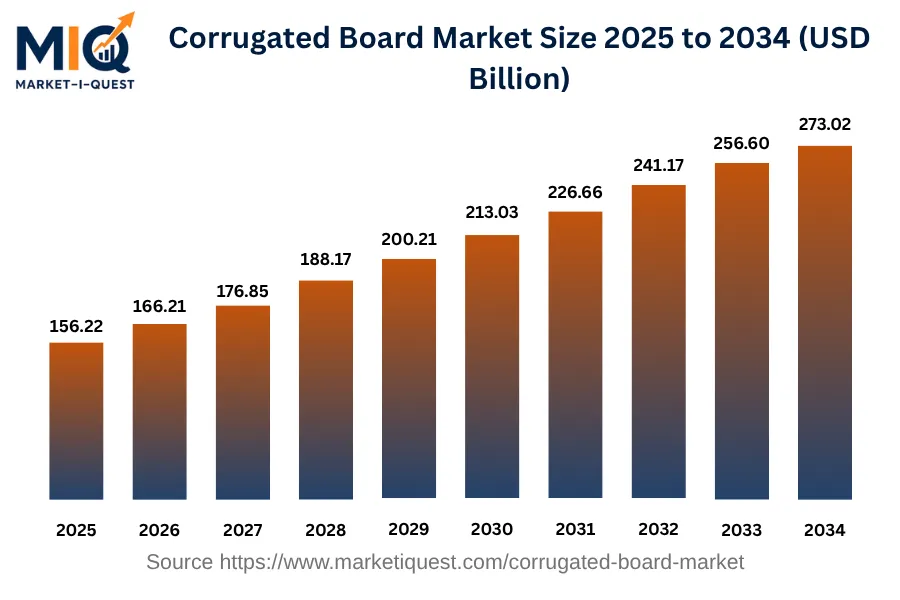
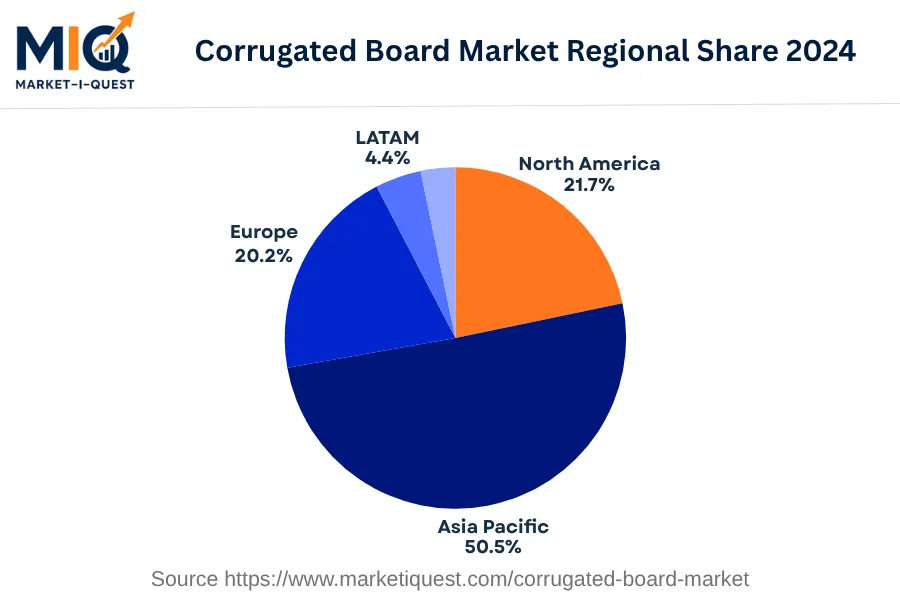
The Corrugated Board Market was sized at USD 156.22 billion in 2025 and will expand to USD 273.02 billion by 2034, growing at a CAGR of 6.4%. The market saw an initial value of USD 146.82 billion in 2024, followed by a fair increase in the following year. Over the decade between 2025 and 2034, the market growth steadily, underpinned by a consistent annual growth rate. This growth can be attributed to the increased demand for packaging material in various sectors, along with the increasing use of corrugated boards for advertising displays. Regionally, as of 2024, the majority of the market share of 50.5% was held by the Asia Pacific. In comparison, North America accounted for 21.7% of the market, Europe had a 20.2% share, followed by LATAM with 4.4%, and MEA with 3.3%.

Key Takeaways

  • By Flute Type - B-Flute had the highest demand standing as the top sub-segment in the corrugated board market.
  • By Board Style - Double Wall held a significant portion of the market accounting for the largest market share in 2024.
  • By End Use Industry - E-Commerce and Retail showed a strong lead accounting for the biggest market share in the corrugated board industry.
corrugated-board-market market size

Key Driving Factors

Adoption of Sustainable Packaging in E-commerce Industry

E-commerce companies are increasingly adopting corrugated boards as their primary packaging material as it aligns with their sustainable business practices. This is attributed to corrugated boards being made of recycled materials and being easily recyclable too, reducing the overall carbon footprint. These boards are lightweight and easily conform to different shapes, providing custom solutions for various product types sold through online channels. E-commerce giants like Amazon and eBay have set environmental-friendly packaging guidelines that strongly recommend the use of corrugated boards. Therefore, the rising preference for environment-friendly, sustainable and cost-effective packaging in the e-commerce sector is a crucial factor driving the demand for corrugated boards.
Stringent Government Regulations on Non-degradable Packaging Material

Governmental bans and restrictions on non-degradable and single-use plastic packaging are significantly influencing the corrugated board market. Countries including China, France and Canada, in an effort to curtail environmental pollution, have implemented legal requirements necessitating the use of environmentally friendly packaging materials. This scenario has prompted businesses, especially in the food & beverage and pharmaceutical sectors, to switch to materials like corrugated boards which offer comparative functionality without harming the environment. Hence, stringent government regulations and subsequent corporate action to comply, is another force propelling the corrugated board market.

Market Evolution by Timeline

2019-2023
During this period, e-commerce was the dominant buyer of corrugated board, especially in the US, Europe, and China due to increased online shopping. Developments in digital print technologies led to more custom designs. However, lack of recycling facilities can limit the supply. There were no significant policy changes directly affecting this market. Most transactions are done through fixed contracts, with price adjustments based on raw material costs. Risks within this period involve fluctuations in raw material prices, affecting the overall cost of production.
2024
The trend continues with e-commerce as the largest consumer of corrugated board. Innovation in lighter and stronger board designs started but faces implementation challenge due to high upgrade costs. Rapid adoption of more sustainable packaging options put pressure on corrugated board manufacturers. No significant policy influences this year. Contract terms remain the same with some price adjustments. Raw material price unpredictability remains a major risk.
2025-2029
Heavy machinery and electronics industries started major usage of corrugated board, particularly in emerging markets such as India, Brazil, and Southeast Asia due to expansion in their manufacturing sectors. Technology keeping up with demand through automation and innovations in production processes. Stricter environmental regulations pushed manufacturers to adopt sustainable practices. The pricing model slightly shifted towards variable contracts considering the conditions of raw materials. The main challenge is transforming into sustainable processes in line with emerging environmental standards.
2030-2034
Demand in developing countries was strong due to the growth in the manufacturing and e-commerce sectors. Fully automated production lines became the norm, with artificial intelligence optimizing the process. Volatility in prices of raw materials remained the key issue for producers. The adoption of sustainable practices became mandatory due to strict government regulations globally. Contracts now mostly dynamic, taking into account the fluctuating raw material prices. The risk remains the same with environmental compliance gain increasing importance.

Future Market Outlook

Future Opportunities

In light of current developments, the corrugated board market is poised for substantial growth opportunities driven by increasing environmental awareness and evolving consumer behavior. Sustainability trends are gaining traction, and companies like WestRock are proactively adjusting their operations to incorporate greener materials, responding to demands for reduced carbon footprints. In regions such as Europe, where regulations on packaging recyclability are tightening, businesses will likely seek partnerships with recycling firms to enhance circularity in their supply chains. In 2023, the U.S. Environmental Protection Agency announced new guidelines aimed at promoting sustainable manufacturing processes, encouraging potential collaborations among corrugated board manufacturers to meet compliance requirements. The rise of e-commerce is further shaping the market, as companies recognize the need for reliable, sustainable packaging solutions. For instance, Amazon has been actively refining its packaging strategies, impacting supplier requirements in the corrugated sector. Additionally, there is an untapped potential for smart packaging solutions that integrate RFID and IoT technology, evidenced by prototypes being developed by firms like Packsize, enabling real-time tracking and inventory management. By aligning operational strategies with these evolving trends, businesses will likely position themselves to meet future consumer needs and regulatory mandates, ensuring profitability and market relevance in a continuously changing landscape.

Segmentation Analysis

By Flute Type

The market is divided into subsegments including A-Flute, B-Flute, C-Flute, E-Flute, F-Flute, and others. B-Flute accounted for the largest revenue share while E-Flute is expected to grow at the fastest CAGR during the forecast period.

Largest Revenue Share

B-Flute

Market Share Leader

The B-Flute segment represents the largest share of revenue in the flute market. This can primarily be credited to its inherent qualities and wide range of applications. B-Flute offers durability and affordability, making it an attractive option for packaging especially in the e-commerce sector. Its relatively lower production cost and versatility make it a preferred choice among manufacturers and customers alike. The fact that B-Flute offers a perfect balance for printing, sturdiness, and cost-efficiency underpins its dominantly high market share. Ever-growing scalability in the e-commerce and manufacturing sectors is thus driving the B-Flute market as it becomes an essential part of the packaging supply chain. Additionally, B-Flute is also widely used in the FMCG sector, further solidifying its revenue stream. However, this assumption is based on common industry logic and may vary if detailed specifics of the market are provided.

Fastest CAGR

E-Flute

Forecast Period Growth Leader

The E-Flute is expected to witness the fastest growth rate among other flute types. This incredible growth projection can partially be attributed to its increasing acceptance in sectors that demand premium quality packaging. E-Flute, known for offering superior printability and strength, is seeing increasing adoption in the luxury goods packaging sector. Technological advances in the printing industry have therefore acted as a catalyst for the E-Flute growth. Its compatibility with various printing techniques has made it a versatile choice for businesses seeking a high-end finish. Market penetration is inhibited by its relative cost depletion which makes it a less likely choice for industries with a lower profit margin, such as the FMCG sector. However, the growing emphasis on sustainability and reduced weight packaging might tip the scales in favor of E-Flute, turning these potential barriers into growth catalysts in the coming years. Note that this is an inference based on typical market behavior, specific market data could yield different outcomes.

By Board Style

The market is divided into subsegments including Single Face, Single Wall, Double Wall, and Triple Wall. In 2024, the Double Wall segment accounted for the largest revenue share, while the Triple Wall subsegment is expected to grow at the fastest CAGR during the forecast period.

Largest Revenue Share

Double Wall

Market Share Leader

In 2024, the Double Wall segment accounted for the largest share of revenue. This high revenue from the Double Wall segment can be attributed to its widespread use across a plethora of industries, including electronics, food & beverages, and pharmaceuticals. Double Wall boards are favored for their strength and durability, offering high puncture and crush resistance to the packaged goods, preventing damage during transit. In areas with complex supply chains and extended shipping durations, the preference for Double Wall board style is notable. Furthermore, regulatory mandates in several regions advocating for robust packaging to reduce product damage have ended up favoring Double Wall packaging boards. Pricing capabilities due to economies of scale and high switching costs for customers also contribute to the dominance of this subsegment.

Fastest CAGR

Triple Wall

Forecast Period Growth Leader

The Triple Wall subsegment, despite currently possessing a smaller market share than its counterparts, is projected to grow at the fastest pace. The robust build of Triple Wall style boards makes them ideal for the shipping of heavy and high-value items, offering increased security and protection. These applications are particularly pertinent in industries such as machinery and automotive manufacturing, which are seeing significant growth themselves. Furthermore, advancements in production technology and the expansion of recycling capacities are expected to lower production costs, making these boards more affordable and catalyzing their adoption. However, there are potential near-term risks associated with the global macroeconomic conditions and potential policy changes impacting trade, which could affect demand in import-heavy industries.

By End Use Industry

This market is divided into subsegments including Food and Beverage, E-Commerce and Retail, Consumer Electronics, and Others. The E-Commerce and Retail subsegment accounted for the largest revenue share, while the Consumer Electronics subsegment is expected to grow at the fastest CAGR during the forecast period.

Largest Revenue Share

E-Commerce and Retail

Market Share Leader

The E-Commerce and Retail subsegment is leading in terms of revenue due to several key factors. The burgeoning rise of online shopping and the convenience it offers has heavily contributed to this subsegment's increase in earnings. Shoppers are more likely to engage in impulse buying due to effortless browsing experience, resulting in the higher sales growth of this subsegment. Additionally, the vast array of products available in one platform draws in a diverse range of consumers from different demographics, thus expanding its consumer base. The continuous enhancements in supply chain, logistics, and delivery processes also play a crucial part in boosting its revenue. Furthermore, the adoption of advanced technologies such as AI and machine learning for personalized shopping experiences and predictive analytics for inventory management respectively have further accelerated the segment's revenue growth.

Fastest CAGR

Consumer Electronics

Forecast Period Growth Leader

On the other hand, the Consumer Electronics subsegment is forecasted to grow the fastest during the period due to a fusion of factors. The advent of innovative technologies has brought forth new electronic devices with improved efficiencies, driving market growth. The increasing consumer demand for advanced smartphones, wearables, home appliances, and personal computers is further bolstering the growth of this subsegment. Besides, the trend towards smart homes has increased the demand for consumer electronic products such as smart TVs and home automation systems. Despite the promising growth, there are potential risks such as market saturation and rapid technology obsolescence. Industry players must keep abreast of technological advancements and constantly innovate to remain competitive in the market, thereby driving sustainable growth.

Competitive Analysis

Key Market Players

Manufacturers / OEMs

International Paper Company
US
WestRock Company
US
DS Smith Plc
UK

Key Suppliers & Raw Materials

Nine Dragons Paper
China
Stora Enso Oyj
Finland
Georgia-Pacific LLC
US

Distributors, Integrators & Channel Partners

Rengo Co., Ltd.
Japan
Smurfit Kappa Group Plc
Ireland
KapStone Paper and Packaging Corporation
US

Porter’s Five Forces Analysis

This analysis provides a detailed and strategic view of the competitive landscape in the corrugated board market.

Supplier Bargaining Power

Medium

Suppliers have moderate power due to the availability of multiple raw material sources.

Buyer Bargaining Power

High

Buyers hold high bargaining power due to the presence of multiple manufacturers and competitive prices.

Threat of Substitutes

Low

Due to its unique properties and limited alternative materials, the threat of substitutes is low.

Threat of New Entrants

Medium

New entrants face moderate barriers to entry including the need for significant investment and industry specificity.

Competitive Rivalry

High

There is high rivalry in the market with numerous competitors and frequent product enhancements.

Regional Analysis

Geographic market dynamics and growth opportunities across key regions

Global Market Outlook

corrugated-board-market market regional share

North America

In 2024, the corrugated board market in North America experienced significant growth as demand soared in various sectors. The primary drivers were increased e-commerce activities, sustainability regulations, and technological adoption within the packaging industry. The growth in online retail fostered higher demand for corrugated boards due to their durability and cost-effectiveness. In parallel, strict environmental regulations in the U.S., Canada, and Mexico encouraged industries to switch to eco-friendly packaging solutions, highlighting the recyclability of corrugated board. Additionally, the adoption of automation and digital printing technologies in corrugated board manufacturing enhanced production efficiency and enabled customization to cater to varying packaging needs across sectors such as retail, food & beverages, and electronics.

In terms of trends, the year revealed a clear shift towards packaging design innovations and green procurement policies. The surge in consumer demand for premium packaging led to the rise of corrugated board solutions with high-quality printability and aesthetic appeal. Furthermore, sustainable procurement became a fundamental norm in government purchasing policies, driving the use of corrugated boards in public sector packaging. M&A activities in the corrugated board marketplace intensified, as players aimed to maximize their market reach, particularly in the U.S. region, underscoring an important development trajectory for the corrugated board sector in North America.

Asia Pacific

In 2024, the Asia Pacific corrugated board market faced a dynamic shift due to various factors. Driving the market, industrial growth in economies like China and India amplified the demand for corrugated boards, primarily in the manufacturing and e-commerce sectors. Changes in government regulations advocating for eco-friendly packaging solutions significantly promoted the usage of these boards. Technology shift with the adoption of advanced machinery optimized the production process, increasing the supply proportionally.

Notably, the buying behaviors markedly changed, with buyers now prioritizing durability and recyclability, hence their propensity towards corrugated boards. The market saw a surge in strategic partnerships and M&As, focused on capacity augmentation and catering to the burgeoning demand. The enforcement of standards and policies such as China's "Green Packaging" policy encouraged manufacturers to enhance their production standards and switch to corrugated boards. Sectors like healthcare and utilities, which traditionally preferred plastic packaging, started to adopt corrugated boards due to their sustainability. Similarly, in the retail industry, a growing demand for packaging solutions with the ability to withstand heavy weights effectively, drove the demand for corrugated boards amidst increasing consumer awareness regarding environmental concerns. Hence, significant shifts in both driving factors and market trends marked 2024 for the corrugated board market in the Asia Pacific region.

Europe

In 2024, the corrugated board market in Europe demonstrated significant growth due to a variety of influencing factors and evolving trends. The market was primarily driven by increased demand from the e-commerce industry, particularly in Germany and the United Kingdom, for environmentally-friendly packaging solutions. Stricter waste management and incentive schemes like Germany's Green Dot system were key regulatory forces influencing market dynamics. Additionally, investment in innovative, highly efficient production technologies visibly increased in countries like Italy and France, stimulating the overall supply of corrugated board.

Concerning trends, buyers shifted towards more sustainable packaging options, leading to greater demand for corrugated board across sectors, including retail, manufacturing, and government enterprises. Notably, the UK and Nordics led in the adoption of these greener alternatives. Technological advancements in corrugated board production were also a prominent trend, with Spain and Benelux pioneering in advanced manufacturing. Channel dynamics saw a rise in online purchases of corrugated board, reflecting the impact of digitization across Europe. Furthermore, there was an increase in partnerships and mergers among market players, particularly in Central and Eastern Europe, aiming to enhance production capabilities and reduce costs, signifying a consolidation trend within the market. Throughout 2024, the commitment to sustainable waste management standards and policies was strictly enforced across Europe, further shaping the corrugated board market landscape.

Latin America

In 2024, the Corrugated Board Market in Latin America (LATAM) represented a dynamic region of growth. An increase in demand was driven by expanding e-commerce, infrastructure investment, and changes in retail packaging regulations. Additionally, the adoption of sustainable packaging practices by prominent industries, as seen in Brazil and Mexico, bolstered market growth. Drivers of this market included increasing urbanization in Colombia and Peru, leading to heightened e-commerce activity and consequently, amplified usage of corrugated board for packaging. New regulations targeting single-use plastics in Argentina contributed to the shift towards corrugated board. Moreover, large-scale investment in the manufacturing sector, particularly in Chile, spurred market growth through enhanced supply dynamics and pricing.

Trends underscoring this scenario were dominated by changes in buyer behavior, with an escalating preference for eco-friendly packaging in retail and enterprise sectors. There was a noticeable shift towards digital printing technology, especially in Brazil, improving the aesthetic appeal of corrugated box packaging. Mergers and acquisitions became prevalent amongst major corporations to capitalise on market opportunities, as evidenced by several deals in Mexico. The Corrugated Board Market in LATAM thus found its footing in 2024, driven by demand from expanding industries combined with transformative regulations and advancing technology.

Middle East & Africa

The Middle East and Africa market for corrugated board was vibrant in 2024, with a steady uptake in various sectors, fueled by expanded infrastructural development and rising consumer goods demand. Investments into manufacturing capabilities bolstered supply, while eco-friendly regulations in countries like Israel encouraged a shift to corrugated board as an alternative to environmentally harmful packaging materials. These factors combined with an increase in online retail, stimulated by expanding telecommunication services in the South African and Nigerian markets, particularly spurred growth.

Additionally, a notable trend was the integration of digital printing technology on corrugated boards in sectors like retail and healthcare, notably in the UAE and Saudi Arabia, contributing to customizability and thereby boosted demand. An emphasis on lightweight packaging solutions in the oil and gas sector, particularly in Qatar, drove further innovation and uptake. Growing partnerships, such as between manufacturers and recyclers, became more common, driven by stringent waste management policies in Egypt. In Kenya, an increased demand for bio-degradable packaging solutions emerged, linked to conscious consumer awareness of environmental sustainability. Overall, the reaction to drivers such as investment, and trends such as technological advancements in the MEA region, were influential factors shaping the corrugated board market in 2024.

Recent Industry Developments

Latest market innovations, product launches, and strategic initiatives

December 2025

VPK Group acquired the remaining 28% stake of Fencor Packaging Group Ltd, taking full ownership of the UK-based corrugated packaging business, adding Manor Packaging (bespoke corrugated and e-commerce solutions) to its expanding network across 21 countries with 2.3 billion m² annual production capacity.

November 2025

SCGP (SCG Packaging) completed a 100% share acquisition of MYPAK, a leading Indonesian corrugated containers producer with 144,000 tons annual capacity and IDR 846 billion revenue, strengthening its integrated fiber packaging business in Indonesia.

July 2025

UniPack Corrugated entered India's ₹50,000 crore packaging market through the strategic acquisition of Congzhou Machinery, establishing UniPack India as a dedicated entity with over 100 existing installations across India, South Asia, and Africa

Frequently Asked Questions