
Copper Tubes Market Snapshot

Key Players

  • Mueller Industries (United States)
  • KME Group (Italy)
  • Wieland Group (Germany)
  • Maksal Tubes (South Africa)
  • Golden Dragon Precise Copper Tube Group (China)
  • Luvata (Finland)
  • Hailiang Group (China)
  • MM Kembla (Australia)
  • Mehta Tubes (India)
  • NUC Corporation (Japan)

Market Size

Base Year 2024
$ 34.68 Bn
CAGR
6.73%
Forecast 2034
$ 66.52 Bn

Market Segments

By Type
  • Straight lengths
  • Coils
  • Pancake or flattened tubes
  • U-Bends
  • Drawn tubes
  • Others
By Thickness
  • Standard Gauge
  • Extra Heavy Gauge
  • Thin Wall Gauge
  • Capillary Tubes
  • Others
By Application
  • Plumbing
  • HVACR
  • Industrial
  • Medical gas Systems
  • Fire Sprinkler Systems
  • Automotive
  • Others

Market Dynamics

Drivers
  • Rising HVAC system installations
  • Growing construction sector demand
Restraints
  • Fluctuating raw material prices
  • Stringent environmental regulations
Opportunities
  • Green building construction demand
  • Urban infrastructure modernization projects

Market Size

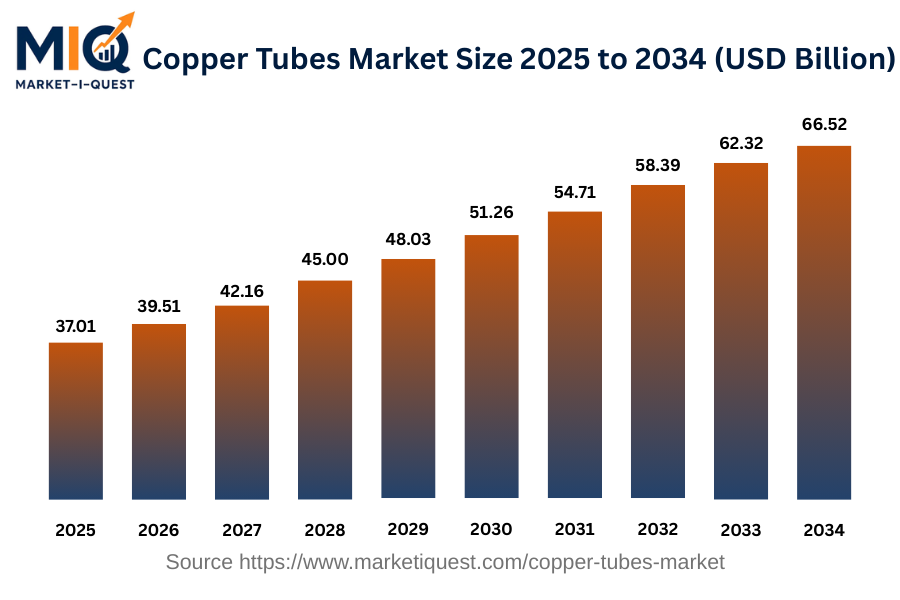
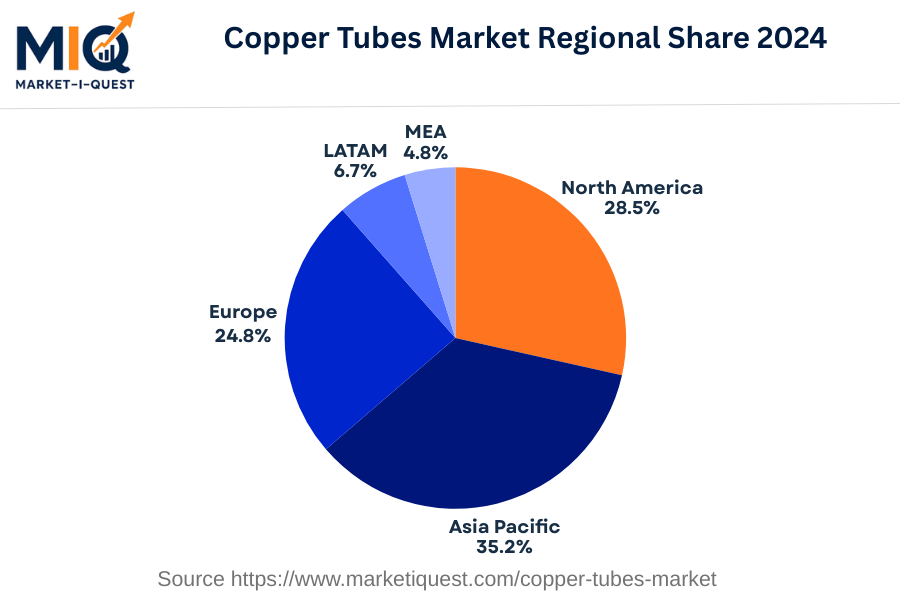
The Copper Tubes Market is valued at USD 34.68 billion in 2024 and USD 37.01 billion in 2025, with an estimated size of USD 66.52 billion by 2034, reflecting a CAGR of 6.73% from 2024 to 2034. The market experiences growth driven by increasing demand across various applications and expanding infrastructure projects. The values show a steady increase from 2024 through 2034, highlighting the upward trajectory of the market. In 2024, the regional share mix indicates that North America accounts is 28.5%, Asia Pacific is 35.2%, Europe is 24.8%, LATAM is 6.7%, and MEA is 4.8%.

Key Takeaways

  • By Type - Straight lengths led the market accounting for a notable position in 2024.
  • By Thickness - Standard Gauge held the largest share in 2024.
  • By Application - Plumbing was the dominant sector expanding significantly in 2024.
copper-tubes-market market size

Key Driving Factors

Stringent International Standards for Quality Assurance

The international plumbing and heating industries are standing by stringent quality assurance standards, influencing the copper tubes market with extensive expansion. For instance, the ASTM International standards, specifically ASTM B88 is a set of guidelines globally recognized, defining the parameters for seamless copper water tubes. Manufacturers in the industry must comply these standards, thereby creating a push towards the production of high-quality, durable, and reliable copper tubes. Failure in compliance can risk market share, reputation, or even incur penalties. Moreover, the investment in achieving these standards translates into product superiority, fueling demand among discerning consumers and professional contractors who value quality assurance over price points.
Adoption of Copper Tubes in Heating, Ventilation, and Air Conditioning (HVAC) Sector

An increased adoption of copper tubes in the heating, ventilation, and air conditioning (HVAC) sector drives increase in the copper tubes market. For various causes, the combination of high conductivity, reliability, and long-term performance has led to the widespread adoption of copper in these installations. Primarily, it boosts both high thermal and electrical conductivity, vital for efficient HVAC systems. Due to the anti-corrosive properties, this ensure longevity in HVAC components. The enhanced durability results in reduced repair and replacement frequency, simultaneously lowering the total cost of ownership, serving as a key procurement driver for aiming to optimize long-term operational expenditure. The accelerating adoption of energy-efficient HVAC systems across residential and commercial building segments is anticipated to generate sustained requirement, compelling manufacturers to strategically align their production capabilities with evolving market requirements and opportunities.

Market Evolution by Timeline

2019-2023
During this period, the copper tubes market experienced varied adoption across various sectors. The HVAC industry in North America utilized copper tubes for air conditioning systems due to their superior conductivity. Additionally, the electrical sector in Europe required copper tubes for wire and cable applications. Notably, China's robust construction sector drove significant interest for copper tubes for plumbing systems. On the supply side, manufacturers encountered notable challenges, due to the copper price fluctuation which ranged from $4,500 to $10,000 per metric ton. Regulations like the EU's REACH (Registration, Evaluation, Authorization and Restriction of Chemicals) influenced producers to prioritize environmentally safe materials. Commercial models typically involved long-term contracts, with price adjustments based on raw material costs. However, challenges included supply chain disruptions caused by geopolitical tensions, leading to delays in shipments and increased costs. Companies responded by diversifying suppliers in countries like Chile and Peru, where copper mining is widespread. Overall, the industry saw varied challenges while establishing a stable foundation for future market expansion.
2024
In 2024, the copper tubes market began to stabilize as global supply chains adjusted following previous disruptions. The construction sector remained a primary buyer, with significant projects ongoing in cities like Dubai and London focusing on energy-efficient residences. Recent introduced regulatory policies, such as the UK's Future Homes Standard, promoted the use of copper for its sustainability and reliability. On the supply side, manufacturers started integrating more automation into production processes, reducing lead times. Pricing remained inconsistent, typically ranging from $8,000 to $9,500 per metric ton due to current raw material volatility. Partnerships between manufacturers and HVAC providers strengthened, allowing for bundled contracts that included installation services. The rise of online procurement channels also emerged, facilitating more efficient access for regional contractors. However, risks persisted in terms of potential trade tariffs impacting international sales, especially between the US and China. Producers remained cautious, establishing inventory management strategies to mitigate the impacts of unforeseen disruptions.
2025-2029
From 2025 to 2029, the copper tubes market focused on broadening applications, especially in renewable energy installations. Increased adoption of solar heating systems in countries like Germany and Japan will drove traction for copper tubes in these markets. The automotive industry also requires lightweight conflict-free materials, leading to innovative uses in electric vehicle (EV) manufacturing. Regulatory frameworks like the European Green Deal incentivized manufacturers to explore recycled copper tubes, appealing to environmentally conscious buyers. By 2027, price trends will be seeing a potential stabilization around $7,500 to $8,500 per metric ton as new mining projects will begin operations in Africa and South America. Contract types shifted towards performance-based agreements, promoting collaboration between manufacturers and construction firms. Competition strengthened, prompting mergers and expansions among key players. Risks included potential resource scarcity and environmental concerns affecting virgin copper extraction processes. Companies responded by investing in research for efficient recycling techniques to ensure sustainable practices.
2030-2034
In the 2030 to 2034 period, the copper tubes market will be seeing a significant evolution driven by sustainable practices and smart technologies. The integration of IoT in manufacturing enhanced operational efficiency and quality control for producers. Countries like India and Brazil increased infrastructure investments, creating elevation in demand and opportunities for high-quality copper tubes within the market. Regulatory standards will be focusing on green building practices motivated builders for the usage of copper for its recyclability and energy efficiency. The rise of e-commerce platforms also transformed distribution models, making it easier for local contractors to acquire materials directly from manufacturers. Strategic partnerships emerging between tech firms and traditional manufacturers to innovate product offerings such as smart tubes integrating sensors for monitoring. Risks included geopolitical tensions affecting trade policies and resource accessibility. Companies focusing on robust risk management strategies, ensuring diversification of material sourcing and investment in local supply chains in strategic markets like Southeast Asia.

Future Market Outlook

Future Opportunities

The future of the copper tubes market is closely aligned with the ongoing shifts toward renewable energy and sustainable construction practices around the world. Countries like Germany are leading initiatives aimed at adopting green building standards, which frequently incorporate copper tubing in plumbing and HVAC systems due to its sustainability credentials. Collaborations between companies such as Aurubis and various energy firms are paving the way for innovative solutions that utilize copper in new energy applications, including solar thermal systems. As building codes increasingly require higher energy efficiency standards, copper tubes are increasingly specified as the medium for heating and cooling systems. In 2023, the International Organization for Standardization approved new energy efficiency benchmarks that inherently drive demand for effective materials like copper. Additionally, the digital transformation of construction through initiatives like Smart Cities is opening approach for the incorporation of smart monitoring systems that utilize copper tubing in IoT applications. Firms that are proactively engaging in partnerships to develop smart, efficient construction solutions are likely to achieve emerging market share. Furthermore, as the construction of energy-efficient buildings gains demand, the need for more advanced, environmentally sustainable materials will rise, trends in market will be presenting significant advancements opportunities for stakeholders in the copper tubes industry globally.

Segmentation Analysis

The copper tubes market is segmented by Type (Straight Lengths, Coils, Pancake or Flattened Tubes, U-Bends, Drawn Tubes, Others), by Thickness (Standard Gauge, Extra Heavy Gauge, Thin Wall Gauge, Capillary Tubes, Others), and by Application (Plumbing, HVACR, Industrial, Medical Gas Systems, Fire Sprinkler Systems, Automotive, Others).

By Type

The market is divided into subsegments including Straight lengths, Coils, Pancake or flattened tubes, U-Bends, Drawn tubes, Others. Straight lengths accounted for the largest revenue share while Coils is expected to grow at the fastest CAGR during the forecast period.

Largest Revenue Share

Straight lengths

Market Share Leader

Straight lengths dominate the market primarily due to their widespread applications across industries such as construction, automotive, and machinery. As a stable and versatile product, these lengths are integral in structural and utility implementations, from piping systems to mechanical components. Customers favour straight lengths for their ease of integration and predictable sourcing. Geographically, regions with heavy industrial activity, such as North America and Asia-Pacific, generate substantial adoption. Furthermore, regulatory frameworks favouring standardized components enhance their engage, as companies can avoid inefficiencies linked to custom fabrications. Within the purchasing criteria, factors such as dimensional accuracy, material quality, and delivery times drive decision-making. Since manufacturers typically face lower switching costs with suppliers of straight lengths, establishing long-term relationships becomes essential. The channels for distribution, including direct sales and wholesalers, further stabilize the dominance of this sub-segment. Given these dynamics, straight lengths not only capture the highest revenue portion today but will likely continue to do so as industries increasingly prioritize efficiency and reliability in their supply chains.

Fastest CAGR

Coils

Forecast Period Growth Leader

Coils are projected to witness the fastest demand due to their distinct adaptability and the expanding needs of industries requiring flexible solutions. Key drivers include technological advancements, enabling more efficient manufacturing processes and better material properties, making coils an attractive option for various applications, including HVAC systems and automotive industries. Additionally, the increasing trend towards concise designs across equipment incentivizes the adoption of coil forms. However, while coils offer significant benefits, their uptake faces challenges such as initial production costs and fluctuation in customer specifications, which can complicate customization. Policy support for energy-efficient solutions further acts as a key influencer for expansion, encouraging manufacturers to utilize coils for enhanced performance and improved adaptability. Partnerships between manufacturers and research institutions also promise innovation, aiding in overcoming resistance associated with switching from conventional straight lengths to coils. Yet, near-term risks include fluctuating raw material costs and shifts in manufacturing capacities that could impact supply chains. Despite these barriers, the overall outlook for coils remains optimistic, driven by their growing acknowledgement and innovative applications across sectors.

By Thickness

The market is divided into subsegments including Standard Gauge, Extra Heavy Gauge, Thin Wall Gauge, Capillary Tubes, and Others. Standard Gauge accounted for the largest revenue share while Capillary Tubes are expected to grow at the fastest CAGR during the forecast period.

Largest Revenue Share

Standard Gauge

Market Share Leader

The Standard Gauge subsegment leads in revenue primarily due to its extensive application across various industries such as construction, automotive, and aerospace. Standard Gauge products are favored for their durability and versatility, making them a essential across many sectors. Companies prioritize these materials due to their compliance with industry standards, ensuring reliability and performance. Furthermore, the global push for infrastructure development enhances the adoption for Standard Gauge products, particularly in emerging markets. Customers in these markets often look for cost-effective solutions without compromising quality, which Standard Gauge delivers. Its well-established supply chains allow for quick turnaround times, creating an efficient purchasing process. Additionally, Standard Gauge products typically face lower switching costs for customers, establishing long-term relationships with suppliers and enhancing market segment. As regulations increasingly favor sustainable practices, manufacturers within this subsegment are adapting to incorporate eco-friendly materials and practices, further strengthening their market position. The competitive landscape also supports stability, with numerous players involved in the supply chain, ensuring consistent availability and price competitiveness.

Fastest CAGR

Capillary Tubes

Forecast Period Growth Leader

The Capillary Tubes subsegment is anticipated to grow at the fastest rate due to several factors that align with emerging technological trends and market needs. The rising traction for precise applications in sectors such as healthcare, electronics, and automotive drives the necessity for Capillary Tubes, particularly given their ability to handle small fluid volumes efficiently. However, barriers to adoption include the requirement for specialized manufacturing processes and longer lead times compared to more traditional tubing options. However, advancements in production technologies are expected to mitigate these challenges, allowing for more widespread availability. Collaborations between manufacturers and technology firms are becoming increasingly common, enabling innovations in design and materials that enhance performance metrics. Regulatory support for improved medical devices and increased demand for space optimization in technology are also significant catalysts propelling development. Near-term risks include fluctuating raw material prices, which could impact profitability, and potential supply chain disruptions. To navigate these uncertainties, proactive management of supplier relationships and investments in flexible manufacturing capabilities will be crucial for companies operating within the Capillary Tubes subsegment.

By Application

The market is divided into subsegments including Plumbing, HVACR, Industrial, Medical gas Systems, Fire Sprinkler Systems, Automotive, and Others. Plumbing accounted for the largest revenue share while Medical gas Systems is expected to grow at the fastest CAGR during the forecast period.

Largest Revenue Share

Plumbing

Market Share Leader

Plumbing continues to be the largest revenue-generating subsegment due to its essential role in residential and commercial construction. The ongoing investments in infrastructure development, especially in emerging economies, are driving the adoption for plumbing systems as they are necessary for clean water access and sanitation. Additionally, the increasing focus on sustainability is motivating companies to innovate and adapt more efficient plumbing solutions that comply with evolving regulations. Key customers include construction firms, property management companies, and government bodies that prioritize building codes and safety regulations. Geographically, North America and Europe remain significant markets, with stringent regulations encouraging the adoption of advanced plumbing technologies. The purchasing criteria revolve around compliance with industry standards, performance efficiency, and durability, leading to higher switching costs as established brands dominate the market. Moreover, the supply chain dynamics, characterized by a reliance on raw materials and components, play a crucial role in pricing and availability, thus affecting overall market revenues.

Fastest CAGR

Medical gas Systems

Forecast Period Growth Leader

Medical gas Systems are positioned for the fastest growth due to the increasing demand for healthcare services coupled with advancements in medical technologies. The global healthcare landscape is evolving, marked by the expansion of hospitals and healthcare centers, which necessitates reliable and sophisticated gas systems for anesthesia, oxygen supply, and other critical applications. Key drivers include regulatory guidelines emphasizing patient safety and the necessity for compliance in medical facilities. However, adoption barriers may arise from the high initial installation costs and the technical complexity associated with advanced systems. The industry is witnessing catalysts in the form of strategic partnerships between gas manufacturers and healthcare providers, further enhancing the development of integrated solutions. Near-term risks include fluctuations in healthcare budgets and potential regulatory changes that may impact capital for new installations. Despite these challenges, the ongoing investment in healthcare infrastructure globally emphasizes the promising outlook for this subsegment, positioning it for solid development in the coming years.

Competitive Analysis

Key Market Players

The copper tubes market is competitive, with a mix of large established companies and smaller regional players. Most companies focus on improving their products/services, keeping prices attractive, and strengthening relationships with key customers. They also use partnerships, acquisitions, and new launches to expand their presence in existing and new markets. Overall, players compete on quality, reliability, and value, and competition is expected to remain strong over the forecast period.

Manufacturers / OEMs

KME Germany AG
Germany
Mueller Industries Inc.
US
National Copper Corporation
US

Key Suppliers & Raw Materials

Aurubis AG
Germany
Southern Copper Corporation
US
Freeport-McMoRan Inc.
US

Distributors, Integrators & Channel Partners

Ferguson Enterprises LLC
US
Wolseley plc
UK
Kjong Company
South Korea

Porter’s Five Forces Analysis

The Copper Tubes Market is characterized by varying competitive dynamics influenced by suppliers, buyers, and market entry barriers.

Supplier Bargaining Power

Medium

Key suppliers can influence prices due to material scarcity and limited sources for copper.

Buyer Bargaining Power

High

Buyers have significant power due to low switching costs and numerous alternatives available in the market.

Threat of Substitutes

Medium

Substitutes like plastic and aluminium can serve similar purposes, but performance differences impact their adoption.

Threat of New Entrants

Low

High capital investment for production and strict regulations create barriers for new entrants.

Competitive Rivalry

High

Numerous established players lead to intense price competition and continuous product innovation.

Regional Analysis

Geographic market dynamics and growth opportunities across key regions

Global Market Outlook

copper-tubes-market market regional share

North America

The North American copper tubes market in 2024 is characterized by robust growth driven by construction and manufacturing sectors. Increased investment in infrastructure projects, supported by government initiatives such as the U.S. Infrastructure Investment and Jobs Act, has propelled the need for copper tubing in plumbing, HVAC systems, and electrical wiring. The ongoing shift towards renewable energy solutions, including solar and wind, further fuels demand as copper is essential for efficient energy transmission.

Technological advancements in manufacturing processes have improved production efficiency and reduced costs, enabling competitive pricing. Additionally, regulatory pressures regarding building codes and standards emphasize the use of high-quality materials, mandating copper’s role in meeting safety and sustainability benchmarks.

Trends indicate a shift in buyer behavior with increased preference for sustainable and recyclable materials. Companies are forming strategic partnerships to enhance supply chain resilience amongst global sourcing challenges. The rise of e-commerce channels is also transforming distribution dynamics in the market, enabling manufacturers to reach a broader customer base. Government regulations around material safety and environmental impact are increasingly influencing procurement decisions across sectors such as construction, utilities, and healthcare, solidifying copper's prominence in these industries in North America.

Asia Pacific

In the base year 2024, the Copper Tubes Market in Asia Pacific is characterized by rising adoption driven by industrial and construction activities, particularly in China and India. The rapid urbanization in these countries necessitates extensive infrastructure development, boosting copper tube applications in plumbing and HVAC systems. Regulatory support, such as China's Green Building Standards, encourages the use of environmentally friendly materials, enhancing copper's appeal. Additionally, sustained investment in manufacturing capabilities across South Korea and Japan contributes to increasing supply dynamics.

Key trends include a shift toward technological innovation, with manufacturers adopting advanced production techniques that enhance efficiency and reduce costs. Buyer behavior reflects a growing preference for high-quality, durable products, influencing purchasing decisions primarily in the automotive and aerospace sectors. Distribution channels are evolving, with an increased emphasis on online sales platforms, particularly in tier-1 cities across India and Southeast Asian markets, facilitating broader reach. Partnerships and mergers are becoming more common as companies consolidate resources to compete effectively in the highly fragmented market. Furthermore, policy enforcement in environmental standards is prompting companies to adopt sustainable practices, which is critical in meeting regulatory compliance and consumer expectations across the region.

Europe

In 2024, the European copper tubes market was driven by strong demand across various sectors, including construction, HVAC systems, and electrical applications. The implementation of the EU's Green Deal prompted increased investments in energy-efficient solutions, enhancing the need for copper tubes. Additionally, stringent regulations on energy efficiency in building standards, particularly in countries like Germany and France, further bolstered requirement for copper in plumbing and roofing applications. Technological advancements, especially in seamless copper tube production, facilitated cost-effective manufacturing, positioning suppliers favorably during rising raw material costs.

Trends in buyer behavior leaned towards sustainable products, leading to a higher preference for recyclable copper solutions. The evolving landscape also saw increased collaborations among manufacturers and distributors to enhance supply chain efficiency. As a result, partnerships formed to innovate in the development of copper tubes with improved performance characteristics to meet regulatory standards. Notably, significant activity in mergers and acquisitions between companies allowed for expanded market segment and technological capabilities, particularly in the Benelux region. The growing focus on health and safety within manufacturing standards further reinforced the adoption of copper tubes, recognized for their antimicrobial properties, appealing to sectors like healthcare and food services.

Latin America

In 2024, the copper tubes market in Latin America is characterized by increasing interest across key industrial sectors. Drivers include a growing construction industry in Brazil and Mexico, driven by government investments in infrastructure projects such as housing and transport. Argentina's legislative initiatives aimed at renewable energy have stimulated need for copper tubes in solar thermal applications. Additionally, the expansion of automotive manufacturing in Colombia is promoting a need for copper products due to the increased incorporation of advanced technologies requiring efficient heat management.

Trends are evident in the rising preference for locally-sourced copper tubes, as countries like Chile and Peru aim to reduce reliance on imports, fostering regional collaborations. The adoption of environmentally sustainable practices is influencing buyer behavior, with enterprises increasingly seeking copper tubes certified by sustainability standards. Partnerships between manufacturers and construction firms are becoming common, enhancing supply chain efficiency and responsiveness to market needs. Furthermore, strict regulatory frameworks concerning environmental impact in countries such as Brazil are driving the industry towards compliance-driven innovation. Overall, these dynamics shape a market environment emphasizing sustainability, local sourcing, and responsiveness to emerging industrial demands across Latin America.

Middle East & Africa

In 2024, the Copper Tubes Market in the Middle East and Africa is characterized by increasing adoption driven by various industrial sectors, particularly construction, HVAC, and oil and gas. Rising investment in infrastructure projects in Saudi Arabia and the UAE is propelling consumption, while regulatory frameworks, such as the UAE’s Green Building Regulations, are fostering the adoption of energy-efficient technologies. Moreover, the surge in electric vehicle manufacturing in countries like Israel is escalating requirement for copper tubes in automotive applications.

Market share indicate a notable shift in buyer behavior with a growing preference for sustainable sourcing, driven by heightened environmental awareness among consumers and businesses alike. Partnerships among manufacturers and local distributors are emerging to enhance supply chain efficiencies, especially in South Africa and Nigeria. Additionally, the enforcement of strict quality standards, such as those set by the South African Bureau of Standards, is impacting market dynamics as companies seek to comply. Channel dynamics are evolving with increased online sourcing facilitated by digital platforms, making it easier for smaller players to enter the industry. Overall, these drivers and trends highlight a complex landscape wherein technological advances and regulatory pressures shape the copper tubes market in the region.

Recent Industry Developments

Latest market innovations, product launches, and strategic initiatives

April 2025

Tata Steel’s Tubes Division in India crossed 1 million tonnes of production in FY25, with growth attributed to demand from construction, infrastructure, and industrial applications, including copper and steel tubular products.

Frequently Asked Questions