Consumer Network Attached Storage Market Snapshot

Key Players

  • Western Digital Corporation (United States)
  • Netgear Inc. (United States)
  • Synology Inc. (Taiwan)
  • QNAP Systems Inc. (Taiwan)
  • Buffalo Inc. (Japan)
  • Dell Technologies (United States)
  • Seagate Technology (United States)
  • Zyxel Communications (Taiwan)
  • Drobo Inc. (United States)
  • ASUSTOR Inc. (Taiwan)

Market Size

Base Year 2024
$26.84 Bn
CAGR
13.6%
Forecast 2034
$96.07 Bn

Market Segments

By Design
1-Bay, 2-Bay, 4-Bay, 6-Bay, Others
By Storage Solution
HDD (Hard Disk Drives), SSD (Solid State Drives), Hybrid
By Connectivity
Ethernet, Wi-Fi, Bluetooth, Others
By End Use
Residential, Commercial

Market Dynamics

Drivers
  • Increased demand for data storage
  • Rising home networking acceptance
Restraints
  • High implementation costs
  • Data security concerns
Opportunities
  • Increased data generation
  • Evolving consumer technology needs

Market Size

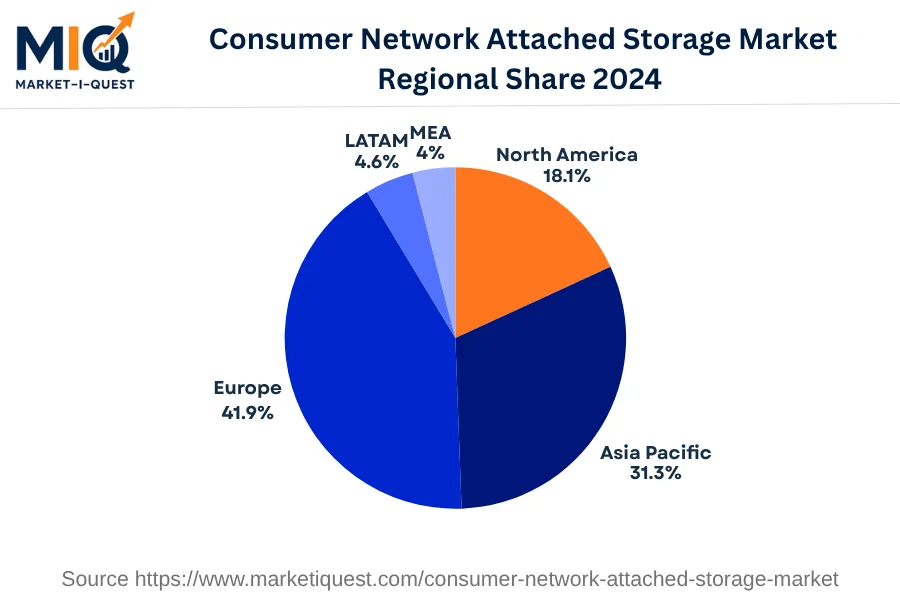
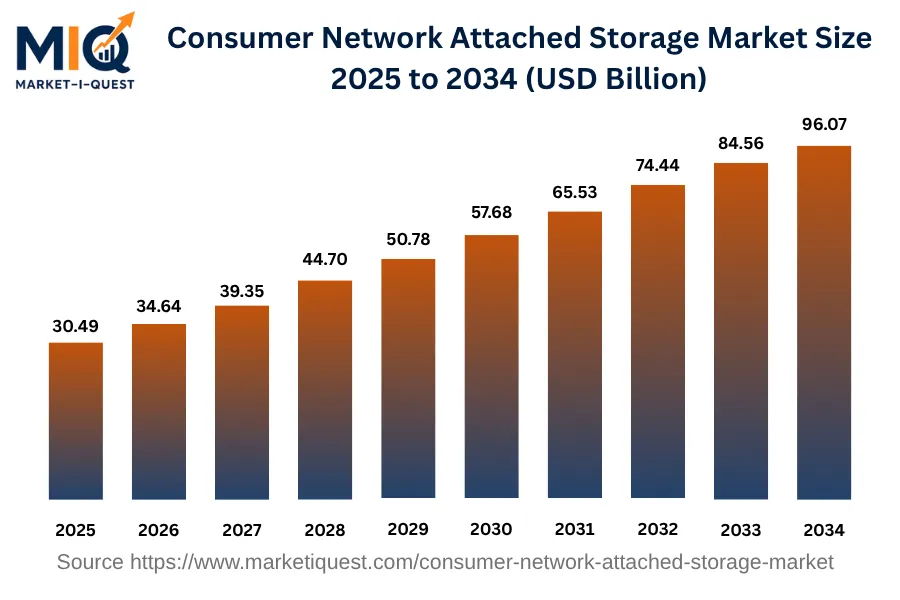
The Consumer Network Attached Storage market was worth USD 30.49 billion in 2025 and is projected to reach USD 96.07 billion by 2034, growing at a CAGR of 13.6%. This extensive growth over the forecast period is due to increasing digital data volumes and growing need for cost-efficient, reliable solutions for data backup, restoration, sharing, and storage. From an initial value of USD 26.84 billion in 2024, there was a noticeable increase in this market's size to USD 30.49 billion in 2025, marking beginning of its decade-long upturn. Statistical analysis of regional market shares in 2024 shows diverse mix: Europe held highest share at 41.93%, followed by Asia Pacific at 31.28%, North America at 18.14%, LATAM at 4.61%, and the MEA region at 4.04%.

Key Takeaways

  • By Design - 2-Bay led segment accounting for a major share in 2024.
  • By Storage Solution - SSD expanded at the fastest pace showing remarkable growth in 2024.
  • By Connectivity - Ethernet held predominant position in 2024 leading the segment.
  • By End Use - Commercial was the leading segment illustrating significant market dominance in 2024.
consumer-network-attached-storage-market market size

Key Driving Factors

Increasing Telecommuting Trends

Over past few years, more businesses are embracing flexible work options, causing significant uptick in number of telecommuting and remote work situations. This shift implies that considerable amount of data is generated off-site, requiring efficient storage solutions. Consumer network attached storage devices make it possible for remote employees to save, access, and share data from multiple devices. This is creating robust push toward adoption as need for streamlined virtual communication and data exchange becomes necessary. The trend of telecommuting is expected to grow stronger in near future, which will continually drive demand and interest in consumer network attached storage market.

Growing Digital Content Production

The upswing in digital content production driven by personal or home-based content creators is causing seismic shift in Consumer Network Attached Storage Market. Content producers from various streams like gaming, podcasting, video creation, and photography require substantial storage facilities to store, edit, and distribute their work. Consumer network attached storage provides the perfect solution by offering flexible and scalable server solutions for these creators. These offerings can be cost-efficient for small-scale content producers while still offering the necessary capacity and processing power for managing and distributing digital content. As number of personal content creators rises, so does requirement for efficient and accessible storage solutions, Giving steady push to consumer network attached storage market.

Market Evolution by Timeline

2019-2023
During this period, primary buyers included tech-enthusiasts and small businesses that housed multimedia files. The standard for most consumer network attached storage devices was 1 to 4 bay HDD or SSD model units. Western Digital and Seagate were prominent manufacturers and made devices with cloud services allowing access to files remotely. Due to General Data Protection Regulation (GDPR), companies emphasized built-in data encryption. Fair pricing of units, fluctuating between $150-$500, was driven by storage capacity and additional features. Issues during this time were typically related to software compatibility or difficulty with network setups.
2024
This year saw push towards energy efficiency, with devices offering lower power usage during standby mode. Voice integration with services like Alexa or Google Home became more common. Devices were sold on e-commerce platforms like Amazon and manufacturer websites. Home users interested in media streaming constituted bulk of the purchases. Although home-based businesses and freelancers increasingly procured these units, a skilled IT background was often required to address setup or maintenance problems. Frequent use of subscription model for extended cloud service or customer support became prevalent.
2025-2029
Increased adoption of 5G technology enhanced performance of network attached storage devices; faster data transfer rates, streaming became more seamless. More manufacturers included added value services like backup support for mobile devices and multi-platform compatibility with a push towards integration with Internet of Things (IOT) home devices. Device purchase remained popular; but there was a noticeable trend towards leasing models offering upgrades. The regulatory environment continued to prioritize data safety, leading to standard protocols in data encryption and user privacy. The primary challenge remained network setup and maintenance.
2030-2034
During this period, home entertainment and small business backup requirements were influenced with increased digitization and remote working. Rise of 8K multimedia content required higher storage capacity devices. Supply side matured with companies offering integrated solutions with router or modem devices. There was a significant rise in devices offering AI-driven support for maintenance and troubleshooting, reducing need for an IT background. Introduction of stricter data regulation norms led to enhanced encryption protocols. Payment models saw shift from outright purchases to leasing models, with regular updates and added cloud storage.

Future Market Outlook

Future Opportunities

As Consumer Network Attached Storage market evolves, significant opportunities will emerge driven by changing user needs and technological advancements. One area ripe for growth is the integration of artificial intelligence (AI) capabilities within personal storage systems. In 2023, Netgear introduced AI-powered features in its ReadyNAS lineup, illustrating this shift towards enhanced data management. As consumers demand more efficient options for organizing and accessing their data, the incorporation of AI algorithms can provide personalized experiences, like automated media categorization or intelligent backups. Furthermore, as smart home applications and IOT devices proliferate, there will be a growing demand for NAS systems that can manage diverse data streams efficiently. Companies like TerraMaster have begun to emphasize compatibility with smart home ecosystems, indicating shift to meet these emerging needs. Additionally, with enactment of stricter data protection regulations globally, following initiatives like European Union's GDPR in 2018, opportunities will arise for NAS vendors to enhance compliance features within their offerings. This trend can lead to increased partnerships with enterprises seeking to protect sensitive consumer data. Overall, evolution of consumer expectations surrounding storage solutions presents diverse opportunities for vendors ready to embrace these shifts while adhering to regulatory standards.

Segmentation Analysis

By Design

The market is divided into subsegments including 1-Bay, 2-Bay, 4-Bay, 6-Bay, and Others. Among these, the 2-Bay subsegment accounted for the largest revenue share while the 4-Bay subsector is expected to grow at the fastest CAGR during the forecast period.

Largest Revenue Share

2-Bay

Market Share Leader

Today, the 2-Bay category dominates segment 1 in terms of revenue. This is primarily driven by the balance between capacity and cost that 2-Bay solutions offer, catering to a wide range of customers. Competing in the middle of the range, 2-Bay solutions offer an appealing equilibrium between the functionality of higher capacity variants and the affordability of lower capacity options. This enables them to cater to a broad spectrum of customers including small businesses, tech enthusiasts, and household consumers. Their affordability, coupled with decent storage capacity, appeals to customers looking for value-for-money solutions. In terms of geography, it's typically the more developed markets seeing the highest demand due to increased data usage and storage requirements from both businesses and households. Regulatory requirements for data retention in certain sectors such as finance and healthcare also drive agreements for 2-Bay solutions. The purchasing criteria are typically a balance between price and capacity, making 2-Bay a popular choice. Switching costs from either lower or higher capacity solutions are also moderate, making it an attractive option for new customers.

Fastest CAGR

4-Bay

Forecast Period Growth Leader

While the 2-Bay subsegment leads in terms of current revenue, the 4-Bay subsegment is expected to see the fastest growth. With rising data usage trends, an increasing number of businesses and consumers are outgrowing their 2-Bay storage solutions and are seeing the need for higher capacity. The 4-Bay offers a practical upgrade path for these users, providing more extensive storage capacity without a substantial leap in cost. Further, advancements in technology that allow for smaller, denser, and less power-consuming storage drives are making 4-Bay solutions more efficient and affordable. Capex investments into enhancing these technologies are expected to continue, serving as a critical catalyst for this subsegment's growth. However, growth could be hampered by adoption barriers like higher initial costs or complexity around data migration for non-tech savvy users.

By Storage Solution

The storage solution market is divided into subsegments including HDD (Hard Disk Drives), SSD (Solid State Drives), and Hybrid drives. In 2024, SSD led the market with the largest revenue share while the Hybrid subsegment reported the fastest growth in the forecast period.

Largest Revenue Share

SSD (Solid State Drives)

Market Share Leader

SSD (Solid State Drives) has captured the largest share of the storage solution market revenue. SSDs are attractive to both individual and enterprise customers due to their higher speed, reliability, and durability compared to HDDs. SSD's lack of moving parts reduces the chances of mechanical failures, making it a more reliable data storage option. Another major driver for SSD demand is the increasing data generation from various sectors like IT, telecommunication, and media entertainment. SSDs' smaller sizes and lighter weight compared to HDDs make them an obvious choice for laptops and mobile devices, fueling their demand. Geographically, developed regions with robust IT and Telecommunication infrastructure, such as North America and Europe, generate significant demand for SSDs. However, regulatory guidelines regarding data protection and storage could influence the market dynamics. The overall SSD purchase decision is often affected by factors such as storage capacity, price, and intended use.

Fastest CAGR

Hybrid

Forecast Period Growth Leader

Hybrid storage drive solutions, combining the features of SSD and HDD, show the fastest Compound Annual Growth Rate (CAGR) in the storage solutions market. Hybrid drives offer an optimal balance between speed, cost, and capacity with SSD-like performance at a lower price. The main growth drivers for this segment are an increased understanding of the benefits of Hybrid drives coupled with ther accessibility. Adoption barriers include fears about the newness and reliability of the technology. Technological advances, including Hybrid drive manufacturers working on reducing the power consumption of these drives, act as key catalysts for market growth. Additionally, strategic partnerships between hybrid drive manufacturers and leading tech companies could further boost market growth. However, near-term risks include potential supply chain disturbances due to global geopolitical scenarios and competitive pressure from SSD and HDD products. Despite these risks, the hybrid subsegment is poised for strong growth, driven by technological advances and strategic partnerships.

By Connectivity

The connectivity market of 2024 is segmented into various categories including Ethernet, Wi-Fi, Bluetooth and others, with Ethernet generating the most revenue and Wi-Fi identified as the fastest growing segment.

Largest Revenue Share

Ethernet

Market Share Leader

In 2024, Ethernet holds the crown in the connectivity market segment in terms of revenue generation. Strong reliability, high speed, and assured security make Ethernet a top choice for businesses of all scales. Even with the proliferation of wireless technologies, Ethernet continues to strengthen its footprint in the data center and corporate world. This connection method enables better control over the data flowing within the network, reducing the likelihood of unexpected downtime, data leaks or breaches. Furthermore, Ethernet is highly adaptable, offering a range of speeds that fits a variety of business needs. Low latency and high-speed data transfer are critical purchasing parameters for industries that rely heavily on real-time data, such as financial services and healthcare, thus keeping the demand for Ethernet connectivity high. Geographic regions where robust digital infrastructure is well established also contribute significantly to the revenue from this segment.

Fastest CAGR

Wi-Fi

Forecast Period Growth Leader

While Ethernet dominates in terms of revenue, Wi-Fi is booming as the fastest-growing segment in the connectivity market, signifying the rising trends of mobility and Incipient IoT era. The advent of new protocols and technologies like Wi-Fi 6 and the forthcoming Wi-Fi 7 have been acting as major adoption catalysts offering improvements in terms of speed, network efficiency, and power optimization. The escalating adoption of consumer smart devices has given a substantial impulse to the growth of Wi-Fi as more manufacturers embrace this technology in home appliances, entertainment gadgets, and personal devices. Smart homes and offices are propelling the expansion of Wi-Fi as part of the larger IoT ecosystem. However, there are near-term risks to this growth, mostly relating to security concerns and the vulnerability of wireless devices. As these hurdles are overcome through more sophisticated technologies and stringent regulations, even faster growth can be projected in the Wi-Fi subsegment.

By End Use

The market is divided into subsegments including Residential and Commercial, with the Commercial subsegment accounting for the largest revenue share while the Residential subsegment is expected to grow at the fastest CAGR during the forecast period.

Largest Revenue Share

Commercial

Market Share Leader

The commercial segment earned the largest revenue share as of the base year 2024 due to several factors. It is largely driven by the rise in infrastructural development across emerging economies. Many businesses are recognizing the benefits of upgrading their facilities for efficiency and sustainability, thus, increasing the need for products and services in this segment. Demand has been particularly high in urban areas, where there's a concentration of businesses and commercial spaces. The strength of the commercial segment also lies in its wide customer base, ranging from small businesses to large corporations. Another supporting factor has been government regulations and initiatives promoting the expansion of commercial infrastructure to boost the economy. In terms of supply, manufacturers have developed strong networks with distributors and retailers to ensure the broad availability of their products, hence easing the purchasing process for customers. However, high switching costs in the commercial market encourage customer loyalty, further boosting its revenue.

Fastest CAGR

Residential

Forecast Period Growth Leader

The residential segment is projected to have the fastest Compound Annual Growth Rate (CAGR) in the forecast period following the base year of 2024. The driving force behind this growth is the increasing investment in home improvements and renovations. Consumers are becoming more financially capable of investing in quality home upgrades due to economic recovery, which plays a significant role in the demand. Technological advancements have further fueled the growth by providing more efficient and convenient products for household use. Moreover, partnerships between suppliers and residential communities are becoming common, supporting the immediate reach to potential customers. Another catalyst for growth is the introduction of policies encouraging energy efficiency in households, which compels consumers to invest in new, efficient products. However, there may be potential risks. Rapid technological changes require continuous product updates making some homeowners hesitant about the frequent replacements and the costs involved.

Competitive Analysis

Key Market Players

Manufacturers / OEMs

Western Digital Corporation
US
Netgear Inc.
US
Synology Inc.
Taiwan

Key Suppliers & Raw Materials

Toshiba Corporation
Japan
Seagate Technology
US
Samsung Electronics
South Korea

Distributors, Integrators & Channel Partners

CDW
US
Ingram Micro Inc.
US
Tech Data Corporation
US

Porter’s Five Forces Analysis

Analysis unveiling the intensity of competitive behavior and economic impact within the Consumer Network Attached Storage Market.

Supplier Bargaining Power

Medium

The market depends on technical components and therefore faces moderate supplier power.

Buyer Bargaining Power

High

Increased competition and lower switching costs lead to higher buyer bargaining power.

Threat of Substitutes

Medium

Cloud Storage and DAS options serve as notable substitutes, posing a modest threat.

Threat of New Entrants

Low

Significant capital investment and complex technology restrict new entrants.

Competitive Rivalry

High

The presence of market leaders such as Synology, Western Digital intensifies competitive rivalry.

Regional Analysis

Geographic market dynamics and growth opportunities across key regions

Global Market Outlook

consumer-network-attached-storage-market market regional share

North America

In 2024, the North American consumer network attached storage (NAS) market was characterized by data-driven demand and vibrant tech-adoption trends.

Directing the market was a surge in consumer demand for efficient, personal data management solutions driven by escalating volumes of data generation across multiple digital devices. Moreover, robust investment in R&D by leading tech firms fortified the supply dynamic with innovative, user-friendly NAS offerings. Enhanced data protection regulations, such as the California Consumer Privacy Act in the U.S., further bolstered demand by mandating stringent data storage requirements. Additionally, falling hardware costs rendered NAS solutions more financially accessible for consumers, amplifying their adoption.

Buyer behavior in 2024 revealed preferential shifts towards hybrid NAS solutions that harmonize the benefits of personal control with cloud-based NAS’s scalability. As a result, partnerships flourished; tech giants like Microsoft and local NAS providers specifically collaborated to create NAS solutions with integrated cloud support. Public sentiment reflecting data privacy concerns prompted manufacturers to prioritize data encryption and other security measures in their NAS models. Within sectors, predominant customers included individual power-users dealing with high volumes of data, such as digital creators. Notably, Canadian and Mexican markets experienced increased adoption rates evidently inspired by the U.S. market trends.

Asia Pacific

In 2024, the Consumer Network Attached Storage (NAS) market in the Asia Pacific region witnessed substantial growth, mainly driven by varied factors. The escalating digitization across sectors like healthcare, retail, utilities, and manufacturing necessitated efficient data storage solutions, intrinsically enhancing NAS adoption. Moreover, comprehensive implementation of data localization regulations in India and China fueled investment in local NAS systems. Striking advancements in technology that enable faster and secure data transmission boosted consumer interest and demand in the market.

Observing the key trends, consumers in markets such as China and Japan heavily prioritized encrypted NAS systems to safeguard sensitive information. In India and key ASEAN markets, the shift towards cloud-based NAS solutions dominated, propelling partnerships and M&A activities among major NAS and cloud providers. In Australia and South Korea, stringent policy enforcements led to a heightened focus on NAS systems with efficient power conservation features. Markets in these regions also witnessed a surge in demand for scalable NAS solutions to accommodate the increasing data generation in enterprise and government entities. The retail sector, specifically, exhibited a move towards NAS solutions offering advanced data analytics capabilities, reflecting a shift in buyer behavior towards high-functionality systems.

Europe

The Consumer Network Attached Storage Market in Europe during 2024 experienced a considerable dynamic shift. The market drivers included higher demand for efficient data backup systems, increased digital content, and robust investment in network infrastructure across various sectors. Germany and the United Kingdom, with their highly advanced tech industries, led in the adoption of this technology, while France and Italy showed significant interest in enhancing their existing systems. On the supply side, technology vendors across the region introduced competitive pricing models, causing a surge in affordability and subsequent market growth.

Concurrently, changing patterns in buyer behavior unveiled new market trends. Users leaned towards private cloud-based storage as it offered heightened data security. This shift led to more partnerships and M&As among tech companies, particularly within Benelux and the Nordics as they aimed at consolidating their market presence. A notable trend was the increasing policy enforcement by governments, targeting improved data protection standards - a move presented most prominently within Central & Eastern Europe.

The primary sectors availing of these services included governments, healthcare providers, and retail businesses. These sectors felt the brunt of increased digital content and hence prioritized efficient data backup systems. With these shifts, the Consumer Network Attached Storage Market in Europe illustrated a considerable change in its trajectory during 2024.

Latin America

The Consumer Network Attached Storage (NAS) market in Latin America witnessed considerable growth in 2024, spurred by different factors. Rising consumer demand for low-cost data storage solutions fueled expansions in Brazil and Mexico, both experiencing a surge in digital content consumption. Regulatory support in Argentina and Colombia promoted technology adoption, propelling NAS installations in sectors like government, healthcare, and utilities. In Peru, local investment in technology infrastructure boomed, enhancing supply chain dynamics and reducing NAS unit costs.

Market trends exhibited distinct shifts in product preference and buyer behavior. Secure data storage became a priority for consumers, particularly in retail and manufacturing sectors, prompting a move towards multi-layer encrypted NAS systems. Channel dynamics evolved in Chile due to the increased preference for digital platforms over physical stores, driving online sales of NAS units. Mergers and acquisitions intensified with major enterprises seeking to consolidate their market position, further influencing the LATAM NAS market landscape. Increasing policy enforcement in sectors like healthcare and government defined standards for data storage and management, prompting a gradual shift towards high-capacity, compliant NAS solutions. This shift was most pronounced in Argentina where data protection regulations demand fortified data storage systems.

In essence, demand for cost-effective, secure data solutions underpinned by supportive regulations, along with shifts in product preference and channel dynamics, drove the LATAM consumer NAS market in 2024.

Middle East & Africa

In 2024, the Consumer Network Attached Storage Market in the Middle East and Africa emerged as a robust and evolving segment of the regional tech industry. Notably, the migration of data to cloud platforms was a key driver for this market. Governments across the region, including Saudi Arabia and the UAE, invested heavily in digitization, leading to an increased demand for consumer network-attached storage systems. Widespread adoption of IoT technology in various sectors such as healthcare, manufacturing, and retail further bolstered the demand. In Nigeria and Kenya, elevated eCommerce activities generated data volumes requiring effective storage solutions, stimulating market growth.

In terms of trends, the enhanced focus on data security across the region resulted in consumers opting for NAS systems. Further, the abundant acceptance of 4G and 5G technology in countries like Israel, Qatar, and South Africa bolstered NAS market expansion. In Egypt, partnerships between telcos and NAS vendors were common, enhancing the market scope. In a different vein, regulatory standards concerning data privacy enforced by the South African and Kenyan governments created a conducive environment for efficient NAS systems. Lastly, we observed a surge in the demand from the financial sector, especially in the UAE and Saudi Arabia, where digital transformation was on a fast-track, reinforcing the relevance and value of the Consumer Network Attached Storage Market in 2024.

Recent Industry Developments

Latest market innovations, product launches, and strategic initiatives

June 2026

Synology officially released the FlashStation FS200T, a compact all-flash NAS. This launch accelerates a significant shift in the consumer market toward eliminating traditional, noisy spinning hard drives in favor of near-silent, SSD-based storage for home networks.

June 2026

ASUSTOR introduced its Ryzen-powered Flashstor 6 Gen 3 and Lockerstor V2 NAS models at the Computex exhibition. This specific hardware development brought enterprise-level features like USB4 networking and extensive M.2 NVMe SSD capacity directly into the consumer and prosumer price brackets.

January 2026

360iResearch published a definitive market forecast detailing the inflection point of the consumer NAS ecosystem. This development formally documented the consumer market's transition from basic local storage devices to multi-modal personal cloud platforms equipped with built-in AI for photo indexing and real-time media transcoding.

Frequently Asked Questions