Concrete Admixture Market Snapshot

Key Players

  • Sika AG (Switzerland)
  • BASF SE (Germany)
  • Grace Construction Products (United States)
  • Mapei SpA (Italy)
  • RPM International (United States)
  • Fosroc Inc. (United Kingdom)
  • Ashland Inc. (United States)
  • Chryso S.A.S (France)
  • Pidilite Industries (India)
  • CICO Technologies (India)

Market Size

Base Year 2024
$23.84 Bn
CAGR
7.8%
Forecast 2034
$50.52 Bn

Market Segments

By Type
  • Water Reducing Agents
  • Waterproofing Agents
  • Accelerating Agents
  • Air-Entraining Agents
  • Retarding Agents
  • Others
By Application
  • Residential
  • Commercial
  • Industrial
  • Infrastructure

Market Dynamics

Drivers
  • Rising urbanization rate
  • Increased infrastructure investments
Restraints
  • High production cost
  • Stringent environmental regulations
Opportunities
  • Increased construction activities
  • Demand for eco-friendly solutions

Market Size

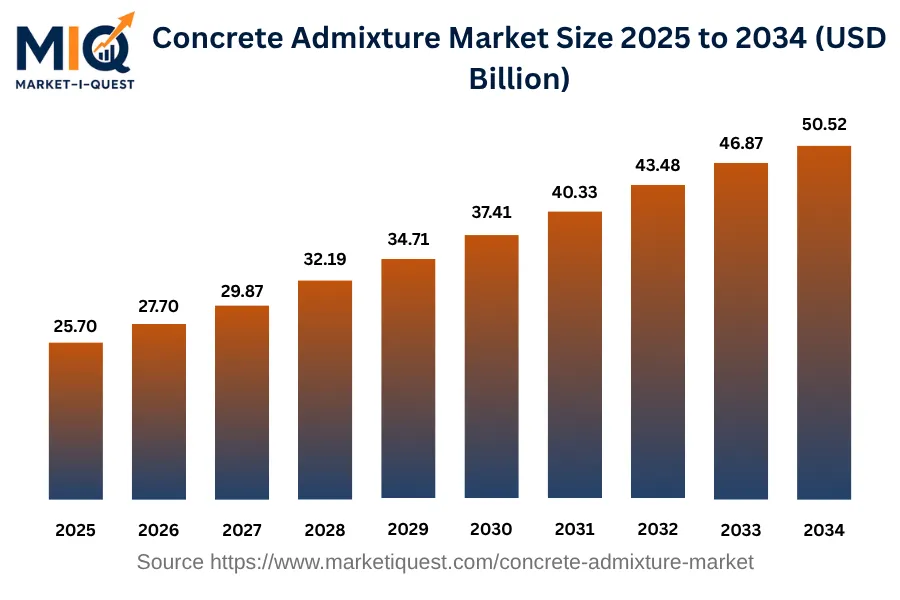
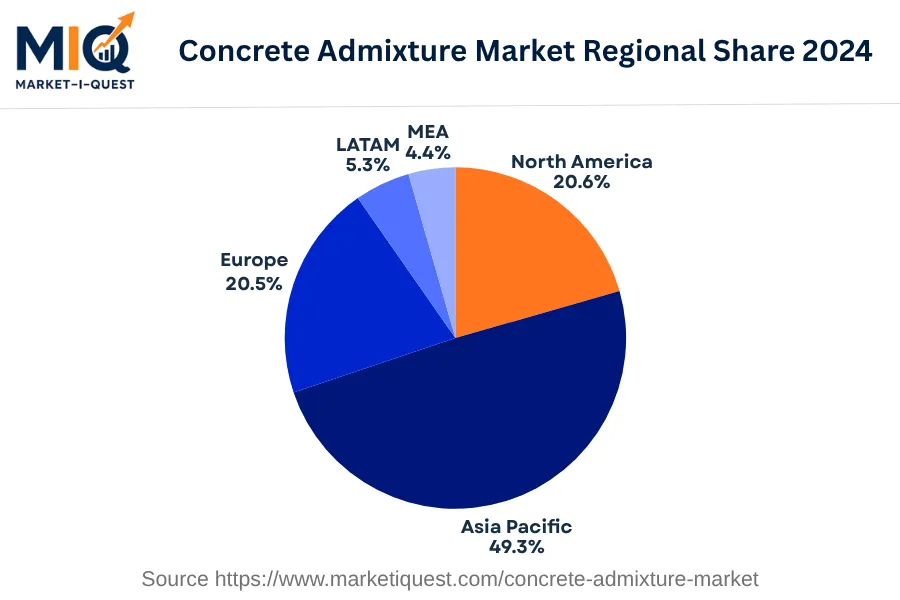
The Concrete Admixture Market is projected to show substantial growth from 2025 to 2034. In 2025, the market size will start at $25.70 billion, and by 2034, it is intended to reach $50.52 billion. This growth path signifies a CAGR of 7.8% over the forecast period. The impressive expansion is reflected in the market's consistent upward trajectory from its 2024 value of $23.84 billion. The dynamics of the market also display substantial variation across different regions. As of 2024, the Asia Pacific holds the majority market share at 49.3%, followed closely by North America and Europe, which constitute 20.6% and 20.5% respectively. Lesser shares are seen in LATAM and MEA at 5.3% and 4.4% respectively. It is indicative of distinct geographical consumption patterns and preferences within the Concrete Admixture Market.

Key Takeaways

  • By Type - Water Reducing Agents led the Concrete Admixture Market accounting for a significant share in the base year.
  • By Application - Commercial sector held the largest portion with a growing demand in the market.
concrete-admixture-market market size

Key Driving Factors

Stringent Environmental Regulations

Environmental regulations have been getting increasingly stringent worldwide, particularly concerning waste management and emissions standards in the construction industry. Among these are the European Union's Directive 2008/98/EC and America's Clean Air Act. These laws necessitate using more environmentally friendly construction materials. Concrete admixtures are both sustainable and compliant with these regulations, contributing to reduced emissions and waste in the production process. This is driving the concrete admixture market as companies strive to stay on the right side of the law. Admixtures reduce the amount of cement necessary in construction projects, which is crucial since cement production is among the biggest contributors to global CO2 emissions.
High Performance Requirements in Infrastructure Projects

Across the globe, complex infrastructure projects are on the rise - from high-rise buildings to vast transport networks subaqueous tunnels. These projects demand construction materials that fulfill high-performance requirements. Concrete admixtures enhance the properties of concrete, improving its workability, strength, and durability under challenging conditions. The performance benefits provided by concrete admixtures, including fast setting times, frost resistance, and improved strength, are leading to increased demand in these intricate and ambitious construction projects. Consequently, the need to fulfill high-performance standards in the construction industry is a significant driving factor for the concrete admixture market.

Market Evolution by Timeline

2019-2023
The Concrete Admixture Market experienced its biggest surge in demand in this period, with commercial construction in growing economies, including India, China, and Southeast Asia, leading this growth. Suppliers like BASF and Sika focused on high-performance superplasticizers, which resist water well, reducing the cost of materials. Policies in these nations favored eco-friendly construction materials, pushing contraction companies to adopt concrete admixtures. The pricing strategy varied between value-based pricing, aligned to the performance of the admixtures, and competitive pricing. Partnerships with local construction firms were typical to penetrate these new markets. The major potential risk was inconsistency in the quality of raw materials, managed through stringent quality checks and multiple suppliers.
2024
This year saw the rise in demand for residential construction in both developed and developing countries. The focus of suppliers shifted towards low-cost admixtures to cater to this segment. Polychem from GRT was one of the key products launched this year. Changes in building regulations, like the International Building Code amendments, pushed for increased use of admixtures for strength and durability. Competition intensified, leading to bundled pricing models where admixtures were sold with other concrete materials. Proprietary technology, like Sika's ViscoCrete, was seen as a mainstay against competition. The primary risk was a potential economic slowdown affecting construction, mitigated through diversification across markets.
2025-2029
Emerging markets in Africa and the Middle-East led the demand growth this period due to increases in infrastructure projects. On the supply side, the development of admixtures for extreme weather conditions was a key trend; heat-resistant admixtures were in demand in the Middle East and cold-resistant ones in areas with harsh winters. Governments implemented local sourcing requirements, favoring suppliers with manufacturing facilities in these regions. Fixed contract pricing became more common as a way to lock-in demand in a more uncertain market environment. The risk of a decrease in supply of raw materials, like fly ash, was typically managed through recycling and the use of alternative materials.
2030-2034
Market dynamics in this period revolved around sustainable construction trends. Buyers were increasingly green construction firms, looking for environment-friendly admixtures. Suppliers tried to meet this demand through innovation in bio-based admixtures. Changes in environmental regulations pushed up prices due to compliance requirements and the cost of innovation. Despite this, the competitive landscape became more fragmented with the entry of new players focussing on sustainable solutions. Partnerships with sustainable construction companies became a strategy for growth. Potential risks, such as stricter environmental norms and higher costs of compliance, typically prompted suppliers to invest in R&D for innovative, cost-effective solutions.

Future Market Outlook

Future Opportunities

The future of the concrete admixture market presents several opportunities for growth, directly linked to ongoing trends in sustainability and urbanization. In 2023, recent initiatives by the Sustainable Concrete Forum in North America aimed at promoting the use of eco-friendly admixtures have gained widespread attention. Such developments indicate a shift in focus towards green building practices, which will likely require further innovation in admixture formulations. Countries like Germany are investing in infrastructure projects alongside the EU's Green Deal, providing a favorable environment for admixture manufacturers to develop products that enhance the sustainability of concrete. Concurrently, advancements in digital technologies such as Building Information Modeling (BIM) have opened avenues for integrating admixture data into construction management. This integration reflects growing demand for customizable and real-time solutions in concrete applications. Companies like Sika and GCP Applied Technologies are actively exploring partnerships with tech firms to create smarter admixture solutions that align with this transformative digital landscape. The ongoing push for resilience against climate change is driving research into admixtures that improve concrete's durability in extreme weather conditions, indicating further market opportunities. Overall, these emerging themes suggest that the concrete admixture market will evolve to meet not only infrastructural demands but also environmental goals, positioning itself for substantial industry growth.

Segmentation Analysis

By Type

The market is divided into subsegments including Water Reducing Agents, Waterproofing Agents, Accelerating Agents, Air-Entraining Agents, Retarding Agents, and others. Among these, Water Reducing Agents accounted for the largest revenue share while Air-Entraining Agents is expected to grow at the fastest CAGR during the forecast period.

Largest Revenue Share

Water Reducing Agents

Market Share Leader

The water reducing agents subsegment takes the lead in revenue generation in the target market as they are crucial for enhancing the workability, durability, and strength of concrete. This subsegment's demand is primarily driven by increasing construction activities across developing regions and more stringent regulations around building durability and resistance. Furthermore, water reducing agents offer considerable cost savings, hence, they have become a popular choice among building contractors and manufacturers. These agents also help in reducing the water content in construction mixtures by 10-15% without impacting the workability, enhancing the environmental sustainability factor, making it appealing for regions with water scarcity. Another reason for the lead of this subsegment is that water reducing agents are mandatory in the production of high-performance concrete, used in the construction of skyscrapers and bridges.

Fastest CAGR

Air-Entraining Agents

Forecast Period Growth Leader

The air-entraining agents subsegment is projected to witness the highest growth rate. The driving factors include their increased use in colder regions where freeze-thaw resistance is essential for concrete durability. These agents produce tiny and stable air bubbles uniformly distributed in the concrete to provide the necessary space to allow for water expansion during freezing and prevent cracking. Furthermore, technologies like easy-mix and metering systems are likely to catalyze this subsegment's growth. However, it is important to note that over-entrainment can lead to loss of strength in the concrete, acting as a potential growth barrier. Future improvements in the distribution system and technological innovations in creating a balance between strength and freeze-thaw durability are expected to bolster the growth of this subsegment.

By Application

The market is divided into subsegments including Residential, Commercial, Industrial, and Infrastructure, among which, the Commercial subsegment accounted for the largest revenue share while the Infrastructure subsegment is expected to grow at the fastest CAGR during the forecast period.

Largest Revenue Share

Commercial

Market Share Leader

The Commercial subsegment has recorded the highest revenue in 2024, which can be attributed to a broad range of factors. The rapid urbanization and the expansion of business activities globally necessitate the establishment of commercial buildings, contributing to market demand. In addition, technology advancement and digitalization have radically transformed commercial spaces, further driving market growth. Furthermore, strict regulatory guidelines for energy-efficient and green buildings have prompted changes in design and construction approaches, fueling the demand for advanced materials and technologies. Besides, an increase in government and private sector investment in major commercial projects, alongside the growing purchasing ability of companies, has bolstered revenue. However, the segment's growth can be constrained due to high switching costs that may deter companies from adopting new technologies or materials.

Fastest CAGR

Infrastructure

Forecast Period Growth Leader

On the other hand, the Infrastructure subsegment is projected to exhibit the fastest CAGR in the coming years. A surge in infrastructure development, supported by strong government initiatives and policies worldwide, is a primary growth driver. Significant investments in large-scale domestic infrastructure projects, including transportation, railways, highways, bridges, and utilities, have boosted demand. Technological innovations, such as smart city initiatives and the integration of artificial intelligence into infrastructure planning, also bode well for future growth. Capital expenditures have been directed towards developing sustainable, resilient, and efficient infrastructure. Nevertheless, high adoption barriers in terms of cost and lack of technical know-how may slow down the growth in the short term. Partnerships with key players and policy reforms could mitigate these barriers and facilitate wider adoption.

Competitive Analysis

Key Market Players

Manufacturers / OEMs

BASF SE
Germany
Sika AG
Switzerland
Admix Inc.
US

Key Suppliers & Raw Materials

Arkema SA
France
Dow Inc.
US
Ash Grove Cement Company
US

Distributors, Integrators & Channel Partners

CEMEX S.A.B. de C.V.
Mexico
LafargeHolcim Ltd.
Switzerland
HeidelbergCement AG
Germany

Porter’s Five Forces Analysis

This analysis provides crucial insights into the competitive intensity and attractiveness of the global Concrete Admixture Market.

Supplier Bargaining Power

Medium

Medium due to the presence of numerous suppliers varying in size and scale offering differentiated product portfolios.

Buyer Bargaining Power

Low

Buyer's bargaining power is low because of the specificity and high cost of switching between different concrete admixtures.

Threat of Substitutes

Low

Low threat as concrete admixtures are requisite in concrete mixing process, presenting limited alternatives.

Threat of New Entrants

High

Potential for new entrants is high due to growing demands in construction industries and low capital investments.

Competitive Rivalry

High

High competitive rivalry due to numerous established players and constant product advancements.

Regional Analysis

Geographic market dynamics and growth opportunities across key regions

Global Market Outlook

concrete-admixture-market market regional share

North America

In 2024, the Concrete Admixture Market in North America was shaped by significant drivers and trends. Critical drivers included increased demand due to rapid urbanization in the U.S., Canada, and Mexico, leading to extensive investment in construction sectors. Stringent environmental regulations enforced by governments amplified the necessity for high-quality and eco-friendly concrete admixtures. Moreover, the adoption of advanced technologies, such as the use of synthesized chemical admixtures, encouraged efficiency in the concrete industry, stimulating market growth.

The trend of prioritizing sustainable and 'green' construction in the region, stemming from increased environmental consciousness among consumers, significantly impacted buyer behavior. This trend, coupled with evolving construction standards for greater durability and higher resistance, propelled the demand for modern concrete admixtures. Key market players engaged in strategic partnerships and M&As to capitalize on product diversification opportunities. An example of this can be seen in partnerships between construction and manufacturing sectors, creating channels to ensure product accessibility. Policy enforcement by regulatory bodies in Canada, such as the Building Code Division, set the standards for concrete admixture composition and use, influencing supply dynamics in the region. On balance, drivers and trends observed in 2024 suggest a robust and evolving Concrete Admixture Market in North America.

Asia Pacific

In 2024, the Asia Pacific region experienced a dynamic market atmosphere for the concrete admixture industry. Prominent drivers included growing urbanization in India and China, leading to profound infrastructure development. Governments' renewed focus on sustainable construction led to regulatory changes, accelerating the demand for environment-friendly concrete admixtures. Technological advancements found a positive reception in Japan and Australia, fundamentally altering the supply dynamics. Higher construction activities in South Korea and key ASEAN markets resulted in a spike in admixture prices.

On the trends front, shifting buyer behavior manifested as a preference for concrete admixtures that guarantee longevity and durability. The ASEAN market also observed a swing towards intelligent concrete solutions, fueled by digital transformations within the construction sector. Partnerships and mergers became commonplace, especially in China and India where domestic and international businesses sought to scale production and distribution. Standards for admixture quality and performance became stringent, with governments emphasizing policy enforcement. This was particularly noted in the manufacturing sector across the region, as companies moved towards adopting eco-friendly solutions to comply with these policies. Thus, 2024 proved a pivotal year for the growth and development of the concrete admixture market in the Asia Pacific region.

Europe

In 2024, the European concrete admixture market showcased a significant uptick, especially prominent in Germany, the UK, France, Italy, Spain, the Nordics, Benelux, and Central & Eastern Europe. Driving factors included enhanced infrastructure investment in fast-growing urban regions and strict European Union environmental regulations promoting sustainable construction methods. Technology adoption also played a key role, with innovative admixture types offering improved durability and strength. Supply dynamics were notably influenced by new quarry capacities in Eastern Europe, affecting the availability and pricing of raw materials.

Simultaneously, shifting trends were observed within this market. Government-led initiatives were seen encouraging green building concepts, propelling demand for eco-friendly admixtures. A pivot towards digital platforms for procurement allowed manufacturing and retail sectors to streamline operations, and strategic partnerships became more common among key producers and suppliers. Standards concerning product quality and consistency became stricter, enforced by regulatory bodies in countries like Germany and Italy.

In particular, growth in infrastructure development in Central and Eastern Europe attracted significant investors in the concrete admixture market, concentrating on transport and energy sectors. Significant policy endorsements led to a parallel rise in residential and commercial projects. This scenario underlined the pivotal role of concrete admixtures in regional projects, ranging from large-scale public construction to individual home renovations. The market also witnessed a shift towards environmentally responsible options, implying a heightened consciousness about sustainability in construction-related industries.

Latin America

In 2024, the concrete admixture market in Latin America (LATAM) showed significant growth due to increased demand in construction. Rising urbanization and infrastructural development, especially in Brazil and Mexico, were key drivers of demand. Investment in sustainable construction technologies in Argentina and Colombia was another important growth stimulant, as builders sought energy-efficient, environmentally friendly concrete admixtures. In Peru, regulatory policies encouraging the use of durable and high-strength concrete accelerated market uptake.

Meanwhile, customers' preference for ready-mix concrete, which provides ease of use and superior finish, influenced product development trends. Technological advances, such as the adoption of water reducing admixtures in Chile for enhanced workability and strength, became more prevalent. Partnerships and mergers and acquisitions dominated the market trend, with companies aiming to capitalize on the expanding market. For example, the acquisition of local manufacturers by global companies increased distribution and market share. However, maintaining consistency in product standards remained a challenge due to the diverse climatic conditions across LATAM countries.

In terms of sector, the highest demand came from the residential construction sector, followed by commercial and infrastructural sectors. The demand for non-residential construction, including utilities and retail establishments, also exhibited a considerable uptick. Industrial manufacturing units and government projects also contributed to the market's growth, particularly in Brazil and Mexico.

Middle East & Africa

In 2024, the Concrete Admixture Market in the Middle East and Africa was marked by a prevailing trend of investment in infrastructure development, particularly in countries like Saudi Arabia, the United Arab Emirates, Egypt, and Qatar. This increased demand spurred growth in regulation-compliant, high-performance admixture products, coupled with a rapid adoption of advanced mixing technologies aimed at improving durability and cutting construction costs. Furthermore, the availability of raw materials and favorable pricing patterns played a pivotal role in driving market expansion in these regions.

Significant consumer trends in the Concrete Admixture Market encompassed a shift towards environment-friendly, low-impact admixtures, propelled by policy enforcement favoring green construction practices and sustainability, noticeably in South Africa, Nigeria, and Kenya. Manufacturers forged strategic partnerships and mergers to collaboratively enhance product quality and expand their regional footprint. The market was also shaped by shifting channel dynamics, with an increase in online sales of concrete admixtures owing to the convenience and expansive product range.

Predominantly, the government sector, including the utilities sector, emerged as a crucial customer base, given large-scale infrastructure investments across these regions. Concurrently, the oil and gas sector's growing infrastructure requirements in countries like Saudi Arabia, the United Arab Emirates, and Qatar also stoked demand for concrete admixtures in 2024.

Recent Industry Developments

Latest market innovations, product launches, and strategic initiatives

May 2026

Master Builders Solutions launched a new fast-curing admixture system. This product aims to speed up the manufacturing process of concrete structures while lowering the overall environmental footprint.

March 2026

Master Builders Solutions finalized its strategic acquisition of Arkaz. This buyout physically expands the company's manufacturing presence and market control throughout the Middle East.

January 2026

Lyten released "S Cure," a new admixture made with carbon nanomaterials. It is designed to drastically increase the initial strength of poured concrete, which allows builders to safely remove structural molds much faster than normal.

Frequently Asked Questions