
Concentrated Solar Power Market Snapshot

Key Players

  • Abengoa Solar (Spain)
  • BrightSource Energy (United States)
  • SolarReserve (United States)
  • Acciona Energia (Spain)
  • Solar Millennium AG (Germany)
  • Aalborg CSP (Denmark)
  • Sener Group (Spain)
  • ACWA Power (Saudi Arabia)
  • eSolar (United States)
  • Torresol Energy (Spain)

Market Size

Base Year 2024
$9.53 Bn
CAGR
9.4%
Forecast 2034
$23.51 Bn

Market Segments

By Technology
  • Parabolic Trough
  • Linear Fresnel
  • Dish
  • Power Tower
By Application
  • Utilities
  • EOR
  • Desalination
  • Others

Market Dynamics

Drivers
  • Increasing environmental consciousness
  • Advancements in solar technology
Restraints
  • High installation costs
  • Intermittency of solar energy
Opportunities
  • Increased solar energy demand
  • Technological advancements in CSP

Market Size

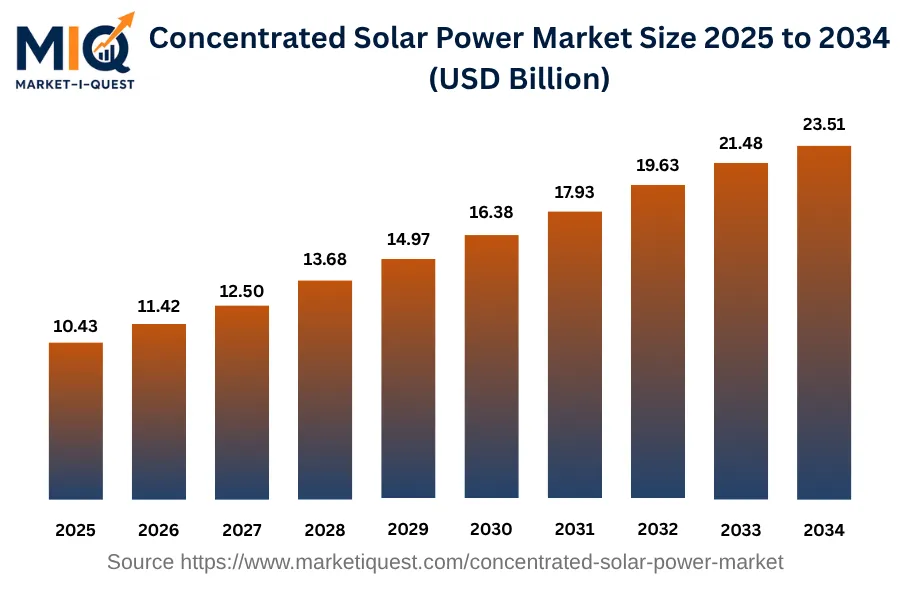
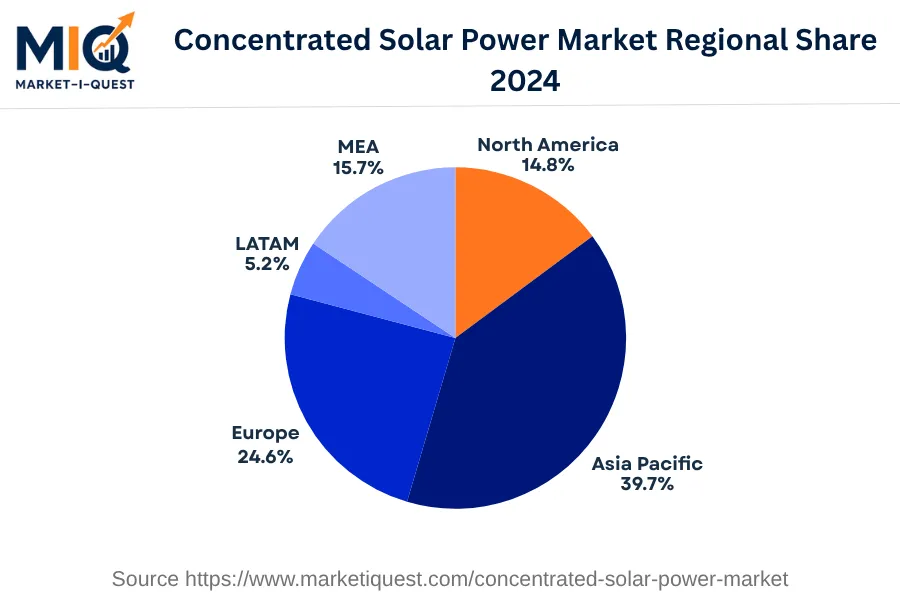
The Concentrated Solar Power Market was valued at USD 10.43 billion in 2025 and is projected to reach USD 23.51 billion by 2034, growing at a CAGR of 9.45%. The market began growing from a base of USD 9.53 billion in 2024, following a consistently steady growth trajectory throughout the examined period. The most substantial expansion of the market occurred between 2025 and 2034, nearly doubling in size due to enhanced technological advances and increased adoption of sustainable energy sources. In terms of regional share in 2024, Asia Pacific held the highest percentage with 39.7% while North America accounted for 14.8%. Europe had a sizeable portion as well with 24.6%, and MEA and LATAM held comparatively smaller shares at 15.6% and 5.21% respectively, wrapping up the global market distribution.

Key Takeaways

  • By Technology - Parabolic Trough held a dominant position in the Concentrated Solar Power market in 2024.
  • By Application - Utilities accounted for the majority market share leading in 2024.
concentrated-solar-power-market market size

Key Driving Factors

Implementation of Clean Power Policies

In an effort to reduce greenhouse gas emissions, numerous governments worldwide are implementing stringent clean power policies to increase reliance on renewable energy sources. Concentrated Solar Power (CSP) falls under this category. For instance, the European Union's '2020 Climate and Energy Package' policy sets a legally binding target of achieving 20% of its energy from renewable sources by 2020. Such policies provide a supportive regulatory framework that is driving the adoption of CSP technology. Additionally, to stimulate renewable energy projects, governments are also providing financial incentives, such as feed-in tariffs and tax benefits, specifically for CSP projects. This is propelling market growth, as these measures reduce the cost of CSP installations, making them a more appealing choice for energy generation.
Integration of Thermal Energy Storage Systems

The integration of thermal energy storage systems with CSP plants is another factor pushing the market forward. These systems allow for the storage of excess solar energy that can be dispatched during low sunlight periods or peak demand hours. As energy security becomes a pressing issue amidst fluctuating supply and demand scenarios, the advantage of providing a stable power supply offers CSP a strategic edge over other intermittent renewable energy resources, like wind and photovoltaics. This flexibility makes CSP an attractive option to utility operators who aim to provide a consistent, reliable energy supply to their customers, thereby driving the adoption of CSP systems in the market.

Market Evolution by Timeline

2019-2023
During this period, the European region received significant demand due to stable and supportive regulatory framework. The region's power plants deployed parabolic trough technology which was mature and cost-effective, but suffered from high water consumption. The buyers were primarily utilities, driven by regulatory pressure and long-term cost savings via feed-in tariffs. The United Nations' Green Climate Fund backed projects, aiding the expansion. Commercial contracts typically involved 20–25 year Power Purchase Agreements (PPAs) that provided supply certainty. The key obstacle was land and water constraint, sometimes mitigated with dry-cooling systems allowing more sites to qualify.
2024
The focus in 2024 distinctly shifted towards the MENA region, due to the abundant availability of sunlight and open land. Linear fresnel reflector technology piloted in Saudi Arabia demonstrated better scalability with lower water usage. The region's buyers included large industries and utilities backed by their governments. The commercial model evolved with a competitive pricing strategy on Renewable Energy Certificates (RECs). However, the challenge remained with grid integration, requiring investments in distribution and storage infrastructure.
2025-2029
Through 2025-2029, the Asia-Pacific region emerged as a potential hotbed for concentrated solar power despite lagging behind in technology. The region headed towards power tower technology backed by China's energy policy. Desalination plants became new buyers seeking renewable solutions in water-scarce regions like Australia. China's Belt and Road initiative pumped investment into projects, yet deployment speed was tempered by immature grid and storage infrastructure. Joint ventures became a common commercial model in this period, with public-private partnerships preferred for project execution.
2030-2034
The period 2030-2034 marked a substantial shift to the American market, where residential sector joined the buyer segment owing to cost reduction and improved efficiency of dish stirling systems. The USA's initiative of 'Sunshot Vision Study' acted as a pivotal program for market penetration. Technological advancements in thermal energy storage allowed higher grid integration. However, potential environmental impacts of large-scale deployment imposed regulatory constraints. The commercial domain saw a rise in direct and third-party ownership models, with residential customers entering 10–15 year power purchase agreements.

Future Market Outlook

Future Opportunities

As the global demand for renewable energy continues to rise, the concentrated solar power market presents several future opportunities closely linked to present developments. In 2022, several countries, including Chile and Morocco, began negotiating agreements to expand their CSP infrastructures, driven by local commitments to reduce carbon emissions. The International Renewable Energy Agency's 2023 report highlights the potential for CSP to provide significant baseload power, especially in regions with high solar insolation. Collaboration frameworks are emerging, such as the Clean Energy Ministerial initiative launched in 2021, which fosters international cooperation and knowledge-sharing focused on CSP technology. Investments in research and development by governments, like those from India for its extensive International Solar Alliance project, propose to lower costs and enhance efficiency in CSP technologies. Educational institutions are also becoming involved; for instance, the Massachusetts Institute of Technology has initiated projects aimed at exploring novel CSP materials and designs. This environment of collaboration among governments, corporations, and academia is poised to drive innovation. Furthermore, the need for energy storage solutions in renewable applications is prompting CSP companies to explore advancements in hybrid technologies, encouraging collaborations between CSP firms and battery manufacturers. Thus, the landscape for CSP holds promise for significant advancements, spurred by existing strategic initiatives and partnerships.

Segmentation Analysis

By Technology

The technology market is divided into subsegments including Parabolic Trough, Linear Fresnel, Dish, and Power Tower, among which Parabolic Trough accounted for the largest revenue share while Linear Fresnel is expected to grow at the fastest CAGR during the forecast period.

Largest Revenue Share

Parabolic Trough

Market Share Leader

The Parabolic Trough subsegment continues to lead the market in terms of revenue due to its proven capabilities and high efficiency. Industry operators and investors feel confident in parabolic trough technology as it has years of operational performance data backing it up. This reduces investment risks and aids in securing financing for new projects. Geographies with high solar irradiance such as the Middle East, North Africa, and parts of the United States and Australia, are increasingly adopting this technology given its low land space requirements. Furthermore, regulations and guidelines supporting renewable energy adoption are ever-growing, driving the expansion of this segment. The criteria for choosing this technology include energy efficiency, cost-effectiveness, and land-use requirements. Switching costs from traditional power generation to parabolic trough technology are significant but justified by long term benefits and sustainability initiatives. Its commercial availability through multiple channels also fosters its large market share.

Fastest CAGR

Linear Fresnel

Forecast Period Growth Leader

Linear Fresnel technology, although currently smaller in market share compared to other technologies, is projected to grow at the fastest CAGR. This faster growth can be credited to its potential for cost reductions and efficiency improvements. The relatively simpler design of Linear Fresnel systems reduces manufacturing and installation costs, making the technology more accessible and appealing to emerging markets. At the same time, the potential for technological advancements and improvements in thermal efficiency further enriches its prospective growth. Regulatory incentives for low-cost renewable energy also play a vital part in its faster growth. However, adoption barriers such as the lack of long-term performance data and high initial CapEx costs could hamper the growth rate. Overcoming these barriers through strategic partnerships, technological advancements, and effective policy measures could ensure Linear Fresnel technology's robust phase of growth.

By Application

The market is divided into subsegments including Utilities, EOR, Desalination, and others. The Utilities subsegment accounted for the largest revenue share while the Desalination subsegment is expected to grow at the fastest CAGR during the forecast period.

Largest Revenue Share

Utilities

Market Share Leader

Utilities is the subsegment with the highest revenue in 2024. This can be attributed to several factors. The increasing urbanization and industrialization are leading to the growth in demand for power and sufficient utilities. The rise in infrastructure development is creating a need for utility services, which in turn is propelling growth in the Utilities subsegment. Consequentially, companies in this segment have a broad base of customers which drives revenue. Aside from this, regulations around the quality of utilities and the need for proper utility management are playing key roles. The geography also plays a notable factor as regions with high population density and industrial activities tend to have high utility requirements leading to increased revenue. Supplier capacities, purchasing decisions, and high switching costs further solidify the revenue standing of the utility subsegment.

Fastest CAGR

Desalination

Forecast Period Growth Leader

The Desalination subsegment is expected to have the fastest CAGR outlook. Global warming and population growth have resulted in increased demand for water consumption, thus driving the need for desalination. The development in technology is also proving to be a catalyst for the Desalination subsegment's growth. Advancements have led to cost-effective and energy-efficient desalination processes, making it an increasingly feasible solution to water scarcity. Government policies and funding towards sustainable water solutions present opportunities for the subsegment. However, some barriers to adoption include the high initial capex and environmental concerns related to desalination processes. Near-term risks include regulatory shifts and the large-scale implementation of alternate water conservation methods. Despite these, the outlook for the Desalination subsegment remains positive.

Competitive Analysis

Key Market Players

Manufacturers / OEMs

BrightSource Energy
US
Abengoa Solar
Spain
Acciona Energy
Spain

Key Suppliers & Raw Materials

Siemens
Germany
Schott Solar
Germany
Saint-Gobain Solar
France

Distributors, Integrators & Channel Partners

General Electric
US
Iberdrola
Spain
EDF Renewables
France

Porter’s Five Forces Analysis

Assessment of the competitive dynamics within the Concentrated Solar Power Market

Supplier Bargaining Power

Medium

Key components are specialized and few suppliers exist, yet alternative technologies are accessible.

Buyer Bargaining Power

High

Buyers are power companies with significant negotiation abilities and access to alternatives.

Threat of Substitutes

High

Continued advancements in photovoltaic solar, wind energy, and fossil fuels pose credible substitute threats.

Threat of New Entrants

Medium

Entry requires substantial capital but government incentives and increasing demand reduce barriers.

Competitive Rivalry

Medium

Competition is intensifying between existing players and newcomers driven by innovative technologies.

Regional Analysis

Geographic market dynamics and growth opportunities across key regions

Global Market Outlook

concentrated-solar-power-market market regional share

North America

In 2024, the North American concentrated solar power (CSP) market remained a major player in energy production, propelled by demand growth, technology adoption and government policies. Key drivers in this year were increased industrial and residential energy demand in U.S., Mexico, and Canada, which spurred significant investment in CSP infrastructure. Government regulations, such as the U.S. Renewable Portfolio Standard, mandated a certain share of energy be sourced from renewables, boosting the CSP market. Adoption of innovative technologies, like thermal energy storage, enabled CSP plants to produce electricity even when sun was not shining, contributing to a steady rise in CSP supply.

Market trends observed in North America included a shift in buyer behavior toward more environmentally-friendly energy sources, pushing demand for CSP. Technological developments in receiver and storage technology enhanced the efficiency of CSP plants. Notable was Sunerise Global's groundbreaking Sterling engine design which dramatically improved CSP efficiency. Mergers and acquisitions defined channel dynamics, with prominent utility companies buying CSP startups to capitalize on this growing market. Applicable sectors playing a pivotal role included established utility companies, such as the Arizona Public Service, which partnered with CSP firms to meet their renewable energy targets. Government remained a primary customer, especially in U.S. where federally-funded facilities procured CSP to achieve carbon neutrality. Manufacturing industries started to switch to CSP-sourced electricity, recalibrating the energy landscape toward a sustainable future.

Asia Pacific

In 2024, the Concentrated Solar Power (CSP) market in the Asia Pacific region exhibited stimulating potential. Falling technology costs and favorable government policies, notably in China and India, spurred adoption. China's Golden Sun Demonstration Project, together with India's Jawaharlal Nehru National Solar Mission, galvanized investment into local CSP projects. South Korea’s Renewable Portfolio Standard played a pivotal role in shaping its domestic CSP market. Additionally, rising electricity demand across urban areas in key ASEAN markets notably prompted CSP deployment.

There was a distinct preference for solar thermal storage systems, driven by their capability to generate electricity consistently. In Japan and Australia, there was a noticeable move towards hybrid CSP systems — combining CSP and photovoltaic technology — to boost solar power generation. The formation of strategic alliances, as seen between Australian and Chinese CSP firms, became increasingly commonplace as a means to expedite technology transfer and strengthen market presence. Furthermore, stringent enforcement of renewable energy targets by government bodies was prevalent, notably in China. Utilities firms were the primary customers of CSP technology in 2024, due to the industry's intensive energy demand. Manufacturing sectors in countries like China and India also adopted CSP for a cleaner, consistent energy supply, driven by their commitment to sustainable practices.

Europe

In 2024, the Concentrated Solar Power (CSP) market in Europe saw noteworthy dynamics driven by various macro forces. The rising demand for clean energy and heightened concern for environmental sustainability stimulated the uptake of CSP technologies, particularly in the UK and Spain. Regulatory backing, including measures promoting renewable energy adoption in the German Energiewende policy, further supported this shift. Italy's strategic investments in technology development and infrastructure also played a key role in market growth, alongside France's subsidized pricing to incentivize renewable energy suppliers.

Key trends encapsulating the market included a pronounced shift towards CSP in utilities and manufacturing sectors across Germany and Benelux. This was triggered by favorable policy enforcement and an increasing emphasis on corporate sustainability. In the Nordics and Central & Eastern Europe, consumer inclination towards green energy products fostered an expansion in the market. Moreover, a rising number of partnerships and mergers, such as the notable collaboration between France's EDF and Italy's Edison for solar thermal power projects, were witnessed, strengthening overall market robustness. Lastly, the utilization of CSP was actively advocated by governments across Europe, including Spain, which led to wider acceptance and realization of its potential benefits.

Latin America

In 2024, the Concentrated Solar Power (CSP) market in Latin America showed significant growth driven by various factors and distinctive trends. Increased energy demand from industries such as manufacturing and retail, alongside government commitments to reduce carbon emissions, played a significant role in driving CSP market expansion in Brazil, Mexico, and Argentina where government incentives boosted solar power investments. Technological advancements, particularly in storage solutions, also led to improved adoption of CSP solutions in Colombia, Chile, and Peru.

Additionally, cost competitiveness of CSP energy contributed to increased adoption, particularly within utility sectors and among energy-intensive consumers. Supply dynamics were mainly shaped by investments in CSP projects and infrastructure. Market trends in 2024 indicated shifts towards renewable energy sources, with CSP being embraced on a wider scale in LATAM. The growing awareness about environmental sustainability prompted a shift in buyer behavior across sectors, with higher preference for green energy sources, further stimulating CSP market growth. The increase of partnerships and merger activity, particularly in Brazil and Chile, reflected companies' attempt to consolidate their positions and increase capacity. Furthermore, the implementation and reinforcement of renewable energy standards and policies by LATAM governments, especially in Argentina and Mexico, played an integral role in promoting CSP market's growth and stability in the region.

Middle East & Africa

In 2024, the Concentrated Solar Power (CSP) market in the Middle East and Africa gained prominence due to its sustainable and efficient energy generation capabilities. Key drivers included increased energy demands in countries like Saudi Arabia and Nigeria, necessitating investment in renewable resources. Stringent environmental regulations implemented by the United Arab Emirates and South Africa directed towards reducing reliance on fossil fuels also propelled demand for CSP. Furthermore, the technology adoption by major utilities providers in Egypt and Kenya driven by ample sunlight was a significant driver.

Likewise, several trends dominated the CSP market this year. A shift in buyer behaviour was evident, with governments and private sectors pivoting towards sustainable energy solutions. For instance, notable oil and gas companies in Qatar and Nigeria initiated the transition to CSP, contributing to the market growth. In Israel, strides in CSP technology marked a new trend, as the technology evolved to increase efficiency and reduce costs. Partnerships played a vital role in this sector, with international alliances such as Saudi Arabia teaming with global CSP industries to establish power projects. Implementation of new standards by policy enforcement across these regions ensured safer and more efficient CSP installation and usage. Thus, 2024 marked a significant year for CSP in the Middle East and Africa, as it emerged as a competitive contributor in the energy sector.

Recent Industry Developments

Latest market innovations, product launches, and strategic initiatives

June 2026

Construction officially started on a 350-megawatt power plant. This facility is designed to be the largest single-unit plant of its kind in the world based on both mirror area and heat storage size.

April 2026

Construction broke ground on the 50-megawatt Wumatang project. Located at roughly 4,550 meters above sea level, it is being built to operate as the highest-altitude facility of its kind globally.

January 2026

The organization confirmed the successful grid connection of nine new power plants. This milestone brought 900 megawatts of new power online, effectively doubling the country's total operating capacity in this sector.

Frequently Asked Questions