Concentrated Photovoltaic Market Snapshot

Key Players

  • Soitec SA (France)
  • Arzon Solar LLC (US)
  • Suncore Photovoltaics Technology Co. Ltd. (China)
  • Solar Junction Corp. (US)
  • Sumitomo Electric Industries Ltd. (Japan)
  • Saint Augustine's University (US)
  • Zytech Solar (Spain)
  • Cool Earth Solar (US)
  • BSQ Solar SL (Spain)

Market Size

Base Year 2024
$3.2 Bn
CAGR
9.6%
Forecast 2034
$8.00 Bn

Market Segments

By Type
  • High Concentrated Photovoltaic (HCPV)
  • Low Concentrated Photovoltaic (LCPV)
By Application
  • Utility
  • Commercial

Market Dynamics

Drivers
  • Increasing sustainability initiatives
  • Technological advancements in CPV systems
Restraints
  • High initial investment costs
  • Limited operational locations
Opportunities
  • Increasing renewable energy demand
  • Technological advancements in CPV

Market Size

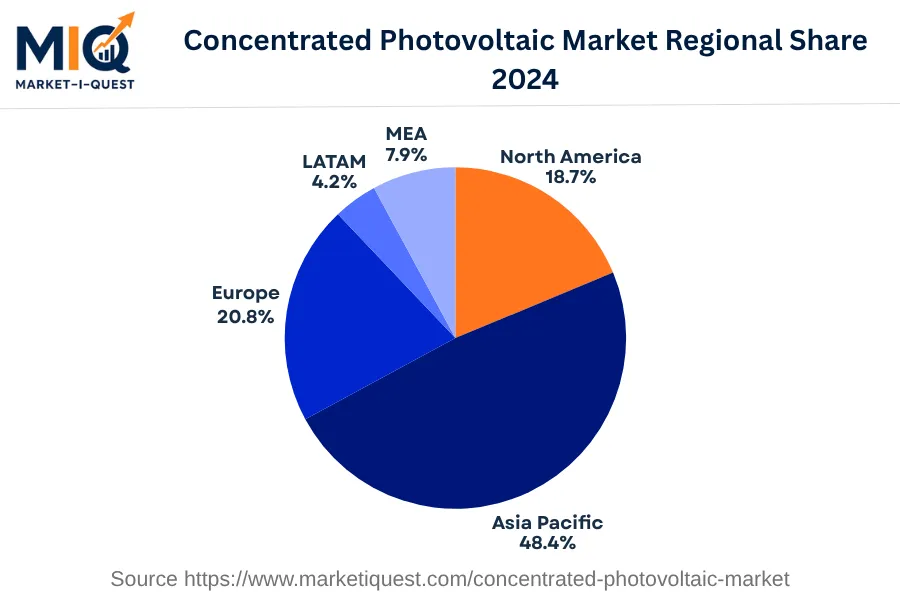
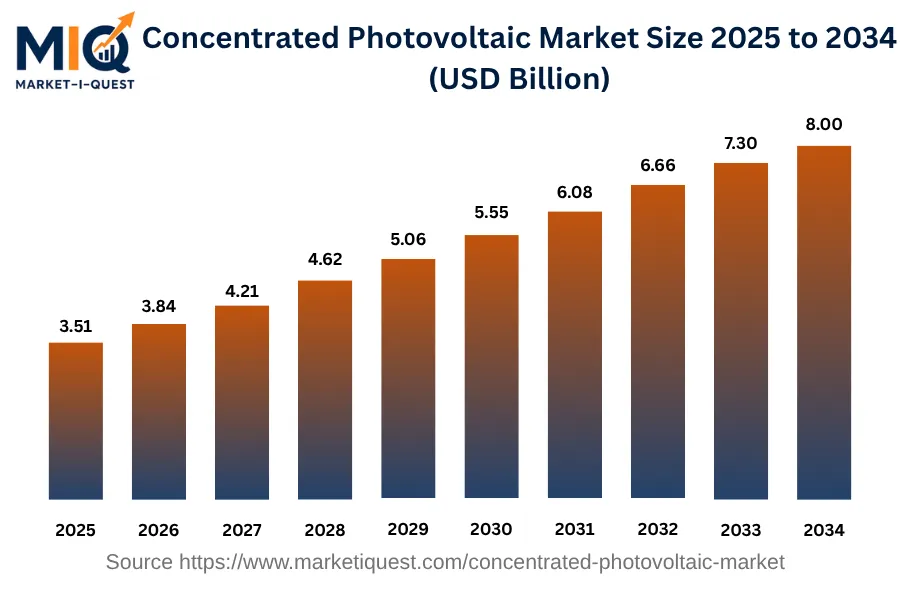
The Concentrated Photovoltaic Market was valued at USD 3.51 billion in 2025 and is predicted to reach a size of USD 8.00 billion by 2034, growing at a compound annual growth rate (CAGR) of 9.6%. This growth trajectory shows a marked increase in market value over the decade, a testament to the inherent momentum in the sector. The upturn is largely attributable to an upsurge in demand in many key regions across the globe, fueled by crucial market dynamics and economic factors. As of 2024, the regional share concentration was as follows: North America accounted for 18.7% of the total market, Asia Pacific held a substantial share of 48.4%, closely followed by Europe with a 20.8% stake, whereas Latin America, Middle East & Africa contributed 4.2% and 7.9% respectively.

Key Takeaways

  • By Type - High Concentrated Photovoltaic (HCPV) held a significant position in the market in 2024.
  • By Application - Utility led the Concentrated Photovoltaic Market in terms of value in 2024.
concentrated-photovoltaic-market market size

Key Driving Factors

Switch to Clean and Renewable Energy

Governments and private sectors across the globe are currently shifting their focus towards clean and renewable energy sources in an effort to reduce carbon emissions and combat climate change. Concentrated photovoltaic technology provides a highly efficient and eco-friendly solution, as it harnesses solar energy and converts it into electricity with minimal environmental impact. Countries like United States, Germany and China have started implementing policies that support adoption of renewable energy technologies, and this is acting as a significant push for the concentrated photovoltaic market.

High Efficiency in High Direct Normal Irradiance Regions

Concentrated Photovoltaic (CPV) systems have proven to be highly effective in regions with high Direct Normal Irradiance (DNI), which is the energy available when sun is directly overhead. Regions like Southwestern United States, parts of Africa, Australia, and Middle East have high levels of DNI and hence, are ideal locations for CPV installations. The exceptional efficiency of CPVs in these regions help in power generation at a large scale, making it a go-to technology in areas that yearn for high energy output. This situational advantage is driving more energy companies to invest in concentrated photovoltaic technology, giving a substantial push to its market growth.

Market Evolution by Timeline

2019-2023
During this period, demand for Concentrated Photovoltaic (CPV) technologies saw an increase particularly in countries with consistent, high-intensity sunlight, like Spain and Australia. The high solar resource regions were prime buyers. Advances dual-axis CPV systems were launched, enhancing efficacy of solar power generation. Constraints high initial cost and need for direct sunlight limited adoption to certain geographies. Policy support Australia's Renewable Energy Target (RET) fueled uptake of CPV technologies. Typically, the commercial model involved capital-intensive upfront investments with long-term Power Purchase Agreements (PPA). Risks included inconsistency of solar intensity and technology competitiveness against traditional Photovoltaic (PV) technologies, mitigated with high-efficiency outputs in optimal locations.
2024
In 2024, the Middle East countries including UAE and Saudi Arabia became significant buyers due to geographical advantage. New CPV system models with enhanced conversion efficiency and system reliability were introduced. The major market restraint remained the requirement for direct sunlight. Further, under the Belt Road Initiative by China, new installations of CPV systems were instigated in partnering countries. The commercial model remained same, with PPA contracts being most common. The high initial investment remained a risk, with increasing competition from improving traditional PV technologies.
2025-2029
From 2025 to 2029, demand started shifting, with companies seeking green energy alternatives. The U.S and parts of Asia showed increase in adoption. CPV technologies became more integrated with storage systems, providing constant energy supply. But the necessity for a high solar resource remained an issue limiting widespread use. Policy initiatives, like USA's Solar Investment Tax Credit influenced adoption rate. The commercial model saw a shift towards leasing contracts, reducing upfront costs. The risk remained in the form of more diversified competition from other clean energy technologies like wind and hydro.
2030-2034
By 2030–2034, implementation of CPV within microgrid applications became common due to improved energy storage integration, primarily in Sub-Saharan Africa and South America. Advances in CPV systems reduced dependency on high solar resources, expanding applications. Ongoing policy initiatives like Brazil's Decennial Plan for Energy Expansion 2026 encouraged adoption of renewable energy sources, including CPV. The commercial model was inclined towards Service Level Agreements. Stiff competition from conventional PV systems persist as a risk, despite mitigation strategies of focusing on optimal geographic locations for CPV installations.

Future Market Outlook

Future Opportunities

Future opportunities in the concentrated photovoltaic market are closely tied to current regulatory frameworks and technological partnerships. Countries such as India are ramping up efforts to incentivize solar energy deployment, with the Ministry of New and Renewable Energy aiming for significant renewable energy integration by 2030. In light of these initiatives, partnerships between CPV manufacturers and local governments may facilitate more projects targeting utility-scale installations. Moreover, the International Energy Agency collaborates with nations to explore CPV applications in off-grid settings, expanding opportunities for rural electrification solutions. Important initiatives like the Solar Energy Technologies Office in the U.S. aim to improve CPV technology performance through targeted funding and research programs. The potential integration of CPV systems with smart grid technologies is another emerging opportunity, as seen in pilot projects in Australia focusing on demand-side management. This indicates a synergistic approach fostering the growth of both sectors. Furthermore, global climate regulations, such as commitments made during the COP26 summit, emphasize clean energy transitions. This political momentum can lead to increased investments in CPV, particularly as companies seek to rely less on fossil fuels. Collectively, regulatory measures, technological collaborations, and environmental commitments create a fertile ground for the concentrated photovoltaic market to expand and evolve comprehensively.

Segmentation Analysis

By Type

The market is divided into subsegments including High Concentrated Photovoltaic (HCPV) and Low Concentrated Photovoltaic (LCPV). The High Concentrated Photovoltaic accounted for the largest revenue share while Low Concentrated Photovoltaic is expected to grow at the fastest CAGR during the forecast period.

Largest Revenue Share

High Concentrated Photovoltaic (HCPV)

Market Share Leader

The High Concentrated Photovoltaic (HCPV) sub-segment is currently the largest revenue generator in the market. This is largely due to its superior efficiency compared to traditional photovoltaic systems. Its ability to focus sunlight onto a smaller area of photovoltaic material makes it more cost-effective, ideal for areas with high direct sunlight exposure. The adoption of HCPV technology has been driven by regulatory initiatives promoting renewable energy, coupled with increasing energy demand, primarily in regions receiving high sunshine hours such as the Middle East and Africa. As a result, HCPV systems have experienced increased adoption in utility-scale applications, contributing to its overall market dominance. The HCPV market has also been boosted by significant improvements in technology, with recent advancements offering enhanced system reliability, a critical factor for customers when selecting photovoltaic technology. The demand is anticipated to continue growing with the increasing number of market players investing in HCPV technology.

Fastest CAGR

Low Concentrated Photovoltaic (LCPV)

Forecast Period Growth Leader

Despite not being the largest in terms of revenue, the Low Concentrated Photovoltaic (LCPV) subsegment is expected to display the fastest growth moving forward. The LCPV market growth is driven primarily by its affordability, wider geographic suitability and lower installation requirements compared to HCPV. Furthermore, it provides a viable solution for regions with less direct sunlight exposure, hence broadening its potential customer base. Moreover, advancements in LCPV system efficiency, combined with increased industry focus on this technology, are likely to further drive the growth. The high CAPEX and infrastructure requirements of HCPV systems have emerged as barriers for many potential customers, especially in developing regions. Here, LCPV has found an opportunity for market penetration. While the low concentration might limit the efficiency of LCPV systems as against their high concentrated counterparts, ongoing research and development efforts are focused on improving the efficiency of LCPV systems, potentially altering the market dynamics in the future. As such, despite the current revenue deficit, LCPV projects an accelerated growth trajectory over the forecast period.

By Application

The market by application is divided into two subsegments, namely Utility and Commercial. With a robust infrastructure and substantial scale of operations, the Utility subsegment secured the largest revenue share in 2024. On the other hand, Commercial subsegment is predicted to grow at the fastest CAGR in the forecast period.

Largest Revenue Share

Utility

Market Share Leader

Utility subsegment emerged as the largest revenue contributor in 2024. Its dominance can be attributed to various factors, key among them being the extensive infrastructure and high operational scale, providing a broad customer base and steady revenue stream. The customers in this segment, mainly power and utility companies, require reliable solutions for maintaining and improving the power supply, which leads to continuous demand. At a geographical level, developed regions with well-established utility infrastructures contribute significantly to the segment revenue. Regulatory frameworks also play a crucial part in driving revenues in this segment as utilities are often subject to stringent laws requiring regular upgrades and maintenance. Furthermore, the purchasing criteria often involve long-term contracts, ensuring steady revenue for players in the market. The high switching costs associated with transitioning to new vendors or technologies act as another deterrent, securing the revenue of existing providers.

Fastest CAGR

Commercial

Forecast Period Growth Leader

The Commercial subsegment is poised for the fastest growth, marked by several growth drivers and catalysts. One of the primary growth drivers is the increasing awareness and adoption of energy-efficient solutions in the commercial sector. The steep decrease in the upfront costs and an increase in long-term benefits is leading to faster adoption. Technological advancements are also playing a crucial role as the emergence of smart grids and internet-of-things devices are improving efficiencies, making the offerings more attractive. Policy-wise, governments globally are promoting eco-friendly commercial spaces through green building initiatives, directly propelling the growth of this subsegment. In terms of near-term risks, the commercial sector's adoption could be hindered due to economic uncertainties or slower-than-expected decline in technology costs. However, the overall outlook remains positive, indicating the potential for rapid growth.

Competitive Analysis

Key Market Players

Manufacturers / OEMs

Morgan Solar
Canada
SunPower Corporation
US
Arzon Solar
US

Key Suppliers & Raw Materials

Sharp Corporation
Japan
Panasonic Corporation
Japan
First Solar
US

Distributors, Integrators & Channel Partners

Amonix
US
SolFocus
US
Isofoton
Spain

Porter’s Five Forces Analysis

An analysis to understand the competitive forces at work in the Concentrated Photovoltaic Market.

Supplier Bargaining Power

Low

Competition amongst suppliers and easily available materials reduce supplier power.

Buyer Bargaining Power

Medium

Limited alternatives available, customers can exercise mediocre bargaining power.

Threat of Substitutes

High

Numerous alternative energy sources like wind and solar present a high substitution threat.

Threat of New Entrants

Medium

Capital intensive, but the growing interest in renewable energy increases the threat level.

Competitive Rivalry

High

The market has significant competition due to the presence of many key players.

Regional Analysis

Geographic market dynamics and growth opportunities across key regions

Global Market Outlook

concentrated-photovoltaic-market market regional share

North America

In 2024, North America's Concentrated Photovoltaic (CPV) market was defined by robust growth underpinned by a blend of strong demand, regulatory support, and advanced technology adoption. Significant drivers for this growth included escalating demand for clean energy solutions due to climate concerns, particularly in sectors such as utilities and manufacturing. This demand was further bolstered by supportive regulatory policies across the U.S., Canada, and Mexico, including the U.S. Solar Investment Tax Credit. Additionally, investment into technological advancements increased efficiency and further driven CPV adoption.

Concurrent market trends reflected not only evolving buyer behavior but also shifts in product technology and partnerships. Sustainability-conscious businesses increasingly preferred CPV energy solutions which instigated a rise in acquisitions and mergers within the CPV market. The dominant technology shift emanated from multi-junction cells, thanks to their higher efficiency. In spite of the high upfront costs, these cells were frequently adopted across the North American market. Further, the enforcement of clean energy standards was evident in the energy portfolios of utility companies, with the government sector also showing a rising interest in CPV systems, thus shaping market dynamics. The year 2024 saw a significant impact of these drivers and trends on the concentrated photovoltaic market in North America, setting a notable pattern for its development.

Asia Pacific

In 2024, the Asia Pacific Concentrated Photovoltaic (CPV) Market experienced intensified demand due to increased government initiative and renewable energy policies. China's commitment to renewable energy, epitomized by its 13th Five-Year Plan, and India's National Solar Mission, catalyzed a surge in demand for CPV technology. Investments from multinational corporations such as IBM and SunPower further enriched the market stability. Technological advancements, particularly in High Concentration Photovoltaic (HCPV) systems, promoted adoption throughout the region, especially in Japan and South Korea.

Simultaneously, falling solar module prices challenged the profitability of CPV manufacturers but incentivized end-users, primarily utilities and manufacturing sectors. Increasing industrialization in key ASEAN markets led to a trend for private company-led CPV projects, shifting away from the government-led model. Strategic partnerships, such as those between Suncore and China Huadian Corporation, impacted market dynamics, consolidating market leadership. Regulatory enforcement, particularly in Australia, shaped the CPV market through measures to enhance grid connectivity and renewable purchase obligations. The retail market saw a growing interest in CPV, driven by increasing environmental consciousness and the shifting focus towards emission reduction. In contrast, the enterprise sector remained slow in technology adoption, mostly due to high setup costs. Nevertheless, the continuous development and promotion of CPV systems contributed to robust market health in the region during 2024.

Europe

In 2024, the Concentrated Photovoltaic (CPV) Market in Europe experienced significant growth, driven by various factors and trends. Due to increased government regulations against carbon emissions, particularly in the UK and Germany, demand for cleaner sources of energy like CPV increased. Large-scale investments in CPV technology, led by the Spanish and Italian governments, further incentivized market expansion. Furthermore, increased CPV technology adoption by utilities and manufacturing sector in major economies boost up the market. Supply dynamics were affected by flux in pricing due to the cost-effective nature of the CPV market in Benelux and Nordic countries.

Market trends in 2024 illustrated a shift towards renewable energy strategies in both private and public sectors. France showed increased buyer behavior towards CPV systems in response to the government aggressively promoting renewable energy adoption. The United Kingdom saw predominant product shifts from traditional to CPV technology among utilities. Partnership building was a prevalent trend, especially in Germany and Spain, as companies joined forces with research institutes to ensure technological advancement. Policy enforcement for the adoption of sustainable and clean energy under the European Green Deal reinforced the CPV market's growth. Central & Eastern Europe reported extensive use of CPV technology in the retail sector, solidifying CPV's position in the regional market.

Latin America

In 2024, the Concentrated Photovoltaic (CPV) market in Latin America marked a significant surge in demand and technological adoption. Drivers included increased investments in renewable energy mainly in Brazil and Mexico, higher efficiency of CPV technology over traditional photovoltaic systems, and supportive government regulations like Argentina's Renewable Energy Law that promotes the use of sustainable energy sources. Noticeably, the falling costs of CPV units provided an additional supply-side impetus, making the technology more accessible within the region.

Market trends saw a shift towards higher degree CPV systems due to their superior energy yield. Further, utility companies in countries like Chile and Peru showed an increased preference for CPV installations over traditional photovoltaics, responding to the rising demand for renewable energy. Also notable was the upswing in strategic partnerships and M&A activities, such as Colombia's Celsia acquiring two photovoltaic projects aimed at boosting CPV installations. Enforcement of energy efficiency standards in sectors like manufacturing and retail propelled the market growth, while government institutions across LATAM began showing more interest in adopting CPV technology for their energy needs. The LATAM CPV market in 2024 can therefore be characterized by strong growth drivers, advancing technology, and emerging partnerships.

Middle East & Africa

In the base year 2024, the concentrated photovoltaic market in the Middle East and Africa relied heavily on supportive government policies and abundant solar resources. Increased investment in renewable energy infrastructure drove market growth, bolstered by strict regulation of traditional energy sources. Notably, Saudi Arabia's clean energy initiatives and the United Arab Emirates' solar power strategy significantly stimulated technology adoption. The ample sunlight, high irradiation rates, and vast deserts presented a favorable environment for concentrated photovoltaics.

Market trends in 2024 featured a shift towards high-efficiency, low-cost modules coupled with advanced tracking systems. High demand for electricity in off-grid locations, such as rural Kenya and Nigeria, induced a notable uptick in decentralized solar installments. There was a prominent tilt towards customer-side adoption in sectors such as government buildings, healthcare units, and utility companies. For instance, Israel adopted concentrated photovoltaic in public utilities on account of its high efficiency and low environmental impact. Partnerships flourished in 2024, particularly in South Africa, as international companies aimed to tap into the region’s burgeoning solar market. Furthermore, standards for concentrated photovoltaic installations in Egypt matured, contributing to market stabilization. Lastly, rigid policy enforcement in Qatar stimulated cleaner energy use, thereby fostering market growth.

Recent Industry Developments

Latest market innovations, product launches, and strategic initiatives

May 2025

Longi introduced a new range of high-efficiency solar products tailored for both residential and utility-scale segments to meet the rising demand for advanced solar energy systems.

February 2025

Solex Energy officially inaugurated a new solar module production line with an 800 MW capacity, expanding its ability to supply high-performance solar products for large-scale utility projects.

Frequently Asked Questions