Commercial Refrigeration Equipment Market Snapshot

Key Players

  • Daikin Industries Ltd. (Japan)
  • Carrier Global Corporation (US)
  • Ingersoll Rand Inc. (Ireland)
  • Guntner AG & Co. KG (Germany)
  • Dover Corporation (US)
  • Hussmann Corporation (US)
  • Frigoglass SAIC (Greece)
  • AHT Cooling Systems GmbH (Austria)
  • Beverage-Air Corporation (US)
  • Blue Star Limited (India)

Market Size

Base Year 2024
$ 44.86 Bn
CAGR
5.8%
Forecast 2034
$78.83 Bn

Market Segments

By Product Type
Transportation Refrigeration Equipment, Refrigerators & Freezers, Beverage Refrigeration, Display Showcases, Ice Merchandisers & Ice Vending Equipment, Other
By Refrigerant Type
Fluorocarbons, Hydrocarbons, and Inorganics
By Cooling Technology
Vapor Compression, Thermoelectric, Absorption
By End Use Industry
Food & Beverage Retail, Hotels and Hospitality, Pharmaceuticals, Healthcare, Biotechnology, Chemicals, Others

Market Dynamics

Drivers
  • Increasing food service outlets
  • Evolving retail landscape
Restraints
  • High initial investment costs
  • Strict energy consumption regulations
Opportunities
  • Increasing hospitality sector
  • Rising global food retail market

Market Size

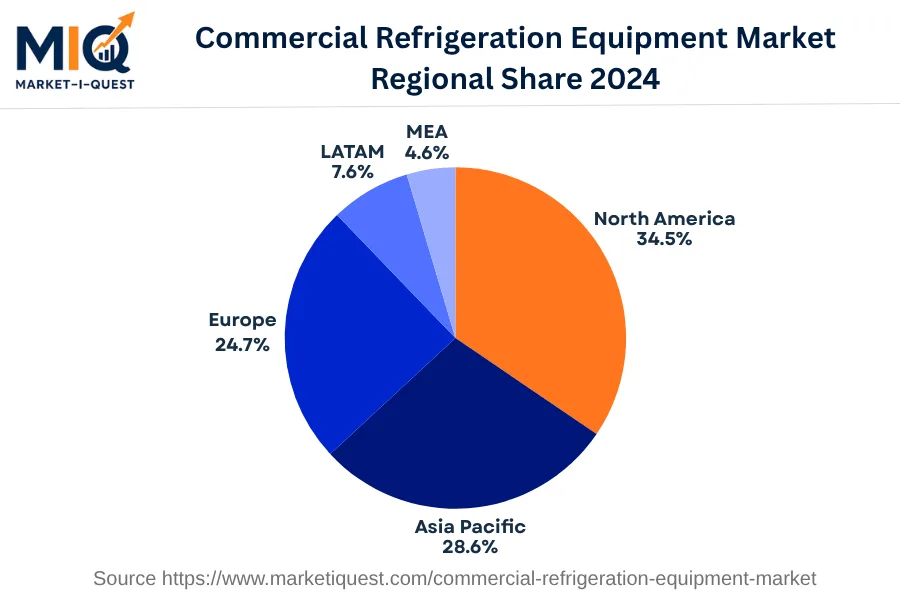
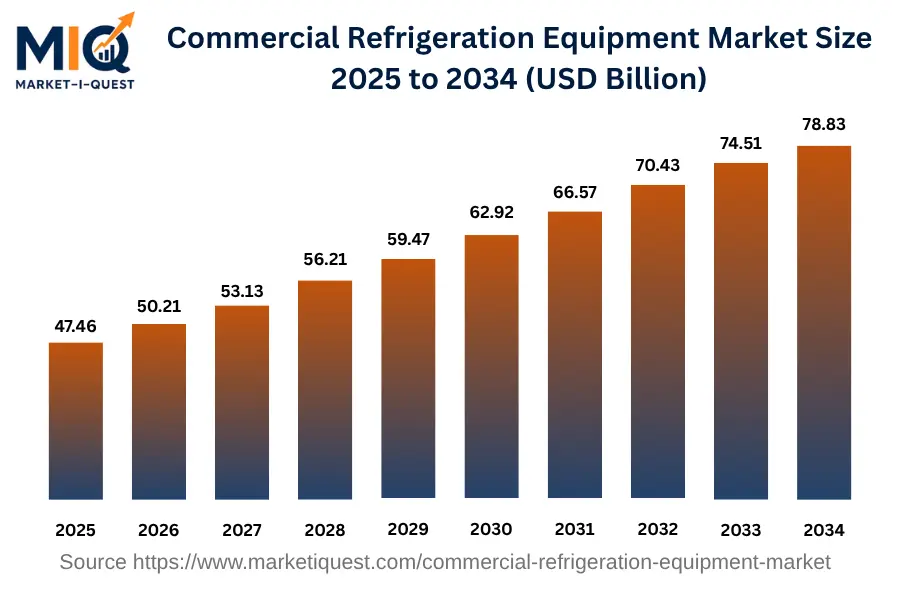
The commercial refrigeration equipment market share is projected to grow with market size of $47.46 Billion in 2025 from $44.86 Billion in 2024 and the forecasted period is expected to reach the market size of $78.83 Billion by 2034 with a CAGR of 5.8% from 2025 to 2034. The rapid growth of market is largely attributed in increased demands in the food and beverage sector with requirements for advanced cold chain solutions, combined with expansion of global retail infrastructure. Furthermore, boosting demand for processed food products and rapidly increasing urban population encourage to stimulate the market growth. In terms of regional distribution in 2024, North America held the largest share of the market at 34.5%, followed by Asia Pacific and Europe with a market share of 28.6% and 24.7% respectively. Whereas, LATAM and MEA, held 7.6% and 4.6% respectively.

Key Takeaways

  • By Product Type - Refrigerators & Freezers segment dominated with a leading share in the base year.
  • By Refrigerant Type - Fluorocarbons held the principal position in the market due to its widespread application.
  • By Cooling Technology - Vapor Compression emerged as the market leader due to its energy efficiency and reliable cooling capabilities.
  • By End Use Industry - Pharmaceuticals held a commanding position reflecting the critical need for refrigeration in food storage and preservation.
commercial-refrigeration-equipment-market market size

Key Driving Factors

Implementation of Energy-Efficient Policies

Major factor for the growth of the commercial refrigeration equipment market growth included the implementation of stringent energy-efficiency policies. Regulatory bodies like the U.S. Department of Energy (DOE) and Europe's Energy Efficiency Directive constantly optimizing their protocols to reduce electricity consumption and greenhouse gas emissions. This demand within industries to comply with sustainability practices has led to an increased demand for energy-efficient refrigeration technologies. Companies are focusing on developing and installing new refrigerating systems which are compliant with these energy regulations driving the growth of this market. Thus, resulting as the major driving factor of the market.

Rise in Consumption of Ready-to-Eat and Frozen Foods

The growing consumption of ready-to-eat and frozen foods is a major driver for the commercial refrigeration equipment market growth. With a shift towards a faster-paced lifestyle, consumers are increasingly shifting towards convenient food options that reduce preparation time. As a result, retailers and grocery stores require high-capacity commercial refrigeration units to store these products at favorable temperatures. Furthermore, new online grocery shopping trends also increase the demand for vast cold storage facilities. This ongoing trend consequently leads to increased procurement of commercial refrigeration equipment to preserve food quality, directly driving market growth. Thus, attributing in increased demand in the market.

Market Evolution by Timeline

2019-2023
During this period, the commercial refrigeration equipment market share saw robust demand primarily from the food and beverage industry for inventory storage. The market reach was high in the regions such as North America and Western Europe due to increased consumption and stricter food safety regulations. Technologically, the period saw increased focus on energy efficiency with manufacturers adopting hydrofluorocarbon (HFC) as a refrigerant in compliance with the Kigali Amendment to the Montreal Protocol. Commercially, rental equipment emerged as an affordable alternative rather than entirely purchasing for small and mid-scale businesses. Thus, this period showed several developments in this market.
2024
The commercial refrigeration equipment market trends in 2024 with the implementation of EU F-Gas regulation, there was a significant shift towards natural refrigerants like CO2 and ammonia. This move primarily was developed from large retail chains in the regions of Europe and North America offers to reduce the carbon footprint. Businesses from Asia-Pacific region started adopting this shift. With the rising equipment costs, 'pay-per-use' emerged as a popular commercial model, reducing initial capital expenses for the buyers. Thus, 2024 was seen for major developments in this growing market.
2025-2029
This period showed growing demand from the pharmaceutical and hospitality industries across regions. Suppliers showed increased development of integration with many adopting IoT technology for efficient operation, predictive maintenance and meeting the evolving standards like ISO 22000 for safety management. Meanwhile, the United States presented the Significant New Alternatives Policy program, impacting refrigerant preference across the globe. The trend of equipment leasing continued, with leasing companies offering extensive service packages. Thus, this phase is seen as crucial for sectors such as pharmaceutical and hospitality.
2030-2034
This period saw increased demand from developing nations in Africa due to a developing food retail sector. Technologically, the market shifted towards advanced solutions such as AI-driven predictive maintenance and efficient compressor technology. The Energy Star program became the standard for various regions, thereby accelerating the adoption of high-efficiency equipment. Commercially, the increased domination of long-term performance-based contracts with businesses willing to pay more for guaranteed availability and reduced energy costs.

Future Market Outlook

Future Opportunities

Emerging trends highlight several factors for growth within the commercial refrigeration equipment market opportunities. In 2023, the shift towards e-commerce has significantly adjusted the cold chain landscape, increasing the need for efficient refrigerated transportation systems. Notable companies such as Uber Eats are expanding their logistics with refrigerated delivery options, highlighting temperature control during transportation. Moreover, the rise in demand for modular refrigeration systems, particularly in Asia-Pacific countries like China and Japan are driving urbanization with increasing need for flexible installations. Additionally, the ongoing drive for regulatory compliance. Including U.S. Department of Energy's energy efficiency standards established in 2021, presents a substantial opportunity for manufacturers to develop compliant and energy-efficient appliances. Advancements in biophilic design, which enhance health and wellbeing with influencing product development in markets like the United States. Companies integrating sustainability with aesthetics increasingly capitalizing on this trend. Furthermore, the increasing focus on e-waste recycling and the circular economy contributing for driving new business models with businesses aiming to minimize their environmental impact. The integration of augmented reality in maintenance and training processes can enhance operational efficiency. Thus, with evolving market dynamics, stakeholders must adapt to leverage these emerging opportunities aligned with sustainability and technology.

Segmentation Analysis

By Product Type

The market is divided into subsegments including Transportation Refrigeration Equipment, Refrigerators & Freezers, Beverage Refrigeration, Display Showcases, Ice Merchandisers & Ice Vending Equipment, and other specialised applications. Refrigerators & Freezers accounted for the largest revenue share while Beverage Refrigeration is expected to grow at the fastest CAGR during the forecast period.

Largest Revenue Share

Refrigerators & Freezers

Market Share Leader

Due to the widespread nature and wide range of application has positioned the refrigerators and freezers subsegment as the share leader of the segment. With a wide reach from household usage to various industries such as hospitality, pharmaceuticals, food and beverage driving the market dominance. The necessity of temperature-controlled storage in various sectors boosted the demand. Moreover, the recent technological advancements that increases the energy-efficiency and durability boosting this market growth. Regions with higher temperatures that have large pharmaceutical or food industries contribute significantly to this subsegment's revenue. Regulatory policies highlighting the reduction of food wastage with substantial driving the growth. Furthermore, the distribution channels are well established, from direct business-to-business sales to consumer-targeting e-commerce platforms with promoting market penetration and increasing overall revenue. Thus, indicating largest revenue share of the segment.

Fastest CAGR

Beverage Refrigeration

Forecast Period Growth Leader

Beverage refrigeration subsegment is projected to grow at the fastest growth rate, particularly in sectors such as hospitality, food and beverage industries. With the increasing diners, pubs, cafeterias and quick-service restaurants are significantly contributing in the demand of this subsegment. Moreover, trends like increasing consumer preference toward healthier lifestyle involves increased demand for fresh, chilled beverages over traditional room-temperature options. The rise in craft drinks industry, particularly beers substantially supports in this growth. Technological advancements for improving energy efficiency with government policies for promoting controlled usage of energy. Thus, represented as the fastest growing subsegment.

By Refrigerant Type

The market is divided into subsegments including fluorocarbons, hydrocarbons, and inorganics, with fluorocarbons commanding the largest revenue share and hydrocarbons expected to grow at the fastest CAGR during the forecast period.

Largest Revenue Share

Fluorocarbons

Market Share Leader

Fluorocarbons subsegment has led the market in terms of producing the largest revenue share in 2024. Fluorocarbons are known for their high energy efficiency, which is increasingly targeted in current energy-conscious consumer base. Moreover, the consumer preference is shifting towards refrigerants due to features such as low Global Warming Potential, further driving the market growth. Key customers in various industries such as automotive, HVAC and consumer appliances are also increasingly preferring fluorocarbons due to their performance and safety features. Various regions with advanced industrial sectors and stringent environmental standards such as Europe and North America contributing in large portions of the fluorocarbons market and revenue share. Also, purchasing requirements commonly shifted towards fluorocarbons due to their various benefits as well as their availability and moderate switching costs. Thus, this subsegment held the largest revenue share.

Fastest CAGR

Hydrocarbons

Forecast Period Growth Leader

Hydrocarbons are projected to grow at the fastest growth rate. The growing adoption of green technologies along with enhancements in the environmental regulations are primary driving the rise of hydrocarbons as refrigerants. As industries aim to reduce the carbon footprint, hydrocarbons become a more prominent option due to it's reduced ozone depletion potential with low GWP. The drivers such as technological advances resulting in safer handling and usage of these refrigerants, policy standards preferring green alternatives and strategic partnerships aiming to improve supply chain efficiency, which can be effective way for overcoming these barriers Thus, making it the fastest growing subsegment.

By Cooling Technology

The market is divided into subsegments including Vapor Compression, Thermoelectric, and Absorption, with Vapor Compression accounting for the largest revenue share while Thermoelectric is expected to grow at the fastest CAGR during the forecast period.

Largest Revenue Share

Vapor Compression

Market Share Leader

Vapor Compression holds the largest revenue share in the cooling technology market segment. The main factors driving the dominance of this subsegment is the wide adoption in numerous applications, economic efficiency and reliability. This cooling methodology is commonly used in applications such as air conditioning systems, refrigeration units and heat pump systems, thereby ensuring a broad consumer base. Regions with a higher growing commercial sector, like Asia-Pacific and Middle East significantly contributing to its market share. Moreover, Vapor Compression has been around for a long time, leading to well-established supply chains, lowering purchasing challenges and overall costs. Regulatory environment, primarily driven by various environmental factors, shifted towards efficient energy usage and Vapor Compression, with its high Energy Efficiency Ratios (EERs) further driving the adoption. Thus, resulted in holding the largest share of the market.

Fastest CAGR

Thermoelectric

Forecast Period Growth Leader

Thermoelectric cooling technologies are forecasted to exhibit the fastest growth. This growth can be attributed to various factors including improved technological advancements, policy support and market partnerships. Thermoelectric cooling methods adopts the Peltier effect, a pattern that allows in the process of converting the electricity into cooling or heating. Manufacturers partnering with tech companies to explore new application opportunities offering a broad growth trend. Moreover, in terms of policy drivers, strict environmental guidelines and policies promoting energy-efficient appliances encourage the shift towards thermoelectric cooling. Thus, recognized as the subsegment with a growth at the fastest pace.

By End Use Industry

The market is divided into subsegments including Food & Beverage Retail, Hotels and Hospitality, Pharmaceuticals, Healthcare, Biotechnology, Chemicals, and Others. Pharmaceuticals accounted for the largest revenue share while Biotechnology is expected to grow at the fastest CAGR during the forecast period.

Largest Revenue Share

Pharmaceuticals

Market Share Leader

The pharmaceuticals subsegment leads the market in terms of revenue. This substantial share can be attributed to the increasing demand for drug development and therapy solutions driving progress in bridging the gap between diseases and treatments. Furthermore, pharmaceutical purchasing decisions are highly consequential due to many products are life-saving and subjected to strict regulatory standards. This leads to higher market value attributed to the pharmaceutical industry. Also, this industry has spread across various regions around the globe indicating a considerable customer base leading to higher sales volumes. With a robust significance for switching suppliers in this industry due to product approval and certification processes are expensive and time-consuming. Therefore, supplier relationships in the pharmaceutical industry is expected to be long-term, as companies often continue working with selected suppliers for extended periods, ensuring repeated revenue for those suppliers. Thus, pharmaceutical helds the largest revenue share of the segment.

Fastest CAGR

Biotechnology

Forecast Period Growth Leader

The Biotechnology subsegment is projected to grow at the fastest growth rate. The primary driver for this growth is rapid technological advancements and the expanding demand for personalized medicines, bio-pharmaceuticals and regenerative medicines. New technologies like gene editing, proteomics and bioinformatics are major drivers in this growth. Substantial capital investments in R&D by both private and public players further boost the growth of sector. International partnerships in research are supporting the cross-regional adoption of biotechnologies. Thus, resulted in growing at the fastest growth rate.

Competitive Analysis

Key Market Players

Manufacturers / OEMs

Carrier Corporation
US
Daikin Industries Ltd.
Japan
Hussmann Corporation
US

Key Suppliers & Raw Materials

Arçelik
Turkey
Dover Corporation
US
Electrolux
Sweden

Distributors, Integrators & Channel Partners

ITW Food Equipment Group
US
Aditya Milk
India
W&G Marketing Co, Inc.
US

Porter’s Five Forces Analysis

This analysis provides a comprehensive evaluation of the competitive forces in the Commercial Refrigeration Equipment Market.

Supplier Bargaining Power

Medium

Diverse suppliers, but potential impacts from volatile raw material prices.

Buyer Bargaining Power

High

Customers range from small businesses to major industries, promoting strong buyer power.

Threat of Substitutes

Low

Few substitute products available due to specific refrigeration requirements.

Threat of New Entrants

Medium

Technical know-how and significant capital expenses can pose entry barriers.

Competitive Rivalry

High

Numerous well-established companies including OEMs lead to intense competition.

Regional Analysis

Geographic market dynamics and growth opportunities across key regions

Global Market Outlook

commercial-refrigeration-equipment-market market regional share

North America

In 2024, the commercial refrigeration equipment market demand in North America saw a notable shift driven by factors and emerging trends. Key drivers included the growing demand from the retail food sector from regions with large grocery chains and convenience stores improving their facilities. Stricter energy efficiency regulations within Canada led shift towards technologies such as variable speed compressors and advanced controls resulting in increased adoption. Whereas, investments in the food and beverage manufacturing sector, especially in Mexico fueled the need for advanced refrigeration systems.

Industry trends shifted majorly towards technological advancements. With notable trend such as smart refrigeration systems offering real-time status monitoring and predictive maintenance, the enterprise sector is primarily driving the need for operational efficiency and food safety compliance. A shift towards eco-friendly options, driven by stricter policy enforcement on HFC refrigerants, shaped product evolution across the region. Channel dynamics witnessed a rise in online sales with buyers from government institutions to healthcare providers, preferring convenience and competitive pricing. Furthermore, heightened M&A activities were observed. Thus, majorly aiming to expand product portfolios and regional presence while capitalizing on the evolving consumer preferences and regulations.

Asia Pacific

In 2024, the Asia Pacific commercial refrigeration equipment market expansion continued growing due to economic factors along with increased demand across diverse sectors. Various drivers including increased demand from retail sector, particularly in regions like China and India with increased urbanization and rising consumer purchasing power rose demand for frozen products. Rapid expansion in Japan and South Korea’s food service sector also contributed, with the requirement for larger capacities in cold storage. Government regulations supporting energy-efficient appliances, especially in Australia and key ASEAN markets, boosted the demand for technologically advanced refrigeration options.

Emerging trends include shifting buyer behavior towards energy-efficient refrigeration equipment and technologically advanced options, supported by government policies. Digital optimization and IoT integration in commercial refrigeration systems gained dominance and enhancing operational efficiency for businesses within retail and foodservice sectors. Customer preference such as remote monitoring capabilities and increased usage of data for predictive maintenance, especially among large enterprises and utilities significantly shaping the market dynamics. The minimum energy performance standards (MEPS) by the government of Australia widely influenced this trend. The market also saw considerable partnerships and mergers with firms gained competitive lead through expanded product portfolios and regional presence. Thus, shifting towards natural refrigerants from HFCs became a notable trend due to environmental concerns and policy enforcement.

Europe

In 2024, the commercial refrigeration equipment market analysis in Europe showed significant growth primarily driven by demand-related factors and regulatory adaptation. A major drivers were including energy efficiency requirements by the European Union indicating advancements in refrigeration units across sectors such as retail, food services and healthcare. Commercial firms in major countries including Germany, United Kingdom, France and Italy, improved to technologically advanced units resulting in increased market activity.

Simultaneously, adoption of smart technology in refrigeration units, boosted by the consistent shift towards Industry 4.0 regulation seen as the major driver of demand. The need for remote monitoring and maintenance within sectors like food & beverage processing and cold logistics drove the rates of adoption, particularly in technologically advanced regions such as the Nordics and Benelux. Furthermore, the rising investment in food retail infrastructure across Central & Eastern Europe also contributed the market demand.

The notable trends were increase in merger and acquisition as companies aiming to expand their market size, particularly in UK, Germany and France. The growing requirement for sustainability influenced shift in buyer behavior and product design, a notable shift towards natural and lower GWP refrigerants. Whereas online sales of equipment gained boost in Spain and Italy, highlighting a shift in channel dynamics. Thus, 2024 witnessed a vibrant market driven by necessities of energy efficiency and sustainable practices.

Latin America

In 2024, the commercial refrigeration equipment market opportunities in Latin America witnessed a key period of growth and adaptation. The major market drivers in the expansion of food and retail sectors with growing regions such as Brazil and Mexico supported by increased consumer demand. Stricter standards for food safety in Argentina and Chile fueled demand for advanced refrigeration equipment whereas, technology playing a key role in meeting these regulatory demands. Furthermore, investment in energy-efficient refrigeration systems saw a significant rise in regions like Colombia with government policies encouraged eco-friendly practices.

The rise in adoption of smart refrigeration systems shaped the market which substantially increased operational efficiency and reduced food wastage in large retail and foodservice firms. Whereas, strengthening their presence in market, companies in Latin America continuously engaged in partnerships and mergers. For instance, major market player from retail sector increasingly partnered with international refrigeration equipment manufacturers.

Middle East & Africa

In 2024, the commercial refrigeration equipment market trends in the Middle East and Africa experienced significant growth, impacted by factors such as technological advancements, increased investment and shifting behavior of consumer. The increased demand for energy-efficient appliances majorly in countries like Saudi Arabia and South Africa, due to the stringent government regulation fueled in adoption of technologically advanced refrigeration units. Moreover, in countries like Qatar and United Arab Emirates with active investments in the retail sector, especially supermarkets and cold storage systems.

The shift towards eco-friendly refrigerants shaped the market trends, due to increased environmental consciousness and supportive policies in Israel and Kenya. With increased customer preference for online shopping, resulted in increased demand for commercial refrigeration in e-commerce warehouses. Partnerships within the industry witnessed a rise with increasing collaborations and M&A’s in oil and gas sector of Nigeria.

Rise in demand from various sectors including healthcare majorly for storing vaccines and test sample and manufacturing sector significantly targeted the telecom industry for maintaining suitable temperature for IT equipment. Thus, 2024 proved to be a year of substantial growth and development for the Commercial Refrigeration Equipment Market in these regions.

Recent Industry Developments

Latest market innovations, product launches, and strategic initiatives

April 2026

Hussmann launched its first line of outdoor distributed A2L refrigerant-based systems for North American commercial retail, giving supermarkets a direct hardware compliance path for impending low-Global Warming Potential (GWP) environmental regulations.

March 2026

BAC debuted its newest natural refrigeration and heat-rejection product innovations, engineered specifically to handle the complex thermal management demands of sustainable, low-emission commercial cold storage facilities.

April 2025

AHT significantly broadened its remote CO₂ commercial refrigeration lineup, a direct strategic hardware response to the 25% to 35% price inflation of legacy hydrofluorocarbon (HFC) refrigerants caused by tightening global import quotas.

Frequently Asked Questions