
Cardiovascular Ultrasound System Market Snapshot

Key Players

  • GE Healthcare (United States)
  • Philips Healthcare (Netherlands)
  • Siemens Healthineers (Germany)
  • Hitachi Medical Systems (Japan)
  • Canon Medical Systems (Japan)
  • Esaote SpA (Italy)
  • Samsung Medison Co. Ltd. (South Korea)
  • Fujifilm SonoSite Inc. (United States)
  • Mindray Medical International Ltd. (China)
  • EDAN Instruments (China)

Market Size

Base Year 2024
$3.32 Bn
CAGR
4.5%
Forecast 2034
$5.16 Bn

Market Segments

By Product Type
Portable Ultrasound Devices, Cart-based Ultrasound Devices, Compact Ultrasound Devices
By Technology
Doppler Ultrasound, 2D Ultrasound, 3D Ultrasound, Spectral Doppler Ultrasound
By Application
Echocardiography, Stress Testing, Transesophageal Echocardiography, Fetal Echocardiography
By End Use
Hospitals, Ambulatory Surgical Centers, Diagnostic Imaging Centers, Research Centers

Market Dynamics

Drivers
  • Rising prevalence of cardiovascular diseases
  • Technological advancements in ultrasound systems
Restraints
  • High equipment cost
  • Lack of skilled professionals
Opportunities
  • Rising cardiovascular disease prevalence
  • Technological advancements in ultrasound systems

Market Size

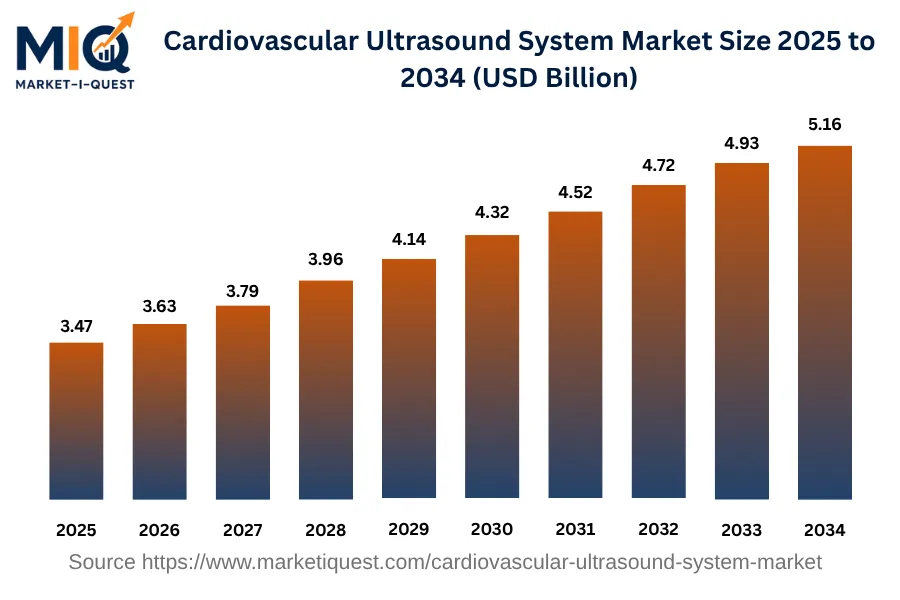
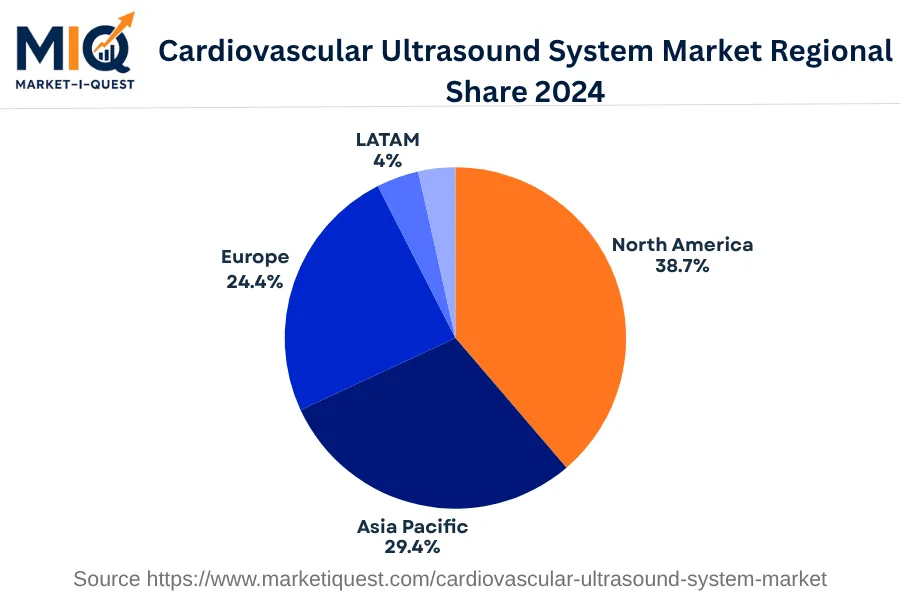
The Cardiovascular Ultrasound System Market, measured in USD billions, stood at 3.32 in 2024 and is estimated to have risen to 3.47 by the close of 2025. By 2034, the market is projected to grow further to 5.16, recording a Compound Annual Growth Rate (CAGR) of 4.5% over the span of nine years from 2025 to 2034. This growth trajectory is characterized by a steady rise, backed by consistent year-on-year market expansion. Hence, the Ultrasound System Market for cardiovascular applications shows a sustainable growth pattern over the projected period. Taking into account regional market shares for 2024, North America accounts for 38.7% of the global Cardiovascular Ultrasound System Market, making it the region with the highest market share. This is followed by the Asia Pacific and Europe owning 29.4% and 24.4% of the market respectively. The remaining shares are held by Latin America and the Middle East and Africa, with each accounting for 4.0% and 3.5% respectively.

Key Takeaways

  • By Product Type - Cart-based Ultrasound Devices led accounting for the highest market share in the year 2024.
  • By Technology - 2D Ultrasound grew fastest capturing a notable position in the market in 2024.
  • By Application - Echocardiography held the leading position accounting for a significant market share in 2024.
  • By End Use - Hospitals led holding the largest share in the Cardiovascular Ultrasound System Market in 2024.
cardiovascular-ultrasound-system-market market size

Key Driving Factors

High Prevalence of Cardiovascular Diseases

The high prevalence of cardiovascular diseases is a powerful driver for the Cardiovascular Ultrasound System Market. On a global scale, Cardiovascular diseases (CVDs) are the number one cause of death. To manage and treat these conditions effectively, healthcare providers are increasingly resorting to cardiovascular ultrasound systems. These systems provide a non-invasive and accurate diagnostic method that aids in early detection and treatment of CVDs. It allows physicians to assess the heartbeat, blood flow, and the condition of the heart valves which are crucial in diagnosing any potential heart diseases. This substantial need for management and prevention of CVDs is encouraging hospitals and clinics to adopt these systems, driving the market demand.
Requirement for Advanced Diagnostic Capabilities in Imaging Centers

The need for advanced diagnostic capabilities in imaging centers is another significant factor that drives the Cardiovascular Ultrasound System Market. In recent years, there has been a significant influx of patients in imaging centers seeking comprehensive and advanced diagnostic evaluations. This surge is due to the growing awareness and understanding of cardiovascular health among the general population. With more patients seeking these services for cardiovascular health assessment, imaging centers are increasing the adoption of cardiovascular ultrasound systems. Their high-resolution imaging, precise procedural guidance, and capacity for early detection of complex cardiovascular conditions are factors that push their integration, driving impressive market growth.

Market Evolution by Timeline

2019-2023
During this period, the demand for cardiovascular ultrasound systems exhibited a rise in North America and Europe due to increased incidence of cardiovascular diseases. Asia Pacific also witnessed an increase in demand due to increased healthcare expenditure. On the supply side, major players like Phillips and GE Healthcare released advanced cardiovascular ultrasound systems with improved image clarity and 3D/4D capabilities. Products were generally sold directly to healthcare facilities, though some distribution was done through specialized medical equipment suppliers. Notable regulatory developments include the FDA's approval of Philips EPIQ CVx for cardiovascular diagnosis. Risk factors included budget constraints in developing countries and lack of skilled sonographers.
2024
By 2024, the expansion of telehealth services increased the demand for cardiovascular ultrasound systems, especially in remote patient monitoring. The dominance of North America continued with Asia Pacific showing consistent growth. Manufacturers focused on integrating AI for enhanced diagnosis accuracy, with products like EchoGo Pro from Ultromics getting FDA clearance. Increased collaboration with service providers was observed, as manufacturers focused on providing integrated solution packages. Regulatory challenges pivoted towards maintaining patient privacy compliance in remote settings and managing clinical decision support system standards. The prominent risk was the overdependence on telehealth services.
2025-2029
From 2025 to 2029, there was a trend in the use of cardiovascular ultrasound systems in personalized and predictive medicine. Demand remained high in North America, Europe and rose in Middle East due to increased incidences of cardiovascular diseases. Manufacturers continued to invest in AI and cloud-based platforms to offer better diagnostic assistance and patient management. Adoption of value-based payment models accelerated, and product pricing depended largely on the software capabilities and package deals. Policy considerations towards establishing common AI standards became prominent. Risk of cybersecurity breaches became a significant concern.
2030-2034
In the period between 2030 and 2034, there was a shifting demand for cardiovascular ultrasound systems towards preventive care. This shift was prominent in North America, Europe, and Australia due to population aging, respectively. Manufacturers started introducing wearables along with ultrasound features, and most of the data from these devices were managed through cloud-based platforms. Manufacturers started strategizing their product pricing based on data management capabilities. Regulations also evolved to incorporate guidelines for wearable medical devices. Risks included data privacy concerns and the challenge of seamless integration of these devices with various healthcare IT systems.

Future Market Outlook

Future Opportunities

As healthcare systems around the world grapple with rising cardiovascular disease prevalence, opportunities in the cardiovascular ultrasound system market are emerging based on current technological trends. The continuing development of portable ultrasound devices is noteworthy; in February 2023, Butterfly Network announced new enhancements to its handheld Butterfly iQ+ system aimed at enhancing cardiovascular imaging in remote or rural settings. This trend complements growing healthcare initiatives in countries such as India, where the government is improving access to diagnostic tools in underserved regions. The ongoing integration of artificial intelligence into ultrasound technologies suggests a future where automated diagnostics become routine; for example, the collaboration between Siemens Healthineers and NVIDIA in 2023 aims to leverage AI for improved imaging analytics. Training and education for healthcare providers about emerging technologies, as seen in initiatives from the European Society of Cardiology in 2022, indicate a long-term commitment to elevating standards in cardiovascular care. Additionally, regulatory pathways are evolving— the Medical Device Regulation (MDR) implemented by the European Commission in May 2021 encourages innovation while ensuring patient safety through more stringent oversight. These conditions signal that stakeholders, including medical device manufacturers, healthcare providers, and regulatory bodies, will increasingly collaborate to address unmet clinical needs, ultimately driving further advancements and accessibility in cardiovascular ultrasound technologies globally.

Segmentation Analysis

By Product Type

The market is divided into subsegments including Portable Ultrasound Devices, Cart-based Ultrasound Devices, and Compact Ultrasound Devices. Cart-based Ultrasound Devices accounted for the largest revenue share while Portable Ultrasound Devices are expected to grow at the fastest CAGR during the forecast period.

Largest Revenue Share

Cart-based Ultrasound Devices

Market Share Leader

The cart-based ultrasound devices subsegment leads the market in terms of revenue. This dominance arises primarily due to their extensive application in hospitals, outpatient surgical centers, and diagnostic centers. They are preferred due to their high-power capacity which enables effective deep scanning during complex procedures. Advanced features like Doppler, 3D, and 4D imaging offered by cart-based devices provide more detailed and accurate results, driving their demand. Moreover, intensive care units and emergency wards in hospitals prefer these devices due to their ability to integrate with other tools and give comprehensive diagnostic information. In terms of geographical market share, mature markets like North America and Western Europe generate a significant portion of the revenue due to higher adoption rates of advanced diagnostic technology. These regions also benefit from robust healthcare infrastructure and high spending capacity.

Fastest CAGR

Portable Ultrasound Devices

Forecast Period Growth Leader

Portable Ultrasound Devices are projected to demonstrate the fastest growth in the market. The primary driver for this trend is the increased demand for point-of-care diagnostics. Portable devices are compact, lightweight and capable of rapid, accurate diagnoses, making them ideal for ambulances, homecare, and battlefield applications. They are increasingly used in remote areas where access to large healthcare facilities might be restricted, leading to wider reach and faster adoption. Technological advancements, like enhanced imaging quality, easy-to-use features, and wireless connectivity, are further accelerating their adoption. In terms of risks, however, the segment could face regulatory challenges as these devices are vulnerable to cyber security threats due to network connectivity. Though, partnerships between ultrasound device providers and cyber security firms could potentially alleviate these risks and ensure secure data management.

By Technology

Under the technological paradigm, the market incorporates a variety of sub-segments, including Doppler Ultrasound, 2D Ultrasound, 3D Ultrasound, and Spectral Doppler Ultrasound. As of the base year of 2024, 2D Ultrasound holds the major share in terms of revenue, whereas 3D Ultrasound exhibits the highest potential for growth.

Largest Revenue Share

2D Ultrasound

Market Share Leader

The 2D Ultrasound sub-segment leads in revenue generation primarily fueled by its extensive application in the healthcare and medical diagnostic industry. Its versatility and reliability have made it a go-to tool for physicians. Leveraging this technology, professionals can rapidly procure images of internal body structures which aids in pinpointing potential disease or injury. Furthermore, 2D Ultrasound devices are generally lower in cost than their counterparts, making them more financially accessible to various healthcare establishments worldwide. In developing countries, where advanced diagnostic tools may be scarce or expensive, these devices often serve as the primary diagnostic tool, supplementing their widespread adoption. Lastly, regulatory approval processes for 2D Ultrasound devices are generally less stringent, easing their penetration into various markets.

Fastest CAGR

3D Ultrasound

Forecast Period Growth Leader

3D Ultrasound, although relatively new, is expected to be the fastest growing sub-segment. The technological improvements and innovations in Ultrasound technology are paving the way for this sub-segment's growth. 3D Ultrasound provides a deeper and comprehensive view of the body, enhancing diagnosis accuracy, which is a key factor driving its adoption. Improving healthcare infrastructure in developing countries, supported by increasing healthcare spending, is further catalyzing the demand. Launch of cost-effective 3D Ultrasound devices is a key trend in the market contributing to its growth. However, there might be certain adoption challenges, particularly involving practitioners' training and the steep learning curve associated with the usage of these high-tech devices. Regulatory barriers might also pose short-term hurdles, but overall, the outlook remains positive.

By Application

The market is divided into subsegments including Echocardiography, Stress Testing, Transesophageal Echocardiography and Fetal Echocardiography. Echocardiography accounted for the largest revenue share while Stress Testing is expected to grow at the fastest CAGR during the forecast period.

Largest Revenue Share

Echocardiography

Market Share Leader

Echocardiography is by far the most revenue generating subsegment in 2024 due to a variety of factors. Primarily, its versatility and affordability have made it the go-to imaging technique for diagnosing and monitoring heart diseases. Its non-invasive nature also ensures that it is preferred by patients over other imaging techniques. Additionally, the ageing population and high prevalence of cardiovascular diseases globally have exponentially propelled the use of echocardiography. Accessibility also plays a role in its widespread adoption. Regulation is not a strong constraint to the adoption of Echocardiography, but strict quality control standards are necessary to maintain the credibility and precision of the tests. The purchasing decision is strongly influenced by the device's technical features such as image quality, ease of use, and reliability, as well as financial considerations such as pricing and reimbursement coverage.

Fastest CAGR

Stress Testing

Forecast Period Growth Leader

Though not currently the largest revenue generator, Stress Testing segment is clearly demonstrating the fastest CAGR. The primary growth drivers behind this are advancements in technology that produce more accurate results and the increasing recognition of the need for early detection of cardiovascular diseases. While adoption has been slower in the past due to high costs, recent developments in cost-effective testing equipment have lowered the barriers to entry, encouraging more widespread use. Health policies promoting preventative care, and investments in research, and development by major players also foster the market's growth. However, the near-term risks include potential regulatory changes and shifting consumer preferences towards new emerging alternatives for cardiac evaluation. Overall, the market for Stress Testing is poised for rapid expansion, driven by current trends in healthcare and advancements in cardiovascular testing technology.

By End Use

The end use market is divided into subsegments including Hospitals, Ambulatory Surgical Centers, Diagnostic Imaging Centers, and Research Centers. In 2024, Hospitals accounted for the largest revenue share while Ambulatory Surgical Centers are expected to grow at the fastest CAGR during the forecast period.

Largest Revenue Share

Hospitals

Market Share Leader

Hospitals hold the largest share in the market, driven by several factors. The primary driver is the scale and range of services offered by hospitals which are unparalleled by other subsegments. Hospitals cater to multiple patient needs, offering a comprehensive range of services, making them a prominent choice for care. Moreover, hospitals often have a larger capacity to invest in advanced technology. This ability to procure and deploy state-of-the-art equipment results in higher revenues. Regular and substantial government funding for hospitals also contributes to the revenue dominance in this segment. Geography presents another significant influence; in developing regions, hospitals are frequently the focal point for healthcare services and hence, generate high revenues. Furthermore, hospital purchases are often backed by long-term contracts with suppliers, leading to a reduction in switching costs and therefore, a stable and predictable revenue stream.

Fastest CAGR

Ambulatory Surgical Centers

Forecast Period Growth Leader

Despite hospitals currently holding the largest revenue share, Ambulatory Surgical Centers (ASCs) are expected to grow at a faster rate. ASCs have become increasingly popular due to its cost-effectiveness and convenience. A surge in the shift from inpatient to outpatient surgeries and the advancements in minimally invasive techniques are driving the rapid growth of this segment. This trend is particularly evident in developed economies where patients and providers alike are incentivized to reduce hospital stays. Adoption barriers primarily revolve around regulatory challenges and capital-intensive nature of setting up a center, however, the expanding partnership models and supportive policies are helping to overcome these barriers. The fact that ASCs capitalize on shorter procedure times and reduced postoperative recovery times, enhancing patient turnover rates, poses a significant factor for the improvement in revenue. The key risks in the near-term involve maintaining stringent quality-assurance practices and navigating an ever-evolving regulatory landscape.

Competitive Analysis

Key Market Players

Manufacturers/OEMs

GE Healthcare
US
Philips Healthcare
Netherlands
Siemens Healthineers
Germany

Key Suppliers & Raw Materials

Microchip Technology Inc.
US
Intersil Corporation
US
STMicroelectronics
Switzerland

Distributors, Integrators & Channel Partners

Medtronic
Ireland
Cardinal Health
US
Johnson & Johnson
US

Porter’s Five Forces Analysis

This analysis summarizes the competitive dynamics of the Cardiovascular Ultrasound System Market.

Supplier Bargaining Power

Medium

Controlled by specialized manufacturers with knowledge but threatened by upstream integration.

Buyer Bargaining Power

High

Numerous product choices and switching options give buyers significant influence.

Threat of Substitutes

Low

Unique diagnostic capabilities makes the threat of direct substitutes relatively low.

Threat of New Entrants

Medium

High capital expenditure and regulatory barriers reduce the threat of new entrants.

Competitive Rivalry

High

Intense competition due to advancements in technology and demand for improved healthcare.

Regional Analysis

Geographic market dynamics and growth opportunities across key regions

Global Market Outlook

cardiovascular-ultrasound-system-market market regional share

North America

In 2024, the North American Cardiovascular Ultrasound System Market experienced significant growth driven by various factors and demonstrated distinct trends. Increased prevalence of cardiovascular diseases in the U.S., Canada, and Mexico spurred high demand for sophisticated diagnostic tools, amplifying market growth. Stringent healthcare regulations and widespread adoption of advanced technology boosted the market, while substantial investment in medical infrastructure and tech R&D solidified the market's expansion. Notably, competitive pricing and active supply dynamics also fueled the market's robust growth.

Simultaneously, the trends dominating 2024 were marked by shifts in buyer preference towards less invasive, more accurate diagnostic tools like three-dimensional (3D) ultrasound technologies. Increased integration of artificial intelligence in cardiovascular ultrasound systems emerged as a significant shift in product technology. The healthcare sector, including major hospitals and diagnostic centers, increasingly endorsed these advancements. An uptick in partnerships and mergers occurred between market players, fostering the development and distribution of high-quality, cost-effective systems. Heightened vigilance around policy enforcement and adherence to medical standards were also observed. In sum, while consumer demand and regulatory landscapes primarily drove it, the cardiovascular ultrasound system market in North America in 2024 was also significantly shaped by trends in technology adoption and sector partnerships.

Asia Pacific

In 2024, the Asia Pacific Cardiovascular Ultrasound System market experienced significant growth due to a combination of demand factors, regulation changes, and technology adoption. The increasing prevalence of cardiovascular diseases in high-population countries such as China and India drove the heightened demand. Sweeping healthcare reforms in Japan and South Korea improved patient access to these technologies, reflecting a regulatory environment conducive to market expansion. Moreover, substantial investments in healthcare infrastructure across the Asia Pacific enabled an influx of advanced ultrasound systems.

Trends observed within the market included shifts in buyer behaviour and product technology. Hospitals and healthcare clinics, major consumers of these products, showed an increasing preference for portable and compact devices, indicating a need for convenience and efficiency in fast-paced environments. Technology shifts were evident in the growing interest towards 3D and 4D systems, notably in Australia and key ASEAN markets, reflecting a move towards improved diagnostic imaging. Additionally, several partnerships and acquisitions amongst leading industry players were observed, suggesting a competitive market landscape. Regulatory standards were consistently enforced across countries, ensuring product efficacy and safety. Overall, the robust growth in the region's Cardiovascular Ultrasound System market in 2024 was shaped by a combination of these clear-cut drivers and trends.

Europe

In the base year of 2024, the cardiovascular ultrasound system market in Europe experienced substantial growth. Increasing prevalence of cardiovascular diseases across Germany, the United Kingdom, France, Italy, Spain, the Nordics, Benelux, and Central & Eastern Europe is a strong driver of the market. Enhanced technological adoption, particularly in countries like the UK and Germany, further contributes to market growth. Investment in healthcare infrastructure, with specific emphasis on non-invasive diagnostic tools, augments the demand for ultrasound systems. Moreover, strict regulatory standards for medical devices in Europe necessitate widespread usage of these high-quality ultrasound systems.

Trends observed in the market include a shift towards portable and compact devices, which facilitate ease of use. Manufacturers are focusing on developing advanced cardiovascular ultrasound machines that are compatible with smartphones and tablets. This is primarily seen in technologically advanced countries like Germany and the Nordic region. In addition, many healthcare facilities and diagnostic centers in the UK and France are showing a preference for refurbished systems due to budget constraints. There is an enforcement of stricter regulations pertaining to the quality of refurbished devices, thus ensuring these remain reliable. Finally, there is an increase in partnerships between device manufacturers and healthcare providers to enhance patient care, particularly in Spain and Italy.

Latin America

In 2024, the Cardiovascular Ultrasound System Market in Latin America exhibited significant growth due to several drivers and trends. Investment in healthcare infrastructure and technology adoption escalated in countries such as Brazil and Mexico due to governmental policies focused on improving the overall quality of health services. In Argentina, Colombia, Chile, and Peru, increased awareness about cardiovascular diseases drove the demand for advanced diagnostic tools, pushing up the market size of ultrasound systems. Pricing competitiveness also influenced the market, as a result of an influx of manufacturers providing cost-effective solutions.

The market experienced key trends influencing buyer behavior and product shifts. In Brazil and Mexico, consumers showed preference for state-of-the-art ultrasound systems, reflecting the increasing reliance on advanced technology in healthcare. The market saw a rise in partnerships and acquisitions across LATAM, primarily aimed at improving product portfolios and providing competitive services. As for policy enforcement, efforts were concentrated on building and maintaining standards for cardiovascular ultrasound systems to ensure safety and reliability. Main sectors driving market growth included healthcare institutions such as hospitals and clinics, alongside government entities investing in public health strengthening. This dynamic underscored the critical role of cardiovascular ultrasound systems in the LATAM healthcare sector in 2024.

Middle East & Africa

In 2024, the market for cardiovascular ultrasound systems in the Middle East and Africa was characterized by solid demand amidst technological advancements and policy shifts. Increased investment in healthcare infrastructure, particularly in Saudi Arabia, United Arab Emirates and South Africa, drove the uptake of these systems. Concurrently, standardized regulations across countries like Egypt and Kenya encouraged adoption by imposing stringent quality controls for cardiovascular diagnosis. Furthermore, the reduction in equipment prices translated into increased affordability for healthcare entities in regions like Nigeria.

Shifting buyer preferences towards non-invasive and accurate diagnostic procedures underpinned the flourishment of this market. Technological advancements led to the emergence of 3D and 4D ultrasound systems in advanced medical facilities of Israel and Qatar, superseding traditional 2D systems. Partnerships and mergers were also seen in these regions as medical device manufacturers sought to expand their presence. The enforcement of stricter data privacy policies signified another pivotal market trend. The key customer segments were government healthcare institutions, private hospitals, and diagnostic centers across the regions. In particular, the Qatari government’s adoption of such systems in their public healthcare sector offered a typical exemplification of patronage. Therefore, a confluence of increased investment, augmented by regulatory standardization, technological advancements, and affordability, dictated the cardiovascular ultrasound system market dynamics in the Middle East and Africa in 2024.

Recent Industry Developments

Latest market innovations, product launches, and strategic initiatives

December 2025

Philips agreed to acquire Spectra WAVE, expanding its intravascular imaging portfolio with the HyperVue Imaging System and AI-enabled X1-FFR technology, strengthening Philips' 88% market share leadership in the global IVUS market.

August 2025

Philips launched Transcend Plus for its EPIQ CVx and Affiniti CVx cardiovascular ultrasound systems, featuring newly FDA-cleared 2D/3D image quality enhancements and 26 integrated AI applications (the most in the industry), including 2D Auto EF Advanced for contrast imaging.

Frequently Asked Questions