Car Rental Market Snapshot

Key Players

  • Enterprise Holdings (United States)
  • Hertz Global Holdings (United States)
  • Avis Budget Group (United States)
  • Europcar Mobility Group (France)
  • Sixt SE (Germany)
  • Localiza Rent a Car (Brazil)
  • China Auto Rental Inc (China)
  • Ola Cabs (India)
  • Times Mobility Networks Co. Ltd (Japan)
  • Redspot Car Rentals (Australia)

Market Size

Base Year 2024
$132.64 Bn
CAGR
8.58%
Forecast 2034
$302.12 Bn

Market Segments

By Booking Type
Offline Booking, Online Booking
By Rental Duration
Short Term, Long Term
By Vehicle Type
Luxury, Executive, Economy, SUVs, Others
By End User
Self-Driven, Chauffeur-Driven

Market Dynamics

Drivers
  • Rising tourism industry
  • Increased mobility needs
Restraints
  • High operational costs
  • Regulation limitations
Opportunities
  • Rising tourism industry
  • Increasing business travel

Market Size

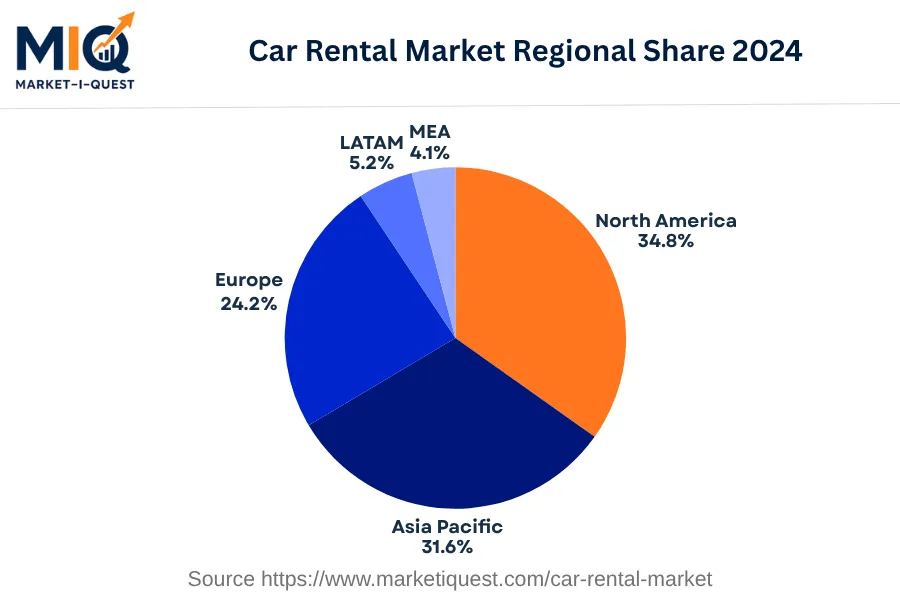
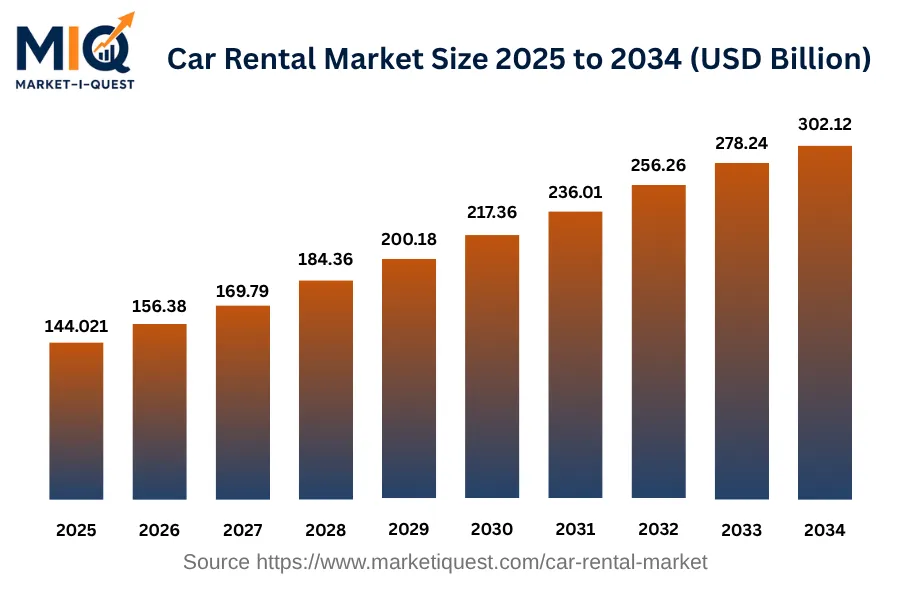
The Car Rental Market was valued at $144.02 billion in 2025 and is projected to reach $302.12 billion by 2034, growing at a CAGR of 8.58%. This substantial growth is partly due to the consistent increase in the market value year after year. For example, the market size in 2024 stood at $132.64 billion and then grew by about 8.58% the following year to reach $144.02 billion in 2025. Moving forward, the same growth pace is expected to continue until 2034 when the market value will have more than doubled from the 2025 figure to reach an impressive $302.12 billion. Regional market share in 2024 provides an important perspective: North America held the largest share of 34.82%, followed by the Asia Pacific at 31.64%, and Europe at 24.18%. The remaining market share was split between Latin America and the Middle East & Africa, holding 5.23% and 4.13% respectively.

Key Takeaways

  • By Booking Type - Offline Booking dominated accounting for a substantial share in the Car Rental Market.
  • By Rental Duration - Long Term held a significant position in terms of popularity among users.
  • By Vehicle Type - Luxury led the market offering cost-effective solutions to consumers.
  • By End User - Self-Driven demand was found to be leading the market.
car-rental-market market size

Key Driving Factors

Transition to Mobility as a Service (MaaS)

The car rental market is currently being influenced by a major market shift towards 'Mobility as a Service' (MaaS). This concept refers to a move away from personally owned modes of transportation and towards mobility solutions that are consumed as a service. The push for this model comes from urban populations and environmental agencies aimed at reducing car ownership due to traffic congestion and pollution. Car rental companies, which already have the infrastructure, can capitalize on this by providing vehicle access memberships and frictionless vehicle reservations, making car rental a part of an on-demand, integrated transportation network.

Increase in International Tourism

Another critical factor driving the car rental market is the steady growth of international tourism. When tourists arrive in a country, they often need a means of transport to traverse the area, sightsee, and enjoy activities at their leisure. Renting a car provides flexibility and convenience that public transportation cannot offer. This need is recognized by tourism boards and travel intermediaries, which often partner with car rental services to provide tailored and integrated travel packages. This symbiotic relationship is aiding in driving the demand for car rentals, and in turn, fueling the growth of the market.

Market Evolution by Timeline

2019-2023
A strong demand was noted for rental cars in North America and Europe with a trend towards hybrid and economy cars for reducing carbon footprint. Shifting commuters' preference for car rentals than ownership due to high insurance costs and vehicle maintenance was a key factor. The market witnessed a technology overhaul with key players integrating IoT technologies to offer services like keyless entry. Government initiatives like 'Clean Power for Transport Package' in Europe influenced the market towards eco-friendly vehicles. There was a surge in partnership models, often between car rental providers and flight operators, to provide convenient car pick-up and drop-off facilities. The main risk was from the lack of a standardized regulatory framework across borders affecting the uniformity of services provided.
2024
In 2024, increased focus on customer experiences was seen as a main driver in the car rental market. The rise of digital platforms in Asia and Middle-East made process automation and bookings easier. API integrations became mainstream, thereby improving accuracy and reducing redundancy in task completion. In the USA, the 'FAST Act' was signed to encourage innovation including the rental car sector. A shift towards pay-as-you-go models was noted where customers were charged only for the distance travelled. The major risk was data breaches as businesses had to secure huge customer data amidst rising cyberattacks.
2025-2029
A rising trend of long-term rentals was observed in developing countries, such as India and Indonesia, due to increasing urbanisation and traffic congestion. Changing technologies like the rise of autonomous vehicles impacted the car rental market in terms of supply. Companies such as Waymo started testing self-driving vehicles in the rental space. Furthermore, policies around emissions and fuel usage, such as Europe's 'Euro 7 standard', pushed rentals towards electric vehicles. Flexible and customised rental plans became the norm. The risk involved infrastructural bottlenecks, especially for electric cars, as charging stations were not available ubiquitously.
2030-2034
High car rental demand was observed in progressive markets like Brazil and South Africa. The market saw major advancements in the integration of AI to manage operations efficiently. Governments worldwide propagated for 'Carbon Neutrality', pushing rental companies to use alternative fuels. Pay-per-minute rental models have emerged, providing extreme flexibility to the customers. The major challenge confronted by the market was the pivotal shift towards autonomous vehicles and the requirement of robust tech infrastructure to support them. Being proactive in establishing new tech systems remained the key response strategy towards the adoption of autonomous vehicles.

Future Market Outlook

Future Opportunities

Current developments in the car rental industry indicate that companies can anticipate substantial opportunities by adapting to evolving consumer preferences and regulatory environments. The increasing emphasis on sustainability, such as the EU’s Green Deal established in 2019 aimed at achieving carbon neutrality by 2050, encourages rental services to expand their electric and hybrid vehicle offerings. This transition is complemented by initiatives from manufacturers like Volvo, which plans to become a fully electric car brand by 2030. Moreover, the rise in remote work, accelerated by the COVID-19 pandemic in 2020, has altered travel patterns, presenting opportunities for rental companies to diversify their service models and develop flexible rental options for longer durations. Companies like Zipcar have already ventured into this space, appealing to urban consumers seeking on-demand mobility without the need for traditional short-term rentals. Additionally, partnerships with tech firms are expected to evolve; for instance, in 2022, Europcar collaborated with a technology provider to enhance their customer experience via connected cars. As artificial intelligence and machine learning technologies advance, the rental sector can leverage data analytics to personalize offerings and improve customer engagement. Ultimately, navigating these simultaneous trends of digital transformation, sustainability, and shifting consumer behavior presents a rich landscape for innovation and growth in the car rental market across various global regions.

Segmentation Analysis

By Booking Type

The market is divided into the subsegments Offline Booking and Online Booking. Offline Booking accounted for the largest revenue share while Online Booking is expected to grow at the fastest CAGR during the forecast period.

Largest Revenue Share

Offline Booking

Market Share Leader

Despite the advent of digitalization, Offline Booking still leads in terms of revenue generation in the base year 2024. This traditional subsegment continues to thrive due to various factors. A significant consumer segment, particularly the older generation or individuals lacking tech literacy prefer the personal interaction that comes with offline bookings. They enjoy the convenience, reliability and assurance of booking in person or via phone. Additionally, some travelers make use of offline bookings as it provides a clear path of communication in case of any booking-related disputes, which assures them of support, should the need arise. Certain geographic areas, predominantly where internet penetration remains low, heavily depend on offline booking channels. Regulations in some markets favoring traditional travel agents also play a role in sustaining the demand for offline booking. Thus, the offline booking segment continues to reign in terms of revenue share despite the growing popularity of online platforms.

Fastest CAGR

Online Booking

Forecast Period Growth Leader

Although Offline Booking currently leads the market in revenue, Online Booking is expected to grow at the fastest compound annual growth rate (CAGR). A variety of growth drivers contribute to this trend. There's a significant wave of technological advancements, particularly in mobile applications, that is pushing consumers towards the convenience of online bookings. Policies promoting digitization, combined with increasing internet penetration globally, have made online platforms more accessible and convenient for consumers. Key players in the market are also making significant investments in technology to enhance user experience on online platforms, thus encouraging their adoption. There are, however, a few near-term risks that can hinder the segment's growth. These include data privacy concerns and the fear of online fraud. Nonetheless, the decreasing costs of internet services and increasing access to smartphones are expected to lead to a swift inflow of users on these platforms, propelling the growth of online bookings.

By Rental Duration

The market is divided into subsegments including short term and long term rentals, with long term rentals accounting for the largest revenue share while short term rentals is expected to grow at the highest CAGR during the forecast period.

Largest Revenue Share

Long Term

Market Share Leader

Long term rentals dominated the revenue share in the base year of 2024. Several factors contribute to this. Firstly, given that long term rentals typically mean a commitment of months or years, the overall revenue generated through these contracts tends to be higher than the more transitory short term ones. Additionally, due to their extended nature, long term rentals often involve larger and more expensive properties, which again translate into more substantial revenues. Geographically, long term rentals are particularly popular in city centers and urban locations, where the demand for housing is high, stable and continuous. Regulatory environment also plays a part. Many cities or nations have different real estate and rental laws that can encourage the long term rental market. For instance, some cities require short term rentals to apply for specific licenses, pushing more owners towards the long-term market.

Fastest CAGR

Short Term

Forecast Period Growth Leader

Despite the current dominance of long term rentals, it is the short term rental subsegment that's forecasted to experience the fastest growth. There are several critical catalysts driving this growth. Firstly, the rise of technology platforms that facilitate short term rentals has created an accessible and efficient marketplace. Secondly, the increasing trend of remote work allows people greater flexibility of location, encouraging more short term stays. On the policy side, while some cities have implemented more restrictive regulations, others have embraced short term rentals as a boost to local economy. However, there are potential near-term risks, such as localized over-tourism and gentrification, which could lead to stricter regulatory laws. The relative affordability of short term rentals and the increased mobility of the global workforce drive the rising demand, contributing to the optimistic growth projection for this segment.

By Vehicle Type

The market is divided into the following subsegments: Luxury, Executive, Economy, SUVs, and Others. The Luxury subsegment accounted for the largest revenue share, while the Economy segment is expected to grow at the fastest CAGR during the forecast period.

Largest Revenue Share

Luxury

Market Share Leader

The Luxury subsegment leads the market in terms of revenue, primarily due to the high purchasing power of consumers and the perceived value associated with luxury vehicles. Consumers typically define their social status by the vehicle they drive, creating a high demand for luxury vehicles. High-net-worth individuals, particularly in developed nations, readily invest in luxury vehicles. Additionally, emerging markets are witnessing a surge in the luxury car market as the standard of living improves. Countries such as China and India have seen a significant increase in luxury vehicle sales, driven by an expanding, aspirational middle class. Furthermore, these vehicles typically feature advanced technology and superior comfort, further driving consumer appeal. There has also been a growing trend of consumers switching from conventional cars to luxury ones which has caused a spike in the overall market revenue. In terms of channels, both online and offline sales contribute to the growth of the luxury vehicle market.

Fastest CAGR

Economy

Forecast Period Growth Leader

Economy vehicles are expected to register the fastest growth, driven by a range of factors. These vehicles are popular with consumers seeking fuel-efficient and cost-effective solutions to their transport needs, particularly in price-sensitive markets. Furthermore, the ongoing transition towards sustainable and environmentally-friendly vehicles is driving the adoption of economy vehicles. Government policies and regulations promoting green transport and reducing carbon emissions also act as significant growth catalysts. Improved engine technology and innovative designs are making these vehicles increasingly attractive to consumers, a trend that is further fueled by rising fuel prices. Economy vehicles face challenges, such as the perception of quality and performance compromises, but these barriers are expected to diminish as technology evolves. Partnership with technology companies can also act as catalysts for growth in this subsegment. However, potential risks involve instability in raw material costs bearing the potential to increase economy vehicle production costs.

By End User

The market in this segment is primarily divided into two subsegments namely, self-driven and chauffeur-driven end users. In the base year of 2024, the self-driven segment garnered the highest revenue while the chauffeur-driven segment is expected to grow at the fastest CAGR.

Largest Revenue Share

Self-Driven

Market Share Leader

The self-driven subsegment holds the biggest piece of the revenue pie in 2024 and this domination isn't surprising. The main driving factors boil down to increased affordability, higher autonomy, and convenience. As consumers around the globe grow wealthier, they're more likely to purchase their own vehicles for personal use. This results in growing demand for self-driven applications. Regulation and supply also play a role. Enhanced fuel efficiency standards and improved availability of diverse models cater to varying customer needs. Meanwhile, geographically, regions with rapidly developing economies like Asia and Latin America contribute significantly to this growth. Rational purchasing criteria include car features, price, and brand reputation. Finally, the presence of established distribution channels, especially online platforms that offer seamless purchase experiences, also stimulate revenue generation in this subsegment.

Fastest CAGR

Chauffeur-Driven

Forecast Period Growth Leader

Despite not leading in revenue, the chauffeur-driven subsegment projects a fast-paced growth trajectory. Key catalysts for this trend include the rise of ride-hailing platforms, demographic changes, and policy supports. With the boom of companies like Uber and Lyft, the use of chauffeur-driven vehicles has witnessed exponential growth. Additionally, certain demographics, such as urban millennials and the elderly, prefer these services due to ease of use and convenience. Government policies also support this trend. In many densely populated cities, policies are being aimed at reducing private car ownership to alleviate traffic congestion. This enhances the business prospects for chauffeur-driven services. However, it is vital to remain cautious of near-term risks, including stricter regulations on ride-hailing platforms and the ongoing debate about the employment status of drivers, both of which may impact the growth rate.

Competitive Analysis

Key Market Players

Manufacturers / OEMs

Enterprise Holdings Inc.
US
The Hertz Corporation
US
Avis Budget Group Inc.
US

Key Suppliers & Raw Materials

General Motors
US
Toyota Motor Corporation
Japan
Ford Motor Company
US

Distributors, Integrators & Channel Partners

Sixt SE
Germany
Europcar Mobility Group
France
Uber Technologies Inc.
US

Porter’s Five Forces Analysis

This analysis evaluates the intensity of competition and attractiveness of the Car Rental Market.

Supplier Bargaining Power

Medium

Car manufacturers' dependence on rental companies balances power.

Buyer Bargaining Power

High

Competition and price transparency give consumers substantial bargaining power.

Threat of Substitutes

Medium

Public transportation, ridesharing services, and car sharing present notable alternatives.

Threat of New Entrants

Low

High capital costs, strong brand identities, and regulatory barriers restrict new entrants.

Competitive Rivalry

High

Intense rivalry exists due to minimal service differentiation and cost competition.

Regional Analysis

Geographic market dynamics and growth opportunities across key regions

Global Market Outlook

car-rental-market market regional share

North America

In the base year 2024, the North American car rental market experienced brisk dynamics as a direct result of consumer preferences and industry innovation. The sector's growth drivers included a surge in tourism, increasingly stringent regulations pushing people away from vehicle ownership, and significant investment in technology to streamline rental processes. In the U.S., the pandemic-induced shift towards domestic tourism bolstered the market while Mexico's booming tourism sector boosted demand for rental cars. The industry adopted key technological advancements including contactless pick-up and drop-off services facilitated by various mobile apps.

Behaviors and trends were also pivotal in shaping the North American car rental market in 2024. Consumers, particularly those from the corporate sector, demanded car rental services for business trips due to the cost-effectiveness, flexibility, and comfort offered by these services. Digitization gained momentum with more consumers now opting for booking online rather than in store. Major companies like Enterprise, Hertz, and Avis, made significant strides in consolidating their market positions by partnering with airlines and hotels to offer integrated travel solutions. With regards to policy enforcement, governments across North America introduced stricter emission standards in 2024, indirectly promoting the usage of car rentals as consumers, particularly in urban areas, sought to offset personal car ownership, thereby influencing the market trajectory.

Asia Pacific

In 2024, the Car Rental Market in Asia Pacific registered noteworthy transformations, driven primarily by growing urbanization, increased tourism, and a surge in business activities. Regulatory policies favoring the growth of this sector, like India’s assertive steps towards smart city projects, reinvigorated the region's car rental businesses. Investments were stirred by substantial technological innovation, such as China’s integration of AI-powered tools for enhanced customer service. South Korea, possessing an advanced IT infrastructure, evidenced superior supply dynamics, effectively handling the escalating demand.

Simultaneously, buyer behavior exhibited a strong preference for app-based platforms for car rentals, spurred by convenience and safety assurances. Japan saw a proliferation of electric rental cars, signifying a shift towards sustainable automobile technology. Channel dynamics witnessed significant changes within Australia, as commercial spaces at airports solidified as prime spots for car rental services. Numerous partnerships and M&A activities were observed, including ride-sharing platforms collaborating with car rental firms for wider service reach in key ASEAN markets. However, the escalated enforcement of stringent policies related to emission control led to a temporary slowdown in certain markets. Sectors ranging from enterprise to retail have engaged car rental services, driven by their need for cost-effective and flexible transportation solutions. Government and healthcare sectors showed sizable demand, especially for fleet services, demonstrating the broadening customer base within this market across Asia Pacific.

Europe

In 2024, the European car rental market experiences notable activity, propelled by a range of nuanced dynamics. Key drivers include heightened tourism demand, particularly in countries such as France, Italy, and Spain, all benefiting from rebounding post-pandemic travel. Additionally, marked growth within corporate sectors across Germany, the United Kingdom and Benelux induce sustained demand for executive vehicle rental services. Newly implemented environmental regulations favouring eco-friendly vehicles also redefine rental fleets across several European nations, with significant vehicle investments observed in the Nordics specifically.

Simultaneously, changing trends emerge shaping market landscapes. The shift towards digitisation reflects in intensified online booking, with brands developing robust digital platforms to accommodate customer preferences. The rising popularity of ride-sharing services amplifies the rental car market in urban regions across Central & Eastern Europe, offering convenient alternatives to traditional public transport. European car rental brands also focus on augmenting customer satisfaction and loyalty, evident through increased partnerships and merger and acquisition activity designed to expand service networks and improve operational efficiencies. Lastly, regulatory enforcement regarding CO2 emission norms across Europe mandates enhanced levels of transparency, impacting vehicle supply and influencing rental rates dictated by these changing service standards. By tightly interweaving drivers and trends, the European car rental market, particularly across Germany, the United Kingdom, France, Italy, Spain, the Nordics, Benelux and Central & Eastern Europe, exhibits heightened resilience and remains adaptive.

Latin America

In 2024, the car rental market in Latin America (LATAM) displayed significant activity, fueled by key drivers and shaped by emerging trends. The rise in tourism and business travel, particularly in regional hubs like Brazil, Mexico, and Argentina, increased demand for car rental services. Government initiatives promoting tourism, such as Brazil's 'Mais Turismo' program, also bolstered these markets as did substantial foreign direct investment into the region's transportation industry.

Regarding trends, the shift towards digitization radically transformed the LATAM car rental market. The growing prevalence of car rental apps and online booking platforms complemented the changing behaviors of technologically savvy consumers, primarily in urban centers of Mexico, Colombia, and Brazil. Simultaneously, the increasing popularity of eco-friendly, low-emission vehicles influenced rental businesses to diversify their fleets. Partnerships and M&A were particularly active in this sector, with companies like Localiza Hertz in Brazil consolidating to increase their market reach.

Finally, there was a noticeable rise in business travel from sectors such as utilities and manufacturing, which expanded the customer base for car rentals. A stricter regulatory environment in countries like Chile and Peru enforced higher standards for rental vehicles, pushing companies to ensure their fleets met these new mandates. Overall, LATAM's car rental market in 2024 exhibited substantial growth with dynamic adjustments to accommodate a more digital, eco-conscious consumer landscape.

Middle East & Africa

In 2024, the Car Rental Market in the Middle East and Africa saw substantial dynamics across several key countries. Investment in innovative technology such as digital bookings and electric vehicles, particularly in Saudi Arabia and the United Arab Emirates, were significant drivers boosting demand. In response to increasing tourism, countries like Egypt, South Africa, and Kenya embraced this industry, building robust infrastructure and streamlining policy regulations thereby attracting considerable foreign investment. Moreover, business travel requirements in the financial hubs like Qatar and Israel contributed significantly to the demand.

However, the market witnessed distinct buyers trend. In Saudi Arabia, UAE and Qatar, corporate sectors including oil and gas, telecom, manufacturing facilities hired fleets, reflecting a shift towards long-term rentals. Meanwhile, in South Africa, Nigeria, Kenya, and Egypt, the rental market catered to travel and tourism industry, signalizing a preference for short-term rentals. Partnerships between car rental companies and airlines also became common, as seen in the UAE. Furthermore, an emphasis on environmental sustainability saw Israel enforcing stricter emission standards, leading to increased rentals of hybrid or electric vehicles. These dynamics shed light on a highly active and diversified car rental market in the Middle East and Africa during the year.

Recent Industry Developments

Latest market innovations, product launches, and strategic initiatives

March 2026

ECO Mobility partnered with SIXT in India on March 24, with ECO acting as General Sales Agent for SIXT's international car rental services, making them more accessible to Indian corporate clients, business travelers, and travel agents.

January 2025

Moove, a Nigerian mobility fintech backed by Uber, acquired Brazilian car rental company Kovi in a share deal as part of its strategy to expand beyond Africa. The acquisition positioned Moove, valued at $750 million, among the top three global fleet operators and financiers of ride-sharing vehicles by revenue.

Frequently Asked Questions