Car DVR Market Snapshot

Key Players

  • Nextbase (United Kingdom)
  • Pittasoft BlackVue (South Korea)
  • Garmin (United States)
  • Mio Technology (Taiwan)
  • Transcend Information Inc. (Taiwan)
  • Thinkware (South Korea)
  • Conbrov (China)
  • Cobra Electronics (US)
  • ABEO Technology (Taiwan)

Market Size

Base Year 2024
$5.69 Bn
CAGR
10.72%
Forecast 2034
$15.75 Bn

Market Segments

By Product
  • Single Channel
  • Dual Channel
By Application
  • Passenger Cars
  • Commercial Vehicles

Market Dynamics

Drivers
  • Rising vehicle theft incidents
  • Advancements in technology
Restraints
  • High product cost
  • Stringent privacy regulations
Opportunities
  • Advanced technology integration
  • Consumer safety awareness

Market Size

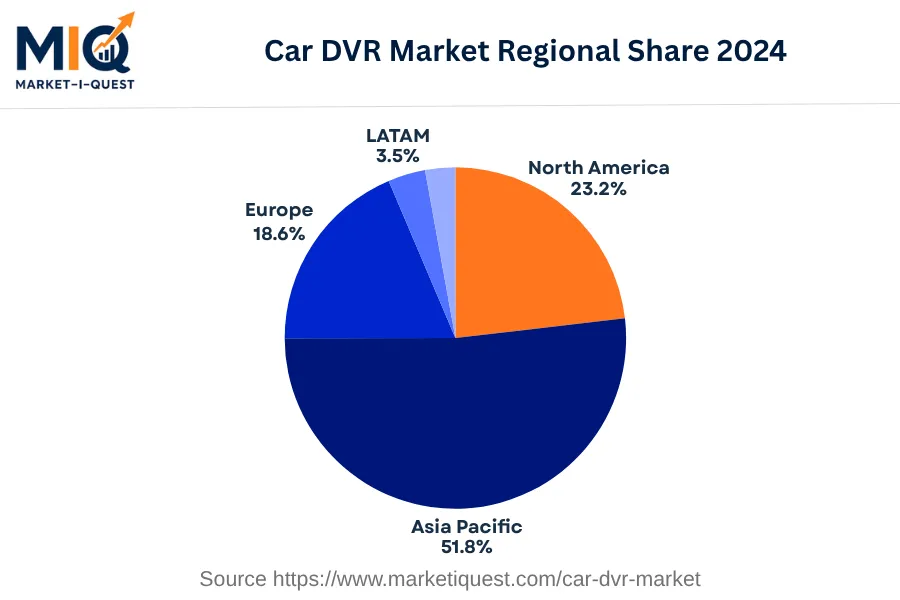
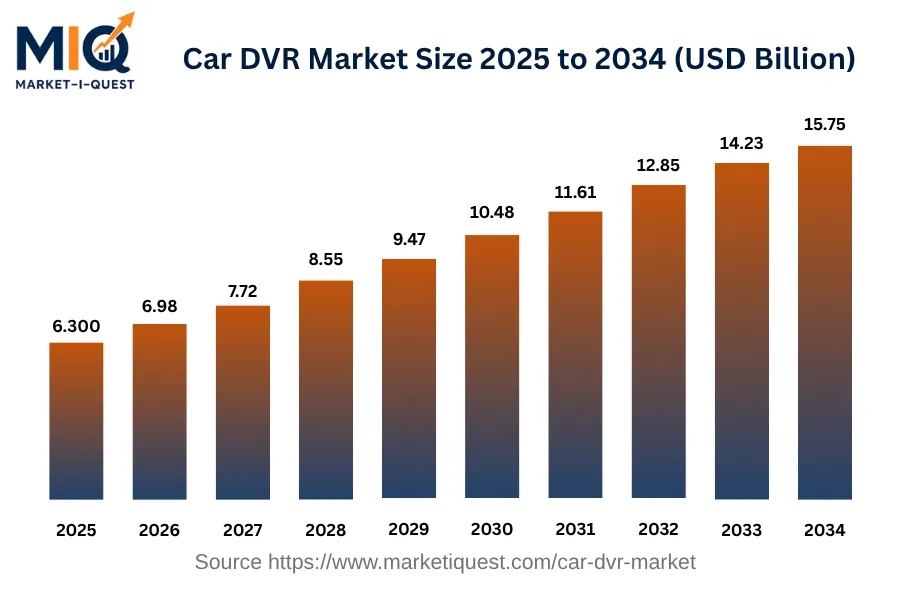
The Car DVR market, sized at USD 6.30 billion in 2025, is projected to grow to USD 15.75 billion by 2034, with a CAGR of 10.72% during the period. The robust growth from 2025 to 2034 is attributed to considerable advances within the technology, potentially increased demand from consumers, and possible innovations within the commercial sector, which might boost the market valuation. In terms of regional shares in 2024, prior to the growth spike, Asia Pacific held the lion's share of the market at 51.82%, followed by North America at 23.16% and Europe at 18.63%. Regions with lesser market shares included LATAM at 3.54% and MEA at 2.85%. This information indicates that majority of the revenue generation came from the Asia Pacific region and further exploration of potential opportunities in this market may be instrumental.

Key Takeaways

  • By Product - Single Channel DVR held the leading position in the market in 2024.
  • By Application - Passenger Cars dominated with considerable market share in 2024.
car-dvr-market market size

Key Driving Factors

Implementation of stringent road safety regulations

An increasingly prominent driver of the car DVR market is the implementation of stringent road safety regulations globally including compulsory installation of dash cams. Governments worldwide are adopting these rules to promote safer driving habits, monitor driver behaviour, and serve as evidence in resolving traffic disputes. For example, in regions like Russia, South Korea, and the U.K., the use of car DVRs is extensively regulated and promoted, significantly driving the demand for car DVR devices. Additionally, insurance companies are increasingly acknowledging the value of car DVR footage in processing accident claims, which could serve as another significant driver for growth in this market.

Increased production of commercial vehicles

A clear catalyst for the expansion of the car DVR market is the rise in the production of commercial vehicles — including fleet cars, taxis, and commercial trucks. As these vehicles spend longer hours on the road, the need for safety and security measures amplifies. Fleet operators are widely adopting car DVR devices in their vehicles to monitor driver behaviour, track the vehicle in real-time, and ensure secure transportation of goods and passengers. This widespread adoption by commercial vehicle companies bolsters the demand for high-end car DVR systems, thus driving growth in the market.

Market Evolution by Timeline

2019-2023
During this period, the consumer segment for Car DVR started showing marked preference towards high resolution devices, for improved clarity in recordings largely in Asia-Pacific and North America. This preference coalesced into a pattern of demand for 1080p resolution devices. Manufacturers like Garmin and BlackSys brought various high-resolution models to the market. However, integrating these devices in diverse car models was still maturing, posing an obstacle for wider adoption. In 2020, the New Car Assessment Programme launched in Europe enforced a safety rule for newly manufactured cars to provide collision avoiding systems. Typically, commercial contracts were signed for bulk orders, while pricing had a wide range from $30 to $250. Supply bottlenecks, like the COVID-19 pandemic, upset market dynamics throughout this period, posing a massive risk.
2024
In 2024, demand for Car DVR was largely driven by the corporate sector, especially from logistic companies in Indian and Chinese markets. Though multiple suppliers had standardized offerings for high resolution options, there were constraints regarding capacity. Regulations such as the General Safety Regulation in the EU that came into effect in July impelled adoption. Pricing dynamics indicated an average selling price of $100 for mid-range models. Partnerships between Car DVR suppliers and car manufacturers were the common commercial model while a major risk in this year was the rising cost of components.
2025-2029
From 2025 through 2029, police forces across many Canadian and New Zealand cities emerged as significant buyers, driving demand with the wish to document incidents more effectively. Companies like Nexar and Dashcam, invigorated their production capacities, thus making supply more consistent. The integration of DVR devices into cars reached a mature level; and European regulations for mandatory dash cams by 2026 impelled broader adoption. While the rise in demand often led to short-term price increases, longer contracts between buyers and suppliers helped stabilize these effects. Malware infecting these devices posed a significant security risk that companies had to address.
2030-2034
During this period, demand for Car DVR was largely fueled by private car owners seeking to enhance personal security, particularly in the Middle East and Africa. While the technology had become more reliable, there were still issues related to device maintenance due to harsh weather conditions. While there were no significant changes in policy, there was a positive trend towards partnerships between Car DVR manufacturers and car rental companies. Physical resale stores emerged as a popular channel for procurement, particularly for the more technologically challenging devices. The recurrent risk of cyber attacks on these devices prompted manufacturers to invest more in cybersecurity features.

Future Market Outlook

Future Opportunities

The future of the car DVR market is projected to be influenced heavily by the evolving regulatory landscape and consumer demands for added safety features. With the National Highway Traffic Safety Administration in the United States focusing on enhancing vehicle safety measures, the push for higher-quality video recording systems is anticipated to gain momentum. Given that insurance companies are increasingly rewarding policyholders who use dash cameras as a preventative measure against accidents, collaboration opportunities between camera manufacturers and insurance providers are likely to expand. In 2024, the United Kingdom plans to evaluate the effectiveness of smart road technologies, which may include integrating dash cam footage to improve transportation safety. This aligns with the demand for real-time data sharing, presenting openings for companies like Thinkware and Nextbase to expand their service offerings beyond just recording to data analytics. Moreover, as electric vehicles continue to grow in popularity, car manufacturers such as Ford are looking into integrating dash camera technology into their electric models to ensure compliance with new standards. The demand for fleet management solutions incorporating DVR technology is also likely to rise, providing opportunities for growth in software development and data integration services, fostering collaborations between tech companies and automotive manufacturers to optimize fleet operations.

Segmentation Analysis

By Product

The market is divided into subsegments including Single Channel and Dual Channel. Single Channel accounted for the largest revenue share while Dual Channel is expected to grow at the fastest CAGR during the forecast period.

Largest Revenue Share

Single Channel

Market Share Leader

The Single Channel segment has a considerable revenue share in the market due to its vast prevalence and incorporation in various industries. Predominantly, its simplicity and cost-effectiveness make it highly desirable for many users and businesses. The ease of operation and straightforwardness of Single Channel products have fostered a higher demand in the consumer industry. Given the inherent simplicity of Single Channel devices, they tend to be more reliable and have less potential for technical difficulties, making them an ideal choice for a broad spectrum of applications that require robust performance. Geographically, these products are widely purchased across developed and emerging markets, largely due to their universal necessity and adaptability to different environmental conditions. Furthermore, the supply and distribution channels for this segment are well-established globally, which in turn has allowed businesses to reach a wider customer base and acquire substantial market share. While there are no stringent regulations controlling this segment, general laws governing fair competition and pricing do apply. Therefore, the competitive landscape is relatively stable with the leaders of this segment rooted in their positions.

Fastest CAGR

Dual Channel

Forecast Period Growth Leader

Despite not as extensively adopted as Single Channel, the Dual Channel segment is expected to yield the fastest growth rate in the coming years. Driving factors cover technological advancements, increasing demand for products with better performance, and strategic partnerships promoting its usage. Dual Channel products offer enhanced efficiency and accuracy, stimulating adoption among high-end users and industries requiring sophisticated functionality. However, some barriers to adoption exist, such as higher costs and increased complexity of operation when compared to Single Channel. As technology further progresses, and with scale economics, these barriers are expected to decrease over time. It should be noted that substantial capital expenditure is necessary for researching, designing, and manufacturing Dual Channel products, which may potentially limit profitability in the short term. Nonetheless, anticipating robust demand growth, firms are increasingly willing to invest in this subsegment. While rapid growth implies substantial opportunity, it also entails more near-term risk, especially risks associated with technological obsolescence and market competition.

By Application

The market, divided by application, branches into two subsegments including Passenger Cars and Commercial Vehicles. In the base year of 2024, Passenger Cars noticeable accounted for the largest revenue share while Commercial Vehicles are expected to show remarkable growth, promising the fastest CAGR during the forecasted period.

Largest Revenue Share

Passenger Cars

Market Share Leader

Passenger cars generated the most market revenue in 2024 due to a variety of factors. Primarily, the sheer volume of passenger cars far exceeds that of commercial vehicles, contributing to larger sales volumes and consequently greater revenues. Additionally, growing urbanization rates coupled with rising income levels have resulted in increased demand for personal mobility. Consumer preference for convenience and the increasing preference for private over public transport have significantly driven the sales of passenger cars. Furthermore, innovation in the automobile industry, including enhanced safety features and fuel efficiency, have made passenger cars an attractive purchase decision for consumers. Although regulatory norms pose some challenges, manufacturers have been leveraging these regulations by progressively moving towards green technology and electric cars, which have gained considerable popularity and further boosted the sales and revenues of this segment.

Fastest CAGR

Commercial Vehicles

Forecast Period Growth Leader

Despite returning a smaller revenue when compared to Passenger Cars in 2024, Commercial Vehicles exhibit potential for faster growth in the coming years. Commercial vehicles are becoming increasingly essential to various industries like logistics, construction, and travel, thus driving growth within this segment. Technology advancements towards improving engine efficiency, load capacity, and safety features have enhanced the utility value of commercial vehicles making them a preferred choice for businesses. Moreover, policies supporting small and medium-sized enterprises and capital expenditure towards infrastructure development are fuelling the demand for commercial vehicles. However, the sector faces some challenges from fluctuating fuel pricing and an ongoing shortage of skilled drivers. Adoption barriers such as initial high costs of advanced commercial vehicles may slow growth, but subsidy programs and corporate partnerships may help overcome these hurdles and expedite the adoption of commercial vehicles.

Competitive Analysis

Key Market Players

Manufacturers / OEMs

Garmin Ltd.
Switzerland
Pittasoft Co. Ltd.
South Korea
Shenzhen Zhixinsheng Electronic Co. Ltd.
China

Key Suppliers & Raw Materials

Taiwan Semiconductor Manufacturing Company
Taiwan
Intel Corporation
USA
Samsung Electronics Co., Ltd.
South Korea

Distributors, Integrators & Channel Partners

Amazon.com, Inc.
USA
Best Buy Co., Inc.
USA
Sunsky Online
China

Porter’s Five Forces Analysis

This analysis evaluates the intensity and attractiveness of the Car DVR Market.

Supplier Bargaining Power

Medium

Depends on specific components such as chipsets and memory storage, causing medium concentration.

Buyer Bargaining Power

High

Numerous brands, low switching costs, and ease of comparison make buyer power high.

Threat of Substitutes

Low

Limited substitutes to car DVRs, enhance the adopted demand and lower the threat of substitutes.

Threat of New Entrants

Medium

Technological know-how and patent rights can be barriers, but low manufacturing costs allow modest entry barriers.

Competitive Rivalry

High

Intense competition with numerous players, frequent product launches and heavy price slashing.

Regional Analysis

Geographic market dynamics and growth opportunities across key regions

Global Market Outlook

car-dvr-market market regional share

North America

In 2024, the Car DVR Market in North America experienced a surge in interest from the end-user segments, marked by increased adoption and various dynamic trends. Driving factors included tightening regulations that prompted a higher demand for dash cams. For instance, insurance companies in the U.S. promoted their use to provide irrefutable evidence in case of accidents, boosting sales significantly. Rising investment in tech firms marked another key driver, as Canada saw its consumer technology sector thrive, translating to increased innovation in the Car DVR space. Lastly, falling pricing, partially due to an excess supply in Mexico's manufacturing sector, influenced market dynamics positively.

Trends in the year showed noticeable shifts in buyer behavior and product technology. The rise in public safety concerns saw government bodies and enterprise customers leaning more towards advanced tech-equipped DVRs for their fleets across both U.S. and Canada. There was a widespread preference for WiFi and GPS-enabled devices for ease of operation and extended functionality. On the supply side, channel dynamics evolved, with online retail platforms becoming primary sales points in Mexico due to increased internet penetration. Partnerships surged, particularly with telecom providers that capitalized on the demand for data-driven devices. Finally, U.S. policy enforcement around data privacy had a modulating effect on the market, limiting certain features in DVRs for personal use.

Asia Pacific

In 2024, the Asia Pacific Car DVR Market emerged as a robust segment in automobile technology, driven by rising safety concerns, increasing automobile sales, and stringent traffic regulations across economies like China, India, Japan, South Korea, Australia, and key ASEAN markets. Demand growth was steered by a surge in vehicle break-ins and accidents, prompting regulatory bodies to recommend DVR installations for evidence collection and fostering the adoption of this technology. Unprecedented investment inflows from technology firms, keen on enhancing vehicular safety, also stimulated the market.

The year saw various trends crystallize in the industry. Digital literacy saw significant improvement, facilitating the rush towards smart devices, including Car DVRs. A trend towards high-definition cameras with wider fields of view emerged, motivated by the need for comprehensive risk management on roads. Notably, the e-commerce boom emerged as a crucial sales channel, spurred by vast improvements in logistics networks. Cross-industry partnerships, particularly those between technology giants and automobile manufacturers, were prevalent to tailor advanced DVR solutions to modern vehicle designs. The primary customer sectors for Car DVRs were private vehicle owners, ride-sharing services, and logistic enterprises requiring fleet management. The demand for these devices was consistent across manufacturing efficiencies, emphasizing the importance of safety in transport infrastructure.

Europe

In 2024, the Car DVR market in Europe exhibited significant innovation and expansion. Drivers for this growth included increasing demand for vehicle safety and security solutions from private consumers and the advent of new European Union regulations mandating dashcam usage for commercial vehicles. Additionally, substantial investments from multinational auto manufacturers seek to integrate advanced driver assistance systems (ADAS) with Car DVR technology, reflecting the increasing adoption of smart technologies in the automotive sector. However, pricing remains a constraint to expansion as cost-efficient models are limited.

Market trends within 2024 underscored a rising demand for dual-channel Car DVRs, driven predominantly by private buyers looking for comprehensive safety solutions. Further, technology shifts became evident when several key players entered strategic partnerships and acquisitions to boost their supply chain efficiencies and technical expertise. OmniVision, a known player within the market, partnered with Leopard Imaging to provide automotive viewing solutions in Europe. Notably, the adoption of cloud-based technologies for data storage is rising in sectors like logistics and government-based fleets. Let us take the example of the London-based Metropolitan Police, deploying DVRs across its fleet. Lastly, the enforcement of the General Data Protection Regulation (GDPR) also influenced market operations, where personal data management became a critical concern for Car DVR providers.

Latin America

In the base year 2024, the Car DVR market in Latin America demonstrated significant traction due to several driving factors and noticeable trends. Key drivers included aggressive marketing strategies by local and international vendors promoting advanced features and multi-functionality, favorable regulatory policies incentivizing vehicle safety, and enhanced consumer awareness about vehicular security in key countries like Brazil and Mexico. Additionally, increased supply of technology-advanced DVRs at competitive prices was a critical determinant, with Argentina and Chile observing substantial market expansion.

Emerging trends were clear in the changed purchasing behavior in Peru and Colombia, where buyers showed a distinct shift towards dual-channel DVR systems over single-channel, citing improved surveillance. The market also noted a pivot towards e-commerce platforms due to their ability to offer a wider product range and price comparisons. Furthermore, partnerships between DVR manufacturers and car insurance companies rapidly gained ground, pushing the benefits of car DVRs in accident-related claims processing. Enforcement of stringent traffic safety regulations in Brazil and Argentina was also a remarkable trend, encouraging market growth by necessitating Car DVR usage. The Car DVR market in 2024 significantly influenced sectors such as insurance, automobile manufacturing, and retail, demonstrating a direct impact on policy-making in these verticals across the LATAM region.

Middle East & Africa

The Car DVR market in the Middle East and Africa showed robust dynamics in 2024, driven by the need for advanced vehicular safety measures. Three significant demand factors influenced these markets. Firstly, the rise in automobile sales, especially in countries like Saudi Arabia and the UAE, increased the need for DVRs. Secondly, stringent traffic regulations by governments, such as those in Israel and South Africa, heightened the demand for these devices as they aid in evidence collection during incidents. Lastly, increased investments in intelligent transportation systems—in Nigeria and Kenya—propelled technology adoption, further boosting the Car DVR market.

Several trends marked the Car DVR market in 2024. Changing buyer behavior showed consumers prioritizing safety features and parking monitoring capabilities in their vehicles, influencing product shifts towards DVRs with advanced functionalities. Technological advancements facilitated the evolution of cloud-based DVR systems, primarily adopted by fleet management services in large-scale manufacturing and retail firms. Also, partnerships started forming between car manufacturers, technology firms, and insurance companies, emphasizing the integration of DVRs into new car models for better policy management. In conclusion, a combination of regulatory forces, safety considerations, and technology adoption drivers contributed significantly to the flourishing Car DVR market in the Middle East and Africa during the base year of 2024.

Recent Industry Developments

Latest market innovations, product launches, and strategic initiatives

January 2026

YI Technology launched a new AI‑powered 4K dashcam featuring cloud connectivity and remote vehicle monitoring, enabling real‑time alerts and over‑the‑air firmware updates for consumer and fleet users.

March 2025

Pruveeo announced a strategic partnership with 360DashCam to integrate Pruveeo's AI video analytics platform with 360DashCam hardware, enhancing fleet management and accident reporting capabilities for commercial vehicle operators.

Frequently Asked Questions