
Caprylic Acid Market Snapshot

Key Players

  • IOI Oleo GmbH (Germany)
  • Wilmar International Limited (Singapore)
  • P&G Chemicals (US)
  • KLK OLEO (Malaysia)
  • Cremer Oleo GmbH & Co. KG (Germany)
  • Ecogreen Oleochemicals (Indonesia)
  • Pacific Oleochemicals (Malaysia)
  • Kao Corporation (Japan)
  • Ecogreen Oleochemicals (Singapore)
  • Oleon NV (Belgium)

Market Size

Base Year 2024
$0.948 Bn
CAGR
6.27%
Forecast 2034
$1.74 Bn

Market Segments

By Source
  • Coconut Oil
  • Palm Oil
  • Mammal Milk
By End User
  • Personal Care and Cosmetics
  • Pharmaceuticals
  • Food & Beverage
  • Fertilizer
  • Chemicals
  • Others

Market Dynamics

Drivers
  • Increasing demand in cosmetic industry
  • Rising health awareness among consumers
Restraints
  • Regulatory compliance challenges
  • Fluctuating raw material prices
Opportunities
  • Growing demand in end-use industries
  • Evolution towards bio-based products

Market Size

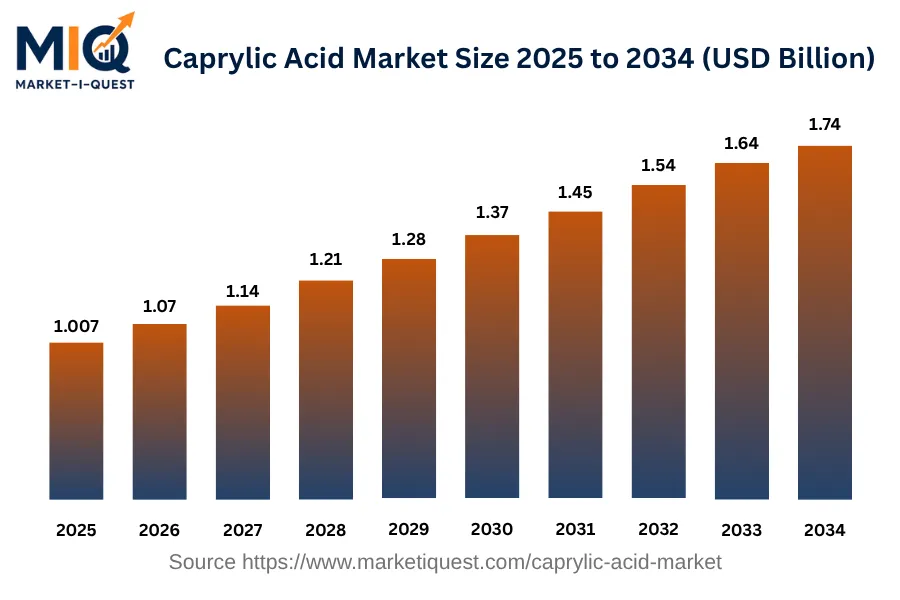
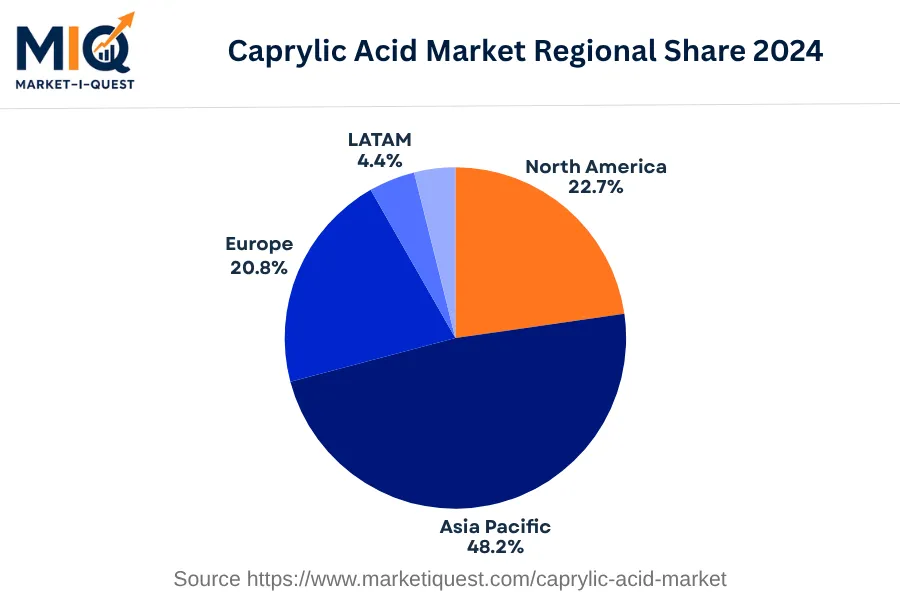
The Caprylic Acid Market size is projected to increase from USD 1.01 billion in 2025 to USD 1.74 billion by 2034. The Compound Annual Growth Rate (CAGR) over this period is calculated at 6.3%. In 2024, the market value was USD 0.95 billion. This growth can be attributed to a growing demand for Caprylic Acid across different regions. The regional shares in 2024 were as follows: North America accounted for 22.7% of the total market share, followed by Asia Pacific with a significant 48.2%. Europe had a share of 20.8%, while the remaining portion was distributed between Latin America and Middle East & Africa, with 4.4% and 3.9% respectively. The substantial share of Asia Pacific is due to the extensive usage of Caprylic Acid in that region. These figures provide an overview of key regional market segments and their contribution to the overall Caprylic Acid Market.

Key Takeaways

  • By Source - Palm Oil subsegment held the highest proportion in the Caprylic Acid Market in recent years.
  • By End User - Chemicals was the dominant accounting for notable market share in this period.
caprylic-acid-market market size

Key Driving Factors

Shift towards Natural Additives in Food and Beverage Industry

The caprylic acid market is being driven significantly by the consumer shift towards natural food additives in the food and beverage industry. Caprylic acid, being a medium-chain fatty acid, is increasingly favored as a healthier alternative to artificial preservatives in food production. It offers antimicrobial properties, which not only extend the shelf-life of products, but also meet consumer expectations for natural, clean-label ingredients. Large food manufacturers are constantly searching for such value-added ingredients that align with consumer preference. This means they are willing to increase their procurement of caprylic acid, which stimulates market growth. In certain jurisdictions such as the European Union, regulatory bodies actively encourage the use of natural food preservatives, which further pushes this trend forward.
Increase in Use of Caprylic Acid in Personal Care Products

Another key driver for the caprylic acid market is its growing inclusion in personal care products, especially anti-aging formulations and products dealing with skin disorders. Caprylic acid, with its antibacterial and antifungal properties, has been found beneficial in treating skin conditions like acne and psoriasis. This has particularly increased its value in the cosmetics industry. Many major personal care brands have begun adopting caprylic acid in their product formulations, fueling demand. At the same time, consumers' rising interest in personal care products containing natural ingredients also stimulates caprylic acid market growth and drives companies to increase its usage in their product lines.

Market Evolution by Timeline

2019-2023
The Caprylic Acid Market was led by Asia Pacific, particularly China and India. Buyers were majorly from the personal care industry, pharmaceuticals, and food & beverages. The usage was largely driven by the antimicrobial and antibacterial properties of caprylic acid. Supply constraints influenced by price volatility of the raw materials and integration complications with other ingredients were evident. Despite this, the development of cost-effective production methods marked a significant milestone in technology deployment. Commercially, contract manufacturing became prevalent, while periodic pricing ruled the market. Product recalls due to contamination risks were addressed through stringent quality checks and increased investments in research and development.
2024
By 2024, North American region began to show potential, alongside Asia Pacific in the Caprylic Acid Market. Dietary supplements and food & beverages industry were main buyers, given the growing acknowledgment of caprylic acid for its anti-aging properties. There were fewer supply constraints largely owing to better raw material chain management by companies. Technology-wise, precise methods for integrating caprylic acid with other lab chemicals emerged, reducing product contamination. Price sensitivity continues with businesses leaning towards long-term contracts and bulk purchases. The risk of inefficient manufacturing processes remained but improving output capabilities served as mitigation.
2025-2029
From 2025 to 2029, the Caprylic Acid Market saw increased demand from Europe, due to a rise in the vegan population, thus propelling the use of caprylic acid in vegan products. Technological advances facilitated manufacture of pure caprylic acid, improving its release in end-products. While procurement models still geared towards long-term contracts, flexible pricing models came into existence. Also, partnerships with local manufacturers emerged as a key growth strategy. Regulation 1223/2009 enforced in Europe demanded more rigorous safety assessments for cosmetics, impacting the use of synthetic caprylic acid. Risks included unreliable raw material supply, countered through inventory management techniques.
2030-2034
The period 2030-2034 observed African countries becoming a part of the customer base in Caprylic Acid Market due to the evolving cosmetics industry there. Technology took a leap with AI impacting product formulations and cloud technologies aiding in supply chain management. Rapid growth called for the need of green chemistry principles in production methods, as environmental policies gained momentum worldwide. The conventional pay-per-use model paved way for performance-based contracts, with a focus on product effectiveness. Main risk was the changing regulatory landscape, pushing companies to continuously innovate without compromising on adherence to the regulations.

Future Market Outlook

Future Opportunities

With the current trajectory of the caprylic acid market, several future opportunities appear viable. The growing focus on plant-based alternatives is fostering demand for caprylic acid derived from coconut oil, leading companies like Kao Corporation to explore sustainable sourcing strategies. Regulatory bodies such as the FDA have been increasingly supportive of natural additives, and ongoing discussions about updating food Safety regulations can further clarify the permissible use of caprylic acid in various applications. Additionally, as consumers become more health-conscious, the potential for caprylic acid in weight management products has been underscored by studies conducted in 2023 that highlight its role in promoting fat metabolism. The expanding e-commerce landscape provides a platform for new entrants to venture into the market, particularly small-scale producers, who can target niche segments. Furthermore, the personal care sector's continued growth presents opportunities for caprylic acid in skin care and hair care products, as seen with brands capitalizing on natural ingredients. Partnerships between manufacturers and research institutions aimed at exploring novel applications of caprylic acid could enhance its incorporation in pharmaceuticals and nutraceuticals. In 2023, multi-national firms began collaborations focused on clinical research, which suggests a burgeoning interest in investigating the therapeutic properties of caprylic acid. As innovative formulations emerge, the versatility of caprylic acid is likely to open new avenues in various sectors globally.

Segmentation Analysis

By Source

The market is divided into subsegments including Coconut Oil, Palm Oil, and Mammal Milk. Palm Oil accounted for the largest revenue share while Coconut Oil is expected to grow at the fastest CAGR during the forecast period.

Largest Revenue Share

Palm Oil

Market Share Leader

Palm Oil has been successful in securing the highest revenue amongst its counterparts due to several factors. Primarily, its elevated usage in diverse sectors such as in food & beverages industry due to its versatile advantages has led it to the top spot. Additionally, Palm Oil has been adopted by several manufacturers owing to its cost-effectiveness and easy availability making it a popular choice among mass consumer goods. Its high yield rate compared to other oil crops is another contributing factor boosting its demand in the market. Geographically, the demand for Palm Oil is high in the Asia-Pacific region, particularly in countries like Indonesia and Malaysia, that are the top producers and consumers of Palm Oil. The market dynamics also reflect a strong supply chain with multi-channel distribution networks further fuelling the dominance of Palm Oil. We certainly need to note the regulatory aspect of Palm Oil production, which is under scrutiny due to environmental considerations; however, it hasn't significantly derailed its market leading position.

Fastest CAGR

Coconut Oil

Forecast Period Growth Leader

On the other hand, Coconut Oil is forecasted to experience the fastest growth rate. The expected growth is driven by a range of factors. Health consciousness among consumers, for one, has led to increased adoption of Coconut Oil due to its recognized health benefits. Particularly, its high demand in culinary and cosmetic applications is driving market growth, alongside its use in manufacturing 'green' detergents and soaps. Further, evolving dietary trends that favor plant-based and natural products have also acted as a catalyst for its growth. The influence of policy shifts, specifically those promoting sustainability and organic produce, also signals a positive outlook for Coconut Oil’s market position. However, high capital expenditure in coconut farming may pose as a growth barrier. In the near term, volatile weather conditions affecting yield could pose a risk; yet, the overall growth trajectory stays affirmative.

By End User

The market is divided into sub-segments including Personal Care and Cosmetics, Pharmaceuticals, Food & Beverage, Fertilizer, Chemicals, Others. The Chemicals sub-segment accounted for the largest revenue share while the Pharmaceuticals sub-segment is expected to grow at the fastest CAGR during the forecast period.

Largest Revenue Share

Chemicals

Market Share Leader

The Chemicals subsegment backed the majority of the industry's revenue in 2024. The main driver of its market dominance is the ubiquitous demand for various chemicals across diverse industries including manufacturing, construction, agriculture, packaging and others. A significant chunk of this demand emanates from the industrial economies where output and consumption of chemicals remain high. This wide-spanning utility and application base supports robust sales volumes for the chemicals industry. Furthermore, stringent regulations concerning the manufacturing and distribution of chemicals, particularly in developed markets, create significant entry barriers, ensuring concentrated market share for a handful of providers. Switching costs also serve as a deterrent for consumers to switch suppliers, further cementing the dominant position of mainstay players in the market. Thus, despite the environmental concerns and volatility in raw material prices, the chemicals segment is expected to maintain its revenue lead in the foreseeable future.

Fastest CAGR

Pharmaceuticals

Forecast Period Growth Leader

The Pharmaceuticals sub-segment is projected to be the fastest-growing part of the market, due to a few key reasons. Firstly, the recent global health crisis has amplified the need for innovative medication and vaccines, thus escalating pharmaceutical R&D spending. Second, with the aging population in developed countries, demand for medical solutions for chronic diseases is on the rise. Advances in technology and precision medicine are catalyzing the segment growth by personalizing patient treatment and thereby enhancing drug effectiveness. Additionally, breakthrough therapies, faster drug approvals and increased access to medication in emerging markets are set to further bolster the growth trajectory. However, high capital expenditure, regulatory complexities and pricing pressures could pose short-term risks for the sector's growth. Yet, robust innovation pipelines and deeper penetration into novel therapeutic areas are projected to navigate these barriers and drive the CAGR of the pharmaceuticals segment.

Competitive Analysis

Key Market Players

Manufacturers / OEMs

IOI Oleo GmbH
Germany
Wilmar BioEthanol
Australia
ECOGREEN OLEOCHEMICALS
India

Key Suppliers & Raw Materials

KLK OLEO
Malaysia
Chemical Associates
US
Acme Synthetic Chemicals
India

Distributors, Integrators & Channel Partners

Univar Solutions
US
Brenntag North America, Inc.
US
Nexeo Solutions
US

Porter’s Five Forces Analysis

An analysis of the caprylic acid market reveals distinct forces influencing competition and market profitability.

Supplier Bargaining Power

Medium

A cohesive supply chain, but dominated by a few major providers, influences market prices.

Buyer Bargaining Power

High

Many buyers in various industries with varying product utility enhances buyers' negotiation leverage.

Threat of Substitutes

Low

Limited substitute products available, locking in most buyers to this market.

Threat of New Entrants

Medium

High development costs impose barriers but potential profitability attracts newcomers.

Competitive Rivalry

High

Intense competition due to a high number of players competing on product quality and price.

Regional Analysis

Geographic market dynamics and growth opportunities across key regions

Global Market Outlook

caprylic-acid-market market regional share

North America

In 2024, North America's Caprylic Acid Market experienced significant growth due to various key drivers and trends. Rising consumer consciousness towards health and hygiene, specifically among U.S. and Canadian populations, dramatically drove demand for Caprylic Acid. Regulatory support from the U.S. Food and Drug Administration (FDA) endorsing Caprylic Acid’s safe usage across sectors further boosted market growth. Technological adoption in the production process was also a critical driver—advanced technology facilitated more efficient extraction of Caprylic Acid, catalyzing supply dynamics, particularly in Mexico. Evolving consumer trends, such as increased preference for organic personal care products, amplified Caprylic Acid market dynamics in North America. There was a notable shift in buyer behavior, with growing investments in clean-label products in the food & beverage industry. This was complemented by a surge in partnerships and mergers and acquisitions within the pesticide industry, where Caprylic Acid is used.

Sector-wise, healthcare and pharmaceuticals emerged as significant consumers of Caprylic Acid due to its extensive applications in treating diseases like Alzheimer's and Crohn’s. The rising demand for sustainable biofuels, most notable within the utilities sector, also became a significant market contributor. The North American retail industry, particularly in the U.S. and Canada, began stocking up Caprylic acid food supplements, reflecting changing consumer preferences towards health-centric products. This concentration in the North American market systematized the supply chain, creating a powerful trend within distribution channels.

Asia Pacific

In the year 2024, the Asian Pacific market exhibited robust dynamics in the Caprylic Acid industry, particularly in China, India, Japan, South Korea, Australia, and key ASEAN markets. Market drivers involved increased demand for organic personal care products, favorable government policies towards sustainable, plant-based chemicals, and investments in research and technological improvements within the chemical manufacturing sector. The strengthening of supply chain for raw materials, such as palm oil and coconut oil, paired with competitive pricing, significantly augmented market potential for this saturated fatty acid.

Market trends were largely characterized by changes in consumer behavior, with a notable increase for high-quality, pollutant-free product offerings especially in healthcare and retail sectors. A shift in technology fostered the production of synthetic caprylic acid, as manufacturers strived to reduce dependency on resource-intensive raw materials. Moreover, there was an uptrend in strategic partnerships and M&A activities to enhance product portfolio and expand market footprint. Policies enforcing strict environmental and safety standards on the production and use of chemicals also pervaded the business landscape, increasing the demand for natural and safe compounds like caprylic acid. These market dynamics underscored the Asian Pacific caprylic acid market's stature in 2024.

Europe

In 2024, the European Caprylic Acid Market was mainly driven by heightened demand in sectors such as pharmaceuticals, personal care, and food and beverages. Increased consumer attention to health and well-being propelled the pharmaceutical and personal care sectors, resulting in higher demand for Caprylic Acid due to its antimicrobial properties. More rigorous environmental regulations contributed to a surge in demand for sustainable and natural products, further inflating the market.

Dominant market trends revolved around advancements in production technologies and changes in purchasing behavior. Adoption of innovative and cost-effective production processes, notably in Germany and France, allowed caprylic acid manufactures to cater to surging demand effectively. Similarly, a shift towards e-commerce platforms in the United Kingdom, Italy, and Spain expedited product accessibility and availability, fuelling market growth. Sectors such as healthcare and food and beverage were key players in market dynamics. For instance, the healthcare sector in Central and Eastern Europe leveraged caprylic acid for pharmaceutical applications. The food and beverage industry in the Nordics and Benelux opted for caprylic acid as a natural preservative, responding to consumer preferences for sustainably-produced goods.

Latin America

In 2024, Latin America's Caprylic Acid market experienced significant activity, primarily influenced by revenue streams like food and beverage, personal care, and pharmaceutical sectors that adopted Caprylic Acid in their operations. Key drivers included surging demand for natural and organic food products, leading to increased use of Caprylic acid as a food additive in countries like Brazil and Mexico. Technology adoption, particularly in the pharmaceutical sector, played a crucial role as firms across Argentina and Colombia embraced Caprylic acid due to its antimicrobial properties. Also, governments' lax regulations on natural food ingredients escalated the acid's production.

Market trends were shaped by dynamic consumer behavior; heightened awareness about health issues led to preference of Caprylic acid-infused products, directly influencing retail and e-commerce channels. Coupled with a shift towards vegan products, this trend reinforced Caprylic acid's prominence in the Chilean personal care sector. Pharmaceutical manufacturers in Peru sought partnerships and mergers to streamline and diversify Caprylic acid application. However, price volatility of raw materials, notably coconut and palm oil, threatened market stability. Lastly, stringent policy enforcement concerning chemically synthesized products pushed enterprises towards naturally derived substitutes like Caprylic acid, signaling a major transition in LATAM's Caprylic Acid market.

Middle East & Africa

In 2024, the Caprylic Acid Market in the Middle East and Africa exhibited substantial growth. The market was driven mainly by the rising demand in industries such as healthcare, cosmetics, and manufacturing. Emphasis on wellness and healthcare in countries like Saudi Arabia and the United Arab Emirates attributed to the growing adoption of caprylic acid due to its antimicrobial properties. Additionally, favorable government regulations in countries like Israel and South Africa promoted capital investment in the local caprylic acid industry. Predominant trends included the increasing shift towards natural and organic products, which spiked caprylic acid demand in the personal care and food industry, particularly in Nigeria and Kenya. Notably, Qatar and Egypt witnessed an upsurge in channel dynamics due to digital transformation, enhancing the supply chain efficiency of caprylic acid in these regions. Moreover, there was a notable rise in partnerships, predominantly in manufacturing sectors across these regions, aimed at expanding the caprylic acid market.

The South African government, recognizing caprylic acid's potential in healthcare and cosmetics sectors, initiated policy enforcements promoting local production, causing a significant market shift. Nigeria's oil and gas sector utilized caprylic acid as a corrosion inhibitor, reflecting the diversifying consumer demand. Overall, the Middle East and Africa’s Caprylic Acid Market in 2024 saw advancement propelled by favorable regulations, enhanced digital infrastructure, and an upward trend towards organic products.

Recent Industry Developments

Latest market innovations, product launches, and strategic initiatives

January 2025

IOI Oleochemical announced process upgrades at its Southeast Asian facilities to improve fractionation efficiency for medium-chain fatty acids, including caprylic acid, with a focus on purity consistency and downstream application reliability.

Frequently Asked Questions