Capnography Devices Market Snapshot

Key Players

  • Medtronic (Ireland)
  • Masimo (United States)
  • Koninklijke Philips (Netherlands)
  • Smiths Group (United Kingdom)
  • Drägerwerk (Germany)
  • Nonin Medical (United States)
  • ZOLL Medical Corporation (United States)
  • Nihon Kohden (Japan)
  • Welch Allyn (United States)
  • Infinium Medical (United States)

Market Size

Base Year 2024
$0.848 Bn
CAGR
7.93%
Forecast 2034
$1.82 Bn

Market Segments

By Type
Hand-Held, Stand-Alone, Multi-Parameter
By Technology
Mainstream, Sidestream, Microstream
By Application
Emergency Medicine, Pain Medicine, Procedural Sedation, Critical Care, Others
By End Use
Hospitals, Ambulatory Care Centers, Others

Market Dynamics

Drivers
  • Rising prevalence of respiratory diseases
  • Technological advancements in capnography devices
Restraints
  • High initial investment cost
  • Lack of skilled personnel
Opportunities
  • Emerging markets growth
  • Technological advancements in capnography devices

Market Size

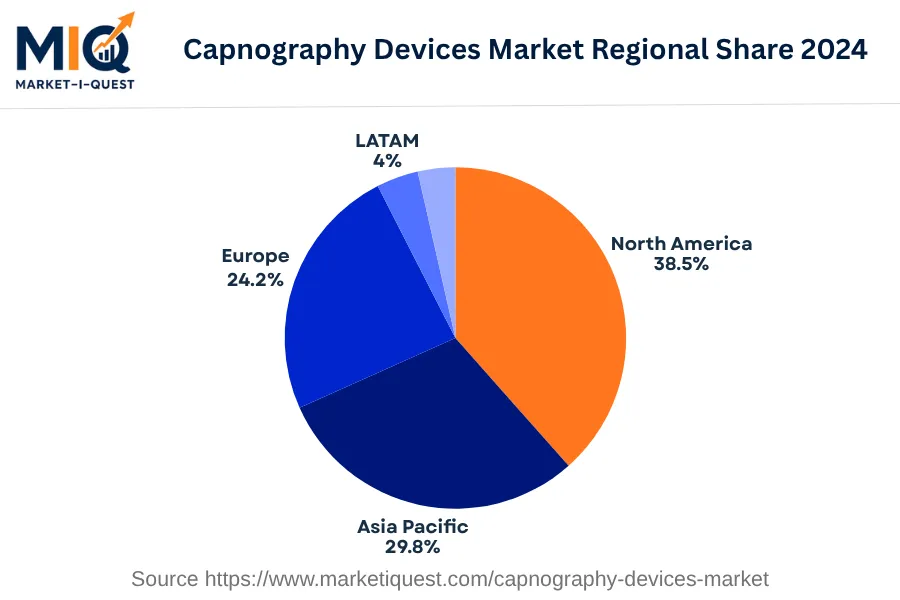
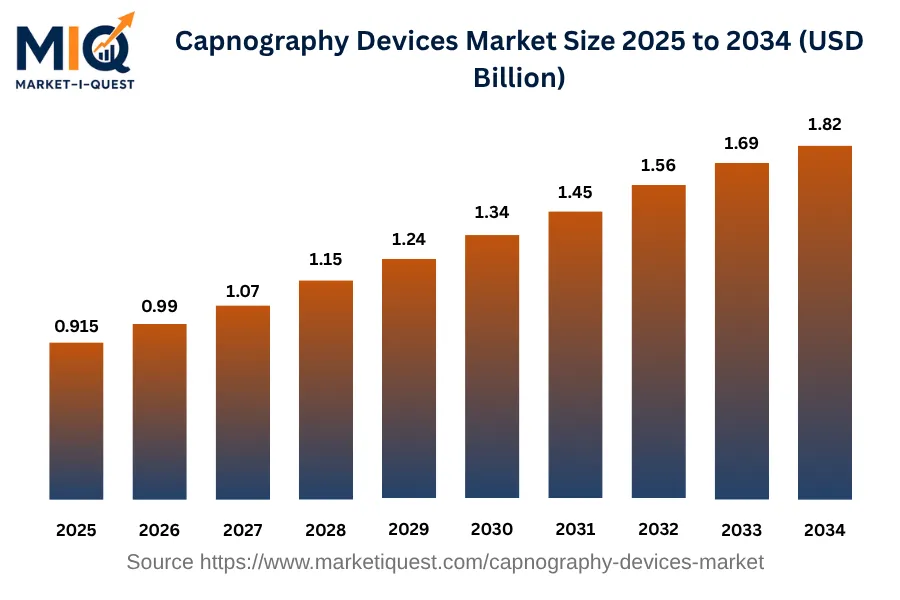
The Capnography Devices Market in 2025 is projected to reach USD 0.92 billion, up from USD 0.85 billion in 2024. This growth continues to 2034, when the market size is expected to significantly increase to USD 1.82 billion, representing a compound annual growth rate (CAGR) of 7.93% over the period. A couple of factors influencing this growth include technology advancement and increased utilization in medical procedures. Still in 2024, North America holds the largest regional share in the capnography devices market, accounting for 38.5% of the total. This is followed by the Asia Pacific and Europe regions, which comprise 29.8% and 24.2% of the market respectively. Latin America and the Middle East and Africa have smaller shares, with the former making up 4.0% and the latter contributing 3.6% to the overall market size.

Key Takeaways

  • By Type - Stand-Alone segment held a significant share in the Capnography Devices Market in 2024.
  • By Technology - Mainstream technology led the market holding a considerable share in 2024.
  • By Application - Emergency Medicine segment led the Capnography Devices Market in 2024.
  • By End Use - Hospitals emerged as the leading segment in the Capnography Devices Market in 2024.
capnography-devices-market market size

Key Driving Factors

Assertive Guidelines for Patient Safety

The globally accepted regulations by the health departments regarding patient safety specifics have a strong correlation with the market dynamics of capnography devices. A concrete example is the Joint Commission's National Patient Safety Goals, which effectively compel healthcare facilities to monitor the CO2 levels in patients during moderate to deep sedation. The main objective behind this is to reduce the risk of adverse events during sedative procedures. As a consequence, this regulation has driven many healthcare facilities to procure and use capnography devices. This, in turn, increases their market demand and drives sales.

Rise in Popularity of Multi-Parameter Monitoring Devices

The increasing interest in multi-parameter monitoring devices among healthcare professionals is another key driver for the capnography devices market. Specifically, the market has seen a rise in demand for capnometers, a type of capnography device, that also perform multi-parameter monitoring. These devices do not just track the level of CO2 in a patient's respiratory system, but also simultaneously monitor various vital signs such as heart rate, body temperature, and blood oxygen levels. As healthcare professionals seek more comprehensive and efficient ways to monitor patient health, demand for multi-parameter monitoring devices, inclusive of capnometry, rises. Thus, expanding the capnography devices market.

Market Evolution by Timeline

2019-2023
During this period, user demand in developed economies, including the USA and Europe, increased. This was largely driven by emergency medical services and general care/surgery settings. Technological developments included the introduction of compact, handheld capnography devices. Despite technological advances, integration with existing medical systems remained a constraint. In terms of policy, the American Society of Anesthesiologists recommended Capnography monitoring in anesthesia administration. There was a trend towards cost-plus pricing models, and major mergers and acquisitions included Medtronic's acquisition of Covidien. Supply shortages posed a risk, partly mitigated by diversifying supply chains.
2024
In 2024, the capnography devices demand surge was observable in the emerging markets, notably India and China. Continuous capnography in anesthesia was a significant use case. Multi-Parameter monitoring devices became prevalent, but medical staff training demanded effort. The World Health Organization's focus on reducing anesthesia-related deaths globally acted as a guiding policy. Device renting became a commercial model, especially in cost-sensitive markets. The device shortage risk lingered, likely due to the increased demand in emerging economies. Manufacturers' response included expedited production and exploring alternative supply chains.
2025-2029
Growth in demand from home care settings and nursing homes characterizes this period. Technological improvements leaned towards non-intubated capnography and wireless models. Nonetheless, interoperability across brands still posed challenges. Regulation saw the European Union's Medical Device Regulation influencing design and safety standards. Leasing continued as a preferred commercial model. Contract modifications included maintenance and replacement clauses. Increased device sophistication risked rendering some models prohibitive for lower-income segments. Manufacturers' responses included offering simpler, lower-cost models, thus broadening the product range.
2030-2034
During these years, demand from veterinary medicine bolstered the market. Technology shipped included AI-enhanced devices enabling better patient monitoring. Battery limitations restricted comprehensive remote monitoring. Policies like the Veterinary Medicine Regulations in the EU played critical roles in device certification and use. A shift towards value-based pricing models was evident. Strategic partnerships between device manufacturers and vet clinics became common, as clinics offered packages including capnography. Shortage risks, a commonality over the years, persisted, sprouting from increased demand in veterinary applications. Manufacturers responded by dedicated production lines for this sector.

Future Market Outlook

Future Opportunities

Future prospects in the capnography devices market are closely tied to current healthcare trends emphasizing patient-centered care and remote monitoring. In 2023, the World Health Organization advocated for increased telehealth capabilities to address challenges presented by the ongoing pandemic, which has prompted healthcare providers to seek remote capnography solutions. Companies like Medtronic and Philips are actively developing solutions that cater to this demand, focusing on features such as analytics for patient management and early detection of respiratory failure. Partnerships between hospitals and technology firms, including recent collaborations by Siemens Healthineers, are prioritizing the co-creation of integrated systems that make capnography data accessible on various platforms. Innovations in artificial intelligence and machine learning are being explored to enhance decision support systems for clinicians. Regulatory advancements, including those from Health Canada, are likely to simplify the approval process for next-generation capnography devices, enabling quicker market entry. These combined efforts suggest opportunities for market growth driven by technological integration, a focus on interoperability, and enhanced user experiences tailored to both patients and healthcare providers. As these initiatives continue to evolve, stakeholders may find new avenues for addressing the needs of an increasingly complex healthcare landscape.

Segmentation Analysis

By Type

The market is divided into subsegments including Hand-Held, Stand-Alone, and Multi-Parameter. The Stand-Alone subsegment accounted for the largest revenue share while the Multi-Parameter subsegment is expected to grow at the fastest CAGR during the forecast period.

Largest Revenue Share

Stand-Alone

Market Share Leader

The Stand-Alone subsegment holds the largest revenue share due to its extensive utility and versatility, which makes it a top choice across different industries. Stand-Alone units are often preferred for their ability to perform without needing to be connected to any other system, making them suitable for a variety of tasks. They are favored for critical operations where reliability and autonomy are paramount. Regulations in some markets also encourage the use of Stand-Alone systems due to their independence from potentially unreliable or interfering resources. Their purchasing patterns have been stable, underpinning predictable, high-volume sales. The switching costs for customers shifting to alternatives are also high, given the capital expenditure and operational change involved. Geographically, established markets with mature industries have been prominent contributors to its revenue as these regions host a majority of the user industries.

Fastest CAGR

Multi-Parameter

Forecast Period Growth Leader

On the other hand, the Multi-Parameter subsegment is expected to grow at the fastest CAGR during the forecast period. Despite its current smaller size, factors such as growing technological advancements, increasing partnerships, and favorable policies are driving its growth. Technology innovations are enabling Multi-Parameter equipment to offer more sophisticated outputs, increasing their usefulness and efficiency. Significant capital investment is being pumped into its development in the hopes of disrupting the market. Barriers to adoption still exist, primarily because of higher upfront cost and complexity in operation compared to single-parameter devices. However, increasing partnerships between manufacturers, software developers, and users are enabling a more thorough understanding of this subsegment, helping overcome these adoption barriers. Still, near-term risks related to technology development and adoption rates need to be monitored for shifts in this growth trend.

By Technology

The market is divided into subsegments including Mainstream, Sidestream, and Microstream. The Mainstream subsegment accounted for the largest revenue share while the Microstream subsegment is expected to see the fastest growth during the projected period.

Largest Revenue Share

Mainstream

Market Share Leader

Mainstream technology leads the market in terms of revenue due to its widespread adoption and inherent advantages. Customers prefer mainstream technology due to its effectiveness and ease of use. Mainstream technology has the highest acceptance rate given its proven track records and reliability drawing the highest income across the globe. This technology is in high demand broadly in many developed nations that are keen on investing in proven and effective technologies. Regulatory approvals for mainstream technologies are relatively easy to obtain given their demonstrated efficiencies, which further propels the segment's growth. The mainstream technology buying criteria usually center on efficacy, proven results, and cost-effectiveness. Since this technology is already established in the market, switching costs are relatively high, thus discouraging customers from opting for emerging alternatives. The mainstream technology segment sales are majorly through direct channels and established distribution networks.

Fastest CAGR

Microstream

Forecast Period Growth Leader

Microstream technology, while not accounting for the largest revenue share currently, shows promise for high growth rate in the coming years. This is driven by various factors such as advancements in technology and an increasing willingness among users to adopt innovative solutions. Those looking for cutting-edge, highly efficient solutions are breaking away from traditional mainstream choices and exploring Microstream. This technology's low capital expenditure (capex) is a key factor propelling its adoption. Additionally, strategic partnerships between microstream technology providers and other companies in the market can further accelerate its use. While the technology shows potential, near-term risks such as user acceptance, regulatory approval, and channel development may impact the pace of growth. This innovative technology stands to disrupt the current market with its faster return on investment and superior performance.

By Application

The market is divided into subsegments including Emergency Medicine, Pain Medicine, Procedural Sedation, Critical Care, and Others. In terms of revenue, Emergency Medicine accounted for the largest share, while Procedural Sedation is expected to grow at the fastest CAGR during the forecast period.

Largest Revenue Share

Emergency Medicine

Market Share Leader

Emergency Medicine is an integral branch of healthcare which operates round the clock attending immediate medical needs of patients. Its necessity and prevalence in hospitals have cemented its place as the subsegment with the biggest revenue share. Diverse applications including ailment alteration, emergency physiotherapy, surgical procedures and trauma care among others drive the demand for this segment. The continuing rise of chronic diseases requiring immediate intervention fuels the revenue expansion significantly. Geographically, developed regions like North America contribute significantly to this, with a robust healthcare infrastructure propped by favorable government policies. The inevitable role that emergency medicine plays in healthcare, coupled with increasing healthcare expenditure, aging population and medical advancements make it a substantial revenue-generating segment.

Fastest CAGR

Procedural Sedation

Forecast Period Growth Leader

Procedural Sedation, which involves administering sedatives or dissociative agents to relieve pain and protect the patient during a medical procedure, is expected to witness the fastest growth over the next few years. The rise in the number of surgical procedures, including elective surgeries, pain management, gastrointestinal endoscopy, and others, has boosted the need for procedural sedation. Additionally, advancements in medical technology leading to the introduction of safer and more effective sedative drugs enhance the growth trajectory of this subsegment. Another catalyst is the growing partnerships among pharmaceutical companies to develop better compounds for procedural sedation. However, risks include potential side effects of sedative drugs and strict regulatory scenarios. Still, the foreseeable increase in surgeries and the focus on patient comfort makes this subsegment a key growth area.

By End Use

The market is divided into subsegments including Hospitals, Ambulatory Care Centers, and Others, with Hospitals accounting for the largest revenue share, while Ambulatory Care Centers is expected to grow at the fastest CAGR during the forecast period.

Largest Revenue Share

Hospitals

Market Share Leader

Hospitals, with their comprehensive range of services and large patient bases, constitute the segment with the greatest revenue within the market. Hospitals routinely provide high-value treatments, including surgical procedures, emergency care, and specialized diseases management, which contribute significantly to their revenue. Since hospitals serve a wide demographic with varying conditions, their revenue streams are typically diversified, underpinning stability. Moreover, infrastructure investments in healthcare across many regions, particularly in metropolitan areas, have expanded hospital networks and increased their capacity to treat patients, further driving revenues. The regulatory environment, which compels strict adherence to safety and quality standards, also necessitates high-value investments in technology and training, increasing costs of service providing and, consequently, revenues. Moreover, the purchasing patterns, driven by the need for quality care, tend towards hospitals, strengthening their market position.

Fastest CAGR

Ambulatory Care Centers

Forecast Period Growth Leader

Ambulatory Care Centers, while not boasting the largest revenue, are presently experiencing the fastest rate of growth. There are multiple drivers behind this trend. One significant factor is the advancing medical technology, which is increasingly enabling procedures to be performed in outpatient settings. This shift is driven by both the capex efficiency of ambulatory care and the patient preference for less invasive treatments with shorter recovery times. Policy changes encouraging outpatient treatments to minimize hospital overloads, particularly amid pandemic situations, are propelling this subsegment's growth as well. Partnerships and tie-ups between hospitals and ambulatory centers, which enable more efficient patient management, are also contributing to this swift growth. However, adoption barriers still exist, primarily due to the perception of lower service quality in ambulatory care centers and regulatory constraints constricting their scope of services. Yet, given the current growth catalysts, the ambulatory care centers segment shows robust potential.

Competitive Analysis

Key Market Players

Manufacturers / OEMs

Medtronic
Ireland
Philips Healthcare
Netherlands
Masimo
US

Key Suppliers & Raw Materials

Nonin Medical Inc.
US
Welch Allyn, Inc
US
Dragerwerk AG & Co. KGaA
Germany

Distributors, Integrators & Channel Partners

Cardinal Health
US
Henry Schein, Inc.
US
Fujifilm Holdings Corporation
Japan

Porter’s Five Forces Analysis

This analysis provides insights into the competition structure within the Capnography Devices Market.

Supplier Bargaining Power

Medium

Suppliers have moderate power due to the reliance on technological advancements and raw material quality.

Buyer Bargaining Power

High

Increasing consumer awareness and availability of alternative options give higher bargaining power to buyers.

Threat of Substitutes

Low

Low threat due to the unique application and benefits of capnography devices over other monitoring devices.

Threat of New Entrants

Medium

Entry is moderately easy given sufficient capital and industry know-how, yet regulations and technical requirements pose challenges.

Competitive Rivalry

High

High competitiveness due to the presence of several global and regional industry leaders.

Regional Analysis

Geographic market dynamics and growth opportunities across key regions

Global Market Outlook

capnography-devices-market market regional share

North America

In 2024, the North American capnography devices market experienced substantial shifts, shaped strongly by technology adoption and regulatory movements. Hospital investment in these critical care pulmonary devices, driven by the rising need to monitor patient ventilation, crucially supported the market. Specific guidelines by health regulatory bodies such as the American Society of Anesthesiologists further reinforced this trend, mandating the usage of capnography in hospitals. Innovations in device technology also stimulated growth, with portable and multiparameter devices becoming more prevalent due to their efficiency and versatility.

Consumer preference leaned more towards handheld capnography devices in healthcare settings such as hospitals, ambulatory centers, and clinics, driving manufacturers to focus on this product type. A shift towards remote patient monitoring and telehealth services influenced this trend, as these devices offer real-time monitoring and quick results. Partnerships and strategic alliances among major players like Medtronic and Philips further consolidated the industry. Regulatory enforcement also influenced the market trajectory, with the FDA's strict regulations ensuring standardization in device quality and safety. The main consumers in this market spanned across healthcare providers in the U.S., Canada, and Mexico, with significant usage in emergency departments and surgeries where constant patient monitoring is essential.

Asia Pacific

In 2024, the Capnography Devices Market recorded robust growth in the Asia Pacific region due to rising healthcare standards and technology adoption. Drivers included regulations mandating the use of capnography in multiple healthcare settings, such as China's Ministry of Health's policy. These devices’ demand surged due to increasing investment in healthcare infrastructure, like India's Pradhan Mantri Swasthya Suraksha Yojana. The high adoption rate of advanced technologies, like Japan's multi-modal monitoring systems, provided impetus to the market growth.

Adoption of capnography devices was prevalent in key sectors, such as hospitals, ambulatory centers, and emergency medical services. Australia, a leader in creating standards for healthcare, triggered behavioral change among buyers leading to a preference for capnography devices in patient monitoring. The market saw product shifts towards handheld capnography devices due to their portability and cost-effectiveness. Noteworthy partnerships developed, as evident by South Korea's leading company, Mediana, collaborating with regional distributors for better market reach. ASEAN markets focused on capnography devices citing policy enforcement, with the Philippines Department of Health recommending these for enhanced patient monitoring. In conclusion, the rising demand for non-invasive procedures, standardization, and policy enforcement catalyzed the growth of the capnography devices market in the Asia Pacific region in 2024.

Europe

In 2024, the Capnography devices market in Europe demonstrated robust growth, thanks to increasing demand in the healthcare sector and the prevalence of respiratory diseases. Driving factors included stringent regulatory norms emphasizing patient safety during anesthesia, which significantly promoted adoption of these devices in countries such as Germany, the United Kingdom, and France. Furthermore, advancements in technology and elevated investment in research and development activities notably in Italy and Spain augmented the market growth. Additionally, pricing competitiveness, catalyzed by dominant players in the market, fostered supply dynamics positively.

As far as trends are concerned, a shift towards portable capnography devices was evident in healthcare settings across the Nordics, Benelux, and Central & Eastern Europe, primarily due to such devices' convenience and efficacy. Partnerships and mergers & acquisitions thrived, with major companies partnering with local manufacturers for expansion. In terms of policy enforcement, stricter adherence to health safety standards by hospitals, surgical centers, and emergency departments drove the proliferation of capnography devices. Reflecting on sectors, the highest application of capnography devices was observed in the healthcare domain, specifically in anesthesiology, emergency medicine, intensive care, and post-operative care in hospitals and healthcare facilities. It is important to note that this performance in 2024 is the outcome of market specifics in this particular year in Europe.

Latin America

In 2024, the Capnography Devices Market in Latin America exhibited steady growth, driven by diverse factors across key countries including Brazil, Mexico, Argentina, Colombia, Chile, and Peru. Various drivers fueled market expansion. Increased prevalence of respiratory and cardiovascular diseases raised demand for improved monitoring. Introduction of stringent healthcare regulations in Brazil and Mexico mandated the use of capnography in anesthesia procedures, boosting device adoption. Investment in healthcare infrastructure witnessed a rise as Argentina prioritized modernization, fueling procurement of advanced Capnography Devices. Lastly, declining device prices induced by increased local manufacturing, especially in Colombia, stimulated market growth.

Trends indicated shifts in market dynamics. Increased awareness of patient safety standards, particularly in Chile, propelled hospitals' inclination towards adopting capnography for procedural sedation. There was a significant shift towards mainstream capnography, driven by its accuracy and reliability, evident in Peru's healthcare landscape. Further, technological advancements in the form of portable capnography devices gained traction, especially among outpatient services. Latin American healthcare providers also observed a spike in adoption due to partnerships and M&As among local and international players aimed at expanding their presence in this region. Sectors at the forefront of this trend included, enterprises, government health agencies, healthcare services, and medical device manufacturing units, all key contributors to the growth and evolution of the Capnography Devices Market in LATAM in 2024.

Middle East & Africa

In 2024, the Capnography Devices Market in the Middle East and Africa showed significant activity. Driving factors included stringent regulatory standards enforcing patient safety in countries like South Africa and Israel, especially in their healthcare sector. In the Middle East, especially Saudi Arabia, Qatar, and the United Arab Emirates, steady investments in healthcare infrastructure greatly influenced the market dynamics. Lastly, rapid adoption of advanced technologies across this region also played key roles in extending the capnography devices market footprint.

Market trends indicated robust growth, with shifts towards next-generation capnography devices observed across numerous healthcare institutions in the region. This was particularly evident in Egypt and Nigeria, where the government's policy enforcement facilitated these shifts. Moreover, partnerships and M&A activities were common in Kenya, with the goal of enhancing product availability. In Israel, with its strong technology sector, advancements in product standards significantly affected capnography device trends. In the healthcare sector and beyond, broader supply dynamics and innovative pricing strategies in the region have had visible impacts on buyer behavior, further shaping the market landscape for capnography devices in the Middle East and Africa in 2024.

Recent Industry Developments

Latest market innovations, product launches, and strategic initiatives

February 2026

Danaher Corporation completed the acquisition of Masimo Corporation for approximately $9.9 billion, underscoring the strategic value of specialized diagnostic technologies in acute care settings. The acquisition marks a significant consolidation event in the capnography and patient monitoring market.

September 2025

Capsule Technologies received FDA approval for its capnography monitor, a device capable of monitoring end-tidal carbon dioxide (EtCO₂), respiratory rate, and fractional inspired CO₂.

Frequently Asked Questions