Camping Cooler Market Snapshot

Key Players

  • Yeti (United States)
  • Igloo Products Corp. (United States)
  • Coleman Company Inc. (United States)
  • Stanley (United Kingdom)
  • Pelican Products Inc. (United States)
  • Engel Coolers (United States)
  • Grizzly Coolers (United States)
  • Koolatron (Canada)
  • Dometic Group (Sweden)
  • Camco Manufacturing (United States)

Market Size

Base Year 2024
$1.07 Bn
CAGR
5.4%
Forecast 2034
$1.81 Bn

Market Segments

By Type
Thermoelectric Cooler, Hard Cooler, Soft Cooler
By Material
Plastic, Metal, Others
By Capacity
Under 25 Quart, 25-40 Quart, 41-60 Quart, 61-100 Quart, Over 100 Quart
By Application
Backyard and Car Camping, RV Camping, Backpacking, Ship and Fishing, Others

Market Dynamics

Drivers
  • Increased outdoor recreational activities
  • Advancements in cooler technology
Restraints
  • Seasonal demand fluctuations
  • High competition intensity
Opportunities
  • Rising outdoor activities trend
  • Increased eco-tourism awareness

Market Size

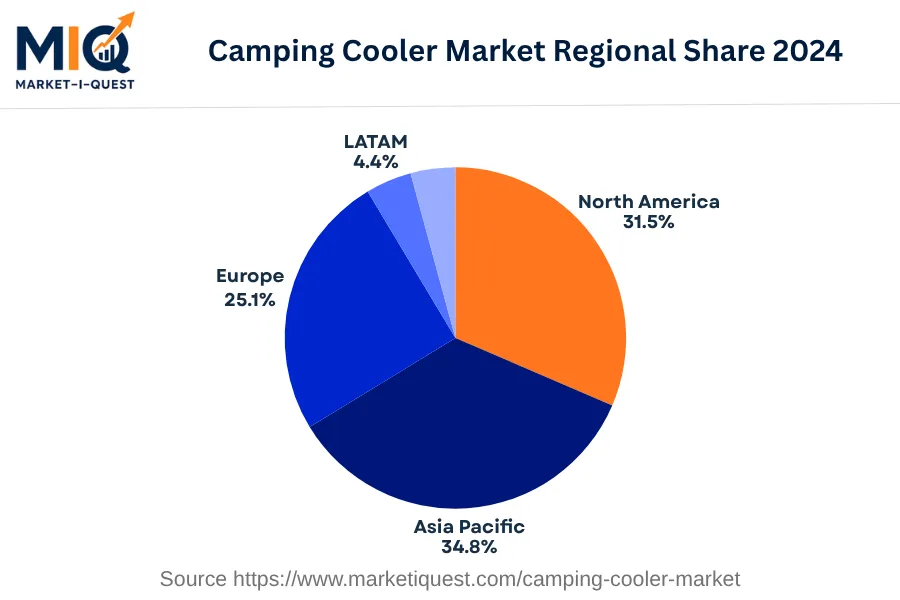
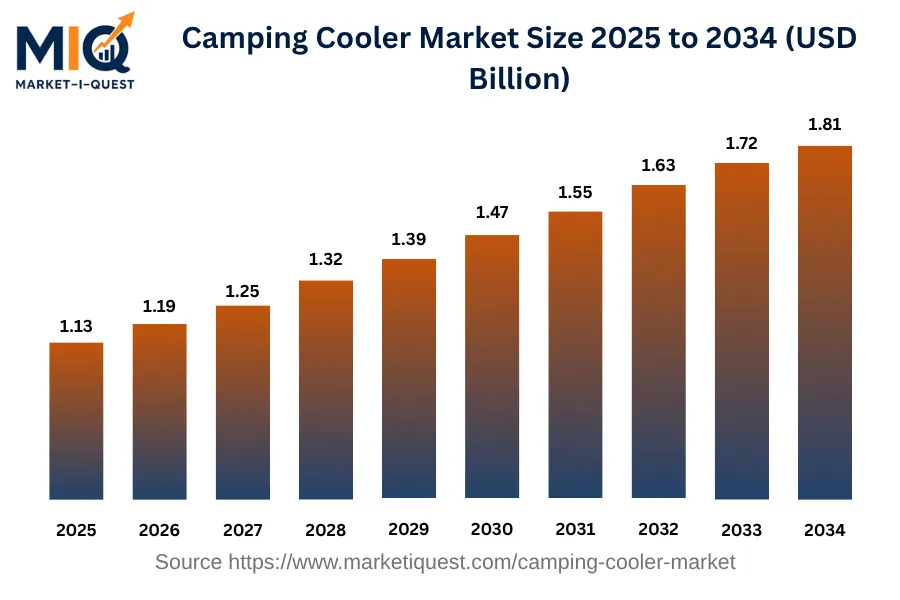
The Camping Cooler market in 2025 is expected to reach a size of $1.13 billion, up slightly from the $1.07 billion recorded in 2024. Furthermore, it is projected to grow over the next decade and by 2034, it is anticipated to reach $1.81 billion, expanding at a Compound Annual Growth Rate (CAGR) of 5.4%. This increase can be attributed to several factors including the rising popularity of outdoors activities such as camping, continuously improving product quality, and changing consumer preferences which are driving demand for more advanced and high quality camping coolers. In terms of regional share in 2024, the market is distributed as follows: Asia Pacific owns the largest share at 34.8%, followed by North America at 31.5%, and Europe at 25.1%. Meanwhile, Latin America and the Middle East and Africa have the smallest shares at only 4.4% and 4.2% respectively.

Key Takeaways

  • By Type - Hard Cooler segment held a prime position in 2025 due to its efficiency and convenience.
  • By Material - Plastic led the market in durability and cost-effectiveness accounting for a significant share in 2025.
  • By Capacity - 25-40 Quart range was the most popular amongst consumers accounting for the majority market share in 2025.
  • By Application - RV Camping was leading segment owing to increasing participation in outdoor recreational activities as of 2025.
camping-cooler-market market size

Key Driving Factors

Adoption of Sustainable Materials in Cooler Design

Today, camping cooler manufacturers are shifting towards the usage of eco-friendly and sustainable materials. This trend emerges as a response to increasing consumer awareness and preference for eco-friendly products. Manufacturers are using materials like recycled plastics, and exploring alternative sources such as bioplastics, to meet this growing demand. This shift towards sustainability is particularly prominent in North America and Europe where consumers are exceptionally conscious about the environmental impact of their consumption. The adoption of these materials has led to the production of premium camping coolers, marketed as ethical and sustainable alternatives, thereby driving the camping cooler market in these regions.

Introduction of Advanced Cooling Technologies

The camping cooler market is benefiting from the integration of advanced cooling technologies. For instance, manufacturers are introducing coolers with temperature control mechanisms that allow food and beverages to remain cold for an extended period. Companies like Yeti and Igloo are pushing the innovations in this field, with products offering ice retention capabilities of up to 5-6 days. These technological improvements, enhancing both user convenience and cooler efficiency, are attracting consumers who regularly embark on long-duration camping trips, picnic, or expedition. Such advances in cooling technologies are set to drive the camping cooler market, particularly in developed economies, as they often involve higher price points, hence, escalate the market value.

Market Evolution by Timeline

2019-2023
During 2019–2023, camping cooler buyers were mostly on-the-go individuals, families, and outdoor trekkers across North America, Europe, and Australia due to their outdoor culture and recreational activities. Traditional hard-top coolers dominated the market, with YETI and Coleman being the key suppliers. But, there was a rising interest in portable and soft-sided models such as those offered by Orca or Arctic Zone. Pricing was mostly premium due to the longer lifespan and high durability of these coolers. No specific regulations affected the market, but environmental awareness was gradually driving demand towards eco-friendly manufacturing processes.
2024
In 2024, Asian markets, especially China and India, showed an increase in demand for camping coolers due to their growing middle-class population and interest in outdoor activities. New trends in technology emerged like solar-powered coolers or rechargeable thermo-electric models started to gain traction, centred around brands like GoSun Chill and LiONCooler. The commercial model shifted towards online retailers and direct-to-consumer channels. Pricing saw a relative decline due to a rise in local manufacturers. Risks included possible patent infringements by copiers in less-regulated markets.
2025-2029
Between 2025 and 2029, sales for camping coolers saw steady growth globally. The demand was high in areas with substantial outdoor activity, such as Western Europe, North America, and some parts of Asia. Consumers increasingly leaned towards lightweight and compact models that could easily fit in vehicles or carry by hand for short trips, for which Yeti Hopper and Engel HD30 were popular. Price competition became fiercer with the entry of multiple new players, leading to more affordably priced coolers in the market. The adoption of IoT technology became evident in the higher-end versions offering temperature control and tracking features.
2030-2034
In 2030–2034, demand for high-tech camping coolers increased with a wider acceptance of IoT and smart devices among off-grid campers and RV travelers. Regulations pushing the use of sustainable materials in manufacture was a significant influencer, leading to brands like Igloo and Koolatron shifting material use. In response to fast-evolving consumer needs, supply became more diverse, and technology integration advanced, with coolers featuring smart temperature adjustment, mobile charging, and solar power capabilities. As a commercial model, subscription services and bundled offerings with camping gear rented to consumer groups became popular. The entrance of tech giants into the market raised concerns about the patent rights of existing manufacturers.

Future Market Outlook

Future Opportunities

The camping cooler market presents numerous opportunities driven by evolving consumer preferences and an increasing focus on sustainability. In 2023, a notable trend has been the growing demand for lightweight, portable coolers, which aligns with the lifestyle changes of outdoor enthusiasts seeking to reduce the weight of their gear. As brands recognize the trend, companies like Pelican are enhancing their modular designs, targeting multi-functional use that appeals to both casual campers and serious adventurers. The rise of eco-conscious consumers is prompting manufacturers to innovate further in sustainable materials; companies are experimenting with biodegradable components, as seen in the recent pilot program by IceMule with its biodegradable cooler bags. Additionally, improvements in manufacturing processes could lead to cost-savings and reduced environmental impact. A collective focus on exploring sustainable production methods is likely to lead to initiatives comparable to the Circular Economy adopted by the European Union, which encourages resource-efficient practices. Adventure tourism is gaining traction, creating a potential expansion segment for camping cooler brands to collaborate with travel operators and outdoor activity providers. Partnerships focusing on promoting eco-friendly camping solutions can enhance brand visibility and loyalty among environmentally conscious consumers. Depending on future regulations and consumer trends, the market is poised to evolve, inviting competitive dynamics that align with contemporary values and an outdoor-centric lifestyle.

Segmentation Analysis

By Type

The market is divided into subsegments including Thermoelectric Cooler, Hard Cooler, and Soft Cooler. The Hard Cooler subsegment accounted for the largest revenue share while Soft Cooler is expected to grow at the fastest CAGR during the forecast period.

Largest Revenue Share

Hard Cooler

Market Share Leader

The Hard Cooler subsegment holds the largest stake in revenue based on their ubiquitous usage, widespread availability, and cost efficiency. These coolers have a wide range of applications – from personal uses such as picnics or camping, to commercial and professional settings like food services or medical storage. Furthermore, Hard Coolers, being relatively sturdy and rugged compared to their counterparts, are the preferred choice in rugged environments and for industrial usages, boosting their market dominance. Moreover, their superior insulation capabilities coupled with their ability to keep items cold for a longer duration are additional factors that contribute to their high revenue contribution. The purchasing decision of Hard Coolers is driven by various factors, such as durability, storage capacity and insulating properties, where Hard Coolers generally outperform. Regional factors also come into play. In regions with hotter climatic conditions, for instance, there's a higher demand for these coolers, which further drives revenue. It should be noted that these trends are based on typical industry dynamics.

Fastest CAGR

Soft Cooler

Forecast Period Growth Leader

Despite not being the highest in terms of revenue, Soft Coolers are projected to experience the most rapid growth. The reasoning for this can be attributed to several key factors. Firstly, the increasing consumer preference for lightweight and easily transportable cooling solutions is driving the demand for Soft Coolers. Additionally, improvements in insulation technologies have significantly improved the thermal performance of Soft Coolers, increasing their attractiveness amongst consumers. Introducing advanced materials and design elements to increase user-friendliness, durability and aesthetics increasingly drives consumer interest and accelerates adoption. Collaboration between cooler manufacturers and material technology providers to improve the longevity and performance of these products also enhances growth potential. Caveats for this optimistic view include economic instability and potential for material shortages, which could impose a price hike, affecting the growth. However, overall, the strong underlying drivers suggest that Soft Coolers are poised for robust growth in the near future.

By Material

The market is divided into subsegments including Plastic, Metal, and Others. As per industry norms, the Plastic sub-segment accounted for the largest revenue share while the Others subsegment is expected to exhibit the fastest CAGR during the forecast period.

Largest Revenue Share

Plastic

Market Share Leader

The plastic subsegment has lead the market in 2024 due to its versatile usage and cost efficiency. Plastic materials, well-known for their durability and longevity, are extensively used across various industries, encompassing several products. Hence, the demand is broadly diversified, reducing concentration risk. Further, advances in production and process technologies have made plastic manufacturing more efficient, offering scope for higher margins. Lower raw material costs and comparatively lesser production complexities also contribute towards cost-effectiveness, giving plastic an edge over other materials like metal in terms of price. Though there is ongoing scrutiny and regulatory pressure regarding environmental impact, the industry has been largely successful in developing and adopting more sustainable and eco-friendly plastic variants, reducing the risk of substantial constriction in demand.

Fastest CAGR

Others

Forecast Period Growth Leader

While plastics lead in terms of revenue, the Others subsegment is projected to grow at the fastest pace. The 'Others' category includes innovative and emerging materials that are gaining traction due to technology advancements or unique properties which address specific end-use requirements. The exploration of alternative materials is primarily driven by sustainability trends, a desire for lighter materials in some industries, and rising technological capacities to handle and manufacture these advanced materials. With growing focus on sustainability, materials like bioplastics, bio-composites or even certain ceramicals are increasingly being used. These industries, although currently niche, are receiving significant investments for development and scaling due to policy pushes and customer preference towards eco-friendly alternatives. There are challenges in terms of price competitiveness and mass manufacturing, but the consistent investment and technological advancements act as strong tailwinds for growth.

By Capacity

The market is divided into subsegments including under 25 quart, 25-40 quart, 41-60 quart, 61-100 quart, and over 100 quart. The 25-40 quart subsegment accounted for the largest revenue share while the 61-100 quart subsegment is expected to grow at the fastest CAGR during the forecast period.

Largest Revenue Share

25-40 Quart

Market Share Leader

The 25-40 quart capacity subsegment dominates the market driven by a balance of storage quantity and compactness, catering to the majority of medium size businesses or services that demand moderate volume without having to compromise on mobility. The ubiquity of this market segment is also apparent in various geographies, both urban and suburban, where average businesses typically do not require capacities exceeding this range. Regulatory environments also lean towards the favourability of mid-range capacities; reducing the risk and requirements often associated with higher capacities. Purchasing criteria are often guided by the need for efficient, affordable, and handleable capacities, making the 25-40 quart category a sought-after choice. Switching costs, supported by necessary industry standards and compatible accessories, are also lower for this category. Therefore, this subsegment maintains a significant lead in revenue generation in 2024.

Fastest CAGR

61-100 Quart

Forecast Period Growth Leader

The subsegment of 61-100 quart capacity units, while not holding the largest market share, is projected to witness the fastest growth. Primary drivers are potentially large-scale operations particularly in the food service, scientific research, and medical sectors, which require significant storage capacities. The rapid advancement in technology is reducing unit costs, making larger capacities more accessible to a wider clientele. Moreover, policy support for sustainability in these sectors is transforming capital expenditure, making larger, more energy-efficient units attractive options. However, adoption barriers include space restrictions, higher initial purchase cost, and installation complexity. In the near term, economic stability and regulatory changes pose potential risks to this subsegment's growth. Strategic partnerships and continued technological innovation, combined with a trend towards high-capacity needs, will likely propel this subsegment's rapid growth.

By Application

The market is divided into subsegments including Backyard and Car Camping, RV Camping, Backpacking, Ship and Fishing, and Others. Among these, RV Camping accounted for the largest revenue share while Backpacking is expected to grow at the fastest CAGR during the forecast period.

Largest Revenue Share

RV Camping

Market Share Leader

The RV Camping market segment holds the largest share in the base year 2024, driven by several key factors. Firstly, the demand for outdoor recreational activities has been propelling in developed countries, thus increasing RV sales. The introduction of modern and sophisticated RVs has also greatly influenced their popularity. RV camping provides an integrated solution for shelter and transportation, an attractive alternative to traditional camping options. These vehicles come with multiple amenities, making camping more comfortable and convenient, contributing to their increasing sales. The expansion of this segment is also backed by the improved economic situation and purchasing abilities of consumers. Featuring flexible travel schedules and personal control over the travel environment, RV camping appeals to retirees and families alike. Geographically, regions with developed road infrastructure and numerous camping grounds, mainly in North America and parts of Europe, are driving the demand in this segment.

Fastest CAGR

Backpacking

Forecast Period Growth Leader

Contrary to RV camping, the Backpacking segment is expected to experience the fastest growth rate. The advent of lightweight and compact camping gear has been a significant driver of increased interest in backpacking. Shifts in consumer behavior towards preferring experiences to physical goods and the rising interest in minimalist living are propelling the growth of the backpacking segment. The trend of eco-tourism is another catalyst for hiking and backpacking as it encourages staying in nature while limiting human impact on the environment. However, potential barriers to growth might lie in the need for physical fitness and wilderness skills for participation. Innovation in gear technology, increased availability and accessibility of information about backpacking trails and safety guidelines, and partnerships with national parks and outdoor gear companies can provide further growth opportunities. Near term risks could include adverse changes in regulatory policies and environmental concerns affecting access to popular backpacking routes.

Competitive Analysis

Key Market Players

Manufacturers / OEMs

Igloo Products Corp.
US
Yeti Holdings Inc.
US
Coleman Company Inc.
US

Key Suppliers & Raw Materials

ExxonMobil Corporation
US
DuPont de Nemours, Inc.
US
BASF SE
Germany

Distributors, Integrators & Channel Partners

Amazon.com, Inc.
US
Walmart Inc.
US
REI Co-op
US

Porter’s Five Forces Analysis

The Camping Cooler Market is characterized by moderate competition and substantial buyer control, with few strong suppliers.

Supplier Bargaining Power

Low

Limited suppliers and low switching costs reduce supplier bargaining power.

Buyer Bargaining Power

High

A plethora of products and brands boosts buyer bargaining power.

Threat of Substitutes

Medium

Availability of substitutes such as traditional cooling methods restricts market growth.

Threat of New Entrants

Medium

Moderate market entry barriers exist, including brand recognition and distribution networks.

Competitive Rivalry

Medium

Rivalry is moderate, due to diverse offerings and customer brand loyalty.

Regional Analysis

Geographic market dynamics and growth opportunities across key regions

Global Market Outlook

camping-cooler-market market regional share

North America

In 2024, the North American camping cooler market exhibited substantial growth, fueled by the growing outdoor recreation trend and technological adoption. Increased consumer interest in outdoor adventures in the US, Canada, and Mexico created a significant demand for camping coolers. Simultaneously, investment in innovations spurred the supply of technologically advanced products, including electric and multi-function coolers. Moreover, regulations promoting environmental sustainability drove the production of eco-friendly coolers.

Amid these drivers, few trends have strongly shaped the market dynamics. The advent of smart coolers has transformed the buyer attitude towards camping coolers; products with enhanced utility and digital features have gained popularity. Moreover, ecommerce channels catered to a significant portion of sales due to the convenience it offered. There has been a notable rise in corporate partnerships and M&A activities that leveraged shared resources for expansion. However, stringent policy enforcement relating to product quality and safety standards have shaped the manufacturing practices in this sector, limiting certain design and material choices. Therefore, the North American camping cooler market in 2024 saw substantial growth, majorly influenced by the consumers' demand for advanced, convenient, and sustainable camping solutions.

Asia Pacific

In 2024, the camping cooler market in the Asia Pacific region exhibited an upward growth trajectory. Demand drivers included the escalating interest in outdoor recreational activities, most notably camping, as part of a greater wellness trend across China, Japan, and South Korea. Regulatory changes in India facilitated more substantial foreign investments in the outdoor equipment sector, which boosted the supply of innovative camping coolers. In Australia and key ASEAN markets, the rapid adoption of advanced cooling technologies amplified the market dynamics, while competitive pricing strategies increased product accessibility.

Trends observed included Chinese and Japanese consumers gravitating towards premium camping coolers with advanced features, reflecting a shift in buyer behavior. In China, online sales of coolers surged due to the rapid proliferation of eCommerce. There was an emergence of strategic partnerships among camping cooler manufacturers and the retail sector across India and ASEAN countries to strengthen distribution channels. In terms of enforcement policies, South Korea rolled out strict consumer safety standards for camping gear, impacting the design and features of coolers. Primarily, the consumer sector was the main customer base, with a significant market share from the retail sector as well. The advent of compact and portable coolers stimulated demand in the healthcare sector, specifically among medical camps providing services in remote areas.

Europe

In 2024, the camping cooler market in Europe experienced noticeable dynamics changes and evolvement. Market growth was primarily driven by the increased participation in outdoor activities in countries like the UK, Spain, and France coupled with heightened tourism in Italy and the Nordics region. Regulations favouring eco-friendly products in Germany, Benelux, and Central & Eastern Europe significantly contributed to increased demand for environmentally sustainable camping coolers. Moreover, the integration of advanced technology such as IoT-based temperature regulation systems, thanks to its widespread adoption in the market, amplified the cooler's efficiency levels, thereby propelling growth. High purchasing power parity in these regions fuelled the demand for premium, high-quality coolers.

Key trends in the market included a marked shift towards robust, lightweight, and high-capacity coolers. These coolers were in demand due to the consumer's need for better convenience and improved mobility in outdoor campsites. Omni-channel retailing also emerged as a major trend, with customers preferring a seamless shopping experience across both online and offline platforms. Furthermore, significant M&A activities further consolidated the market as established players sought to expand their reach and product portfolio. Compliance with non-toxic cooler manufacturing standards and strict adherence to environmental policy enforcement were also noticeable trends, particularly in light of the emergence of eco-aware consumers. The leading sectors driving the demand included outdoor enthusiasts, travellers, and campers.

Latin America

In the year 2024, the camping cooler market in Latin America (LATAM) demonstrated significant growth and dynamism. The market expansion was spurred by several drivers; primarily, a surge in tourism, more widespread public access to protected lands in Brazil and Argentina, and a growing interest in outdoor recreational activities across the region amplified the demand for camping coolers. An increasing demand for energy-efficient products also drove manufacturers in Mexico and Colombia to invest in the production of innovative, eco-friendly camping coolers. Furthermore, favorable government regulations in Chile, supporting the manufacturing and retail of outdoor recreation equipment, positively influenced the market.

Trends shaping the LATAM camping cooler market in 2024 revolved largely around sustainability and digitalisation. Consumers in urbanised regions like Mexico City, Buenos Aires, and Lima displayed a growing preference for eco-friendly camping coolers made of recyclable materials. The development of smart camping coolers, integrated with IoT technology, gathered momentum in major markets such as Brazil and Argentina. A major trend was the rise in online retail sales, due to an increasing number of internet users and the convenience of purchasing from home. The key buyers were participants in the tourism industry including hotels, holiday resorts, and travel agencies, alongside individual consumers, particularly from the middle-income group.

Middle East & Africa

In 2024, the camping cooler market in the Middle East and Africa recorded considerable growth, expanding as a result of increased outdoor recreational activities and overall lifestyle changes. Drivers included surging demand for chilled beverages in sweltering regions like Saudi Arabia, United Arab Emirates, and Qatar, bolstered by ever-growing tourism. Furthermore, advanced technological adoption empowered manufacturers to introduce energy-efficient coolers, inducing demand in off-the-grid areas like South Africa, Kenya and Nigeria. Regarding pricing, Egypt unveiled regulations encouraging local production, mitigating high import costs and fostering market penetration.

In terms of trends, customer preference favored lightweight and portable camping coolers, triggered by the region's nomadic culture. As seen in Israel, digital innovations allowed consumers to monitor cooler performance remotely, setting a new normal in the camping arena. Meanwhile, Egypt and Kenya exploited e-commerce for cooler sales, reflecting the channel's influence due its ease of accessibility. Partnership activities saw companies like Yeti engaging in promotional events with tourism agencies to drive sales. Additionally, environmental considerations were evident in policy enforcements, endorsing materials which contribute less to global warming for cooler production, mostly in environmentally conscious nations like South Africa and Kenya. The market catered to diverse sectors, with sustained sales in the retail sector, alongside oil and gas field operators' requisitions for field operations, strengthening the market further in 2024.

Recent Industry Developments

Latest market innovations, product launches, and strategic initiatives

February 2026

YETI Holdings, Inc. announced the operational scaling of its international business with a new regional supply chain footprint in Thailand. Spurred by a 16% jump in non-US revenue, this expansion diversifies production assets while accelerating commercial rollouts into major Asian outdoor markets.

January 2026

Igloo Products Corp. launched a multi-brand licensing alliance with Sanrio and Sweethearts Candies to debut a special-edition line of lifestyle lunch coolers. The co-branded launch targets a diversifying, lifestyle-oriented camping demographic to capture market share outside traditional hard-utility sectors.

June 2025

YETI Holdings, Inc. expanded its premium backcountry vehicle-camping vertical by launching an integrated line of outdoor cast-iron cookware. The launch follows YETI's acquisition of Butter Pat Industries and was designed to cross-sell directly alongside its heavy-duty Tundra hard cooler series.

Frequently Asked Questions