
Camera Module Market Snapshot

Key Players

  • Sony Corporation (Japan)
  • Samsung Electronics (South Korea)
  • LG Electronics (South Korea)
  • Sharp Corporation (Japan)
  • Toshiba Corporation (Japan)
  • Lite-On Technology Corporation (Taiwan)
  • Chicony Electronics Co. Ltd. (Taiwan)
  • Foxconn Electronics Inc. (Taiwan)
  • Partron Co. Ltd. (South Korea)
  • STMicroelectronics (Switzerland)

Market Size

Base Year 2024
$46.58 Bn
CAGR
9.85%
Forecast 2034
$119.18 Bn

Market Segments

By Type
Module Camera, Integrated Camera, PC Camera, Panoramic Camera
By Technology
CMOS, CCD, Infrared, Time of Flight
By Application
Smartphones, Automotive, Security Cameras, Consumer Electronics, Others
By End Use
Personal, Commercial, Government, Industrial

Market Dynamics

Drivers
  • Increasing smartphone penetration
  • Advancement in camera technology
Restraints
  • High manufacturing costs
  • Technological complexities
Opportunities
  • Emerging smartphone technologies
  • Increasing demand for security surveillance

Market Size

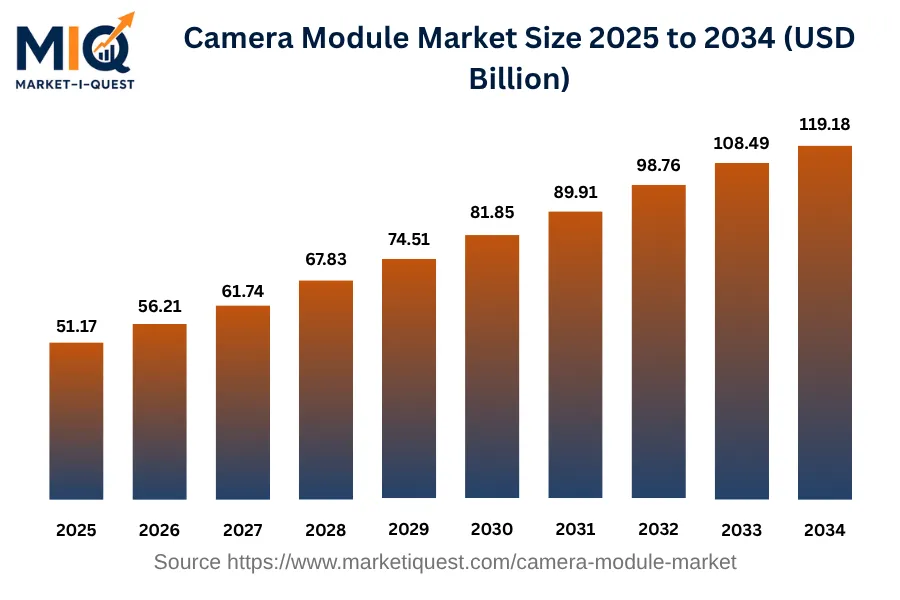
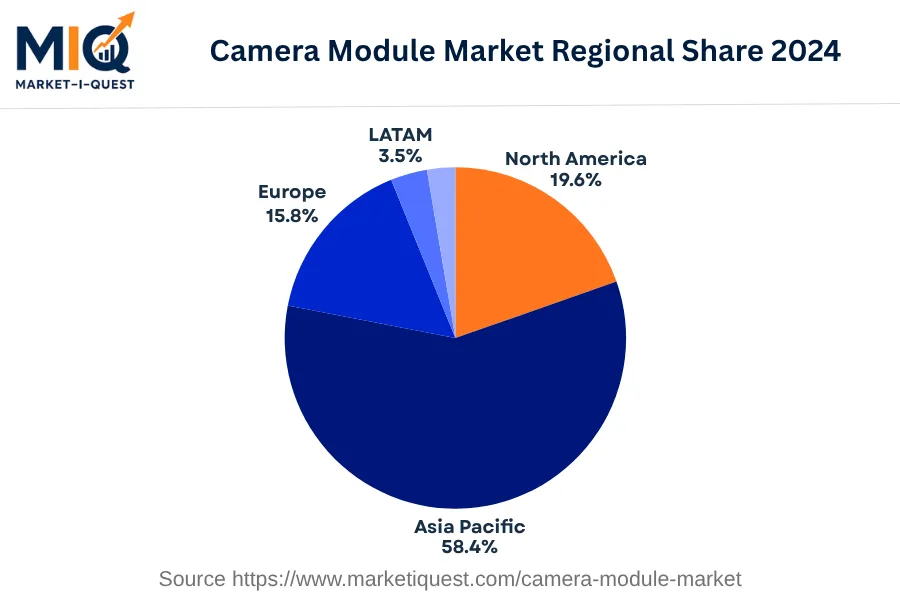
The Camera Module Market was valued at USD 51.17 billion in 2025 and is anticipated to reach USD 119.18 billion by 2034, growing at a compound annual growth rate (CAGR) of 9.85%. The pathway to growth is marked by an increase in the market size from USD 46.58 billion in 2024 to USD 51.17 billion in 2025. The market then further expands nine-fold over the following decade to reach USD 119.18 billion in 2034, displaying consistent growth throughout the period. Regarding the regional share in 2024, the Asia Pacific dominated the market with a 58.4% share. It is followed by North America and Europe with shares of 19.6% and 15.82% respectively. The remaining regions, Latin America and the Middle East & Africa, held smaller shares of 3.47% and 2.67% respectively. This suggests that while the Camera Module Market is global in scope, the majority of market activity is centered in the Asia Pacific region.

Key Takeaways

  • By Type - Integrated Camera led accounting for a significant share in 2024.
  • By Technology - CMOS expanded fastest across the forecast period marking the highest growth.
  • By Application - Smartphones spearheaded holding a major share in the given market year.
  • By End Use - Commercial sector witnessed the most noteworthy growth in 2024.
camera-module-market market size

Key Driving Factors

Integration of Advanced AI Capabilities in Camera Modules

In the evolving technology landscape, the convergence of artificial intelligence (AI) with camera technology is becoming a compelling driver for the Camera Module Market. AI algorithms offer functionalities such as facial recognition, object detection, and autonomous controls that enhance the utility of camera modules. Prime users, such as smartphone manufacturers and security surveillance industries, are actively leveraging these features for improved product efficiencies. For instance, smartphone companies utilize AI-infused camera modules to provide better image clarity and advanced shooting modes. Similarly, the security industry depends on AI-powered surveillance cameras for specific tasks like crowd management or threat detection. Hence, this growing utilisation of AI-oriented enhancements in camera modules by distinct industries is propelling the market's growth.
Increasing Adoption of Miniature Camera Modules

The second driving factor for the Camera Module Market is the rising integration of miniature camera modules in a variety of devices. The trend of miniaturization offers significant benefits including space efficiency, lightweight design, and uncompromised imaging performance. These compact camera modules find high demand across sectors such as consumer electronics, robotics, and healthcare. For example, manufacturers of drones and robotics seek tiny, yet high-grade camera modules for accurate mapping and navigation. In the healthcare sector, micro-sized camera modules are crucial components in endoscopes and other diagnostic tools. As such, this trend of miniaturization and its resulting broad-based demand across multiple sectors are encouraging the growth in the Camera Module Market.

Market Evolution by Timeline

2019-2023
In this period, the primary buyers of camera modules were smartphone and automotive companies, centering in East Asia, notably China and South Korea. An increased interest in upgrading to high-resolution imaging fueled the demand. Meanwhile, suppliers experimented with integrated miniature lenses and advanced image sensors. However, cost-effectiveness and lack of standardization posed a constraint. Brazil's INMETRO and Europe's CE marking were established as critical compliance standards. The commercial model was characterized by a mix of spot purchases and long-term contracts, with some strategic partnerships between module makers and device manufacturers. High manufacturing and R&D costs coupled with low pricing flexibility presided as significant risks.
2024
In 2024, the DSLR camera segment started creating demand due to increasing consumption in North America and Europe, while Asia remained dominant. Suppliers embraced advanced technologies, such as Liquid Crystal on Silicon (LCoS) and Laser-Induced Surface Nanocrystals (LISNs). Policy agenda began focusing more on eco-compliance and recycling, influencing design and manufacturing. The commercial model saw an uptake in framework agreements, laying grounds for long-term supply. However, the prolonged integration time and lower profitability turned out to be evident risks.
2025-2029
During this time, a surge of demand came from the augmented/virtual reality (AR/VR) sector, particularly in the US and Europe. Simultaneously, space science and defense sectors in these regions also contributed to demand. Suppliers pioneered areas such as embedded depth sensors and multifocal lenses. Influencing policies included the WEEE directive in the EU and Senate Bill 1300 in the US. Subscriptions and usage-based pricing emerged as dominant commercial models, while technological complexities and adoption rates emerged as key risks.
2030-2034
In this period, the demand for camera modules escalated from industries leveraging artificial intelligence and machine learning, especially in North America. Suppliers fought challenges in packing high-resolution imaging capabilities into small-sized camera modules. There was a significant shift towards green manufacturing processes due to stringent policies like the EU's Green Deal. Commercially, partnerships became predominant over contracts. There were uncertainties regarding technology integration, underlining the risks.

Future Market Outlook

Future Opportunities

Several opportunities are emerging in the camera module market, linked to technological advancements and evolving consumer preferences. The global shift towards augmented reality (AR) and virtual reality (VR) applications is a defining factor shaping future developments. In July 2023, Meta expanded its AR offerings with an updated version of the Quest headset, which includes improved camera modules for enhanced user interaction. This trend implies a growing need for high-performing camera systems capable of seamless integration into AR applications. Furthermore, the increasing momentum towards sustainability has encouraged manufacturers to develop eco-friendly camera modules. For example, in April 2023, Canon announced plans to implement sustainable materials in its camera production by 2025, addressing environmental concerns while capturing market interest. Security applications represent another growth avenue, driven by advancements in smart home technology. In March 2023, Ring introduced its latest outdoor camera equipped with AI-driven features to enhance home security. Partnerships and collaborations between tech companies are likely to intensify as they seek to leverage each other's strengths. For instance, the partnership between Microsoft and Qualcomm announced in 2022 focuses on combining AI algorithms with camera technology to enhance real-time video processing capabilities. As these trends develop, the camera module market is poised to adapt accordingly, meeting the demands of industries ranging from gaming to telecommunication, while ensuring continual enhancements in functionality and user satisfaction.

Segmentation Analysis

By Type

The market is divided into subsegments including Module Camera, Integrated Camera, PC Camera, and Panoramic Camera. The Integrated Camera subsegment accounted for the largest revenue share while the Panoramic Camera is expected to grow at the fastest CAGR during the forecast period.

Largest Revenue Share

Integrated Camera

Market Share Leader

Integrated cameras, being the most revenue-generating subsegment, owe their popularity to their convenience, versatility, and ubiquitous presence in a wide range of devices. Today, integrated cameras are standard features in most smartphones, laptops, tablets, and other smart devices. Their compact sizes combined with improving image quality have resulted in high demand from consumers and businesses alike. These cameras allow for immediate video communication, increasing their utility in both professional and personal contexts. Geographically, these devices with integrated cameras are sold worldwide leading to a broad revenue base. There are no tight regulations impacting the sale of integrated cameras, ensuring steady supply of these products. In terms of purchasing criteria, the cost to performance ratio is a significant determinant, which works in favor of the integrated camera subsegment due to its relatively low cost and high functionality. Furthermore, the barriers to switch from integrated cameras to other types are high due to the need for additional devices and installations.

Fastest CAGR

Panoramic Camera

Forecast Period Growth Leader

The Panoramic Camera subsegment is expected to have the fastest CAGR outlook. There are multiple growth drivers behind this trend. The compelling need for comprehensive visual coverage, graduating from traditional viewpoints, is a key determinant. These cameras find significant applicability in surveillance systems, allowing for wide coverage and eliminating blind spots. Regulation policies encouraging improved security measures also act as catalysts for their growth. Investment costs remain a barrier for adoption, yet significant advancements in technology and increasing partnerships among key players aim to offer cost-effective solutions. Moreover, panoramic cameras provide increased functionality and offer value for money, contributing to their adoption rates. Despite the promising growth, near-term risks including data management issues and concerns about privacy could potentially slow down the growth trajectory.

By Technology

The technology market is divided into subsegments including CMOS, CCD, Infrared, and Time of Flight, of which CMOS accounts for the largest revenue share, while Time of Flight is expected to grow at the fastest CAGR during the forecast period.

Largest Revenue Share

CMOS

Market Share Leader

In the year 2024, CMOS (Complementary Metal Oxide Semiconductors) holds a significant stake in technology market segment owing to its extensive use in image sensor technologies across diverse industries. Its cost-effectiveness and low power consumption attributes stand out, making it a preferred choice in consumer electronics, especially in products like smartphones, cameras, and scanners, contributing significantly to its revenue. Moreover, advances in CMOS technologies have led to the surge in its adoption in the field of healthcare, space, and automobile sectors, further driving its revenue. Also, geographically, regions with robust electronics industry such as Asia Pacific, specifically China and India, contribute massively to CMOS's revenue. Regulatory environment promoting digitalization and smart solutions is equally favoring the growth of the CMOS subsegment, creating substantial demand.

Fastest CAGR

Time of Flight

Forecast Period Growth Leader

At the same time, Time of Flight technology is projected to emerge as the fastest growing subsegment. This rapid growth can be attributed to the increasing demands in automation, robotics, and 3D imaging sectors. Being a critical component in LiDAR systems, Time of Flight technology finds increasing applications in autonomous vehicles, accelerating its growth. The expansion of 5G networks propels its usage in sensors for interactive interfaces, gaming, and AR/VR devices. However, high implementation costs and limited awareness could pose challenges to this rapid growth. Strategic partnerships, investments in R&D, and policy incentives towards digital transformations are anticipated to serve as essential catalysts in overcoming these barriers and supporting the projected high CAGR of this subsegment.

By Application

The market is divided into subsegments including Smartphones, Automotive, Security Cameras, Consumer Electronics, and Others. The Smartphone segment accounted for the largest revenue share while Automotive is expected to grow at the fastest CAGR during the forecast period.

Largest Revenue Share

Smartphones

Market Share Leader

In 2024, Smartphones remained the largest revenue-generating subsegment in this application market. This can be attributed to several factors. Technological advancements and rapid digitization have led to an increased demand for these devices globally. Their multifaceted functionality makes them a vital tool for communication, entertainment, navigation, and even remote work or education. With a broad base of consumers spanning virtually all demographics, the market reach is quite extensive. Emerging economies exhibit significant potential for growth, with increasing purchasing power and demand for cutting-edge technology. Government efforts to promote digital literacy and connectivity also contribute to the robust demand for smartphones. However, it's crucial to note that this subsegment is highly competitive, with established brands vying for market share, necessitating innovation and differentiation.

Fastest CAGR

Automotive

Forecast Period Growth Leader

The Automotive segment is projected to grow at the fastest CAGR in the coming years. As we move towards an era of self-driving and electric vehicles, there is an increased tech integration in automotive manufacturing. This trend is expected to spur significant growth in this sector. Intelligent systems, in-car entertainment, navigation, and vehicle safety tech are driving growth in this subsegment. However, several challenges could potentially slow this progress. Regulatory barriers, high capital investment, security concerns, and complex supply chain processes are among the primary hindrances. Companies that are able to address these barriers while maintaining focus on innovation and strategic partnerships are likely to benefit most from this rapid growth. Specific risks to consider include the potential impact of global economic fluctuations and possible changes in regulatory landscapes.

By End Use

The market is divided into subsegments including personal, commercial, government, and industrial. In the base year 2024, the commercial subsegment accounted for the largest revenue share, while the industrial subsegment is expected to grow at the fastest CAGR during the forecast period.

Largest Revenue Share

Commercial

Market Share Leader

The commercial sector dominates in revenue generation due to its diverse use cases and wider customer base. As businesses continue evolving, they increasingly rely on solutions provided in the commercial market to drive efficiency and improve their service delivery. This henceforth, creates an upward pull in demand, translating in greater revenue contribution for this sector. Key drivers for this dominance include a growing number of businesses globally, expansion in the service industry, and increased business diversification which necessitates the use of specialized solutions. Additionally, the widespread geographical presence of commercial entities also fuels revenues, as these solutions are adopted across various regions encompassing varied business cultures and demands. Furthermore, government regulations stimulating business operations and compliance also impose a positive impact on commercial segment revenues. Importantly, purchasing decisions in this sector often rely on considerations such as quality, adaptability, customer service, and pricing thus influencing the dynamics of revenue generation.

Fastest CAGR

Industrial

Forecast Period Growth Leader

Beyond the base year 2024, the industrial sector presents the most promising growth outlook, buoyed by significant drivers acting as catalysts to its accelerated growth rate. Digital transformation and automation in the industrial sector are key drivers. Rapid technology upgrade cycles and advancements in machine learning, artificial intelligence, and industrial IoT are major factors propelling adoption. The increasing capital expenditure in the industrial sector for modernization and digitalization of facilities and processes is also fueling growth. Policies encouraging industry 4.0 are playing a crucial role as catalysts for this subsegment’s growth. However, barriers to adoption may include high switching costs, resistance to change, and complexity of new technological solutions. Certain risks also need to be acknowledged in the near-term, including cybersecurity threats and uncertainties in global trade and manufacturing.

Competitive Analysis

Key Market Players

Manufacturers/OEMs

Sony Corporation
Japan
Samsung Electronics Co., Ltd.
South Korea
LG Innotek
South Korea

Key Suppliers & Raw Materials

Omnivision Technologies Inc.
US
STMicroelectronics N.V.
Switzerland
Sunex Inc.
US

Distributors, Integrators & Channel Partners

Sharp Corporation
Japan
Lite-On Technology Corporation
Taiwan
Chicony Electronics Co., Ltd.
Taiwan

Porter’s Five Forces Analysis

This analysis evaluates the competitive intensity and exploitability within the Camera Module Market.

Supplier Bargaining Power

Medium

A balanced power due to the availability of multiple suppliers and specialized product requirements.

Buyer Bargaining Power

High

Buyers, mainly large-scale manufacturers and OEMs, exert considerable power due to large purchase volumes.

Threat of Substitutes

Low

Limited threat as high-quality camera modules are essential for modern electronic devices.

Threat of New Entrants

Medium

Technological expertise and capital investment requirements create a barrier for entrants.

Competitive Rivalry

High

Intense rivalry driven by large players, technological advancements, and product differentiation.

Regional Analysis

Geographic market dynamics and growth opportunities across key regions

Global Market Outlook

camera-module-market market regional share

North America

The North American camera module market in 2024 experienced significant growth and development. Driven by increased demand for high-resolution imaging in sectors such as security, automotive, healthcare and smartphones, the market saw a surge in both investment and technology adoption. Regulatory requirements in these sectors, particularly pertaining to security and automotive industries, resulted in a strong demand for advanced camera modules, further accelerating market growth. The influence of cutting-edge technologies like AI and IoT, resulted in an enhanced supply dynamics and competitive pricing.

Consumer preference for smartphones with superior camera quality was clear, catalyzing technological shifts within the module market. For example, the move towards increased pixel count and the integration of AI for enhanced image quality. Emerging partnerships and mergers and acquisitions among key market players are also evident. This reflects an urge to leverage technological advances and enrich product portfolios. In terms of market channels, omnichannel shopping experienced substantial popularity where customers preferred a blend of both physical and online purchasing experiences. Standards and policy enforcement, particularly in relation to data privacy and security regulations, had increasing bearing on market trends. Industries such as enterprise, government and healthcare formed a considerable share of the demand side of the market. Also, the role of manufacturers and retailers were prominent in the supply side dynamics.

Asia Pacific

The Asia Pacific Camera Module market in 2024 showed significant growth potential driven by several factors and trends. Increased demand for high-quality imaging in smartphones, security systems, and automotive industries acted as a major catalyst. Foremost, advancements in technology adoption, especially in China, Japan, and South Korea, were integral to market expansion. Furthermore, India's investment in its digital infrastructure accelerated the market's momentum. Notably, the production cost reduction in key ASEAN markets, aligned with an increasing supply chain efficiency, promoted a competitive pricing model.

Market trends emerged on close observation. The growth of e-commerce in the Asia Pacific region propelled a shift in buyer's behavior, favoring online purchases. Technological shifts were witnessed in favor of High Definition (HD) and Ultra-High Definition (UHD) camera modules in sectors like healthcare, manufacturing, and enterprise. An increase in partnerships and M&A activities, especially in the security and surveillance system industry in Australia was a significant trend. With the enforcement of stricter standards and policies by governments, a rise in demand for high-end camera modules in national security and law enforcement was evident. For instance, India's Central Government endorsed the use of advanced camera technology in its Digital India program. Hence, 2024 saw a thriving camera module market in the Asia Pacific.

Europe

In 2024, the European camera module market presented a dynamic and diversified landscape. The demand was driven by the proliferation of smartphones and IoT devices, resulting in amplified uptake in sectors such as automotive, consumer electronics, and healthcare. Stringent European regulations for automotive safety surveillance necessitated advanced camera modules, propelling the market's growth. Additionally, continuous investments in 5G technology and AI led to a significant increase in advanced camera module adoption, particularly across countries such as the UK, Germany, and France.

Within the buyer environment, a notable trend was the gradual shift towards AI-powered camera modules for smart home security systems and autonomous vehicle applications. Consumer preference for high-resolution imaging further solidified this trend, particularly in Germany and France. Niche markets, such as drone photography in Spain and aerial surveillance in Italy, also garnered interest. Corporate partnerships flourished across the region, including between major electronics manufacturers and software companies, spurred by the need for advanced camera systems within enterprise and consumer goods. These trends, combined with policy enforcement for embedded camera modules in public safety mechanisms, underscored the growth trajectory of the camera module market in Europe in 2024.

Latin America

In 2024, the camera module market in Latin America unveiled a rising environment of competitive development and technological adoption. Drivers involved intense smartphone use in Brazil and Mexico, stimulating higher demand for sophisticated camera modules. Strong investment in automotive industries in Argentina and Peru also escalated the requirement for advanced camera systems in vehicles. Additionally, government regulations in Colombia and Chile promoted the adoption of surveillance camera modules for enhanced security.

Market trends exhibited a shift in buyer behavior towards devices with multiple-camera configurations, impacting demand and supply dynamics. Notably, the retail and manufacturing sectors showed increased uptake of high-resolution camera modules for quality control and surveillance. Striking changes also occurred in technology, with greater integration of AI capabilities in camera modules, particularly in enterprise and healthcare sectors across LATAM. Channel dynamics displayed a notable growth in e-commerce sales of camera modules, signifying a transformative shift in purchasing patterns. Partnerships and mergers were evident, aiming to enhance technological capacity and widen customer bases. Finally, stricter enforcement of data privacy policies was observed, influencing the way camera modules were utilized and managed, especially in government and utilities sectors.

Middle East & Africa

In 2024, the camera module market in the Middle East and Africa demonstrated significant growth driven by several region-specific factors. The increased consumer demand for high-tech mobile phones and smart home security systems was a significant driver for the market, especially in affluent countries like Saudi Arabia and the UAE. Advances in digital transformation, fuelled by government investment in sectors such as telecom in Qatar and Nigeria, notably stimulated the adoption of advanced camera technologies. Regulatory changes in Egypt, mandating the inclusion of rear-view cameras in vehicles, heightened the demand for automotive camera modules.

Customer trends revealed a distinct shift towards higher resolution camera modules for smartphones and the incorporation of thermal imaging in security camera systems, amid rising security concerns. The adoption of AI-based camera modules in the healthcare sector, particularly noticeable in Israel and South Africa, was a notable trend. Additionally, the market saw strategic partnerships between regional telecom companies and camera module manufacturers aiming to leverage the ongoing 5G rollout. Lastly, the enforcement of stringent quality standards for camera modules in key retail sectors in Saudi Arabia and the UAE, was another noteworthy trend of 2024.

Recent Industry Developments

Latest market innovations, product launches, and strategic initiatives

January 2026

MCNEX highlighted strong market momentum after a camera module surge, with growth tied to smartphone camera sophistication and advancing automotive applications.

December 2025

Yole Group reported the camera module market was undergoing rapid change, with mobile still dominant but automotive, XR, robotics, and medical imaging becoming major growth engines.

Frequently Asked Questions