Camera Accessories Market Snapshot

Key Players

  • Canon Inc. (Japan)
  • Nikon Corporation (Japan)
  • GoPro Inc. (United States)
  • Manfrotto (Italy)
  • Sigma Corporation (Japan)
  • Phottix (China)
  • Zeiss AG (Germany)
  • FUJIFILM Holdings Corporation (Japan)
  • DJI (China)
  • Sandisk Corporation (United States)

Market Size

Base Year 2024
$16.30 Bn
CAGR
14.6%
Forecast 2034
$63.68 Bn

Market Segments

By Product Type
  • Lenses
  • Tripods
  • Camera Bags
  • Filters
  • Flash Equipment
  • Batteries
  • Others
By Camera Type
  • DSLR Cameras
  • Mirrorless Cameras
  • Action Cameras
  • Smartphone Cameras
  • Others
By Distribution Channel
  • Online
  • Offline

Market Dynamics

Drivers
  • Rising photography enthusiasts
  • Technological advancements in accessories
Restraints
  • High product substitution rate
  • Increasing smartphone photography popularity
Opportunities
  • Increasing photography hobbyists
  • Growing demand for DSLRs

Market Size

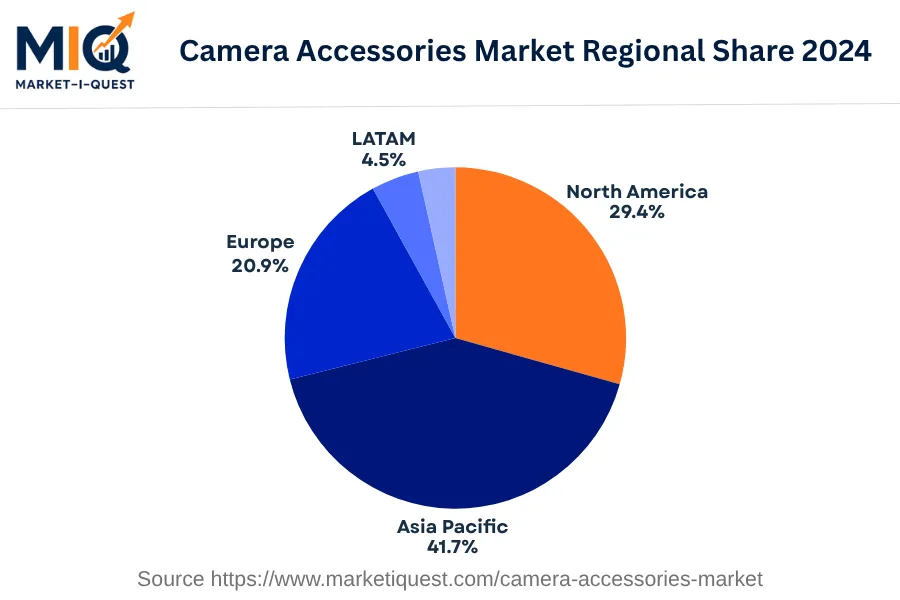
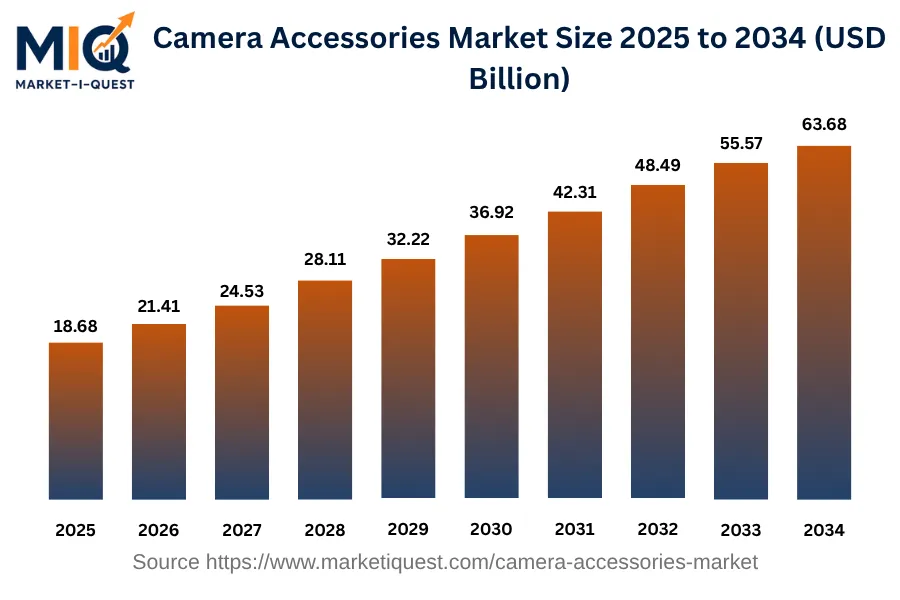
The Camera Accessories Market, sized at USD 18.68 billion in 2025, is expected to grow to USD 63.68 billion by 2034, with a CAGR of 14.6%. This substantial rise in market value over the nine years indicates ongoing positive momentum in the demand and sales of camera accessories. The growth may be attributed to advancements in photography technology and an increasing fashion for professional-grade personal photography equipment. Delving into the regional share mix in 2024, the Asia Pacific region has the largest share with 41.7%, followed by North America with 29.4% and Europe at 20.9%. Meanwhile, shares in the Latin American and Middle East & African regions are smaller in comparison, at 4.5% and 3.5% respectively. These figures illustrate the geographical distribution of the camera accessories market and can provide insight into the regional growth trends of this sector. From the data, it would appear that the Asia Pacific region holds the greatest potential in terms of market expansion.

Key Takeaways

  • By Product Type - Lenses held the major share in the Camera Accessories Market in recent years.
  • By Camera Type - Smartphone Cameras led in market dominance accounting for an impressive share in the recent years.
  • By Distribution Channel - Offline sales have seen a significant rise leading over the years.
camera-accessories-market market size

Key Driving Factors

Rising Popularity of Content Creation

One of the primary drivers of the camera accessories market is the rising interest in content creation, both among professionals and hobbyists. Influencers across social platforms such as YouTube, Instagram and TikTok have created demand for high-quality camera accessories which can make a significant difference in image and video quality. This includes items like tripods, lenses, filters, and lighting equipment. The rise of at-home and on-location shooting due to remote working conditions in many industries has further exacerbated this trend. High-quality content is viewed as a necessary marketing strategy for businesses and individuals, leading to the procurement of better camera accessories to give them an edge in a saturated market.

Shift Towards Specialized Photography Genres

Another key driver for the camera accessories market is the increased interest in specialized photography genres, requiring specific tools and equipment. For example, landscape and wildlife photographers often require long-range lenses and sturdy tripods. Products like waterproof housings, flotation devices, and special filters are equally crucial to underwater photographers. Even in macro photography where details matter most, specialized lenses and lighting solutions are a must. This shift towards specialization has resulted in a higher demand for specific camera accessories, as professionals and amateurs alike seek out the best equipment to enhance their unique photographic endeavors.

Market Evolution by Timeline

2019-2023
Photography enthusiasts and professionals, ranging from individuals to large media companies, sought superior camera accessories across the globe, noting significant interests in Asia. Manufacturers released advanced lenses, tripods, flash units, and camera bags, barebone integration remaining a challenge. Policies favoring data protection led to surge in encrypted storage devices. Pricing followed a premium model, with high-end brands forming partnerships with key camera manufacturers. The risk of counterfeit products resulted in more vigilant patent rights enforcement.
2024
The popularity of drone photography spiked, prompting a higher demand for drone camera accessories among drone enthusiasts, especially in North America. Technological investments focused on producing lightweight, durable materials intended for extreme weather conditions. Changes in drone regulation led manufacturers to offer accessories that comply with weight and broadcast requirements. Direct-to-consumer sales gained traction, supported by influencer marketing strategies. The supply chain was disrupted due to geopolitical tensions, causing concerns around material shortages.
2025-2029
360-degree video and virtual reality technology necessitated a new variety of accessories among VR content creators, noting a surge in European and Asian markets. Supplier focus shifted toward creating high-quality 360-degree lenses and VR-ready storage solutions, although cross-compatibility issues arose. Environmental sustainability regulations impacted packaging and disposal procedures. Subscription model adopted for accessories supplies spiked, creating recurring revenue streams for sellers. Potential risks hinged on the adoption pace of VR technology and related hardware.
2030-2034
Growing interest in astrophotography resulted in high demand for star-tracking mounts and long-exposure lenses, particularly among hobbyists in North America and Europe. Technology suppliers eagerly developed more precise tracking systems and low-light lenses, but faced challenges with affordability. New ISO standards for long exposure photography dictated the functionality of many accessories. Flat-rate pricing models emerged as a competitive differentiator. The risk of light pollution led to campaigns promoting sustainable lighting practices, affecting the marketing strategies of accessory manufacturers.

Future Market Outlook

Future Opportunities

The future of the camera accessories market appears promising as demand for advanced, user-friendly products continues to rise. As of 2023, the increasing adoption of mirrorless cameras, like Sony's Alpha series, is reshaping consumer preferences, creating opportunities for specialized accessories such as high-capacity batteries and customizable grips. Given the ongoing surge of social media platforms, particularly TikTok which gained significant traction since 2016, users increasingly require accessories that enhance video quality and ease of use. Additionally, in 2022, the International Consumer Electronics Show (CES) showcased innovations in camera accessories that integrate with smart technologies, implying opportunities for the development of app-controlled devices. Partnerships between accessory brands and content creators, such as the collaboration between Rode and YouTube influencers, signal a trend where marketing strategies increasingly target creators directly, allowing brands to align products with audience needs. Furthermore, as environmental concerns continue to shape consumer behavior, opportunities exist for companies to produce accessories with biodegradable materials. For example, major players are beginning to explore additive manufacturing, which was highlighted in a 2023 industry forum as a method for creating sustainable accessories with reduced waste. This combination of technological integration, a focus on user experience, and alignment with sustainability could drive growth in various segments of the camera accessories market across regions like North America and Europe.

Segmentation Analysis

By Product Type

The market is divided into subsegments including Lenses, Tripods, Camera Bags, Filters, Flash Equipment, Batteries, and Others. Lenses accounted for the largest revenue share while Tripods is expected to grow at the fastest CAGR during the forecast period.

Largest Revenue Share

Lenses

Market Share Leader

Lenses take the pole position among the subsegments through their essential role in photographic equipment. Without a lens, a camera's usability diminishes greatly. This indispensable role is why the lenses subsegment holds the highest market share. Major drivers that contribute to the dominance of the lens market are innovations in lens technology, high consumer demand for high-quality images, and the ongoing shift towards digital photography. Furthermore, demand for lenses is propelled by their necessity across different photography applications, including sports, wildlife, portrait, and events, among others. Digital transformation, particularly in developing regions, also promote lens sales, given the growing inclination towards high-quality digital cameras over traditional film-based units. On the supply side, renowned names such as Canon, Nikon, and Sony continually introducing new lens models equips the market with a wide range of options, upholding consumer interest. Essentially, the broad usage of lenses across various photography genres coupled with consistent technological advancements directly align with market growth and revenue generation.

Fastest CAGR

Tripods

Forecast Period Growth Leader

Projecting the fastest CAGR, tripods lead in growth rate among the segments. Stability and versatility are driving the tripod market’s rapid growth pace. Consumers are increasingly realizing the value of a stable platform in enhancing the quality of their photos, especially in challenging shooting scenarios such as low-light conditions, macros, panoramas, and long exposures. Moreover, advancement in technology infused with consumer demand for efficient and lightweight tools has increased the adoption of carbon fiber tripods that are sturdier and lighter than their aluminum counterparts. Barriers to adoption like cost and portability issues are being addressed with the emergence of budget-friendly and compact models. Risks could emanate from low-cost alternatives, and innovative product substitutes disrupting the market. Nevertheless, strategic partnerships between industry giants for product development can catalyze growth. Overall, the need for stability in complex photography, constant product innovation, and addressal of barriers contribute to the growth of the tripod sub-segment.

By Camera Type

The camera type market is divided into segments including DSLR Cameras, Mirrorless Cameras, Action Cameras, Smartphone Cameras, and Others. In 2024, the Smartphone Cameras held the largest market share, whilst the Mirrorless Cameras segment is anticipated to grow at the fastest rate during the forecast period.

Largest Revenue Share

Smartphone Cameras

Market Share Leader

The Smartphone Cameras segment holds the largest revenue share. This leadership can be attributed to widespread smartphone usage globally and continual advancements in smartphone camera technology. Emerging markets such as Asia, Latin America and parts of Africa, where an increasing number of consumers are shifting from traditional mobile phones to smartphones, greatly contribute to the segment's growth. Additionally, the purchasing decision for smartphones is often heavily influenced by camera quality, driving smartphone manufacturers to invest heavily in camera technology advancements to maintain competitiveness. Low switching costs also contribute to the segment's revenue as consumers frequently upgrade smartphones, often every one to two years. Despite stiff competition from DSLR and mirrorless cameras, the sheer accessibility and continuous technological development of smartphone cameras continue to fuel its largest market share.

Fastest CAGR

Mirrorless Cameras

Forecast Period Growth Leader

The Mirrorless Cameras subsegment is growing at the fastest rate. With the technology's growing maturity, mirrorless cameras offer potential advantages over the traditional DSLR cameras, such as a lighter weight and a more compact size. These factors make mirrorless cameras increasingly attractive for professional photographers and hobbyists alike. Market growth acceleration can also be attributed to the technological advancements leading to higher image quality and increased speed in these cameras. Increasing collaboration between manufacturers to develop advanced features such as enhanced autofocus, Wi-Fi, and GPS has further fueled growth. Finally, increased spending potential, especially in developed markets, has also encouraged consumers to invest in mirrorless cameras for high-quality photography. However, potential near-term risks include the high costs of these cameras and the requisite investment in compatible lens systems.

By Distribution Channel

The market is divided into two subsegments including Online and Offline. The Offline subsegment accounted for the largest revenue share while the Online subsegment is expected to grow at the fastest CAGR during the forecast period.

Largest Revenue Share

Offline

Market Share Leader

The Offline distribution channel commands the largest share in the market revenue, primarily due to the widespread practice of traditional purchasing methods. Even with the advent of digitalization, many consumers still prefer the tactile experience of shopping in brick-and-mortar stores where they can physically examine the goods. This is particularly true for high-value items where the quality is paramount. Additionally, consumers also appreciate the immediacy of buying offline, where there are no shipping delays or costs. Furthermore, in many regions around the world, particularly in rural areas and developing economies, the infrastructure for online shopping isn't as developed. There, customers rely heavily on offline stores for their purchases. Regulatory landscapes in certain regions also favor offline businesses, providing the segment with a revenue boost. Consequently, these factors have combined to make the Offline distribution channel a dominant force in the market revenue stream in the base year 2024.

Fastest CAGR

Online

Forecast Period Growth Leader

The Online distribution channel, despite not holding the largest revenue share, is projected to expand at the highest CAGR in the coming years. This growth can be attributed to the numerous advantages that online shopping offers including convenience, wider selection, and often, lower prices. Furthermore, technological advancements and the proliferation of smartphones and the internet have made online shopping more accessible than ever before. Government initiatives promoting digitalization and internet penetration are acting as catalysts for the growth of the Online subsegment. Moreover, consumers' behavior is also changing, with many favoring the comfort and convenience of shopping from home. However, key challenges like cyber security and data privacy issues remain, which businesses & policymakers are working to address. As these barriers are resolved, the adoption of online shopping is expected to accelerate, leading to high speed growth in this segment.

Competitive Analysis

Key Market Players

Manufacturers/OEMs

Canon Inc.
Japan
Nikon Corporation
Japan
Sony Corporation
Japan

Key Suppliers & Raw Materials

SanDisk Corporation
US
Zeiss AG
Germany
Schneider Kreuznach
Germany

Distributors, Integrators & Channel Partners

B&H Photo Video
US
Adorama Camera
US
Jessops Europe Ltd
UK

Porter’s Five Forces Analysis

This analysis sheds light on the competitive intensity and attractiveness within the Camera Accessories Market.

Supplier Bargaining Power

Medium

Many suppliers, differentiated products, but significant dependency on a few major camera manufacturers.

Buyer Bargaining Power

High

Unrestricted information availability, low switching costs, and existence of quality alternatives increase power.

Threat of Substitutes

Low

Limited substitutes due to necessity for specialized products matching particular camera models.

Threat of New Entrants

Medium

Easy to manufacture, but requires established supply chains and market knowledge.

Competitive Rivalry

High

Numerous players, rapid innovation, and strong price competition characterize the market.

Regional Analysis

Geographic market dynamics and growth opportunities across key regions

Global Market Outlook

camera-accessories-market market regional share

North America

In the 2024 base year, the North American camera accessories market was characterized by dynamic and evolving consumer preferences. Driving factors included technological advances, like the emergence of high-definition image capturing, resulting in increased demand for lens filters and tripods. Simultaneously, the proliferation of digital photography prompted a surge in storage accessories like memory cards and hard drives. Regulatory support, particularly stronger intellectual property rights in the U.S., also boosted the market.

Market trends indicated a shift from traditional to online retail channels, particularly in the U.S. and Canada. Consumer preference leaned towards high-end, professional-grade accessories, reflecting the rise in content creation for social media. Enterprise adoption also grew, especially in sectors like real estate marketing and unmanned aerial vehicle (UAV) surveillance that often require superior camera accessories. A noteworthy trend in the market was the increasing partnerships between camera-accessories manufacturers and smartphone companies, as the latter expanded their product lines to include camera enhancement accessories. The growth in the market was balanced. However, a few regions like Mexico lagged due to limited technology accessibility and lower consumer purchasing power. Nonetheless, the North American camera accessories market in 2024 displayed robust vigor, driven by rapid technological advancements and novel consumer purchasing trends.

Asia Pacific

In 2024, the Camera Accessories Market in the Asia Pacific showcased significant dynamism, marked by an uptick in consumer preference for superior photography equipment. Key demand drivers included the escalating popularity of digital photography in China and India, spurred by the rise in social media usage and growing urban middle-class population. Additionally, progressive trade policies bolstered the import of superior quality camera accessories in Australia, Japan, and key ASEAN markets. Innovative technology adoption, such as drone photography in South Korea, generated fresh demand.

Shifting trends included an increased inclination towards online shopping for camera accessories, as evidenced in the digital marketplaces of China and India. The rise in partnerships between camera accessory manufacturers and e-commerce platforms further contributed to this trend. In Japan, demand for mirrorless cameras boomed, signaling a shift in product preference. Meanwhile, Australia witnessed a surge in environmental photography, leading to greater demand for specialized camera accessories. Standardization policies implemented across several markets, like ISO standard in camera lenses, maintained the market's competitiveness.

Significant customer segments included industries such as entertainment, media, tourism, and e-commerce. Retail consumers, like photography enthusiasts and social media influencers, formed an equally significant customer base. Furthermore, governmental sectors across the Asia Pacific harnessed high-end camera accessories for surveillance and security applications, thereby stimulating the market.

Europe

In 2024, the European market for camera accessories experienced significant activity. Underpinning this vibrancy were several drivers. Accelerated technology adoption led to demand uplift, especially in countries like Germany and the UK, where increasing digitalization prompted a rise in high-quality imaging needs. In France and Italy, regulations encouraging local accessory production gave impetus to supply dynamics. Market growth was fueled by rising investment, particularly from Spain and the Nordics, which saw a surge in start-ups offering innovative camera accessories. Meanwhile, pricing remained a critical determinant; markets like Benelux and Central & Eastern Europe offered affordable packing options, strengthening their competitive positioning.

The year's trends marked shifts in both buyer behavior and product specifics. Consumer preference trended towards smart accessories, particularly among the retail sector and personal users. Tech advancements triggered the emergence of novel accessories, posing challenges to traditional supply chains. Predominantly in countries like Germany and the UK, online channels increasingly became the popular purchase platform, a shift propelled by the ongoing digitalization. Major partnerships and M&A activities were witnessed in the French and Spanish markets, reflecting the changing business landscape. Finally, policy enforcement on product standards was firmly instated across regions, ensuring customer trust in the reliability and safety of accessories.

Latin America

In 2024, the Latin America (LATAM) camera accessories market saw intensified activity, spurred by increased digitalization and consumer inclination towards advanced photographic technologies. Technology adoption and the rise of social media platforms that prioritize visual content led to greater demand from Brazil and Mexico. Regulatory alleviations in Colombia, Chile, and Peru stimulated local manufacturing, making high-quality products more accessible and affordable. Dominant drivers in the market are the augmented demand from professional photographers, significant technological advancements in camera accessories, and the growing trend of sharing high-definition images and videos on various online platforms. Economic stabilization in Brazil and Mexico boosted consumer purchasing power, which, in turn, escalated retail sales.

Latin American buyers demonstrated a preference for e-commerce, driven by competitive pricing and diversity of options, usurping traditional retail channels. As consumers increasingly sought high-quality photos and videos, advancements like artificial intelligence-enhanced accessories and drone technology gained traction. In terms of policy enforcement, revised import regulations in Argentina encouraged international brands to enter the market, while public initiatives in Chile promoted local production. The surge in travel and tourism, coupled with heightened security needs across enterprises and government, underpinned the market growth. Additionally, retail and fashion industries' emphasis on high-quality visual content increased the demand for advanced accessories. Consequently, the LATAM camera accessories market sustained robust growth during 2024.

Middle East & Africa

In 2024, the camera accessories market in the Middle East and Africa demonstrated substantial growth due to several driving factors. Increasing tourism and a expanding photography industry in regions like Kenya, Saudi Arabia, and South Africa bolstered demand for advanced accessories. Strategic investment, particularly in the United Arab Emirates and Qatar, further enhanced the supply dynamics of premium camera equipment. Additionally, the adoption of innovative technology such as camera drones in sectors like oil and gas, government surveillance, and TV broadcasting underpinned the market expansion.

Several trends marked the 2024 market landscape. A shift towards online retailing, particularly in Egypt and Nigeria, supported by robust e-commerce platforms, significantly influenced buyer behavior. Technology advancements such as VR/AR equipment gained momentum, especially in ICT-rich environments like Israel, driven by consumer interest in immersive photographic experiences. An uptick in partnerships and M&A activities among retail, manufacturing, and telecom sectors emerged, with notable partnerships between camera accessory companies and smartphone manufacturers. Lastly, stricter policy enforcement on drone usage in several countries, including Saudi Arabia and United Arab Emirates, affected the market dynamics, steering it towards regulated growth.

Recent Industry Developments

Latest market innovations, product launches, and strategic initiatives

April 2026

Zhiyun introduced a newly redesigned line of camera gimbals at the National Association of Broadcasters Show. These new models feature a significantly smaller physical footprint while increasing the maximum weight they can hold, allowing users to mount heavier cameras on lighter stabilization gear without needing a larger crew.

April 2026

DJI released the Mic Mini 2 wireless audio system. This launch specifically targets mobile content creators who require ultra-compact equipment, further solidifying the organization's dominance in the portable audio accessory market.

January 2026

SmallRig officially launched the S70 Wireless Microphone at the Consumer Electronics Show. This marks a major pivot for an organization previously known almost entirely for metal camera cages, as they are now aggressively competing in the electronic audio recording space.

Frequently Asked Questions