Calcium Stearate Market Snapshot

Key Players

  • Faci Asia Pacific (Singapore)
  • Nimbasia Stabilizers (India)
  • Dover Chemical Corporation (United States)
  • Peter Greven GmbH & Co. KG (Germany)
  • Seoul Fine Chemical Ind. Co. Ltd. (South Korea)
  • Baerlocher GmbH (Germany)
  • Lumega Industries (India)
  • Norkem Limited (United Kingdom)
  • Hallstar (United States)
  • PMC Biogenix (United States)

Market Size

Base Year 2024
$1.26 Bn
CAGR
5.28%
Forecast 2034
$2.11 Bn

Market Segments

By Grade
  • Pharmaceutical Grade
  • Food Grade
  • Industrial Grade
  • Cosmetic Grade
By Form
  • Powder
  • Flakes
  • Granules
  • Liquid
By End Use Industry
  • Automotive
  • Construction
  • Consumer Goods
  • Medical
  • Electronics
  • Packaging
  • Others

Market Dynamics

Drivers
  • Increased Pharmaceutical Applications
  • Rising Plastic Industry Demand
Restraints
  • Regulatory compliance challenges
  • Volatile raw material prices
Opportunities
  • Growing pharmaceutical industry
  • Expanding construction sector

Market Size

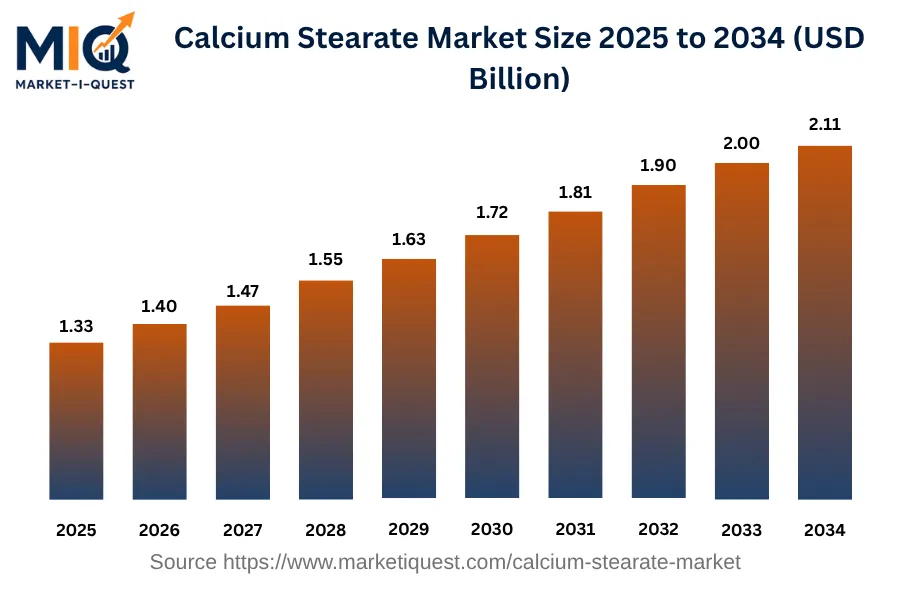
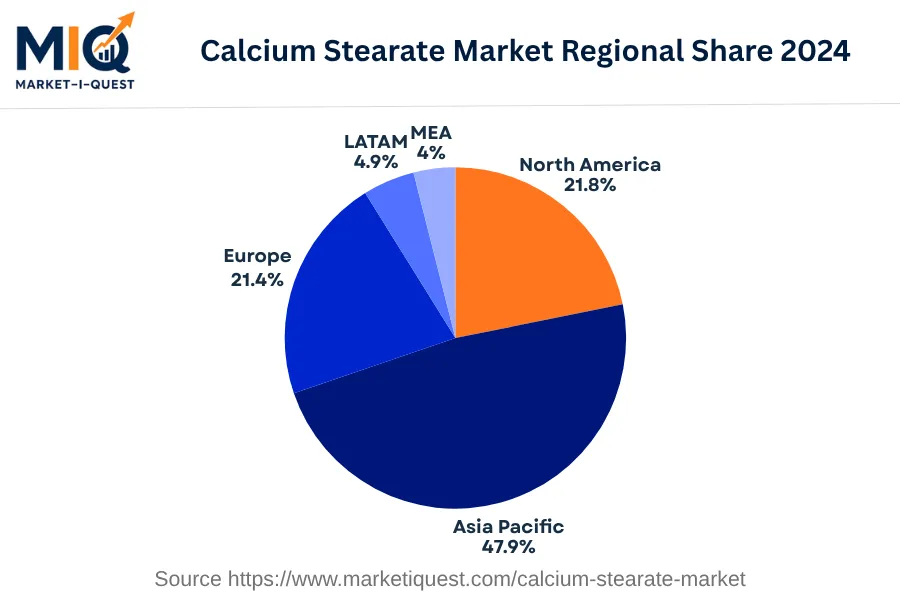
The Calcium Stearate Market size stood at USD 1.33 billion in 2025 and is expected to reach USD 2.11 billion by the end of 2034, growing at a CAGR of 5.28%. Beginning at USD 1.26 billion in 2024, the market demonstrated steady growth to 2025 and is predicted to continue this trend over the following years up to 2034. The primary contributors to this market expansion are increased demand and adoption across various industries. The regional share mix in 2024 showed that nearly 49.92% of the market was held by the Asia Pacific along with North America possessing a 21.84% stake. Europe followed closely contributing 21.38% to the market. LATAM and MEA held smaller portions of the market, with 4.91% and 3.95% respectively.

Key Takeaways

  • By Grade - Pharmaceutical Grade led in the Calcium Stearate Market accounting for a significant share in 2024.
  • By Form - Powder held a predominant position in the market in 2024.
  • By End User - Automotive sector accounted for the largest market share in 2024.
calcium-stearate-market market size

Key Driving Factors

Strict Environmental Regulations

The Calcium Stearate market is being significantly driven by the tightening environmental regulations globally, particularly related to the plastic and rubber industries. As Calcium Stearate is biodegradable and non-toxic, it is considered an environmentally friendly substitute for harmful stearates. Governments and environmental bodies are increasingly imposing regulations that enforce the reduced use of toxic materials in the production processes of these industries. For example, the European Union's Registration, Evaluation, Authorization, and Restriction of Chemicals (REACH) regulations push for alternatives to toxic chemicals. These environmental regulatory pressures effectively stimulate the demand for Calcium Stearate in the plastic and rubber industries.
Increased Application in the Pharmaceutical Industry

Another key driver of the Calcium Stearate market is its growing application in the pharmaceutical industry. More specifically, Calcium Stearate is widely used as an excipient in tablet manufacturing due to its lubrication properties. As the pressure to increase production efficiency in the pharmaceutical sector heightens due to rising global healthcare needs, the demand for efficient and quality excipients like Calcium Stearate significantly grows. Additionally, no serious health implications have been reported from the use of Calcium Stearate in medications, thus enabling pharmaceutical companies to use it without the fear of facing legal repercussions.

Market Evolution by Timeline

2019-2023
During this period, major buyers of calcium stearate were industries using it as an anti-caking agent in food, plastic, and pharmaceutical products; led by Asia-Pacific markets, particularly China and India. Technological growth saw refinery plants increasing their production capacity with integration maturity reached in purifying raw materials. The regulation that provided major impact was the 'Food Safety and Standards Regulation (FSSR), 2011' in India which defined safety parameters for additives like calcium stearate. Commercial models were mainly long-term contract-based sales for constant supply. High dependence on petroleum as a raw material posed a risk due to unpredictable fluctuations in oil prices.
2024
Californian buyers expressed a surge in demand for calcium stearate as a plastic stabilizer due to the state's commitment to sustainability in 2024. Supplier companies fortified their R&D endeavors focused on efficient stearic acid extraction. No notable changes took place—either in regulatory norms or commercial models—from the previous phase tended to affect the market. Main risk stemmed from environmental activists who questioned the idea of deriving stearic acid, essential to produce calcium stearate, from animal fat.
2025-2029
Latin America, especially Mexico and Brazil, displayed increased demand for calcium stearate in the cosmetic industry. However, supplier companies found it challenging to meet this demand, owing to the lack of skilled workforce in these markets. The introduction of Mercosur's 'Common Market Group Resolution No. 3/92' altered the market dynamics, enabling more stringent controls over food and cosmetic additives. No significant shifts in partnerships or commercial models were observed. Risks pertaining to this period were largely around the sourcing and supply of raw materials, specifically stearic acid.
2030-2034
In this timeframe, Southeast Asia led in the demand for calcium stearate in the paint and construction industries. Major suppliers introduced advanced level automated production facilities, overcoming previous constraints, and achieving an intensified production volume. Association of Southeast Asian Nations' new level of required standards for paint (ASEAN Coating Standard - ACS) spurred the regional calcium stearate market. Commercial models exhibited a shift towards dynamic pricing, even in long-term contracts. The risk was identified as dependency on regional stability due to potential geopolitical tensions.

Future Market Outlook

Future Opportunities

The future of the calcium stearate market presents significant opportunities driven by regulatory advancements and emerging applications. The growing electrification of transportation, exemplified by companies such as Rivian preparing to launch electric trucks in 2024, highlights the need for high-performance materials in energy storage systems, where calcium stearate's properties can be critical. Additionally, the increase in global plastic bans, notably in countries like Canada that are implementing comprehensive single-use plastic regulations by 2025, necessitates the development of alternative materials where calcium stearate can play a pivotal role. Investments from companies like BASF into research on sustainable alternatives may facilitate the transition towards bio-based calcium stearate formulations, aligning with market shifts towards sustainability. In the food industry, rising consumer awareness regarding additives is pushing manufacturers to seek compliance with regulations like the FDA's GRAS (Generally Recognized as Safe) status, motivating further innovation in calcium stearate applications. Moreover, the growing focus on product quality in coatings and inks, especially in Asia-Pacific markets, signifies an expanding landscape for calcium stearate as a rheological modifier. As regulatory frameworks evolve and industries seek to comply with new standards, companies active in the calcium stearate space are poised to explore various verticals, including pharmaceuticals and cosmetics, further broadening the market's scope. This adaptation will be crucial for sustaining competitive advantage and facilitating growth in diverse sectors.

Segmentation Analysis

By Grade

The market is divided into subsegments including Pharmaceutical Grade, Food Grade, Industrial Grade, and Cosmetic Grade, of which the Pharmaceutical Grade accounted for the largest revenue share while the Industrial Grade is expected to grow at the fastest CAGR during the forecast period.

Largest Revenue Share

Pharmaceutical Grade

Market Share Leader

The Pharmaceutical Grade segment is a lead contributor in terms of revenue. This can majorly be attributed to the consistently high demand in the health and wellbeing sector, which requires these grades for a wide range of medications, vaccines, and therapeutic remedies. Furthermore, the stringent regulatory environment in pharmaceuticals is a primary driver for high grade products, as companies need to ensure regulatory adherence to maintain their market positions. The primary customers of Pharmaceutical Grade are large pharmaceutical companies, hospitals, and health care organizations, who require these precise, high-grade substances to develop and administer life-saving treatments. Another contributory factor is the higher purchasing criteria and switching costs in the pharmaceutical field, where companies cannot easily switch suppliers due to regulatory constraints and the subsequent need for rigorous testing procedures. The Pharmaceutical Grade products are often sold via specialized B2B channels, which creates a stable and predictable revenue flow.

Fastest CAGR

Industrial Grade

Forecast Period Growth Leader

The Industrial Grade subsegment is expected to witness the fastest growth, driven by rapid industrialization in emerging economies like China, India, and Brazil. Industrial Grade products, while lower in grade compared to Pharmaceutical or Food Grade, find extensive use in several industries such as construction, textiles, automotive, and paints. A key catalyst for its growth has been the tech advancements that have improved product quality and reduced production costs, making them more attractive to industrial users. Another catalyst is increased investment in infrastructure development, which increases the demand for industrial grade materials. The adoption barriers include a hesitance to switch from traditional materials due to established supply chains and the high upfront costs of transitioning towards newer material. However, strategic partnerships with suppliers and increased capex in research and development can mitigate these challenges. Near-term risks include fluctuating raw material prices and any adverse changes in trade policies.

By Form

The market is divided into subsegments including powder, flakes, granules, and liquid components. In the base year 2024, the powder subsegment accounted for the largest revenue share while the liquid component is expected to grow at the fastest CAGR during the forecast period.

Largest Revenue Share

Powder

Market Share Leader

In the market, the 'powder' subsegment stands out as the largest revenue generator. This can attribute to its superior features such as easy storage, transportation, and versatile use in various applications. Powder form is typically preferred by industries due to cost-effectiveness and the convenience it provides in terms of ease of mixing and accuracy in measurement, which are critical factors in manufacturing settings. Furthermore, in terms of geography, regions with a strong industrial base such as North America and Europe contribute significantly to the demand for the powder form. Regulatory requirements also play a role as powdered compounds often have longer shelf lives and a lower risk of contamination, which is a key purchasing criterion for stakeholders. Finally, the entrenched nature of the powder distribution channels, which benefits from incumbent relationships, also helps to maintain the primacy of the powder form subsegment in the industry.

Fastest CAGR

Liquid

Forecast Period Growth Leader

Despite the dominance of the powder form in terms of current revenue, the 'liquid' subsegment is expected to grow at the fastest rate during the forecast period. Liquids tend to offer reduced preparation times and ease of application, making them increasingly attractive to fast-paced industries. The cost involved in switching from powdered to liquid form is also decreasing, thanks to advancements in technology and increased process efficiency. Moreover, partnerships among key industry players are fostering faster adoption of liquid forms as they strive to promote technologically advanced and sustainable solutions. However, there are potential short-term risks to the growth of the liquid subsegment such as the resistance to change in well-established industries and potential regulatory hurdles. Regardless, the growing demand for accelerated, efficient industrial processes provides a prime catalyst for the acceleration of the liquid subsegment.

By End Use Industry

The market is divided into subsegments including automotive, construction, consumer goods, medical, electronics, packaging, and others. Of these, the automotive sector accounted for the largest revenue share, while the electronics sector is expected to grow at the fastest CAGR during the forecast period.

Largest Revenue Share

Automotive

Market Share Leader

The automotive industry has consistently emerged as a lucrative sector due to its intensive material demands. Catering to various components of vehicles, ranging from interior applications, outer body applications to engine and electrical components, the sector's high consumption rate of diverse materials justify the commanding revenue share. Recent innovation trends, like lightweight, fuel-efficient vehicles have further increased demand, with manufacturers investing in durable materials to reduce vehicle weight without sacrificing safety. Furthermore, the growing automotive industry in Asia, particularly China and India, is a key factor fueling revenue growth. In today's globalized economy, many automotive companies have established production facilities in these regions to leverage lower labor costs and easy access to raw materials. Legislation encouraging sustainable practices and recycling is also a significant driver for some materials

Fastest CAGR

Electronics

Forecast Period Growth Leader

The electronics industry is poised for the fastest growth, bolstered by increasing consumer demand for advanced and sophisticated electronic devices. The miniaturization trend, promoting greater functionality in smaller packages, is driving high demand for unique materials that can meet stringent requirements for size, weight, conductive properties, and heat resistance. Additionally, the continuing digital revolution, encompassing everything from smartphones to IoT devices and data centers, provides ample opportunities for growth. However, the segment faces challenges, including price-sensitive customers, rapid technology obsolescence, and intense competition, which could slow momentum. To conquer these barriers, companies need to maintain a keen focus on innovation and cost-efficiency. Partnerships with tech firms and investment in advanced materials capital expenditure can provide a competitive edge and fuel growth in the near term.

Competitive Analysis

Key Market Players

Manufacturers / OEMs

Faci Asia Pacific Pte. Ltd.
Singapore
Baerlocher GmbH
Germany
James M. Brown Ltd.
UK

Key Suppliers & Raw Materials

Imerys
France
Omya AG
Switzerland
Huber Engineered Materials
US

Distributors, Integrators & Channel Partners

Univar Inc.
US
Barentz
Netherlands
Brenntag
Germany

Porter’s Five Forces Analysis

This is a detailed analysis of the competitive landscape in the Calcium Stearate market.

Supplier Bargaining Power

Medium

Limited number of chemical manufacturers potentially increases bargaining power.

Buyer Bargaining Power

Low

High switching costs and lack of alternatives reduce buyer bargaining power.

Threat of Substitutes

Low

Lack of effective substitutes for calcium stearate in various applications.

Threat of New Entrants

Medium

Initial capital costs and environmental regulations moderate the threat of new entrants.

Competitive Rivalry

High

Industry has many established key players resulting in intense competitive rivalry.

Regional Analysis

Geographic market dynamics and growth opportunities across key regions

Global Market Outlook

calcium-stearate-market market regional share

North America

In 2024, North America's Calcium Stearate market displayed strong dynamism driven by several factors. Increasing demand in the plastic and rubber industry significantly propelled production rates. Regulatory environments in the U.S., Canada, and Mexico further prompted market growth with environmental policies encouraging the use of eco-friendly compounds notably affecting production and consumption patterns. Investment in sustainable manufacturing methods also positively influenced the market, with technological adoption leading to more efficient production techniques.

In terms of trends, buyer behavior indicated a shift towards products utilizing Calcium Stearate due to its thermal stability and non-toxic properties. This particularly influenced sectors of the manufacturing industry, including pharmaceuticals and food production. There was a clear pattern of consolidation in the market as companies sought to enhance competitiveness, leading to numerous partnerships and acquisitions. Furthermore, stricter policy enforcement around the use of potentially harmful additives in the consumer goods sector gave a definitive direction of growth to the Calcium Stearate market. In essence, 2024 saw the North American Calcium Stearate market affected by an array of drivers - demand increase in specific industries, changing regulations, and technological advances. Concurrently, buyer behavioral change, notable market consolidation, and policy enforcement characterized the market trends for the year.

Asia Pacific

In 2024, the Calcium Stearate market in Asia Pacific thrived under various dynamic conditions. Significant drivers were escalating demand from end-use industries such as plastic & rubber, pharmaceuticals, and personal care, especially in India, China, and Japan. Favorable regulations and policies in these countries contributed to this growth. China's pharmaceutical reform policy, for example, increased the adoption of calcium stearate in the pharmaceutical industry. In India, steady investment in plastic & rubber industries expanded the market, whereas Japan's high-tech adoption fostered utilization in manufacturing processes.

Significant trends shaping the market include shifting consumer preferences towards environmentally friendly and non-toxic products. This change was particularly noticeable in mature markets such as Australia, where a green consumerism trend stimulated the demand for calcium stearate in biodegradable plastics production. Channel dynamics also shifted, with an emphasis on digital platforms brought about by Korea's smartphone penetration rate reaching a record high, disrupting traditional distribution channels. Additionally, there were noteworthy partnerships in China; the strategic alliance between Sinopec and BASF resulted in the production of high-quality, cost-effective calcium stearate. Stringent policy enforcement in ASEAN markets, focusing on limiting heavy metal residues, drove industries to opt for safer alternatives, further fueling the demand for calcium stearate.

Europe

In 2024, the European calcium stearate market showcased crucial dynamics deeply rooted in diverse industries. The growth was driven by increased utilization in plastics manufacturing due to its thermal stability and anti-caking characteristics, depicting a noteworthy surge predominantly in the Nordics and Benelux. The stringent regulation effectuated by the European Union to maintain food safety standards ignited the extensive use of calcium stearate in the food and beverage industry. Additionally, escalating investments in the life sciences industry, particularly healthcare entities across Germany, France, and Italy, the growing requirement for calcium stearate in pharmaceutical manufacturing elevated its demand.

Identifying market trends, the adoption of calcium stearate in construction and building materials due to its water-repellency feature gained traction in the United Kingdom and Spain, signaling an inclining pattern. A noticeable shift was seen in manufacturers adopting calcium stearate as a flow agent in cosmetics, predominately within Central and Eastern Europe. The increased partnerships and M&A's within the consumer goods sector had driven its widespread application for PVC stabilization, compliance with policy enforcement by the EU. In the identified sectors, namely plastics manufacturing, food and drinks, healthcare, construction, and consumer goods, the European calcium stearate market developed an integrated market structure in the base year.

Latin America

In 2024, the Calcium Stearate market in Latin America flourished remarkably due to several influencing factors and changing trends. Fueling its growth were the rising demand in the plastic, pharmaceutical and food industries in Brazil and Mexico. This was because Calcium Stearate served as a primary additive in producing various products. Meanwhile, Brazil's reformed environmental regulations prompted many manufacturers to adopt the mineral as a more eco-friendly option. Increasing foreign investments in Argentina’s thriving pharmaceutical sector necessitated the use of Calcium Stearate, hence boosting the market. Finally, supply dynamics in Peru - known for its prosperous mining sector - bolstered market proliferation.

The year saw a shift in buyer behavior in Colombia, opting for Calcium Stearate-based products due to their non-toxic nature. The introduction of advanced technology in Chile's manufacturing sector necessitated the use of this calcium salt. Mergers and acquisitions became a common trend among leading Calcium Stearate manufacturers in Mexico, increasing their market footprint. Regulation enforcement tightened in all aforementioned countries, ensuring the use of Calcium Stearate adhered to quality and safety standards. Major customers of the Calcium Stearate market encompassed industries such as manufacturing, pharmaceutical, food and utilities sector. This mineral was vital in manufacturing processes, drug production, food and drink preservation, and providing heat resistance in utility industries.

Middle East & Africa

In 2024, the Calcium Stearate Market in the Middle East and Africa was characterized by steady demand and evolving supply dynamics. Drivers of this market included an uptick in consumption in sectors such as manufacturing and healthcare, a response to improving economic conditions. New investments into raw material extraction in countries like Saudi Arabia and Nigeria fueled a surge in production capacity, thereby enhancing supply. The enforcement of stricter environmental regulations in countries such as the United Arab Emirates stimulated demand for eco-friendly Calcium Stearate variants.

Trends indicated a shift in buyer focus towards locally sourced Calcium Stearate, especially in markets like Egypt and South Africa. The growing influence of digital channels was evident from the increased online sales in Kenya and Israel. Notably, there were no high-profile mergers or acquisitions in 2024, although many companies aimed to strengthen their regional foothold through partnerships. In sectors such as oil and gas and utilities, particularly in Qatar, a standardization drive was seen, pushing towards the use of Calcium Stearate in corrosion protection. Lastly, the year saw no significant change in pricing, which remained consistent across most targeted countries.

Recent Industry Developments

Latest market innovations, product launches, and strategic initiatives

March 2026

Baerlocher GmbH and Peter Greven finished factory automation upgrades at their major compounding hubs to meet ISO 45001 workplace standards. The expansions shift production from legacy dust-heavy powders to dustless, pelletized, and granular calcium stearate formulations for high-speed plastic extrusion lines.

March 2026

BASF announced the sale of its Softex business to GOVI CAST Sdn. Bhd.; the portfolio includes calcium stearate dispersions used as anti-tack and mould-release agents in glove manufacturing.

November 2025

CMS and international pharmacopeia groups enforced stricter USP-NF purity guidelines for trace metals and fatty-acid ratios. This regulatory update forces chemical suppliers to upgrade processing lines to high-purity, pharmaceutical-grade calcium stearate to maintain generic drug manufacturing contracts.

Frequently Asked Questions