Calcium Peroxide Market Snapshot

Key Players

  • Solvay (Belgium)
  • Evonik Industries (Germany)
  • Arkema (France)
  • PeroxyChem (United States)
  • BASF SE (Germany)
  • Aditya Birla Chemicals (India)
  • Huzhou City Linghu Xinwang Chemical (China)
  • Lianyungang Rely Intl Trading Ltd (China)
  • Suzhou Huatai Biological (China)
  • Jiangxi Boholy Chemical (China)

Market Size

Base Year 2024
$2.47 Bn
CAGR
3.5%
Forecast 2034
$3.48 Bn

Market Segments

By Grade
  • Food
  • Industrial
By Application
  • Clarifying Agent
  • Oxidizing Agent
  • Deodorizing Agent
  • Others
By End-User
  • Food & Beverages
  • Agriculture
  • Mining
  • Pharmaceuticals
  • Paper & Pulp
  • Others

Market Dynamics

Drivers
  • Increasing calcium peroxide applications
  • Rising environmental concerns
Restraints
  • Stringent environmental regulations
  • Availability of substitutes
Opportunities
  • Growing environmental concerns
  • Rise of sustainable agriculture

Market Size

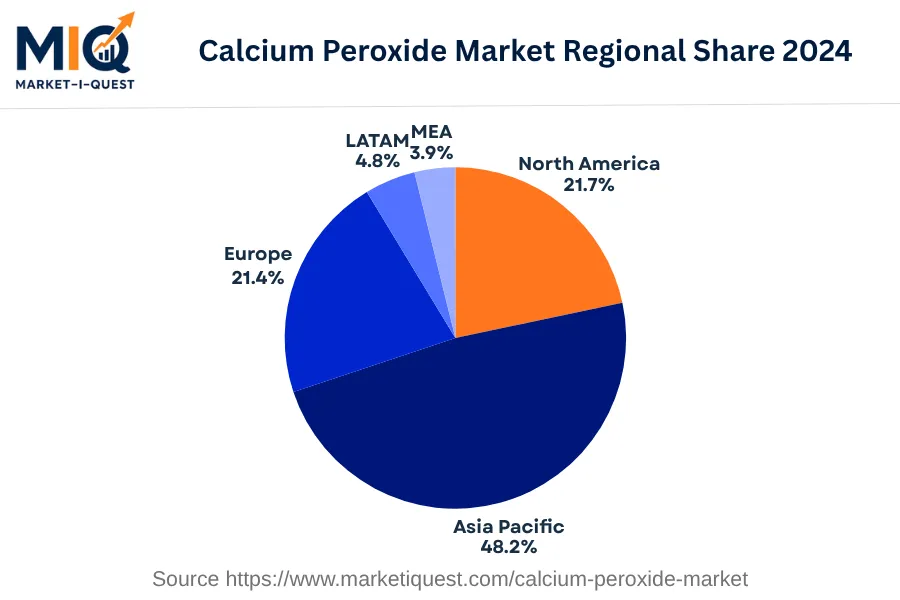
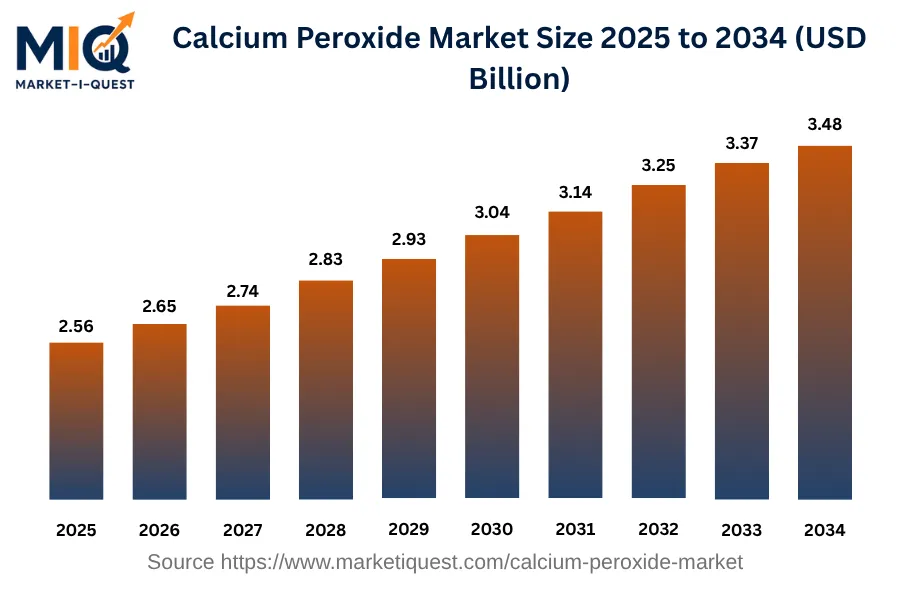
The Calcium Peroxide market size was valued at $2.56 billion in 2025 and is projected to reach $3.48 billion by 2034, growing at a CAGR of 3.5%. Observing the growth path, the market started from $2.47 billion in 2024, with a noticeable increase the following year. This growth is primarily fueled by the increased usage of Calcium Peroxide in various sectors which demands a high volume of this chemical compound due to its effective properties. Gradual growth was observed year after year, reaching the valuation of $3.48 billion by 2034. The regional market shares in 2024 were distributed with Asia Pacific holding the largest share at 48.2%, followed by North America with a 21.7% share, and Europe held 21.4%. Meanwhile, the shares of Latin America and the Middle East & Africa were comparatively lower at 4.8% and 3.9% respectively. These figures provide a snapshot of the geographical distribution of the Calcium Peroxide market.

Key Takeaways

  • By Grade - Industrial segment held majority of the market share in the base year.
  • By Application - Oxidizing Agent led in terms of usage and accounted for a significant share in the base year.
  • By End-User - Pharmaceuticals most extensively accounting for a significant share of the market in the base year.
calcium-peroxide-market market size

Key Driving Factors

Increase in Aquaculture practices

The growing practice of aquaculture worldwide is a significant driving factor in the calcium peroxide market. Calcium peroxide acts as an oxygen provider promoting microbial degradation of organic matters in aquatic environments which becomes necessary in maintaining the quality and health of aquaculture environments. As the global aquaculture industry expands to meet increasing global seafood demand, the usage of calcium peroxide also rises. Specifically, emerging economies like India, China, and Vietnam are witnessing a surge in aquaculture activities, thereby contributing to the demand for calcium peroxide in these regions. Moreover, the emphasis on sustainable aquaculture practices is accentuating this demand further.

Offering of Soil Remediation Solutions

The adoption of calcium peroxide for soil decontamination purposes is another driving force in its market. Calcium peroxide serves as an environmentally friendly solution to soil remediation, enhancing soil quality by improving its oxygen content and eliminating pollutants. It's a credible alternative to the use of synthetic chemicals in land rehabilitation. Government regulations, primarily in developed countries like the U.S., U.K., and Germany, mandating industrial entities to adhere to soil decontamination procedures and avoid environmental harm are inducing the demand for calcium peroxide. Also, non-governmental organizations' endeavors to create awareness about these environment-friendly alternatives are adding to this demand.

Market Evolution by Timeline

2019-2023
During this period, the buy-side of the Calcium Peroxide market typically involved dental care and agricultural industries, which sought it for teeth whitening products and enhanced soil aeration respectively. Primary demand was concentrated in North America and Western Europe. The market witnessed a structured supply chain, with major global manufacturers like Solvay, BASF, and Arkema leading pilots. Technological adaptation was moderately paced, and supply was occasionally constrained by limited access to raw materials like limestone. Regulatory environment primarily impacted the dental care segment, guided by FDA's regulations that limited peroxide concentration in teeth whitening products to 15%. Flat-rate pricing prevailed in contracts with long-term agreements between suppliers and big manufacturers. Potential risks included market volatility due to unstable raw material prices.
2024
In 2024, the Calcium Peroxide market's demand primarily came from aquaculture and environmental industries in areas like USA, Canada and China as they figured out Calcium Peroxide's usage in pond and lake treatments and wastewater management. There was a shift towards more efficient production methods, aided by technological maturity and processing equipment upgrades. However, environmental regulations by EPA and European Chemicals Agency grew stricter, causing challenges. Average selling prices of Calcium Peroxide trended upward, pushing for the execution of more fixed-price contracts. Risks were amplified by regulation changes and supply chain disruptions due to environmental norms and geopolitical scenarios.
2025-2029
Within these years, the demand side for the Calcium Peroxide market opened up in developing regions, such as Southeast Asia, driven by agricultural purposes, soil remediation projects, and public health applications. Technology-wise, enhanced formulations were rolled out, supporting integration maturity along the supply chain. Supply constraints started to loosen due to diversification of raw material sources. Policy interventions were observed in the form of environmental standards set by ASEAN countries that had lately joined the purchasing pool. Re-negotiated contracts with flexible pricing was adopted to address global market changes. Risk management strategies started accounting for potential global trade policy shifts.
2030-2034
Expectedly, the Calcium Peroxide market in this period saw an expanded buyer base to include waste management companies and municipal bodies responsible for city planning, from both developed and developing countries. Supply evolved with comprehensive product suits adapted to new use-cases, with greater integration maturity and advanced handling standards. Policies were marked by country-specific regulations on chemical use in municipal projects, which influenced market operations. Experimentations with performance-based contracts were noted to tackle unpredictable raw material prices and environmental norms. Risk contemplation became broader, examining global environmental scenario, supply chain reliability, and transition to green technologies.

Future Market Outlook

Future Opportunities

The current trajectory of regulatory support for calcium peroxide opens up exciting opportunities across various applications, particularly in agriculture and environmental remediation. In 2023, several countries, including Germany and Canada, began implementing stricter environmental regulations that emphasize the need for eco-friendly agricultural inputs, positioning calcium peroxide as a viable alternative. This shift aligns with the ongoing global commitment to sustainable development goals, as outlined by the United Nations in 2015, which encourages countries to adopt practices that reduce chemical runoff and promote soil health. Additionally, the increasing interest in organic farming methods presents further scope for calcium peroxide, given its efficacy as a biodegradable alternative to conventional fertilizers. Notably, industry leaders such as BASF are exploring partnerships to develop calcium peroxide-based products tailored for organic agriculture. Moreover, the rise of bioremediation practices specifically targeting contaminated soil continues to fuel demand, as seen in the 2022 collaboration between multiple environmental firms in Japan to utilize calcium peroxide for soil decontamination. As industries continue to embrace sustainability, the extension of calcium peroxide's applications into new markets, including wastewater treatment and food safety, seems promising. The combination of these factors signifies that stakeholders in the calcium peroxide market will likely find numerous pathways for growth while responding to societal and regulatory pressures aimed at sustainable practices.

Segmentation Analysis

By Grade

The market by grade is divided into subsegments including Food and Industrial. The Industrial subsegment accounted for the largest revenue share while the Food subsegment is expected to grow at the fastest CAGR during the forecast period.

Largest Revenue Share

Industrial

Market Share Leader

The Industrial subsegment leads the market in terms of revenue due to a variety of factors. This can be attributed to the scale of industrial applications for grade-based commodities, which significantly outpace those in the food sector. The range of applications spans numerous industries from manufacturing and construction to chemicals and materials, thus driving demand. Additionally, purchasing patterns have also been in favor of industrial grade materials, often due to higher durability and cost-effectiveness in the long term. Furthermore, the regulatory landscape shaping global trade of industrial commodities, combined with supply chain efficiencies has also contributed to higher revenue generation in this subsegment. Additionally, high switching costs, particularly in niche industries, favor the retention of industrial grade commodities. Sales channels, predominantly B2B, have also played an important role in driving revenue, often characterized by long-term contracts and bulk purchasing. It is important to understand that this dominance reflects the current market structure and any disruptive changes in market dynamics could challenge this positioning.

Fastest CAGR

Food

Forecast Period Growth Leader

The Food subsegment is expected to demonstrate the fastest CAGR growth during the forecast period. While this subsegment currently doesn't match the revenue scale of the industrial grade, its growth potential is noteworthy. Factors influencing this growth include changes in consumer behavior, increasing demand for high-quality food-grade commodities, technological advancements in food processing, and evolving regulations. Furthermore, progressive sustainability goals are pushing companies to invest in cleaner, higher-grade food products, acting as a catalyst for growth in this subsegment. There are, however, certain adoption barriers such as hesitant consumer acceptance for new food-grade materials, cost implications, and stringent compliance norms. All these factors form a critical part of the growth ecosystem of the Food subsegment. While growth is expected, companies need to navigate these challenges successfully to capture opportunities. These growth factors assume that the landscape remains intact with no disruptive changes in market dynamics.

By Application

By Application, the market is divided into subsegments including Clarifying Agent, Oxidizing Agent, Deodorizing Agent, and Others. In 2024, the Oxidizing Agent subsegment accounted for the largest revenue share while the Clarifying Agent subsegment is expected to grow at the fastest CAGR during the forecast period.

Largest Revenue Share

Oxidizing Agent

Market Share Leader

The Oxidizing Agent subsegment leads in market revenue in the base year 2024 owing to several market dynamics. This category finds significant usage in manufacturing applications where oxidative properties are required. The demand is driven primarily by sectors like water treatment, industrial operations, and healthcare due to the critical role of oxidation in purifying and sterilizing, giving the segment a wide customer base. Geographically, its demand has been extensively captured in industrialized regions due to dependence on such agents for regular operations. Regulatory norms regarding cleanliness and purity standards in these industries require frequent application of oxidizing agents, further fuelling their demand. The purchasing decision for this subsegment is mostly driven by product effectiveness, cost, safety regulations, and environmental impact. Some industries rely heavily on this agent which contributes to its high market revenue. Distribution generally occurs through B2B channels, with suppliers having long-term contracts with industries to assure supply continuity and manage procurement costs.

Fastest CAGR

Clarifying Agent

Forecast Period Growth Leader

The Clarifying Agent subsegment is expected to report the fastest growth rate. The growth outlook for this subsegment is primarily anchored in the increased demand for clean and pure products across many industries. Using Clarifying Agents helps to significantly improve the visual appeal and quality of products, creating a key purchasing criterion for consumers. This trend is being reinforced by rigorous quality norms and standards. Adoption barriers include potential reaction or contamination risks, high dependence on manufacturing operations, and cost concerns. Rapid technological advancement in processing capabilities is likely to offer improved and cost-effective clarifying agents, thus serving as a catalyst for growth. Recent partnerships in the sector aimed at enhancing product quality and enforcing stricter regulations could propel the segment's growth. However, short-term growth could potentially be hindered by fluctuating raw material prices and the adverse results of the global economic conditions that have followed the COVID-19 pandemic.

By End-User

The market is divided into subsegments including Food & Beverages, Agriculture, Mining, Pharmaceuticals, Paper & Pulp, and Others. In the base year 2024, Pharmaceuticals accounted for the largest revenue share while Agriculture is expected to grow at the fastest CAGR during the forecast period.

Largest Revenue Share

Pharmaceuticals

Market Share Leader

The Pharmaceuticals subsegment leads the market in revenue generation. This is primarily driven by the consistent demand for medication, health supplements, and pharmaceutical supplies across the globe. Countless health conditions necessitate the continual use of pharmaceutical products, thus ensuring steady revenue. In addition, the ongoing innovation and increasing customization in pharmaceuticals have expanded the variety and complexity of products available, attracting diversified customer groups and driving growth further. Regulatory requirements too play a part, making certain medications mandatory in some cases. Another important driver is the aging population across developed nations, leading to increased demand for medical care and associated pharmaceuticals. Lastly, the reach and effectiveness of distribution channels — online and offline, have also significantly contributed to the revenue.

Fastest CAGR

Agriculture

Forecast Period Growth Leader

Despite not being the largest, the Agriculture subsegment is projected to be the fastest growing over the forecast period. Innate to survival, agricultural activities are omnipresent, and the increasing global population is escalating food demand. The advancement in technology such as precision farming, smart irrigation, and agricultural robots act as catalysts, facilitating agricultural activities and increasing productivity. Also, major investments in research and development, together with government incentives and partnerships with tech firms are propelling the sector growth. However, challenges like high capital investment, lack of technical knowledge, and adoption barriers in some regions pose risks. Nonetheless, the intense focus on sustainable farming practices globally and improvements in networking infrastructure in rural areas bode well for the market’s growth trajectory.

Competitive Analysis

Key Market Players

Core Manufacturers & OEMs

Solvay SA
Belgium
Evonik Industries AG
Germany
Arkema Group
France

Key Suppliers & Raw Materials

Huber Engineered Materials
US
BASF SE
Germany
HELM AG
Germany

Distributors, Integrators & Channel Partners

Univar Solutions Inc.
US
Nouryon
Netherlands
Brenntag North America, Inc.
US

Porter’s Five Forces Analysis

This analysis evaluates the competitive intensity and attractiveness of the Calcium Peroxide Market.

Supplier Bargaining Power

Medium

Chemical manufacturers exercise medium power due to control over raw materials and product quality.

Buyer Bargaining Power

High

Multiple suppliers and transparency in pricing give high bargaining power to buyers.

Threat of Substitutes

Low

Low threat due to the unique properties and performance of calcium peroxide in targeted applications.

Threat of New Entrants

Medium

With ample raw materials and high market demand, new entrants pose a medium threat.

Competitive Rivalry

High

High competitive rivalry due to the presence of several large and small firms competing on price and quality.

Regional Analysis

Geographic market dynamics and growth opportunities across key regions

Global Market Outlook

calcium-peroxide-market market regional share

North America

In 2024, the North American calcium peroxide market is sizeable, driven predominantly by developments in the agrochemical and environmental sectors. Demand is elevated due to its use as an oxygen fertilizer, with its efficacy in soil remediation boosting adoption rates among American, Canadian, and Mexican farmers. Regulatory standards addressing soil pollution and encouraging sustainable alternatives propel the market further, amplifying calcium peroxide's recognition. Simultaneously, advancements in hygienic product manufacturing, mainly for oral care, stimulate interest for more efficient calcium peroxide supplies.

Emphasizing the shift towards green chemistry, calcium peroxide has seen strong preference, having beneficial impacts on crop yield and quality. Shifts are discernible in purchasing behaviors, with companies seeking environment-friendly options over synthetic chemicals. Mergers and acquisitions trends have also begun to accelerate with California-based Solvay's acquisition of PeroxyChem acting as a key regional example. Enforcement of policy initiatives such as the United States Environmental Protection Agency's Contaminated Site Clean-Up Information program has further benefited the market. Major sectors utilizing calcium peroxide in North America include environmental services, agriculture, healthcare, and consumer goods manufacturing. Therefore, the North American sale of calcium peroxide in 2024 can be understood as largely driven by an eco-conscious ethos, stringent environmental regulations, and technology adoption. This requires suppliers to continually innovate while addressing demand for sustainable and efficient derivatives.

Asia Pacific

In the base year 2024, the Calcium Peroxide Market within the Asia Pacific region showcased robust activity. Market drivers included an escalated demand from the agriculture sector, primarily in India and China, where calcium peroxide's utility as a soil conditioner and fertilizer gained acknowledgement. Furthermore, regulations promoting environmental sustainability in countries like South Korea amplified the preference for calcium peroxide, known for its eco-friendly attributes. Investment in advanced production technologies saw a surge, especially in Japan and Australia, leading to an increased supply at competitive prices.

Trending in the market was a distinctive shift towards online procurement platforms among purchasers in key ASEAN markets, enabling streamlined transactions that linked suppliers and buyers effectively. A notable tech shift observed was the deployment of nanotechnology in calcium peroxide production, particularly embraced by Chinese manufacturers. In this regard, M&A activity was evident, with firms aiming to boost their capabilities and market reach. Policy enforcement towards minimizing chemical pollution had China enforcing stricter measures on polluting industries, indirectly spurring demand for cleaner alternatives such as calcium peroxide in industrial applications. These applications included fresh produce preservation, in which calcium peroxide is used to eliminate potential microbial contaminants, thus ensuring food safety for retail consumers.

Europe

In 2024, the European market for calcium peroxide exhibited noteworthy dynamism. Regulatory policies advocating for environmentally friendly products drove demand, notably in Germany and Benelux where government mandates endorsed the use of calcium peroxide in soil remediation efforts. Simultaneously, technology adoption in the agriculture sector spurred investment, with Spanish and Italian producers incorporating calcium peroxide as an oxygen fertilizer to improve crop yields. In the UK market, supply dynamics were dominated by native manufacturers due to Brexit-induced trade barriers, fostering competitive pricing.

Consumer inclination towards products with longer shelf-life amplifies the usage of calcium peroxide in the food industry, particularly in Nordic countries recognized for their long-term food storage practices. Modifying trends in the wastewater treatment sector, primarily in France and Central & Eastern Europe, saw calcium peroxide gaining traction due to its effective contaminant degradation properties. M&A activity in the dental care sector underscored the product's reputation as a safe teeth whitener, contributing to its increased usage in this domain. Finally, governments across Europe, particularly in the UK, France and Germany, enacted strict policies to enforce standards for the use of calcium peroxide in various sectors. These customer-centric rules intended to protect end-users against potential misuse in manufacturing, healthcare, and retail industries.

Latin America

In 2024, the Latin American (LATAM) Calcium Peroxide market underlined steady growth, buoyed by various drivers within the region. Increased agricultural activities, particularly in Brazil and Argentina, spurred demand due to the product's use in modifying soil characteristics. Government regulations encouraging environment-friendly chemicals in Mexico and Chile bolstered market prospects, adding demand pressure in tandem with a rise in investment in clean industrial processes. Colombia's robust mining sector, a significant consumer of calcium peroxide in pollution control, underpinned supply dynamics in its favor.

Market trends exhibited certain noticeable shifts. Buyers, especially from mining and agriculture sectors, leaned towards suppliers offering superior product quality and sustainability credentials, pushing manufacturers to adapt. Innovations in application technology, particularly in Peru's agri-tech space, created newer channels for calcium peroxide use. The manufacturing sector in Brazil sought strategic partnerships and engaged in M&A activities to enhance supply chain robustness. Stringent enforcement of mining environmental standards in Chile and Argentina pushed for increased calcium peroxide use. Overall, the market's landscape in LATAM was shaped by a blend of regulatory measures, sectoral dynamics, and consumer preferences, with the demand surge particularly noticeable in the agriculture, mining, and manufacturing sectors. The LATAM calcium peroxide market in 2024 offered tangible opportunities for stakeholders, backed by both demand and supply-side dynamics.

Middle East & Africa

In 2024, the Calcium Peroxide Market in the Middle East and Africa emerged as a fast-growing segment in the chemical sector. Major demand drivers included increased adoption in soil remediation, especially in oil-rich countries like Saudi Arabia, Qatar, and the United Arab Emirates. Stricter environmental regulations also played a role in propelling the market, as Calcium Peroxide is considered a safer alternative for soil and waste water treatment applications compared to traditional chemistries. Investment in technology adoption resulted in efficient production and availability, meeting the rising demand.

Shifting buyer behavior towards sustainable practices was a key trend, with industries like oil and gas, utilities, and manufacturing opting for Calcium Peroxide due to its eco-friendly nature. In South Africa and Nigeria, changing policy enforcement backed by government bodies such as the Department of Environmental Affairs solidified this shift. There was also a noted increase in partnerships between manufacturers and local distributors to enhance supply chain dynamics, for example in Egypt and Israel. Overall, the Calcium Peroxide market growth in the Middle East and Africa in 2024 was primarily driven by increased adoption in eco-sensitive industries, push for environmentally friendly regulations, and enhanced supply chain dynamics through strategic partnerships.

Recent Industry Developments

Latest market innovations, product launches, and strategic initiatives

February 2026

Shaanxi Sciphar Hi-Tech Industry Co. finalized bulk supply agreements with wastewater treatment systems in the Asia-Pacific region. The alliance integrates commercial-grade calcium peroxide powder into automated sludge management systems to act as an odor-control agent and aerobic digestion accelerator.

September 2025

Evonik Industries launched a technical, granulate-grade calcium peroxide additive optimized for rice farming. The specialized formulation functions as an inline oxygen generator when coated on seeds, preventing anaerobic root rot during early-stage field flooding.

June 2025

Solvay SA implemented manufacturing upgrades across its South American peroxide facilities. The expansion optimizes production lines for solid calcium peroxide, directly targeting regional demand for controlled-release oxygen agents used in deep-soil bio-remediation and agriculture.

Frequently Asked Questions