Calcium Chloride Market Snapshot

Key Players

  • OxyChem (United States)
  • Tetra Technologies (United States)
  • Tiger Calcium Services (Canada)
  • Weifang Haibin Chemical (China)
  • Zirax Limited (United Kingdom)
  • Ward Chemical (Canada)
  • B.J.Services (United States)
  • Punjab Chemicals & Crop Protection (India)
  • Aarti Industries Limited (India)
  • Solvay (Belgium)

Market Size

Base Year 2024
$2.36 Bn
CAGR
5.8%
Forecast 2034
$4.15 Bn

Market Segments

By Product Type
  • Flakes 77%
  • Flakes 94%
  • Prills 94%
  • Pellets 94%
By Form
  • Liquid
  • Hydrated Solid
  • Others
By Application
  • Dust Control and De-icing
  • Gas and Oil
  • Construction
  • Food
  • Others

Market Dynamics

Drivers
  • Increasing industrial usage
  • Demand in de-icing activities
Restraints
  • Environmental regulations
  • Potential health hazards
Opportunities
  • Growing pharmaceutical industries
  • Increasing de-icing demands

Market Size

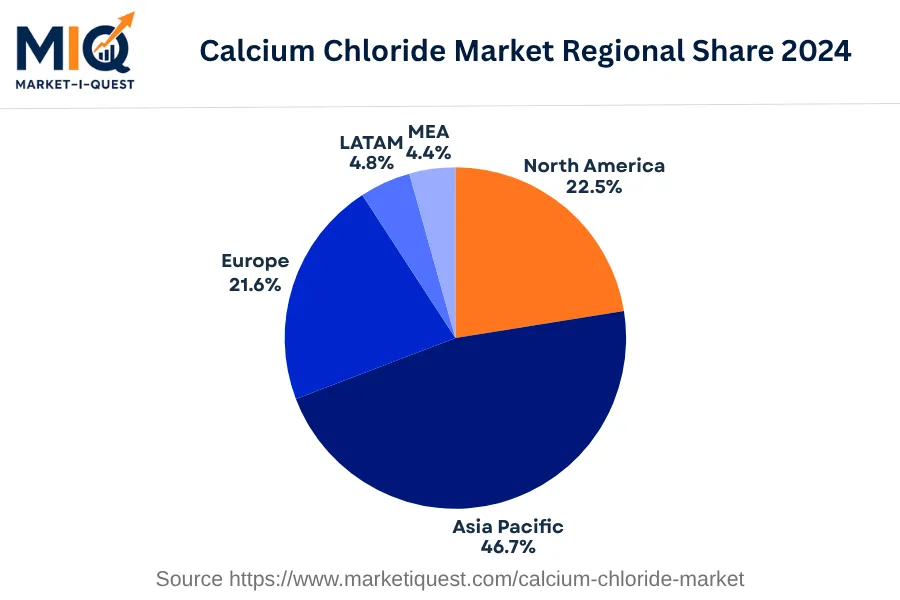
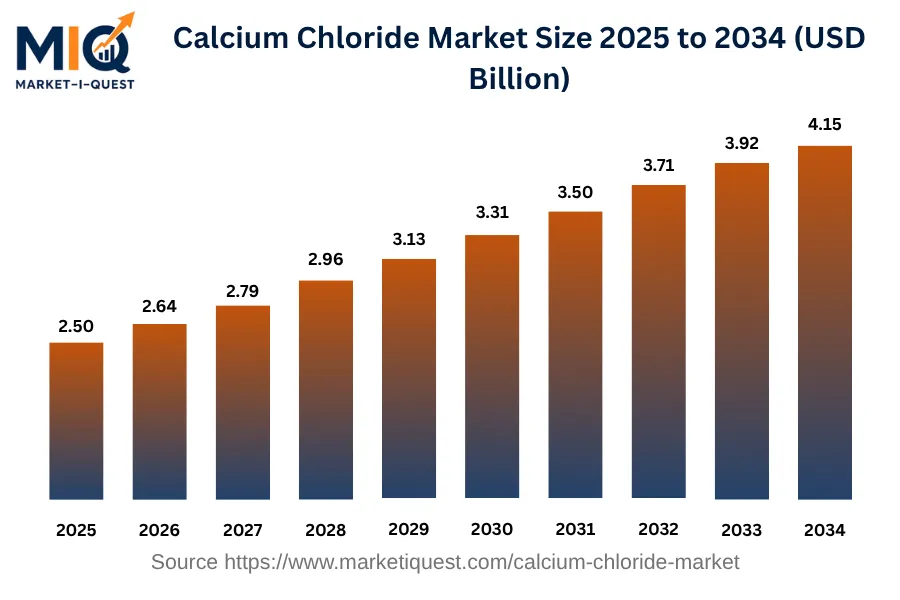
The Calcium Chloride Market, valued at $2.50 billion in 2025, is estimated to reach a value of $4.15 billion by 2034, growing at a Compound Annual Growth Rate (CAGR) of 5.8%. This substantial increase over the nine years is driven by key factors such as market expansion and rising demand in various applications. The year 2024 witnessed the market size standing at $2.36 billion, beginning the upward trajectory that leads to the anticipated market size in 2034. In term of regional share in the year 2024, the Asia Pacific region held the largest portion of the market at 46.7%, followed closely by North America and Europe with 22.5% and 21.6% respectively. The smaller market fractions were in the Latin America and Middle East & Africa regions, reported at 4.8% and 4.4% respectively. These figures give a comprehensive layout of the geographical distribution of the Calcium Chloride Market.

Key Takeaways

  • By Product Type - Flakes held the market lead share.
  • By Form - Liquid led the segment with the most substantial market presence.
  • By Application - Gas and Oil held a noteworthy position contributing to market diversity.
calcium-chloride-market market size

Key Driving Factors

Escalation in Freeze-Resistant Construction Projects

The adoption of calcium chloride to meet freeze-resistant requirements in construction projects is a prominent factor propelling demand within the Calcium Chloride market. Calcium chloride, due to its capacity to lower the freezing point of water, is often mixed into concrete used in building structures in frost-prone areas. This addition helps to keep the water in the concrete mixture from freezing too quickly, thus reducing potential damage to the building material. With construction companies continually aiming to implement preventative measures against cold-induced harm to the integrity of their structures, they increasingly favor calcium chloride, causing a significant upturn for the market.

Growing Application in Dust Control and Deicing

The escalation in the use of calcium chloride for dust control and deicing is another substantial driver for the Calcium Chloride market. Calcium Chloride, as a hygroscopic substance, binds with dust, keeping roads and construction sites dust-free for extended periods. This attribute intensifies its utilisation by public works departments and construction firms, boosting its market demand. Furthermore, municipalities across colder climates engage calcium chloride for deicing roads due to its ability to depress the freezing point of water, ensuring public safety during winter months. Such a usage leads to a noteworthy growth in the Calcium Chloride market.

Market Evolution by Timeline

2019-2023
During this period, demand for calcium chloride was primarily driven by its uses in dust control and de-icing, especially in North American and European regions. Technological innovation focused on improved manufacturing processes to reduce waste. Constraints included environmental concerns related to extraction and disposal. Governments adopted regulations like the US EPA's Industrial Waste Management guidelines to control these issues. Commercial structures typically had fixed-term supply contracts, with contracts often including clauses to account for regulatory changes. A key risk was the potential for regulatory tightening, which prompted companies to integrate green practices into their extraction and processing activities.
2024
In 2024, a pattern of emerging demand from the food preservation segment was observed, especially in developing markets of Asia and Latin America due to changing food consumption habits. There were no major changes on the supply side. However, increased enforcement of environmental regulations influenced the overall production process. Commercially, suppliers explored outcome-based contracts to share environmental compliance risks. Risks comprised supply chain disruptions due to stricter environmental regulations, and companies responded by reassessing their procurement strategies and sourcing raw materials more sustainably.
2025-2029
During 2025-2029, use of calcium chloride in oil & gas and construction sectors picked up pace, primarily in Middle Eastern and Asian countries, driven by infrastructural developments and flourishing oil & gas industry. Technological developments mainly focused on utilizing waste brines from fracking process, thereby dealing with disposal issue and providing an alternative source. The introduction of the Global Compact for Responsible Resource Development incited companies to revise production methods to meet new standards. The market saw a rise in cooperative contracts, enhancing supply security to handle the growing demand from new sectors. Risks included price volatility caused by supply-demand dynamics, managed by incorporating flexible pricing clauses into contracts.
2030-2034
By 2030-2034, the demand for calcium chloride continued to diversify with new uses in wastewater treatment and paper manufacturing industries. From the supply perspective, integrated systems that simultaneously produced calcium chloride along with other commodities like soda ash became a common practice. Regulations began focusing on complete life-cycle management, like the EU's Circular Economy Package. Partnership-based contracts became more prevalent to encourage long-term relationships and stability. Market risks involved escalating energy costs, with companies investing in energy-efficient technologies to negate these growing costs.

Future Market Outlook

Future Opportunities

Looking ahead, the calcium chloride market presents a myriad of opportunities driven by ongoing regulatory developments and shifting consumer preferences. In 2024, environmental agencies in Asia are expected to tighten regulations regarding the use of harmful substances in agricultural practices, creating space for calcium chloride, known for its efficiency in soil stabilization and moisture control. Additionally, as the trend toward sustainable agriculture grows, manufacturers may find a market for organic certifications associated with calcium chloride. In North America, the increasing number of infrastructure projects planned by governments aims to utilize calcium chloride extensively for road maintenance and dust control. The American Association of State Highway and Transportation Officials (AASHTO) continues to advocate for the use of calcium chloride as an industry standard, enhancing its credibility and acceptance. Moreover, the improvement of logistics networks for distribution, evident from the 2022 initiatives in Europe, shows that transportation efficiency directly influences market dynamics, allowing for more accessible delivery of calcium chloride to end-users. This context sets the stage for new strategic collaborations among manufacturers, logistics providers, and regulatory bodies, leading to innovative applications that align with market demand while meeting compliance standards in various regions.

Segmentation Analysis

By Product Type

The market encompasses subsegments including Flakes 77%, Flakes 94%, Prills 94%, and Pellets 94%, where Flakes 94% account for the largest revenue and Prills 94% are anticipated to grow at the fastest CAGR throughout the forecast period.

Largest Revenue Share

Flakes 94%

Market Share Leader

In the granular products market, the Flakes 94% appears to be the dominant player in terms of current revenue generation. Flakes 94% are widely favored for their versatility, easy compatibility with a variety of industrial applications, and their efficient production process. This product type benefits from an optimal balance of performance and price, making it a superior choice for customers, consequently leading to revenue gains. The geographic distribution of the Flakes 94% market is broad and encompasses mature markets where the established infrastructure supports the proliferation of this product. The stable regulatory environment and established supply chain also contribute to the profitability of this subsegment. Customer purchasing criteria heavily favor Flakes 94% due to its reliable performance and favorable economics, which reduce the inclination to switch to alternative products. Its robust distribution channels have played a significant role in solidifying its market position.

Fastest CAGR

Prills 94%

Forecast Period Growth Leader

Prills 94% are projected to experience the fastest growth rate among the product subsegments, spurred by a mix of factors. While they currently have a smaller share of the market compared to Flakes 94%, the growth drivers for this subsegment are positioned to provide a catalyst for rapid expansion. Advances in production technology are facilitating more cost-effective manufacturing of Prills 94%, while partnership initiatives are helping to break down adoption barriers. Moreover, capital expenditure in this subsegment also indicates a favorable growth outlook. Changes in policy favoring eco-friendly and efficient products are positions Prills 94% for substantial growth. However, the near-term risks such as fluctuating raw material prices and economic volatility must be vigilantly monitored to capitalize on the potential growth of this subsegment.

By Form

The market, based on form, is segmented into Liquid, Hydrated Solid and Others. Among these, the Liquid form accounted for the largest revenue share, while the Hydrated Solid form is expected to grow at the fastest CAGR during the forecast period.

Largest Revenue Share

Liquid

Market Share Leader

In 2024, the Liquid form of the segment led the market in terms of revenue. This dominance can be attributed to several factors. The liquid form is generally easier to handle and blend, making it the preferred form by most end-users. Its high solubility compared to other forms enhances its effectiveness, making it a favorable selection. Additionally, the strategy of manufacturers focusing on the development of the liquid form due to its high demand has further pushed its growth. Regulation and supply also favor the liquid form because it does not require specialized storage conditions like some other forms and meets most safety regulations. The liquid form also has wide applicability across different sectors including manufacturing, healthcare, and research, thereby driving its demand. Geographically, its demand is high in developed regions due to their high industrial activities.

Fastest CAGR

Hydrated Solid

Forecast Period Growth Leader

Despite the dominant revenue share of the Liquid form, the Hydrated Solid form is expected to grow at the fastest pace. The increasing interest in this form is attributed to its benefits like extended shelf life and stability during transport. These characteristics make the Hydrated Solid form particularly attractive for industries operating in hard-to-reach regions or where storage facilities are sparse. Moreover, technological advancements are expected to lower the cost of production, further increasing the attractiveness of the Hydrated Solid form. Partnerships with local governments and industries are creating a favorable environment for the adoption of this form. However, there are challenges such as customer resistance to change and the need for specialized handling and disposal mechanisms, which may hamper its adoption. Despite these barriers, the Hydrated Solid form is expected to gain significant traction due to its potential benefits and increasing investment in technological advancement.

By Application

The market is divided into subsegments including Dust Control and De-icing, Gas and Oil, Construction, Food, Others. Gas and Oil accounted for the largest revenue share while Construction is expected to grow at the fastest CAGR during the forecast period.

Largest Revenue Share

Gas and Oil

Market Share Leader

The Gas and Oil subsegment generates the bulk of the segments_3 market revenue in 2024. This can be attributed to the critical role these industries play globally, and the constant demand for services within these sectors. Gas and Oil industries undergo continual operations which require the application of products part of segments_3, to ensure smooth and efficient working. Economically, these sectors are powerful with massive budgets allocated for operations, allowing room for expenditure on necessary applications. Additionally, environmental regulations ensure that dust control is maintained in these areas, contributing to the demand. Geographically, regions like the Middle East, where the Oil Industry is dominant, and North America, a hub for both Oil and Gas industries, contribute significantly to the revenue. All these factors collectively boost the revenue generation from these applications.

Fastest CAGR

Construction

Forecast Period Growth Leader

Construction is projected to be the fastest-growing subsegment in segments_3. Multiple factors drive this growth, key among them being rapid urbanization and infrastructure development. With cities expanding rapidly, the construction industry's demand for dust control and de-icing solutions is on the rise. Improvements in technology and new building regulations are catalysts for growth, fostering the adoption of advanced solutions that promote efficiency and environmental sustainability. However, certain factors could pose challenges to this rapid growth. High capital expenditure could prove prohibitive to smaller construction firms, slowing down adoption rates. Additionally, potential changes in policy and regulatory environments could pose unpredictable risks. Despite these potential obstacles, partnerships between construction firms and solution providers, coupled with support from policymakers, could significantly fuel the subsegment growth.

Competitive Analysis of Calcium Chloride Market

Key Market Players

Manufacturers/OEMs

OxyChem
US
Tetra Technologies
US
Ward Chemical
Canada

Key Suppliers & Raw Materials

Tangshan Sanyou Group
China
Weifang Haibin Chemical
China
Shandong Haihua Group
China

Distributors, Integrators & Channel Partners

Brenntag North America
US
Univar Solutions
US
PVS Chemicals
US

Porter’s Five Forces Analysis

This analysis examines the competitive environment of the Calcium Chloride market.

Supplier Bargaining Power

Medium

Controlled by limited companies, affected by availability and pricing of raw materials.

Buyer Bargaining Power

High

Numerous buyers with significant knowledge leading to high bargaining power.

Threat of Substitutes

Medium

Existence of substitutes like magnesium chloride poses a moderate threat.

Threat of New Entrants

Low

High initial investment and complex manufacturing process act as barriers for new entrants.

Competitive Rivalry

High

Intensely competitive environment with several established players dominating the market.

Regional Analysis

Geographic market dynamics and growth opportunities across key regions

Global Market Outlook

calcium-chloride-market market regional share

North America

In 2024, the North American calcium chloride market was strongly influenced by several key drivers and dominated by a series of trendsetting activities. High-demand from de-icing operations in the U.S. and Canada triggered supply growth, while strict anti-dust regulations in southwestern U.S. and northern Mexico spurred calcium chloride's use as a dust suppressant. The year also observed increasing industrial and municipal wastewater treatment across North America which in turn led to the significant usage of Calcium Chloride as a pH reducer. The burgeoning gas and oil industry in the U.S. caused a surge in demand for calcium chloride as an additive to drilling mud for enhanced oil recovery. In Canada, stringent environmental norms necessitated calcium chloride usage in hydrocarbon reduction technologies in bitumen production. On the supply side, the high extraction and processing cost of brine deposits necessitated technology advancements to keep the product affordable.

Trends in this year were heavily characterized by buyers prioritizing sustainability, leading them to opt for cleaner, natural alternatives to synthetic calcium chloride, coerced by stringent environmental norms. The year also witnessed a significant shift towards the utilization of calcium chloride in ready-mix concrete to accelerate the curing process in the construction sector. Mergers and acquisitions were seen among major players, primarily to enhance market presence and consolidate supply chains across the U.S., Canada, and Mexico.

Asia Pacific

In 2024, the Calcium Chloride market exhibited a robust growth in the Asia Pacific region. China's aggressive investment in its construction sector, India's expanding healthcare industry leveraging calcium chloride as pharmaceutical ingredients, and Japan's growing demand in industrial applications such as wastewater treatment drove substantial upshot. Moreover, South Korea's surge in coastal-salt production, heavily employing calcium chloride, and Australian mining companies' utilization of this compound for dust suppression accelerated the market expansion in this region. At the same time, a significant trend observed was the high reliance on domestic production in China and India to reduce dependence on import and maintain product cost. Besides, the increase in online sales channels across the region offered larger market access to calcium chloride-based consumer products, particularly in the desiccant sector. Cross-industry collaborations also gained momentum, such as between chemical manufacturers in ASEAN countries and Australian mining firms, aiming to ensure steady supply.

Moreover, regulations around waste management across the Asia Pacific market necessitated the use of calcium chloride, especially in Japan and key ASEAN markets like Malaysia and Indonesia. The adoption of technological advancement in manufacturing and stringent policy enforcement were key market trends, with a growing need for dust control in manufacturing and construction sectors being of special note. These combined drivers and trends underpinned a dynamically evolving Calcium Chloride market in the Asia Pacific during 2024.

Europe

In 2024, the European Calcium Chloride market experienced heightened activity, with considerable variation across regions. Increased demand was seen in industries such as de-icing, food preservation, and construction because of the product's versatility and essential properties. The push for safer road conditions during winter in countries like Germany, the United Kingdom, and the Nordics drove the demand for Calcium Chloride for de-icing. Its unique hygroscopic nature found usage in the food industry across France and Italy for preserving moistness in foods. In Spain and Benelux, the flourishing construction sector used it as a concrete additive to accelerate the setting.

Trends revealed a growing inclination towards environmentally friendly and sustainable products. This led to an increased collaboration among Calcium Chloride producers, such as those in Central & Eastern Europe, focusing on eco-friendly production processes and waste reduction. Digitalization in the purchasing process was seen as a significant trend in 2024, with a shift towards e-commerce platforms for order placements and tracking. Government regulations came into effect, enforcing stricter quality standards, and influencing market operations. For instance, the European Food Safety Authority's guidelines on food additives made firms more vigilant, indirectly affecting the pricing structure. Thus, Europe displayed a highly active and evolving Calcium Chloride market in 2024.

Latin America

In 2024, the Calcium Chloride Market in Latin America (LATAM) experienced a significant uptick driven by a confluence of factors. There was heightened demand owing to increased utilization in the oil and gas sector, specifically in Brazil and Mexico, for drilling activities. Tightened environmental regulations in Argentina led to escalated usage in wastewater treatment plants. Moreover, investments in new technology adoption by Chilean manufacturing industries boosted the demand curve. Additionally, the favorable pricing provided by domestic supply chains enhanced the market significantly.

The year witnessed emerging trends that shaped the market dynamics. The preference for eco-friendly de-icing agents, mainly calcium chloride, in colder regions, especially Chile and Argentina, surged noticeably. Interestingly, the LATAM construction sector, remarkably in Peru and Colombia, gravitated toward the use of calcium chloride as a concrete accelerator. e-Commerce began playing a pivotal role in distribution channels, primarily in Brazil and Mexico. There was also a marked increase in strategic partnerships and joint ventures among major players to exploit untapped regions. The enforcement of food safety policies fanned the use of calcium chloride as a firming agent in the food processing industry across LATAM.

Middle East & Africa

In 2024, the Calcium Chloride Market in the Middle East and Africa demonstrated stable growth leveraging demand-supply dynamics and technological advancements. Diverse factors drove this growth; a boom in construction projects in countries like Saudi Arabia, UAE, and Qatar increased demand for calcium chloride, used in concrete to help speed up its setting. The vigorous oil and gas sector in these regions also spurred demand, utilizing calcium chloride in drilling procedures. Additionally, a rise in government investments in public infrastructure projects in South Africa and Nigeria intensified consumption.

Trends in 2024 revealed a shift in buyer behavior, with an increased preference for products maintaining environmental standards, ranging from use in healthcare to manufacturing settings. Technology also played a significant role, with more advanced methods of calcium chloride extraction gaining adoption, particularly in Kenya and Israel's chemical industry. Stricter policy enforcement around mining activities led to a rise in partnerships and M&A to secure stable calcium chloride supplies. The evolution of retail channels, with a strong move towards e-commerce, further reshaped the market dynamics. The growing emphasis on quality and service amongst financial service providers in the regions suggested that a more streamlined, efficient supply chain had become a necessity in the Calcium Chloride Market in the Middle East and Africa in 2024.

Recent Industry Developments

Latest market innovations, product launches, and strategic initiatives

March 2026

Leading chemical producers, including TETRA Technologies, maximized production runs for industrial-grade calcium chloride to offset tight merchant inventories following severe late-winter weather. High feedstock overheads for limestone and hydrochloric acid drove manufacturers to pivot capacity focus toward high-margin solid flake lines over liquid variants.

January 2026

Advanced storage developers introduced an industry-first 10-hour solar-powered calcium chloride desiccant storage system. The technology integrates highly hygroscopic solid matrices into freight containers, leveraging the compound's massive moisture absorption capacity to create electricity-free humidity control for global shipping lines.

February 2025

Occidental Chemical Corporation (OxyChem) implemented an automated, location-specific batch numbering system across its North American industrial chemical hubs. The system standardizes tracking formats for packaged calcium chloride lines, optimizing traceability for bulk logistics, municipal road salt networks, and industrial oilfield brines.

Frequently Asked Questions