Calcium Carbonate Market Snapshot

Key Players

  • Omya AG (Switzerland)
  • Imerys (France)
  • Mississippi Lime Company (USA)
  • Minerals Technologies Inc. (USA)
  • Excalibar Minerals LLC (USA)
  • Carmeuse (Belgium)
  • Fujian Sanmu Nano Calcium Carbonate Co. Ltd (China)
  • Schaefer Kalk (Malaysia)
  • Okutama Kogyo Co. Ltd. (Japan)
  • Fimatec Ltd. (Japan)

Market Size

Base Year 2024
$36.7 Bn
CAGR
4.3%
Forecast 2034
$55.91 Bn

Market Segments

By Grade
  • Industrial Grade
  • Food Grade
  • Pharmaceutical Grade
By Form
  • Ground Calcium Carbonate
  • Precipitated Calcium Carbonate
  • Surface-coated Calcium Carbonate
By Application
  • Paper
  • Plastics
  • Paints and Coatings
  • Building Materials
  • Food and Pharmaceuticals

Market Dynamics

Drivers
  • Growing pharmaceutical industry
  • Increased plastic consumption
Restraints
  • High Production Costs
  • Stringent Environmental Regulations
Opportunities
  • Rising health consciousness
  • Increasing plastic industry demand

Market Size

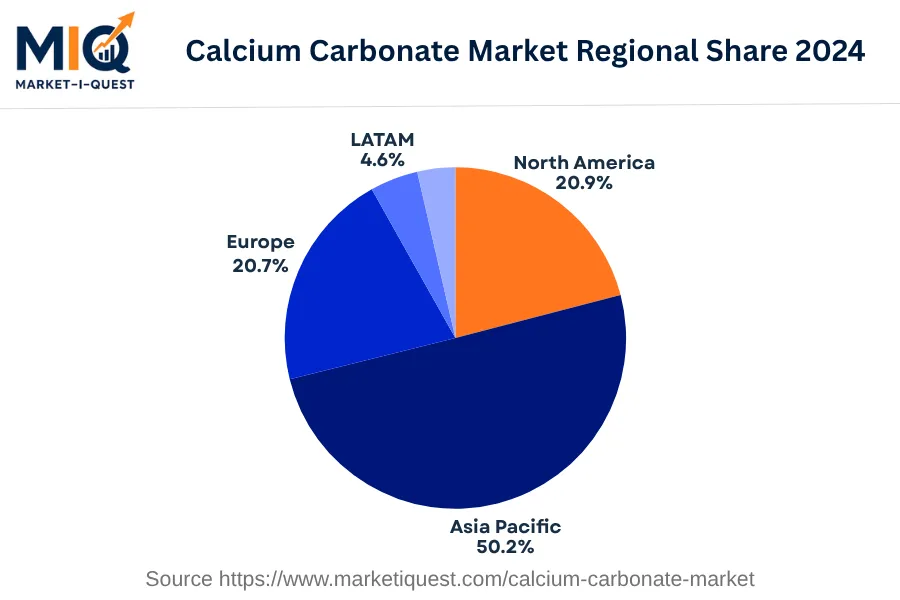
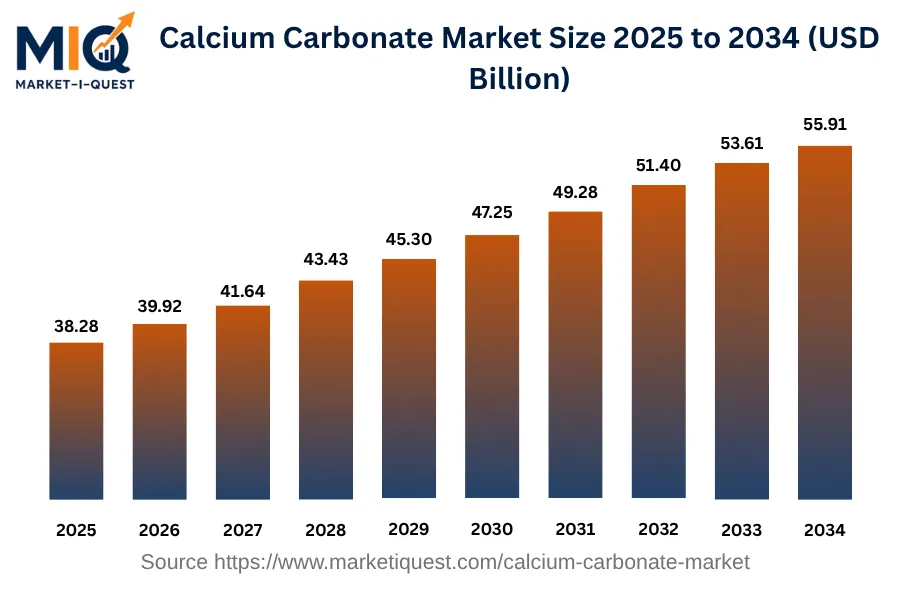
The Calcium Carbonate Market size was USD 38.28 Billion in 2025, and it is forecasted to reach USD 55.91 Billion by 2034, demonstrating a CAGR of 4.3%. Progressively, the market witnessed a growth rate from USD 36.7 Billion in 2024 to USD 38.28 Billion by 2025. Over the years leading up to 2034, the market will consistently expand, attesting to the growing demand and consumption of Calcium Carbonate. Regional data for 2024 indicates a diverse distribution of the Calcium Carbonate Market shares: Asia Pacific held the majority share with 50.18%, while North America and Europe followed closely with 20.94% and 20.73%, respectively. LATAM and MEA had comparatively smaller shares, with 4.56% and 3.59%, respectively. This regional share mix presents an insightful view into the geographical distribution and potential growth areas of the Calcium Carbonate Market.

Key Takeaways

  • By Grade - Industrial Grade led the Grade segment accounting for the highest market share in 2024.
  • By Form - Ground Calcium Carbonate held the dominant position in the same year.
  • By Application - Plastics emerged as the leading subsegment in market shares for the year 2024.
calcium-carbonate-market market size

Key Driving Factors

Shift towards Bio-based Products in the Plastics Industry

One of the key factors propelling the calcium carbonate market presently is the shift towards bio-based products in the plastics industry. The result of quarantine policies and greater societal awareness of environmental issues is a stimulus to reduce the use of conventional plastics worldwide. To cater to this demand, the plastic industry has adopted the use of calcium carbonate. It is utilized as a filler to enhance the properties of bio-plastics, such as its heat resistance and durability. These enhancement properties result in lowering overall costs for manufacturers and creating products that are more environmentally friendly, which caters to the increasing demand of conscious consumers.

Stringent Air Quality Regulations Influencing Paper Industry

A second driving factor is the imposition of stricter air quality regulations, particularly in the paper industry. Governments worldwide are setting limits on air pollutants released from the production process of various industries, including paper and pulp. The emphasis on reducing sulfur dioxide emissions, most notably, has compelled the paper industry to use more calcium carbonate. As a non-sulfur emitting substitute for kaolin in the bleaching process, calcium carbonate considerably reduces sulfur dioxide emissions without compromising the quality of paper. Thus, the quest to comply with environmental regulations makes the use of calcium carbonate more attractive for the paper industry.

Market Evolution by Timeline

2019-2023
The period from 2019 to 2023 saw robust demand from buyers, especially from the construction and pharmaceutical industries. Asia-Pacific, with China as the main consumer, was the leading region in demand. Supply at this time was primarily coming from quarries with smaller-scale operations. Calcium carbonate was adopted into a spectrum of industrial applications due to its reliability and low cost. The EU's REACH regulations on inorganic substances put some limitations on the handling and storage of calcium carbonate. Pricing was typically on a per-tonne basis, and contracts were usually short to medium term. Risks during this period were mostly the environmental concerns associated with quarrying and the occupational health hazards of handling calcium carbonate.
2024
During 2024, the construction industry continued to dominate the buyer segment. The Asia-Pacific region, notably India, increased its demand for calcium carbonate. New technologies allowed for a more efficient extraction and processing of calcium carbonate, assisting in supply reliability. Start-ups began to enter the market, introducing carbon capture and storage techniques in their processes. A downward tension in per-ton pricing was noted due to increased production. The Calcium Carbonate Association established stricter guidelines for production and handling, targeting a decrease in environmental impact and health risks. The risk of stricter regulations became apparent.
2025-2029
The timeframe from 2025 to 2029 saw a diversified range of buyers, with the proliferation of calcium carbonate in plastic and rubber industries. The Asia-Pacific region maintained its lead in demand, with Southeast Asian nations as emerging consumers. Technology improved to enable better-quality calcium carbonate products. Decomposition of limestone became a focus due to environmental challenges presented by quarrying. There was a shift from short-term to longer-term contracts, with price stabilization efforts from major providers. Standardization efforts focused on lower carbon emissions from calcium carbonate production. The risk of diminishing limestone reserves was noted.
2030-2034
During 2030 to 2034, new applications of calcium carbonate in agriculture and water treatment increased demand. North America saw a surge in demand due to an increase in shale gas exploration. Companies further integrated sophisticated extraction technologies to meet growing demand and environmental standards. Buyers began pushing for 'greener' calcium carbonate, prompting suppliers to establish carbon-neutral production processes. Longer-term supply contracts became more typical, with prices stabilizing through increased efficiency in production. Greater regulation was introduced for the handling and disposal of calcium carbonate due to environmental concerns. Emerging risk elements included water scarcity and its impact on supply.

Future Market Outlook

Future Opportunities

Looking ahead, considerable opportunities exist for the calcium carbonate market, particularly within the construction and environmental sectors. As countries like the United States focus on infrastructure renewal, there is an increasing demand for calcium carbonate in building materials. The U.S. Department of Transportation's announcement of infrastructure improvement plans in 2021 is set to create a surge in the need for calcium carbonate for use in concrete and plaster formulations. Additionally, as jurisdictions worldwide enforce stricter emission regulations, carbon capture technologies are emerging, with calcium carbonate playing a key role. The partnership between companies like Carbon Clean Solutions and various cement manufacturers has highlighted the use of calcium carbonate in reducing industrial carbon footprints. Moreover, as advanced recycling methods gain traction, the potential to recycle calcium carbonate-based materials opens avenues for reducing waste in various manufacturing processes. In the food and beverage sector, the growing consumer trend toward natural additives promotes the use of high-quality calcium carbonate derived from natural sources. Regulatory bodies such as the FDA are increasingly reviewing and approving new applications for food-grade calcium carbonate. These trends illustrate that the calcium carbonate market is poised for substantial growth driven by regulatory frameworks, technological advancements, and evolving consumer preferences.

Segmentation Analysis

By Grade

The market is divided into subsegments including Industrial Grade, Food Grade, and Pharmaceutical Grade. Industrial Grade accounted for the largest revenue share while Pharmaceutical Grade is expected to grow at the fastest CAGR during the forecast period.

Largest Revenue Share

Industrial Grade

Market Share Leader

Industrial Grade's domination of the market revenue can be attributed to a multitude of factors. The widespread utilization of this grade across various industries, including automotive, chemical, and construction, has increased its demand. The versatility of Industrial Grade products, suitable for a range of applications, is another driver. Further pushing the demand in certain geographical regions is the emphasis on industrial development and infrastructural establishments in emerging economies. Yet, the regulatory environment also plays an important role. The guidelines concerning waste management in industrial production have led to increased consumption of Industrial Grade products, seeing them as a cleaner alternative to conventional materials. Moreover, the decision-making process for purchasing is typically driven by product performance and cost efficiency. In terms of sales channels, both direct and indirect channels including online and offline sales significantly contribute to the large market share of Industrial Grade.

Fastest CAGR

Pharmaceutical Grade

Forecast Period Growth Leader

While Pharmaceutical Grade might not be the current market leader in terms of revenue, it has shown the potential for rapid growth, and is projected to grow at the fastest CAGR in the near future. This growth can be traced back to several key drivers. First, the rise in health consciousness and increasing global population leads to a surge in demand for pharmaceuticals. Linked with this is the steadily increasing expenditure in healthcare sector across many regions. However, the growth is not without its challenges. While concerning regulations and high capital expenditures can prove to be initial barriers to adoption, strategic partnerships and investments in R&D can likely mitigate these obstacles. And while there is always a risk with new technological advancements, the potential benefits of enhanced efficiency and cost reduction in long term are indicated to outweigh the initial implementation risks.

By Form

The market, by form, is divided into subsegments including Ground Calcium Carbonate, Precipitated Calcium Carbonate, and Surface-coated Calcium Carbonate. Ground Calcium Carbonate accounted for the largest revenue share, while Precipitated Calcium Carbonate is expected to grow at the fastest CAGR during the forecast period.

Largest Revenue Share

Ground Calcium Carbonate

Market Share Leader

In the base year of 2024, Ground Calcium Carbonate lead the revenue share in the calcium carbonate market. This is due to its widespread use across various industries for multiple applications such as building & construction, paper, plastic, sealants, and adhesives among others. Ground Calcium Carbonate is in high demand, especially in the construction industry, for limestone as a building material and in production of lime which is used in manufacturing cement. As economies grow, the pace of infrastructure and construction activities also rises in tandem. Therefore, the need for ground calcium carbonate is directly proportional to the level of construction activities. Additionally, as an additive in sealants, ground calcium carbonate is preferred due to its unique physical and chemical properties that provide cost efficiency and enhanced productivity. The growth in these industries drives the demand for Ground Calcium Carbonate, thus accounting for the highest revenue.

Fastest CAGR

Precipitated Calcium Carbonate

Forecast Period Growth Leader

While Ground Calcium Carbonate holds the current dominance in terms of revenue, it is Precipitated Calcium Carbonate that is expected to exhibit the fastest growth rate. This can be credited to its significant use in the paper industry where it is used as a filler and coating pigment to enhance the quality of printing paper. As e-commerce and the demand for home delivery services continue to bloom, so does the need for packaging materials, and consequently, paper. Furthermore, this subsegment is being driven by advancements in technology leading to its increased use in the healthcare industry as a dietary calcium supplement and antacid. However, there remain challenges in the form of stringent environmental regulations related to limestone mining which can impact its growth. On the other hand, the push by governments towards eco-friendly products presents a potential catalyst for this subsegment’s growth.

By Application

The market is divided into subsegments including Paper, Plastics, Paints and Coatings, Building Materials, and Food and Pharmaceuticals. In 2024, the Plastics subsegment accounted for the largest revenue share, while the Food and Pharmaceuticals subsegment is expected to grow at the fastest CAGR during the forecast period.

Largest Revenue Share

Plastics

Market Share Leader

The Plastics subsegment in 2024 has seen a significant growth contributing to the highest revenue in the market. This can be attributed to their extensive use across an array of industries, including automobile, construction, packaging and electronics. Additionally, the versatility of plastics has made them an indispensable part of daily consumer life, thus driving the demand. The advantage of plastics is their convenience, durability, and, significantly, their weight-to-strength ratio, which reinforces practical usage in differing environments and applications. Plastics' capacity for customization also caters to the diverse needs of clients. From geographically perspective, Asia-Pacific leads in global plastics consumption, primarily driven by two of the biggest economies, China and India. However, environmental regulations pose a potential hindrance to growth. But the emergence of bio-based and biodegradable plastics may counter this challenge and continue to support the revenue growth of this subsegment.

Fastest CAGR

Food and Pharmaceuticals

Forecast Period Growth Leader

The Food and Pharmaceuticals subsegment is poised to register the fastest CAGR in upcoming years. This growth is primarily driven by the increasingly global food supply chain requiring innovative and effective solutions to ensure product safety and quality. Pharmaceuticals further bolsters this subsegment's growth due to rising healthcare expenditure, an aging global population, and the expansion of the global middle class with increasing disposable income. Technological advancements, such as the application of nanotechnology in drug delivery, are also catalysts for this subsegment's growth. Additionally, the COVID-19 pandemic has brought about a surge in global demand for pharmaceuticals, especially vaccines and antiviral drugs. Nevertheless, potential risks include regulatory hurdles and potential supply chain disruptions. Increasing partnerships between market players for technological upgrades and expansions are expected to offer lucrative growth opportunities to this marketspace.

Competitive Analysis

Key Market Players

Manufacturers / OEMs

Imerys
France
Minerals Technologies Inc.
US
Omya AG
Switzerland

Key Suppliers & Raw Materials

Lhoist Group
Belgium
Carmeuse
Belgium
Mississippi Lime Company
US

Distributors, Integrators & Channel Partners

Calcinor
Spain
Schaefer Kalk GmbH & Co KG
Germany
Midwest Calcium Carbonates
US

Porter’s Five Forces Analysis

This analysis provides insights into competitive pressures and market dynamics for the calcium carbonate market.

Supplier Bargaining Power

Medium

Suppliers possess moderate power, driven by availability of natural source materials like limestone and marble.

Buyer Bargaining Power

High

Buyers hold high power due to availability of numerous suppliers and low switching costs.

Threat of Substitutes

Low

Threat from substitutes is low as calcium carbonate has unique properties and wide applications.

Threat of New Entrants

Medium

The capex and regulatory barriers are moderate, allowing the potential for new entrants.

Competitive Rivalry

High

High rivalry fueled by presence of strong players and minimal differentiation in product offerings.

Regional Analysis

Geographic market dynamics and growth opportunities across key regions

Global Market Outlook

calcium-carbonate-market market regional share

North America

In 2024, North America's Calcium Carbonate market was primarily influenced by the demand from various end-use industries, escalating investments, and shifting supply dynamics. The market derived its strength from demands in the pharmaceutical sector, wherein Calcium Carbonate is a standard component in antacid products. Progressive investment in the paper industry, where Calcium Carbonate is an essential part of the pulp bleaching process, also sparked growth. Supply dynamics, especially mining operations in Mexico, brought marked impacts on the raw material availability.

In terms of trends, a key development was the increased adoption of this product by the plastics industry aimed at reducing production costs. Advancements in technology gifted the industry with a more refined and purified form of Calcium Carbonate, driving its demand among cosmetics and personal care product manufacturers in the U.S and Canada. Concerning policy enforcement, stringent environmental regulations pressed industries to seek sustainable options, bolstering the use of Calcium Carbonate in waste treatment processes. Simultaneously, notable partnerships, mainly in the construction and adhesives sectors, contributed to the expansion of this market; Calcium Carbonate’s properties make it an excellent filler in asphalt, sealants, and adhesives. The market in 2024 displayed a compelling composition of industry demand, investment trends, and regulatory influence.
Asia Pacific

In 2024, the Asia Pacific region demonstrated robust demand in the Calcium Carbonate market. One major driver was the burgeoning construction industry in India and China, where the application for Calcium Carbonate in cement increased substantially as urban development initiatives gained momentum. Regulatory support from the Chinese government led to a surge in production, especially due to policies promoting resource recycling and environmentally friendly practices. An investment influx into the paper and pulp sector, particularly in Japan and ASEAN nations, further propelled market growth. Despite abundant supply, escalated prices could be observed from technological advancements in manufacturing processes boosting production efficiency, leading to heightened product quality in the market.

Consumer behavior trends reflected a growing preference for eco-friendly construction materials and paper products in key markets like Australia, influencing producers' strategies. Technology shifts indicated the wider adoption of carbon capture and storage (CCS) technologies in industries, including utilities and manufacturing. Moreover, distribution strategies evolved as digital channels, particularly e-commerce, boosted Calcium Carbonate sales. In regards to partnerships, South Korea noticed significant M&A activity as firms sought to maximize resources and tap local demand. Lastly, stricter regulatory enforcement in all geographies on environmental standards impacted sourcing strategies, favoring those with cleaner production methods, thus shaping the Calcium Carbonate market in 2024.

Europe

In 2024, the European Calcium Carbonate Market experienced significant dynamics. Driving forces included robust demand from healthcare and manufacturing sectors, increasing environmental regulations, and expanding investments in technological innovations. The adoption of calcium carbonate in pharmaceuticals, primarily in antacids and calcium supplements, surged due to rising awareness about preventive healthcare in countries like Germany, the UK, and France. Manufacturing sectors in Italy and Spain played pivotal roles in boosting demand for calcium carbonate for the fabrication of cement and glass. Furthermore, stricter environmental regulations in Europe enforced by EU's Industrial Emissions Directive motivated industries to opt for eco-friendly processes, favoring calcium carbonate due to its recyclability and non-toxic nature. Enhanced investments in technology also leveraged supply dynamics, improving production efficiency and quality of calcium carbonate.

Trend analysis revealed a shift towards higher grade, ultra-fine calcium carbonate. Consumer preference for premium quality in end-products like paper, paints, and plastics instigated this trend, prevalent in the United Kingdom and Nordics. Channel dynamics saw a rising focus on partnerships and M&A, with major players establishing alliances to ensure a consistent supply amidst the competitive European market. For instance, the market witnessed several business consolidations in Central & Eastern Europe and Benelux, enabling companies to expand their customer reach. Enforcement of stringent production standards like REACH (Registration, Evaluation, Authorisation and Restriction of Chemicals) further shaped market conditions in 2024.

Latin America

In 2024, the Calcium Carbonate market in Latin America witnessed significant growth. Drivers behind this growth included rising demand from end-use industries in key countries like Brazil and Mexico, especially in the construction and paper sectors. Stringent environmental regulations also came into play, pushing industries to adopt eco-friendly alternatives like calcium carbonate. In addition, heightened investment in technological advancements and improvements in supply dynamics supported this market growth. Argentina and Chile-based manufacturers witnessed cost efficiencies due to favorable pricing of raw materials, like limestone.

Trends in the market included changing buyer behavior in Colombia, where new consumption patterns showed preference towards calcium carbonate in dietary supplements due to growing health awareness. The market saw a shift towards nano-calcium carbonate technologies, offering superior properties and enabling varied applications. In Peru, partnerships and mergers/acquisitions were prominent, with companies joining forces to expand their foothold. Strict policy enforcement became evident in regulatory bodies' inspections to ensure quality standards. Customer segments for the calcium carbonate market were diversified, however, more inclined towards manufacturing and retail, where calcium carbonate was used in products like paints and plastics. Despite offering a myriad of applications, the dominance of these sectors was clearly visible in this LATAM market in 2024.

Middle East & Africa

In 2024, the Calcium Carbonate Market in the Middle East and Africa experienced discernible growth. Driving this expansion were critical adoption of technologies and strategic investments across key sectors such as manufacturing, oil and gas. For instance, Saudi Arabia and the United Arab Emirates were instrumental in implementing energy-efficient measures in oil and gas industries by utilizing calcium carbonate as an additive. Concurrently, strategic investments by Egypt in the manufacturing sector to leverage calcium carbonate for its superior properties including brightness, contributed to the market growth. Additionally, the advent of stringent environmental regulations, notably in Israel and South Africa, to reduce industrial waste, endorsed the use of calcium carbonate in waste treatment processes. A shortage in the supply of raw limestone, crucial for the production of calcium carbonate, resulted in market price increments in Nigeria and Kenya, stimulating the market dynamics.

On the trend front, buyer behavior inclined toward local sourcing due to the elevated global shipping costs. An increase was observed in partnerships and mergers among regional players, particularly in Qatar, aimed at strengthening local production and minimizing import dependency. The enforcement of new quality standards for calcium carbonate in healthcare and related sectors, especially in countries like Saudi Arabia and South Africa, directed the product's usage towards more high-purity applications. All these factors shaped the Calcium Carbonate Market in the Middle East and Africa in 2024.

Recent Industry Developments

Latest market innovations, product launches, and strategic initiatives

March 2026

Gulshan Polyols Ltd. finalized an agreement with Trident Limited to build and operate an on-site PCC satellite manufacturing plant in Punjab, India. The dedicated infrastructure provides Trident with a direct pipeline of specialized PCC slurry, cutting freight costs and transit emissions.

May 2025

MIDROC Investment Group opened Ethiopia’s first coated calcium carbonate facility in Awash 7 Kilo. Simultaneously, Apex Chemical Industries launched a ground calcium carbonate (GCC) plant in Fujairah, UAE, scaling localized raw material supplies for the Middle East and Africa's booming construction sectors.

February 2025

CarbonFree commenced construction on an industrial-scale carbon-capture system at U.S. Steel’s Gary Works facility in Indiana. The project utilizes SkyCycle™ technology to mineralize blast furnace CO2 emissions into carbon-neutral precipitated calcium carbonate (PCC) for use in eco-friendly plastics, coatings, and paints.

Frequently Asked Questions