
Calcium Acetate Market Snapshot

Key Players

  • Niacet Corporation (United States)
  • Solvay SA (Belgium)
  • Akzo Nobel NV (Netherlands)
  • Canpro Ingredients Ltd (Canada)
  • Shaanxi TOP Pharm Chemical Co. Ltd. (China)
  • Avantor Inc (United States)
  • Nithyasri Chemicals (India)

Market Size

Base Year 2024
$0.164 Bn
CAGR
3.27%
Forecast 2034
$0.23 Bn

Market Segments

By Function
  • Texturizer
  • Stabilizer
  • Thickener
  • Firming Agent
By End USe
  • Pharmaceuticals
  • Agriculture
  • Food and Beverages
  • Pet Food

Market Dynamics

Drivers
  • Growing dialysis patient population
  • Increasing calcium deficiency awareness
Restraints
  • Regulatory compliance challenges
  • Side effect concerns
Opportunities
  • Increasing dietary supplement demand
  • Expanding wastewater treatment industries

Market Size

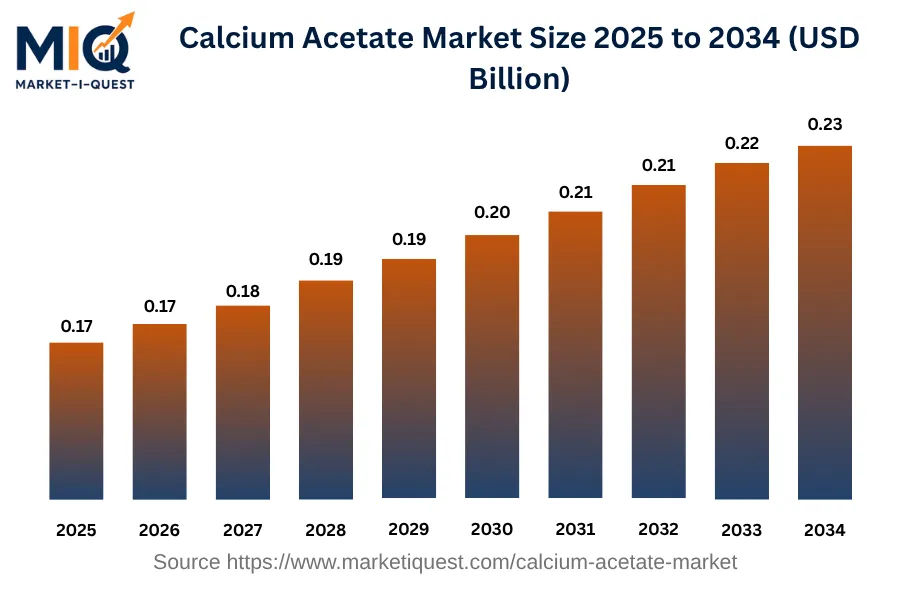
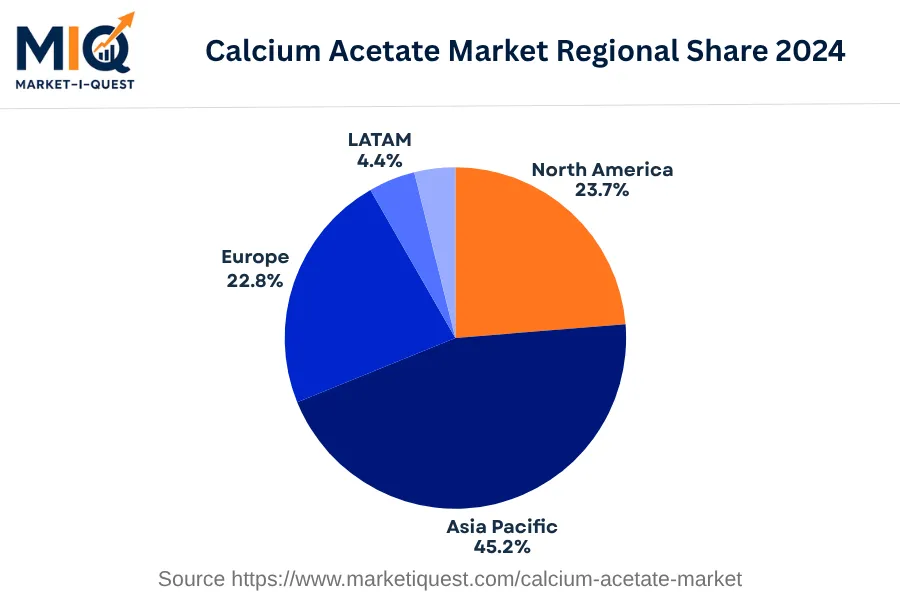
The Calcium Acetate Market size stood at 0.16 billion USD in 2024 and increased to 0.17 billion USD in 2025. By 2034, the market size is anticipated to reach 0.23 billion USD, registering a CAGR of 3.3%. The upward growth trajectory between 2025 and 2034 indicates a consistent expansion in the market during this window. This rise in market size is likely associated with progressively increasing demand. The regional market share analysis in 2024 showed a dominant position for the Asia Pacific region accounting for 45.2% of the market. North America held a 23.7% share and Europe constituted 22.8% of the total market. Additionally, the LATAM and MEA regions contributed to 4.4% and 3.9% respectively of the market share.

Key Takeaways

  • By Function - Stabilizer held a significant position in the Calcium Acetate Market in 2024.
  • By End Use - Pharmaceuticals led the sector accounting for a substantial share in 2024.
calcium-acetate-market market size

Key Driving Factors

Shift towards Non-Toxic Food Preservatives

The calcium acetate market is being driven by a significant shift in the food industry towards the use of non-toxic preservatives. Suppliers of processed foods have increasing awareness about the ill-effects of chemical preservatives and the resulting consumer inclination towards natural and safer alternatives. Calcium acetate has emerged as a preferred choice owing to its efficacy in inhibiting bacterial growth and prolonging shelf life of food items. This pivot towards safer food preservatives is predominantly observed in developed markets like the European Union and North America, where there is high scrutiny on food safety standards and consumer lifestyle preferences favour organic and clean label products.
Rise of High-Purity Applications in Pharmaceuticals

The demand for calcium acetate is being further pushed by its rising applications in the pharmaceutical industry. The unique chemical properties of calcium acetate, such as high reactivity and low toxicity, make it ideal for use in various pharmaceutical processes. Specifically, it's employed as a phosphate binder in renal health medication, playing a critical role in treating kidney ailments. The growing prevalence of kidney diseases across the globe, fueled by increasing rates of diabetes and hypertensive disorders, is piling pressure on pharmaceutical companies to develop effective treatments. Consequently, this is directly influencing the procurement strategies in these companies and they are investing more in buying high-purity calcium acetate to bolster their production capabilities.

Market Evolution by Timeline

2019-2023
In the USA, the use of Calcium Acetate in kidney dialysis patients to control high phosphorus levels started to rise. The overall supply of the chemical compound in this period came largely from China, the largest global manufacturer. However, raw material price volatility and supply chain disruptions posed challenges to the industry. Regulatory frameworks like Reach in Europe and the China National Standards set clear guidelines on production and use, supporting market stability. Typically, companies adopted long-term contracts with major pharmaceutical companies to ensure consistent demand. The main risk during this period was the potential for raw material price spikes and shortages, so companies diversified their supply sources.
2024
As the need for kidney disease treatment continued to grow worldwide, so did the demand for Calcium Acetate. In 2024, India emerged as another significant supply source. Technology development revolved around optimizing manufacturing processes to decrease costs and improve product quality. The commercial model shifted towards shorter, flexible contracts due to fluctuating raw material prices. In terms of policy, the Indian Standard on Calcium Acetate usage was implemented steering market trajectory. The risk of supply chain disruptions persisted but efforts became more focused on developing local supply chains in countries like India and the USA.
2025-2029
Pharmaceutical applications upheld the demand, notably in the USA, EU, and India. Plant-based Calcium Acetate emerged as another source, addressing sustainability needs. Policies like the Indian National Green Tribunal's ruling on sustainability influenced the industry extensively. The commercial model witnessed an increased emphasis on partnerships with biotech companies for obtaining plant-based supplies. Procurement efforts focused extensively on securing sustainable raw material sources due to the rise of eco-conscious consumers. Risks associated with meeting environmental regulations and constantly evolving consumer preferences became more prominent.
2030-2034
Calcium Acetate's demand in pharmaceuticals remained steady, especially in rapidly developing regions like Africa and the Middle East. Alternative green sources started becoming mainstream due to advancements in biotechnology. Regulatory bodies across several countries introduced stringent rules for chemically derived supplies, directing businesses towards green alternatives. As traditional supply sources became constrained due to new regulations, the market saw a surge in prices. The commercial model adapted to reflect these changes, mostly favoring providers meeting both supply and environmental requirements. The prevalent risk was adhering to the strict environmental regulations set out by different countries globally.

Future Market Outlook

Future Opportunities

Looking ahead, the calcium acetate market is poised to capitalize on various emerging opportunities stemming from current market dynamics. The increasing prevalence of chronic kidney diseases globally, as identified in a 2021 World Health Organization report, suggests a growing patient base requiring phosphate binders in therapeutic settings. This trend positions calcium acetate as a prime candidate for expanded use in pharmaceutical formulations, particularly in regions such as North America where healthcare is evolving. Companies like Fresenius Medical Care are currently exploring novel formulations for dialysis patients, indicating potential for collaborative advancements. Additionally, the rising demand for calcium-based additives in food preservation and dietary supplements may further drive exploration into new applications. For instance, marketing efforts spearheaded by companies in Europe since late 2022 emphasize the safety and efficacy of calcium acetate in food products. The increasing consumer awareness regarding sustainable products also offers a path for innovation, as manufacturers align with environmental standards initiated by bodies like the Food and Drug Administration to leverage eco-conscious branding. Lastly, research partnerships between academic institutions and industry players focused on calcium acetate's benefits in agriculture since 2023 suggest a budding interest in its applications beyond traditional sectors. Collectively, these factors set the stage for a vibrant future for calcium acetate across multiple industries.

Segmentation Analysis

By Function

The market function segment is divided into subsegments including Texturizer, Stabilizer, Thickener, and Firming Agent. Among these, Stabilizer accounted for the largest revenue share, while Firming Agent is expected to grow at the fastest CAGR during the forecast period.

Largest Revenue Share

Stabilizer

Market Share Leader

Within the functional segment, the Stabilizer subsegment records the largest revenue. This is mainly driven by the increasing need in diverse industries such as food and beverage, pharmaceuticals, and cosmetics to maintain the physical and chemical stability of products. Stabilizers help in maintaining the consistency, texture, and color of the products, thereby extending their shelf life. They are also instrumental in preventing product separation in emulsions, which is crucial in food, pharmaceutical, and cosmetic products. Regulatory bodies worldwide have approved the use of stabilizers, which has further fortified the demand. In addition, important purchasing criteria for stabilizers include their cost-effectiveness, performance, and compatibility with other ingredients, which are generally met by most of the stabilizer manufacturers. Stabilizers continue to hold a dominant market share due to these factors and the high switching costs associated with changing production processes.

Fastest CAGR

Firming Agent

Forecast Period Growth Leader

The Firming Agent subsegment is expected to grow at the fastest CAGR during the forecast period. The growth will largely be fueled by increasing consumer demand for firm and crisp food products along with long-lasting cosmetics. Other catalysts include continuous advances in technology and formulation practices that improve the effectiveness of firming agents. Software developments also facilitate better understanding of firming agent interactions leading to innovative product development. Despite this, the adoption of firming agents inevitably faces some barriers. High capital expenditure for research and potential regulatory scrutiny over ingredient safety remain significant hurdles. However, strategic partnerships among key players can accelerate the acceptance of new firming agents in the market. Hence, barring any near-term risks such as extreme regulatory changes or sudden shifts in consumer preferences, the Firming Agent subsegment is poised for the fastest growth.

By End USe

Within the end use market, key subsegments comprise Pharmaceuticals, Agriculture, Food and Beverages, and Pet Food, with Pharmaceuticals contributing the highest to the revenue whilst Pet Food displays the most robust growth projections.

Largest Revenue Share

Pharmaceuticals

Market Share Leader

Pharmaceuticals, in the base year of 2024, emerged as the largest segment by revenue. Several factors contribute to this dominance. Firstly, rapid advances in medical research necessitate the continuous development and production of a vast array of pharmaceutical products. This constant necessity underpins the segment's steady revenue stream. Secondly, the aging population in developed economies has led to an upsurge in demand for medical services and pharmaceutical products. Thirdly, expanding access to healthcare in developing countries contributes significantly to the global demand for pharmaceuticals. Regulatory measures that prioritize safety also support investments in pharmaceuticals, further driving revenue. Thus, entrepreneurs and investors looking to enter or expand in this market must consider these crucial dynamics which include customer demographics, regional market development, regulatory climate, and underlying industry trends.

Fastest CAGR

Pet Food

Forecast Period Growth Leader

Expected to deliver the fastest Compound Annual Growth Rate (CAGR), the Pet Food segment is poised for stellar growth in the near term. Mounting attentiveness towards the health and nutrition of pets is driving customers towards premium pet food products, acting as a definitive catalyst. Furthermore, the convergence of consumer trends such as increased pet ownership and the humanization of pets has put a spotlight on the pet food industry, boosting sales. Yet barriers to adoption, like pet food recalls due to safety concerns, can hinder growth. Pairing ongoing industry collaboration with stringent regulations, aiming to rectify such concerns, the segment is likely to overcome these challenges. Therefore, market players should strategize around these key factors to harness forthcoming growth opportunities while navigating potential risks.

Competitive Analysis

Key Market Players

Manufacturers / OEMs

Niacet Corporation
US
Solvay S.A.
Belgium
Tokyo Chemical Industry Co., Ltd.
Japan

Key Suppliers & Raw Materials

Merck KGaA
Germany
Thermo Fisher Scientific
US
Sigma-Aldrich Corporation
US

Distributors, Integrators & Channel Partners

Fisher Scientific International, Inc.
US
Avantor, Inc.
US
VWR International, LLC
US

Porter’s Five Forces Analysis

This analysis covers key forces shaping the Calcium Acetate Market dynamics.

Supplier Bargaining Power

Medium

Moderate due to suppliers often being either chemical manufacturers or mineral processers.

Buyer Bargaining Power

High

High due to low product differentiation and easy availability of alternatives.

Threat of Substitutes

Low

Low threat as calcium acetate's applications especially in industries like food and pharmaceuticals are unique.

Threat of New Entrants

Medium

New entrants face a moderate difficulty due to regulatory constraints, capital requirements and process complexity.

Competitive Rivalry

High

Strong rivalry due to presence of numerous local and international players, price competition and geographical expansion.

Regional Analysis

Geographic market dynamics and growth opportunities across key regions

Global Market Outlook

calcium-acetate-market market regional share

North America

In 2024, the North American calcium acetate market was characterized by a blend of dynamic drivers and market trends. Major drivers included a surge in demand for food preservatives, increased investment in water treatment facilities, and a shift towards environment-friendly additives in the U.S., Canada, and Mexico. Regulatory changes also favored calcium acetate, revealing a ripple effect in the manufacturing and healthcare sectors due to the compound's vital role in dialysis and kidney-related treatments. Several trends emerged in this time frame. Consumer behavior was leaning towards an increased consumption of processed food, in response to rapid urbanization and a fast-paced lifestyle, bolstering demand for food-grade calcium acetate. The rise of e-commerce sales channels for chemicals and additives also played a significant role in shaping the market. Public and private partnerships in wastewater treatment initiatives led to an increased need for calcium acetate.

Moreover, technological advancements in healthcare mirrored an increasing demand in controlling high phosphate levels to avoid complications. Additionally, the cement industry leveraged calcium acetate as a reliable set accelerator due to its quick-dry nature, demonstrating a multi-sector nature of the compound. Irrespective of these sectors, the policy enforcement around environmental sustainability enhanced the adoption of calcium acetate due to its biodegradable trait.

Asia Pacific

In 2024, the Asia Pacific Calcium Acetate market experienced extensive expansion largely due to increased demand from various industries. The robust pharmaceutical sector, particularly in markets like India and China, drove consumption as calcium acetate found wide application as a phosphate binder in renal care. In parallel, the boom in food processing, especially in China and Australia, accelerated demand; the compound's role as a food additive for bread, cakes, and other bakery products was a crucial factor. A rise in investment in research and development propagation in Japan and South Korea also fueled the demand for Calcium Acetate due to its importance in laboratory applications.

Buyer behaviour evolved, with an increased preference for products complying with stringent quality standards. Furthermore, there was a significant rise in partnerships and M&A activity often involving Chinese and Indian manufacturers aimed at capacity expansion. This boosted the supply dynamics, leading to a stable price scenario. Amendments in food safety regulations, particularly in key ASEAN markets, tightened the use of food additives, promoting the use of certified products. This led to an increased prominence of Calcium Acetate in the food and beverage sector. Also, with the expansion of the utilities sector, particularly water treatment plants in India and China, the demand for Calcium Acetate as a scale inhibitor saw considerable growth.

Europe

In 2024, the European Calcium Acetate market displayed a dynamic pattern of demand and supply influenced by various driving factors. Regulatory enforcement concerning water treatment, a surge in the utilization of Calcium Acetate in pharmaceutical production, and advances in manufacturing technologies were key drivers. Germany led the demand for Calcium Acetate, stimulated by its thriving chemical and pharmaceutical industries, followed by the United Kingdom and France. Spain and Italy also saw a substantial uptake due to their expanding food and beverage sectors.

Trends shaping the market included the growing preference for Calcium Acetate in retail food preservation due to its superior anti-mold properties. Fluctuations in raw material prices proved influential, particularly in Central and Eastern Europe. The push towards greener manufacturing practices was prominently seen in the Nordics, leading to innovations in the production methods of Calcium Acetate. An uptick in strategic partnerships, especially in healthcare and manufacturing sectors in Benelux, to secure consistent supply and enhance product quality, marked another trend. While government and healthcare sectors remained crucial for demand, retail and manufacturing revealed increased consumption. Prominent examples were the widespread use of Calcium Acetate in the production of acetate ester in Germany's manufacturing sector and its utilization in the UK's healthcare sector as a phosphate binder in dialysis treatment.

Latin America

In 2024, the Latin American market for Calcium Acetate – a compound used predominantly in food, healthcare, and water treatment industries – experienced several defining dynamics. Drivers of the market included the expanding food industry, particularly in Mexico and Brazil, which demanded Calcium Acetate as a food preservative. Additionally, stringent environmental regulations in countries like Chile and Argentina fueled usage in wastewater treatment facilities. Investment in healthcare technology also facilitated the compound supply, as Calcium Acetate is a key ingredient in phosphate binders used for kidney disease treatments.

Market trends reflected shifting demographics and policy impacts. For instance, healthier eating trends in urban areas, notably in Colombia and Peru, steered towards calcium-enriched food products. Technology adoption in the wastewater treatment sector witnessed channel dynamics, as more businesses sought eco-friendly solutions. Moreover, mergers and acquisitions in the local pharmaceutical industry marked a significant trend, enhancing the compound usage in medication production. Significant customers of Calcium Acetate in 2024 encompassed food manufacturers, healthcare providers, and water utility enterprises. Regulations like Argentina’s Protection of Environment Law and Chile’s Environmental Framework Law steered public and private sector practices in waste management, influencing demand in both the utilities' and manufacturing sectors. The year's market landscape was thus shaped by diverse factors, from demographic shifts to regulatory policies.

Middle East & Africa

In 2024, the Calcium Acetate Market in the Middle East and Africa (MEA) experienced robust market activity. Key drivers included surging demand in the pharmaceutical sector, particularly in Nigeria and South Africa, where calcium acetate was widely administered to manage hyperphosphatemia. Government health regulations across the MEA region advanced this demand curve. Industrial applications also drove market growth, especially within the manufacturing sector in Qatar and the United Arab Emirates. Moreover, technology adoption in processing calcium acetate contributed to a cost-efficient supply chain, securing stable pricing across MEA markets.

Noteworthy trends involved a shift in buyer behavior: customers demonstrated preference for locally produced calcium acetate, particularly in Saudi Arabia and Egypt, initiating an influx of domestic production. Partnerships emerged among regional counterparts, such as that between Saudi-based chemical producers and Kenyan enterprises. Meanwhile, Israel led policy enforcement to maintain quality standards, influencing a regional elevation in product standards. This trend of intra-region cooperation endorsed a more resilient Calcium Acetate market in MEA. The sectors most impacted by these trends and drivers were healthcare, owing to the compound's medical application, and manufacturing, due to its industrial use. Both sectors experienced an accelerated demand for calcium acetate, shaping a healthy market performance within the MEA region in 2024.

Recent Industry Developments

Latest market innovations, product launches, and strategic initiatives

November 2025

FutureCeuticals, Inc. and Global Calcium Pvt. Ltd. finalized a strategic global manufacturing and sales alliance. The joint venture integrates Global Calcium's processing facilities to scale and export calcium acetate and mineral-fortified dietary ingredients into high-growth consumer wellness markets across Asia and Africa.

September 2025

Brenntag Specialties secured an exclusive commercial distribution agreement for Kerry’s Niacet portfolio of pharmaceutical-grade acetates across Europe. The partnership provides medical manufacturers with a reliable supply of high-purity, GMP-compliant calcium acetate used in dialysis fluids and hyperphosphatemia treatments.

Frequently Asked Questions