Cable Television Networks Market Snapshot

Key Players

  • Comcast Corporation (United States)
  • ViacomCBS Inc. (United States)
  • Sky Plc (United Kingdom)
  • Rogers Communications Inc. (Canada)
  • Discovery Inc. (United States)
  • Foxtel (Australia)
  • Star India Private Limited (India)
  • Liberty Global Plc (United Kingdom)
  • Cogeco Inc. (Canada)
  • Altice Europe (Netherlands)

Market Size

Base Year 2024
$385.65 Bn
CAGR
4.72%
Forecast 2034
$611.63 Bn

Market Segments

By Type
  • Direct Broadcast Satellite Services (DBS)
  • Closed Circuit Television Circuits
  • Multipoint Distribution System Services (MDS)
  • Satellite Master Antenna Systems Service (SMATV)
  • Subscription Channel Services
  • Cable & Other Pay Television Services
By Application
  • Household
  • Commercial

Market Dynamics

Drivers
  • Increasing demand for high-definition content
  • Advancements in digital technology
Restraints
  • Rapid shift to OTT platforms
  • High subscription costs
Opportunities
  • Emerging streaming partnerships
  • Digital advertising potential

Market Size

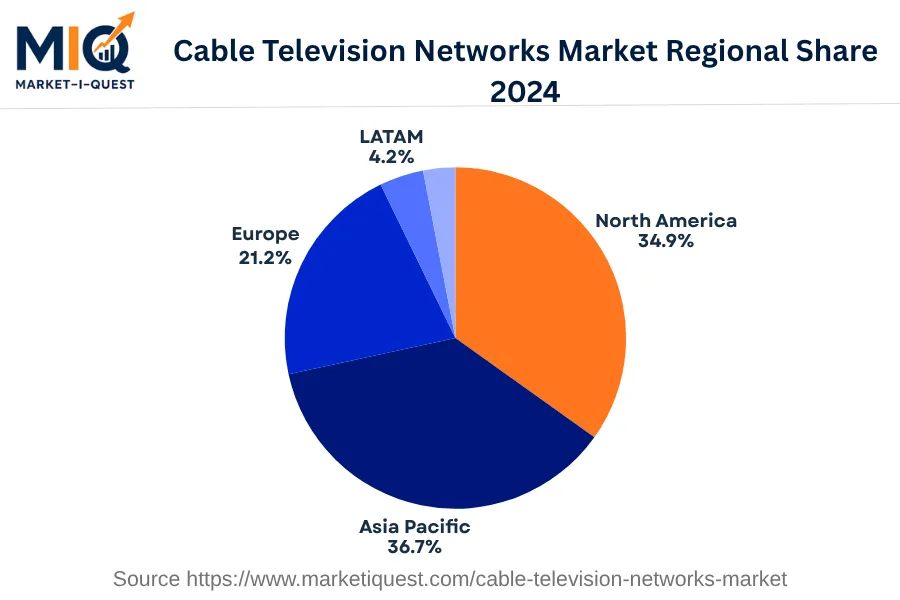
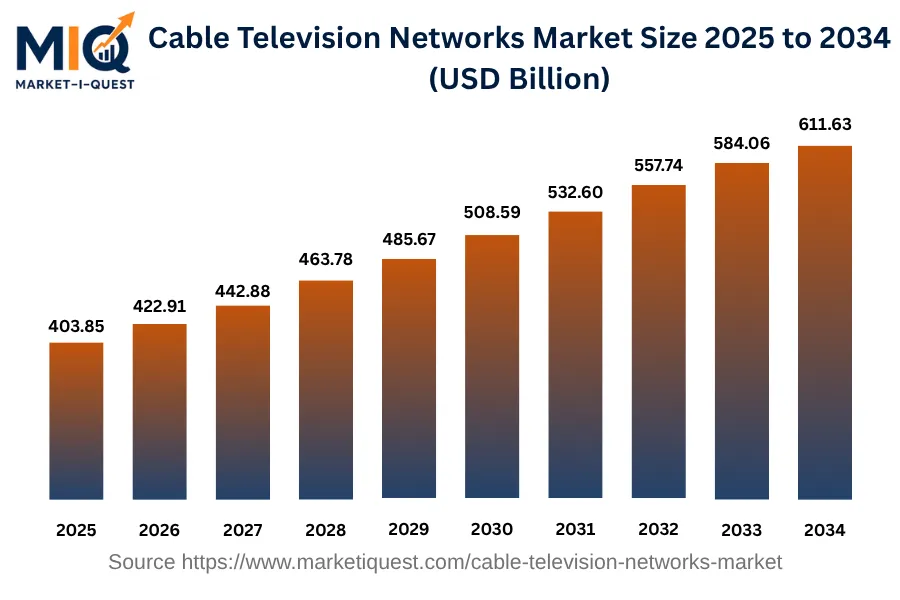
The Cable Television Networks Market in 2025 is projected to reach $403.85 billion, up from $385.65 billion in 2024. By 2034, the market size is expected to grow to an estimated $611.63 billion, expanding at a compound annual growth rate (CAGR) of 4.72% during this period. Over the span of these years, the constant increase exemplifies the steady demand and growth potential of the Cable Television Networks Market. This compelling progression in the market size, progressing from the $400 billion range to over $600 billion, illustrates the decisive growth trend of the market over the decade. In 2024, the regional market share was divided with Asia Pacific holding the largest share at 36.7%, slightly ahead of North America's 34.9%. Europe held 21.2% of the market, significantly ahead of LATAM with 4.2%, and MEA trailed at 3.0%.

Key Takeaways

  • By Type - Cable & Other Pay Television Services held a lead in the Cable Television Networks Market.
  • By Application - Commercial segment constituted a commanding portion of the market in 2024.
cable-television-networks-market market size

Key Driving Factors

Shift towards high-resolution formats

A significant driving factor for the cable television networks market is the industry-wide transition to high-resolution formats such as 4K and 8K. Increased focus on viewer experience and the availability of compatible devices at consumer-friendly price points is applying pressure on networks to provide their content in these higher resolutions. This is prompting cable television network companies to invest in new infrastructure and equipment to stay competitive in the marketplace. The shift towards high-resolution formats is particularly prevalent in markets where consumer purchasing power is high and there is strong demand for high-quality video content.

Implementation of targeted adverting strategies

The entry of Over-the-Top (OTT) platforms into the video services industry is intensifying competition for the Cable Television Networks Market. As a response, traditional cable television networks are adopting targeted advertising strategies to remain competitive and ensure sustainability. Targeted advertising involves using collected data about consumers, such as their viewing habits and preferences to serve personalized advertisements. This allows traditional cable networks to provide more value to advertisers, making their platforms more attractive for advertising budgets. The increased revenue from advertising gives cable networks the capital they need to invest in new content and technology, fueling their growth in the process.

Market Evolution by Timeline

2019-2023
In this period, more consumers transitioned from traditional cable television to online streaming services, particularly in urban areas across United States, Europe, and Asia. Major networks like NBC and CBS started shipping direct-to-consumer streaming services that complemented their basic cable packages. Policies provided flexibility for broadcasters to transition from analog to digital broadcasting, led by the FCC's ATSC 3.0 broadcast standard in the US. Commercial models began to favor smaller, customizable packages rather than comprehensive bundles. A key risk was the loss of revenue if consumers cut cables altogether. To mitigate, many players reshaped their models to integrate streaming services.
2024
In 2024, the demand for cable network eased in favor of Internet Protocol Television (IPTV) systems. Notably in Europe and Asia, where IPTV reached maturity faster due to efficient infrastructure and regulations. Technologically, providers such as AT&T with its U-verse service, transitioned from traditional cable systems to IPTV. Regulatory advantage was at play in countries where laws explicitly encouraged IPTV technologies. Operators sought to monetize content by offering distinct pricing tiers, targeting a wide range of customer segments. There was a risk of consumer dissatisfaction due to network issues during this switch to IPTV, and operators needed to ensure a smooth transition.
2025-2029
The cable market witnessed the adoption of advanced technologies like 4K and HDR during this period. Major cities in North America were the primary buyer segment, due to increased interest in high-definition content and faster internet connections. Technologically, multi-gigabit broadband became crucial for transmitting 4K/HDR content, with companies like Comcast leading efforts. Policymakers established standards for 4K/HDR content dissemination in various markets to facilitate the adoption. Different subscription models emerged, with premium 4K/HDR packages attracting higher pricing. The risk was that lower-income segments could be priced out, requiring providers to offer a diverse range of packages.
2030-2034
Scope for cable has further diversified with concrete use cases in rural areas where the reach of OTT and IPTV is limited. Thus, rural communities in developing regions such as Africa, South Asia became significant buyers of traditional cable. Technology restricted to satellite broadcast due to bandwidth constraints. In countries like India, the Telecom Regulatory Authority of India (TRAI) played a vital role in formulating favorable policies. Commercially, the cost per channel basis became the most common pricing model. The lack of high-speed internet capabilities poses a risk to cable markets in these regions, calling for improved internet infrastructure.

Future Market Outlook

Future Opportunities

The cable television networks market has notable future opportunities driven by ongoing consumer behavior shifts and technological innovations. As of 2023, the integration of artificial intelligence (AI) presents opportunities for operators to enhance customer experience through personalized content offerings. This is exemplified by advancements made by platforms like Paramount+, which utilize AI to tailor recommendations to viewers. Another significant opportunity lies in the expansion of regional content to cater to diverse demographics; for instance, Netflix has increasingly invested in localized content since 2017, acknowledging the global audience's varied preferences. The trend towards bundling services is also expected to grow; traditional networks may consider forming alliances to offer comprehensive packages that combine cable, internet, and streaming services. Regulatory changes in various regions, such as the European Union's Digital Services Act, could result in a more favorable environment for content distribution and protection of consumer rights. Additionally, as telecommunication infrastructure improves, particularly in underserved regions, cable networks might see opportunities to expand their reach through hybrid models that leverage both traditional and digital broadcasting. Finally, with increasing consumer interest in interactive content, cable networks can pivot towards gaming and esports, as companies like Twitch have demonstrated the significant viewer engagement this segment garners. Overall, leveraging these realities could enhance the cable television ecosystem and reinvigorate subscriber interest.

Segmentation Analysis

By Type

The market is divided into subsegments including Direct Broadcast Satellite Services (DBS), Closed Circuit Television Circuits, Multipoint Distribution System Services (MDS), Satellite Master Antenna Systems Service (SMATV), Subscription Channel Services, and Cable & Other Pay Television Services; with Cable & Other Pay Television Services accounting for the largest revenue share while Direct Broadcast Satellite Services (DBS) is expected to grow at the fastest CAGR during the forecast period.

Largest Revenue Share

Cable & Other Pay Television Services

Market Share Leader

Cable & Other Pay Television Services is the subsegment with the highest revenue, primarily due to its wide reach and ability to offer diverse content. Large population centres around the world are connected via cable networks, providing a significant customer base for these services. Moreover, these services offer a vast range of content, engaging viewers with various interests, thus attracting a broad range of customers. They also have the infrastructure to provide high-definition content, enticing customers who seek premium viewing experiences. The regulatory environment also favours Cable & Other Pay Television Services, as widespread cable network connectivity is seen as a public service in many jurisdictions. Additionally, customers are often reluctant to switch from cable due to the associated reinstallation costs and potential disruptions. Cable services also benefit from partnerships with local distributors, which allows for efficient and cost-effective distribution.

Fastest CAGR

Direct Broadcast Satellite Services (DBS)

Forecast Period Growth Leader

Direct Broadcast Satellite Services (DBS) is anticipated to grow at the fastest CAGR. The demand for these services is driven by consumers' evolving content consumption preferences and improved technological capabilities. DBS enables broadcast of high-definition channels and niche content, which are increasingly preferred by consumers. As people across the globe seek diversified content beyond what traditional cable can offer, this fuels DBS growth. Satellite TV is also less restricted by geographical barriers, ideal for areas where cable infrastructure is non-existent or underdeveloped. Technological advancements enabling smaller, more efficient receiving dishes and increased satellite capability have made these services more accessible. However, capex is a significant barrier to adoption, with high installation and hardware costs. The next wave of growth could potentially be driven by evolving pricing models or partnerships between DBS providers and other industry stakeholders. Near-term risks include regulatory changes impacting satellite broadcasting and competition from streaming services.

By Application

The market by application is divided into subsegments including household and commercial. As per our analysis, the commercial subsegment accounted for the largest revenue share while the household subsegment is expected to grow at the fastest CAGR during the forecast period.

Largest Revenue Share

Commercial

Market Share Leader

In 2024, the commercial subsegment demonstrated a clear lead in terms of revenue. This is largely driven by the increasing demand in commercial spaces including offices, shopping centers, and public institutions where high-end, innovative products tend to be adopted more readily than in households. These settings generally have larger budgets and heightened need for quality products and services that not only perform but also enhance the value and aesthetics of their spaces. Furthermore, regulations and policies targeting environmental sustainability and energy savings in commercial buildings also play a key role in driving purchases within this subsegment. Access to bulk purchases and contractual agreements also give this subsegment an edge over household buyers when it comes to demand and revenue generation. Lastly, the sheer volume of potential units within a single commercial purchase order dramatically tilts the scale in its favor.

Fastest CAGR

Household

Forecast Period Growth Leader

On the other hand, the household subsegment, while not the largest in 2024, holds immense potential for the fastest growth. This is primarily due to the increasing household incomes, changing consumer lifestyle and rising trend of tech incorporation in daily life. Moreover, concerted efforts towards awareness creation relating to product utilization, benefits, and energy conservation contribute to households being more open to adopting newer technologies and products. Despite a slower start, the proliferation of consumer friendly technologies and growing focus on sustainability at individual levels are acting as key catalysts for this subsegment. However, price sensitivity and smaller purchase volumes compared to commercial subsegments could present near-term barriers to growth. Future forecasts should account for these dynamics as part of their considerations.

Competitive Analysis

Key Market Players

Manufacturers / OEMs

Comcast Corporation
US
ViacomCBS Inc.
US
The Walt Disney Company
US

Key Suppliers & Raw Materials

Cisco Systems, Inc.
US
Harmonic Inc.
US
ARRIS International plc
UK

Distributors, Integrators & Channel Partners

Spectra Services
US
Tech Data Corporation
US
Ingram Micro Inc.
US

Porter’s Five Forces Analysis

This is a strategic assessment of the cable television networks market dynamics.

Supplier Bargaining Power

Medium

Controlled by few large producers with essential broadcast technology and content rights.

Buyer Bargaining Power

High

Due to availability of alternatives like internet streaming services, buyers hold significant power.

Threat of Substitutes

High

Rapid advancement of internet-based platforms presents a significant substitution threat.

Threat of New Entrants

Medium

High capital investments limit entry, yet technological developments invite potential disrupters.

Competitive Rivalry

High

Intense competition due to convergence of media, technology, and telecom industries.

Regional Analysis

Geographic market dynamics and growth opportunities across key regions

Global Market Outlook

cable-television-networks-market market regional share

North America

In 2024, the North American cable television networks market saw substantial developments driven by technological, regulatory, and consumer behavioral changes. The increased investment in high-speed broadband services by major players in the US, Canada and Mexico was a prominent driver, spurred by ever-growing consumer demand for reliable, high-speed connectivity. Furthermore, the implementation of stricter regulatory frameworks, particularly in the U.S., fostered a competitive market environment, impacting pricing structure considerably.

The market saw shifting trends in response to these drivers. In the face of intense competition, network providers prioritized technological advancement to enhance customer experience. Notably, the adoption of next-generation technologies such as 4K resolution and video on demand services became more apparent. Shifting consumer behavior also played an integral role, as the inclination towards on-demand and streaming services expanded across all age groups, influencing network providers to constantly innovate their service portfolio. The market's influence spanned across various sectors, with enterprise and retail seeing increased usage of cable network services for digital advertising. Further, the healthcare sector utilized these networks for telemedicine, whilst the government sector saw widespread use for public communication. Mergers and acquisitions, substantial in the base year, also rewired channel dynamics, providing opportunities for new entrants in the market.

Asia Pacific

In 2024, the Asia Pacific Cable Television Networks Market witnessed significant evolution, characterized by the increasing penetration of digital technology and a surge in content consumption. Adoption of advanced technologies, the rise in investment from regional media companies, and favorable government regulations like China's "Three-network Convergence Plan," promoting the fusion of telecom, Internet, and broadcasting networks, served as prime growth catalysts. The demand for high-definition channels in Australia, coupled with robust cable networks in Japan and South Korea, powered market expansion. Furthermore, increased purchasing power in India and key ASEAN countries fueled demand for premium content, leading to pronounced subscriber growth.

Simultaneously, shifts in consumer behavior, embracing streaming services through cable TV, shaped market trends. Partnerships between network providers and OTT platforms in China and India gathered momentum, as companies sought to deliver diverse viewing options. Technological innovations like Japan's "Full-Seg" digital broadcasting service bolstered the market, shaping the future of television services across Asia Pacific. In terms of customers, the enterprise sector pressed towards investing in quality cable network systems, catering to their clientele's demand for uninterrupted digital services. Meanwhile, retail establishments capitalized on the increased demand for high-quality cable services, leveraging the trend to bolster customer attraction and retention. Overall, the Asia Pacific Cable Television Networks Market in 2024 reflected a perfect blend of technology, demand, and investment dynamics.

Europe

In 2024, the European Cable Television Networks market marked novel developments driven by technological advancements and evolving viewing behaviour. A surge in demand for high-definition content was registered, chiefly influenced by a pro-digital regulatory stance in nations like Germany and France. Investment in broadband infrastructure in Spain and Italy was key in enhancing the delivery of cable services. Rapid tech adoption across Central & Eastern Europe, highlighted by widespread digitization, played a significant role in driving market expansion.

Consumer trends revealed a shift in preference towards flexible viewing, with innovations like Video on Demand (VOD) gaining traction in urban populations across the UK. Widespread closures of traditional distribution channels due to ongoing digitization in Benelux and the Nordics triggered a rise in online sales. Partnerships and M&A were prevalent, for example, Liberty Global's acquisition of Sunrise in Switzerland added new dynamics to the market. Rigorous policy enforcement saw stricter data privacy regulations impacting service providers, compelling them to revise their user agreements. Notably, sectors such as enterprise and healthcare saw an increased reliance on cable networks for efficient telecommunication and data transfer. Furthermore, retail benefited from personalized ad placements over cable networks, while utilities leveraged cable services to transmit high-volume data.

Latin America

In 2024, the Cable Television Networks Market in Latin America saw substantial changes due to both internal and external factors. One key driver was the rise in demand for diversified content, notably from younger audiences seeking localized productions in Brazil and Mexico. Stricter content regulations in Argentina and Colombia led to an increase in local investment, creating a dynamic environment for content creation. High-speed internet penetration and the adoption of advanced technology, particularly in urban areas of Chile and Peru, enhanced the consumption of cable television services.

Trends showed an evolving viewer behavior towards preference for on-demand content, effectively reshaping the traditional cable TV mode. The increase of technology-induced platforms steered changes in distribution channels, fostering partnerships and mergers to consolidate market share. For instance, renowned cable providers began partnering with telecom companies to offer bundled services. Policy enforcement on content production and streaming within the region acted as a standardization force, impacting the overall market. Different sectors in this region responded to these changes in unique ways; the retail sector, for example, adopted cable networks for better consumer reach and targeted advertising. Government institutions utilized cable networks for spreading informational and educational content in the region. Enterprise customers integrated it for better communication reach, whereas healthcare found its use in telemedicine.

Middle East & Africa

In 2024, the cable television networks market in the Middle East and Africa experienced undeniable vigor. Key drivers included growing demand for high-definition content in South Africa and Saudi Arabia, which propelled investment in advanced cable technologies. In Nigeria and Kenya, new digital regulations triggered an accelerated shift from analog to digital cable television. The UAE and Qatar saw increased technology adoption with the emergence of 5G-enabled cable TV. Trends within the market illustrated shifts in buyer behavior and technology. Internet Protocol Television (IPTV) adoption was a prominent trend in Israel and Egypt, serving as a testament to evolving viewer preferences. There was notable M&A activity in the sector, as telecom companies in the UAE and Saudi Arabia sought to expand their content offerings through aggregation. The landmark GCC policy on digital switchover also influenced market dynamics in key Gulf states.

Sectors heavily impacting the market included telecom—providers played pivotal roles in shifting the market landscape, due to their considerable investments in digital technologies and content-driven strategies, especially in the UAE and Saudi Arabia. Furthermore, the growing demand from the retail sector for immersive in-store experiences, particularly in South Africa and Egypt, contributed to the uptake of advanced cable network services.

Recent Industry Developments

Latest market innovations, product launches, and strategic initiatives

February 2026

Paramount Skydance increased its acquisition offer for the entirety of Warner Bros. Discovery (WBD) to $111 billion in cash and debt commitments, aiming to secure regulatory approvals in the US and Europe. The massive consolidation unites two deep Hollywood libraries along with an extensive global portfolio of linear and cable television networks.

November 2025

Major global multi-system operators, including Comcast and Charter Communications, completed phased rollouts of DOCSIS 4.0 technology. This infrastructure expansion upgrades traditional hybrid fiber-coaxial (HFC) cable networks to deliver symmetric 10 Gbps broadband speeds, designed to curb cord-cutting subscriber attrition.

May 2025

Charter Communications announced its intention to merge operations with Cox Communications in a definitive consolidation effort. The strategic transaction unifies their extensive commercial fiber and coaxial infrastructures, directly scaling residential broadband speeds and expanding localized pay-TV video delivery networks across the United States.

Frequently Asked Questions