Building and Construction Tapes Market Snapshot

Key Players

  • 3M (United States)
  • Tesa SE (Germany)
  • Scapa Group (United Kingdom)
  • Nitto Denko Corporation (Japan)
  • Intertape Polymer Group (Canada)
  • Shurtape Technologies (United States)
  • Saint-Gobin Performance Plastics (France)
  • Berry Global Inc. (United States)
  • Avery Dennison Corporation (United States)
  • H.B. Fuller Company (United States)

Market Size

Base Year 2024
$4.78 Bn
CAGR
4.95%
Forecast 2034
$7.75 Bn

Market Segments

By Product Type
Double Sided Tapes, Masking Tapes, Duct Tapes, and Others
By Application
Flooring, Walls & Ceiling, Windows, Doors, Roofing, Others
By Function
Bonding, Protection, Insulation, Glazing, Sound & Water Proofing, Others
By End Use
Residential, Commercial, Industrial

Market Dynamics

Drivers
  • Rapid urbanization growth
  • Increasing infrastructural activities
Restraints
  • Regulations on material usage
  • Fluctuations in raw material costs
Opportunities
  • Growing construction sector
  • Rising urbanization rate

Market Size

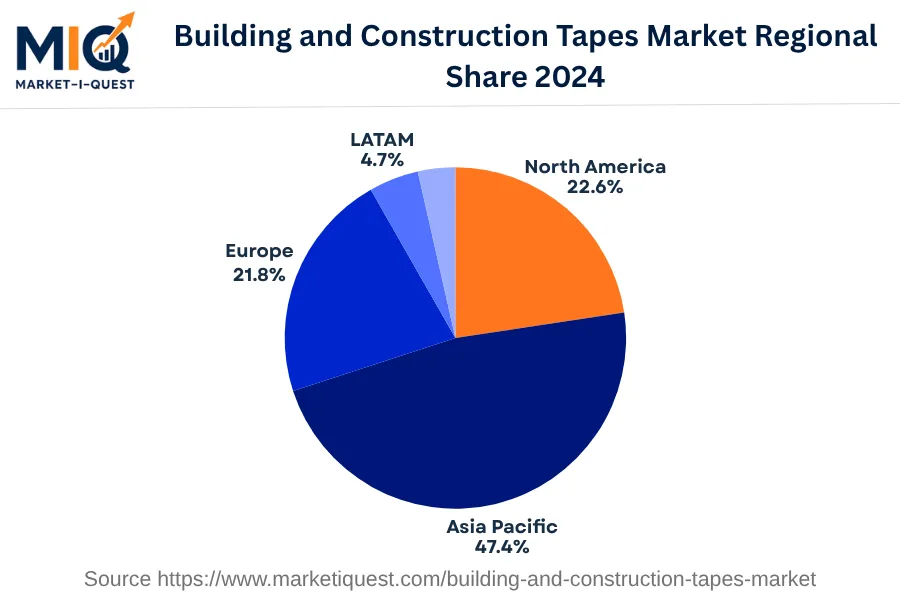
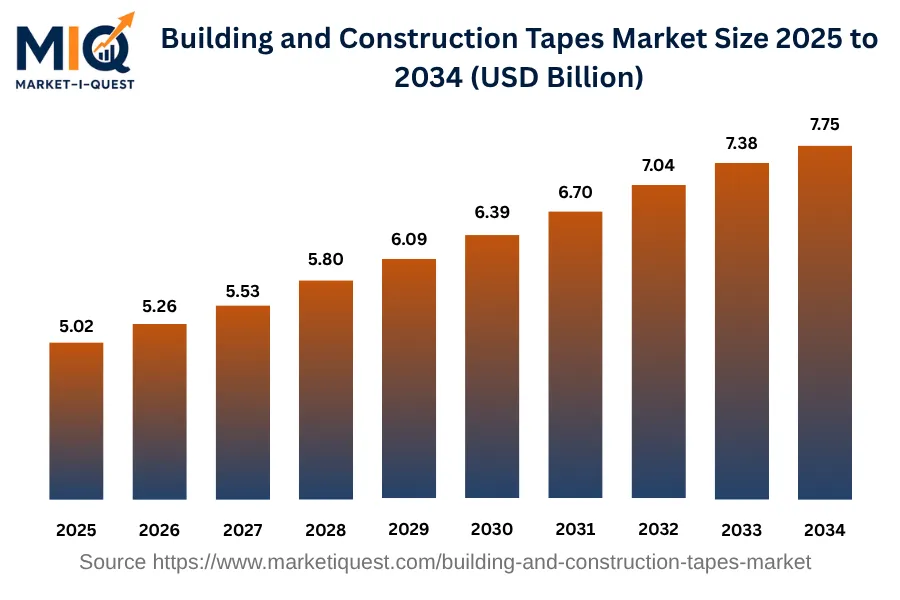
The Building and Construction Tapes Market is projected to grow from a size of $5.02 billion in 2025 to $7.75 billion in 2034, registering a Compound Annual Growth Rate (CAGR) of 4.95%. The growth path portrays a steady upswing over this period, indicated by these specific sizes in key years. From 2025 onwards, an increasing market size is recorded, leading up to a substantial increase by 2034. This increase in market size is largely due to the consistent expansion and development trends within the global construction sector, which consequently propel the demand for building and construction tapes. Moreover, advancement in adhesive technologies and the rising preference for tapes that deliver high performance in different conditions are assisting in the market's growth. Regionally, the market share in 2024 demonstrates that Asia Pacific leads with 47.4%, followed by North America with 22.6%, Europe with 21.76%, Latin America with 4.71%, and the Middle East and Africa with 3.54%.

Key Takeaways

  • By Product Type -Duct Tapes Tapes led the market accounting for a significant share in 2024.
  • By Application - Flooring held the top position holding a large segment share in 2024.
  • By Function - Insulation led a major market share of segment in 2024.
  • By End Use - Commercial segment held the largest share of the segment.
building-and-construction-tapes-market market size

Key Driving Factors

Stricter Building Codes and Regulations

Across various jurisdictions, stricter building codes and regulations regarding energy efficiency and environmental sustainability have been enacted. These codes often mandate the use of certain tapes in building and construction due to their property of sealing gaps and acting as effective thermal barriers. Such tapes reduce energy consumption by improving insulation and cutting down the energy lost through leaks. This has driven demand in the market as the contractors, builders, architects, and other professionals involved in the construction process now require these tapes to meet the regulatory standards and avoid penalties.

Increasing Preference for Green Buildings

There's a growing trend in the construction industry towards 'green buildings'- structures designed with an emphasis on efficiency and minimal environmental impact. Building and construction tapes are a key component in these projects because of their role in ensuring better insulation and airtightness, crucial for energy efficiency. Furthermore, many of these tapes are made from or include recycled or bio-based materials, aligning with the green building principles. As a result, builders, developers, and architects prioritizing sustainability are driving the demand for these specific tapes in the market, projecting a steady growth in its volumes sold.

Market Evolution by Timeline

2019-2023
In the time window of 2019-2023, the demand for building and construction tapes was primarily driven by urban development, specifically in emerging markets such as China and India. New construction projects and infrastructure developments fueled the need for these tapes. Suppliers were focused on producing waterproof, anti-slip and high durability tapes to meet this demand. Regulatory requirements, like the Building Code of Australia's standards on building materials, tightened, influencing tape manufacturers to enhance product qualities. Pricing was generally stable but varied based on tape materials and quantities purchased. Typical contracts were long-term in nature and involved significant volumes. The key risk during this period was shipment disruptions due to supplier-side supply chain issues and increasing tariffs.
2024
In 2024, the construction sector in North America witnessed a surge in repair and renovation activities due to weather-related damages, which boosted demand for building tapes. Manufacturers experimented with more sustainable and environment-friendly materials for tape production, addressing growing green building trends. Newly introduced regulations like Europe's Green Building Programme influenced the adoption of sustainable construction tapes. Buyers engaged in strategic sourcing, combining volume commitments with price and delivery guarantees. Risk to supply was mainly from escalating material costs due to increasing petroleum prices, which likely impacted overall prices.
2025-2029
The demand for construction tapes from 2025 to 2029 was projected to rise largely in South America due to ongoing infrastructure projects. Manufacturers began to lean towards nanotechnology to improve tape adhesion and durability. These tapes were considered under the category of advanced materials in many countries, leading to regulatory scrutiny under standards like the US ANSI/ISO/ASQ Q9001-2000. Prices fluctuated due to increasing raw material costs, particularly in South America. Manufacturers often entered into strategic alliances to secure raw material supplies. Supply chain disruptions posed risks, mainly due to geopolitical uncertainties in key material producing regions.
2030-2034
From 2030 to 2034, Middle Eastern countries, with their focus on infrastructure development, emerged as significant buyers of construction tapes. Complex building designs stimulated technology development towards custom-tailored tapes. The ISO 14024 standard on Eco-labelling became a significant regulatory consideration. Contracts became more flexible, offering tailored solutions based on individual project needs. Increasing raw material prices continued to impact costs, compelling manufacturers to explore alternative, cost-effective materials. The risk of increased competition from local tape manufacturers was also prominent.

Future Market Outlook

Future Opportunities

As the construction industry shifts toward sustainability, a parallel increase in demand for eco-friendly tapes becomes evident. By 2025, the North American construction sector is expected to focus more on energy-efficient buildings, creating an opportunity for manufacturers to develop high-performance tapes that complement energy-saving insulation systems. In 2022, the International Code Council revised its building codes to emphasize green building practices, which will likely propel the use of construction tapes made from renewable materials. Partnerships between traditional tape manufacturers and tech companies, such as the collaboration between Avery Dennison and Microsoft, are pointing towards a future where augmented reality aids tape application, enhancing operational efficiency. Furthermore, with new construction projects ramping up in emerging markets like India and Brazil, local tape manufacturers could harness regional raw materials to create cost-effective solutions tailored to their markets, thereby enhancing market penetration. The ongoing trend of modular construction, recognized officially by NAHB in 2023, also presents opportunities for specialized tapes that facilitate quick assembly and disassembly. This promising environment for collaborative R&D, focused on innovative adhesives and sustainable materials, suggests that players in the global construction tape market are poised to benefit significantly while contributing to overall industry advancements.

Segmentation Analysis

By Product Type

The market is divided into subsegments including Double Sided Tapes, Masking Tapes, Duct Tapes, and Others, where Duct Tapes accounted for the largest revenue share while Double Sided Tapes are expected to grow at the fastest CAGR during the forecast period.

Largest Revenue Share

Duct Tapes

Market Share Leader

Duct tapes account for the lion's share of revenues in the product type segmentation, owing to their ubiquitous and versatile use across a range of industries, such as construction, aerospace, automotive, and retail. They serve essential functions from sealing and binding to repairing and reinforcing, making them an indispensable part of everyday operations. Moreover, their broad adoption is further buoyed by their affordability, availability, and ease-of-use, resulting in greater market penetration. Most notable is their competitive edge in geographies with a strong industrial base or rigorous construction activities as they drive the demand for such versatile products. With regard to regulation/ supply, minimal governmental restrictions on their production, supply, and usage have contributed substantially to its market growth. However, the high switching costs and the traditional purchasing criteria which favors multi-functionality, and durability gives duct tapes a distinctive advantage over the other subsegments.

Fastest CAGR

Double Sided Tapes

Forecast Period Growth Leader

Despite not being the largest revenue earner, Double Sided Tapes hold the potential for the fastest CAGR outlook. This growth is primarily fueled by the increasing demand in industries like packaging, healthcare, and electronics, where they play a crucial role in bonding, holding, mounting, and splicing applications. Moreover, advancements in adhesive technology are a significant catalyst propelling the adoption of these tapes. A shift in policy promoting environmentally friendly alternatives to traditional bonding methods is also a favorable trend supporting this growth. However, high capital expenditure needed to fulfill the demand might pose a significant adoption barrier. Furthermore, partnerships could catalyze market growth as manufacturers seek to diversify their product portfolio and expand their customer base, although near-term risks such as fluctuating raw material prices and the uncertainty introduced by the global pandemic must be factored into the strategic outlook.

By Application

The market is divided into subsegments including flooring, walls & ceiling, windows, doors, roofing, and others. Of these, the flooring subsegment accounted for the largest revenue share, while the windows subsegment is expected to grow at the fastest Compound Annual Growth Rate (CAGR) during the forecast period.

Largest Revenue Share

Flooring

Market Share Leader

Flooring emerged as the highest revenue-generating subsegment in the market in the base year 2024. One of the main drivers behind flooring's top position is the constant need for replacement and upgrades in residential and commercial spaces, creating a sustainable demand. Flooring projects, whether renovation or new construction, are often large scale in nature, thus contributing to a significant share of revenue. The preference for high-quality flooring for its durability, aesthetic appeal, and better lifespan adds to this subsegment's growth. Geographically, developed regions such as North America, Europe, and the Asia Pacific significantly contribute, owing to high disposable income, demand for comfort living, and regulatory standards that mandate periodic floor replacement. The role of suppliers and distributors is also noteworthy in the supply chain, ensuring the availability of a variety of flooring materials to meet numerous consumer preferences.

Fastest CAGR

Windows

Forecast Period Growth Leader

The windows subsegment is slated for the fastest growth during the forecast period. This growth is driven significantly by evolving consumer trends favoring energy efficiency, design, and security. Energy-efficient windows have gained prominence due to increasing environmental consciousness and regulatory compliance, pushing homeowners and corporates to retrofit or install new windows. Furthermore, advancements in window technology, including the incorporation of smart controls for ease of operation, contribute to increased adoption rates. There's also a shift in consumer preference towards larger windows for better natural light and improved aesthetics, propelling the demand. However, barriers like high initial capital expenditure and in some cases, architectural restrictions may slow down its growth. Despite these challenges, partnerships with leading architects and home designers, coupled with affordable financing options, are likely to catalyze the market growth.

By Function

The market is divided into subsegments including Bonding, Protection, Insulation, Glazing, Sound & Water Proofing, Others. In the base year 2024, the Insulation subsegment accounted for the largest revenue share while Protection is expected to grow at the fastest CAGR during the forecast period.

Largest Revenue Share

Insulation

Market Share Leader

The Insulation subsegment commands the largest revenue share in 2024 due to its widespread application across several end-use sectors. It is a critical component in construction and HVAC industries, where it is used to maintain optimal temperatures and reduce energy usage. Furthermore, with growing awareness about energy conservation and regulatory mandates for energy-efficient buildings, the demand for insulation materials has soared. This use-case ubiquity, coupled with the regulatory push, has created a consistent demand-supply cycle propelling the revenue growth for this subsegment. Insulation also serves a key role in industrial settings, in equipment or processes that involve high temperatures, further diversifying its customer base. Its versatility and indispensable nature have solidified its position as the revenue leader in this market.

Fastest CAGR

Protection

Forecast Period Growth Leader

Despite not being the largest in terms of revenue, the Protection subsegment is foreseen to grow at the highest pace. Propelling this growth are several behavioural and technological changes. The escalating need for secure and robust systems in the face of increasing technological risks and physical threats has given this subsegment renewed importance. Demand is particularly strong in developing economies, where infrastructure is evolving and the need for protection measures are becoming more apparent. Key obstacles to adoption, including high initial installation costs and lack of awareness, are gradually eroding due to advancements in affordable safeguarding technologies and increased education about the cost-benefit ratio in the long-term. Nonetheless, the limited availability of skilled installation and maintenance personnel poses near-term adoption risks. Despite these challenges, the protective function is poised for rapid expansion, boosted by technological advancements, changing regulations, and increasing consumer awareness.

By End Use

The market, which divides into the Residential, Commercial, and Industrial subsegments, saw the Commercial subsegment account for the largest revenue share in 2024. However, it is the Residential subsegment that is projected to grow at the fastest CAGR during the forecast period.

Largest Revenue Share

Commercial

Market Share Leader

The commercial subsegment emerged as the leading revenue-generator in the base year of 2024. This has been primarily due to its direct relationship with the booming corporate market space. As businesses expand, so does their need for larger commercial spaces, driving higher demand in this subsegment. Providing spaces for both well-established and upcoming enterprises have played a crucial role in boosting its revenue. The geographies with intensified business activities have further catalyzed profits. The commercial subsegment also benefited from favorable regulations that promote business expansions and rigorous market activities. The investment criterion of businesses, which are mainly long-term and dedicated investments, also contributed to the increased revenue. Moreover, the growing trend of businesses leaning towards renting commercial spaces to reduce asset-related obligations has helped maintain a steady revenue stream for the commercial subsegment.

Fastest CAGR

Residential

Forecast Period Growth Leader

While the commercial subsegment might hold the largest revenue share, it is the residential subsegment that is set to grow at the fastest pace. The principal growth driver for the residential subsegment is the increasing global population, which creates a persistent demand for housing. This inclination is further accelerated by policy initiatives that promote homeownership and provide subsidies for residential construction. Technological advancements play a significant role too. They have streamlined and sped up residential construction processes, thereby driving further growth in this subsegment. Capital investments directed towards affordable housing projects, along with strategic partnerships with construction and real estate companies, are boosting sector performance. However, barriers like rising real estate costs pose near-term growth risks. Despite these challenges, the demand for residential housing is likely to keep expanding, underpinning ongoing growth in the residential subsegment.

Competitive Analysis

Key Market Players

Manufacturers / OEMs

3M Company
US
Scapa Group plc
UK
Nitto Denko Corporation
Japan

Key Suppliers & Raw Materials

Eastman Chemical Company
US
Dow Inc.
US
Exxon Mobil Corporation
US

Distributors, Integrators & Channel Partners

Carlisle Companies Inc.
US
Fastenal Company
US
Grainger, Inc.
US

Porter’s Five Forces Analysis

This analysis presents the competitive landscape and market dynamics of the Building and Construction Tapes Market.

Supplier Bargaining Power

Medium

Segment consolidation limits options, but diversity in raw materials softens innate supplier power.

Buyer Bargaining Power

High

Numerous suppliers and low switching costs give superior bargaining power to the buyers.

Threat of Substitutes

Low

The unique characteristics and reliance on tapes in construction restrict the threat of substitutes.

Threat of New Entrants

Medium

Entry is constrained by scale economies and established brands, yet low capital requirements make it possible.

Competitive Rivalry

High

Many established players and aggressive price wars intensify competitive rivalry.

Regional Analysis

Geographic market dynamics and growth opportunities across key regions

Global Market Outlook

building-and-construction-tapes-market market regional share

North America

In 2024, the Building and Construction Tapes Market in North America experienced noticeable growth. Driving forces behind this momentum included demand for advanced adhesive solutions across various construction activities, substantial investments in residential and commercial real estate, especially in the U.S. and Canada, and innovative technology adoption. Regulatory policies, such as the U.S.'s Federal Green Construction Code, promoted the use of environment-friendly adhesives, while competitive pricing strategies influenced supply dynamics.

Several trends in 2024 shaped the Building and Construction Tapes Market. Increased buyer preference for durable, resilient, and easy-to-use adhesives revamped product offerings, favoring tapes with advanced capabilities. Digital channels played a significant role in product promotion and distribution, enhancing market reach. Strategic partnerships and mergers and acquisitions were rampant, particularly among manufacturers aiming to expand their market presence. In line with evolving construction standards, policy enforcement for sustainable building practices intensified, creating an upward demand curve for green adhesives. Various sectors, such as enterprise, government, manufacturing, and utilities, significantly adopted building and construction tapes. From repairing minor wear and tear in office spaces to large-scale public infrastructural projects, the role of construction tapes was ubiquitous, making them an indispensable part of North American construction in 2024.

Asia Pacific

In 2024, the Asia Pacific building and construction tapes market experienced significant growth due to industry-specific drivers and trends. Key demand drivers included rapid urbanization pushing construction activity in China and India, along with technology adoption for improved productivity and quality of buildings. Additionally, concerted investments in infrastructure projects by governments across China, Japan, and key ASEAN markets fueled market growth. Stringent regulations around building safety and material standards in Australia and South Korea also compelled the use of high-quality tapes.

Shifting trends included an increased buyer preference for weather-resistant and long-lasting tape materials with the robust construction sector in Japan and South Korea. Eco-friendly, recyclable tapes gained traction in China and India due to growing environmental awareness and regulatory action. Digitization in retail saw e-commerce platforms becoming key distribution channels for building and construction tapes. Moreover, a wave of partnerships and mergers in Australia and ASEAN sought to leverage different competencies, optimizing supply chains and increasing market share. Lastly, stricter policy enforcement pertaining to counterfeit products reinforced customers' (i.e., construction companies, real estate developers, and contractors) trust in established tape brands, putting premium manufacturers in a favorable market position.

Europe

In 2024, the building and construction tapes market in Europe exhibited steady growth linked to robust construction activity and sustained urban development. Drivers included escalated residential and commercial real estate development, particularly in high-growth economies like Poland and the Czech Republic, bolstering the demand for tapes. Regulatory frameworks such as the EU's Energy Performance of Buildings Directive encouraged energy-efficient construction, boosting the requirement for insulation tapes. Rapid technological transformation supported faster, more efficient construction processes, escalating the demand for advanced adhesive solutions.

Market trends reflected a growing preference for eco-friendly, VOC-free adhesive tapes, particularly in countries like Germany and the Nordics, owing to stringent environmental regulations. In regions like the UK and France, buyer behavior indicated a shift towards high-performance tapes that offer better durability and resistance to environmental factors. There was noticeable growth in e-commerce for construction tapes, propelled by accessibility, variety, and competitive pricing. Manufacturer partnerships and M&A activity were instrumental in expanding product ranges and entering new markets. Policy enforcement, particularly in the Benelux region, was directed towards ensuring product quality and compliance with safety and environmental regulations. Predominant industries leveraging these tapes included residential and commercial construction, infrastructure development, and renovation projects.

Latin America

In 2024, the Building and Construction Tapes Market in LATAM is highly affected by urbanization, infrastructure modernization, and sustainable construction demand. Demand has been particularly high in Brazil and Mexico due to strong residential construction activities spurred by housing credit easing and population growth. In Argentina and Chile, stringent environmental regulations have encouraged industry-wide adoption of eco-friendly adhesive tapes, reducing waste and lessening the environmental impact. Additionally, the favorable investment climate in Peru has led to the influx of foreign companies into the market, raising supply quality and competitive pricing dynamics.

Trends seen in this year include a heightened interest in specialty tapes. This is reflected in altered buyer behavior favoring high performance, customizable tapes over generic types. For instance, waterproof and friction-resistant tapes are popular in Chile's industrial sector. Technological innovation has brought about advanced tapes with properties like reusability and high adhesion strength, raising interest in the star sectors — enterprise and manufacturing. Remarkably, the e-commerce boom in Colombia has impacted distribution channels, pushing manufacturers to tie up with online retailers. There is also enforcement of stringent standards and policies, like Brazil's Inmetro regulations for construction material safety, elevating market quality and customer trust.

Middle East & Africa

In 2024, the building and construction tapes market in the Middle East and Africa experienced a considerable climb due to several driving factors. Increased infrastructure projects, particularly in nations such as Saudi Arabia, the United Arab Emirates, and Qatar, ignited demand for these adhesive solutions. Regulatory mandates in countries like South Africa and Kenya, advocating for improved construction standards and increased safety measures, also fueled the uptick in consumption. Additionally, elevated investments in real estate and commercial developments across Nigeria and Israel played a pivotal role in the sector's steady progression.

Noticeable trends in 2024 included an inclination towards advanced, eco-friendly adhesive technologies due to heightened environmental consciousness, particularly in Egypt and South Africa. Manufacturers and suppliers adapted to growing online buying behaviors, resulting in improved e-commerce strategies. A significant product shift was seen in demand for weather-resistant, high durability tapes for extreme regional climate conditions. Strategic partnerships and acquisitions, particularly in UAE and Israel, were part of the sector's efforts to meet the escalating demand. Enforced policies for construction safety and quality regulations, specifically in Saudi Arabia, further shaped the buying choices, favoring trusted, compliance-ready brands. Highly impacted sectors encompassed government infrastructure projects, oil and gas facilities, utilities, and telecom installations.

Recent Industry Developments

Latest market innovations, product launches, and strategic initiatives

February 2026

Henkel introduced an upgraded sustainability framework and portfolio of low-emissions adhesive materials at the LOPEC 2026 exhibition. The transition targets rising regulatory demand for circular building components, providing weather-resistant sealing and insulation tapes designed to lower structural carbon footprints.

January 2026

Henkel Adhesive Technologies acquired ATP Adhesive Systems Group, a specialist in customized, high-performance adhesive tapes. The transaction adds solvent-free, eco-friendly pressure-sensitive tapes to Henkel's structural portfolio, targeting green building and insulation standards.

August 2025

Avery Dennison acquired the flooring adhesives division of Meridian Adhesives Group, integrating the Taylor and Polycom brands. The acquisition expands Avery Dennison’s specialty adhesives portfolio, strengthening its structural bonding and tape capabilities across commercial construction markets.

Frequently Asked Questions