Bronchitis Treatment Market Snapshot

Key Players

  • Boehringer Ingelheim (Germany)
  • GlaxoSmithKline (United Kingdom)
  • AstraZeneca (United Kingdom)
  • Pfizer (United States)
  • Sanofi (France)
  • Novartis (Switzerland)
  • Teva Pharmaceutical Industries (Israel)
  • Sun Pharmaceutical Industries (India)
  • Abbott Laboratories (United States)
  • Roche Holding (Switzerland)

Market Size

Base Year 2024
$6.43 Bn
CAGR
14.8%
Forecast 2034
$25.56 Bn

Market Segments

By Type
  • Chronic Bronchitis
  • Acute Bronchitis
By Drug Class
  • Antibiotics
  • Anti-Inflammatory Drugs
  • Bronchodilators
  • Mucolytic
By Distribution Channel
  • Hospital Pharmacies
  • Retail Pharmacies
  • Online Pharmaceutical Stores

Market Dynamics

Drivers
  • Increasing bronchitis cases worldwide
  • Advancements in treatment technologies
Restraints
  • High treatment costs
  • Limited awareness in developing regions
Opportunities
  • Growing geriatric population
  • Increasing pollution levels

Market Size

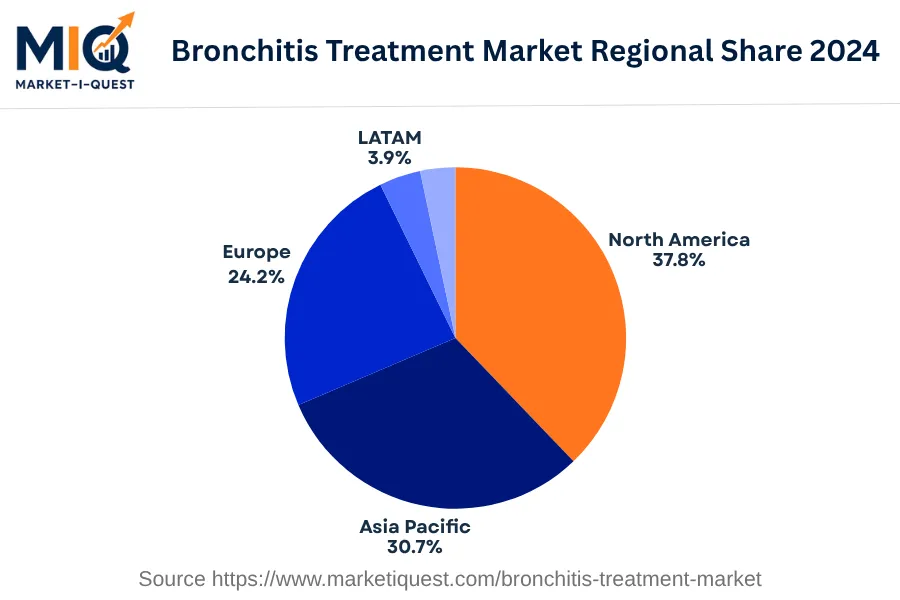
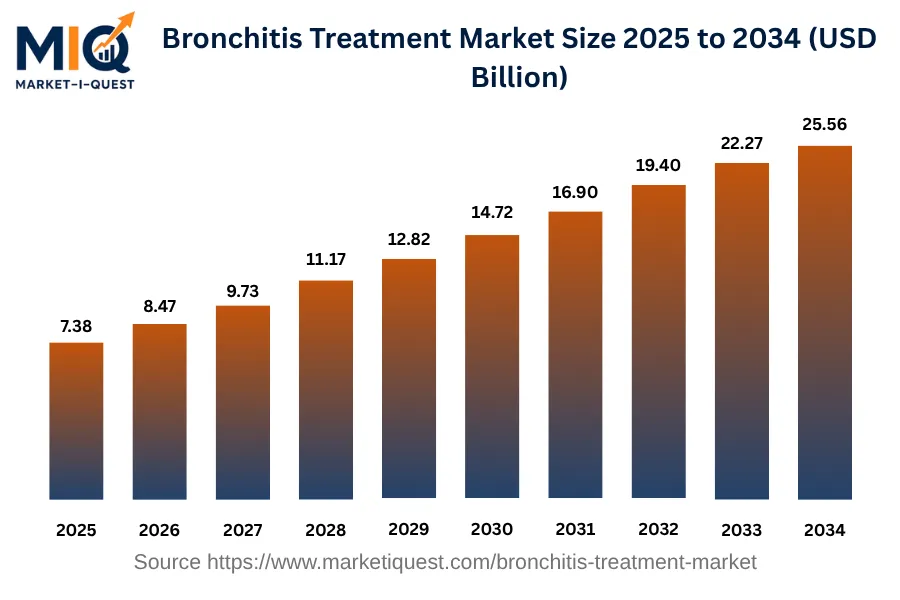
The Bronchitis Treatment Market is valued at $7.38 billion in 2025, up from $6.43 billion in 2024, and is anticipated to reach $25.56 billion by 2034, growing at a CAGR of 14.8%. The steady rise in market value is indicative of sustained growth over the 9 years from 2025 to 2034. The growth in the Bronchitis Treatment Market is attributable to an increasing prevalence of bronchitis and advancements in treatment methods during this period. In 2024, regional market shares were distributed with North America holding the largest share of 37.8%, followed by Asia Pacific at 30.7%, Europe at 24.2%, LATAM at 3.9%, and MEA at 3.3%.

Key Takeaways

  • By Type - Chronic Bronchitis exhibited largest share of the segment.
  • By Drug Class - Antibiotics were the leading subsegment commanding a substantial market share in 2024.
  • By Distribution Channel - Hospital Pharmacies exhibited largest share of the market.
bronchitis-treatment-market market size

Key Driving Factors

Shift Towards Smokeless Tobacco Products

A key driver for the bronchitis treatment market is the ongoing shift in consumer habits towards smokeless tobacco products in most developed countries. Dealing with bronchitis involves alleviating symptoms and diminishing triggers that incite inflammation and infection; hence, focus on reducing triggers like smoking is noteworthy. Economically affluent countries are witnessing a steady decrease in cigarette usage due to increased health awareness and stricter regulations, leading many to switch to smokeless products. Nonetheless, these smoke-free alternatives can still result in bronchitis, consequently propelling the need for treatment. Increased demand for treatments among these demographic can significantly drive market growth.

Prevalence of Air Pollution in Emerging Economies

Another key driver of the bronchitis treatment market is the high rate of air pollution in emerging economies. Rapid industrial growth and urbanization in these regions have led to worsening air quality levels, contributing significantly to respiratory diseases including bronchitis. Despite active steps towards cleaner energy and less harmful industrial processes, the impact to the general population is still significant. High levels of suspended particulate matter, for instance, prompt chronic bronchitis cases and drive the need for advanced treatment options. As the economic cost of pollution-related health issues rise, these nations are likely to aggressively invest in preventative and curative measures, prompting expansion in the bronchitis treatment market.

Market Evolution by Timeline

2019-2023
This period has seen a rise in buyers, particularly in regions with high pollution levels like China, India, and the US Midwest. The primary reason was environmental factors causing increased bronchitis cases. Bronchitis treatments showed improved effectiveness due to gradual application of new technologies like Prednisolone. Regulatory standards by FDA and EMA pushed for more robust clinical trials, dictating adoption of these treatments. Most commercial deals saw a fixed pricing model, often with insurance coverage. Partnerships with hospitals and clinics became more common. A significant risk involves demand variability, countered by maintaining surplus supply.
2024
In 2024, buyers of bronchitis treatments were mainly countries in South East Asia, due to the rise in air pollution levels. Countries with ageing populations, like Germany and Japan, also contributed to the demand. The introduction of advanced bronchodilators has generated more effective treatments. Governments launched initiatives, such as Germany's Coalition for Patient Safety, to promote adoption. Value-based pricing was typical, with contracts often including maintenance services. Risks include resistance to new treatment approaches, which providers addressed through comprehensive patient education.
2025-2029
This period saw increased demand from the Middle East, particularly in cities like Dubai and Abu Dhabi, due to dust storms associated with bronchitis. Moreover, the rise in smoking prevalence worldwide led to an upsurge in cases. Firms have been piloting new bronchitis treatments like stem-cell therapy. New compliance standards fostered transparency and quality assurance. Most contracts included both purchase and post-purchase services. The main challenge was treatment cost; however, government initiatives and health insurances mitigated this to an extent.
2030-2034
There was a high demand in Africa due to increasing industrial pollution. Furthermore, allergic bronchitis was on the rise globally due to climate change. Development in genetic therapies marked a breakthrough in supply. New regulations under the Affordable Drug Act often dictated the adoption of these treatments. A majority of deals were on a subscription basis, with long-term partnerships featuring heavily. Insufficient infrastructure in developing countries was a prominent hurdle; typically, firms coped by collaborating with local health departments.

Future Market Outlook

Future Opportunities

The bronchitis treatment market has substantial opportunities stemming from ongoing research and development in pharmacotherapy and individualized treatment protocols. In 2023, preliminary results from a clinical trial conducted by the National Institutes of Health indicated that combination therapy, specifically using a long-acting beta-agonist with a corticosteroid, significantly improved lung function in chronic bronchitis patients. Furthermore, the World Health Organization’s guidelines established in 2021 advocate for the development of more targeted therapies based on patient phenotyping, which presents opportunities for pharmaceutical companies to innovate new drugs tailored to specific patient profiles. The increasing prevalence of bronchitis in developing regions, with countries like India and Brazil reporting rising incidences, suggests a growing demand for effective treatment options. In response to this trend, several biopharmaceutical firms are focusing their R&D efforts on inhaled antibiotics and anti-inflammatory drugs, with promising results reported in late-stage trials. Additionally, the integration of personalized medicine frameworks presents lucrative prospects for market players to enhance their product offerings, enabling more effective management of chronic bronchitis. Regulatory bodies worldwide are also supporting this advancement, with the FDA’s newly established Fast Track designation for treatments targeting chronic bronchitis fostering a more agile approval process. The intersection of scientific research and evolving patient needs is expected to create an environment ripe for innovative treatment solutions and comprehensive care models that address the complexities of bronchitis management across diverse populations.

Segmentation Analysis

By Type

The market is divided into subsegments including Chronic Bronchitis and Acute Bronchitis, of which Chronic Bronchitis accounted for the largest revenue share while Acute Bronchitis is expected to grow at the fastest CAGR during the forecast period.

Largest Revenue Share

Chronic Bronchitis

Market Share Leader

Chronic Bronchitis, a consistent inflammation in the bronchial tubes, emerged as the leading subsegment due to its prevalence and the recurring nature of the disease. It is one of the underlying conditions in COPD, an increasingly pervasive ailment globally, especially among smokers and older adults. Government initiatives advocate for early diagnosis and chronic disease management, further augmenting Chronic Bronchitis' prominent market position. Advanced economies lead the segment, driven by robust healthcare systems, sizable elderly population, and high levels of air pollution in certain regions, coupled with the higher incidence of tobacco consumption. Treatment requires medication and sometimes oxygen therapy, both of which have their own demand dynamics. Issues surrounding supply chains or regulatory updates could potentially disrupt this balance. The treatment options are largely the same, resulting in low switching costs and homogeneous purchasing criteria for customers in this segment. The primary channels for patient acquisition include hospitals and pulmonary clinics, further catering to these subsegment's growth.

Fastest CAGR

Acute Bronchitis

Forecast Period Growth Leader

Acute Bronchitis is marked for its rapid growth potential. Acute Bronchitis, typically a one-off inflammation of bronchial tubes usually caused by a viral infection, exhibits a higher incidence rate, especially during colder months, and this seasonal trend accelerates its growth. Crucial barriers to adoption include the urgency in treatment and the general perception of bronchitis as a common, self-limiting condition requiring only symptomatic treatment. However, advancements in diagnostic technology and increased accessibility to advanced healthcare increase its identification and treatment. Further, partnerships between healthcare providers and pharmaceutical companies may drive innovations in therapeutics, potentially enhancing the subsegment's growth. Forecasted investment in public healthcare, coupled with growing awareness, may catalyze adoption rates. Yet, variability in treatment effectiveness and potential regulatory changes in the healthcare sector pose near-term uncertainties for growth.

By Drug Class

The market is divided into subsegments including Antibiotics, Anti-Inflammatory Drugs, Bronchodilators and Mucolytic. Of these, Antibiotics accounted for the largest revenue share while Bronchodilators are expected to grow at the fastest rate during the forecast period.

Largest Revenue Share

Antibiotics

Market Share Leader

In the base year 2024, the Antibiotics sub-segment accounted for the majority of the sector revenue. This is largely attributed to the high prevalence of bacterial infections, along with the widespread use of antibiotics in treating diverse medical conditions. Antibiotics' broad range of applications, from treating respiratory tract infections to sexually transmitted diseases, gives them a significant share in prescription drugs globally. Additionally, the geographical spread of antibiotic-resistant strains has necessitated increased antibiotic production and use contributing to the subsegment's high revenue. Regulatory guidelines advocating for the prudent use of antibiotics have also played a pivotal role in shaping this market. Lastly, the purchasing criteria for antibiotics is broad, since they are enlisted as essential drugs in many healthcare systems, mandating their availability and consequently, enhancing the revenue.

Fastest CAGR

Bronchodilators

Forecast Period Growth Leader

Despite not being the largest segment in terms of revenue, bronchodilators are projected to register the fastest Compound Annual Growth Rate (CAGR) during the forecast period. This trend can largely be attributed to the rising prevalence of respiratory disorders such as asthma and chronic obstructive pulmonary disease (COPD), which is driving the demand for bronchodilators. Other potent growth catalysts include technological advancements in drug delivery systems and increased healthcare expenditure. The advent of partnerships between pharmaceutical firms for collaborative research is also expected to fuel the market. On the other hand, adoption barriers such as potential side effects and regulatory issues regarding the sale and use of these drugs could potentially limit market growth. However, capital expenditure in ongoing R&D for safer and more effective bronchodilators provides a positive outlook for the subsegment's near-term growth.

By Distribution Channel

The market is divided into subsegments including Hospital Pharmacies, Retail Pharmacies, and Online Pharmaceutical Stores. In 2024, Hospital Pharmacies accounted for the largest revenue share while Online Pharmaceutical Stores is expected to grow at the fastest CAGR during the forecast period.

Largest Revenue Share

Hospital Pharmacies

Market Share Leader

Hospital Pharmacies generate the largest revenue primarily due to the consistent high volumes of pharmaceuticals they manage and dispense. As a crucial part of health systems, these pharmacies fulfill an indispensable role in providing medication to in-patients and out-patients. Their direct association with healthcare facilities positions them uniquely to accommodate emergency medical needs and specialty treatments, thus influencing their revenue significantly. Geographically, regions with a substantial number of hospitals naturally give a boost to the revenue of this subsegment. The high purchasing criteria and strict regulations guide hospital pharmacies, ensuring a continuous stream of revenue generated by the necessity of prescribed medications. Additionally, hospital pharmacies often have exclusive contracts with pharmaceutical companies, providing a stable demand and supply operation.

Fastest CAGR

Online Pharmaceutical Stores

Forecast Period Growth Leader

The Online Pharmaceutical Stores subsegment is projected to be the fastest-growing. Driving this growth are multiple factors like increased internet penetration, convenience of home delivery, and round-the-clock availability. Technology stands as a significant catalyst in this acceleration due to emerging trends such as e-prescriptions and telemedicine consultations. Moreover, policies encouraging digital health services provide favorable conditions for growth, despite regulatory barriers surrounding the sale and distribution of drugs online. As patients become more comfortable with online consultations and remote healthcare, the ease of ordering medication directly online is an attractive proposition. However, challenges remain. Issues concerning transaction security, counterfeit drugs, and maintaining the cold chain for certain types of medication could slow the growth. Tackling these concerns through partnerships with reliable carriers, implementing robust data security measures, and ensuring supply of only quality approved drugs can help maintain the pace of growth.

Competitive Analysis

Key Market Players

Manufacturers / OEMs

Pfizer Inc
US
GlaxoSmithKline plc
UK
Sanofi
France

Key Suppliers & Raw Materials

Ajinomoto Co. Inc
Japan
Arch Pharmalabs Limited
India
BASF SE
Germany

Distributors, Integrators & Channel Partners

McKesson Corporation
US
Cardinal Health
US
Cigna
US

Porter’s Five Forces Analysis

An examination of the competitive pressures and market dynamics in the Bronchitis Treatment Market.

Supplier Bargaining Power

Medium

Balance of power between companies and raw material suppliers due to dependency on pharmaceutical ingredients.

Buyer Bargaining Power

Low

Patients possess limited ability to influence prices due to imperative need for effective treatment.

Threat of Substitutes

Medium

Potential alternatives like home remedies or traditional medicine exist, but reliability varies.

Threat of New Entrants

Low

High entry barrier due to regulatory certifications, substantial R&D investment, and patent protections.

Competitive Rivalry

High

Intense competition between existing providers fighting for market shares, driven by technological advancements and drug efficacy.

Regional Analysis

Geographic market dynamics and growth opportunities across key regions

Global Market Outlook

bronchitis-treatment-market market regional share

North America

In 2024, the North American market for bronchitis treatments exhibited sustained traction, driven by heightened respiratory health awareness. Increased investment in healthcare infrastructure, particularly in the U.S. and Canada, rendered these markets more accessible to advanced bronchitis therapeutics. The prioritization of respiratory health, influenced in large part by recent global health events, also drove demand. Meanwhile, patient-centered reforms in the Mexican health sector have contributed positively to the treatment market dynamics.

Several trends further shaped the bronchitis treatment market in North America. Shifts in buyer behavior towards preventive care and integrated health solutions, supported by advancements in telehealth, demonstrated conspicuous impact. Integration of Artificial Intelligence in healthcare, particularly in diagnosis, has been transformative, creating more personalized treatment avenues. The prevalence of mergers, acquisitions and strategic collaborations, predominantly in the enterprise and healthcare sectors, reflected increased confidence in the potential of the market. In addition, enforced policies such as the Patient Protection and Affordable Care Act (ACA) in the U.S., which ensures more comprehensive coverage, influenced market trends. The key sectors that availed these treatments were primarily healthcare institutions, ranging from public healthcare providers to private clinics and hospitals. In the retail sector, pharmacies and drug stores also expanded their stocks, made possible by the strong supply chain dynamics across U.S., Canada, and Mexico.

Asia Pacific

The Bronchitis Treatment Market established a significant presence in the Asia Pacific region in the base year of 2024. Drivers contributing to this included the surge in pollution levels across urban cities like Beijing and New Delhi, leading to an increased prevalence of bronchitis and demanding greater medical care. Further, the ratification of the ASEAN Comprehensive Investment Agreement promoted improvement in the provision of healthcare services through enhanced investment in both pharmaceutical firms and research institutions. Technological adoption, particularly the expansion of telemedicine services in countries like Australia and Japan, made diagnosis and treatment more accessible, thereby stimulating demand.

Trends shaping the industry included a shift towards preventive healthcare in India and China, with governments focusing on raising awareness about bronchitis and its risk factors among both urban and rural populations. Demand for shorter, more convenient treatment courses grew, catalyzed by the active lifestyle of consumers in developed markets like Japan and South Korea. Additionally, there was a significant rise in strategic partnerships between pharmaceutical firms in these countries and their western counterparts to enhance research and development efforts. Furthermore, there was standardized policy enforcement across the Asia Pacific region, particularly in the ASEAN markets, to ensure the quality and efficacy of bronchitis treatment drugs. Key customers included government healthcare bodies, public and private hospitals, as well as retail pharmacies, with the rising middle class becoming increasingly health-conscious and demanding better healthcare services.

Europe

In 2024, the bronchitis treatment market in Europe experienced significant dynamics reflecting evolving disease understanding, patient preferences, and healthcare imperatives. Among primary drivers, heightened public health focus on respiratory diseases pushed demand, particularly amid more severe winter seasons across Germany and the United Kingdom – both accounting for high bronchitis prevalence. Advances in telemedicine, notably in Nordic countries, allowed better patient care and bolstered drug adherence, improving treatment outcomes. Lastly, sizeable healthcare investment flowed into Italy and Spain, boosting available treatments and infrastructure for bronchitis management.

Trends also shaped the market landscape. An uptick in patient belief for self-medication, steered by internet-based medical information, affected the channel dynamics, leading to increased over-the-counter antibiotics sales in countries like France and the United Kingdom. Technology-driven shift unveiled as hospitals in Benelux and Central & Eastern Europe adopted more digital patient records, allowing swift electronic prescribing, thus driving prescription drug sales. Lastly, an increase in public-private partnerships was noted, especially related to research for bronchitis therapeutics, driven by governmental and European Union policies to advance healthcare. Overall, these drivers and trends underscore the complex, evolving bronchitis treatment market in Europe in 2024.

Latin America

In 2024, the Bronchitis Treatment Market in Latin America experienced significant dynamics due to multiple factors. High pollution levels in major cities of Brazil, Mexico, and Argentina increased the prevalence of bronchitis, driving demand for treatment methods. Government health policies in Colombia and Peru, focusing on increased access to healthcare services, stimulated market growth. High investment in healthcare technology across the region, especially in Chile, fostered the adoption of advanced treatment options, further accelerating market expansion.

Consumer behavior in LATAM exhibited a shift towards digital platforms for medical consultations, driven by widespread adoption of telehealth, thus altering product procurement channels. Rapid digitization also influenced the growing preference for online pharmacies over traditional stores. Mergers and acquisitions were frequent amongst pharmaceutical companies striving to extend their product portfolios and geographical presence in an increasingly competitive market environment. The enforcement of stringent guidelines on drug approvals and patent laws had a profound impact on the Bronchitis treatment market, dictating the strategic directions of key players for compliance. These market drivers and trends predominantly shaped the Bronchitis Treatment Market landscape for healthcare providers, pharmacies, and government health initiatives in 2024. A key customer group included metropolitan residents in polluted cities where bronchitis was endemic, further segmented by individual access to internet-based medical services.

Middle East & Africa

In 2024, the bronchitis treatment market across the Middle East and Africa witnessed significant dynamism, driven by several key factors and trends. Increased demand was influenced by rising air pollution levels, particularly in populous nations like Nigeria and Egypt. Government initiatives to improve healthcare infrastructure, especially in Saudi Arabia and United Arab Emirates, widened the availability of treatments, while private sectors in nations like South Africa actively invested in advanced healthcare technology. Furthermore, the adoption of telemedicine applications in Israel vastly improved accessible disease management, counteracting previously prevalent supply restrictions.

On a trend level, buyer behavior shifted noticeably towards online pharmacies, galvanized by the ongoing digital transformation across the region. Technological advancements, particularly in inhaled therapy, gained traction in countries like Qatar, addressing the need for efficient and patient-friendly treatments. Heightened collaboration was observed in the healthcare sector to promote research and development, with a notable example being the partnership between major hospitals in Kenya and Nigeria. Lastly, stricter enforcement of healthcare regulations was observed across the board, particularly in Saudi Arabia and the United Arab Emirates, in an effort to maintain high standards of patient care, transforming the bronchitis treatment landscape across these regions. This confluence of drivers and trends propelled significant growth and innovation in the bronchitis treatment market in 2024.

Recent Industry Developments

Latest market innovations, product launches, and strategic initiatives

August 2025

The U.S. FDA approved Insmed’s Brinsupri (brensocatib) as the first targeted treatment for non-cystic fibrosis bronchiectasis. As a first-in-class DPP1 inhibitor, the oral drug directly counters the neutrophil-driven bronchial inflammation and frequent flares that clinically overlap with advanced chronic bronchitis.

Frequently Asked Questions