Bone Grafts and Substitutes Market Snapshot

Key Players

  • Medtronic plc (Ireland)
  • Stryker Corporation (US)
  • Johnson & Johnson (US)
  • Baxter International Inc. (US)
  • Zimmer Biomet Holdings Inc. (US)
  • Smith & Nephew plc (US)
  • Integra LifeSciences Holdings Corporation (US)
  • NuVasive Inc. (US)
  • Orthofix Medical Inc. (US)
  • SeaSpine Holdings Corporation (US)

Market Size

Base Year 2024
$3.48 Bn
CAGR
9.6%
Forecast 2034
$8.74 Bn

Market Segments

By Material Type
  • Allograft
  • Synthetic
By Application
  • Spinal Fusion
  • Dental
  • Joint Reconstruction

Market Dynamics

Drivers
  • Increasing cases of bone disorders
  • Technological advancements in healthcare
Restraints
  • Stringent regulatory approvals
  • High procedure costs
Opportunities
  • Advancements in biomaterials
  • Rising incidence of orthopedic conditions

Market Size

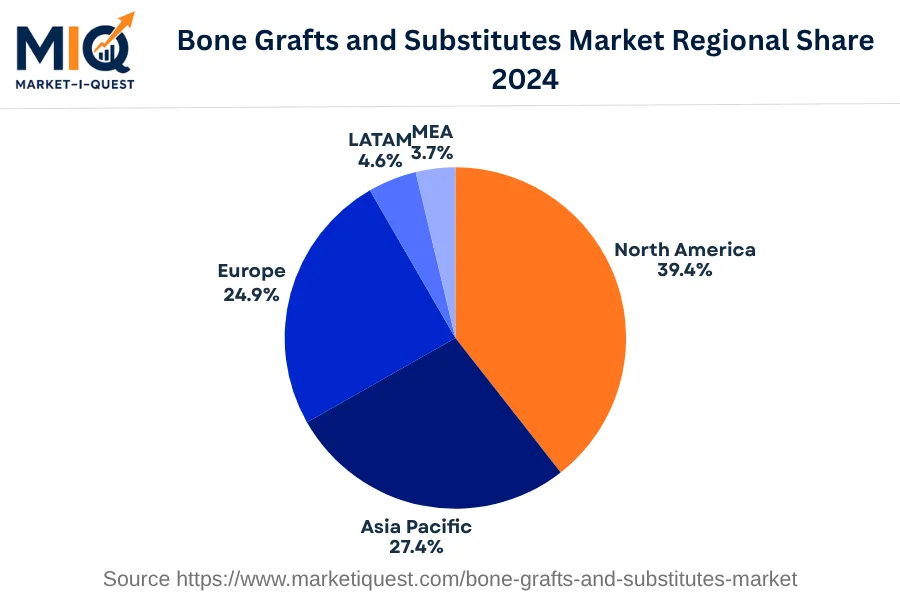
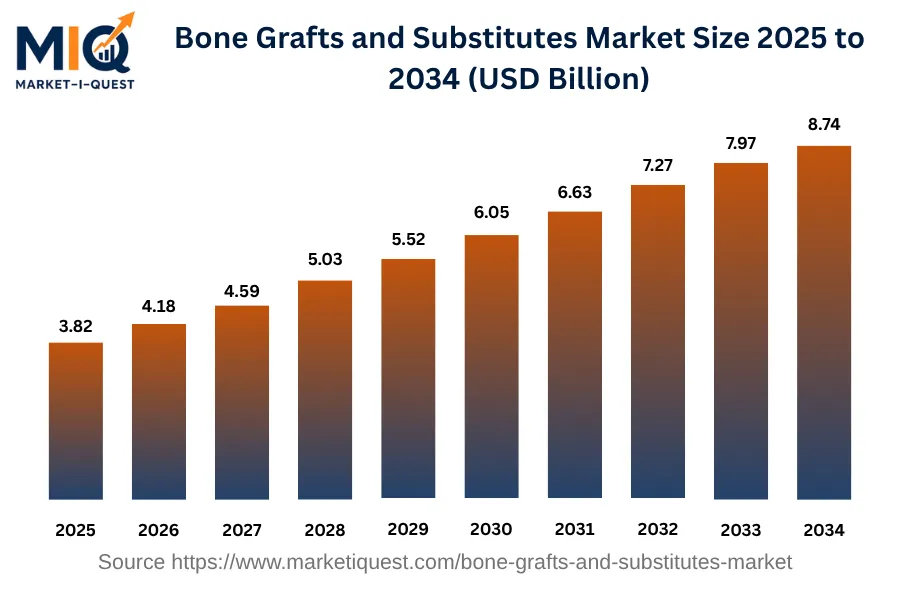
The Bone Grafts and Substitutes Market was valued at $3.82 billion in 2025 and is expected to reach $8.74 billion in 2034, growing at a CAGR of 9.65%. The market has shown consistent growth from its valuation of $3.48 billion in 2024. This rise in the market valuation, nearly tripling over the ten-year period, can be attributed to an increase in the demand for these products across various demographics due to their increasingly versatile medical applications. As of 2024, the market share was distributed regionally with North America holding a majority share of 39.42%, followed by Asia Pacific at 27.36%, Europe at 24.87%, LATAM at 4.61%, and MEA at 3.74%.

Key Takeaways

  • By Material Type - Allograft held a major portion of the segment in 2024.
  • By Application - Spinal Fusion holds a leading position in 2024.
bone-grafts-and-substitutes-market market size

Key Driving Factors

Uptick in Orthopedic Surgeries Due to Sports Injuries

Over recent years, there has been a definite rise in orthopedic surgeries due to sports injuries. These injuries often involve serious bone or skeletal damage that necessitates the use of bone grafts and substitutes to promote bone healing and restore mobility. The frequency of these injuries, especially in high contact sports like football, wrestling, and ice hockey, contributes significantly to the demand for bone grafts and substitutes. Increasing participation in sports activities worldwide and the risk of injuries associated with them creates a consistent demand in the bone grafts market.

Emergence of Bioactive Glass-based Bone Grafts

Bioactive glass-based bone grafts are proving to be a boon in the medical world. Physicians prefer these over traditional grafts for bone regeneration and tissue engineering due to their ability to stimulate faster bone growth. The biocompatibility, chemical composition, and porous architecture of bioactive glass make it an excellent option for bone grafting. The bone graft substitutes made from bioactive glass have properties like osteoconduction and osteoinduction, which enhance their ability to facilitate bone regrowth in patients. This new form of graft has redefined regenerative medicine and is driving the bone grafts and substitutes market due to the accelerating adoption rate by healthcare professionals.

Market Evolution by Timeline

2019-2023
In this period, orthopaedic surgery was a primary driver for demand of bone grafts and substitutes, particularly from countries such as the US, China, and India where such treatments are common. Allograft techniques, cell-based matrices, and demineralised bone matrices were regularly used in spinal fusion surgeries. Production was limited by stringent FDA regulations on human donor tissue and synthetic production. NHS's NICE promoted the use of synthetic substitutes for lower post-surgical complications rates over allogenic materials. Pricing remained high due to the complexity of production, with many procurements relying on longer-term contracts. Ethical concerns were raised over the procurement of human donor tissue.
2024
In 2024, rising geriatric population and sports-related injuries in countries like Germany, UK, and Japan saw increasing demand for bone grafts and substitutes. The combination of synthetic materials with growth factors became more mainstream. Supply was influenced by the Biologics License Application (BLA) requirements. Some unique partnerships evolved with universities for research and development to pace up with market demands. Widespread adoption of 3D printing technology was observed, with the FDA releasing specific guidelines for 3D-printed bone graft products. Bioethical concerns around sourcing further complicated the risk dynamics.
2025-2029
In this period, emerging economies such as Brazil, Russia, India, and China (BRIC) became significant contributors to bone grafts and substitutes market. Demand was boosted because of a surge in the number of spinal fusion procedures and other bone-related surgeries. Adoption of bioactive glasses and calcium phosphate cements emerged as new trends. The decade saw biotech companies partnering with materials science companies to improve product portfolios. Recombinant proteins started being used to reduce disease transmission risk. FDA's Center for Devices and Radiological Health played a crucial regulatory role.
2030-2034
From 2030 to 2034, demand increased from developing nations due to higher incidence of degenerative joint diseases and affordable healthcare solutions. Tissue engineering technology, 3D bioprinting, and use of nanotechnology became more prominent. Policy shifts included the adoption of the EU's Medical Device Regulation (MDR) and In Vitro Diagnostic Medical Devices (IVDR). Commercial trends saw bundled payment models, significantly affecting hospital procurement. Supply risk centered on the reduced number of donations for allografts and the need for complex manufacturing processes for synthetic materials.

Future Market Outlook

Future Opportunities

The growing attention to personalized medicine is creating substantial opportunities within the global bone grafts and substitutes market. As of 2023, many companies are exploring advanced custom bone graft options tailored to individual patient needs, leveraging patient-specific imaging and 3D printing technologies. This shift aligns with regulatory encouragement from agencies like the FDA, which has initiated discussions on the pathways for personalized tissue-engineered products. Moreover, markets across Europe and the United States are increasingly investing in research efforts surrounding bioprinting techniques, which aim to address the limitations of traditional graft options. With advancements made by companies such as Materialise, which launched its customized 3D-printed bone graft solutions in 2022, growth opportunities are becoming apparent as these products show improved outcomes in clinical settings. Furthermore, the expanding applications of bone graft substitutes in fields such as dentistry and veterinary medicine suggest additional avenues for market growth. The increasing demand for minimally invasive procedures, driven by patient preference and economic factors in healthcare, is also prompting companies to innovate new delivery systems for graft materials. Collaborations between industry players and research institutions are likely to intensify, as seen in ongoing partnerships initiated in 2023 aimed at developing advanced biomaterials. Thus, as technology continues to evolve, the potential for new applications and enhanced patient outcomes will foster a dynamic and responsive market landscape.

Segmentation Analysis

By Material Type

The market is divided into subsegments including allograft and synthetic materials, with allograft accounting for the largest revenue share while synthetic is projected to grow at the fastest CAGR during the forecast period.

Largest Revenue Share

Allograft

Market Share Leader

Allograft materials have earned the largest revenue share in the market due to a combination of factors. Foremost among these is the widespread acceptance and use of allografts in a wide range of medical procedures, specifically in orthopedics, dentistry and reconstructive surgery. For clinicians, the significant benefits of these materials, including their biocompatibility, lower risk of disease transmission, and lack of an additional surgical site, have driven their preference. These benefits also strongly influence patient's choice and overall satisfaction. Regulatory bodies have typically encouraged the use of allograft over other materials given its natural origin, further bolstering its market position. Also contributing to allograft's revenue dominance is the existence of robust supply chains and established purchasing relationships between hospitals, physicians, and allograft material manufacturers. High switching costs associated with transitioning to other materials, as well as ongoing product and process advancements in the allograft segment, help to maintain its market stronghold.

Fastest CAGR

Synthetic

Forecast Period Growth Leader

Despite allograft's current revenue dominance, the synthetic materials subsegment is projected to showcase the highest growth rate. This anticipated surge follows from advances in materials science that are increasing the acceptance and adoption of synthetic graft materials. Technological innovations, specifically in the development of materials that mimic the biological and mechanical properties of natural tissues, provide a significant growth catalyst. Policies encouraging the usage of synthetics in place of natural materials, as they are easier to standardize and pose no risk of disease transmission, are also accelerating adoption rates. Cost reductions arising from economies of scale, strategic partnerships between manufacturers and medical institutions, uptick in the number of surgical procedures and an increasingly aging global population are also contributing towards this upward trend. However, barriers remain which could temper growth. These include potential regulatory challenges, patient and clinician unfamiliarity with the new materials, and the need for significant capital investment in both materials production and practitioner training.

By Application

The market is divided into subsegments including Spinal Fusion, Dental, and Joint Reconstruction. Spinal Fusion accounted for the largest revenue share while Joint Reconstruction is expected to grow at the fastest CAGR during the forecast period.

Largest Revenue Share

Spinal Fusion

Market Share Leader

Spinal Fusion holds the largest revenue share mainly due to the increasing number of spinal surgeries performed and rising incidences of disorders related to the spine such as degenerative disc disease and scoliosis. The aging population and growing demand for minimally invasive surgeries are also driving this growth. Furthermore, increased adoption of bone grafts in spinal fusion surgeries to promote bone growth and achieve a successful fusion has significantly contributed to the revenue. This segment is primarily fueled by developed regions like North America and Europe, where the healthcare infrastructure and patient's ability to afford expensive treatments are relatively high. Stricter regulatory standards for product approvals ensure that only high-quality products enter the market, further driving the revenue from the Spinal Fusion subsegment. High switching costs associated with spinal surgery technologies can also lead to strong recurring revenues for companies already in this space.

Fastest CAGR

Joint Reconstruction

Forecast Period Growth Leader

Despite not contributing the largest share of revenue in 2024, Joint Reconstruction is expected to have the fastest growth during the forecast period. Driving this growth is an increased incidence of joint disorders like osteoarthritis and rheumatoid arthritis, primarily due to the aging population. Advancements in surgical technique and implant technology have increased the success rates of these surgeries, encouraging more patients to opt for joint reconstruction procedures. Partnerships between medical device companies and hospitals are making these procedures more accessible, especially in emerging markets. Potential barriers to adoption could be high cost and limited healthcare infrastructure in less developed regions. But international regulatory bodies are increasingly recognizing these procedures as essential, providing hope that policy stimulus will enable greater access worldwide.

Competitive Analysis: Bone Grafts and Substitutes Market

Key Market Players

Manufacturers / OEMs

Medtronic
US
DePuy Synthes
US
Stryker
US

Key Suppliers & Raw Materials

SigmaGraft
US
Zimmer Biomet
US
NovaBone
US

Distributors, Integrators & Channel Partners

Orthofix International N.V.
Netherlands
Arthrex, Inc.
US
Biomatlante
France

Porter’s Five Forces Analysis

A detailed analysis of the Bone Grafts and Substitutes Market through Porter's five market forces.

Supplier Bargaining Power

Medium

Balanced power due to decent number of suppliers providing raw materials and services for bone graft production.

Buyer Bargaining Power

Low

High degree of specificity and regulatory requirements leads to low bargaining power for buyers.

Threat of Substitutes

Medium

Continuous innovation and development in medical technology can lead to potential substitutes.

Threat of New Entrants

Low

High capital investments, technical expertise requirements, and rigorous regulatory standards entail significant entry barriers.

Competitive Rivalry

High

Presence of numerous established players with similar products fuels high competitive rivalry.

Regional Analysis

Geographic market dynamics and growth opportunities across key regions

Global Market Outlook

bone-grafts-and-substitutes-market market regional share

North America

In 2024, North America's Bone Grafts and Substitutes Market experienced significant growth mainly driven by an aging population, increased orthopedic procedures, and technological advancements. Notably, the high prevalence of orthopedic conditions, such as degenerative joint disease and osteoporosis, along with a significant rise in trauma and sports injuries, dictated the escalating demand in the United States, Canada, and Mexico. Additionally, government-funded healthcare in these countries enabled more individuals to avail expensive bone graft procedures, further propelling the market.

In terms of trends, customer preference shifted towards technologically advanced, safe, and effective bone graft alternatives. Notably, synthetic bone grafts attracted considerable attention in comparison to traditional autografts and allografts due to lower risk of disease transmission and availability issues. The healthcare sector saw increased collaborations and partnership agreements among leading industry participants aimed to secure and improve market positions. Medical device manufacturers focused on research and development activities targeting innovative, patient-specific 3D printed bone grafts tailored to individual skeletal defects. Regulatory bodies enforced stricter policy adherence to ensure product safety, quality, and efficacy. These policy measures firmly established the U.S. as the dominant market player, followed by Canada and Mexico, each evidencing a steady market growth in 2024.

Asia Pacific

In the base year 2024, the Asia Pacific market for bone grafts and substitutes sustained significant growth, propelled by a confluence of factors. Increasing prevalence of orthopedic conditions and burgeoning awareness about bone grafting procedures spurred demand across China, India, Japan, South Korea, Australia, and key ASEAN markets. Chinese regulations created a conducive environment for enhanced investment in biocompatible synthetic bone grafts thus catalyzing the market growth in that region. Rapid adoption of advanced healthcare technologies in Japan and Australia significantly improved the supply dynamics, making innovative bone grafts more accessible.

Trends that shaped this market include a notable shift in consumer preference towards bioengineered bone grafts, largely due to their superior efficacy and minimal complications. As a result, healthcare entities in India and South Korea formed strategic partnerships for the development and distribution of these cutting-edge products. Channels for product distribution also witnessed changes, as hospitals increasingly procured bone grafts directly from manufacturers, thus influencing partnership dynamics. Regulatory policies reinforced strict standards for product approval concentrating on safety and efficacy, curbing malpractices and promoting fair competition. In response to these regulations, several enterprises initiated rigorous internal audits to ensure policy compliance. Therefore, the bone grafts and substitutes market across the Asia Pacific region underwent significant transformation in 2024.

Europe

In 2024, the Bone Grafts and Substitutes market in Europe was characterized by a rising demand for orthopedic surgeries, stringent regulations, and technological innovation. The market was driven by escalating prevalence of bone-related conditions, especially in Germany and the United Kingdom, leading to increased demand for orthopedic surgeries involving bone grafts and substitutes. The absolute necessity for these surgeries created a robust demand for high-quality bone graft materials. Regulatory bodies such as the European Medicines Agency played a crucial role in this market, creating stringent quality and safety standards governing bone graft substitutes. These standards encouraged the use of high-quality, clinically effective products, while technological advancements in biomaterials led to the introduction of innovative products offering superior treatment outcomes.

Concurrent trends included remarkable shift towards synthetic bone grafts over autografts due to better convenience and lesser risk of infections, with a notable acceptance in France. Italy, Spain, and the Nordics showed an increased uptake of allograft based substitutes owing to their cost-effectiveness. Moreover, active collaboration between research institutions and bone graft producers in Central & Eastern Europe and Benelux fostered innovative product development. The implementation of Europe’s General Data Protection Regulation also had indirect impact on the market, affecting processes around patient data handling and usage, thus influencing the bone grafts and substitutes market’s modus operandi. The primary consumers remained healthcare providers – hospitals, clinics, and medical institutions.

Latin America

In 2024, the Bone Grafts and Substitutes Market in Latin America (LATAM) demonstrated strong growth across key countries such as Brazil, Mexico, Argentina, Colombia, Chile, and Peru due to several factors. Significant drivers included rising traumatic injury instances, higher osteoporosis prevalence, and the increasing population of the elderly across LATAM. The stringent regulations by governments led to advanced product innovations, while increased healthcare expenditure supported market growth. For example, Brazil, with its robust healthcare investments, witnessed substantial market growth. Additionally, the adoption of technologically advanced implants and bone grafting procedures positively influenced the market dynamics.

Key trends observed in 2024 included a notable shift towards synthetic bone grafts, primarily due to their biocompatibility and resistance to disease transmission. The healthcare sector saw an enhanced focus on minimally invasive surgical procedures, driving the demand for bone grafts and substitutes. Partnerships and M&A activities among key players also paved the way for product innovation and diversity in the market. For instance, prevalent enforcement of health regulations witnessed in Colombia encouraged companies to produce safer, more efficient bone graft substitutes. Overall, the LATAM bone grafts and substitutes market in 2024 was significantly driven by the convergence of demand factors, regulatory guidelines, and advanced healthcare practices prevalent in the respective countries.

Middle East & Africa

In the base year 2024, the Bone Grafts and Substitutes Market in the Middle East and Africa was prominently active, stimulated by critical determinants. Key drivers included a surge in orthopedic surgeries due to increased musculoskeletal disorders in countries like Saudi Arabia, Nigeria, and South Africa. Advancements in technology, such as synthetic bone grafts, gained traction in the United Arab Emirates, instrumental in market growth. Stringent regulations in Israel led to the rise of allografts, pushing manufacturers to pivot towards these substitutes.

In terms of trends, there was a noticeable shift towards bioresorbable grafts, primarily in Qatar, due to the better post-operative outcomes. In Egypt, increased governmental healthcare expenditure led to heightened adoption of novel products like ceramics and composites. In Kenya, a growing trend of medical tourism accelerated the need for innovative graft solutions. Mergers and acquisitions were prominent in Israel, with large players aiming to expand their footprints and access to advanced technologies.

The preferred sectors using bone grafts and substitutes were healthcare and medical tourism, with significant buyers being large hospitals and orthopaedic clinics. This highlights that improvements in the region's healthcare systems and increased health awareness have significantly influenced the bone grafts and substitutes market in the Middle East and Africa in 2024.

Recent Industry Developments

Latest market innovations, product launches, and strategic initiatives

February 2026

The U.S. FDA granted Premarket Approval for the INFUSE Bone Graft for specific spinal surgeries. This product uses laboratory-made proteins instead of harvested donor bone, which speeds up surgery and reduces patient pain.

January 2026

The company received expanded FDA approval for its PearlMatrix bone graft. This regulatory win allows surgeons to use the product in a wider range of spinal fusion surgeries to help bones heal together faster.

December 2025

The organization launched the nanOss strata-synthetic bone graft. This product uses a synthetic material that dissolves naturally and helps new bone grow, providing a reliable alternative to using human or animal bone tissue.

Frequently Asked Questions