Blood Pressure Monitoring Devices Market Snapshot

Key Players

  • Omron Corporation (Japan)
  • ABBOTT Laboratories (United States)
  • Philips Healthcare (Netherlands)
  • A&D Company Ltd (Japan)
  • GE Healthcare (United States)
  • Smiths Medical (UK)
  • Medtronic Plc (Ireland)
  • Nihon Kohden Corporation (Japan)
  • Hillrom Holdings Inc (United States)
  • Rossmax International Ltd (Taiwan)

Market Size

Base Year 2024
$3.98 Bn
CAGR
9.9%
Forecast 2034
$10.20 Bn

Market Segments

By Product Type
  • Upper Arm Monitors
  • Wrist Monitors
  • Ambulatory BP Monitors
  • Cuffless Wearables
  • Accessories
By Technology
  • Digital
  • Aneroid
  • Wearable
By End User
  • Hospitals
  • Ambulatory Surgical Centers
  • Home Care Settings

Market Dynamics

Drivers
  • Increasing prevalence of hypertension
  • Growing geriatric population
Restraints
  • High equipment cost
  • Regulatory framework complexities
Opportunities
  • Aging global population
  • Rising hypertension prevalence

Market Size

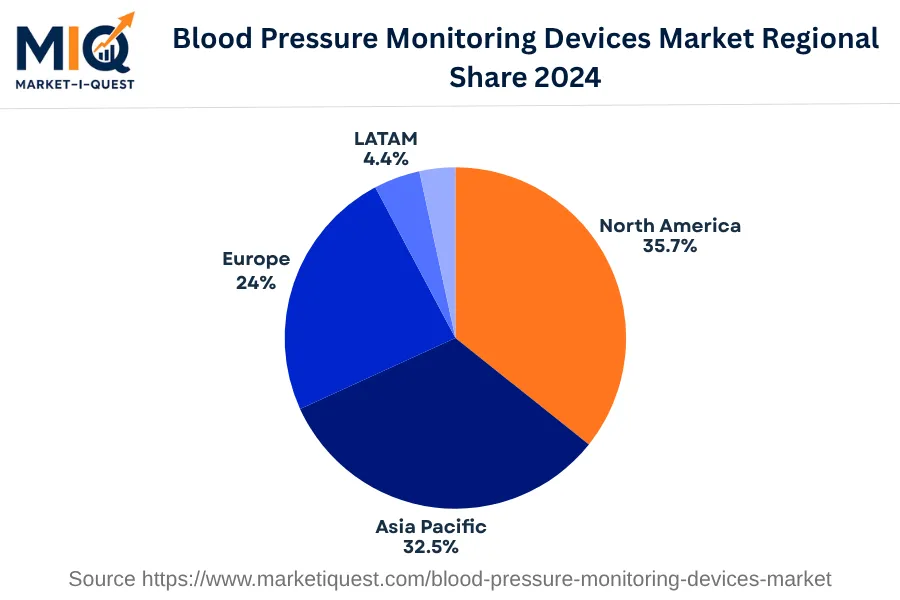
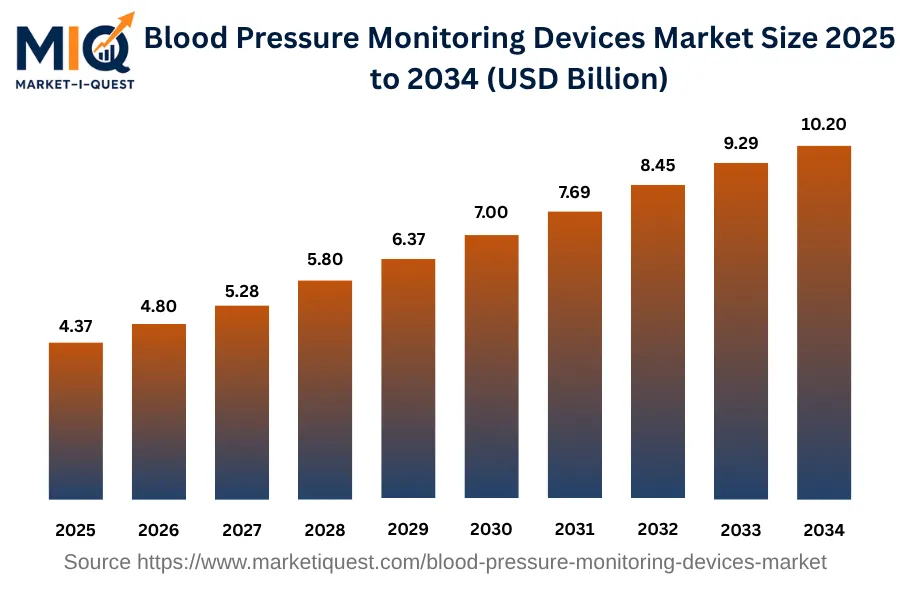
The Blood Pressure Monitoring Devices Market was valued at USD 4.37 billion in 2025, and it is projected to reach a value of USD 10.20 billion by 2034, demonstrating a CAGR of 9.87%. This nearly twofold increase over nine years reflects the market expansion, mainly attributed to rising health awareness influencing the growing adoption of blood pressure monitoring devices for managing cardiovascular diseases, hypertension, and associated complications effectively. Regionally in 2024, North America captured 35.71% of the market share, followed closely by the Asia Pacific at 32.48%, demonstrating significant demand for these monitoring devices. Europe held 24.03% of the market share, while the shares of Latin America and the Middle East and Africa were relatively smaller at 4.39% and 3.39% respectively.

Key Takeaways

  • By Product Type - Upper Arm Monitors held the major market share in 2024.
  • By Technology - Digital devices led the market holding a dominant position in the same year.
  • By End User - Hospitals accounted for the largest share in the Blood Pressure Monitoring Devices Market in 2024.
blood-pressure-monitoring-devices-market market size

Key Driving Factors

Increasing Prevalence of Hypertension

A sharp rise in the number of hypertension cases worldwide is a major driving force in the Blood Pressure Monitoring Devices Market. Hypertension is often referred to as a 'silent killer' because it can lead to severe complications, including heart attacks and strokes, without showing significant symptoms. Public healthcare entities globally have thus ramped up their initiatives to monitor blood pressure levels regularly within their communities. Such steps have resulted in surging adoption rates of blood pressure monitoring devices, particularly amongst at-risk populations, thereby enhancing market growth.

Shift towards Home-Based Healthcare

The shift towards home-based healthcare is another significant driving factor in the Blood Pressure Monitoring Devices Market. The ongoing COVID-19 pandemic has heightened the necessity for remote patient monitoring, steering clear from unnecessary exposure in healthcare facilities. With hypertension patients designated as high-risk for severe COVID-19 outcomes, medical professionals are advocating home-based blood pressure monitoring for regular checkups. Furthermore, the convenience and comfort of in-home monitoring ensure greater compliance from patients, consequently driving stronger demand for easy-to-use, accurate blood pressure monitoring devices.

Market Evolution by Timeline

2019-2023
During this period, primary buyers of blood pressure monitoring devices include hospitals, clinics, and home care settings globally. The demand increase in developing countries like India and China is largely due to the growing elderly population prone to chronic diseases. The market saw increased production of digital sphygmomanometers and wrist monitors. These devices, however, exhibited limitations like accuracy and reliability, particularly in home settings. Government programs such as the US's Million Hearts initiative emphasized hypertension control, thereby creating a conducive environment for market growth. Most transactions during this period deployed volume-based pricing models, and contract manufacturing became more frequent. Major risks included regulatory backlash due to device accuracy issues and data security breaches.
2024
In 2024, focus shifted towards ambulatory and portable devices that facilitate remote monitoring. This shift is a response to the global trend of home healthcare triggered by the pandemic. The US and Europe emerged as leading regions, facilitated by strong healthcare infrastructure and high awareness levels. Telemedicine platforms started integrating blood pressure monitoring devices with their systems resulting in a seamless data flow and real-time patient data access. The implementation of stringent government regulations like the EU's Medical Device Regulation impacted device approval processes, hence delaying market entry for some products. A risk during this year included software glitches in remote monitoring systems.
2025-2029
During these years, major purchases came from long-term care centers, rehab facilities, and individual consumers globally. Asian countries, especially Japan, contributed significantly to market growth because of their rapidly aging population and high healthcare expenditure. The emergence of smart wearable devices dominated the supply side characterized by user-friendly designs, AI integration, and advanced data analytics. The US FDA's 'Digital Health Innovation Action Plan' guided product development, ensuring safety and efficacy. Subscription-based pricing models gauged popularity owing to their affordability. Risks associated with data privacy and cyber threats prompted organizations to strengthen their IT security systems.
2030-2034
In this timeframe, preventive healthcare became the central buying motive driving demand from health-conscious young adults. Developed countries maintained their buyer leadership while African countries demonstrated potential growth due to increased healthcare investments. Supply was dominated by multi-function smart devices incorporating blood pressure monitoring with other vital sign checks. Regulatory bodies introduced specific standards for these devices, such as the ISO 81060-2 for non-invasive sphygmomanometers. Pricing strategies shifted to value-based models, reflecting product innovation and increased perceived value. The major risks during this period were related to potential malfunctioning of AI systems.

Future Market Outlook

Future Opportunities

Future opportunities in the blood pressure monitoring devices market are closely linked to ongoing initiatives aimed at improving patient outcomes and healthcare access. As of early 2023, government programs in countries like Germany have started to incentivize the use of digital health technologies, promoting remote patient monitoring strategies. This trend is supported by health policies introduced by the World Health Organization that encourage monitoring of chronic conditions via telehealth, reflecting a global emphasis on preventive care. In 2021, the FDA released guidelines supporting the use of machine learning in health applications, paving the way for more personalized blood pressure monitoring solutions. Companies are also exploring collaborations with healthcare providers, as demonstrated by the partnership between Abbott and Walmart in 2022 to enhance remote monitoring capabilities. Additionally, advancements in smartphone technology present an opportunity for the development of more sophisticated applications that integrate blood pressure data with overall health metrics. Innovations in mobile health (mHealth) are expected to grow, with user-centric design focusing on ease of use for seniors being a priority. Moreover, emerging markets in regions such as Southeast Asia are witnessing a surge in demand for affordable yet effective monitoring solutions. Regulations supporting telemedicine in countries like Australia further enhance the prospects for future developments in this sector. Ultimately, the convergence of technology and healthcare policies will likely create numerous pathways for market expansion.

Segmentation Analysis

By Product Type

The market is divided into subsegments including Upper Arm Monitors, Wrist Monitors, Ambulatory BP Monitors, Cuffless Wearables, and Accessories. Upper Arm Monitors accounted for the largest revenue share while Cuffless Wearables is expected to grow at the fastest CAGR during the forecast period.

Largest Revenue Share

Upper Arm Monitors

Market Share Leader

Upper Arm Monitors hold a lion's share in revenue amongst the product types. Major factors contributing to this leadership position involve ease of use, accuracy, reliability and the fact that they have been in the market significantly longer than the other product types. They are predominantly used not just at homes but also in clinics, hospitals, and by healthcare professionals due to their accuracy of measurements, thereby driving their overall market share. Additionally, the upper arm monitors are typically equipped with advanced functionalities such as irregular heartbeat detection and risk category indicator. This, coupled with their validation by regulatory authorities, increases their acceptance amongst the consumers. The increasing prevalence of hypertension globally also adds to the usage of these monitors for early detection and treatment. This type of monitor generally opts for a traditional cuff and bladders making it familiar to doctors and patients. While other products in the segment are developing, as of now, upper arm monitors hold the maxima in the revenue.

Fastest CAGR

Cuffless Wearables

Forecast Period Growth Leader

The fastest growing subsegment in the forecast period is projected to be the Cuffless Wearables. The growth can be attributed to their innovative 'cuffless' design, comfort of use, continuous monitoring capabilities, and incorporation of the latest technologies. In addition to blood pressure monitoring, these devices often offer multi-functionality such as heart rate monitoring, sleep tracking, physical activity monitoring, making them attractive to health-conscious consumers. They further appeal to the tech-savvy younger population who are increasingly conscious about their health. These devices also have potential for expanding into telemedicine applications. However, there are potential barriers for the adoption of cuffless wearables including accuracy concerns, relatively higher prices, and the need for calibration. Continuous Research and Development, with the potential for machine learning and AI technology integration, will increase leverage in this segment. Adoption will be a complex interplay of price, accuracy, and customer trust.

By Technology

The technology market is divided into subsegments including Digital, Aneroid and Wearable. In 2024, the Digital subsegment accounted for the largest revenue share while the Wearable subsegment is expected to grow at the fastest CAGR during the forecast period.

Largest Revenue Share

Digital

Market Share Leader

The Digital subsegment dominates the technology market due to a few primary factors. For instance, the maturity of this sector, coupled with the widespread use and acceptance of digital technologies, primarily drives the revenue for this segment. Digital technologies span across different industries, and their versatility is a strong revenue driver. Influencing factors like increased digitization, consumer demand for connected and digitally advanced devices, and the proliferation of digital interfaces in common gadgets have enhanced revenue generation in this sector. The category's broad scope, which encompasses software, hardware, and services, diversifies revenue streams and mitigates risks associated with depending on a single source. The continued investment in digital transformation strategies by businesses worldwide further bolsters the revenue generation in this segment.

Fastest CAGR

Wearable

Forecast Period Growth Leader

The Wearable subsegment is predicted to observe swift growth during the forecast period. Catalyzed by ongoing technological advancements and increasing consumer adoption driven by desired convenience and efficiency, wearables promise a fast growth trajectory. Capex in technological research, development of novel applications and partnerships with tech giants are anticipated to contribute significantly to the growth rate. However, adoption barriers such as data privacy concerns, cost, and lack of consumer awareness may impede progress in certain regions. Policy evolution to regulate wearables' data security issues offers an opportunity for faster market adoption. Overcoming purchasing hesitations with clear demonstration of value, wider applications, and assurance of data security are the near-term strategic imperatives for stakeholders in the Wearable subsegment.

By End User

The market is divided into subsegments including Hospitals, Ambulatory Surgical Centers, and Home Care Settings. In 2024, Hospitals accounted for the largest revenue share while Home Care Settings is expected to grow at the fastest CAGR during the forecast period.

Largest Revenue Share

Hospitals

Market Share Leader

Accounting for the largest revenue share in 2024, Hospitals dominate on the basis of the high volume of surgical procedures performed in these institutions. As primary facilities for critical care, they are equipped with sophisticated surgical and diagnostic tools which trigged the heavy inflow of revenue. The high footfall of patients necessitates the frequent usage of medical devices and surgical equipment. The constant demand for innovative and high-quality medical products provides a sustainable revenue stream for this segment. Additionally, strong government funding and private investments in hospital infrastructure favor market growth. With improvements in healthcare insurance coverage in many regions, patient’s ability to afford hospital-based treatments has increased, further strengthening the revenue prospects for the hospitals subsegment.

Fastest CAGR

Home Care Settings

Forecast Period Growth Leader

Expected to experience the fastest CAGR during the forecast period, Home Care Settings are quickly becoming the preferred choice for many patients. This can be attributed to several factors, including the rise in chronic diseases requiring long-term care, an aging population, and the escalating costs of hospital stays. The ongoing shift towards personalized care has increased the need for medical devices in home settings. Technological advancements have also made it possible for complex procedures to be carried out at home, thereby reducing the need for hospitalization. However, potential risks lie in the lack of skilled personnel, patient safety issues, and regulatory barriers. Partnerships with healthcare providers and technology firms could further drive the adoption of home care services. While the market outlook is promising, full-scale adoption is dependent on overcoming these challenges.

Competitive Analysis

Key Market Players

Manufacturers / OEMs

Omron Corporation
Japan
American Diagnostic Corporation
US
A&D Company
Japan

Key Suppliers & Raw Materials

Bosch Sensortec GmbH
Germany
TE Connectivity
Switzerland
AMS AG
Austria

Distributors, Integrators & Channel Partners

Medline Industries, Inc.
US
Cardinal Health
US
Henry Schein, Inc.
US

Porter’s Five Forces Analysis

This analysis presents the competitive scenario and market dynamics in the Blood Pressure Monitoring Devices Market.

Supplier Bargaining Power

Medium

Driven by the availability of diverse components for blood pressure monitoring devices.

Buyer Bargaining Power

High

Increased patient awareness and choice between devices enhances buyer power.

Threat of Substitutes

Medium

Alternative methods of blood pressure monitoring provide moderate substitution threat.

Threat of New Entrants

Low

High R&D costs and stringent regulation barriers deter new entrants.

Competitive Rivalry

High

The market is highly competitive with several established players.

Regional Analysis

Geographic market dynamics and growth opportunities across key regions

Global Market Outlook

blood-pressure-monitoring-devices-market market regional share

North America

The North American blood pressure monitoring devices market witnessed steady growth in 2024. This was primarily driven by increasing prevalence of hypertension, stroke, and other heart diseases in countries like the U.S., Canada, and Mexico. Regulatory approvals and wide acceptance of technologically advanced home-use monitors fueled the market expansion. Furthermore, substantial investments made in healthcare sectors by governments and private entities played a pivotal role in upscaling production and supply chain dynamics.

Trends shaping the market included a shift towards home-based healthcare, particularly following the COVID-19 pandemic, spurring demand for user-friendly, digital monitoring devices. Telehealth integration became a significant development in delivery channels, fostering patient-doctor communication and improving disease management. Industry partnerships and mergers were common as market players sought to expand their reach and enhance innovation capabilities. Finally, health policies like the Medicare coverage for ambulatory blood pressure monitoring in the U.S., shaped and strengthened the market.

The major sectors contributing to the demand comprised healthcare, government, and patient-home monitoring. Hospitals and clinics largely turned to automated blood pressure monitors, while the market also witnessed an increase in individual usage for personal health management. Overall, the North American blood pressure monitoring devices market observed steady growth and technological adoption in the year 2024.

Asia Pacific

In 2024, the blood pressure monitoring devices market in Asia Pacific was shaped by significant health factors and revolutionary technologies. An increased prevalence of hypertension and related disorders bolstered demand for these devices, especially in populous regions including China and India. Governments across Japan, South Korea and Australia, along with key ASEAN markets implemented stringent regulations to ensure the accuracy and reliability of these devices, propelling market confidence and product investment. Advanced technologies like smart wearable devices and IoT drove adoption rates, whilst improved supply chain dynamics resulted in competitive pricing and improved accessibility to these monitoring devices.

Consumer behavior leaned heavily towards homecare and self-monitoring, with the pandemic's residual culture of self-reliance still apparent. The rapid development in telehealth technology also introduced more portable and user-friendly devices in the market. Meanwhile, partnerships and mergers among key healthcare manufacturers fostered innovations in product designs and improved device functionality. The enforcement of standardized policies in device manufacturing considering region-specific factors intensified competition among manufacturers, benefiting both stakeholders and customers. The primary purchase sectors observed were healthcare establishments, government health programs, and personal purchases from individuals seeking to effectively manage their health conditions, reflecting a clear shift towards preventive healthcare in Asia Pacific.

Europe

The Blood Pressure Monitoring Devices Market in Europe in 2024 was underpinned by rising health consciousness, regulatory involvement, and advanced tech adoption. Heightened prevalence of hypertension coupled with increased emphasis on preventive healthcare drove significant demand for blood pressure monitors, particularly in Germany, the United Kingdom, and France. Government policies focused on improving healthcare infrastructure, and reimbursement policies in countries like Italy and Spain supported the market expansion. Technological advancements, including remote and wireless monitoring devices, saw broad adoption across larger hospitals and healthcare centers.

Market trends were chiefly defined by changes in buying behaviours and the shift towards home-based care. In the Nordics and Benelux, the preference for home-based blood pressure monitoring surged, as technology integration made these devices more user-friendly and precise. Central & Eastern Europe witnessed an influx of partnerships and M&A activities with players seeking to increase their geographic footprint and customer base. The implementation of policies favoring data privacy and accuracy of readings accelerated the demand for sophisticated, IoT-enabled devices in enterprise healthcare solutions. Consumer trust in these regulations further fortified the market position of these devices across all sectors.

Latin America

In 2024, the Blood Pressure Monitoring Devices Market in Latin America showed dynamic growth due to several drivers and trends. Primary growth drivers included increased healthcare investment in countries like Brazil and Argentina, advanced adoption of digital health technologies in Mexico and Chile, and heightened awareness of hypertension risks in Colombia and Peru. New regulation standards across LATAM, aiming for better diagnosis quality, prompted manufacturers to develop precise, user-friendly devices. Robust demand was further catalyzed by rising telemedicine practices in metropolitan areas, where home blood pressure monitoring became a standard.

Trends observed in 2024 revealed a shift towards ambulatory and wearable monitoring devices, primarily adopted by younger, tech-savvy customers. The rapid growth of e-pharmacies and online healthcare platforms facilitated easy access to these devices for consumers. Partnerships among device manufacturers and health-tech firms flourished, enhancing product development and distribution channels. Brazil and Mexico, leading in digital health infrastructure, prominently drove this trend. The LATAM region also saw strict policy enforcement pertaining to product standards and patient safety, shaping manufacturers' strategies. Key clientele included healthcare facilities, government health programs, and the growing home healthcare sector. In summary, the LATAM Blood Pressure Monitoring Devices Market in 2024 was significantly influenced by healthcare investment, technology adoption, regulatory standards, and digital channel dynamics.

Middle East & Africa

In 2024, the Middle East and Africa Blood Pressure Monitoring Devices Market showcased numerous growth drivers and evident trends. Demand was fueled by an increased prevalence of hypertension coupled with improved healthcare infrastructure, particularly in Saudi Arabia, Nigeria, and South Africa. Governments across these regions initiated stringent regulations to promote the utilization of these devices, encouraging unprecedented technology adoption. The UAE's healthcare sector invested heavily in digital solutions, thereby boosting supply dynamics.

Technological advancements were concentrated around wearable devices, given their convenience and accuracy, making them trending favorites across nations like Israel and Egypt where digitization is rampant. Consumers showed a growing preference for portable, easy-to-use devices. In response, manufacturers expanded their product lines to include compact, digital monitors.

There's also been a shift in distribution channels, with an increase in online sales noted in nations like Kenya, Qatar, and the UAE due to higher internet penetration rates. Partnerships between device manufacturers and healthcare providers were also observed, playing a significant role in increasing accessibility.

The insurance sector, notably in Saudi Arabia and UAE, played a significant role as well, promoting the purchase and use of these devices as part of their policy enforcement, thereby shaping the market in 2024.

Recent Industry Developments

Latest market innovations, product launches, and strategic initiatives

March 2026

Samsung officially rolled out blood pressure tracking capabilities to Galaxy Watch users, allowing the smartwatch to estimate blood pressure after an initial calibration with a standard arm cuff.

October 2025

Withings introduced the BPM Vision, a connected at-home monitor designed to simultaneously measure blood pressure and check for irregular heartbeats without complex setups.

July 2025

The organization received FDA clearance for the Hilo Band, marking the first time an over-the-counter, cuffless wearable monitor was approved to track blood pressure continuously from the wrist.

Frequently Asked Questions