Biological Safety Testing Market Snapshot

Key Players

  • Charles River Laboratories (United States)
  • Lonza Group (Switzerland)
  • SGS SA (Switzerland)
  • Merck KGaA (Germany)
  • WuXi AppTec (China)
  • Pall Corporation (United States)
  • Thermo Fisher Scientific Inc. (United States)
  • Pharmaceutical Product Development (United States)
  • Toxikon Corporation (United States)
  • BioReliance Corporation (United States)

Market Size

Base Year 2024
$4.89 Bn
CAGR
11.9%
Forecast 2034
$15.05 Bn

Market Segments

By Product Type
Reagents, Kits, Services
By Testing Type
Sterility Testing, Endotoxin Testing, Bioburden Testing, Validation Testing
By Application
Vaccine Development, Therapeutics, Blood and Blood Products, Cellular and Gene Therapy
By End Use
Pharmaceutical Companies, Biotechnology Companies, Research Institutions

Market Dynamics

Drivers
  • Rising instances of pandemic threats
  • Growth in pharmaceutical industry
Restraints
  • High implementation costs
  • Regulatory compliance challenges
Opportunities
  • Rising biopharmaceutical development trends
  • Increasing outsourcing of biosafety testing

Market Size

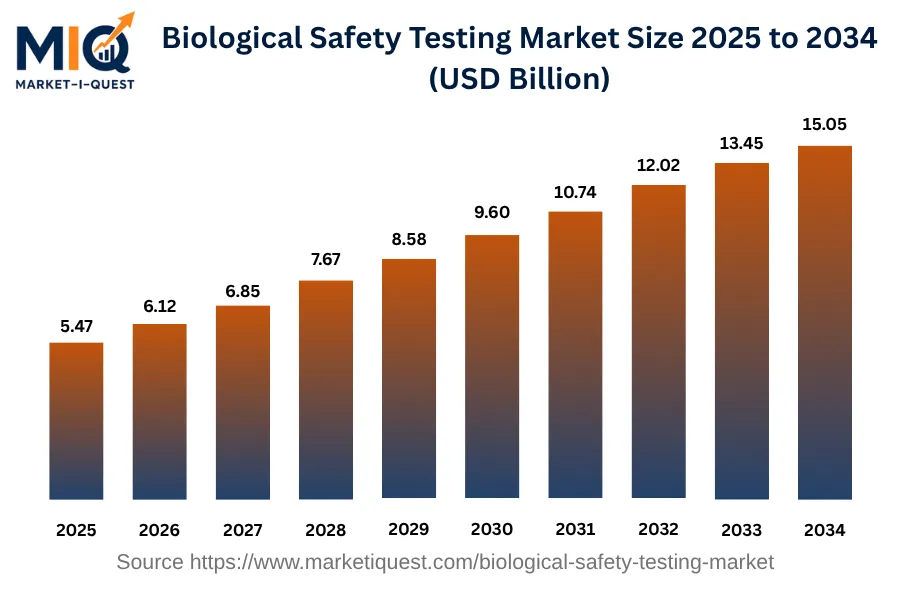
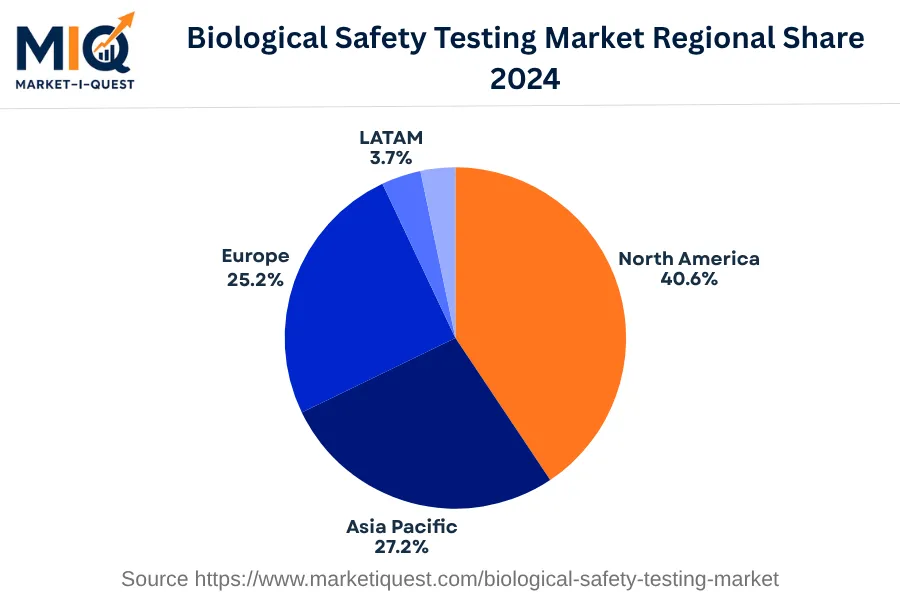
The Biological Safety Testing Market was valued at $5.47 billion in 2025, and is projected to reach $15.05 billion by the end of 2034, representing a compound annual growth rate (CAGR) of 11.9%. This notable increase indicates a tripling of the market size over the span of nine years. This strategic growth path witnesses a consistent and proportional expansion each year. Speaking to this growth, the increase in the market value corresponds directly to advancements in research techniques, the escalation in the development of new biologics, and corresponding improvements in technological standards contributing to a wider spectrum of testing procedures. This progression is harmonized in manufacturing and research facilities across global sectors. Pivoting to the regional share in 2024, North America counted for 40.6% of the market, representing the largest share, with the Asia Pacific and Europe following behind at 27.2% and 25.2%, respectively. The remaining market shares were filled by LATAM at 3.7% and the MEA at 3.3%, demonstrating more constrained market activity in these areas.

Key Takeaways

  • By Product Type - Reagents held the highest share becoming a top choice for Biological Safety Testing in 2024.
  • By Testing Type - Sterility Testing led the segment with a significant hold in the Biological Safety Testing Market in 2024.
  • By Application - Therapeutics reflecting the demand surge for vaccines in the forecast period.
  • By End Use - Pharmaceutical Companies led the segment establishing a remarkable presence in the market in 2024.
biological-safety-testing-market market size

Key Driving Factors

Implementation of Rigorous Quality Control Regulations

Markets worldwide are experiencing a strong driving factor for the Biological Safety Testing market due to the implementation of rigorous quality control regulations in biotherapeutics and pharmaceutical industries. Globally recognized regulatory bodies such as the U.S. Federal Drug Administration (FDA) and the European Medicines Agency (EMA) have laid out strict criteria for safety profiles of biotherapeutic products, vaccines, and biopharmaceuticals to ensure their safety and efficacy. These policies necessitate detailed biological safety testing before the product's entry into the market, thus fueling the demand for these methods. The aim is to reduce chances of product recalls, which are costly and damage the reputation of the company, while ensuring the safety of the end consumers.
Escalation of Biopharmaceutical Outsourcing

The escalating trend of outsourcing in the biopharmaceutical industry is another significant driving factor for the Biological Safety Testing market. This trend towards outsourcing is propelled by the high operational costs and the technical expertise required in biological safety testing. Small to medium-sized biopharmaceutical companies often lack the resources or facilities to conduct comprehensive safety tests. This has promoted the tendency to outsource these tasks to specialized contract research organizations (CROs), driving the demand in the Biological Safety Testing market. These CROs possess dedicated infrastructure, skill expertise, and are updated with the nuanced needs of regulatory conformity, benefiting the biopharmaceutical companies and contributing to the growth of this market.

Market Evolution by Timeline

2019-2023
During this period, North America, especially the United States, dominated the biological safety testing market due to stringent regulatory requirements. Several pharmaceutical and biotechnology companies emerged and invested heavily in biological safety testing infrastructure. As a result, a series of assays and reagents were launched for endotoxin detection and microbial isolation. Despite the strong infrastructure, supply constraints were noted due to a lack of expertise. The Food and Drug Administration (FDA) imposed additional controls over gamma sterilization to enhance biological safety testing, spurring market expansion. Fixed-pricing models were popular among contracts, with a majority of services being executed via long-term agreements. One risk was the potential false-positive detection, mitigated by using multiple validation methods.
2024
This year saw a significant shift in the market dynamics with a surge in demand from Asia-Pacific, driven by the expansion of pharmaceutical companies. Innovative testing methods such as PCR-based tests were gaining ground due to their speed and effectiveness, but the integration of these methods with existing procedures was challenging. Regulatory bodies like the Chinese National Medical Products Administration (NMPA) have started enforcing stricter rules. Variable pricing models were commonly seen due to the adoption of more sophisticated testing technologies. The risk of cyber-attacks on automated testing systems was identified, and companies began investing in cybersecurity measures.
2025-2029
In this phase, the primary market demand was vaccine safety testing due to the ongoing global pandemic recovery. With an increase in demand, the technology matured, and several companies introduced genomics-based tests. The harmonization of international standards by the US FDA and EU's EMA led to smoother adoption of these technologies. Collaborations between companies and clinical research organizations became common, marked by revenue-sharing agreements. Detecting novel contaminants posed significant challenges from a risk perspective, leading to a tighter focus on test validation methods and regulatory compliance.
2030-2034
The demand for biological safety testing surged globally with the emergence of new diseases. The use of advanced machine-learning techniques for rapid analysis of test results increased. Despite the technological advancements, integrating these AI-based tools with traditional testing methods faced hurdles. Regulatory bodies like the European Medicine Agency (EMA) revised their guidelines to accommodate AI-based testing methods. The trend for service contracts was 'pay-per-use' models, influenced largely by the uncertain disease landscape. Key risks were data privacy issues due to the digital nature of the tests, resulting in added scrutiny over data management practices.

Future Market Outlook

Future Opportunities

The biological safety testing market is positioned to benefit from the growing global emphasis on personalized medicine and next-generation therapeutics. As of early 2023, healthcare providers and regulatory bodies, such as the World Health Organization, have signaled a heightened focus on genetic and cellular therapies, which necessitate rigorous safety testing processes. Companies like Novartis and Gilead Sciences are already investing in advanced testing paradigms to ensure the efficacy and safety of their innovative therapies. Furthermore, emerging regions such as Southeast Asia are increasing their regulatory frameworks to address biopharmaceutical safety, presenting new avenues for market expansion. Partnerships between firms specializing in biological safety and artificial intelligence companies are also on the rise, aimed at developing smarter testing protocols. The push for consistent adherence to international standards, including ISO 14971:2019 on risk management, continues to create demand for comprehensive safety assessments in product development. As personalized therapies evolve, the demand for specialized testing services that cater to specific patient populations will likely grow. These scenarios create expansive opportunities for niche service providers to integrate advanced methodologies, thereby aligning with the strategic direction set by regulatory agencies worldwide. The combined influence of technology adoption, regulatory evolution, and market demand are expected to outline a robust landscape for stakeholders within the biological safety testing sector in the coming years.

Segmentation Analysis

By Product Type

The market is divided into subsegments including reagents, kits, and services. Reagents accounted for the largest revenue share while kits are expected to grow at the fastest CAGR during the forecast period.

Largest Revenue Share

Reagents

Market Share Leader

The reagents subsegment leads the current market due to its significant usage in all types of biochemical and biotechnological experiments or processes. High sensitivity and reliability of results provided by these reagents bolster their demand. Moreover, the frequent purchase of reagents due to their limited shelf-life escalates the overall revenue generated by this subsegment. Likewise, expanding biotechnology and pharmaceutical sectors globally affirm the continuous demand for reagents. Comprehensive applications in clinical diagnostics play a vital role in contributing to its leading share as well. In terms of geography, North America and Europe, due to an established healthcare infrastructure and a robust pharmaceutical sector, act as significant revenue contributors. On the other hand, the Asia-Pacific region is starting to show promising growth potential, given the rapid advancements in its healthcare sector. However, stringent regulation systems and fluctuating raw material costs can act as impediments to this subsegment's growth.

Fastest CAGR

Kits

Forecast Period Growth Leader

The kits subsegment is projected to exhibit the fastest growth in the forthcoming years, driven primarily by their convenience and cost-effectiveness. By bundling multiple related reagents and other components necessary for a particular process or test, kits offer users a handy solution. Their user-friendly nature makes them more favorable for various processes, especially in research and diagnostics. The growing popularity of point of care testing due to its quick results fosters the kits subsegment. Transformative technological advancements catapulting the production of innovative, efficient and easy-to-use kits significantly propel its growth. Also, strategic partnerships among key industry players to launch and distribute kits effectively amplifies growth prospects. However, rigorous regulatory pathways for approval and potential risks relating to false results could challenge this growth. The industry could mitigate this risk with continued advancements aimed at increasing the accuracy of kits.

By Testing Type

The market is divided into subsegments including Sterility Testing, Endotoxin Testing, Bioburden Testing, and Validation Testing. Sterility Testing accounted for the largest revenue share while Bioburden Testing is expected to grow at the fastest Compound Annual Growth Rate (CAGR) during the forecast period.

Largest Revenue Share

Sterility Testing

Market Share Leader

Sterility Testing forms a vital part of the medical and pharmaceutical sectors, ensuring the absence of viable microorganisms in the final product. Given the fact that sterility is a significant quality control requirement, the revenue margins in this testing type inherently account for a large portion of the market. Worldwide healthcare regulations mandate these tests for a variety of products such as pharmaceuticals, biologics, medical devices, thus driving increased demand. Geographically, the large-scale adoption of sterility testing in developed economies, coupled with stringent industry regulations, contributes to its dominant revenue position. Purchasing criteria often rely on factors such as accuracy, speed, and test sensitivity, giving an edge to providers with advanced testing solutions. Suppliers mostly utilize direct sales channels or partner with distributors for market coverage.

Fastest CAGR

Bioburden Testing

Forecast Period Growth Leader

Bioburden Testing is projected to experience rapid growth in the coming years. This testing type, encompassing the quantitative estimation of microbes, including bacteria, yeast, and mold in medical devices or drugs, is instrumental in maintaining human safety. Substantial investments in product innovations, technological advancements, and regulatory policies facilitate the rapid adoption of these tests. Catalysts such as increasing public-private partnerships in research and development, excessive capital expenditure by major companies, along with a favorable policy environment, are also spurring growth in this segment. Despite its promising growth trajectory, there are near-term risks associated with the high cost of testing and the complexity of test procedures, which could act as potential adoption barriers. Nonetheless, the burgeoning demand for contamination control in healthcare, food and beverages, and cosmetics industries, as well as the rise in the prevalence of diseases, drives the growth of the bioburden testing market.

By Application

The market is divided into subsegments including Vaccine Development, Therapeutics, Blood and Blood Products, Cellular and Gene Therapy. Out of these, Therapeutics accounted for the largest revenue share while Vaccine Development is expected to grow at the fastest CAGR during the forecast period.

Largest Revenue Share

Therapeutics

Market Share Leader

The therapeutics subsegment leads the market primarily due to the ever-increasing global demand for effective treatments for a wide range of diseases. Novel therapeutic approaches are being continuously developed and refined, contributing to increased revenues. Growth is particularly prominent in highly developed healthcare markets that are characterized by the adoption of innovative treatment modalities, the presence of advanced healthcare facilities, and the increasing aging population prone to chronic diseases. Additionally, the regulatory landscape in many regions favors the development and implementation of new therapeutics, providing a further boost to the subsegment. Consumers are increasingly aware and knowledgeable about available therapeutic options, driving demand in this subsegment. The therapeutics market also benefits from strong supply chains and established purchasing processes in healthcare facilities. However, the significant financial resources required for research, development, and commercialization represent a barrier for smaller players.

Fastest CAGR

Vaccine Development

Forecast Period Growth Leader

The Vaccine Development subsegment is projected to exhibit the highest growth rate, primarily fueled by global health challenges that necessitate the rapid development and distribution of effective vaccines. Specifically, heightened public and private sector focus on immunization programs and pandemic preparedness are significant catalysts. Technological advancements are speeding up traditional vaccine development timelines, and collaborative efforts between biopharmaceutical companies and research institutions are driving innovation in this field. Additionally, there's anticipated increased capital expenditure towards vaccine development, particularly in regions most vulnerable to emerging infectious diseases. The subsegment could face near-term risks concerning the regulatory approval process for new vaccines, potential supply chain disruptions, and vaccine hesitation in certain populations. However, the overall outlook for vaccine development remains strongly positive.

By End Use

The market is divided into subsegments including Pharmaceutical companies, Biotechnology companies, and Research institutions. In 2024, Pharmaceutical companies accounted for the largest revenue share while Biotechnology companies are expected to grow at the fastest CAGR during the forecast period.

Largest Revenue Share

Pharmaceutical Companies

Market Share Leader

The pharmaceutical industry emerged as the largest revenue-generating subsegment in 2024 because of several driving factors. The perennially growing demand for new and advanced medicines driven by an aging global population and rising incidence of chronic and infectious diseases have been key drivers. The large capitalization of pharmaceutical companies allows them to spend more on the development and commercialization of novel drugs, which translates to higher revenues. Additionally, regulatory enhancements and government initiatives aimed at promoting drug research and development have significantly favored revenue growth in this subsegment. The availability of well-established distribution channels and strong relationships with healthcare providers have also been crucial in maintaining this segment's revenue lead. Nevertheless, factors such as stringent regulatory compliance, high switching costs because of patent protections, and customer loyalty make it challenging for other subsegments to surpass the pharmaceutical companies.

Fastest CAGR

Biotechnology Companies

Forecast Period Growth Leader

Biotechnology companies are projected to be the fastest-growing subsegment in the coming years. Factors driving growth in this subsegment include rapid advances in genomic sequencing, gene editing technologies, and automation in laboratories. These technological advancements have significantly enhanced the pace and precision of research and development activities in biotech companies. However, these companies also face a number of growth barriers such as strict regulatory environments, high capital expenditure and operational costs, and challenges in convincing traditional pharmaceutical companies to adopt new biotech solutions. Catalysts for growth include potential partnerships with larger pharmaceutical companies, outsourcing of R&D activities by pharmaceutical companies to specialized biotech firms, and a favorable policy environment encouraging investment in biotechnology research. Despite these optimistic prospects, there can be near-term risks including the high cost and complexity of biotech R&D, reliance on external funding, and the competitive landscape.

Competitive Analysis

Key Market Players

Manufacturers / OEMs

Charles River Laboratories International, Inc.
US
Thermo Fisher Scientific Inc.
US
Merck KGaA
Germany

Key Suppliers & Raw Materials

Avantor, Inc.
US
Becton, Dickinson and Company
US
Bio-Rad Laboratories
US

Distributors, Integrators & Channel Partners

Sartorius AG
Germany
Danaher Corporation
US
QIAGEN N.V.
Netherlands

Porter’s Five Forces Analysis

A comprehensive analysis of the competitive dynamics within the Biological Safety Testing Market.

Supplier Bargaining Power

High

Limited providers of biological testing services coupled with high switching costs increase supplier power.

Buyer Bargaining Power

Low

High technical specificity needs and rigorous regulations mitigate buyer influence.

Threat of Substitutes

Medium

Advancements in synthetic biology present substitute possibilities, but are held back by regulatory constraints.

Threat of New Entrants

Low

High capital expenditure, expertise requirements, and complex regulations create barriers to entry.

Competitive Rivalry

Medium

Intense competition within incumbent players, but differentiation using unique technologies lowers overall rivalry.

Regional Analysis

Geographic market dynamics and growth opportunities across key regions

Global Market Outlook

biological-safety-testing-market market regional share

North America

In 2024, the North American Biological Safety Testing Market was defined by a pronounced emphasis on safeguarding public health. Key drivers propelled this market. Demand surged amidst rising concerns about public health safety, spurred by a significant increase in outsourcing services by pharmaceuticals. Regulations underpinned market dynamics. In the U.S, FDA strict guidelines on biological product safety and stringent regulations in Canada and Mexico galvanized the market. The adoption of technology, particularly laboratory automation in the U.S., streamlined safety testing and enhanced lab productivity.

Trends in the market reflected wider change. Buyers favored contractual research organizations (CROs) to mitigate hassles of in-house tasks. In technology, next-generation sequencing emerged as a preferred method for detecting microbial contaminants in biological products. Partnerships grew between CROs and biopharmaceutical companies, exemplified by PPD and Biocom alliance. Compliance with USP Endotoxin Test, a rigid standard for microbial testing, emerged as a typical trend. Policy enforcement around produce testing, particularly in the U.S., influenced market behavior.

Customers across the pharmaceutical, biotechnology, and agricultural sectors drove demand. U.S. government spending on health and safety lured investors, while healthcare sectors in Canada and Mexico substantially bolstered the market. Overall, the biological safety testing market in North America for the base year 2024 was robust, driven by demand, regulation, technology adoption, and a shift in buyer behavior and partnerships.

Asia Pacific

In 2024, the Asia Pacific Biological Safety Testing Market had a significant presence, particularly concerning key markets in China, India, Japan, South Korea, Australia, and ASEAN nations. Drivers for this market included an increase in biopharmaceutical R&D, brought about by investment from both private sources and government initiatives, contributing to the rising demand for safety testing. Robust regulations that set high safety standards for biological products compelled manufacturers to prioritize testing, fostering market growth. Technological adoption, particularly in China and Japan, influenced supply dynamics by improving accuracy and reducing testing duration.

Trends included a shift towards in-house biological safety testing by pharmaceutical businesses, circumventing the need for outsourcing, mainly noticeable in India and China. A spike in collaborations and M&A activities was observed, with organizations pooling resources to investigate biological threats better. Notably, South Korea showed an increase in adoption of risk-based policies, changing the way safety testing requirements were enforced and encouraging predictive analytics. The healthcare sector, notably enterprises involved in the production of vaccines, played a pivotal role in fuelling the demand for these tests, closely followed by government bodies and pharmaceutical manufacturing organizations. Transparency in reporting and quality assurance became key market expectations.

Europe

In 2024, Europe's Biological Safety Testing Market experienced notable dynamism, driven by a synergistic interplay of regulatory changes, technological adoption, and healthcare investments. The revisions in EU's legislation for comprehensive biological testing in the pharmaceutical and healthcare sectors propelled demand, concurrently prompting manufacturers to elevate safety standards. Additionally, robust investment in advanced biotechnology particularly in Germany and the United Kingdom, augmented the uptake of high-efficiency testing systems. Couple this with France's enthusiastic adoption of cutting-edge safety testing tech, and the supply dynamic became favorably skewed.

The pivot towards preventative healthcare in the Nordics, Benelux, and Central & Eastern Europe set new buying patterns. Digitalization led to greater utilization of Cloud-based testing platforms, fostering a shift in provider-client interaction towards online channels. 2024 also saw amalgamation activities as pharmaceutical majors partnered with testing solution providers to enhance their in-house safety testing capabilities. Stricter policy enforcement, especially in Spain and Italy postulated rigorous biological safety testing as non-negotiable standard in drug production, affecting the entire supply chain. Hence, institutional healthcare, pharmaceutical enterprises, and government regulatory bodies constituted the primary customer sectors. Overarching these trends and influences, the market's pulse was significantly guided by the escalading need for superior biological safety amid a persisting pandemic context.

Latin America

In 2024, the Latin American Biological Safety Testing Market experienced dynamic growth driven by several key factors. Advancements in biopharmaceuticals and biotechnologies in leading economies like Brazil and Mexico created heightened demand for stringent safety testing. Rising awareness of bio-contamination and increasing regulatory compliance accelerated the market growth, especially in the healthcare and pharmaceutical sectors. Furthermore, significant R&D investments in nations like Argentina and Colombia strengthened the market, driving the adoption of advanced safety testing technologies.

Simultaneously, buyer behavior trended towards products guaranteed by rigorous bio-safety testing, notably in consumer-focused sectors like retail and food manufacturing. Biotechnologies in Chile and Peru witnessed significant product shifts towards embracing mandatory safety testing standards while ensuring rapid turnaround times. Channel dynamics were heavily influenced by digital transformation, with robust partnerships and M&A activities observed within the testing service providers to consolidate resources and improve service quality. Lastly, progressive enforcement of safety policies by governments across the region promoted market integrity, encouraging enterprises and manufacturers to adopt comprehensive biological safety testing protocols on a wider scale. In conclusion, 2024’s LATAM Biological Safety Testing Market was steered by demand needs, regulatory requirements, investments, and tech adoption, all while undergoing significant trends in buyer behavior, product shifts, and policy enforcement.

Middle East & Africa

In 2024, the Biological Safety Testing Market experienced significant growth across the Middle East and Africa. Key drivers include stringent regulatory norms by government agencies in Saudi Arabia and UAE, promoting increased adoption of biological safety testing in healthcare and pharmaceutical sectors. Increased investment in medical research and biotechnology in countries like Qatar and Israel has further reinforced the market growth. In countries such as Nigeria, Kenya, and Egypt, amplified demand for safer biological products in the pharmaceutical and healthcare sectors has spurred the market.

Notable trends in the market encompass a shift towards adoption of advanced testing technologies in healthcare establishments, majorly in South Africa and Israel. Partnerships and mergers are observed predominantly in the UAE and Saudi Arabia, aiming at technology transfer and enhancing product portfolios. There is a notable enforcement of biological safety standards across all relevant sectors in the Middle East and Africa. Market-specific customers comprise the government, healthcare, manufacturing, and pharmaceutical sectors. For instance, in Saudi Arabia, the healthcare and pharmaceutical sectors extensively use biological safety testing in drug development processes. In South Africa, manufacturing units are increasingly adopting safety testing to maintain bio safety standards. Overall, these factors substantiate the market dynamics of the biological safety testing market in the Middle East and Africa in 2024.

Recent Industry Developments

Latest market innovations, product launches, and strategic initiatives

May 2026

Merck KGaA became the exclusive biosafety testing provider for Genetix Biotherapeutics' newly FDA-approved gene therapies. Under the agreement, Merck will handle long-term commercial release testing and viral clearance studies, cementing its role in advanced therapy manufacturing.

October 2025

Charles River Laboratories partnered with biotech firm Toxys to gain access to its ReproTracker screening platform. The human stem cell-based in vitro assay allows the company to rapidly identify developmental toxicity hazards, expanding its biosafety testing portfolio for new drug pipelines.

Frequently Asked Questions