Biologic Imaging Reagents Market Snapshot

Key Players

  • Thermo Fisher Scientific (United States)
  • Beckman Coulter Inc. (United States)
  • GE Healthcare (United States)
  • Bracco Imaging S.p.A (Italy)
  • PerkinElmer Inc. (United States)
  • Medtronic Plc (Ireland)
  • Affymetrix Inc. (United States)
  • Becton Dickinson & Company (United States)

Market Size

Base Year 2024
$12.43 Bn
CAGR
7.4%
Forecast 2034
$25.38 Bn

Market Segments

By Type
Fluorescent Dyes, Bioluminescent Probes, Radioactive Isotopes, Enzyme-Based Reagents
By Technology
Microscopy, Flow Cytometry, Imaging Systems
By Application
Cell Imaging, Tissue Imaging, Molecular Imaging, In Vivo Imaging
By End Use
Academic Research, Clinical Diagnostics, Pharmaceutical Development

Market Dynamics

Drivers
  • Accelerated drug development
  • Rising technological advances
Restraints
  • High production costs
  • Stringent regulatory requirements
Opportunities
  • Advancements in biotechnology
  • Increased use of personalized medicine

Market Size

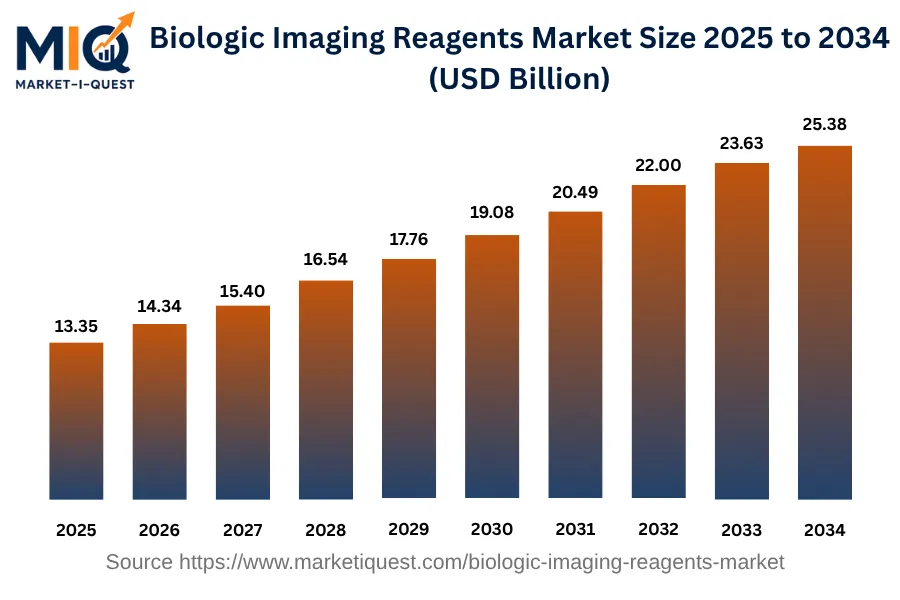
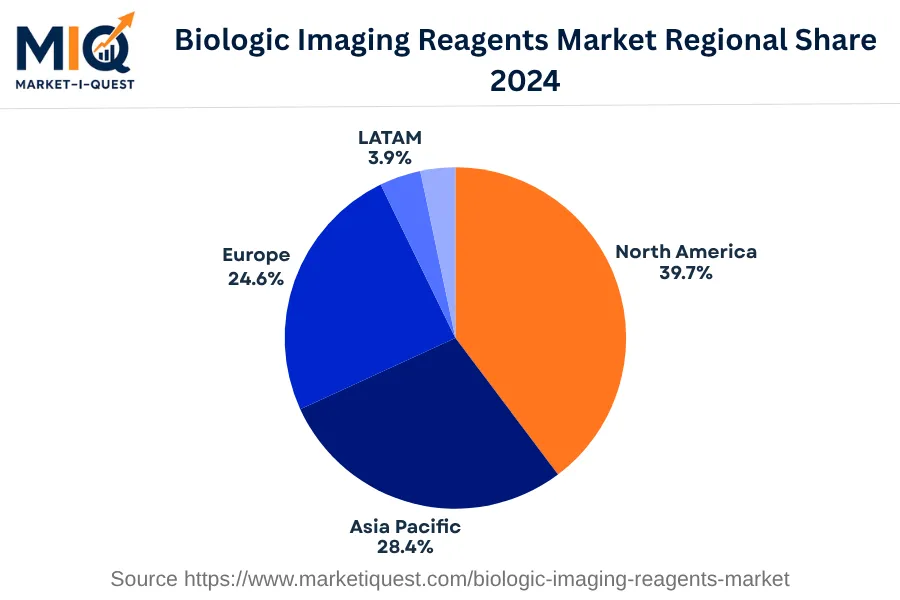
The Biologic Imaging Reagents market stood at USD 13.35 billion in 2025 and is projected to reach USD 25.38 billion by 2034, growing at a CAGR of 7.4%. The market doubled its size during the given period arising from continuous technological advancements and an increase in healthcare spending. It saw a notable increase from USD 12.43 billion in 2024 to USD 13.35 billion in 2025. The market further expanded at a steady pace over the years, eventually reaching USD 25.38 billion by the end of 2034. However, the regional share distribution indicated North America holding for the largest share at 39.7%, followed by the Asia Pacific with 28.4%, and Europe with 24.6%. The remaining market share was occupied by LATAM at 3.9% and MEA at 3.3% respectively, showing the distribution of the Biologic Imaging Reagents market worldwide.

Key Takeaways

  • By Type - Radioactive Isotopes took the lead in the Biologic Imaging Reagents Market accounting for a significant share in the base year.
  • By Technology - Flow Cytometry held a dominant position in 2024 demonstrating the key role of this method.
  • By Application terms - Molecular Imaging led the market underlining its importance in the biologic imaging reagents industry.
  • By End Use - Academic Research grew fastest reflecting the increasing demand for Biologic Imaging Reagents in the health sector.
biologic-imaging-reagents-market market size

Key Driving Factors

Acceleration of Personalized Medicine

A significant driving force in the Biologic Imaging Reagents Market is the acceleration of personalized medicine and therapies. Personalized medicine relies heavily on diagnostic tools to tailor treatments to individual patients, aiming to increase treatment effectiveness and safety. Biologic imaging reagents are fundamental for these diagnostic processes, providing the ability to visualize and quantify biological processes at the molecular level. As healthcare providers strive for better patient outcomes and seek ways to reduce costs of unsuccessful treatments, the demand for personalized medicine, and by extension the demand for biologic imaging reagents, is on the rise. This approach to healthcare is leading organizations to invest more resources into these specialized, diagnostic reagents.
Prevalence of Chronic Diseases

The rising prevalence of chronic diseases globally, such as cancer, cardiovascular diseases and neurodegenerative disorders, is another major driver pushing the biologic imaging reagents market forward. These conditions often require elaborate diagnostic processes, using biologic imaging reagents for both detection and monitoring, particularly those conditions characterized by slow progression or asymptomatic stages. The rise of health conditions needing continuous monitoring is driving healthcare establishments to heavily stock up on these reagents. Hence, the surging demand for early detection and real-time tracking of disease progression exerts a considerable impact on the market, adopting its expansion.

Market Evolution by Timeline

2019-2023
During this period, the Biologic Imaging Reagents market saw heightened interest from hospitals and diagnostic centers. The use of these reagents in cancer diagnostics has emerged as a significant demand influencer. Regions such as North America and Europe led the demand due to higher incidence of cancer and growth in funding for medical research. Suppliers faced constraints, primarily in the form of lack of adequate production capacity to meet demand. Integration maturity was still in its early stages. Pricing models mostly favored bulk purchases with heavy discounts. Regulatory approval processes made market entry challenging with US FDA and European Medicines Agency (EMA) setting high onset standards.
2024
By 2024, advancements in technology allowed for the production of novel reagents, facilitating a wider range of medical investigations. Buyers continued to majorly encompass hospitals and diagnostic centers with added interest from research institutions. Despite potential supply chain disruptions due to COVID-19, manufacturers managed for maintaining supply levels. Growing regulation was a significant concern, with the International Organization for Standardization (ISO) introducing ISO 13485:2016 which detailed quality management system requirements for regulatory purposes.
2025-2029
From 2025 to 2029, the market might witness expansion into rising economies such as India and China, due to the increasing healthcare expenditure and disease prevalence in these regions. Biotech and genetic research labs will likely begin indicating interest alongside hospitals and diagnostic centers, increasing the buyer spectrum. Production capacities will likely rise to meet the demand, yet bottlenecks may persist due to limited raw material availability. Regulatory bodies such as the FDA and EMA might impose stringent rules for product quality, safety, and efficacy.
2030-2034
In this period, the market will likely experience increasing competition hence impacting pricing strategies. More suppliers might enter the market, leading to an expansion of product offerings and service agreements for longer contract periods. The introduction of disruptive technologies and techniques such as AI may require the upgradation of ISO 13485 for incorporating new practices and standards. Demand is expected to primarily driven by hospitals and diagnostic labs, but a growth in personalized medicine may direct retail distribution to consumers emerge as a potential channel.

Future Market Outlook

Future Opportunities

Current trajectories in the biologic imaging reagents market suggest numerous opportunities for growth and development. The continuing research on targeted imaging agents presents prospects in detecting diseases at earlier stages. As reported in a study by the American Association for Cancer Research, there are significant advantages in utilizing bioluminescent probes for real-time imaging of cellular activity, indicating a potential shift in oncological diagnostics. Additionally, partnerships like the one between Roche and Abcam announced are likely to accelerate the development of novel biomarkers for imaging applications. The emphasis on radiological education and training, supported by initiatives from professional bodies such as the Radiological Society of North America, is poised to enhance proficiency among healthcare providers, thereby increasing the adoption of advanced imaging techniques. Furthermore, with regulatory bodies like the Food and Drug Administration actively streamlining approval processes for new biologic agents, companies are encouraged to innovate. Countries like South Korea are investing in imaging technology infrastructures, as mentioned in their national health technology assessment reports, which facilitates research in this area.

Segmentation Analysis

By Type

The market is divided into subsegments including Fluorescent Dyes, Bioluminescent Probes, Radioactive Isotopes, and Enzyme-Based Reagents. Radioactive Isotopes accounted for the largest revenue share while Bioluminescent Probes is expected to grow at the fastest CAGR during the forecast period.

Largest Revenue Share

Radioactive Isotopes

Market Share Leader

Radioactive isotopes are the leading revenue generator today in the type segment. Their dominance can be attributed to their widespread usage in multiple sectors including healthcare, industries, and research. In healthcare, their application is vast in radiotherapy and imaging, which is driving the revenue growth. Also, increasing cases of cancer around the world have led to a surge in demand for radiotherapy treatments involving radioactive isotopes. Other contributing factors are their usage in non-destructive testing in various industries, tracing in oil and gas pipelines and geological investigations contributing to their revenue generation. It's safe to assume that, geographically, regions with a sophisticated healthcare infrastructure and strong industrial sector use significant amounts of radioactive isotopes, translating into higher revenues from these regions. Key purchasing factors include product quality, safety standards, reliability, and cost-efficiency.

Fastest CAGR

Bioluminescent Probes

Forecast Period Growth Leader

Bioluminescent Probes are projected to register the highest CAGR in the coming years. The rising demand for these probes can be linked to their increasing use in research fields, specifically, in vivo imaging and drug discovery. Bioluminescent probes are preferred over other types due to the high sensitivity and non-invasiveness of bioluminescent imaging. However, high initial costs and the need for specialized handling can be a barrier to adoption. Nevertheless, advancements in technology, government support and funding for research activities, and the formation of research partnerships are likely to propel this segment's growth. Additionally, increased capital expenditure in biotechnology and pharmaceutical industries is also expected to boost usage.

By Technology

The Technology market is divided into subsegments including Microscopy, Flow Cytometry, and Imaging Systems. In the base year 2024, Flow Cytometry accounted for the largest revenue share while Imaging Systems is expected to grow at the fastest CAGR during the forecast period.

Largest Revenue Share

Flow Cytometry

Market Share Leader

The Flow Cytometry subsegment leads in revenue generation due to its wide application in both clinical and research settings. A significant driver for this subsegment is the demand from laboratories for disease diagnosis and monitoring, due to Flow Cytometry's ability to quantitatively analyze cells for specific parameters. Flow cytometry is indispensable in diagnosing certain types of blood cancer, as well as innate and adaptive immune defects. Additionally, its use in drug discovery and development processes is another significant source of revenue. The requirement for flow cytometry in these fields is likely to stay consistent or increase, thereby solidifying its place as the highest revenue earner. Geographically, it's worth noting that North America commands a substantial share of this market due to a higher incidence of lifestyle-related diseases and a robust healthcare research infrastructure.

Fastest CAGR

Imaging Systems

Forecast Period Growth Leader

Forecasted to have the highest growth rate within the technology market, the Imaging Systems subsegment benefits from rapid advancements in technology and evolving clinical applications. The key growth driver for this subsegment is the increasing shift towards minimally invasive procedures, for which Imaging Systems play a crucial role. Demand is further augmented by the growing global aging population and the correlating increase in chronic diseases, which require regular medical imaging for efficient management. Additionally, the integration of artificial intelligence in imaging systems presents significant potential for growth and adaptation in various clinical settings. However, high equipment costs and a lack of skilled professionals could potentially hinder rapid growth. Governments and healthcare providers will need to invest in training for professionals and consider funding mechanisms for healthcare facilities to adopt these advanced technologies.

By Application

The market is divided into subsegments including Cell Imaging, Tissue Imaging, Molecular Imaging, and In Vivo Imaging. In 2024, the Molecular Imaging segment accounted for the largest revenue share while the In Vivo Imaging is expected to grow at the fastest CAGR during the forecast period.

Largest Revenue Share

Molecular Imaging

Market Share Leader

Molecular Imaging is currently generating the most revenue in the market, as it offers precise and detailed visualization of biological processes taking place inside the body at the cellular and molecular level. This allows for the ability to diagnose diseases, such as cancer, cardiovascular diseases, and neurological disorders, at an early stage enhancing patient prognosis. As a result, this segment has attracted significant demand from hospitals, clinics, and research institutions, bolstering market penetration. Moreover, the growing emphasis on personalized medicine further augments the demand, as molecular imaging serves as a crucial tool for understanding patient-specific profiles and design treatments accordingly. The adoption of the technology has been particularly strong in developed regions like North America and Europe, owing to well-established healthcare systems and high investments in R&D.

Fastest CAGR

In Vivo Imaging

Forecast Period Growth Leader

In Vivo Imaging is anticipated to experience the fastest growth in the coming years. The critical driving force behind this growth is its non-invasive nature, which allows real-time visualization of biological processes happening in a living organism without the need for invasive procedures or surgery. Also, advancements in imaging technologies, especially in MRI and PET scans, have improved the resolution and specificity of In Vivo Imaging, facilitating more accurate disease diagnosis, which has substantially contributed to increasing adoption rates. Furthermore, partnerships between imaging devices manufacturing companies and healthcare institutions for the development of more efficient In Vivo Imaging systems have accelerated the market growth. However, challenges like high capital expenditure and a stringent regulatory scenario may act as potential barriers to the rapid adoption.

By End Use

The market is divided into subsegments including Academic Research, Clinical Diagnostics, and Pharmaceutical Development, with the most revenue being generated from the Clinical Diagnostics subsegment while Academic Research is anticipated as the fastest-growing subsegment.

Largest Revenue Share

Clinical Diagnostics

Market Share Leader

The Clinical Diagnostics subsegment leads the market due to several factors. Firstly, it caters to a constant demand driven by the growing global health concerns and increasing necessity for diagnostics tests. Additionally, continuous advancements in technology have amplified the efficacy and relevance of clinical diagnostic procedures, thereby broadening its appeal. As a subset of healthcare, clinical diagnostics is often more resilient against economic fluctuations, providing a steady revenues stream. Geographically, developed countries with advanced healthcare systems contribute largely to this revenue, even as developing regions show promising growth thanks to increased healthcare investments. The regulatory environment favors clinical diagnostics due to its direct relevance to health outcomes. Clinics and hospitals form a significant purchaser base, with purchasing decisions often founded on reliability, accuracy, cost-effectiveness, and supplier reputation. Long-term use and repeated purchases present high switching costs, reinforcing customer retention.

Fastest CAGR

Academic Research

Forecast Period Growth Leader

Academic Research is forecasted to be the fastest-growing subsegment because of its crucial role in innovation and discovery. Advances in technology are reducing operational barriers, while collaborations and partnerships within academic groups provide funding and platform for research work. Universities and institutions globally are investing in research facilities, enabling the growth in this subsegment. Government policies have also been instrumental in encouraging investment in research, with grants and funding available for scientific studies. However, this growth could be hampered short-term by budgetary restrictions in the wake of economic downturns, though the long-term outlook remains promising. Academic research has a unique advantage over others due to the continuous influx of fresh talent from students and staff, fueling constant innovation.

Competitive Analysis

Key Market Players

Manufacturers / OEMs

GE Healthcare
US
Thermo Fisher Scientific
US
Merck KGaA
Germany

Key Suppliers & Raw Materials

Bio-Techne Corporation
US
PerkinElmer
US
Roche Diagnostics
Switzerland

Distributors, Integrators & Channel Partners

Agilent Technologies
US
Siemens Healthineers
Germany
Leica Microsystems
Germany

Porter’s Five Forces Analysis

This analysis evaluates the competitiveness and strategic options for stakeholders in the Biologic Imaging Reagents Market.

Supplier Bargaining Power

Medium

Controlled raw material supply and high switching costs lead to medium supplier power.

Buyer Bargaining Power

Low

Absence of alternatives and critical nature of products result in low buyer bargaining power.

Threat of Substitutes

Low

Few substitutes and high end-user switch costs keep the threat of substitutes low.

Threat of New Entrants

Medium

High barriers to entry, strict regulations, and costly capital investment deter new entrants.

Competitive Rivalry

High

High competition due to presence of actively participating global and regional key players.

Regional Analysis

Geographic market dynamics and growth opportunities across key regions

Global Market Outlook

biologic-imaging-reagents-market market regional share

North America

In 2024, the North American biologic imaging reagents market is thriving due to advanced technological developments and increased funding in research and development (R&D). This growth is driven by factors like the rising demand for non-invasive diagnostic imaging techniques, growing investment in biomedical research, and adoption of advanced imaging techniques in clinical trials. Specifically, robust R&D spending from sectors like pharmaceuticals and biotechnology industries in countries like the U.S., Canada, and Mexico has facilitated the rapid adoption of these reagents. Moreover, regulatory norms have encouraged the swift approval of imaging reagents aiding the expansion of the market. Conventionally high healthcare expenditure in the U.S., coupled with increasing population and ageing demographics in Mexico, has inflated the demand.

Market trends for 2024 include a shift towards buyers seeking personalized medicine, which has amplified the use of biologic imaging reagents. Product innovation has been rampant, with a focus on the generation of high-performance imaging reagents. Mergers and acquisitions have played a major role in developing market dynamics, with enterprises seeking to consolidate positions and expand their portfolio. Stricter policy enforcement on product quality and safety standards has impacted market strategy, forcing manufacturers to upgrade their offerings accordingly. This year, the primary demand has been observed in healthcare and pharmaceutical sectors, which have utilized imaging reagents extensively in diagnostic procedures and therapeutic monitoring.

Asia Pacific

In 2024, the Biologic Imaging Reagents Market in Asia Pacific experienced considerable changes driven by robust demand, refined regulatory landscapes, and advanced technological adoption. Rising healthcare expenditures in major economies, such as India and China, led to an increased demand for biologic imaging reagents. In Japan and South Korea, upgraded regulatory frameworks for medical devices and diagnostics encouraged greater production and distribution of these products, bolstering market activity. Across the region, there was sustained investment in healthcare technologies, with a noticeable tilt towards non-invasive diagnostic tools -- seeding growth for the Biologic Imaging Reagents Market.

Key trends impacting this market in 2024 included shifts in buyer behavior and modifications in product technology. The onset of a more health-conscious consumer base was observed, which demanded effective, precise, and quicker diagnostic solutions. This, in turn, influenced manufacturers to tailor their product offerings, with Australia leading in the development of advanced biologic imaging reagents. Retail channels also diversified to accommodate e-commerce platforms for easier accessibility and quicker delivery, significantly impacting markets in ASEAN countries. Additionally, a surge in consolidation activities such as M&As among healthcare providers intended to fortify their product portfolios was prevalent in the year, creating a favorable environment for the growth of the Biologic Imaging Reagents market.

Europe

In 2024, the European Biologic Imaging Reagents market experienced significant growth due to several key driving factors and trends. Notable drivers for market expansion included increased investment in healthcare technology across Germany, France, and the United Kingdom. The adoption of advanced imaging techniques in Italy and Spain also enhanced diagnostic capabilities, serving as another propellant for market growth. Stricter regulations, especially in the Nordics and Benelux regions, resulted in higher standards of biologic imaging reagents, further bolstering market value. Demand showed substantial increase due to the surge of complex diseases which necessitate advanced imaging technologies for detection and treatment.

Trending in 2024, patient preference for minimally invasive diagnostics stimulated demand for biologic imaging reagents. Digital Transformation of healthcare systems across Europe, especially in Central & Eastern Europe, enabled quicker and thus increased usage of these reagents. M&A activities were prominent, with major healthcare companies seeking to expand product portfolio and reach a larger patient base. Imaging standards were constantly upgraded due to evolving healthcare practices and increasing competition. Policy enforcements prioritising patient safety and quality, specifically in Germany's healthcare sector, resulted in increased reliance on biologic imaging reagents, setting an aspirational standard for other European markets. Influence and growth of the market was further felt across sectors such as enterprise, healthcare, and government.

Latin America

In 2024, the Biologic Imaging Reagents market in Latin America showed considerable dynamism due to various drivers and prevalent trends. Among the significant drivers was increased investment in healthcare innovation in countries like Brazil and Mexico, leading to higher adoption of modern imaging technologies. In Colombia and Chile, stricter regulations in the healthcare sector necessitated the use of advanced imaging reagents that meet regulatory standards, driving up demand. Changes in supply dynamics, predominantly in Argentina and Peru, elicited by a surge in domestic manufacturing of biologic imaging reagents, also stimulated market growth.

Consumers demonstrated a shift towards personalized medicine, essentially altering buying behaviors in the market. This shift, coupled with advances in nanotechnology and molecular imaging, led to a demand surge for more precise and effective reagents. The burgeoning partnerships between LATAM countries' research institutes and global biotech companies gave rise to new product developments and technological shifts. Moreover, increased policy enforcement in maintaining imaging standards boosted the market for certified and high-quality biologic imaging reagents. Major consumers ranged from healthcare institutions, research laboratories to pharmaceutical manufacturers. Given the scenario in 2024, the Biologic Imaging Reagents market in LATAM clearly demonstrated dynamic evolution driven by regulatory changes, technological advancements, and changing consumer preferences.

Middle East & Africa

In 2024, the Biologic Imaging Reagents Market in the Middle East and Africa has matured, marked by robust investment, regulatory shifts, and evolving consumer habits. Significant drivers include the rising prevalence of chronic diseases, such as cancer and cardiovascular conditions, stimulating demand for diagnostic solutions in countries like Saudi Arabia and South Africa. Innovations in technology and increased adoption, particularly in Israel and UAE's healthcare sector, are allowing more precise and early detection. Low production costs and local production in Nigeria and Kenya make biologic imaging reagents affordable, further propelling market dynamics.

Trends emerging include a shift towards personalised medicine and non-invasive diagnostic procedures, predominantly noticeable in healthcare facilities across Qatar and Egypt. This shift is also backed by the gradual policy enforcement in these countries to promote healthcare infrastructure. A swing towards partnerships and strategic collaborations among key players, such as pharmaceutical corporations and diagnostic centers, signifies attempts to consolidate market presence and widen access to these reagents. Increasing standardization of diagnostic procedures and regulatory norms is being observed across the region, impacting the manner in which biologic imaging reagents are prescribed and utilized. The spearheading sectors utilising these biologic imaging reagents are predominantly healthcare, research institutes, and academic institutions among others.

Recent Industry Developments

Latest market innovations, product launches, and strategic initiatives

June 2026

Merck KGaA announced a definitive agreement to acquire Bio-Techne Corporation for $11.3 billion. The transaction integrates Bio-Techne’s specialized RNAscope in situ hybridization technology and spatial biology reagents directly into Merck's global life science and advanced imaging portfolio.

October 2025

Saguaro Biosciences partnered with Bio-Techne Corporation to expand global laboratory access to its non-toxic, live-cell imaging reagents. The collaboration combines Saguaro's advanced dye technology with Bio-Techne's commercial network to improve data resolution and probe stability in cell analysis.

Frequently Asked Questions