
Bio Butanol Market Snapshot

Key Players

  • Gevo Inc (United States)
  • Butamax Advanced Biofuels (United States)
  • Abengoa Bioenergía (Spain)
  • BioAmber Inc. (Canada)
  • Cathay Industrial Biotech Ltd. (China)
  • COMET-Bio (Canada)
  • BP p.l.c. (United Kingdom)
  • DuPont (United States)
  • BASF SE (Germany)

Market Size

Base Year 2024
$4.92 Bn
CAGR
8.3%
Forecast 2034
$10.92 Bn

Market Segments

By Feedstock
  • Sugarcane
  • Corn
  • Cellulosic biomass
  • Others
By Production Process
  • ABE fermentation
  • Butanol fermentation
By Application
  • Fuel
  • Industrial solvent
  • Chemical intermediate
  • Others

Market Dynamics

Drivers
  • Rising environmental concerns
  • Growing bio-based products demand
Restraints
  • High production costs
  • Stringent environmental regulations
Opportunities
  • Increased demand for biochemicals
  • Adoption of biofuels in automotive sector

Market Size

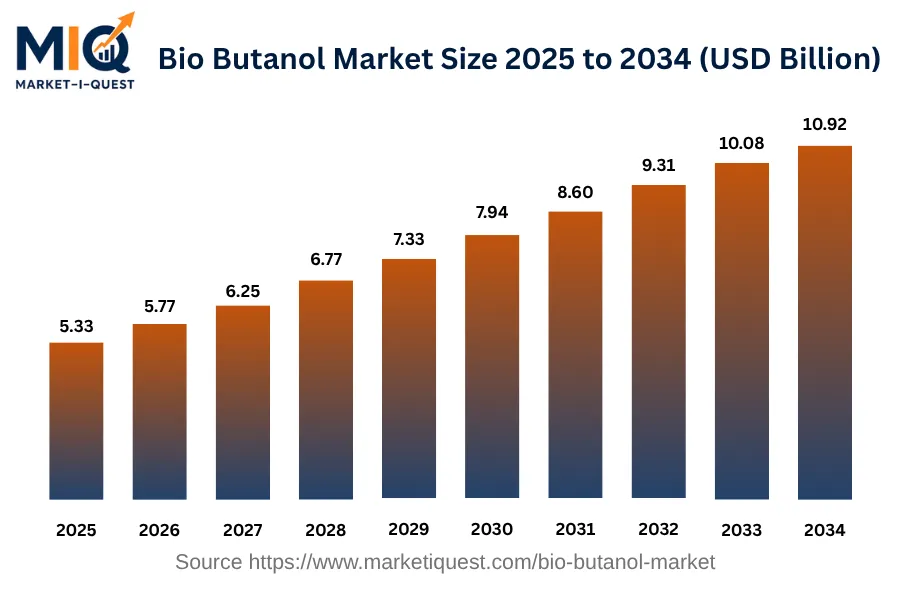
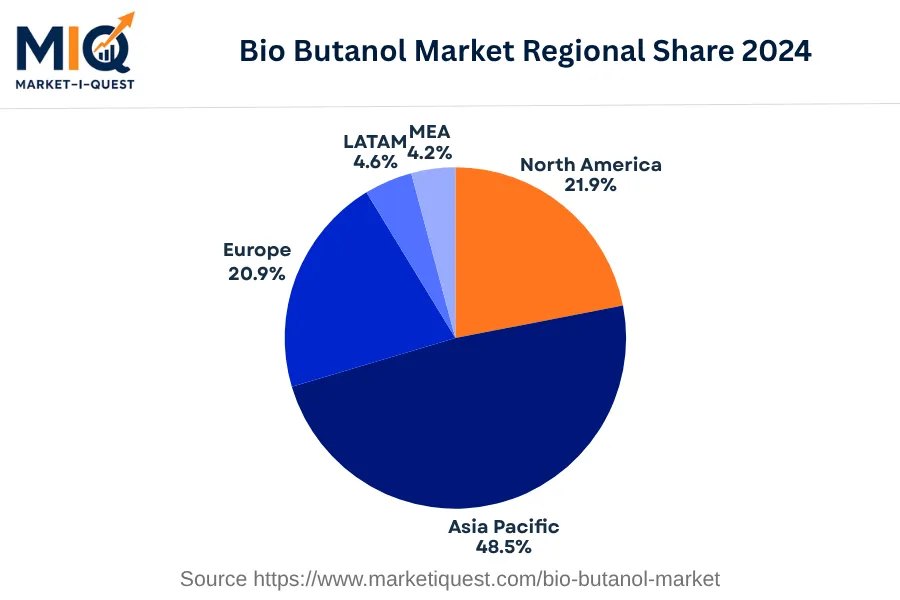
The Bio Butanol Market was valued at USD 4.92 billion in 2024, increasing to USD 5.33 billion in 2025, and is projected to reach USD 10.92 billion by 2034, witnessing a Compound Annual Growth Rate (CAGR) of 8.3%. Over this ten-year span, the market size more than doubles, driven by consistently positive growth throughout the period. In addition, the regional distribution of the Bio Butanol Market in 2024 was as follows: North America commanded 21.9% of the market share. In contrast, Asia Pacific led the share mix, holding a dominant 48.4% of the pie. Europe's market share stood at 20.9%. The Latin America (LATAM) and Middle East & Africa (MEA) regions held smaller fractions of the total, with 4.6% and 4.2% respectively. No trends by region beyond these shares were enumerated.

Key Takeaways

  • By Feedstock - Corn held a significant share with its widespread use in 2024.
  • By Production Process - ABE fermentation dominated in 2024 due to its efficient production capabilities.
  • By Application - Fuel led in terms of usage in the Bio Butanol Market for 2024.
bio-butanol-market market size

Key Driving Factors

Stringent Environment Regulations Emphasizing Low Carbon Emissions

Among key influencers pushing the Bio Butanol market are stringent environmental laws mandating lower carbon emissions from vehicles. This is a market circumstance noted worldwide, but countries like Germany, Norway, and China, known for their tough regulations, act as notable pacesetters. Major fuel-consuming industries, including the automotive sector, are obliged to follow these standards, driving them to seek alternatives to traditional fossil fuels. The bio-based nature of Butanol makes it a practical solution, as it delivers comparative energy output while significantly reducing carbon emissions. This makes Bio Butanol an attractive proposition for stakeholders wanting to achieve regulatory compliance, simultaneously fueling the market growth of this sustainable fuel variant.
Shift Towards Sustainable Raw Material Sources

A pivot towards lower-cost, renewable raw material sources is another unique trigger impacting the Bio Butanol market. Companies in the chemical industry are progressively exploring bio-based feedstocks to substitute their reliance on petrochemical-based materials, which are finite and vulnerable to price volatility. Bio Butanol is derived from renewable resources like corn, sugarcane, and beet, offering an affordable, sustainable solution. This shift becomes even more pivotal, considering the economic implications brought about by unpredictable petrochemical market fluctuations. Hence, an intentional move towards sustainable sourcing and cost-effective alternatives is propelling the wider adoption of Bio Butanol, particularly in chemical manufacturing industries.

Market Evolution by Timeline

2019-2023
Demand for bio butanol during this period is driven by the industrial sector, primarily in North America and Europe due to stringent environmental regulations and growing sustainability concerns. Companies such as Gevo and Butamax Advanced Biofuels began producing bio butanol, but supply chain constraints such as raw materials reliability limited production. Regulations like the Renewable Fuel Standard in the U.S. supported the use of biofuels, influencing uptake. Fixed price contracts were the preferred commercial model, offering price certainty for suppliers and buyers. However, high production costs and low fossil fuel prices presented profitability challenges for bio butanol producers.
2024
In 2024, improving production processes significantly increased bio butanol delivery reliability, still with the industrial sector being the major buyer in advanced economies. Whereas, Asian markets experienced growth in consumption due to growing awareness about biofuels and regulatory support. Europe introduced the Renewable Energy Directive II, setting a new target for renewable energy use by 2030, boosting bio butanol adoption. The pricing dynamics shift towards long term contracts to balance the risks of price volatility. Consumer acceptance is still recognized as a potential risk factor, as the biofuely industry struggled with public misconceptions.
2025-2029
Demand for bio butanol started diversifying, extending to sectors like automotive, driven by adoption of biofuels in vehicles across Europe, North America, and certain Asian countries. China, in particular, emerges as a significant market. Companies such as BASF and Eastman Chemical Company starts adopting bio butanol in their operations extensively. Regulations continue playing a key role, with initiatives like the Advanced Biofuel Payment Program in the U.S assisting in reducing production cost related challenges. This period sees an increased trend towards partnerships between biofuel producers and large-scale users, sparking efficient value chains.
2030-2034
There is a significant increase in bio butanol use for purposes such as solvent manufacturing, further expanding demand demographics. Suppliers are now global with significant production capacities, notable entities being Biobutanol Conversion Technologies and Cobalt Technologies. Clean Energy Standard Act in the U.S enforces carbon reduction targets, leading to increased bio butanol adoption. The market witnesses a variety of pricing models including spot contracts and index-linked prices. Risk factor continues to surround around high production cost, however, technological advancements like genetic optimization of butanol producing microbes likely offers a promising potential resolution.

Future Market Outlook

Future Opportunities

The global bio-butanol market presents diverse future opportunities due to evolving regulatory landscapes and increasing environmental concerns. Several countries, including Canada and Germany, have implemented policies encouraging the transition to renewable energy, which favor the adoption of biofuels such as bio-butanol. The U.S. Environmental Protection Agency's Renewable Fuel Standard (RFS) is specifically focused on fostering the use of advanced biofuels, setting the stage for significant growth in bio-butanol applications. Additionally, the transportation sector is progressively seeking alternatives to conventional fuels, with notable interest from automotive companies like Ford, which in 2021 expressed commitment to evaluating bio-derived fuels in their vehicle lineup. Bio-butanol's compatibility with existing fuel infrastructure positions it favorably, allowing for seamless integration by businesses seeking to enhance sustainability. Market players are exploring partnerships that leverage bio-butanol’s potential not only as a fuel but also as a solvent in various industrial applications, as illustrated by the collaboration between Global Bioenergies and partners in 2022 to explore its use in cosmetic products. Furthermore, increased investments in research initiatives are anticipated, driven by academic institutions that are actively investigating breakthroughs in feedstock development and conversion technologies. As these trends continue to unfold, bio-butanol is poised to play a pivotal role in the shift toward a more sustainable and circular economy.

Segmentation Analysis

By Feedstock

The market is divided into subsegments including Sugarcane, Corn, Cellulosic biomass, and others. Among these, Corn accounted for the largest revenue share while Cellulosic biomass is expected to grow at the fastest CAGR during the forecast period.

Largest Revenue Share

Corn

Market Share Leader

The corn subsegment holds the largest revenue share in the feedstock market. This dominance can be attributed to its multiple industrial advantages. Primarily, corn is an abundant, cheap and versatile feedstock that is readily available for a variety of agricultural and industrial conversion processes. Its advantage derives from the high-starch content, which makes it an ideal raw material for a multitude of starch-based products. Furthermore, the corn production is highly developed and is spatially widespread, mainly in the North American and Chinese regions, providing a stable supply chain. In parallel, its conversion processes are mature and optimized, with governmental support through subsidies and regulatory frameworks that favor the use of corn as a biofuel source. Buyers favor corn-based products due to their cost efficiency, ensuring a steady customer base. However, the competition is stiff and constant innovations are required for the corn segment to retain its prime position.

Fastest CAGR

Cellulosic biomass

Forecast Period Growth Leader

The cellulosic biomass subsegment is projected as the one with the highest growth potential. This expectation stems from its environmental benefits and technological advancements that increase its viability. Cellulosic biomass holds the potential to significantly reduce greenhouse gas emissions due to its ability to sequester carbon during its growth phase, making it a prime candidate for the production of advanced biofuels. Furthermore, next-generation technologies are being developed to break down cellulose into simple sugars more efficiently, potentially making cellulosic biomass cost competitive with traditional feedstocks. While upfront capital expenditure for these technologies may be high, partnerships are being forged throughout the sector to facilitate their implementation. However, adoption may be slowed by regulatory uncertainty and availability of suitable land for biomass cultivation. Overcoming these challenges, with the concurrent rise in demand for sustainable energy sources, cellulosic biomass has the potential to become the fastest growing subsegment in the feedstock market.

By Production Process

The market is divided into subsegments including ABE fermentation and Butanol fermentation. In the base year 2024, ABE fermentation accounted for the largest revenue share while Butanol fermentation is expected to grow at the fastest CAGR during the forecast period.

Largest Revenue Share

ABE fermentation

Market Share Leader

ABE fermentation, short for Acetone-Butanol-Ethanol fermentation, led the market in terms of revenue generation in 2024. This dominance can be attributed to its extensive application in the biofuel industry, where it serves as a key process in producing solvents and biofuels. The increased global emphasis on cleaner energy solutions has positively impacted this sub-segment's growth. Additionally, its adoption has been encouraged by authorities worldwide due to its environmentally friendly nature and contribution towards reducing carbon footprints. Regions like North America and Europe, which have stringent environmental regulations, have become vital geographical markets for ABE fermentation. The purchasing criteria for this segment are primarily based on its efficiency and carbon-neutral process, making it more appealing to industries. Its stable supply chain and relatively lower switching costs also contribute to its continued leadership in the market.

Fastest CAGR

Butanol fermentation

Forecast Period Growth Leader

Butanol fermentation is projected to grow at an impressive rate in the foreseeable future. Key growth drivers include its versatility as a compound and rising applications in various end-user sectors such as biochemical, biofuel, and pharmaceuticals. Despite ABE fermentation's current market dominance, Butanol fermentation offers higher energy content and less corrosiveness, creating a significant adoption barrier for the former. Technological advancements and increased investments in R&D are likely to increase Butanol fermentation's efficiency further, accelerating its market appeal. Moreover, policy changes favoring the development of green technologies and strategic partnerships within the industry to reduce capital expenditure (capex) are expected to catalyze its growth. However, near-term risks may hover around regulatory uncertainties and varying raw material costs.

By Application

The market is divided into subsegments including fuel, industrial solvent, chemical intermediate, and others. The fuel subsegment accounted for the largest revenue share while the chemical intermediate subsegment is expected to grow at the fastest CAGR during the forecast period.

Largest Revenue Share

Fuel

Market Share Leader

The fuel subsegment leads the market revenue and it's predominantly attributed to the high global demand for energy. Fuel products are ubiquitous; they power vehicles, heat homes, and provide electricity to industries and households alike, thus creating a steady demand. Furthermore, various geographical regions heavily rely on fuel for their energy requirements, strengthening its market position. Regulatory factors also play a role in driving this subsegment with certain jurisdictions mandating reserve energy supplies, therefore requiring the purchase and storage of significant quantities of fuel. In terms of purchasing criteria, the density and purity of the fuel are crucial factors. Finally, the supply chain for fuel is well-established with many integrated systems ensuring efficient delivery to the end consumer. Therefore the high demand, geographical importance, regulatory requirements, criticality of product specifications and established supply chain contribute collectively to making fuel the subsegment with the highest revenue.

Fastest CAGR

Chemical Intermediate

Forecast Period Growth Leader

The chemical intermediate subsegment is expected to register the fastest growth during the forecast period. The primary growth drivers include the expanding global chemical sector and the increasing adoption of advanced materials in various industries. These industries require chemical intermediates for producing high-quality products. Rapid advancements in technology and innovative manufacturing practices are catalysts for the growth in this subsegment. On the regulatory front, policies favoring sustainable and eco-friendly manufacturing processes are prompting companies to source high-quality chemical intermediates. However, potential near-term risks include increasing prices and supply chain disruptions owing to global economic uncertainties. Despite these risks, partnerships and strategic alliances through the supply chain could foster faster growth of this subsegment. As a caveat, the adoption could be slowed by the initial costs and the need for technical expertise in handling these chemicals.

Competitive Analysis: Bio Butanol Market

Key Market Players

Manufacturers / OEMs

BASF
Germany
Butamax
US
Gevo
US

Key Suppliers & Raw Materials

DuPont
US
Sigma-Aldrich
US
Thermo Fisher Scientific
US

Distributors, Integrators & Channel Partners

GreenBiologics
UK
Bioamber
Canada
Cobalt Technologies
US

Porter’s Five Forces Analysis

The bio butanol market exhibits varying degrees of forces that shape its competitive landscape.

Supplier Bargaining Power

Low

Raw material suppliers lack power due to the abundant availability of organic waste and agricultural feedstock.

Buyer Bargaining Power

High

Buyers possess significant power in negotiating prices due to the variety of sustainable fuel alternatives.

Threat of Substitutes

High

Strong threat owing to the availability of numerous eco-friendly fuel alternatives, like ethanol and biodiesel.

Threat of New Entrants

Medium

Capex requirements and regulatory complexities afford some protection, but not against well-capitalised entrants.

Competitive Rivalry

Medium

Rivalry is moderated by the specialised knowledge required, but invigorated by the growing sustainability trend.

Regional Analysis

Geographic market dynamics and growth opportunities across key regions

Global Market Outlook

bio-butanol-market market regional share

North America

In 2024, the North American Bio Butanol market was dominated by the U.S., Canada, and Mexico with increased demand for sustainable fuels significantly shaping the industry landscape. Market drivers included stringent environmental regulations advocating for clean energy alternatives, especially in the U.S., encouraging businesses to invest in Bio-Butanol production. Advancements in technology also spurred adoption rates across the region, specifically the application of biotechnology in producing Bio Butanol efficiently. Furthermore, increased biofuel supplying capacities, in conjunction with competitive pricing, triggered interest from consumers and stakeholders in the sector.

Emergent trends had buyer behavior shifting towards environmentally friendly products, a change mirrored in the manufacturing and retail sectors' increased demand for Bio Butanol. Channel dynamics were influenced by strategic partnerships and mergers & acquisitions, aimed at consolidating market share and expanding the production footprint. For instance, the significant collaboration between major bio-refiners dramatically increased the diversity and supply of biofuels. Enforcement of biofuel standards and policies, particularly in Canada and Mexico, also defined the Bio Butanol market's direction. In conclusion, the 2024 North American Bio Butanol market's performance was highly influenced by environmental consciousness, regulatory factors, technological advancements, market consolidation, and biofuel policy enforcement. Market trends and drivers pointed towards a heightened adoption of Bio Butanol across different sectors as a sustainable alternative to conventional fuels.

Asia Pacific

The bio-butanol market in Asia Pacific witnessed substantial growth in 2024 due to factors such as increasing demand, favorable regulations, and advancing technology. Rising energy needs and sustainability goals drove China, India, and Japan to diversify their energy sources, spurring bio-butanol adoption. High investments in renewable energy by South Korea and Australia further stimulated market growth. Meanwhile, the shift towards advanced bio-refining techniques improved supply dynamics.

Trend-wise, 2024 saw a remarkable shift in buyer behavior with enterprises expressing increased preference for green products. In China and India, bio-butanol became the choice fuel source for utilities and manufacturing sectors owing to its minimal carbon footprint. The evolving technology landscape saw Japan and South Korea leading the adoption of advanced bio-butanol production techniques. Additionally, the market saw significant alliances between bio-butanol manufacturers and potential end-users across the Asia Pacific, signaling a paradigm shift.
Government initiatives, such as India's National Biofuel Policy and China's Five-year plan for bioenergy, encouraged bio-butanol production and consumption. The penetration of bio-butanol was high in areas like utilities, manufacturing, and retail sectors, strengthening the regional market's footing. To sum up, the Asia Pacific bio-butanol market growth in 2024 was influenced by favourable regulations, increased demand due to the shift towards sustainability, technological advancements, and market-wide partnerships.

Europe

In 2024, the European Bio-Butanol market experienced significant growth, primarily driven by increasing demography and economic progression. Demand escalated from industries such as manufacturing, retail, and utilities due to the benefits of Bio-Butanol's non-toxic and highly renewable nature. Moreover, stringent environmental regulations, especially in Germany and the UK, instigated industries to transition toward Bio-Butanol production. Investment also surged in the sector with an elevated presence in the Nordics. Simultaneously, technology adoption fortified the market propagation. Higher efficiency processes such as Acetone-Butanol-Ethanol Fermentation saw adoption in France and Italy. This shift also triggered an uptick in supply dynamics, with Spain notably increasing its Bio-Butanol output. Concurrently, price stability enhanced Bio-Butanol's competitiveness against conventional fuels.

On the trends front, buyer behavior inclined towards sustainable alternatives, thereby accelerating Bio-Butanol consumption. Enterprises especially shifted sourcing to Bio-Butanol for production processes. Clear policy enforcement in regions like Benelux and Central & Eastern Europe reaffirmed Bio-Butanol's market position. Changes in distribution dynamics were prevalent, with e-channels becoming prominent for transaction ease and transparency. Finally, corporate partnerships and M&A activities intensified, aiming to secure Bio-Butanol supply and streamline the market structure. For instance, government and industry collaborations to foster bioenergy production unfolded throughout the year, underscoring the growing importance of Bio-Butanol in Europe’s energy landscape.

Latin America

In 2024, the Bio Butanol Market in Latin America demonstrated notable dynamics and shifts. Key drivers include regulatory frameworks supporting renewable fuels in Mexico and Brazil, which have spurred the use of bio butanol in these regions. Brazil's commitment to biofuel development, through its RenovaBio program, played a significant role, as did Argentina's growing biofuel sector. Technology adoption, particularly in terms of fermentation techniques, impacted supply, making bio butanol more readily available across the market. Demand factors such as increased usage in synthetic rubber production in manufacturing sectors, plus rising energy needs, particularly within utilities, boosted the market. Pricing dynamics, with cost-effective bio butanol production in Mexico and Brazil, also influenced market expansion.

Trend analysis showed a shift towards cleaner energy sources by governments across the region. This was evidenced through increased adoption of bio butanol in transportation and manufacturing sectors. Channel dynamics identified an increased online presence and e-commerce platform use by bio butanol suppliers. In terms of partnerships and M&A, companies operating in the region, such as Gevo, have explored collaborations for technological exchanges. Standardisation efforts were observed, particularly in Brazil where government has sought to regulate bio butanol's quality and use. Finally, policy enforcement in countries like Peru and Chile resulted in stricter emission standards, which in turn drove up demand for bio butanol.

Middle East & Africa

In 2024, the Bio Butanol Market in the Middle East and Africa saw significant development. The drivers of this growth included increased demand from the manufacturing and chemical industries across core nations like Saudi Arabia and South Africa, a rise in environmental regulations fostering bio-based product adoption, and technological advancements in biofuels. Investment also played a crucial role, most notably in Saudi Arabia, where government-backed initiatives were spurred to promote renewable energy sources. On the supply side, increased production from key players in Israel and South Africa helped meet demand and stabilize prices.

In terms of trends, consumer behavior shifted towards eco-friendly products, mainly driven by stringent governmental regulations on carbon emissions. Bio Butanol became a preferred choice for renewable energy in sectors such as utilities and oil and gas, especially in UAE and Nigeria. Technology shifts were evident, with Israeli companies leading biofuel innovation, aiming to reduce dependency on traditional sources. Channels for distribution were primarily monopolized by key stakeholders: factors like ease of availability and delivery efficiency were prioritized. Collaborations and partnerships sprung up within nations such as Kenya, prioritizing domestic production over imports. Finally, strict policy enforcements in countries like Egypt ensured adherence to environmental standards, boosting the credibility of products in this market.

Recent Industry Developments

Latest market innovations, product launches, and strategic initiatives

February 2026

Godavari Biorefineries launched its strategic partnership with Synthomer to manufacture bio-based butyl acrylate. The commercial initiative directly utilizes renewable bio-butanol to replace petrochemical feedstocks in the high-demand paints, coatings, and adhesives sectors.

September 2025

Verbio SE announced significant investments to scale its production of advanced bio-based intermediates from agricultural residues. The strategic funding bolsters Germany's localized renewable chemical supply chain, accelerating the industrial transition from fossil-derived n-butanol to bio-butanol for sustainable solvents.

Frequently Asked Questions