
Bio-based Propylene Glycol Market Snapshot

Key Players

  • BASF SE (Germany)
  • Dow Chemical Company (USA)
  • Huntsman Corporation (USA)
  • Archer Daniels Midland Company (USA)
  • DuPont (USA)
  • Royal Dutch Shell (Netherlands)
  • Cargill Incorporated (USA)
  • Ashland Global (USA)
  • Archer-Daniels-Midland Company (USA)
  • SKC Co. Ltd. (South Korea)

Market Size

Base Year 2024
$4.83 Bn
CAGR
4.6%
Forecast 2034
$7.57 Bn

Market Segments

By Application
  • Unsaturated Polyester Resin
  • Antifreeze & Coolant
  • Chemical Intermediates
  • Solvent
  • Others
By End Use Industry
  • Automotive
  • Food Processing
  • Cosmetics
  • Pharmaceuticals
  • Construction
  • Marine
  • Transportation
  • Others

Market Dynamics

Drivers
  • Increasing environmental concerns
  • Rising demand in pharmaceuticals
Restraints
  • High production costs
  • Regulatory restraints
Opportunities
  • Increasing environmental consciousness
  • Advancements in green chemistry technologies

Market Size

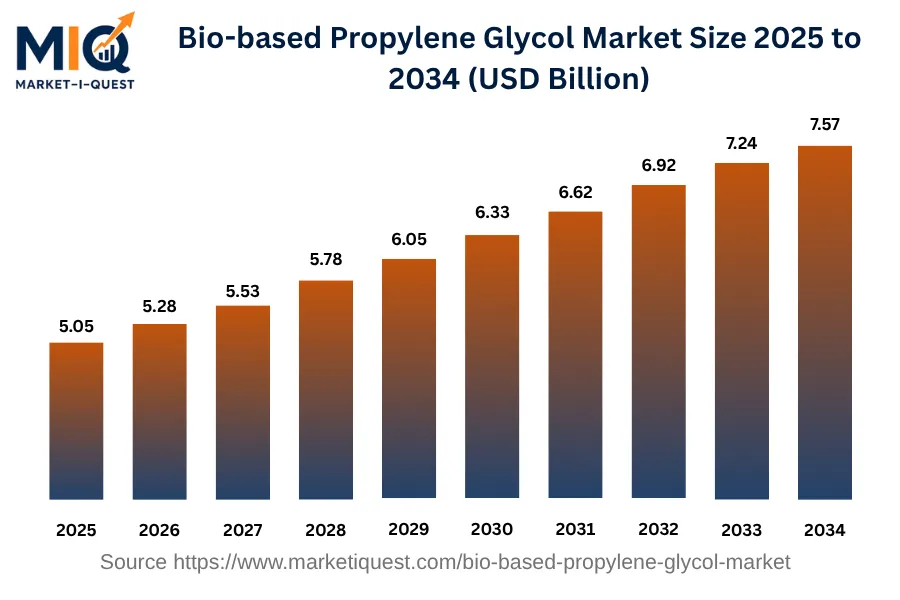
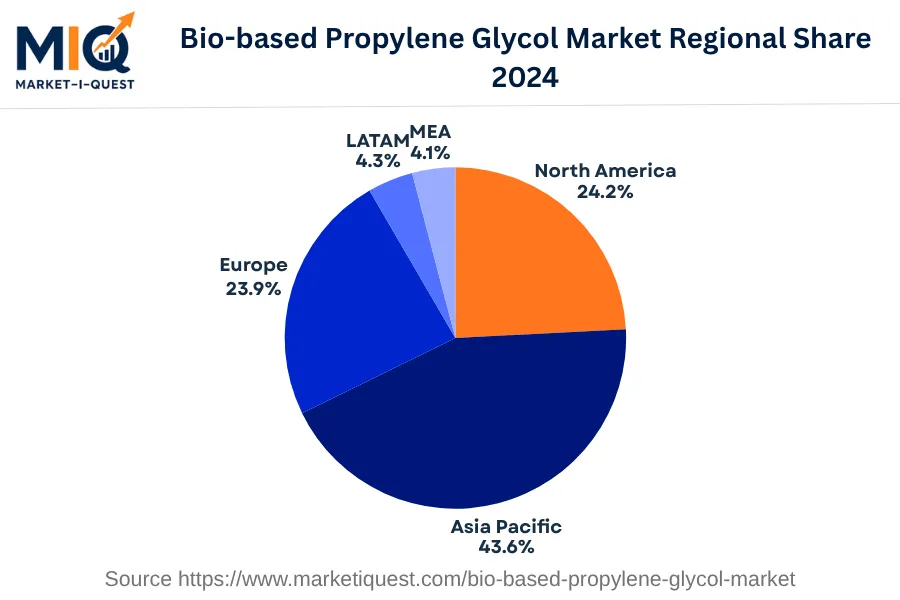
The Bio-based Propylene Glycol Market was valued at $5.05 billion in 2025, growing to $7.57 billion by 2034. This represents a compound annual growth rate (CAGR) of 4.6% during the nine-year period from 2025 to 2034. The consistent growth path is visible through the increase of the market size valued at $4.83 billion in 2024 to $5.05 billion in 2025, and further to $7.57 billion in 2034. In terms of regional share in 2024, the Asia Pacific region held the largest portion of the market, amounting to 43.6%. North America and Europe followed closely behind, each accounting for 24.2% and 23.9% of the market share respectively. The rest of the market was divided between Latin America and the Middle East and Africa, with 4.3% and 4.1% shares, respectively.

Key Takeaways

  • By Application - Chemical Intermediates held the leading position in the Bio-based Propylene Glycol Market.
  • By End Use Industry - Pharmaceuticals led the market accounting for a significant share in the base year.
bio-based-propylene-glycol-market market size

Key Driving Factors

Shift Towards Sustainable Products in Personal Care Industry

One important factor driving the bio-based propylene glycol market is the increasing shift towards eco-friendly, sustainable products in the personal care industry. Propylene glycol, a key ingredient in many skincare and haircare products, traditionally comes from petroleum. However, the industry is witnessing a growing preference for bio-based alternatives due to increasing consumer awareness about environmental sustainability. People are concerned about the environmental impact of the products they use, leading to increased demand for natural and green products. This rise in consumer consciousness is making personal care manufacturers move towards bio-based alternatives like bio-based propylene glycol. This transition is underpinning the growth in the market of the said product.
Stringent Environmental Regulations

Another major driving factor for the bio-based propylene glycol market is the imposition of stringent environmental regulations across many regions. Governments worldwide are implementing laws to reduce the use of petroleum-based products due to their harmful environmental impact. Such regulatory policies are pressurizing industrial sectors to adopt bio-based substitutes. Propylene glycol, widely used in various industries ranging from cosmetics to pharmaceuticals, is no exception to this environment-driven trend. Thus, the regulatory push to replace petroleum-based propylene glycol with bio-based alternatives is accelerating the growth in its market.

Market Evolution by Timeline

2019-2023
During this period, the European Union and North America were among the leading regions in the demand for bio-based propylene glycol owing to tightened environmental regulations and sustainability initiatives. Packaging and Construction industries adopted bio-based PG in an effort to lower their carbon footprints and align with the United Nations' Sustainable Development Goals (SDGs). Manufacturers including Archer Daniels Midland Company and DuPont actively shipped bio-based PG, though faced challenges with production scalability and cost competitiveness compared to petroleum-based alternatives. Pricing for this product remained high due to production costs and premium for eco-friendliness. Potential risks included adoption rates not in line with escalated production capacities.
2024
In 2024, consumer product companies such as Unilever expressed a growing interest in bio-based materials as part of their sustainability strategies. Demand continued from packaging and construction industries while the addition from consumer products further increased market desirability. Archer Daniels Midland Company expanded their production capacities, but concerns of supply meeting the surge in demand created uncertainty. Reduced production costs started exerting downward pressure on the price of bio-based propylene glycol. New regulations fostering use of sustainable materials in Asia were seen as indicators for future policy and demand shifts in the region.
2025-2029
From 2025-2029, Asia and South America saw increased demand for bio-based propylene glycol due to a combination of policy shifts, increasing eco-consciousness, and growing infrastructure projects. Supply managed to keep pace with demand as industry investments into bio-based PG technology enhanced production efficiency, lowering costs. Price point continued to become more competitive, with varying price models based on renewable content proportion and market regionalization. Risks involving sustainability of feedstocks triggered initiatives for next-gen bio-based propylene glycol sourcing from waste and residues.
2030-2034
In 2030-2034, global standards and certifications validating sustainability claims of bio-based propylene glycol became prevalent, influencing commercial adoption levels. Expansion proceeded into industries such as cosmetics, food and beverages, thanks to fully matured production technologies and cost optimization. Incumbent suppliers Dopunt, Huntsman International adjusted their models focusing on co-production of bio-based and conventional propylene glycol, in efforts to mitigate associated risks and cater to all segments of the market. Regionally-adapted pricing models and long-term contracts with robust eco-verification became norms. Countries with strong bio-economy policies including Germany, Brazil and Canada were market front-runners.

Future Market Outlook

Future Opportunities

Future opportunities in the bio-based propylene glycol market are closely linked to current consumer behavior and regulatory frameworks. A clear pathway is noted with the European Union's Green Deal, which aims to make Europe climate-neutral by 2050. This aligns with growing consumer preferences for sustainable products, as a 2022 survey indicated that 72% of consumers prefer brands that employ eco-friendly manufacturing practices. Companies like Coca-Cola are already adopting bio-based propylene glycol for their products, as evidenced by their recent sustainability initiatives. Additionally, the ongoing trend of corporate sustainability commitments is pushing manufacturers towards greener supply chains. In particular, the transition from fossil fuel-based to bio-based solutions is anticipated to broaden as more enterprises recognize the importance of sustainable sourcing and production. The potential for regulatory incentives is underscored by various national frameworks, such as the U.S. government's support for bio-based materials through the Biobased Products Innovation Program. As demand for environmentally responsible products continues to rise, producers may explore diverse applications of bio-based propylene glycol in industries such as food, cosmetics, and pharmaceuticals, driven by increasing regulatory support and changing customer preferences. Consequently, the market is expected to witness a surge in investments towards research and development in bio-based products, particularly aligned with global sustainability goals.

Segmentation Analysis

By Application

The market is segmented into various applications such as Unsaturated Polyester Resin, Antifreeze & Coolant, Chemical Intermediates, Solvent, and Others. Among these, the Chemical Intermediates subsegment accounted for the largest revenue share, while the Antifreeze & Coolant subsegment is expected to grow at the fastest CAGR during the forecast period.

Largest Revenue Share

Chemical Intermediates

Market Share Leader

The Chemical Intermediates subsegment holds the largest share of revenue in this market. A key driver for this dominance is the broad spectrum of its applications in various industries including chemical, pharmaceuticals, agriculture, and others. Chemical intermediates are integral to the manufacturing of a wide variety of products, providing a solid customer base for the subsegment. Geographically, demand within major industrial markets in regions such as Asia-Pacific and North America creates robust purchasing volumes, heavily contributing to revenue. Regulatory influence also favours this subsegment as the quest for safer and environmentally friendly chemical solutions is growing, refining the market's shift towards versatile chemical intermediate products. The purchasing patterns typically lean towards chemicals providing efficient performance and cost-effectiveness, and chemical intermediates max out on these criteria. Furthermore, high switching costs towards alternative products make the customer retention ratio generally high, benefiting the revenue generation for this subsegment.

Fastest CAGR

Antifreeze & Coolant

Forecast Period Growth Leader

The Antifreeze & Coolant subsegment is anticipated to show the fastest CAGR globally. The growth is primarily driven by rising demand in the automotive industry, which is embracing coolant technology to enhance vehicle performance. Adoption barriers are minimal as the importance of regular coolant change is already well-recognized within the automotive sector. Technological advancements in antifreeze & coolant products, such as longer lasting and environmentally-friendly solutions, are acting as a catalyst for growth. Regulation, such as enhanced emission standards, also supports the wider uptake of these products. Heavy capital investments in research and development from major players seeking to advance their products stimulate the subsegment's growth as well. Partnerships between key coolant manufacturers and automotive companies may also enhance market penetration and overcome near-term risks like price volatility. In conclusion, while this subsegment doesn’t lead in revenue today, its strong growth prospects make it one to watch.

By End Use Industry

The market is divided into subsegments including Automotive, Food Processing, Cosmetics, Pharmaceuticals, Construction, Marine, Transportation, and Others. The Pharmaceuticals subsegment accounted for the largest revenue share while the Cosmetics subsegment is expected to grow at the fastest CAGR during the forecast period.

Largest Revenue Share

Pharmaceuticals

Market Share Leader

The dominance of the Pharmaceuticals subsegment in terms of revenue generation can be attributed to a variety of factors. One key driver is the consistent demand for pharmaceutical products as a result of the ever-growing global population and the associated need for healthcare and wellness products. Additionally, regulatory frameworks across the globe positively reinforce this demand, with policies often in place to ensure access to medication for all citizens. The customer base is widespread, cutting across all demographic and socioeconomic groups. Geographically, while developed economies make up a sizeable portion of the revenue due to higher purchasing power, emerging economies contribute significantly due to their vast population. In terms of supply, there are numerous pharmaceutical giants catering to this demand, with a well-established supply chain. The buying criteria is well defined, hinged on regulatory approval and efficacy of the drugs. The nature of the product results in a high switching cost. Lastly, both traditional retail and online channels contribute to the distribution of pharmaceutical products.

Fastest CAGR

Cosmetics

Forecast Period Growth Leader

Projected to experience the fastest CAGR, the Cosmetics subsegment derives its growth from various factors. The primary driver is the increasing consumer consciousness about appearance and personal care, fueled by a cultural shift towards self-expression and confidence. Also, the advent of more sophisticated technologies in cosmetics manufacturing has led to superior product innovations providing efficient and personalised solutions, catalysing market growth. Disruptive marketing strategies, particularly through social media, and collaborations with influencers have induced a higher rate of adoption. However, barriers do exist, mainly in the form of regulatory hurdles regarding the safety and efficacy of cosmetic products. Additionally, the high capital expenditure involved in research, development and marketing could impede growth. Near-term risks include the fluctuation of raw material prices and potential backlash from a growing natural and organic product movement. Regardless, the outlook for this segment is strong, with significant market penetration foreseen in emerging economies.

Competitive Analysis

Key Market Players

Manufacturers / OEMs

DuPont Tate & Lyle
US
BASF
Germany
Archer Daniels Midland Company
US

Key Suppliers & Raw Materials

Cargill, Inc.
US
Oleon NV
Belgium
Huntsman Corporation
US

Distributors, Integrators & Channel Partners

Ashland Global Specialty Chemicals Inc.
US
Dow Chemical Company
US
Triveni Chemicals
India

Porter’s Five Forces Analysis

A comprehensive analysis of the competitive landscape in the bio-based propylene glycol market.

Supplier Bargaining Power

Medium

Control on raw materials like biomass feedstock and glycerol elevates supplier power.

Buyer Bargaining Power

High

Wide availability and few switching costs allow buyers to negotiate pricing.

Threat of Substitutes

Low

Fewer eco-friendly & cost-efficient alternatives limit substitution threat.

Threat of New Entrants

Medium

Need for significant capital, technical expertise limit number of new entrants.

Competitive Rivalry

High

Established players control the market, intensifying competitive pressures.

Regional Analysis

Geographic market dynamics and growth opportunities across key regions

Global Market Outlook

bio-based-propylene-glycol-market market regional share

North America

The Bio-based Propylene Glycol (BPG) Market exhibited resilient growth in North America in 2024. Growing environmental concerns fueled the demand for eco-friendly solvents, driving investments into bio-based alternatives in the region’s chemical industry. Regulatory pressures in the U.S., Canada, and Mexico further galvanized the shift towards BPG, particularly due to the adoption of green building standards that mandate the use of sustainable materials. Moreover, advancements in bio-refining technologies considerably reduced the cost of producing BPG, stimulating supply dynamics in the market.

Several key trends were noticeable in the North American BPG market in 2024. First, major chemical manufacturers amplified their commitment to sustainability, gaining a competitive edge by capitalizing on the increased demand for bio-based products. Second, there was a marked shift in the distribution of BPG, with online channels becoming a significant contributor to sales. Furthermore, partnerships and M&As became more prevalent as manufacturers sought to secure bio-based feedstock supply and expand their production capabilities. Lastly, stricter enforcement of chemical policies, like the Toxic Substance Control Act in the U.S., sparked renewed focus on the development and use of safer and bio-degradable chemicals in sectors such as manufacturing, retail, and healthcare.

Asia Pacific

In 2024, the Bio-based Propylene Glycol Market in the Asia Pacific showed robust dynamics. Drivers primarily comprised escalating demand in key sectors like utilities, manufacturing, and healthcare. Stringent environmental regulations across China, India, and Japan promoted the adoption of bio-based propylene glycol over petroleum-derived alternatives. Moreover, significant investments in green technology, notably in South Korea and Australia, played a pivotal role in market expansion. Market pricings remained relatively stable, underscoring consistent supply dynamics across the region.

Amid these trends, shifts in buyer behavior were apparent. A clear preference emerged for bio-based products due to their reduced environmental impact and potential health benefits. This was particularly pronounced in the healthcare and manufacturing sectors, both having sizeable contributions to the market's sustenance. Additionally, digital channel dynamics shifted, with higher online sales owing to the thriving e-commerce sector in the key ASEAN markets. The market also witnessed increased partnerships and M&A activities targeting technological advancements and expansion of production capacities. Stringent policy enforcement continued to drive standard compliance in bio-based propylene glycol production, further solidifying the market's growth trajectory. For instance, China's stringent pollution control norms significantly shaped the market landscape.

Europe

In 2024, the European bio-based propylene glycol market experienced an upswing in demand due to a combination of factors. The market was driven by an increase in consumer preference for bio-based products, the enforcement of stringent environmental regulations by governments, and a surge in investments in bio-refineries across Germany, the United Kingdom, France, and Italy. The implementation of the European Renewable Energy Directive was particularly influential in stimulating demand.

Several key trends shaped the dynamics of the market in 2024. An upshift in buyer focus towards sustainability boosted purchases of bio-based propylene glycol in sectors such as healthcare and manufacturing, particularly within the United Kingdom and Benelux. There was also a notable shift towards technology adoption to enhance production efficiency, especially in Germany and Nordic countries. Furthermore, the increase in the number of partnerships and mergers and acquisitions was remarkable, demonstrating a consolidated industry striving for regional expansion. Policy enforcement remained strong across Europe, with governments underlining their commitment to reducing carbon footprint. A clear example of this was seen in Spain's rigorous implementation of the recast Waste Framework Directive, pushing companies towards the use of bio-based inputs. The Central and Eastern Europe region also saw stronger demand due to efforts by businesses to uphold these policies, further deepening the market penetration of bio-based propylene glycol.

Latin America

In the base year 2024, the Latin American (LATAM) market for bio-based propylene glycol (PG) exhibited substantial growth due to several factors. The demand was primarily driven by increased adoption in industries such as cosmetics, food and beverage, and pharmaceutical sectors in select countries like Brazil, Mexico, Argentina, Colombia, Chile, and Peru. Advances in production technology, influenced by sustainability mandates, have enabled a widened supply of bio-based PG over petroleum-derived variants in this region. Regulatory policies favoring bio-based products significantly influenced market dynamics.

Market trends in 2024 signaled a paradigm shift towards greener alternatives, with a surge in bio-based PG demand substantially linked to consumer awareness and sustainable product preferences. In Mexico and Argentina, this preference was particularly accentuated. The market also saw partnerships and mergers between chemical companies and suppliers bolstering the supply chain. The local manufacturing sector played a significant role, with enterprises catering to both domestic and international demands. The market was also impacted by policies such as Brazil's National Biofuels Policy (RenovaBio), propelling industry standards towards more environmentally responsible practices. However, high pricing relative to petroleum-based PG posed a market challenge, thereby influencing buying behaviors.

Middle East & Africa

In 2024, the Bio-based Propylene Glycol market in the Middle East and Africa showed defining structures and dynamic trends. Regulatory drives for eco-friendly substances were significant market drivers, along with heightened demand due to increasing investments in sustainable industries, particularly in Saudi Arabia and the United Arab Emirates. These countries saw growth in oil and gas sectors searching for bio-based substitutes, hence escalating the demand for Bio-Based Propylene Glycol. A surge in technology adoption in South Africa, Egypt, and Nigeria aggressively propelled this shift, shaping supply dynamics profoundly.

The observed trends comprised developing buyer behavior towards green alternatives, recognized notably in retail and manufacturing sectors in Israel and Kenya. Furthermore, the perceived shift towards sustainable products led to numerous partnerships and M&A, particularly in healthcare and telecom sectors in Qatar and South Africa. Standards and policy enforcement promoting the use of bio-based products across various sectors have also become more prevalent. The governments in these regions facilitated a supportive policy framework, backing the rise of Bio-Based Propylene Glycol market in the Middle East and Africa. Meanwhile, customers were prioritizing ethical and sustainable procurement, reflecting a move towards environmentally conscious consumption patterns.

Recent Industry Developments

Latest market innovations, product launches, and strategic initiatives

May 2026

UPM acquired Avantium’s Ray Technology intellectual property to expand its bio-based glycol production capabilities and strengthen its renewable chemicals portfolio.

May 2023

ORLEN Południe’s BioPG plant made propylene glycol production more sustainable using BASF technology, showing an early commercial example of bio-based propylene glycol scale-up.

Frequently Asked Questions